General Horror Stuff
13 O’Clock Episode 57 – Spontaneous Human Combustion
So you’re sitting in your comfy chair, relaxing with a cocktail and the newest edition of Smoking Hot MILFs, when suddenly…BLAMMO! You’re consumed by flames that seem to have emitted from inside your body, and all that will be left of you is a pile of ashes and two weirdly intact feet, perhaps still wearing your favorite pair of bunny slippers. On episode 57, Tom and Jenny are talking about spontaneous human combustion…is there really some mysterious force that can ignite a person from within? Or is there always a rational explanation, like smoking in bed or falling asleep too close to your fireplace? Hose yourself down with the nearest fire extinguisher in preparation for this incendiary installment of 13 O’Clock. Download the audio version here or watch the YouTube video here.
Don’t forget to follow the 13 O’Clock Podcast blog, subscribe to our YouTube channel, like us on Facebook, and follow us on Twitter. Check out our list channel, 13 O’Clock In Minutes! Song at the end: “I’m On Fire” by Bat for Lashes (Bruce Springsteen cover). Part one of Inside Spontaneous Human Combustion with Bruce Dickinson.


An Interview with Me on the Deviatus Podcast!
Here is a new interview with me on the awesome Deviatus Podcast, discussing poltergeists and lots of other fun stuff. Enjoy!
13 O’Clock Movie Retrospective: Predator
Horror Double Feature: The Disappointments Room and Haunter
Welcome back for another random spin of the Netflix horror wheel…round and round she goes, coughing up two spooky flicks for my post-hurricane-Irma viewing pleasure. Well, I don’t know if pleasure is exactly the right word in this particular situation. Viewing adequacy? Something like that.
First up is the ghost story/psychological thriller The Disappointments Room. Directed by D.J. Caruso, this movie was actually finished in 2014, but shelved after its original production company went into bankruptcy. It ended up being purchased by Rogue and released in September of 2016. The film was a dismal failure, both critically and commercially, probably due in some small measure from being shuffled around on the schedule and not promoted to any great degree; I didn’t know that before watching it, so I’m slightly mystified as to why it was so reviled otherwise. No, it’s not a great movie by any means, but it’s perfectly watchable, if eminently unoriginal and forgettable.

Starring Kate Beckinsale (who I actually thought was a different actress who looked a lot like Kate Beckinsale the entire time I was watching it) and Mel Raido as the stereotypical couple who have just suffered a tragedy and decide to move out to a run-down house in the country to deal with their grief, The Disappointments Room is a pretty bog-standard haunted house story slash psychological thriller where you’re never really sure if the supernatural stuff is real or if the main character is simply losing her marbles. In general I’m a pretty big fan of that subgenre, so I’ll give quite a bit of leeway to a film that fits those parameters; even if it’s nothing I haven’t seen before, if it’s mildly creepy and atmospheric, and isn’t aggressively stupid, then chances are I’ll enjoy it just fine, though it probably won’t leave a lingering impression.
Architect Dana Barrow and her husband David leave Brooklyn after the accidental death of their baby daughter and relocate to an old mansion in North Carolina that they plan to fix up. They have a five-year-old son named Lucas who has the patented Danny-from-The-Shining hair, and also eventually sees a ghost girl in the hallway, in a scene that very much recalls a certain famed set of twins lurking in the corridors of a certain hotel in Colorado. There’s also an apparently ghostly black dog skulking around the yard, much like in The Omen, a mysterious red ball like in The Changeling, a creepy spiral staircase like tons of other haunted house movies throughout the ages, and scores of other genre touchstones borrowed from many other, superior movies. On the plus side, there is an adorable fluffy kitty cat whose presence is not really explained, but who I gathered was a sort of protector of Lucas, but the poor little kitty gets horribly killed later in the movie. Seriously, kill all the people in movies you want, but leave the damn kitties alone!

Anyway, early in the film, Dana sees a light coming on by itself up in an attic window, and upon investigation discovers a hidden room behind a big armoire. Since she has the blueprints at hand due to her planned renovations, she realizes that the room isn’t on the plans, despite the window of the room being very obviously visible on the front of the house. Yeah. Upon entering the room, Dana begins to see visions of a little girl and a scary old man with the aforementioned black dog on a leash, and she subsequently gets locked in the room for what seems like hours, even though in reality it was only a few minutes. Her sanity seems to crumble from that point forward, she stops taking her medication, and her husband thinks she’s flipping out again.
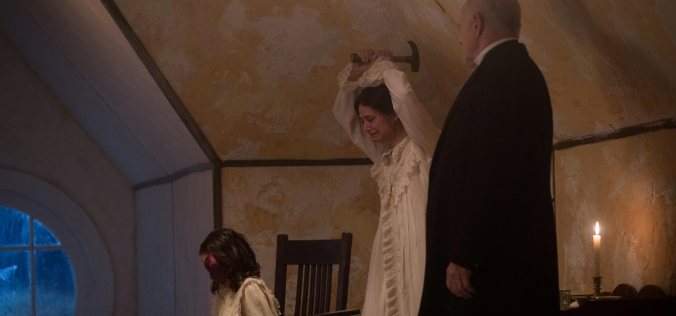
Amid her heightening psychosis, she learns from the kooky local librarian that the hidden room is actually a “disappointments room,” a sadly real thing that some wealthy families had in their houses back in the day to stash their physically deformed or mentally challenged children away from prying eyes. Therefore it becomes clear that the former patriarch of the house, Mr. Blacker (subtle), kept his deformed daughter up there before finally snapping and battering her to death with a hammer because she was such an embarrassment to his Victorian clenched anus.
All of this back story is somehow supposed to be related to the death of Dana’s own daughter, who passed away on the same day of the year as the Blacker child (July 5th). But I think here is where the movie really failed to make much of a connection between the two situations that might have elevated the story somewhat. Dana’s baby daughter died after Dana accidentally rolled over on her while sleeping and suffocated her. So, sure, she blames herself for killing her daughter, but her daughter wasn’t a “disappointment” to her in a way which would have tied in with the past story. The best psychological and haunted house stories set up a parallel between the past and the present, having one reflecting on the other, but this didn’t really do that in any meaningful way, so it felt a bit disjointed and not particularly cohesive.

While the acting was fine and the cinematography was quite nice, I felt like the conceit of the disappointments room was a cool idea that was mostly wasted amid a largely clichéd collection of standard haunted house tropes. As I said, it’s not a terrible movie, but it brings nothing new to the table, being content to simply recycle plot devices and images from other genre films and trying to weave them together into a fairly threadbare narrative.
The second film in the lineup was much more interesting, and while I’m not sure it entirely worked a hundred percent of the time, I appreciated that it was at least trying to do something original with its story. Directed by Vincenzo Natali (best known for Cube and Splice), 2013’s Haunter is a sort of convoluted time-loop ghost story, a bit like a mash-up of Groundhog Day, The Others, and Beetlejuice.
Our main character is a teenager named Lisa (Abigail Breslin) who not only has impeccable musical taste, but also seems to be the only member of her family to realize that they are all reliving the same day in 1985 over and over again. Every morning she is awakened by her little brother calling her over a walkie-talkie, every breakfast is pancakes, every afternoon sees her practicing Peter and the Wolf on her clarinet, Dad is perpetually working on the car in the garage, Mom is always asking her to do the same load of laundry, and every dinnertime features a plate full of meatloaf, followed by sitting in front of the TV to watch Murder, She Wrote. The next day is supposed to be Lisa’s sixteenth birthday, but that day never comes.

It’s an intriguing set-up which becomes even more compelling when Lisa begins to realize what is happening. As she does, little things about the routine begin to change. She tries to leave the house on her bike, but her dad stops her because the fog is too thick. One morning her brother says something different into the walkie-talkie. On one run-through, her dad smokes a cigarette after dinner, even though he never smoked before. One time when she actually does succeed in cycling out into the fog, she keeps circling back to the house again.
Slowly, Lisa begins to figure out that her entire family is dead and trapped in some sort of limbo, so she begins to use a Ouija board to try to make contact with a living girl named Olivia (Eleanor Zichy) who occupies the house in some future timeline to try to figure out how to get out of the loop.

Along the way, a creepy dude called Pale Man (Stephen McHattie) keeps calling her on the phone or dropping by the house dressed as a phone repairman in order to warn her to stop meddling with the timelines. He shows her that he can affect her reality if she hates the one she’s in so much (for example, he makes her parents and brother turn into mummified corpses in front of her eyes in a pretty effective scene), but Lisa just can’t let it go, and continues her desperate investigation.

It turns out that Pale Man is actually the spirit of a serial killer named Edgar Mullins who once lived in the house, and that he collects other spirits the way some people collect dead butterflies (and here the opening credit sequence begins to make sense, as does the ingenious use of Siouxsie and the Banshees’ “The Killing Jar” over the end credits). Over the years, Edgar has been possessing the fathers of each family that lived in the house and forcing them to slaughter their wives and children and then themselves so that all their ghosts would be forever stuck in the house’s purgatory. Lisa’s family were all locked in the garage and killed with carbon monoxide on the night before Lisa’s sixteenth birthday, hence the reason why Dad is always working on the car in every iteration of their last day.

Eventually, Lisa is able to rally her family into realizing what is happening to them and also enlists the help of the other spirits as well as still-living Olivia, who is next on Edgar’s kill list. In the end, Pale Man is defeated, and a new day dawns…Lisa and her family are still in the same house, but it is bathed in golden light, her birthday has finally arrived, and they can leave the premises whenever they like.
Haunter was actually a cool little experiment of a film, a sort of multi-layered, reverse ghost story slash murder mystery. Because of the whole “reliving the same day over and over” trope, the beginning of it got slightly repetitive, but I was so interested in where the story was going that I didn’t really mind, and I liked being able to pick up subtle little differences in the routine every time she lived through it again. The movie wasn’t all that scary, though it did have some eerie imagery, and there was no gore to speak of, so it sort of had the feel of a YA novel, not that there’s anything necessarily wrong with that. I found the plot slightly overly-complicated, but in the end I enjoyed this flick a lot, and I really appreciate that Vincenzo Natali did something a little different with the genre.
That’s all for this installment, so until next time, keep it creepy, my friends. Goddess out.
13 O’Clock Episode 56 – Anton LaVey and the Church of Satan
Anton LaVey, infamous founder of the Church of Satan and a consummate showman, brought his particular brand of philosophical occult belief to wider acceptance in the 1960s. In its heyday, the Church of Satan boasted some notable Hollywood names and respected writers among its membership, though after the Manson Family murders of 1969, Satanism began to lose some of its rebellious allure. On this episode of 13 O’Clock, Tom and Jenny delve into the lingering legend of Anton LaVey, separating the truth from the fiction and discussing his influence on American culture throughout the 60s to the present day. Raise a horned hand in salute to episode 56. Download the audio version here or watch the YouTube video here.
By the way, sorry about some of the weird sound anomalies we got on this episode…must be the devil or Anton LaVey’s ghost fucking with my audio. Or hurricane voodoo. 😦
Don’t forget to follow the 13 O’Clock Podcast blog, subscribe to our YouTube channel, like us on Facebook, and follow us on Twitter. Check out our list channel, 13 O’Clock In Minutes! Song at the end: “Satan Takes a Holiday” by Anton Szandor LaVey.


13 O’Clock Movie Retrospective: An American Werewolf In London
Horror Double Feature: The Damned and The Pact
Well, as the God of Hellfire and I batten down the hatches in central Florida in preparation for a possible smackdown by Hurricane Irma, I thought I’d take the opportunity before the power goes out to run through a couple of horror movies on Netflix for yet another installment of my Double Feature series. So off we go.
First up, the 2013 Columbian/American co-production The Damned (aka Gallows Hill), directed by Victor García. I just kind of picked this one on a whim because I was tired of scrolling through the offerings, and though sometimes when that happens, I stumble across a hidden gem, unfortunately this was not one of those times. It’s not a terrible movie by any means, but it’s not particularly notable either.
Briefly, the story follows American dad David (Peter Facinelli) and his British fiancée Lauren (Sophia Myles) as they go to Columbia to bring David’s daughter Jill (Nathalia Ramos) back to the U.S. so she can attend their upcoming nuptials. Jill rebelled against her dad after the death of her mother/David’s first wife Marcela (Tatiana Renteria), she hates David’s girlfriend for no real reason, and she has been living in Columbia with her aunt, TV journalist Gina (Carolina Guerra), and her boyfriend/Gina’s cameraman Ramón (Sebastiàn Martinez) ever since.
Jill is resisting being taken home to the wedding, and gets all passive aggressive about it, saying she can’t go back yet because her passport is back in her apartment in Medellín. So the five of them pile into an SUV in a torrential downpour and head out there. Along the way, they are stopped by Captain Morales (Juan Pablo Gamboa), a cop who warns them that the road ahead is flooded out, but of course Gina knows everything and convinces them to press on because she’s really familiar with these roads (not much use in being familiar with roads that have been washed away, but whatever). Predictably, moments later, the car gets stuck in the mud and then tumbled off the road by a flash flood. Most of the gang escape with minor injuries, but Lauren has two broken ribs, so they are forced to wade out into the jungle to look for help.
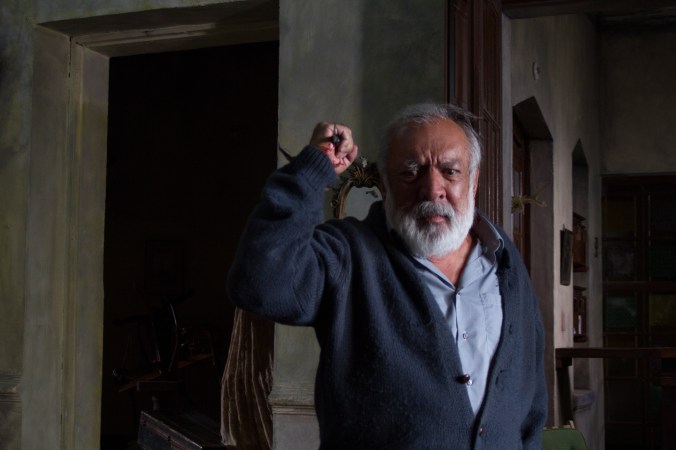
They soon come across an inn, and a standard-issue creepy old guy named Felipe (Gustavo Angarita) tells them the inn is closed and they need to hit the (nonexistent) pavement. But they eventually talk their way into the inn (heh) and Felipe grudgingly gives them some water and then takes David outside to cut some wood for the fireplace, but not before warning all the remaining interlopers to not leave the front room and go wandering about the house.
After less than five minutes, our heroes discover that all the phone lines have been cut and that no one has signed the guest register since 1978. Shortly after this revelation, Jill and Ramòn decide to do precisely what the old man told them not to, which is to go wandering about the place looking for a bathroom. In the grungy, roach-infested shitter, Jill hears a little girl’s voice coming through the pipes and calling for help. After a bit of investigating, they find out that the little girl is locked in a big wooden box down in the cellar, and decide that they need to rescue her.
In short order, Felipe is knocked out and tied up, and his filthy, obviously creepy daughter Ana Maria (Julieta Salazar) is released. Almost from the moment the kid starts interacting with her supposed liberators, you know something sketchy is up, but our gang refuse to see it until they stumble across the skeleton of Felipe’s wife in the wooden prison box (which is also completely covered in what appear to be written invocations) and a decades-old photograph of Felipe and his family that nonetheless shows Ana Maria the same age as she is now.

So, surprise, Ana Maria is possessed by a demon, or more specifically by a bruja who was hanged as a witch on that patch of land years ago (hence the film’s alternate title of Gallows Hill) and has vowed to kill all the descendants of the people who executed her. Once Ana Maria is released from the box, the bruja begins to search for a better host among the assembled chuckleheads, but the true nature of the bruja’s endgame doesn’t really become clear until the cop from earlier, Morales, appears and tells the gang that if you kill the person the bruja is possessing, then the bruja will simply inhabit your body instead; thus there is really no way to destroy her.


This was actually the best aspect of the film, I thought, the idea that you were in a sort of Catch-22 in regards to the bruja: If you killed the person the witch was using, she would just move on to you, and then you would go on to kill everyone else. There was really no way to beat her, which gave the movie a nicely bleak undertone. And I also appreciated the pessimism of the ending, where (spoiler alert), everyone gets killed except for David and his daughter Jill. David is trying not to kill Lauren, who is now housing the bruja, but then Jill kills Lauren to save her dad, thus passing the bruja on to Jill, who pleads with her father to confine her before the bruja takes over and kills him. David ends up being forced to lock Jill into the box that Ana Maria was released from, with just a weary voiceover implying that he’s going to take the boxed-up Jill back home to try to figure out a way of expelling the witch.
As I said, all in all, not a great movie; not awful, but mostly meh. The acting was all right, though most of the dialogue was kind of lame and obvious, and though I did like the conceit of the bruja being passed from person to person, on the whole I found I didn’t care enough about the characters for the hopelessness of their situation to have any emotional impact. And honestly, right from the outset, I found most of the characters fairly unlikable. Ramón and Lauren were all right, but the others ranged from bland and useless to actively obnoxious, especially Jill and Gina. They made stupid decisions at pretty much every turn, willfully disobeyed reasonable requests just because they thought they knew better, and generally ended up bringing all this shit down upon themselves. On the plus side, the movie looked pretty nice and had some decent gore, but that was about all it had going for it; it didn’t even have much in the way of scary scenes or memorably creepy visuals.
The second film on the Double Feature tip was actually much, much better, a far more restrained supernatural/murder mystery called The Pact. Released in 2012 and written and directed by Nicholas McCarthy, this movie used atmosphere and subtlety to great effect, mostly keeping the jump scares to a minimum and relying on eerie set-pieces and the quiet building of suspense.
The movie opens with a woman named Nicole Barlow (Agnes Bruckner) arriving at her old family home to put affairs in order after her mother’s death. As Nicole has a strained phone conversation with her sister Annie (Caity Lotz), much back story is revealed with very little in the way of exposition. Annie is refusing to come back for their mother’s funeral because their mother was abusive. Nicole was a former drug addict who was known for shirking her responsibilities, but is trying to make amends with her family and herself by dealing with her mother’s estate and trying to do right by her own young daughter Eva (Dakota Bright). The family dynamic is set up efficiently, and almost at once, we move on to the scary paranormal stuff.

While Nicole is in the house alone, she starts to hear odd noises and feel some kind of presence. Nervous, she gets on her laptop to talk with her daughter Eva, who is staying with cousin Liz (Kathleen Rose Perkins). The lights keep flickering on and off, and Nicole keeps losing her wifi signal, barely being able to see or hear her daughter. Eva asks her mother who that is behind her, and then the signal cuts out entirely. A terrified Nicole whips around, but sees no one. However, a closet door is open that wasn’t open before. Nicole goes to investigate, and the screen fades to black.
The next scene shows Annie arriving at their mother’s house on her motorcycle. Over the next few minutes, it’s established that Nicole hasn’t been heard from for three days, and that even though Annie initially didn’t want anything to do with her mother’s death, she decided to return to the homestead to find out what happened to Nicole. At first, she doesn’t suspect anything particularly nefarious; she simply assumes that Nicole reverted to her old junkie days, found herself unable to deal with the stress of the funeral, and took off to hang in some drug den someplace.
But then, she makes another attempt to call Nicole, and hears Nicole’s phone ringing from inside the hall closet. Annie finds Nicole’s phone lying on the floor of the closet, but doesn’t find Nicole. Troubled, she heads down to the church for her mother’s funeral, and speaks with Liz and Eva, convincing them to come back to the house with her because she thinks something weird might be going on.
That night, all hell breaks loose as Annie has horrible nightmares about a crying shirtless man in the house, then awakens to see an actual dark figure in the hallway. She grabs a knife and starts giving chase, but is thwarted by an unseen force that starts throwing her against the walls, and as she runs through the place, she discovers that Liz has also disappeared. Terrified, she scoops up the screaming Eva and flees to the police station.
The cops obviously don’t believe her story, though an officer named Bill Creek (Casper Van Dien) seems at least partially sympathetic, since he knew Nicole back in the day. He still thinks that Annie might have something to do with the disappearances, though, and warns her not to leave town.

Annie refuses to return to her mother’s house, understandably, but while she’s holing up in a seedy motel, she has more of the horrible dreams, and then notices that her phone keeps pinging with an unknown address. Clicking on the map brings up a photo of a park-like area with a bench which also happens to feature a blurry, ghostly female figure in a flowered dress, who seems to be pointing to something.
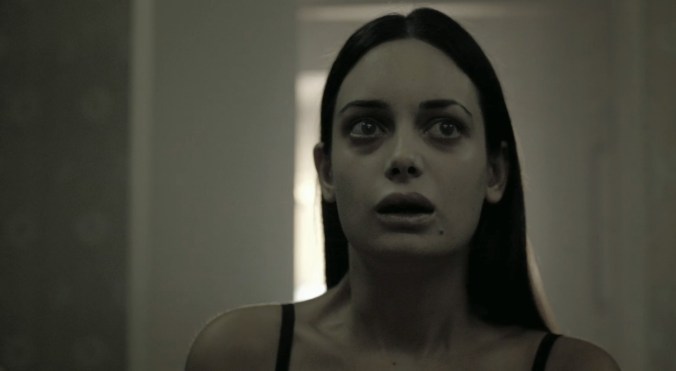
Eventually, after many clues, she and Bill Creek discover a room hidden behind a wall in her family home. It contains nothing but a mattress spring and a bunch of tiny holes in the walls that give a view of every other room in the house. Annie insists that the house is haunted by a ghost who isn’t her mother and is trying to urgently tell her something. After Bill Creek refuses to buy into this idea, Annie goes to an old druggie friend and psychic named Stevie (the intensely spooky Haley Hudson), who is able to tell Annie that there is someone in the closet, and that the ghost in the house wants to tell her something that her mother didn’t want anyone to know about. She also tells Annie that she can see all the abuse that Annie and Nicole suffered at the hands of their mother in the closet in question. Stevie also goes into a kind of fit in the hidden room, where she repeatedly screams the name “Judas,” and everyone sees the eerie specter of the woman in the flowered dress floating up near the ceiling.
Annie is able to discover that there was an uncaught serial killer in the area years earlier called the Judas Killer, and by putting two and two together, she determines not only that the ghost haunting the family home is one of the serial killer’s victims, Jennifer Glick, but also that the serial killer was named Charles Barlow and was her mother’s brother, a relative she previously did not know existed.
While Annie is finding all this stuff out at the Hall of Records, Bill Creek has been going through some photos he took at the house and is beginning to get on board with the whole ghost scenario. He goes back to the house to check on his hunch, but abruptly gets stabbed in the neck and killed by an unseen individual.
Annie returns to the house later and sets up an ersatz Ouija board in the hidden room where she communicates with Jennifer Glick, who confirms Annie’s suspicions about the Judas Killer. But just as Jennifer spells out the word “below,” a scrawny bald dude emerges from a trap door in the floor beneath the mattress spring. Annie hides and watches the creepy fellow, quickly coming to the conclusion that this is Charles Barlow (Mark Steger), her uncle the serial killer, that he is still alive, and that he has been living behind the walls of the house the entire time, protected by Annie‘s mother.
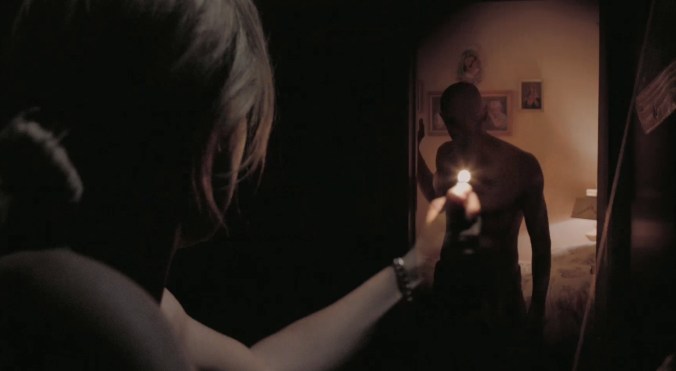
After Judas goes out to the kitchen for food, Annie peers down into his basement hovel and sees the bodies of Bill Creek and her sister Nicole (I don’t think Liz is shown, but she’s presumably down there too). She wisely swipes Bill’s gun and there is a tense sequence where she and Judas struggle, Annie is knocked out and tied up in the closet, but manages to free herself, stab Judas with a coat hanger, then eventually shoot him right in the forehead.
In the coda, it is shown that Annie sold the house and adopted Nicole’s daughter Eva, and the implication is that she has now completely turned her life around and left her unhappy past behind her. But at the very end, there is a brief shot through one of the holes in the wall of the secret room, which shows one blinking blue eye. I don’t know if that is meant to say that Judas somehow survived, or if it was just a dream sequence to freak us out, but it was pretty creepy, regardless.
Now, there is another implication here that isn’t really made super obvious, but there were a couple shots of the film that showed that Annie, like David Bowie, had one green eye and one blue eye. After Judas is killed, there is a close-up of his face that shows him to have the same thing. So I’m pretty sure they were suggesting that Judas was actually Annie and Nicole’s father, and that he and their mother had an incestuous relationship. Like I said, they didn’t spell this out, but Annie did make an offhand comment early in the film that she didn’t know who their father was, so I’m guessing that was what that was all about. And to be honest, one of the things I liked most about this film was how it didn’t feel the need to over-explain itself; it just laid out the clues and tendrils and let the audience figure them out.
I also loved the slow build of the tension, the skin-crawling long shots of the hallways and doorways of the house, and the really unsettling glimpses of the ghosts (particularly when Annie briefly sees the ghost of Jennifer Glick with her top half and her bottom half weirdly out of alignment). I also enjoyed that the house was not only haunted by a ghost, but also housed a real person who had been hiding out there all along. The implications of all this family drama left a lot to the imagination, which made it much creepier, in my opinion. There were no flashbacks to Annie and Nicole’s abusive childhood, or to Judas’s former crimes. Everything was kept mostly subtle and limited to one or two mentions, so that the viewer could fill in her own blanks.

Many times while watching this movie, matter of fact, I was pleasantly reminded of I Am the Pretty Thing That Lives in the House, one of my favorite horror films of the past several years. The Pact had that same looming atmosphere of dread, that same framing of mundane household details as sinister, that same ambiguity about where the haunting ended and the terror of the living killer began. It had some fantastically disturbing visuals without going over the top, and even though the story itself wasn’t wildly original, it really sucked you into its mystery and moody ambiance from the moment it began. It’s an impressive debut from director Nicholas McCarthy, and I’ll definitely be seeking out his future work.
Well, from the storm-lashed streets of central Florida, this is the Goddess signing out and urging you to keep it creepy, my friends. And stay safe, all you folks in the path of wrathful nature.
13 O’Clock Episode 55 – It’s Not the End of the World: Failed Doomsday Predictions
THE END IS NEAR!!! Okay, not really, but a whole bunch of people throughout history have certainly thought that the whole human race was heading for a worldwide cataclysm…any day now. So far, not a single one of these gleeful doomsday prophecies has turned out to be accurate, but what is it with folks who keep predicting the end of the world? And why do their followers still believe them? On this episode, Tom and Jenny take a wild, whirlwind tour through the wacky world of the end of the world, discussing everything from the Great Disappointment of the Millerites to the repeated prediction fails of Harold Camping to the inscrutable prophecies of Nostradamus. Hunker down in your rapture bunker and spend your final hour with episode 55.
Download the audio version here or watch the YouTube video here. Song at the end: “Doomsday” by Love Like Blood.
Don’t forget to follow the 13 O’Clock Podcast blog, subscribe to our YouTube channel, like us on Facebook, and follow us on Twitter. And be sure to check out our list channel, 13 O’Clock In Minutes! AND SUPPORT US ON PATREON!!!


13 O’Clock Movie Retrospective: Escape From New York
Tom and Jenny revisit the work of John Carpenter, reviewing the 1981 dystopian classic!

