I told you guys I was Kindle-izing all my older books, and here is another one! My 2009 short story collection Hopeful Monsters is now available on Kindle for the low, low price of $2.99! More to come, so keep an eye out.

I told you guys I was Kindle-izing all my older books, and here is another one! My 2009 short story collection Hopeful Monsters is now available on Kindle for the low, low price of $2.99! More to come, so keep an eye out.
My 2011 short story collection The Associated Villainies is now available on Kindle for $2.99! If you always wanted to read it but didn’t want to kill trees with the print version, well, here you go. I’ll be adding more of my books on Kindle as the weeks go by, so keep watching this space.

The God of Hellfire and I were interviewed on Paranormal Central last night, and here’s the whole show! The hosts start talking about The Mammoth Mountain Poltergeist at about the 25:50 mark, and then a few minutes later they call us up and we start yapping. Please listen in, if you’d like! 🙂
At this point I almost feel like I should start a separate series called “Book To Movie” or something instead of just cramming these types of posts into my “Favorite Horror Scenes” series, but fuck it. Maybe I’ll get around to it; it doesn’t make much difference, I guess, but my anal-retentiveness really likes to have everything categorized neatly and correctly. The Goddess is nothing if not fastidious.
EDIT: Okay, I went ahead and did it. Not that anyone cares, but there are a couple new categories called “From Parchment to Pixel: Great Horror Books on Screen” to encompass these kinds of posts, and a “General Genre Musings” category as a catch-all for stuff that didn’t fit in any of the other classifications. Everything is correctly categorized, and I feel better now.
All that aside, here’s another discussion about a great horror novel that got turned into a mildly disappointing TV movie! If you’ll recall, I’ve done similar posts on Thomas Tryon’s Harvest Home and Stephen King’s miniseries version of The Shining. And if you’ll further recall, I highlighted today’s book in an earlier post about my favorite horror novels written by women. As you might have guessed, the subject of this post is Anne Rivers Siddons’s stellar 1978 novel The House Next Door and the surprisingly-not-terrible 2006 Lifetime TV adaptation of same. Into the breach!
Because this was made for Lifetime, the shoe-buying, chocolate-scarfing menstrual cycle of TV networks, I was expecting this adaptation to be far more cheeseball than it turned out, particularly because the source novel contains such sordid, over-the-top plot points (albeit presented in an oddly toned-down sort of way). But the movie—starring Lara Flynn Boyle and her surgically unfortunate upper lip as Col Kennedy, Zack from “Saved by the Bell” as Kim the architect, and a few other familiar faces—is actually relatively restrained, which was kind of nice to see. The book handily pulled off its ridiculously melodramatic incidents because of Siddons’s matter-of-fact delivery and pacing, but I’m not sure some of the crazier, modern-Southern-Gothic stuff would have flown in the movie; it could have easily slipped into camp. So points to Lifetime for tamping down on the more lurid aspects of the novel (although I admit I did enjoy those on the page).
The story has been modernized, obviously, to reflect the twenty-eight years between page and screen. The suburb in the movie is just presented as a generic yuppie enclave, so the more specific “old South vs. new South” themes of the book (which was set in a fancy suburb of Atlanta) are no longer in evidence. I feel like main protagonist Col Kennedy (never referred to in the movie by her full book name of Colquitt) is a bit younger than in the book, as is her husband Walker (who was named Walter in the book, which I guess seemed like an old-fashioned name, so okay), but that’s pretty standard as adaptations go. The horribly class-conscious, shallow and backbiting characters of the novel actually make pretty good fodder for a Lifetime movie, so I’m awarding more points there; some of the characters in the movie, in fact, were more likable than their novel counterparts.
The plot follows that of the novel pretty closely (and by the way, if you haven’t read the book, I’m gonna spoil it for you, so go read it real quick and then come back, okay? It’s pretty short; I’ll wait).  Done? Okay, moving on. The House Next Door is basically a frame story, with the Kennedys watching a succession of three families moving into the gorgeous, newly-built house next door, and slowly coming to the realization that the house is evil and destroys everyone who lives within it by pinpointing what the residents value or fear most and then dismantling their lives in the most spectacular ways possible. The movie is only an hour and a half long, so obviously the plot had to be substantially compressed, with incidents being combined, or one horror coming quickly on the heels of the last one. Characterization suffers, of course, and to someone who’s read the book it will seem as though shit is happening at lightning speed, but that’s a failure of the medium, really, so I’m not going to fault the movie for that. It seems they did okay within the time constraints.
The novel is told from Col’s point of view, but despite this, she remains on the periphery of the action for a good part of the book, mostly hearing things about the house next door second hand, and not witnessing anything herself until quite late in the story. In the movie, though, Col is the main character, so this outsider status wouldn’t really work. However, the screenwriter came up with what I thought was a fairly elegant solution: as in the book, Col is an interior decorator, and in the movie she gets to spend a lot of time with the families next door because they hire her to help them decorate. A totally believable approach, and a good way to get her more directly involved in the shenanigans.
As in the book, there’s a short flash-forward introduction where Col and Walker are shown leaving copies of their wills conspicuously at their house before heading over to the house next door, with Col’s voice-over explaining that they know what they’re going to do is terrible, but that it won’t matter because they probably won’t live long enough to get into trouble for their actions. Then we cut to eighteen months earlier, as Col, Walker and the neighbors express their understandable displeasure that a house is being built on the beautiful wooded lot next to the Kennedy house, and then there’s the same change of heart as they meet the hot-shit, tormented genius architect Kim (a shockingly well-cast Mark-Paul Gosselaar) and the couple that will be moving into the house, Pie and Buddy Harrelson.
The Harrelson family section of the movie was the most different from the novel, and I think most of the changes made were probably the right ones (though I’ll have more to say on that in a minute). In the book, Pie was a very young, naïve, perky cheerleader type with a bizarre, quasi-sexual relationship-cum-competition with her old-fashioned father; in the movie, only the competitiveness and spite are highlighted, with Pie telling Col that she’s basically basing her whole life around showing her father up, since Daddy never thought her husband was good enough. Movie Pie is actually much less annoying than Book Pie, which I thought was a good decision, as portraying Pie on screen exactly as she was in the book may have made her not only less realistic, but also much less sympathetic.
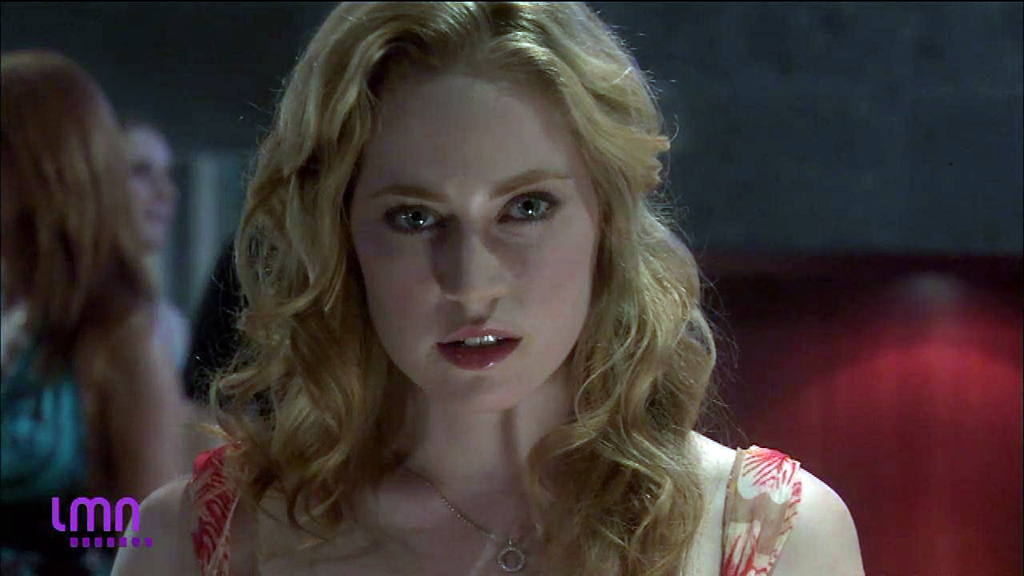
We’ve got spirits, yes we do; we’ve got spirits, how ’bout you?
As in the book, Pie is happily pregnant and unable to believe her luck at how her life is progressing. Also as in the book, Buddy buys her an adorable puppy that you just know something bad is going to happen to (especially as we’ve earlier seen Col finding a torn-up animal in her garden). Shortly afterward, the puppy is found ripped to pieces (RIP puppy), and though Pie is heartbroken, she goes ahead with a planned housewarming party, so that she can schmooze with her neighbors and show Daddy how high up the social ladder his little girl has climbed.
So here is where the movie parts ways with the book rather significantly. In the movie, everything bad that happens to the Harrelsons comes crashing down all at once; the party seems to be going swimmingly, but partway through, Pie can’t find Buddy and goes to look for him. As she is standing at the top of the basement stairs, Buddy pushes her to the bottom, possessed by some evil within the house. Col finds her and rallies the troops, Pie is carried off in an ambulance (she ends up having a miscarriage, naturally), Buddy is carted off in handcuffs and charged with attempted murder, Pie’s Daddy screams at him that he always knew Buddy was a piece of shit, and that’s the end of the Harrelsons.
In the book, however, the events had a darker and much more batshit quality. Pie actually does fall down the stairs and lose her baby at one point, but it happens earlier in the story, and she is alone in the house at the time. She is found by neighbor Virginia (if I recall correctly), and Col is summoned to help. Despite the miscarriage, Pie decides to go on with the party, since displaying her status to her Daddy is of utmost importance to her. At the party, she loses track of Buddy, but she finds him in a much less murderous frame of mind; in short, he’s indulging in some intensely ass-slapping gay sex with his law partner on the bed where all the guests have been leaving their coats. Not only that, but Pie’s Daddy has found the fuckers first, and is in the process of dying from a shock-induced stroke on the bedroom floor. Now, I can see why the movie chose to downplay the novel’s scenario; public infidelity aside, homosexuality is not shocking or immoral to anyone anymore (aside from a few knuckle-draggers), so the scene would not have played out the same in 2006 as it did in 1978. Additionally, the screenwriter likely thought that the incidents portrayed in the book would have just been too much for audiences to swallow. A caveat, though. The whole M.O. of the house, both in the book and in the film, was that it systematically took away everything that was most important to the people who lived there or came in close contact with it. In the book, the house was very specific in how it chose to destroy the Harrelsons: It took their beloved puppy, then it took Pie’s baby, then it shit all over Buddy’s professional reputation by involving him in a sex scandal with his law partner (which everyone at the party saw, by the way), then it not only had Pie’s Daddy see Buddy in such a compromising position, but it killed Daddy off too, thereby leaving Pie with her life in complete and utter shambles. So while I can see why the movie went in the direction it did, it also seemed to soften the blow for Pie somewhat, as her father didn’t die in the movie, leaving her with something of her old life left to cling to. The book left her no such consolation.

Crabgrass! My life is over! #firstworldproblems
Anyway, as in the book, after the Harrelsons beat cheeks, a new couple called the Sheehans (Anita and Buck) move in. Buck seems pretty similar to how he did in the book, but the character of Anita is quite different. In the book, Anita was a delicate, dark-haired beauty who seemed haunted by something unspoken in her past, but was eager to make friends in the neighborhood despite her still-fragile mental state. During the course of the story, we discover that the Sheehans’ son Toby was killed in a helicopter crash in Vietnam, and Anita had to be institutionalized to deal with her grief. Buck, unable to deal with what had happened, had an affair, which Anita found out about. Through counseling, the couple had reconciled and were well on their way to getting their shit together; Anita was in a much better mental place, Buck had made his amends and had newly committed to their marriage, and things seemed to be looking up when they moved into the house next door, looking for a fresh start.
In the movie, Anita was an average-looking, matronly type with short mom hair and nothing of the ethereal or mysterious about her; in fact, she seemed completely open and friendly when Col and a couple of the other neighbor ladies showed up with flowers and cake to welcome the couple to the neighborhood. Immediately, though, things start going to shit; Anita orders a pizza for the ladies, and when the pizza guy comes to the door, she freaks out, thinking her dead son (killed in Iraq in the movie) is standing on the doorstep. As in the book, she begins to receive mysterious phone calls where she thinks she hears Toby calling to her, and she eventually starts to see the helicopter accident which killed him playing on the television in the living room; unlike in the book, Col is actually a witness to one of these horrific telecasts from beyond. As I said, the plot had to be substantially speeded up due to time constraints, but it was still jarring that Anita flipped out so quickly; in the book it was a much slower progression. And in the book, this was the point where Col only started to suspect that maybe something was wrong with the house; Book Col didn’t actually see the helicopter crash on the TV, but after Buck told her about it, she checked the TV listings and saw that no war movie had been on TV at the time when Anita had seen the vision, thereby making her wonder if something more sinister was going on over there. The rest of the Movie Sheehans’ arc plays out similarly to the book; Anita keeps seeing visions of Toby and loses her marbles, then is pushed over the edge when she sees Buck and Virginia in flagrante delicto. Anita kills herself, Buck moves away, and Virginia flees the neighborhood in shame at what the house made her do.
Part three, with the Greenes, is also fairly similar. Norman Greene is a self-important, tight-assed, abusive asshole with OCD issues, his cowed wife Susan vainly tries to be perfect for him while attempting to maintain a pleasant social face, and their daughter Belinda (who I think was named Melissa or Missy in the book) suffers from some unspecified illness that causes her to have stomachaches and vomit at times inconvenient for her jackwad father. (In the book, Norman is her stepfather, and the girl’s gastrointestinal disease is a source of intense embarrassment for him, so much so that he denies that she has it, claiming that she is simply faking illness for attention. This is touched on in the movie, though it is never explicitly stated that Belinda is anything other than his biological daughter.) As in the book, the Greenes have a party which few people attend because the invitations mysteriously never get mailed, even though Susan is shown getting ready to mail them; also as in the book, Susan is blamed for her “stupidity” in not getting the invitations out. Norman makes the most of the awkward vibe at the party, though, and pontificates at length to his captive audience about how awesome he is and how put-upon he feels at being burdened with such a sub-par and useless family. In the film, the party comes to a screeching halt when Belinda pees herself in front of the party guests (shades of The Exorcist), horrifying her father’s sense of neat-freak propriety. This scene is also substantially toned down from the book, but that’s probably for the best, because it would have been pretty gross to portray as written. In the novel, everyone at the party is alerted by a scream from the kitchen. When they go to investigate, they find Melissa-or-Missy cramped up in a fetal position on the floor, spraying diarrhea all over her white dress, the floor, and her mother, as the illness her father frightened her into ignoring comes to a spectacular head. If I recall correctly, the capper on the evening is the power going out (ruining the “perfect” party Norman had planned), and then coming back on just at the moment when Norman is standing over the blender, which Susan has conveniently left the top off of. Norman is drenched by whatever was in the blender, filthifying him and making his public embarrassment complete. In the book, he furiously runs everyone out of the party, and it comes to light later that after everyone left, there was a blistering argument between Norman and Susan which resulted in Susan finally flipping her shit, and shooting him, her daughter, and then herself. In the movie, this is also toned way down; Susan does end up shooting Norman and herself, but Belinda escapes, fleeing to the Kennedys’ house for help. Lifetime didn’t want to kill off the cute little girl, I guess.

So, what are your qualifications for becoming my new mommy?
The rest of the movie plays out in pretty much the same way; architect Kim returns from the trip to Italy he took to get his mojo back, and he buys “his” now-empty house. When he and Col are in there alone, the insidious evil of the house causes them to uncharacteristically act on their previous light flirtations and start going at it, Walter/Walker witnesses the infidelity and attempts to kill them both, but Walker and Col manage to drag themselves out of the house before anything too horrible happens. As in the book, it is this shattering event that finally shows Walter/Walker how evil the house is, and cements his decision to join with his wife and destroy the thing. In the book, Col and Walter actually went to the press to warn people about the house and subsequently had the entire neighborhood shun them; in the movie they never go to the press, but are kinda given slight pariah status just the same because of their theories about the house next door. In the movie, they destroy the house by blowing it up (which I think is pretty much the same thing that happened in the book) and making it look like an accident. Kim is killed in the explosion, which I think also happened in the book, though I’m not entirely sure and don’t have the book with me to check. Similar to the book, the movie ends with Pie and Buddy’s contractor from the beginning of the movie talking to an idealistic new couple about these fantastic house plans he still has from some hot-shit but now deceased architect, and he tells them that he can build the house for them if they want it, because the house on the plans looks “magical and alive.” And thus the cycle of evil continues, even after its emissary is dead. I think the movie was a lot less subtle in its portrayal of Kim as the definite agent of the evil, making him almost seem a willing participant. In the book, it is understood that there is something inside of Kim, a curse of some kind, that causes everything he designs to cause misery and death, but he doesn’t seem complicit in the evil, simply an innocent conduit (though I could have been misreading the text on this score). As in the book, Col and Walter eventually leave their house and move permanently to their beach house to escape the sneers of their neighbors (in the book they also escaped a substantial media frenzy surrounding the haunting; this isn’t really touched on in the movie); unlike in the book, they seem to adopt the surviving Belinda Greene, neatly tying up the several hints in the movie that the Kennedys (or at least Walker) were somewhat bothered by their childlessness. End film.
As I said, not really a bad adaptation at all, especially considering it was a Lifetime movie. It never got too eye-rollingly silly, and moved along at a pretty good clip. Some of the changes made from the novel I agreed with, and some I didn’t, but I can understand why certain changes were made, even though I might not have liked them. Worth checking out if you’re bored and have ninety minutes to kill, but as always, the book is light years better and would obviously be a much more satisfying investment of your time.
Until we meet again, keep it creepy, my friends. Goddess out.
Yes, minions, despite my crotchety old person ways, I actually got off my lazy duff and (sloppily) formatted The Mammoth Mountain Poltergeist for Kindle! It’s on sale for $2.99, so if you were waiting for an ebook version, TODAY IS YOUR LUCKY DAY! Ebook versions of my other books that don’t yet have them will also be forthcoming in the next few weeks, so if the book-type technology was the only thing keeping you from reading my exalted words, now you no longer have an excuse. Download, read, review! Thank you, and Goddess out.
![Pageflex Persona [document: PRS0000038_00060]](https://goddessofhellfire.com/wp-content/uploads/2015/02/mammothmountainbookcover_blog.jpg)
Myself and the God of Hellfire will be appearing LIVE on Paranormal Central Radio this coming Sunday (Mother’s Day!) at around 8:45pm Eastern Time to discuss The Mammoth Mountain Poltergeist. Please tune in, won’t you? Thank you.
Top of the afternoon, minions! I just realized I hadn’t posted anything in either of my movie series for several days, and I felt sorta bad about that. I also realized that I have come down with the plague and don’t really feel like doing anything other than lying in my bed and wallowing in a cold-medicine-fueled delirium. But because I love you guys and have a pathological need to do something productive even when I’m in the throes of deathly illness, I’ve decided to compromise by discussing a nice, short little silent film known as The Red Spectre. Here it is:
Released in France in 1907, The Red Spectre was directed by Segundo de Chomón and is one of the few surviving examples of early-twentieth-century “trick” films. It’s only ten minutes long and doesn’t have a “plot” per se, but I gotta admit, for 1907, this thing looks fucking amazing. How is it in color, Goddess? You may be asking. Glad you asked. It’s in color because it was painstakingly hand-tinted, frame by frame. That’s hardcore, Goddess, you may be saying. And yes, I would have to agree. Also, the effects are pretty damn cool-looking, and honestly, since I don’t know much about early film technique and can’t really figure out how they did some of them, I’m just gonna assume MAGIC IS REAL.

Does this red grotto make my hips look big?
We open in a little flaming hell-grotto with a happy dancing coffin. The coffin fades away and reveals a skeleton dude with horns and a fabulous cape, which he proceeds to open all TA-DA, BITCHES, I’M THE DEVIL. WELCOME TO MY WORLD OF EVIL AND KICK-ASS SPECIAL EFFECTS. He swishes back and forth a couple times, since that’s evil’s prerogative, and then the rocks in the background part, and then there’s like a cave background with stalactites and shit. He poses some more, like CHECK OUT THE BATCAVE, PUNY MORTALS, and then he waves his bony arms and there’s smoke and fire, and oh, I guess he’s holding a torch or a bottle rocket or something, and then he holds the torch down near the floor and GIRLS APPEAR! I get the feeling that he really digs showing off his magical girl-appearing fire wand. Evidently the girls are his harem of captured souls, and even though there are only five of them I’m not gonna hate. Maybe he’s just a minor demon, after all, or maybe he’s just starting out in the soul-capturing biz. Or maybe it’s the beginning of the month and he had a shitload of souls that he dispatched earlier and this is the new batch. I don’t know the protocol, so far be it from me to dis the Red Spectre’s meager soul count at this juncture.
The girls dance around in a circle all pagan-like, and the Spectre stands behind them with his arms crossed all like WORD. Then the girls disappear and turn into little flaming will-o-the-wisps. He dances around with his cape like he’s trying to wrangle them, but he can’t quite do it, or maybe he just doesn’t want to set his cape on fire. Then he magicks his torch back again, and with it he materializes two elaborate gold cauldron thingies which he lights with flame like it’s the Devilympics up in here. Then he does the WORD pose again, and then girls appear in the flames in the Olympic bowls. They hold their hands out and he takes one girl in each hand and helps them down to the floor, all gentlemanly, and guides them to the back of the grotto. Then he’s all IMMA BLOW YOUR MIND and draws his arms together and the gold cauldrons scoot close together in the middle of the stage. From beneath his voluminous cape, he produces a huge roll of what looks like black Hefty bag material. He lays the roll across the cauldrons and rolls out a length, then picks up one of the girls and puts her on the barbecue and wraps her up like a Triple Steak Burrito from Taco Bell. Then he waves his caped arms again, all EENIE MEENIE CHILI BEANIE and the girl-burrito floats up in the air, then catches fire and suddenly disappears, much like the contents of your intestines do after eating a Triple Steak Burrito from Taco Bell. He then repeats the procedure with the second woman, because where girl-burritos are concerned, you really need to see the whole thing twice to get the full effect.

Behold my gold-plated hibachis of death!
Then he makes another TA-DA gesture with his hand and produces a pitcher outta THIN AIR. This is better than Mindfreak, you guys, for real. He takes what are presumably the girls’ ashes out of the cauldrons and puts them in the pitcher. Then HUZZAH the cauldrons disappear, and then at stage left there’s a puff of smoke and VOILA, Peter Pan appears! Okay, not really Peter Pan, I think it’s a girl who’s supposed to be a good spirit or a wood sprite or something, but y’know, she has some Mary Martin action going on. And the Spectre looks at her all SO WE MEET AGAIN, MY NEMESIS, and she waves her hand like Vanna White and some curtains part in the back and there are more girls back there, and Peter Pan seems to be showing Spectre something and he’s pretty indignant about it, but she’s all DEAL WITH IT and waves her hand to close the curtains again. She points at him and then points at herself, all GIRLS RULE AND SPECTRES DROOL, and he looks all huffy with his ash-filled pitcher, because he just wants to do a little spot of evil in peace, for fuck’s sake, and he doesn’t need no womany do-gooder wood sprite cramping his nefarious style and being a nag, man. She keeps pointing at him and then he starts to come at her all YOU’RE GONNA GET IT NOW, HO, but she ducks behind a rock and disappears. Minx.
Anyway, Spectre is all FINALLY, SHE’S GONE, NOW I CAN GET ON WITH THINGS, and he poofs a properly Satanic-looking pedestal into existence. The base of the pedestal looks like a caduceus, and the top of the pedestal holds three bottles. Spectre picks up the pedestal and carries it really close to the camera. I don’t know why he didn’t just poof it into existence closer to the camera in the first place, but maybe he carved that pedestal and wanted everyone to appreciate his handiwork. He spent a long time making that, you guys. Sure, he could have just magicked it, but he likes to work with his hands sometimes, do things the old fashioned way. It relaxes him, dontcha know.
He pours the ashes, which are now liquid somehow, into the first bottle, and hey, there’s a tiny girl in the bottle! I guess he likes to shrink down his ladies and keep them in bottles to maintain their freshness. Turns out there are girls in all the bottles, revealed as he pours the black liquid in over them. Spectre is all smiles as he surveys his bottled ladies, and then he turns the bottles until they’re white and we can’t see the teeny girls anymore. Then he carries the pedestal back to the center of the stage, and then POOF the Wood Sprite is back! She seems a bit put out, all YOU CAN’T KEEP GIRLS IN BOTTLES, WTF ARE YOU EVEN THINKING WITH THAT and Spectre’s all YOU’RE NOT THE BOSS OF ME, but I guess she is because Wood Sprite poofs the pedestal away herself. Spectre’s all BITCH, I WAS USING THAT and chases her around, but she disappears again and Spectre is all FUCK THIS SHIT, I JUST CAN’T DEAL.
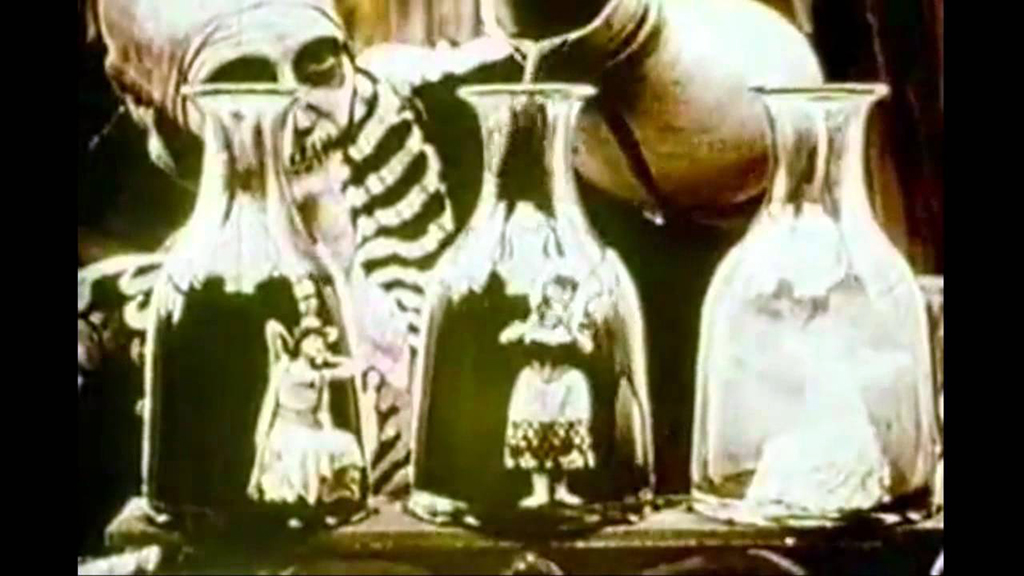
Pictured: Bottle blondes.
But he recovers quickly from his tantrum, and then poofs another thing into existence. The pedestal base looks the same, but now the top of it looks like some kind of fancy screen or whiteboard in three sections. He drags the pedestal close again and starts turning the sections around one by one. There’s another girl on the back of each screen, so this is like a screen-in-screen effect, which seems pretty high-tech for 1907. The girl on the screen bows and sniffs a flower like she’s the queen of England, and Spectre turns the screen sections back around because he just can’t stand any more of her attention-whoring. The pedestal is taken back to the center of the stage, where a newly apparated Wood Sprite appears again and magicks it away. GOD, PETER PAN, I AM JUST TRYING TO DO MY ONE-DEMON TRIBUTE TO DAVID COPPERFIELD, WHY YOU GOTTA BUST MY CHOPS. She just laughs like Nelson Muntz (I presume) and runs away from him and disappears again. I know this is probably not what the filmmakers intended, but I’m starting to feel a little sorry for the devil here.
But, being the consummate professional, the Spectre knows that the show must go on. He does a dramatic gesture and causes another big screen to appear, but this one is super fancy and gold, with a big devil head at the top and devil hands on the sides. The screen has another three girls posing and dancing around on it. Spectre goes around behind the screen and then rolls under it, which is the cutest thing, and then he’s lying on his back and waving his arms, and the picture on the screen changes to a single smiling woman in a really over-the-top feathered chapeau. Then another wave of the skeleton arms, and the picture changes to what looks like an old couple indulging in some modest PDA. And then ABRACADABRA, the screen disappears and there’s that troublesome sprite again, and Spectre is REALLY mad because that was his greatest illusion, goddammit! He tries to throw down on her and enfold her with his Liberace cape, but she keeps disappearing and he’s all FUUUUUUUUUUUCK.
Getting on with things again, Spectre waves at the backdrop and it lifts up with much flame and smoke and rock & rollery, like KISS are about to come out. Then he starts dancing, and I guess the film is running backwards because his cape is moving all weirdly, and then boxes start flying in from off-screen like he works at the world’s most aggressive post office and it’s the Christmas rush. He catches them like a pro, and begins stacking them, and then they magically cohere into a big square and they’re a screen too, because in the hell-grotto, everything is a TV showing episodes of “Real Housewives of the Underworld.” The box-stack-screen is showing a dowdy old woman in another crazy feathered hat feeding a dog, and Spectre stands there presenting it with his hand like he’s super proud of the dog thing, y’all. Then he runs his hand up the side of the boxes, and there’s another puff of smoke and then it disappears, and then, you guessed it, up pops Peter Pan. They have an altercation, Peter Pan waves her arms and all the cave curtains in the back raise up and there’s just fire and explosions everywhere like we’ve stepped into a proto-Michael Bay movie and Spectre, defeated, lets Peter Pan lead him toward the rear of the stage, where he spreads his arms like he won a trophy and acts all like YEAH, I WON ALL THIS SHIT, and then all the girls that he burritoed and bottled up earlier come rising up out of the stage at Peter Pan’s mystical gesturing. So I guess Spectre got his evil butt kicked and all his trapped girl souls got released by Peter Pan. ALL THAT WORK FOR NOTHING.
And then there’s one girl remaining, and Spectre tries to enfold her with his cape like he’s gonna give her a noogie, and she looks like she’s into it, but then BAM the girl turns into Peter Pan and everything turns red and the cave rocks come back and Peter Pan knocks the poor Spectre on the ground and just stomps the shit out of him with her little fairy shoes, and then as a final fuck you, she pours some stuff from his pitcher onto the poor fella, and then he’s just a cape, which she lifts up to reveal that our previously spry Spectre is now just a lame-ass skeleton from Mrs. Fisher’s second period bio class. She throws the skeleton on the ground and then puts on his cape, all OOH, THIS IS QUITE FETCHING AND I HAVE YOUR PITCHER TOO SO I’M YOUR GOD NOW, SATAN. SUCK IT. And then that’s the end.
Like I said, this is pretty incredible for being more than a hundred years old, what with all the really pretty decent screen effects and the hand-coloring and the devilish shenanigans. A fun little experiment in early film, all the more valuable because it’s one of very few that survived the years.
Until next time, Goddess out.
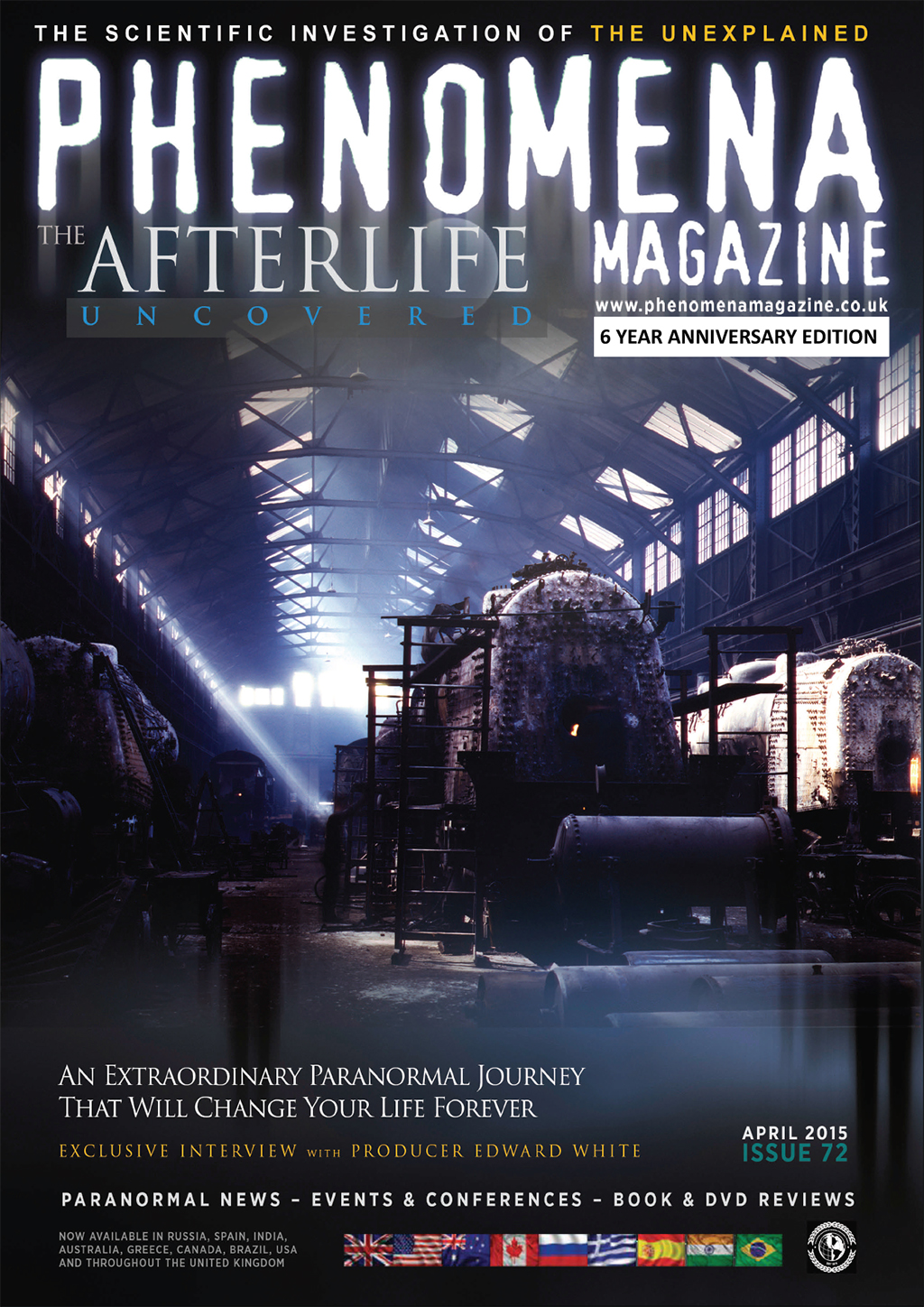
Greetings, paranormal pals! I know you are all on tenterhooks to hear the radio program that the God of Hellfire and I hopefully didn’t make fools of ourselves on, but be patient; the audio file will be forthcoming today or tomorrow. To whet your appetite, check this out right here! UK paranormal magazine Phenomena contains an almost embarrassingly glowing review of our little poltergeist book, written by distinguished British parapsychologist and all-around awesome guy Steve Mera. He has been investigating paranormal phenomena for over thirty years, and I am tremendously humbled and intensely thrilled that he enjoyed our book so much and has put the weight of his professional expertise into recognizing it! You will likely be seeing some more activity involving us and Steve Mera in the future, though I’m keeping that on the down-low for now until everything is a bit further along. The GoH and I may also have a SUPER exciting announcement about The Mammoth Mountain Poltergeist coming very soon; I won’t go into too many details, but television is involved. Sorry to be so secretive, beloved minions, but I like to have everything squared away before I go shooting my mouth off about it; I’m sure you guys understand. So read the new issue of Phenomena, stay tuned to listen to our radio show, and keep your eyes peeled for exciting new developments!
PLEASE DON’T FORGET! I and my charming co-author Tom Ross will be on Jim Harold’s The Other Side podcast this coming Tuesday, April 28th at noon to discuss The Mammoth Mountain Poltergeist. Kindly listen in, minions! Thank you, and keep it creepy, my friends.


Welcome back to Scary Silents! Even though this series is relatively new, I’m already changing things up a tad, so I hope none of y’all mind. Yes, this is still a silent film I’m discussing, but it isn’t from the sanctioned “silent film era” (hence the reason I also cross-posted it in my “Creepy Scenes” category). It’s a notorious experimental film from 1991 called Begotten, directed by Edmund Elias Merhige, who was also responsible for the fantastic film Shadow of the Vampire (which of course focused on the making of F. W. Murnau’s Nosferatu). I became intrigued with Begotten because of its persistent appearance on pretty much every “Most Disturbing Films EVAR” list circulating on the internet, so being something of a masochist, I decided to check it out and write down my thoughts for posterity. If you would like to follow along, here is the linky-poo:
The first thing I gotta say is that this certainly does look like a legitimate silent film from the era. It’s filmed in very stark black and white, and the film stock is all grotty and the camera work shaky, so kudos for realism. There is also no sound other than the constant drone of crickets, and the occasional grunt. The first shot is a shack in the woods, and already I’m digging the whole look of the thing; it really conveys that creepy, otherworldly feel I look for in my old silent films. I have a creeping suspicion that the entire production is going to be intensely arty-farty, but I don’t have a huge problem with either arts or farts, so it’s all good.
Inside the shack is a man in an eerie Leatherfacey mask and a white robe. He has blood all down his front and he’s coughing up even more of the stuff as he shakes and twitches, so I’m guessing it isn’t really his day. From the Wikipedia entry, I’m led to understand that this is supposed to be God™, so I’m rolling with it and calling him that. He produces a straight razor and begins to disembowel himself, pretty enthusiastically, I thought. He’s pulling viscera out from between his ribs and just merrily hacking away, chucking organs on the floor all willy nilly and wiping blood on the walls, because fuck it, he’s God™ and he knows he’s not the one who’s gonna have to clean up the place. That’s what worshippers are for. And just as a final dick move, he poops himself a lot (I think; since the movie’s in black and white, poop and goopy organs look the same) and lets it splooge all over his feet and everything. OH MY GOD, GOD™, GET A DIAPER.

I have no bowel control and I must scream.
Then, from out of the mess of fabric and innards and fecal matter, a woman’s arm emerges, and the rest of the woman invariably follows. This is Mother Earth, and she’s wearing a black mask over her eyes like it’s Mardi Gras all up in here, and she can’t seem to keep her hands off her perky ta-tas. She wanders around for a bit, her head thrown back. Then, because why not, she begins giving DeadGod™ a handie. He jizzes on her tummy and she rubs it in like Oil of Olay, because the protein in semen is like REALLY good for stretch marks (claim not evaluated by the FDA). She then smooshes her man-battered hand into her impressively furry bush, making sure it gets alllllll up in there so that she may preggify her bad self with DeadGod’s™ SuperSperm™. Is anyone reminded here of The World According to Garp? Just me? Okay, moving on.
We next see a black coffin appearing at various points in an empty field, and then Mother Earth is standing next to the coffin, rubbing her preggo belly. There are some quickly-edited shots of what looks like blood on skin, and I think I saw a fetus hand in there, and then suddenly there’s a fully-grown man lying all bloody on the ground, and what looks like a janky umbilical cord connecting him to Mother Earth. She wanders off and leaves him there, all WELL, YOU’RE ALL GROWN UP NOW SO GO GET A JOB, and he’s all twitching and hyperventilating and looking like a victim of the Mount Vesuvius eruption, and I wonder if he’s gonna have abandonment issues from here on out. WTF MOM, NOT EVEN ONE SIP OF BREAST MILK? Mother Earth is super harsh, you guys.

Well, my work here is done.
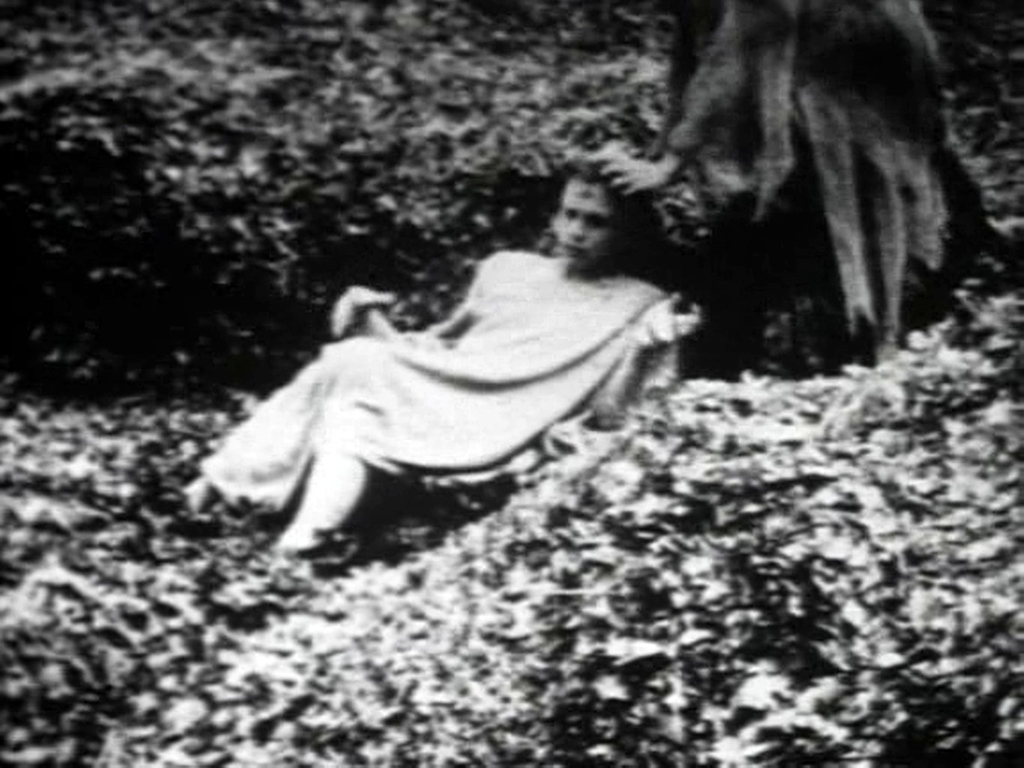
Game of peek-a-boo? Bedtime story? Anything?
And then there are a bunch of hooded men shown in shadow, and I guess they’re nomads because they look like they’re all laden down with merchandise from Pier One, and they come across the Son of God, and they’re all like HEY, FREE NAKED DUDE while he writhes around. They scoop him up and tie him with ropes (or maybe this is the umbilical cord, hard to tell) and bring him along on their nomadery, because maybe they’re bored out there wandering in the barren landscape or maybe they’re gonna eat him later, who knows. Son of God (henceforth SOG) doesn’t appear to be having too fun a time, convulsing his limbs and struggling and being all WHERE ARE YOU GUYS TAKING ME, SHIT’S NOT FUNNY ANYMORE and the nomads just drag him around like it ain’t no thang. SOG begins vomiting up organs or something, and the nomads are all FUCK YEAH and start collecting the stuff in their bags, and then, because they apparently can’t wait until he yaks up some more of his insides, they start pulling the goo right out of his midsection while he’s going SO I GUESS YOU GUYS AREN’T GONNA HELP ME THEN and they’re like NOPE, JUST GONNA SWIPE ALL YOUR INNARDS AND THEN PUT YOU IN A SLING AND DRAG YOU UP A CLIFF. THAT’S HOW WE ROLL.
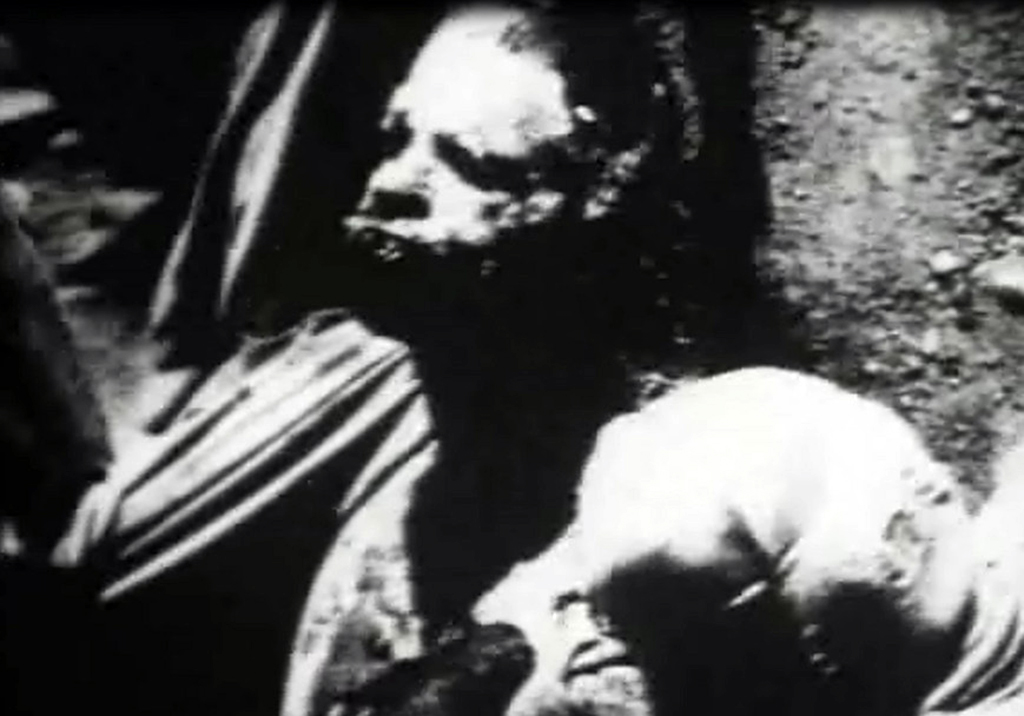
Pictured: Traumatic childhood.
They make a fire and drag him to it, because presumably this is like The Hills Have Eyes and they’re all cannibals too, because they really needed that last little push to cement their dickery. They stab the shit out of him while he writhes and vomits, and the nomads aren’t even fazed, man, they’re like WHATEVER, VOMIT JUST TENDERIZES THE MEAT and then they drag him around some more while a bunch of his meaty bits hang out his mouth, while the sun glares down, impassive.
Then he’s lying on the ground alone, still twitching but now all clean again, so I guess they didn’t barbecue him after all, and Mother Earth comes back and puts a collar on him and starts dragging him around too, because nothing like rubbing salt into the wound, right, MOM? SOG really hasn’t had the most pleasant introduction to the world, in case you hadn’t noticed.

Something something, apron strings, something something.
The nomads, apparently peeved that someone made off with their toy, begin following, gesturing at her like GET THAT UPPITY WOMAN WHO TOOK OUR FREE NAKED MAN, BUT FIRST LET’S BASH THE MAN’S HEAD IN WITH A STICK WHEEEEE and then it looks like they punch him in the dick too, and then maybe pull it off, but the way the film is shot it’s kinda hard to tell. Sounds like something they would do, though. Fuckin’ nomads.
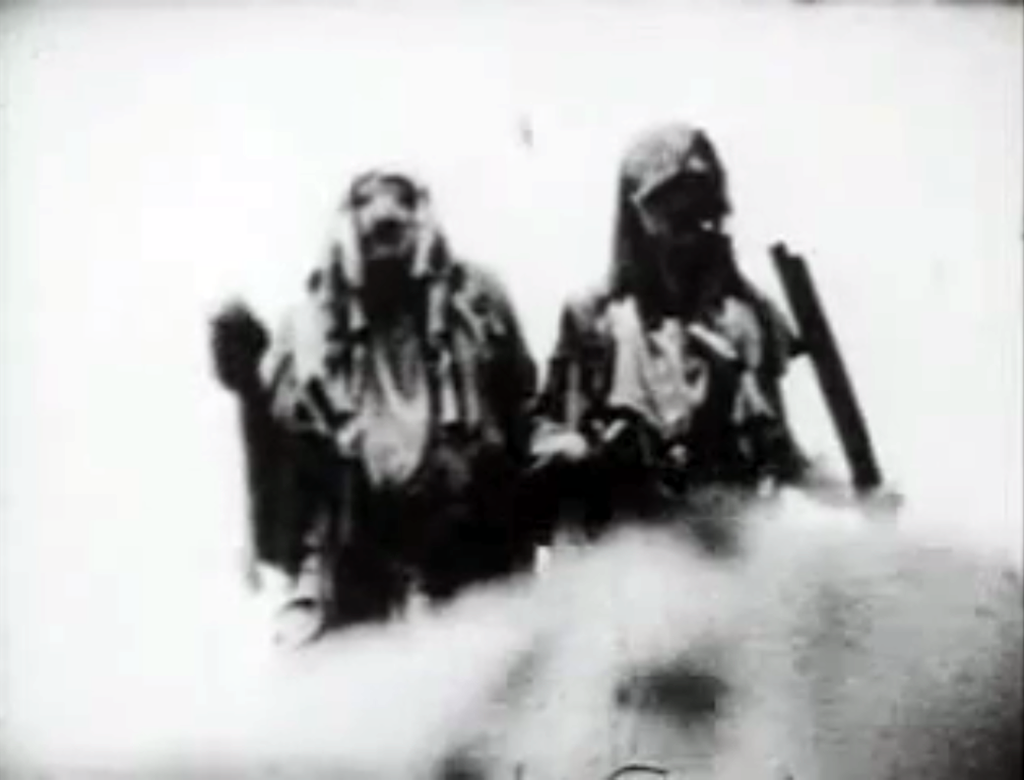
Hi, we represent humanity, and we’re just the worst.
Then they gang rape Mother Earth, because of course they do, all the while beating on her with their sticks and just tearing her all up and jizzing on her by the gallon. This bit was actually kind of upsetting to watch; even though it’s not particularly gory because of the black and white and because it’s so shaky and grainy that it’s hard to tell exactly what’s happening, in a way that makes it worse because you can see enough of what’s going on to imagine the rest. The flashes of them just pounding the shit out of her labia with their big mace-like staffs (not a euphemism) especially had me going:

Then Mother Earth is lying there, and SOG is kneeling between her legs, so I guess he’s still alive despite the head-bashing, and I’m thinking OH, ARE YOU GONNA RAPE HER TOO? MIGHT AS WELL, EVERYONE ELSE HAD A GO, FUCKING HELL, but I guess he’s just mourning or something. Two nomads come and drag Mother Earth away from him while he’s all WHYYYYYYY.

Therapy. He’ll need some.
And then it looks like they’re nailing her to a rock face while feeling her up some more because they’re just shameless, these nomads. Then they cut her into pieces, so that’s nice. They put the pieces into a big barrel that they’ve evidently brought along for that very purpose, so it’s good to know they were planning ahead, and at least had the wherewithal to stop by Home Depot on the way to the dismembering.
Then there’s a sunrise, and we see SOG still crawling around like a worm in the dirt, and because the nomads are nothing if not thorough, they scoop up SOG again, put him in a sack, and beat the stuffing out of him with a huge clown hammer and poke at him with sticks. It starts to rain, and there’s some waterfall action going on, then the nomads are stabbing and punching all the guts into the ground, because FUCK THOSE GUTS, and I mean, really, this all seems a bit like overkill at this point. Then I guess they’re planting the guts, and the next scene is of plants and flowers blooming. So everything worked out okay in the end, and only three beings had to be raped and eviscerated, but they’re like not even people, they’re just like representations, man, so no big. Circle of life, folks, nothing to see here. Good times.
So what was my final impression? The film is certainly nightmarish, that’s for sure, and seems to spring from some dark, primitive place of savagery miles removed from most people’s day-to-day lives. As a metaphor, it’s pretty brilliant, examining as it does the tortures that the earth and our gods go through to satisfy our human whims (or at least that’s what I understood the film to mean). I didn’t find the film particularly hard to watch, other than the rape scene (because rape scenes always give me the squicks), but that’s mostly because the shots were deliberately grainy and obscured, leaving most of the violence to the imagination. I think the horror comes more from the idea of what’s going on, rather than what the viewer can actually see. It was a strange experience for sure, and the imagery was rather haunting. I might actually give it another watch when I’m not distracted by office noises and having to stop it every few minutes to write this silly crap about it. Heh.
Please stay tuned for more Scary Silents! I will probably go back to the more traditional silent films for the next installment, but I wanted to do this one as an experiment because it was so highly recommended. Keep creepy, my friends, and until next time, Goddess out.

