
Germany’s Waiting Mortuaries
Fears of premature burial prompted the construction of these strange institutions in the 19th Century. The original article I wrote can be found here.
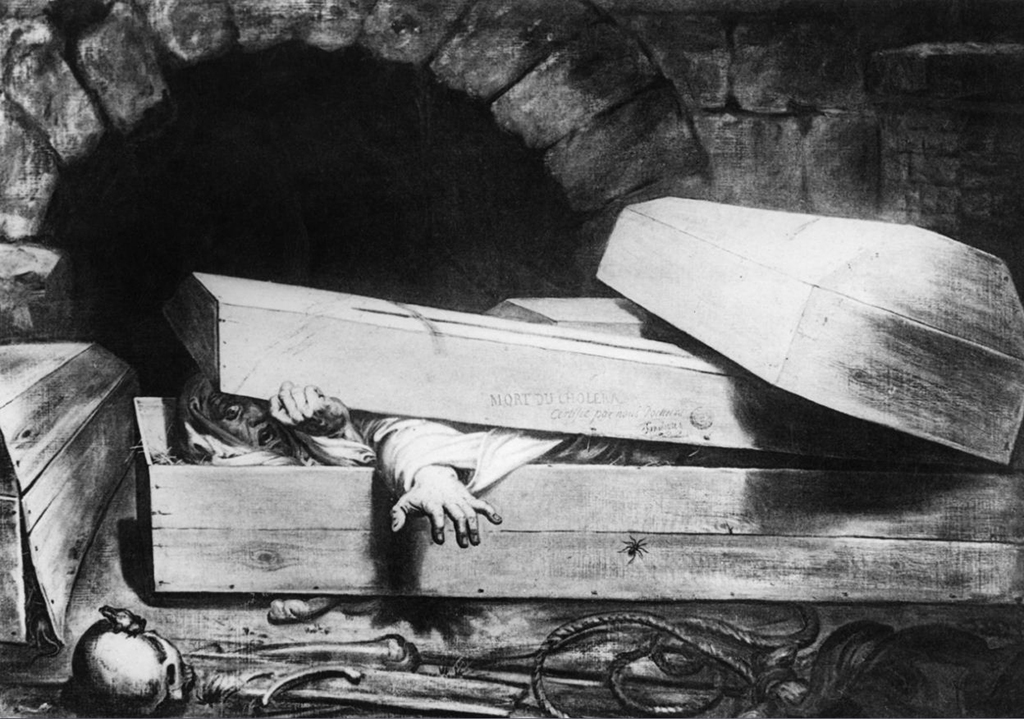
The idea of being interred alive is one of humans’ most primal and unspeakable fears, though its common recurrence in legend and literature betrays a helpless fascination as well. There is probably no way to ever discern how many unfortunate people throughout history have fallen victim to this gruesome fate; it’s likely that the numbers swelled during plagues and other epidemics of disease, as bodies were hurriedly placed into mass graves to forestall contagion. Whatever the actual numbers, it is certain that the problem was clearly widespread enough to cause some societies to take unusual precautions.
Bruhier and the Uncertainty of Death
Debates about the exact moment when a person made the transition between life and death had been raging at least since the days of Pliny, with many criteria being used to determine the difference between a dead body and a living one. But the possibility that fallible medical professionals or family members might mistakenly bury someone who was still alive didn’t fully capture the public’s imagination until the 1745 publication of a book called Dissertation sur l’incertitude des signes de la mort by Jean-Jacques Bruhier.
The book was a translation and expansion upon the work of a Dutch anatomist named Jacob Winsløw, who recommended a series of tests on supposed corpses — blowing pepper into the nostrils, shoving red-hot pokers up the anus, slicing the soles of the feet with a razor — to ensure death before burial. Bruhier’s book repeated these ideas, but also added scores of grim, sordid accounts of premature burials — some well-documented, some repetitions of long-lived folk tales. Additionally, Bruhier took Winsløw’s calls for burial reform even further, arguing that putrefaction was the only sure sign of death, and advocating for a system of “waiting morgues” where bodies could be kept above ground until they began to rot.
The Germans Build the Morgues
Though Bruhier’s ideas were never implemented in France for one reason or another, the massive success of the book ensured a series of translations, including a German one in 1754. This book, along with a similarly themed tome by another Frenchman, François Thiérry, was taken very seriously, discussed at length among German doctors and intellectuals. Beginning in the early 1790s in Weimar, at the behest of influential physician Christoph Wilhelm Hufeland, plans began to percolate to construct a Totenhaus, or house for the dead, in every German town.
These first waiting mortuaries were large, stately affairs. Corpses (or supposed corpses) were laid out in their shrouds, watched over by attendants who stared through windows, waiting for any signs of life. The attendants often worked 12-hour shifts amid the pungent stench of rotting flesh, and were not allowed to move from their posts. In addition, each corpse was fitted with a series of strings attached to fingers and toes; the strings all led to a central alarm bell which would ring at the slightest movement. Unfortunately the gases from the putrefying bodies were often sufficient to set off the bell, and there were countless false alarms.
Waiting Morgues Spread Throughout Germany
Throughout the following decades, interest in premature burial was high, and more of these waiting mortuaries were built around the country — Ansbach, Munich, Frankfurt, Berlin. Their architecture became ever more elaborate, with classical columns and marble façades that would rival any church or mausoleum. Many of the mortuaries had separate, fancier chambers for the wealthier corpses, and later morgues upgraded their alarms with ingenious clockwork mechanisms and electric buzzers. The morgues also became something of an odd tourist attraction, even visited by literary luminaries like Wilkie Collins and Mark Twain.
The Heyday for Waiting Morgues Passes
Though similar institutions were established in Copenhagen, Prague, Lisbon, and New York, and though a few of the morgues were still operating in Brussels and Amsterdam as late as the 1870s, Germany remained the center of the waiting mortuary phenomenon. But even there the enthusiasm soon began to wane. For one thing, though the morgues were applauded for their philanthropic aspects, the fact was that few citizens actually wanted to install their loved ones in such places, and some morgues had to close for lack of “customers.” In addition, there was never any solid evidence that any corpse had ever revived after a stint in the mortuary; critics questioned the tremendous expense on something which seemed so unnecessary.
Finally, by the mid-nineteenth century, better medical instruments like the stethoscope were coming into common use, making determination of death easier. Besides that, there was also a slowly evolving movement away from unsanitary “communal” death houses and toward more individualistic inventions like “security coffins” outfitted with air tubes, lock-and-key mechanisms, firecrackers, bells, flags, and sirens.
Source:
Bondeson, Jan (2001). Buried Alive: The Terrifying History of Our Most Primal Fear. W.W. Norton & Co., Inc. ISBN: 039332222X.
A Brief History of the Giallo Film
Born of the pulp crime novels of the 1930s, the giallo came into its own on screen, culminating in classic films from legendary Italian directors. The original article I wrote can be found here.

An American writer is walking the streets of Rome one night when he passes an art gallery with enormous glass doors. Peering inside, he is shocked to see a woman struggling with a black-clad figure holding a knife. The writer rushes to help, but when he passes through the first door of the gallery, it closes and locks behind him, while the second glass door before him will not open at all. Trapped in the space between the glass panels, he can only watch in helpless horror as the black-gloved killer plunges the knife into the woman’s body.
This opening scene is taken from an early example of the giallo film genre, Dario Argento’s The Bird With the Crystal Plumage (1970), which was loosely based on Frederic Brown’s 1950 pulp novel The Screaming Mimi. Giallo as a film style began roughly around 1963; though aspects of the stories and themes emerged from pulp novels, filmmakers were quick to add their own ingredients to the mix.
The Origins of the Giallo
Giallo is the Italian word for yellow, which was the predominant color on the covers of the pulp crime novels published by Mondadori, starting in 1929. Following their success, other publishing houses began getting into the act, starting their own lines of cheap mystery novels with yellow covers. These were so popular during the 1930s that the word ‘giallo’ became synonymous with crime and mystery fiction.
The First Giallo Films
It soon became apparent that the medium of film could be used to add interesting elements to the straightforward crime stories from the novels. Taking several pages from Alfred Hitchcock’s playbook and spicing things up with elements of eroticism, horror, and madness, legendary director Mario Bava made what is generally considered the first giallo film, 1963’s The Girl Who Knew Too Much. The plot revolves around a murder witness who is tormented by an important detail that she can’t quite remember. The following year, Bava followed with the now-classic giallo, Blood and Black Lace (known in Italy as Sei Donne Per L’Assassino, or Six Women for an Assassin), which featured a masked and gloved killer stalking the catty and underdressed models at an upscale fashion house. By this point, the particular tropes of the giallo were becoming de rigueur, and the early 1970s saw a flood of films that displayed variations on the theme.
Conventions of the Giallo Film
Films designated as giallo are usually murder mysteries, but they have many features that distinguish them from straightforward crime stories or police procedurals (which are known in Italy by a different name, Poliziotteschi). First of all, the murders that occur in gialli are often grotesque and horrific, and are filmed in artful, operatic, or even disturbingly erotic ways, with much spilling of blood. The killer in the 1972 film What Have You Done to Solange?, for example, dispatches his usually nude victims by plunging knives into their vaginas.
In addition, the structure of the films is often baroque, and sometimes contains dreamlike imagery. The killer almost always wears black leather gloves and usually a black trenchcoat or raincoat. The weapon of choice is nearly always a shiny and suitably phallic knife. A giallo’s plot often deals with an unlucky person who witnesses a crime and then spends the remainder of the film struggling to remember some aspect of the scene that they have forgotten or cannot make sense of. The psychological motivations of the killer nearly always have to do with madness or revenge triggered by childhood traumas, lending gialli a hint of gothic horror in juxtaposition to the more modern slasher-type violence that is usually featured. Finally, the films generally have a Grand Guignol feel, and tend to have bombastic or unusual film scores containing free jazz or prog-rock, for example.
Examples of the Giallo Genre
Genre pioneer Mario Bava, in addition to his first two gialli, made two other films in this line, 1970’s Five Dolls for an August Moon and the 1971 classic Twitch of the Death Nerve. Dario Argento has returned to giallo perhaps more than any other director, turning out films like The Cat O’Nine Tails (1971), Four Flies on Grey Velvet (1971), Deep Red (aka Profondo Rosso, 1975), Tenebrae (1982), and Giallo (2010).
Lucio Fulci, a cult figure in America for his grisly zombie films, made movies in nearly every imaginable genre, and giallo was no exception; his psychedelic Lizard in a Woman’s Skin was released in 1971, and was followed by 1972’s Don’t Torture a Duckling, the understated mystery The Psychic (aka Murder to the Tune of Seven Black Notes, 1977), and 1982’s New York Ripper. Other directors who tried their hand include Umberto Lenzi (Knife of Ice, 1972; Eyeball, 1974), Michele Soavi (Deliria, 1987), and Pupi Avati (The House With Laughing Windows, 1976).
Sources:
Palmerini, Luca M. & Gaetano Mistretta (1996). Spaghetti Nightmares: Italian Fantasy-Horrors As Seen Through the Eyes of Their Protagonists. Fantasma Books. ISBN: 0963498274.
McDonagh, Maitland (1991). Broken Mirrors Broken Minds: The Dark Dreams of Dario Argento. Sun Tavern Fields. ISBN: 095170124x
Victorian Spirit Photography
To a public entranced by the seeming magic of photography, capturing ghosts on film was par for the course. The original article I wrote is here.
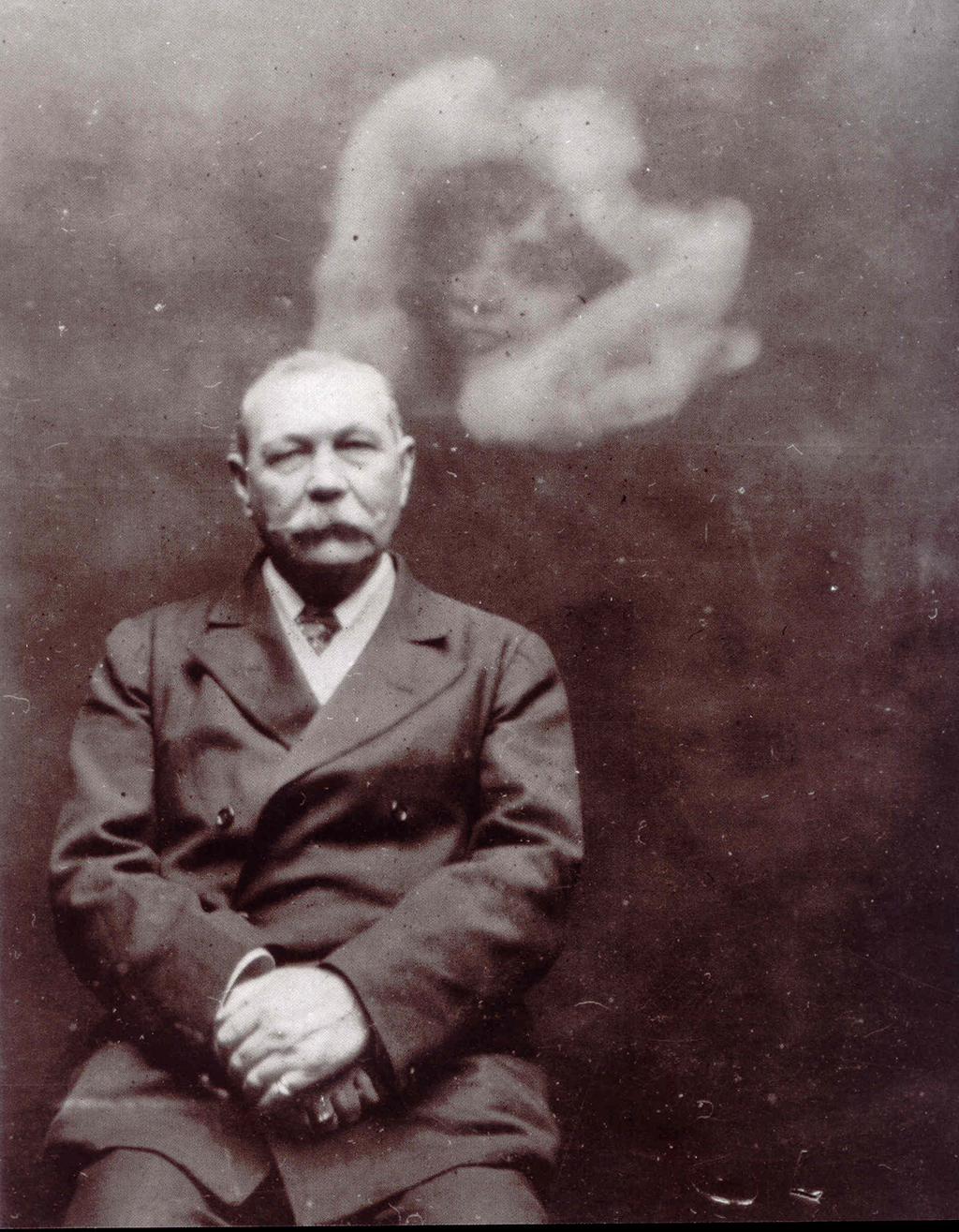
It seems hard to imagine in this modern era of ubiquitous digital photography and cheap photo manipulation software, when creating a picture of a ghost (or anything else) is as simple as clicking a mouse; but to the Victorians, the realism of the photographic image seemed incredible and, somewhat ironically, rather mystical. The art of photography was to them a way to miraculously stop time, to forever embed memory in concrete form. Given this perception, it was probably inevitable that people of the era would initiate not only a demand for photographs of corpses, but also a brisk trade in supposed pictures of the spirits of the dead.
Louis Daguerre and Early Photography
Photography as a medium grew out of scientific experimentation in optics and chemistry. The earliest photographic images were made by placing objects (such as plants or fossils) onto light sensitive paper and then exposing the paper to the sun. William Henry Fox Talbot produced the first examples of these, and later Louis J.M. Daguerre experimented with similar images before going on to develop the “daguerreotype,” the forerunner of the modern photograph.
Because of the nature of early photography — passive camera operators, long exposure times — it was widely felt that a photographic image was a completely objective record, untainted by human bias. Additionally, Eadweard Muybridge’s famous photographic series of a galloping horse demonstrated that the flat, uninvolved gaze of the camera could capture things the human eye could not see; in the case of the horse, this proved to be the fact that all four of the horse’s hooves were off the ground simultaneously at some point during the gallop. These two aspects of the new technology — both its supposed scientific inviolability and its ability to freeze images invisible to the human eye — contributed to its use in the sciences as well as among adherents of the new religion of Spiritualism.
Spiritualism, Seances, and Photographing Ghosts
The rise of Spiritualism in the 19th century coincided with the waning of traditional religious belief and the flowering of the Enlightenment, when people began to realize that science could be used as a tool to solve problems that had vexed humanity for millennia. Spiritualists, even while they attempted to speak to the dead at seances and shrouded themselves in paranormal trappings, saw themselves in a decidedly scientific light. They reasoned that since science had uncovered and explained invisible “forces” animating the universe — electricity, magnetism — science would also soon explain “life forces” that survived the body after death. Photography played a large part in their supposed “experiments” aiming to prove the existence of ghosts.
Early photographers were of course aware of the faint ghostly images produced when the subject of the photograph moved while the plate was being exposed. It isn’t clear who was the first photographer to use this quirk as a means to make spirit photographs, but one of the most famous was William Mumler, who in 1861 began producing spirit photographs in his Boston studio. Likely using double exposures and various other tricks, Mumler made quite a comfortable living taking pictures of grieving sitters with ethereal friends and relatives hovering nearby. He even took the infamous photograph of Mary Todd Lincoln in which the supposed spirit of her assassinated husband stands behind her with his hands resting on her shoulders.
Mumler’s fame was so widespread that he soon came under scrutiny from authorities, who eventually charged him with fraud — not because his pictures were not really of ghosts, which of course they weren’t, but because the blurred images of the “spirits” in the photographs were not usually recognizable as the friend or relative of the living sitter.
Photographic Fakes and the Culture of Mourning
While the Victorians were quick to accept the reality of the spirits in the photographs, believing as they did that photography was resistant to human manipulation, the truth is that the pictures were fakes, in most cases rather clumsy fakes. Like that other Spiritualist trope, the seance, which was performed through cunning trickery and hidden accomplices, spirit photography stood as a testament to creative fraud, an attempt to bolster people’s deeply held beliefs through managing their perceptions of reality. The culture of death and mourning prevalent in the Victorian era combined with a new attachment to the objectivity of the scientific method produced a strange hybrid of materialism and metaphysics whose reverberations can still be felt to the present day.
Source:
Firenze, Paul. “Spirit Photography: How Early Spiritualists Tried to Save Religion by Using Science.” Skeptic. Vol 11 No 2. 2004: 70-78.
Edgar Allan Poe and the Murder of Mary Rogers

This is an article I wrote a while back about the real case that Poe used as an inspiration for his story, “The Mystery of Marie Rogêt.” The original article appeared here.
Tragic American scribe Edgar Allan Poe, while most popular today for his gruesome horror stories, in fact wrote successfully in many genres and is generally credited with pioneering the modern detective story through the invention of his fictional sleuth, C. Auguste Dupin.
Several of Poe’s stories were partly based on true events, but one of the most intriguing examples was the detective story “The Mystery of Marie Rogêt,” inspired by the brutal 1841 rape and murder of a pretty twenty-year-old woman in New York City. There has been rampant speculation as to what happened to Mary Cecilia Rogers, the “real” Marie Rogêt, but even now, almost 170 years after her death, her killer remains unidentified.
The Disappearance of Mary Rogers
It was on the morning of Sunday, July 25, 1841 that twenty-year-old Mary Cecilia Rogers told her fiancé Daniel Payne that she was going uptown to visit her aunt. Mary, by all accounts a stunningly beautiful young woman, was clad in a white dress with a black shawl and a blue silk scarf, her black hair tucked under a flowered hat. Daniel Payne agreed to meet Mary at the omnibus station when she returned from her aunt’s house later that evening. But Mary Rogers would never be coming back.
Payne, alarmed when Mary had not returned by Monday, placed a missing persons ad that ran in Tuesday’s New York Sun. Upon hearing of Mary’s disappearance, a former sweetheart named Alfred Crommelin also joined the search. It was Crommelin who, on Wednesday the 28th, saw the commotion around the Hudson river, where a woman’s body had been pulled from the water. Crommelin initially identified Mary by the presence of a birthmark on her arm — the face was too battered for easy recognition — and Mary’s mother later identified the clothing the girl had been wearing when she’d last been seen alive.
An Unlikely Drowning and a Range of Suspects
In the early stages of the investigation, it was thought that Mary Rogers had simply drowned, but even a peremptory examination of the body demonstrated that Mary had obviously been dead before going into the water, which of course pointed to murder. Payne and Crommelin were naturally questioned, though both had unimpeachable alibis, as did Mary’s former employer, tobacconist John Anderson, and all of her other friends and fellow residents at the boarding house where she lived. In the absence of a clear suspect, rumors began to circulate almost immediately.
A Clandestine Abortion
One of the most insidious of these was that Mary had died either during or shortly after a botched abortion, and had been disposed of to cover it up. This tenacious rumor was based on the alleged confession of a tavern keeper who had supposedly seen Mary in the presence of a physician and knew that the abortion had been performed in his tavern. The “confession” turned out to be completely fabricated, but the abortion story not only turned up in a later revision of Poe’s fictional account of the crime, “The Mystery of Marie Rogêt,” but continued to be repeated as truth in several books about the murder, right up into the modern day. It was also apparently a factor in abortion becoming criminalized in New York State in 1845.
The Suicide of Daniel Payne
Though Payne was quickly dismissed as a suspect, new stories began swirling about his involvement after he took his own life in October of 1841, by taking an overdose of laudanum. A cryptic suicide note was found in his pocket that some interpreted as a confession, but the note could also be read as simply a statement of grief, an unwillingness to go on living after Mary’s death. Indeed, Payne’s friends claimed he had been inconsolable after the murder, and were not terribly surprised that he would take such drastic action.
Who Really Killed Mary Rogers?
It was clear that someone had murdered the girl, but the mystery of who had done it was becoming murkier. In Poe’s story, the killer is thought to be a naval officer, perhaps the fictional counterpart to Mary’s real-life fellow boarder, sailor William Kiekuck, who was questioned about the crime but had a solid alibi. There was also speculation that Mary had been set upon by a gang; initial autopsy reports stated that Mary had been “violated by more than two or three persons,” though later investigation suggested otherwise.
In a recent article in Skeptical Inquirer, Joe Nickell analyzed the many books and articles written about the unsolved murder, and also went back to revisit contemporary news stories and police reports. His conclusion, also reached by other scholars, was that Mary was likely raped and killed by a single assailant, an unidentified “swarthy” man who a few witnesses saw walking with her shortly before her disappearance.
She was raped and then strangled with a piece of lace trim; her unknown murderer then tore a strip from her petticoat and used it to fashion a sort of sling which he used to drag the body to the river (this fact alone casts doubt on the gang-rape theory, as a group of men could have easily carried the body). Whoever he was, the man who killed Mary Rogers evidently got away with his crime. Mary herself lives on in the pages of Poe’s masterful fiction.
Source:
Nickell, Joe. “Historical Whodunit: Spiritualists, Poe, and the Real ‘Marie Rogêt'”. Skeptical Inquirer July/August 2010: 45-49.
Excerpt from “Bluebottle”

When the next day passed with no sign of The God Who Brings Rain, and then the next day, Monarch knew it was time for him and his subjects to take definitive action. The butterflies were growing weak from lack of water, and some of them could barely keep their heads up as Monarch addressed them from his flower. He knew that even if they chose to move to another garden now, some of them would not make it.
As he finished his speech, in which he outlined the plan for the exodus, Monarch happened to glance down into the soil. The beetles were gathered there in their numbers, carapaces shimmering in the sun. The head beetle, the one who had found the orphaned worm, stepped forward and spoke. “We would like to be included in any plans you have for relocation,” she said, her tiny voice almost lost, coming from so far below. “Surely there is another garden nearby where The God Who Brings Rain will see fit to be more generous.”
“You will only slow us down,” Monarch said, fluttering his wings as if to remind them of his superior attributes. “You can make your own way, if you wish to.”
“But you can scout farther ahead, tell us where to go,” the beetle protested, but already Monarch was tuning her out. He turned to the other butterflies and signaled them for takeoff.
But just at that moment, a curious buzzing was heard coming across the garden, from where The God Who Brings Rain had last been seen. Monarch looked around, confused and hopeful, but then he saw that it was just that creature, the horrid one he had raised, thinking it would be a princess someday. He couldn’t believe he’d ever actually thought anything good could have come from that detestable little grub. “What are you doing back here?” he shouted with all the scorn he could muster.
The little creature hovered, clear wings flapping so quickly that they were nearly invisible. “I don’t know where else to go,” came the plaintive reply. “I am not at home here, but all that I found beyond the garden was a lonely plain with none of my kind to be seen. Out there is only a large pale creature who lies on the grass, as still as death.”
“We have our own problems here, as you can see,” Monarch said testily.
The head beetle was waving frantically with her black legs as Monarch talked, as though trying to get his attention. When he finally deigned to give it, the beetle spoke with breathless rapidity. “The worms we saw crawling on The God Who Brings Rain were not his pets at all,” the beetle cried. “They killed him! Surely they did! Isn’t it true that The God Who Brings Rain has not been seen since we brought this creature here?”
“Yes, that’s true,” Monarch answered, glancing sidelong at the other butterflies.
“She and her kind killed The God Who Brings Rain, with the sole intention of ridding us of our water supply! It all makes sense!” The beetles around her were chattering their agreement, and some of the butterflies seemed to be picking up on the mood of the crowd.
“What have you to say for yourself?” Monarch asked the tiny creature pointedly.
“Please! I don’t know what you all are talking about,” the ugly outcast said. “All I remember is coming out of my cocoon and seeing all of you around me. I bear you no ill will.”
“Then what have you done to The God Who Brings Rain?” the beetle demanded.
“Nothing! I don’t know!” The little creature was frantic, her wings beating the air so hard that the flower petals around her danced crazily.
“We cannot let something like this go unpunished,” Monarch intoned. He signaled to the other butterflies, who immediately took to the air and surrounded the buzzing little murderer. They closed in, gripping her minuscule legs with their much larger ones, barring her escape with their massive and gaily colored wings. Monarch watched her as she struggled, eyes wild with fear. “We will take her to the sill, where we take all enemies of our kind,” he said. “Perhaps this act will purify the garden, and return us to favor with The God Who Brings Rain, so that we may remain in this place that has always been our home.”
The insects were all in agreement, and moving slowly as befitted the solemnity of the occasion, they began the short journey to the residence of The God Who Brings Rain, which was a wooden shed at the north edge of the garden, a shed with a large open window and a smooth white sill.
Red Menace Coming Soon

A Brief Self-Promotional Interlude
Reptilian Reminiscence

He was about ten inches long; powder blue, and covered in gaudy orange polka dots. His eyes were round and yellow and lidless. His name was Crispin; he wasn’t named after quirky character actor Crispin Glover, as you might think, but rather after Crispin Sasserach, a character in an obscure Nugent Barker horror story, who ran a tavern and made soup out of the flesh of wandering travelers. An apt handle, though I didn’t realize it at the time.
I first saw him clinging to the glass in a flea market pet stall, the overlapping lamellae on his tiny feet pressed adorably flat, his tongue flicking lazily over his eyeball in what I interpreted as a come hither gesture. He could be had for the laughably reasonable price of fifteen dollars, and after successfully begging my father for the money, I took possession, carrying my new little companion home in a clear plastic box with a black lid.
The Tokay gecko, according to Wikipedia, is the second largest of all gecko species, and originally hails from the rainforests of southeast Asia. Another amusing tidbit mentioned therein is that Tokays are known as the pit bulls of the gecko world, though Wikipedia was unclear on whether other gecko species gave them that distinction, perhaps out of misplaced jealousy.
Our relationship was rocky from the start. As soon as I got Crispin home, I reached into his tank to stroke his beautiful blue scales, and he promptly latched on to my finger with his wide, bony jaws and refused to let go. Love hurts, as I believe more than one wise person has pointed out. In a panic, I shook my hand so hard that I flung the hapless lizard across the room and against the far wall. He dropped to the floor unhurt and then stood there staring at me with his slit-pupiled eyes, an obvious challenge displayed in his short-legged stance. For a long time everyone stood around a little uncomfortably, unwilling to pick up the gauntlet this wee little reptile had thrown down, but at last between me and my nerve-wracked family members we managed to herd Crispin back into his box, and then vowed that no one would try to touch him ever again.
After the first few difficult days, Crispin and I settled into an uneasy routine. I would reach into the small tank adjoining his and pull out a handful of live crickets, which I would then very gingerly deposit into his inner sanctum, hoping I would be able to pull my defenseless hand free before he clamped down on it in unbridled rage. Crickets were his favorite food; he liked the challenge of following their quick, fitful movements with his golden eyes and then darting in for the kill, faster than the human eye could process. I had read that Tokays liked to eat mealworms as well, so I kept a supply of them on hand for variety, but more often than not I would find their dried up and uneaten carcasses in the bottom of his tank weeks later. Evidently he wasn’t interested in the slow and the steadfast; he only wanted the nimble ones you had to chase.
Crispin and I were together for the better part of a year, and though I cared for him faithfully and developed a deep and abiding love for him that still tugs at my heart to this very day, he never showed the slightest bit of appreciation, let alone affection of any sort. His initial bitey phase passed once his feeding schedule was established, though every now and then he would still lunge at me just to show who was boss. Mostly he just sat on his heat rock and licked his eyeballs scornfully, and regarded me with a stoic tolerance laced with burning resentment. When at long last I had to sell him to a pet store because I was moving overseas, I cried bitterly for a week, thinking often of his tiny blue triangular head tilting to watch me as I left him behind forever. Anthropomorphization, I knew; Crispin cared nothing for me at all, would not miss me as I missed him, would not dream of me from the cramped empty tank in the darkened pet store where I had abandoned him. He was simply the taker, and I the giver.
I realize now that this was my first experience with loving an impossibly reptilian creature who was incapable of loving me in return. And of course, naturally, it would not be the last.
The Severed Feet Dream

This is a very vivid dream I had a few months ago that I’d like to somehow turn into a story one day.
The first thing I remember, it was night and I was in bed with Tom and we were half asleep, though we weren’t in our house. We were in some kind of boarding house or off-campus housing, because I knew there were lots of other people living in the house as well. It was dark, but I could see a TV flickering; I don’t remember if it was in the same room as us or if it was in an adjacent room that I could see through the open door. I lifted my head up a little and looked at the TV. There was a woman on the TV talking, though the volume was muted. There was a guy standing in front of the TV, just a couple feet from it, staring at the screen. He was talking to the woman on the TV like she was a real person, and he was just saying all these horrible violent things he was going to do to her. His voice was getting louder and the stuff he was saying was getting more vile, and I was starting to wig out. I scooted closer to Tom and said in his ear, “I’m scared.” Tom told me that it was okay, that there was nothing to be scared of.
Then, for some bizarre reason, I decided that I had to get up and go down to the kitchen to wash the dishes, even though it was the middle of the night (WTF?). In the dream, I remembered that earlier there had been some excitement at a house nearby, with cops there and stuff, and everyone in our house had been looking out the windows trying to see what was going on. I got to the kitchen and there was a girl there; I couldn’t see her, she was just a tall black shape, but she was leaning against the counter in the dark. In the dream I knew who she was, and I also knew she didn’t like me at all, so I was nervous about her being there, but I just nodded at her and went over to the sink. While I was washing the silverware, she started moving around behind me, and I was glancing over my shoulder, thinking, “What is she doing back there?” But all she did was go to a window and peer out through the blinds, checking on the action at the neighbors’. I tried to make small talk, like, “Wonder what that’s all about,” but she just went, “Hm,” and then left. I never could see her, she was just a shadow.
The kitchen sink was on a bar that faced the living room. There was moonlight and light from the other houses, so I could clearly see the front door and the Oriental rug on the living room floor. I could also see through the front windows that there was a party going on at the house across the street; people were standing outside talking, with drinks in their hands.
The front door opened and a guy and girl came in, laughing and grabbing at each other. They left the front door open, and then sat down on the floor and started goofing off and making out. I didn’t know if they could see me, or if they just didn’t give a shit. The girl took her shirt off, though her jeans were still on; the guy stayed dressed. I could only see him from the back; he was preppily dressed, wearing jeans and a button-up shirt in a pale blue color. I was just standing there washing dishes, wondering if they could see me.
Suddenly the guy grabbed the girl’s ankles and pulled her legs apart and up off the floor. She started to cry like he was hurting her, and I thought that I should help her, but I was frozen to the spot. Then he started pulling and squeezing really, really hard around her ankles, and as stupid as it was, I thought, “Holy fuck, he’s going to pull her feet off.” And then, yeah, he ripped her feet off at the ankles. There wasn’t much blood, but I could hear the feet thump as they hit the rug. And I was still standing there, just shocked and horrified and unable to move.
And then the guy got up and whipped around and grabbed my wrist, hard. I was holding a butter knife that I’d been washing, and I saw the blade press into his palm, though of course it didn’t hurt him. I stared into his face, which was really wide, with wide-set blue eyes. He also had shoulder-length blond hair that was swept up and back off his forehead. He gave me this horrible grin, and then with his other hand he grabbed my elbow and started to twist my arm, like was going to tear my arm off. In panic I just kicked out at him, which in real life wouldn’t have worked because the kitchen bar was between us, but at any rate my leg thrashed violently and I woke up to Tom (who was still awake next to me) saying, “Hey. Did a flea bite you or something? You kinda kicked me.” And I said no, that I had a nightmare. He asked what it was about, and I didn’t feel like explaining it just then, so I said, “Some guy was trying to kill me.” And then Tom asked what he looked like (maybe so he could find the guy in one of his own dreams and kick his ass? I dunno, haha) and again, I didn’t feel like going into it because I was freaked out, so I just said I didn’t know. And then, kinda like at the start of the dream, Tom said (in real life), “It’s okay. No one’s trying to kill you.”
I couldn’t fall asleep for ages after that.

