
gothic
The Goddess’s Favorite Creepy Movie Scenes, or Nothin’ Says Lovin’ Like Somethin’ from the Coven
Witches are badass, let’s just agree on that right out of the gate. Especially the old, scary, haggy ones that mix potions by moonlight and smooch the devil’s butt and turn people into toads and shit. They are the ultimate expression of unlimited female power, a fantasy representation of the point at which a woman no longer gives a fuck, refuses to put up with anyone’s crap, and decides to just plague her enemies with suppurating boils. Despite witches’ obvious excellence, however, I feel as though they’re a sort of under-utilized baddie in recent horror movies. I briefly survey the horror landscape and see it littered with countless shambling zombies, vampires both sparkly and otherwise, and big bad werewolves, but witches…not so much, especially if you’re discounting “sexy” witches and Wiccans, which I am because they aren’t scary. I was actually so distraught by the lack of old-school witchy shenanigans in recent horror that I decided to make a small, insignificant contribution toward their little image problem by writing a novel called Red Menace (out October 1st) that features some of that wicked witchcraft that I love so much and never see enough of. There are withered old crones! Spells! Glamours! Also, some serial murder, if you’re into that! Okay, plug over, let’s get on with today’s scene!

Just kidding, one more little plug. Buy my book! Or, y’know, I’ll curse your livestock and make you have three-headed babies.
Let’s talk about Dario “Italian Hitchcock” Argento, shall we? Specifically, let’s talk about him when he was still collaborating with Daria Nicolodi and making beautiful, surreal, violent, and kick-ass horror and giallo films, and let’s not talk about his more recent output because it just makes me sad (do not think of The Card Player, repeat, DO NOT THINK OF THE CARD PLAYER). Back in that mythical time known as “the day,” Argento couldn’t put a foot wrong: The Bird With the Crystal Plumage, The Cat O’Nine Tails, Four Flies on Grey Velvet, Deep Red, Opera, Tenebrae…all fantastic shit. But because I opened with witches, you guys know what movie I’m gonna be talking about, right? Of course you do.
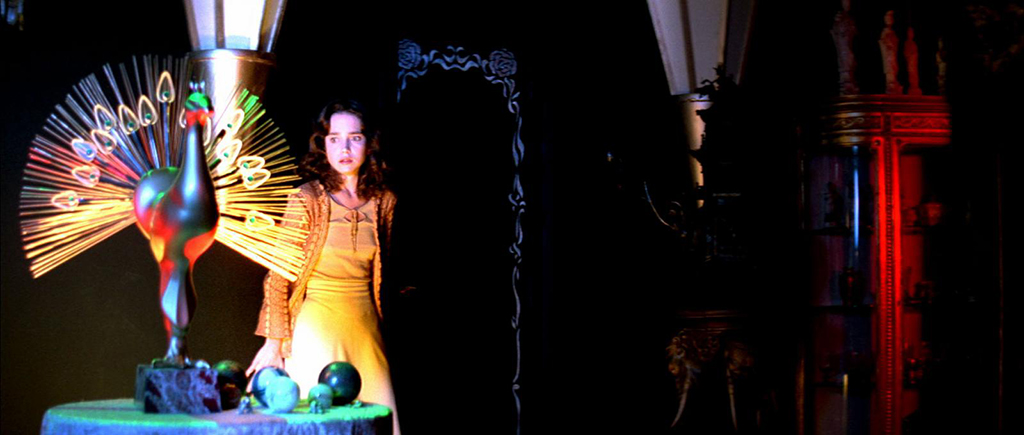
This one. This gorgeous bastard right here.
Suspiria (1977) was the first film in Argento’s “Three Mothers” trilogy, loosely based upon Thomas De Quincey’s Suspiria de Profundis. The other two films were the excellent Inferno (1980) and the massively disappointing Mother of Tears (2007). Basically, the mythology behind the trilogy is that of three dreadful witches (Mater Suspiriorum, Mater Tenebrarum, and Mater Lachrymarum) who get up to all sorts of worldwide evil from their bases in Rome, Freiburg, and New York; the films sort of take the mythos in three different directions, though, so they actually stand very well as individual movies. Suspiria is the nightmarish tale of an American ballet student, Suzy Bannion (Jessica Harper) who travels to an elite dance school in Freiburg, Germany and slowly discovers that it’s a front for an evil coven of witches, headed by the terrifying Helena Markos, the Mother of Sighs.
First off, I have to say that Suspiria is probably one of the world’s most beautiful films to look at. Argento not only shot the spectacular set in super-saturated hues and utilized special lenses and light filters, but he also used the same unusual Technicolor process that was used for The Wizard of Oz. Every frame of the film is like a strikingly composed light painting of a particularly gruesome fairy tale, with stark shadows and garish shafts of red, blue, green, and yellow light falling across the baroque and hyper-violent murder tableaus. I mean, just check out some of these stills:
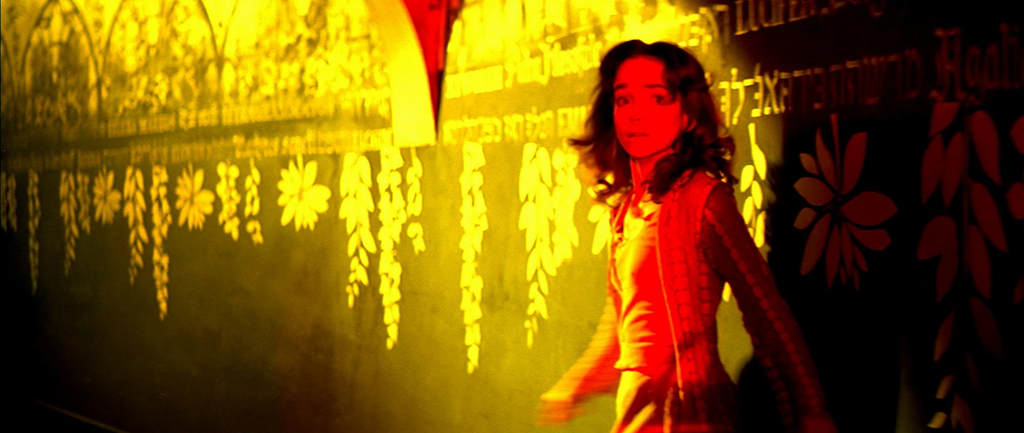
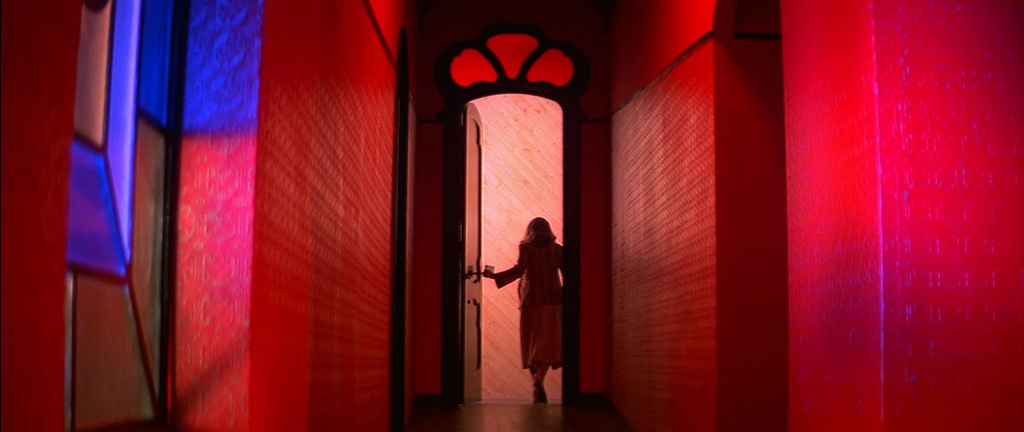

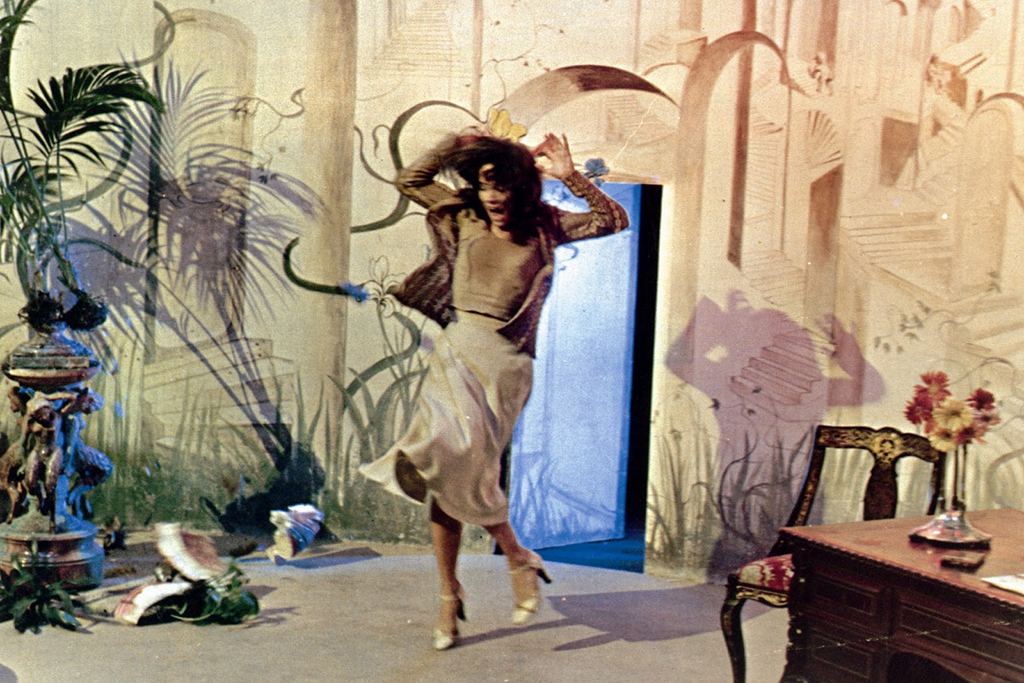

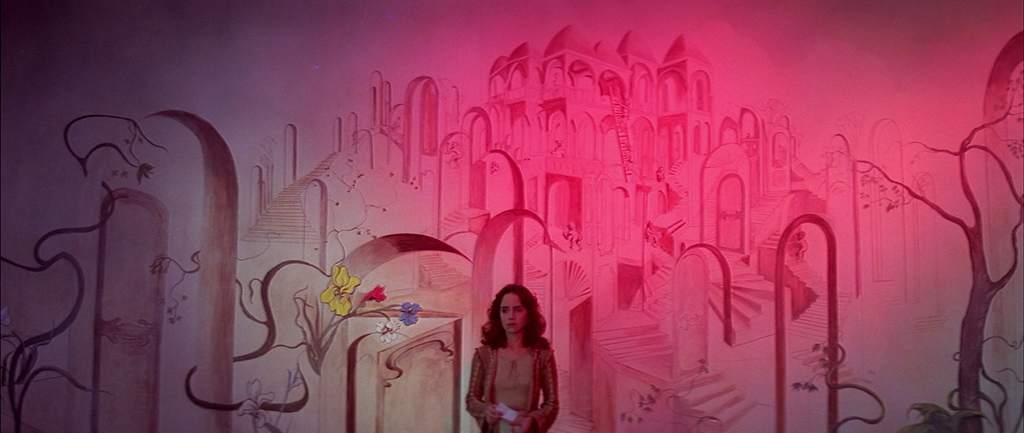
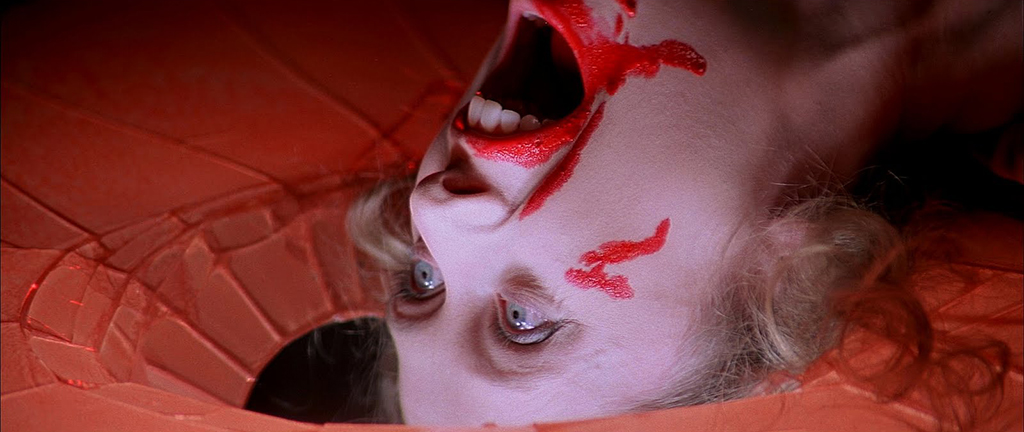
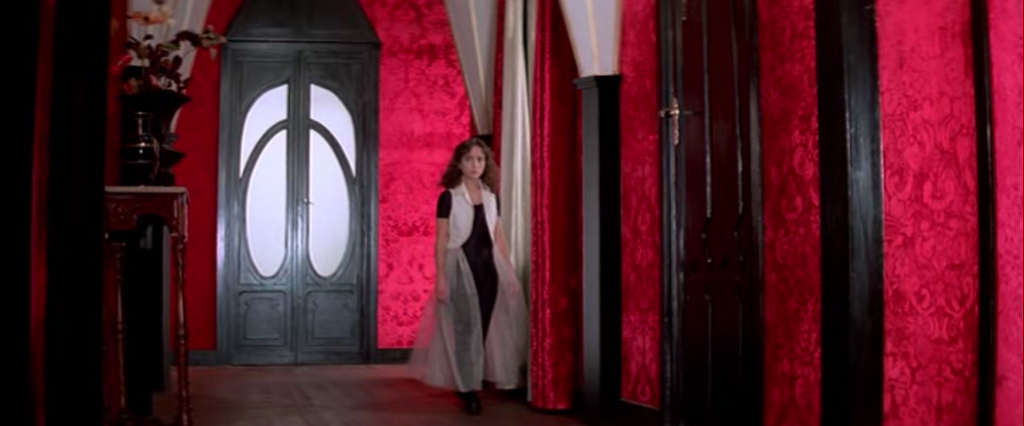
We get it, movie. You’re pretty.
I mean, that is so splendid that it’s almost ridiculous. Fun personal fact: in the house I used to live in, I took great care in decorating the whole space in a Suspiria theme. Every room was painted a different, dark, saturated color, and all the doors were painted black with red art-nouveau-style insets, just like in the movie. It looked wicked cool, and even though I had to leave the house behind, I still have fond memories of my one and only attempt at free-reign interior design.
Anyway, on to the scene. There are actually two scenes from Suspiria that are usually called out on various “scariest scene” lists, both of which are suitably amazing. The first is that tense, dynamite opener where Suzy is first arriving at the school in a torrential downpour, intercut with the grisly murder of expelled student Pat Hingle (Eva Axén). The other scene, fittingly, is the closing one, where Suzy finally confronts the ghastly figure of Helena Markos (as well as the reanimated corpse of murdered student Sarah, played by Stefania Casini) and kills her with a beautiful, glass peacock-feather spike. Italian killings are clearly far more elegant and aesthetically pleasing than other kinds of killings, you see.
But true to the spirit of this blog series, I’d like to discuss a lesser-recognized scene that had that subtle, unsettling vibe that I’m so fond of, particularly as it appears in a film as over-the-top operatic as this one. In the scene, the catty ballet students have just been subjected to a literal rain of maggots in their respective quarters, which is probably like the last thing you’d expect to happen at one of the most snooty and elitist ballet schools on the planet. The teachers and staff (read: witches, you guys, they’re all witches) are all like, NBD, there was just some rotten food stored in boxes up in the attic or something, that’s all, and the maggots just squirmed out through the cracks in the ceiling and kinda ruined everyone’s day. It’s all cool, tho.

It’s raining maggots, hallelujah.
While the students’ rooms are being de-grubbed, the staff set up an impromptu dorm in the practice hall, with rows and rows of fold-out beds, and the girls and boys separated by high white curtains. All the women are getting into their beds and trying to make the best of things, saying it’ll be just like camp. One of the heads of the academy, the sternly efficient Madame Blanc (Joan Bennett), walks through the dorm to make sure everyone is comfortable. One of the students asks if the teachers will all be sleeping in the dorm too, to which Madame Blanc replies that all of them certainly will be, except for the directress, of course. Then Madame asks if it’s all right if she turns the lights out. She disappears behind one of the curtained walls, and immediately the whole space is plunged into a saturated, blood-red dimness, like a photographic darkroom.
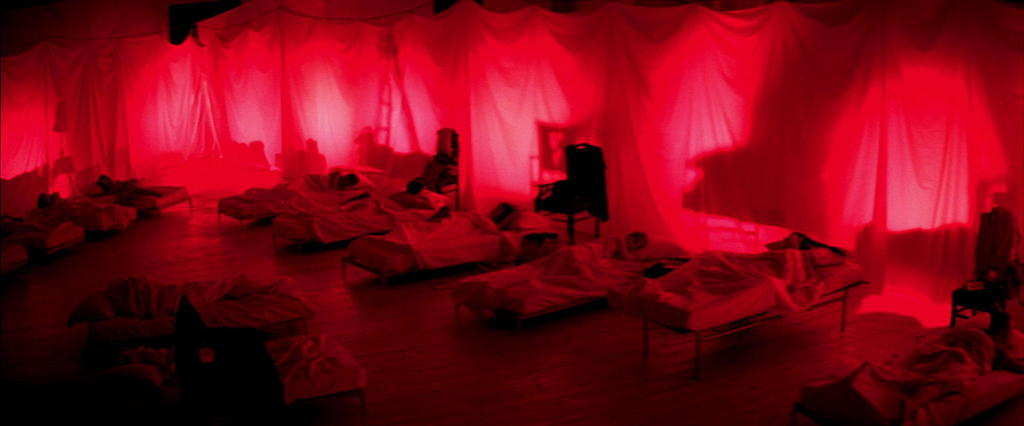
Let’s just see what develops. (I know, boooooo.)
There is some banter and chicanery, as one of the male students climbs up to say hello from the other side of the curtain, and then the students settle into bed and begin gossiping and arguing until one of the girls tells them to put a sock in it so they can all get some sleep. Then there’s a creepy panning shot across the dark red dorm, and on the soundtrack are the eerie sounds of sighs and wails and screams, threaded through an ominous prog-rock beat (provided by frequent Argento collaborators Goblin). We can see shadowed silhouettes of presumed staff members sleeping on the other side of the curtain, filtered through that intense red light. Then we close in on a silhouette of one empty bed. A weird shadow approaches the bed and sits down on it. It appears to be a woman, but something about her is…off. She almost looks bald, for one thing, and as she lies back on the bed, the silhouette of her body through her nightgown looks like a skeleton, almost like an x-ray. The background music gets louder and weirder (and I have to say that I absolutely love Goblin’s score for this film, which actually doesn’t seem as though it would work, but does, beautifully). We see Suzy and Sarah lying in their beds side by side, and behind them is that creepy-ass silhouette on the other side of the curtain. Then we start to hear this weird, rattling wheeze.
Sarah sits up in bed, listening, then whips her head around to look at the silhouette behind them. There’s a shot of Sarah from the other side, as though someone is peeking through the curtain at her. She shakes Suzy and asks if she’s awake. “Do you hear that snoring?” Sarah asks. “It’s weird.” And indeed, it is very weird and intensely unnerving. The chest of the silhouette rises and falls in time with the rasping horror-noise. Sarah gets out of bed and kneels next to Suzy’s bed so she can whisper to her. “They lied to us,” Sarah says. “The directress is here. That’s her, the one who’s snoring.” She points back toward the sheet. “How do you know?” Suzy whispers. “Last year, for a while,” Sarah explains, “I lived in one of the guest rooms. The ones at the top of the stairs. One night, I heard someone come in very late, and get into bed in the room next to mine.” As she’s saying this, in a creepy whisper, she’s looking around the room and Suzy is just staring ahead, wide-eyed and obviously frightened. “And then…I heard this weird…kind of snoring. I tell you it was so weird I never forgot it. Listen! Do you hear that whistle? It’s…exactly…the…same.” Then she says, “The next morning, Madame Blanc told me that the directress had spent a few hours at the school, and had checked in the room next to mine. So you see, I know that’s the directress. She’s here. She’s theeeeeeere,” Sarah hisses, peering over her shoulder at the silhouette. “Right…behind…that…sheet.” And then there is a closeup of the head of the silhouette, and then another creepy wheeze, and then fade to black.
At this point in the film, we only know the directress by reputation, and are not yet really aware that she is indeed the powerful witch Mater Suspiriorum. Even so, you know something is going on with that scary-ass woman behind the sheet, and the scene is perhaps even more affecting, given what we don’t yet know about her. Coming about halfway through the film, it’s a fantastic tension-building scene, laden with mystery and foreboding. Had Argento continued to make movies in this particular and distinctive style, instead of losing his mojo somewhere around 1996, just think of the further masterpieces he could have produced as he grew as an artist. Alas, that’s not how the cauldron bubbled, but at least we’ll always have Suspiria.
Once again, Goddess out.
“Red Menace” on Damnation Books’ Upcoming Releases Page!

Zombie Bram Stoker T-Shirt

The Goddess’s Favorite Creepy Movie Scenes, or Home is Where the Haunting Is
In my previous post on Burnt Offerings, I mentioned that haunted house movies were my very favorite subgenre of horror film. I’ve also discussed on more than one occasion my belief that the best horror is achieved through suggestion and subtlety, through the principle of “less is more,” through manipulating the viewer’s (or reader’s) imagination to engineer the scares. I think I’ve also mentioned once or twice (in my entry on The Tenant, for example) that I love ambiguity in horror films, of never being sure if what we’re seeing is really happening to the protagonist or is simply a figment of his/her fevered brain.
In this entry, I’d like to focus on a film that is sort of the ultimate distillation of all of these themes. Even though — at odds with my loose “rules” about posting discussions of better-known movies — this film is generally considered to be one of the scariest ever made, and even though scenes from it have appeared on other lists around the internet, I really, really want to talk about it anyway because it’s probably my favorite horror movie of all time and it’s my blog anyway and SO THERE.

You can complain about having to read this, but no one will hear you. In the night. In the dark.
The 1963 film The Haunting (masterfully directed by Robert Wise) is like the granddaddy of creepy, atmospheric haunted house films that achieve their effect through nothing but insinuation. The movie appears on pretty much every legitimate list of the scariest films ever, but, spoiler alert: IT NEVER SHOWS A THING. There are no phantoms drifting through the hallways, no blood dripping from the walls, no demons leering from the mirrors. That overwhelming feeling of dread you feel as you watch it is entirely down to camera angles, strategic shadows, sound design, and the terrified reactions of the actors.

I will, for a moment, deign to acknowledge that there was an intensely stupid (and Razzie-nominated!) remake of this film in 1999, directed by Jan de Bont. I am only mentioning its vile existence in order to draw a stark contrast with the original. The remake essentially showed EVERYTHING…there were CGI ghosts flitting around everywhere, I think some dragonlike something-or-other flew out of the fireplace at one point (I honestly can’t remember and I refuse to rewatch it to check), there was a big purple mouth in a ceiling or some shit, I really just can’t even. This right here is a cautionary tale: the remake saw everything that was atmospheric and spooky and frightening about the original and took a giant ectoplasmic dump all over it. MOAR GHOSTS!!! MOAR FIRE!!! MOAR MONSTERS!!! CAN WE PUT SLIMER FROM GHOSTBUSTERS IN THERE??? HOW ABOUT A BED THAT’S LIKE A BIG-ASS SPIDER OR SOMETHING??? WHY THE FUCK NOT? HERP DERP. Okay, I’m exaggerating, but as you can tell, the emotions are still a little raw. So let’s just go back to forgetting that festering pile of feces pieces ever got made and get on with the good stuff, shall we?
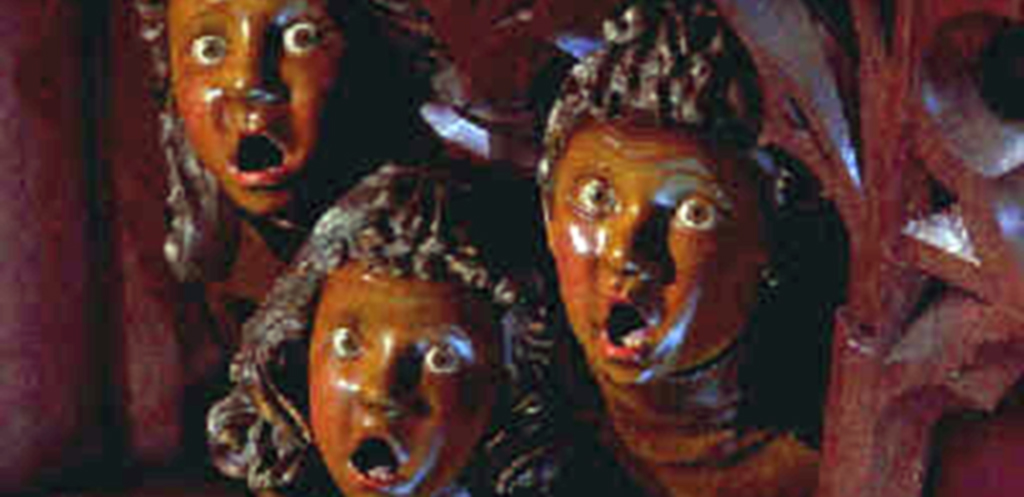
Seriously? Just knock it off.
The Haunting was of course based on Shirley Jackson’s spectacular 1959 novel The Haunting of Hill House, which I heartily recommend. Stephen King rightly chose it as one of the best horror novels of all time, and discusses its themes at length in a chapter of his 1980 book Danse Macabre. The 1963 film hews very closely to the plot of the book. It’s a fairly standard haunted-house type of story: Dr. Markway (Richard Johnson) is doing a paranormal investigation of the infamous Hill House, which has been the scene of many mysterious deaths and creepy happenstances since it was built. Joining his ghostbusting posse are heir-to-the-owner Luke Sanderson (played by Russ Tamblyn of West Side Story fame), free-spirited lesbian psychic Theodora (Claire Bloom), and sheltered, mentally unstable poltergeist focus Eleanor (Julie Harris). Markway’s wife Grace (Lois Maxwell) joins the fun later on in the film.
Elevating the story from a run-of-the-mill spooky-house romp into an artful masterpiece of terror are not only the gorgeous cinematographic flourishes, but also the layers of uncertainty surrounding the character of Eleanor, and the way her own past seems to mirror that of the dreadful house. She is summoned to the investigation by Dr. Markway because of an incident in her youth where stones fell on the roof of her house in an apparent poltergeist attack, though she never experienced paranormal activity again until arriving at Hill House. Eleanor herself is intensely reflective, perhaps even self-absorbed, and insecure to an almost monstrous degree. She is working through her feelings of guilt and inadequacy following the death of her mother, who she had wiled away years of her life caring for. Because Hill House’s history boasts a similar situation of a suicidal companion, Eleanor feels an immediate affinity with the house, and senses that her destiny is there, and that she has “come home.” The house, for its part, seems to play upon this connection she feels, as Eleanor becomes the main focus of the activity. There is banging on the walls that reminds her of the way her mother would bang on the walls to call to her, and at one point writing appears on the walls of Hill House, chillingly reading, “Help, Eleanor, come home.” Is the entity in the house using Eleanor for its own nefarious purposes? Or is Eleanor unconsciously projecting her own fears and insecurities onto the house and manifesting an entity that was never really there? The film never takes a stand either way, and this is one of its great strengths.
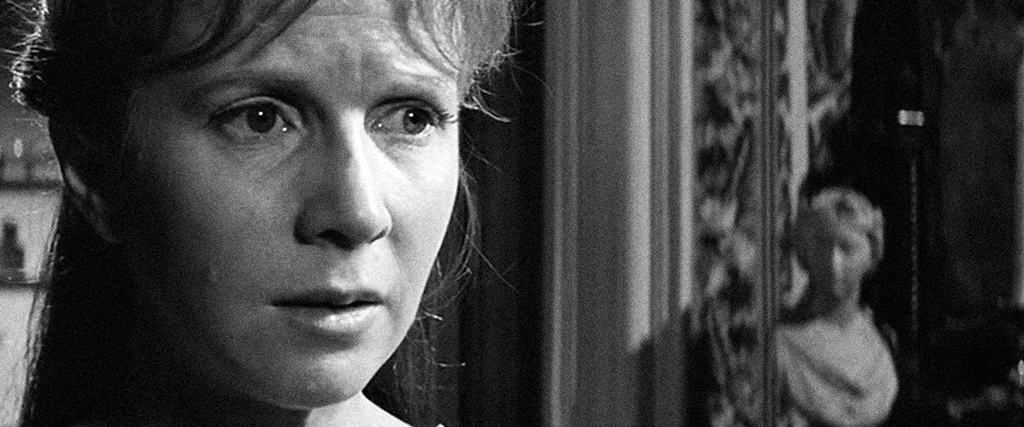
Filmed in luminous black and white, the whole movie is a study in atmosphere and escalating tension. The vast interior of the house itself is often shot from unsettling angles and skewed perspectives, and there are always eerie shadows populating the corners. There are many, many scenes of skin-crawling dread, but there are really two I’d like to discuss here. In the first, Markway and the two women are downstairs. Luke has come downstairs to raid the bar (as you would), and as he stands there chugging straight out of the bottle (classy), suddenly we see (and hear) a door slam by itself. All four of our heroes are naturally wigged out, and as they stand there frightened, wondering what to do, they begin to hear another sound, a sort of strange, windy shuffling that then resolves itself into a steady bang…bang…bang. Like loudly echoing footsteps, coming toward them down the hall. Markway initially thinks it may be his wife Grace wandering the halls (she had been sleeping in the nursery) and goes to open the door, but Luke stops him, saying that the sounds were not coming from anywhere near the nursery. The steady banging gets louder and closer. Eleanor and Theodora are huddled up in blankets on the couch, terrified. The banging is joined by that weird windy noise again. Eleanor thinks to herself (in voiceover), “It knows my name. This time it knows my name.” Markway, fearing that his wife is in danger from whatever is out there, lunges toward the door. Eleanor leaps to her feet to stop him. “NO! NO! It hasn’t hurt me, why should it hurt her?” Markway points out, “She may try to do something about it.” Before Markway can get the door open, though, the noise stops, and he hesitates. Eleanor turns and addresses Theodora. “Is it over, Theo?” Theodora says no, that she still feels cold, and that she senses that “it’s going to start everything all over again.” And sure enough, the next second there comes a volley of metallic-sounding blows on the back of the door that Markway and Luke are still standing in front of. “Don’t let it get in!” Eleanor pleads. Then…silence. Everyone looks at the door, their faces hopeful but still contorted with fear. And then the doorknob begins to rattle, ever so slightly. Luke’s eyes get as big as saucers. Eleanor, her hands clutched in front of her mouth, mews, “Oh God, it knows I’m here!” The doorknob stops rattling, but then the door itself starts to…breathe. There is no apparition, there is no sound other than a slight creaking. There is only that door, bulging weirdly out and then back in. Out, and then back in. It’s such a creepily affecting visual, and so simply done. There is a closeup of Luke’s hand as he drops the liquor bottle on the floor, and then he attempts a little levity by choking out, “Hey Doc. I’ll let you have the house cheap.” There is another moment of silence when they think the terror has passed, but then the banging starts up again, moving across the floor above them this time. All four stare at the ceiling, following the progress of the thing that haunts Hill House. Eleanor thinks that the entity will keep going on until it finds her. Bang…bang…bang…and then there is a strange, sort of rolling metallic sound, almost like thunder but more like someone plowing through pieces of sheet metal. Dr. Markway is staring up at the ceiling and following the sound, and he suddenly knows where the entity is heading. “It’s at the nursery!” he says, and then lunges for the door. Spoiler alert: when they get to the nursery, Grace has disappeared, and we don’t find out what happened to her until the very end (or do we?). Mwahahahaha.

The second scene is even better. It starts with a gorgeous night shot of the exterior of Hill House, accompanied by a creepy soundtrack that sounds sort of like church bells. We pan into Eleanor’s shadowy bedroom, and focus on a sort of raised floral pattern on the wall. Eleanor wakes up and peers over her shoulder at the section of wall. She thinks she hears a man’s muffled chanting coming from behind there, though she can’t make out the words. The camera closes in on the pattern as the voice gets louder, and we start to imagine we can see things in the wall, like a single disapproving eye in the top right corner. In reality there is nothing there, but the way the sequence is shot makes you think there may be. Closer still, and we can almost see another eye, and perhaps even a gaping mouth in the floral pattern. Frightened, Eleanor whispers for Theo, who is sleeping in another bed across the room, though it is too dark for Eleanor to see her. “Are you awake?” she whispers. “Don’t say a word, Theo, not a word. Don’t let it know you’re in my room.” Theo doesn’t answer, but then Eleanor hears a woman’s eerie laugh coming from behind that creepy-ass wall. Eleanor, the covers pulled up to her chin, sticks her hand out into the darkness. “Hold my hand, Theo,” she whispers. “And for God’s sake, don’t scream.” The muffled chanting gets louder, and there’s more of that laughing, and now the pattern on the wall REALLY looks like a horrible face, even though it’s exactly the same pattern as it was before. The noises stop, and Eleanor asks the psychic Theo if it’s over. Then she winces. “You’re breaking my hand!” she says. Then she hears a child crying from behind the wall, and the way the shadows fall on the pattern now makes it clear that there are two eyes and a mouth. She thinks to herself how monstrous and cruel the entity must be, to hurt a child, and how no one should ever do such a thing, and how it’s probably only doing it to scare her but it isn’t succeeding. Then she thinks again that Theo is hurting her hand by squeezing it so tight. She thinks that she will put up with a lot from the house for the sake of the experiment, but that the house hurting a child to get to her is going too far, and she insists she’s going to yell, and indeed, that she does; she screams, “STOP IT!” And then the shot quickly pulls back to show her in her bed, and the lights come on, and there’s a spinning shot across the room to show that Theo is still in her bed across the room, and has just woken up, disoriented. Eleanor gazes down in horror at her hand, which is still extended out and loosely closed, exactly as if someone had been holding onto it. She gets out of bed, still staring, transfixed and disgusted, at her hand. “Oh God,” she says, extending her fingers. “Whose hand was I holding?”
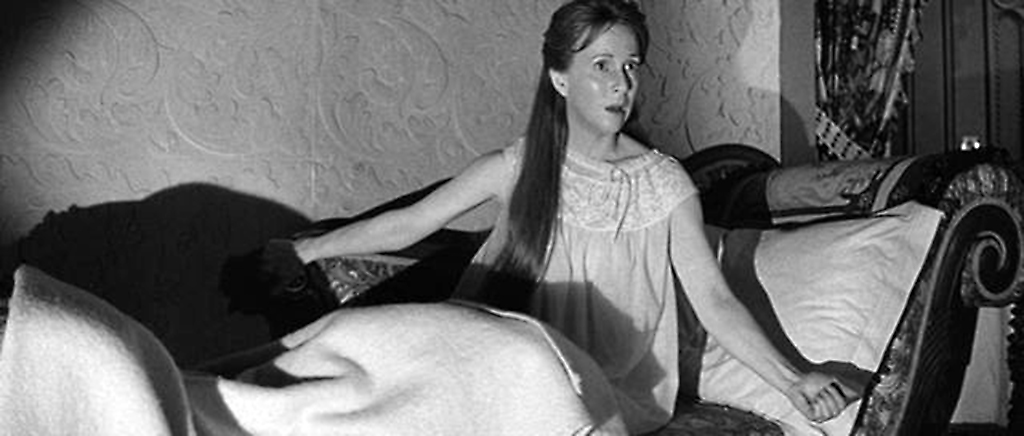
Meeeeeeeeeeep. Think about THAT next time your foot comes out from under the covers in the middle of the night. Yes, it’s true, everybody…THE MONSTERS UNDER YOUR BED WILL GRAB YOUR SHIT IF IT COMES OUT FROM UNDER THE COVERS.
And with that, I bid you adieu. Goddess out.
The Goddess’s Favorite Creepy Movie Scenes, or If Chauffeurs Ruled the World
Allow me to briefly expound upon my love of haunted house movies. They are, bar none, my go-to genre of horror film, and my list of favorites includes many stellar examples: The Haunting, The Others, The Changeling, The Innocents, The Shining, The House by the Cemetery, Let’s Scare Jessica to Death, Ghost Story, The Legend of Hell House. There is just something so inherently nasty about the haunted house story. Your house, after all, is where you sleep, where you get naked, where you’re the most vulnerable, where you’re supposed to be able to relax and live your life safe from the prying eyes of the public. When this feeling of safety is subverted by a haunting, you feel doubly violated, as you have nowhere to go to escape the terror; it has literally invaded the place where you live. The haunted house film, when done well, gives the viewer a sense of claustrophobia and unease that cannot be matched by any other subgenre. Intense atmosphere can be wrenched from every shot of a darkened hallway, a locked door, a dusty basement or attic. Our houses are our outer shells, and when they turn on us, the results can be horrifying.

One of my favorite haunted house films of the 1970s, and one that typifies the “house as living entity” trope apparent in many films of the period, is 1976’s Burnt Offerings. Based on Robert Marasco’s novel and directed by Dan Curtis (well known as the creator of the 1960s vampire soap, “Dark Shadows”), the film tells the story of a married couple, Ben and Marian Rolf (Oliver Reed and Karen Black) who rent a gorgeous neo-classical mansion for the summer, along with their 12-year-old son David (Lee Montgomery) and Ben’s delightfully sassy aunt Elizabeth (Bette Davis). The beginning of the film sees the couple arriving at the house, unable to believe that this enormous estate is the same one offered for a “reasonable” price in the ad they answered. The first person they meet is the obligatory toothless hick caretaker, Walker, and shortly afterward they come face to face with the owners of the house, the weirdly intense brother and sister team of Arnold and Roz Allardyce (Burgess Meredith and Eileen Heckart). The siblings offer the Rolfs the unheard-of rental price of $900 for the entire summer, provided the Rolfs are “the right people.” Ben is skeptical, thinking the whole situation is too good to be true, and monumentally freaked out by the Allardyces’ strange way of talking about the house as if it’s alive. The viewer is pretty much on Ben’s side too, at this point, since we have already seen Arnold watching hungrily out the window as David falls and cuts his leg as he’s playing in the garden. We have also seen that one of the dead plants in the greenhouse has developed a new, young shoot.
Marian, however, has no reservations at all about renting the place, as she has already been seduced by its beautiful interior, full of shining wood, sparkling chandeliers, priceless antiques, and creepy old photos in ornate frames. Her enthusiasm is hardly dampened at all when the siblings throw in one final “catch”: their 85-year-old mother will be staying in the house with the Rolfs. The Allardyces insist that their mother will be no trouble at all, that she never leaves her room and that they will probably never even see her. All they ask is that Marian make a tray of food three times a day and leave it on the table in their mother’s sitting room. Ben is extremely put out by this condition of their rental (what if the old woman dies on their watch, he rather reasonably points out to his wife), but he finally gives in when he sees how much Marian loves the house. They move in on July 1st, planning to stay until Labor Day.
From there, little things conspire to make the house seem creepier and creepier. Marian begins to spend all her time cleaning and fixing the house up, and insists that no one is allowed into Mother Allardyce’s quarters but her. Ben and David find an old cemetery on the grounds, in which all the graves are Allardyces, but none of the death dates is more recent than 1890. Ben also finds a mysterious pair of broken spectacles at the bottom of the swimming pool. The trays of food that Marian dutifully leaves for the mother are never eaten, and the old woman never responds to Marian’s knocks. Marian herself slowly begins to dress more primly, as if she is from the era when the house was built. She also takes to mooning around for hours in Mrs. Allardyce’s sitting room, listening to an antique music box and staring longingly at the old woman’s collection of photographs. Her hair is also slowly beginning to turn gray.
As the tension builds, the weirdness gets weirder: while horsing around in the pool, Ben succumbs to an uncontrollable bloodlust and almost drowns his son. Marian notices that certain things around the house and grounds seem to be regenerating themselves. The windows and doors in David’s room close and lock, and the gas heater somehow turns on and almost kills him. The formerly perky Aunt Elizabeth begins to quickly decline from some mysterious ailment, and eventually dies.
And then, there’s Ben’s nightmare.

The night after almost drowning his son in the pool, Ben has a dream, filmed in spooky black and white, of himself as a little boy attending his mother’s funeral. In this nightmare, there is an unsettling figure of a lanky chauffeur, clad in a black uniform and dark glasses, lurking around the outer edges of the funeral party, and standing by the door of an old-fashioned black car to usher Ben inside. Ben gets into the car, and then the chauffeur’s creepily smiling face appears in the car window. The chauffeur is so eerie looking that one wonders if it was an actual person that Ben remembers from the funeral, or just a product of his subconscious. In either case, what the hell is that freaky-looking chauffeur smiling at?
As if the dream scene wasn’t bad enough, there comes a chilling sequence later in the film where Ben, who has been out working in the garden, is taking a break, sitting on the grass and drinking a beer. Suddenly, he sees the grille of a car approaching through the trees. It’s the same black car from his nightmare. It comes ever so slowly up the drive, and Ben is just sitting there watching it, shaking like a leaf. The car stops several yards away, and the chauffeur’s pale face can be seen through the window, watching Ben with that horrible smile. Ben loses his shit and covers his eyes, and when he looks up again, the car is gone.
The third appearance of the chauffeur is also a cracker. Ben is sitting with his dying aunt one night and hears a car pulling up outside. Creeping to the window, he sees the telltale black car coming around the drive. He wigs out and backs slowly away from the window back toward Elizabeth’s bed. Both Ben and a nearly incoherent Elizabeth begin to hear a noise at the door, as of someone trying to get in. Then there’s a close-up of the door, and then a loud bang as the door opens, then there’s that damn chauffeur in the doorway, grinning, his eyes invisible behind his dark glasses. There’s a full-length shot of him standing on the threshold, a shot of Elizabeth screaming, and then the chauffeur pushes a coffin into the room toward the camera, and everything goes black. Brrrrrrrrrrrrrrr.
I’d like to add here, on a personal note, that the first time I saw this film was when I was about thirteen. I was at a slumber party at an old mansion owned by the wealthy parents of a friend of mine. This house was straight out of a movie itself, with a giant sweeping marble staircase, crystal chandeliers, back staircases for servants, and endless twisting hallways leading to rooms upon rooms. I had never seen such a house in real life, and it was probably not the best environment to see Burnt Offerings in, for as soon as the chauffeur made his first appearance, I and all the other girls at the slumber party were scrambling to hide under the blankets on the sofa or hightail it out of the room. The house around us just seemed a little too similar to what we were seeing on the screen, and we could all imagine glancing behind us and seeing that smiling motherfucker standing in the doorway and pushing a coffin at us. It’s a memory that’s stayed with me for almost thirty years.
As for the rest of the film, as you can probably guess, things don’t go well for the Rolf family. Spoiler alert: everybody, including the kid, dies in various horrid ways, except for Marian, who becomes the formerly non-existent Mrs. Allardyce in the end, a living embodiment of the house.
When I was doing research for this recap, I noticed that reviews of the film were very mixed, as many filmgoers felt the ending was too obviously telegraphed, but I’ve always found that the atmospheric creepiness of the journey makes up for any pedestrian aspects to the plotting or theme. One also has to take into consideration that many aspects of the film that seem old hat to people nowadays weren’t quite the clichés they are now, and in fact, some themes in this film were quite original, but later co-opted for later films in a similar line. I also really think the acting is terrific; Karen Black is always great, and Oliver Reed is splendid, especially in scenes featuring the fun, smart-ass bickering between Ben and Elizabeth. So if you’re in the market for a classic slice of 1970s haunted house eerieness, you could certainly do worse than Burnt Offerings. The book is great too, by the way, and with that, I’ll bid you pleasant, chauffeur-free dreams.

Nope. I’m here as an emissary of your demise.
Goddess out.
My New Author Promo Video
The Goddess Picks Her Top Five Books and Stories That Desperately Need Film Adaptations
As we all know, the book is almost always a thousand times better than the movie, but sometimes that doesn’t stop me from seeing a movie in my head as I read and desperately wishing I had unlimited funds and some measure of directing talent so I could bring my vision of these stories to the masses. My choices may be a bit idiosyncratic, but if any Hollywood execs are reading this, you’d have at least one ticket sale right here, so think about it, won’t you? For the Goddess. Oh, and by the way, if any of you aforementioned execs want to option any of MY wonderful books or stories for film, give me a shout. We’ll have a cappuccino and a chat and then maybe you can fork me over a largish check. The movie can even suck, I don’t care, so no pressure on you from my end. Thank you, and on with the list:

5. And the Ass Saw the Angel by Nick Cave
Nick Cave is like the mad genius of all media. He’s a singer/songwriter, film score composer, screenwriter, novelist, actor, and lecturer, and miraculously, he is ridiculously brilliant at all these endeavors. It’s really not fair to the rest of us, as infinitely less awesome mortals, but I content myself with believing that Nick is actually Satan himself and has chosen to capture human souls through the sheer dark force of the splendid entertainment he produces. Nick’s first novel, And the Ass Saw the Angel, is a whacked-out, Faulkneresque brew of Old Testament fury and Southern Gothic excess, and any adaptation would of course have to be scripted and scored by the man himself. I’m seeing it done in sepia tones, perhaps with a hand-cranked camera to give it that otherworldly feel; bonus points if it’s also done as a silent film (since main character Euchrid Euchrow is a mute). In theaters, it should be preceded by a short film: a sinister, stop-motion animation adaptation of Nick’s 1986 song, “The Carny.”
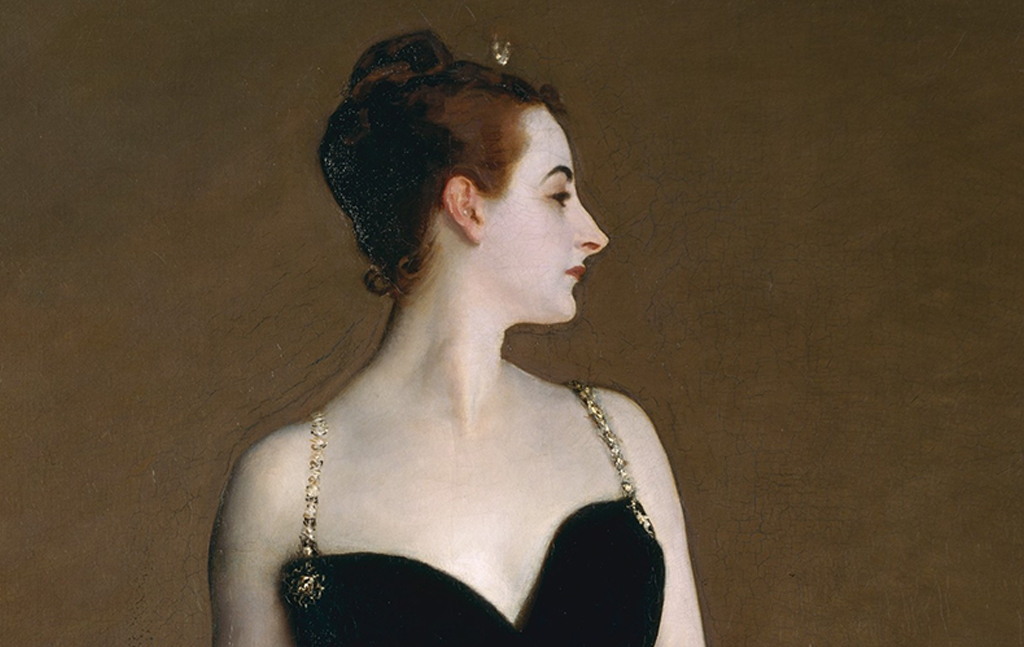
Perhaps an unusual choice, as it’s non-fiction, but I have long been enchanted with the story of Virginie Amélie Avegno Gautreau, the haughty society woman who posed for John Singer Sargent’s most famous painting, Madame X. (I even wrote an article about her on this very blog.) It could be a fascinating study of vanity and how pride goeth before a fall, and the set design and costumes would be FANTASTIC. In fact, I wanted to see this on film so badly that I actually wrote a (not very good) screenplay a couple of years ago that interwove Virginie’s biography with a modern tale of an unstable woman participating in an art heist, but screenwriting isn’t really my strong suit, so if anyone out there would care to take the reins, I swear I won’t be mad.

Dan Simmons’s gigantic novel, a Victorian medley of supernatural horror, drug abuse, and fictionalized biography, sees Charles Dickens and Wilkie Collins on the trail of the mysterious man-creature known as Edwin Drood (who was, in real life, the main character of Dickens’s final unfinished novel). This would be a fabulously spooky cobblestone-streets-and-top-hats film in the line of From Hell or The Prestige. Missed opportunity alert: back in 2009, Universal Pictures hinted at a Drood adaptation that would possibly be directed by Guillermo del Toro (TAKE ALL MY MONEY. ALL OF IT), but sadly, that project seems to have gone nowhere.
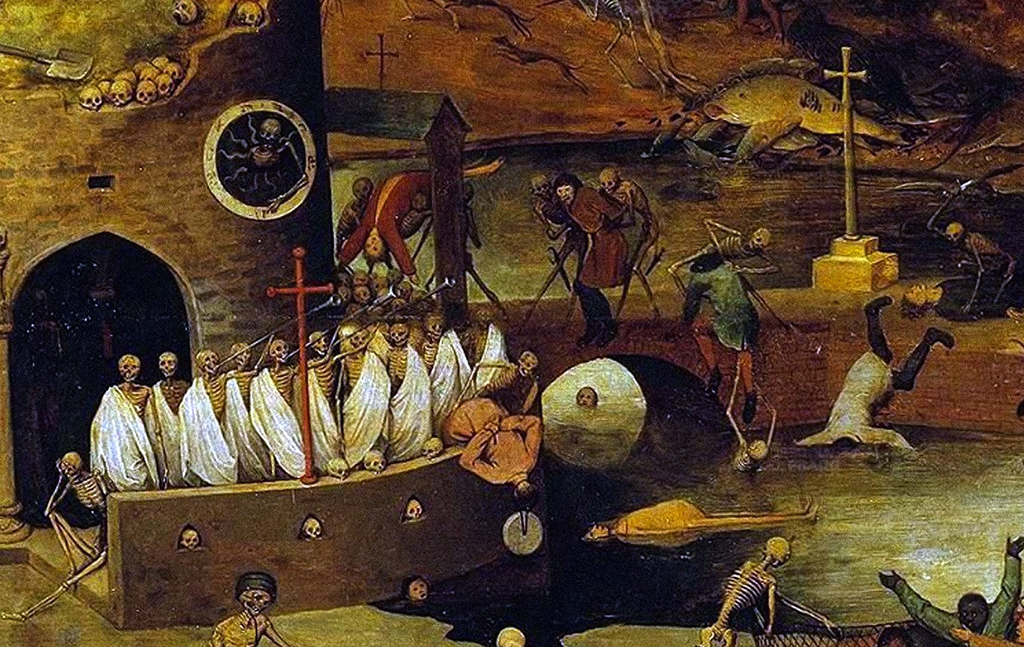
2. “The Triumph of Death” by H. Russell Wakefield
Early 20th century author Herbert Russell Wakefield is considered one of Britain’s finest writers of supernatural horror. His 1949 short story “The Triumph of Death” is one of my favorite stories of all time, and although it was adapted once for British television in 1968 as part of an anthology series called “Late Night Horror,” I really feel that its themes of cruelty, madness and revenge could be expanded to a feature-length movie. The story isn’t really set in a specific time or place, but I’d like to see the action unfold maybe around the 1920s, in either an English village or a small colonial-style enclave in Massachusetts or somewhere like that. It should be understated, but the flashes of Gilles de Rais-style torture shouldn’t be overlooked. The vile Miss Pendleham should be played like the high-collared stepmother from Disney’s Cinderella, but in human form, perhaps by Judi Dench or Maggie Smith. This is another story that I’ve actually been itching to write a screenplay for, and I even went so far as to try to contact various people about obtaining the adaptation rights, but I seem to have hit a dead end in that regard. More’s the pity.

1. The House with a Clock in its Walls by John Bellairs
With the unbelievable explosion in popularity of films based on YA literature that occurred in the wake of Harry Potter, I must say that I am absolutely flabbergasted that no one has thought to adapt this as a film. This and The Westing Game were absolutely my favorite books growing up, and I read them again and again. They both hold up amazingly well even when read as an adult. There should probably also be a good, big-budget adaptation of The Westing Game, now that I think of it, but The House With a Clock in its Walls is such a wonderfully creepy and fun story, and it could be done super dark or a tad more lighthearted, either as live action or perhaps as Tim Burton-esque stop-motion. It would actually be great if a filmmaker could capture the eerie look of Edward Gorey’s delightful illustrations, which for me added so much to the magic of the book. I feel that it should be set in a sort of mythical 1950s, and that the main character of Lewis should be a straight-laced but likable boy whose chubby awkwardness makes him at once pitiable and relatable. Uncle Jonathan should be his affably wizardly self, and witch neighbor Florence should be like a cool grandmother type. I’m seeing the resurrection scene, when Lewis accidentally raises evil wizards Isaac and Selenna Izard from the dead, as super, super scary, like maybe with a Sleepy Hollow kind of vibe. Also, the house itself should be a rambling, creepy, Victorian pile (perhaps they could even shoot the film in the real-life house the story was based on, Cronin House in Michigan), and the interiors should be suitably gothic. The sound design would of course have to include the constant ticking of that terrible doomsday clock. It would make a terrific film for kids and adults, and it’s even the first book in a series (cha-ching, Hollywood execs), though the rest of the books didn’t grab me the way this one did. Amazingly, the only filmed adaptation of this book that I know of was as one lame, cheesy third of a Vincent Price-hosted 1979 TV anthology, “Once Upon a Midnight Scary.” YOU GUYS, THIS NEEDS TO HAPPEN. Gather up all of your money and diamonds and cookies and gold bars and Red Lobster gift cards and send them to whoever can greenlight this. DO IT NOW. Thank you, and Goddess out.
Coming Soon…
Excerpt from “The Omitted Thirteenth”
The dead man had lain in the wreckage of his host body for hours after his quarry had fled, wondering what in the hell he was supposed to do now. He already knew he could not escape this flesh, not until the woman saw fit to release him, and he could have screamed in frustration if his windpipe had not been crushed along with the rest of him. He stared at the darkened ceiling through his spirit eyes, pleading silently to the woman who had trapped him here, the woman who was controlling his fate from afar. Let me out, he said. I’ll continue to do your bidding, but let me find another body to do it in.
After an eternity of the begging to her (and where had she gone, last night, while he was being mangled by that stupid girl? She hadn’t even come in to help), he gave up and considered his situation. Perhaps his only option was to try and reintegrate his scattered parts, at least enough so that he could move around. He strained to the limits of his will, tried to strain beyond them, and for a second he felt a glimmer of hope as he thought the molecules of the shattered corpse were pulling themselves back together. And he had done it before, when Faustine was looking down at him, hadn’t he? All he had to do was try, imagine himself whole with every fiber of his being.
Despite much struggle, he was unable to pull off any more than a few twitches of bone, a slight knitting of flayed skin. Sighing, he settled back into his misery. What would become of him now? Would he just lie here forever in this battered carcass, unable to escape? The proposition seemed more horrible than anything he could imagine. And the girl would never be back now, he was almost certain of that. Nick had taken her away and they had failed in their vague mission. Even in the unlikely event that the girl did return, what could he do to her in this pitiful state?
Lost in his thoughts, he at first failed to notice a peculiar lightness of feeling overtaking him, a sensation of a weight being lifted. By the time he realized what was happening, his incorporeal self was hovering somewhere near the ceiling, gazing down on the ruin his borrowed body had become. Had he been solid instead of spirit, he would have whooped with joy. He was out, he was free! He zoomed around the room a few times, testing his new liberty, reveling in the feel of his individual atoms stretching and contracting, invisibly, in the stinking room. How he loved the feeling of being out of a body; although his kind could not remain as pure spirit for long — they were as vulnerable as hermit crabs outside of their shells — he had always adored the sensation of being unencumbered by the clumsy limitations of human flesh. He felt at one with the universe.
Then he stopped to think. How could he be out? Surely he hadn’t done it himself; even after all his efforts, he wasn’t stupid enough to think he could have escaped against the will of the more powerful woman, his lord and master. He swished around the room again. Maybe his prayers had been heard, and the woman was allowing him the freedom to find another body, one that would be more suitable. He smiled with his non-existent lips. And if he chose a body of his own, perhaps the rotting and deterioration that had plagued his old skin would not be a factor. That was a definite plus. Besides that, Faustine would be unable to recognize him when she saw him again. Or her, he thought, overcome by the deliciousness of the idea. I could always inhabit a woman.
Excited by the prospect of a new flesh, he took a last glimpse at the body he’d vacated. When he’d gone and fetched a new skin, he thought, he should come and clean all that up. Let Nick and Faustine wonder what had happened to him, where he had gone. Let them think he’d still be shambling around in that broken-down housing. Let it be the rotting zombie that they were looking for. At the moment, he’d find the woman, then he’d find a new body, a nice one this time.
This decided, the dead man, now spirit and nothing more, dissipated his atoms sufficiently to pass through the door and out into the night.
 Goddess of Hellfire