“Brilliant Cut”

BrilliantCutPic

The womb is a trap, Philip thought to himself. He caught his reflection in a shop window and slowed his pace, taking in his furrowed brow, his stooped shoulders. The trap was pressing down.

Bonnie was already naked when she answered his knock. He peeled off his pants without a word and followed the promise of her bottomless gaze.

Afterwards, she lay on the sheets, afternoon light making a triangle across her flat belly. She smoked and didn’t look at him.

“Judy’s pregnant.” He hadn’t really meant to say it out loud, but there it was, echoing among the sounds of the traffic from the street below.

“And?”

He swung his legs over the side of the bed and reached down for his socks. “And I don’t know what to do about it.”

“Your part’s already done, champ.” She smirked as she watched the smoke coils hanging in the air.

“Fuck you, it’s not funny. You know Judy, she’ll expect marriage and happy family life and all that.”

Bonnie sighed and crushed her cigarette into the ashtray on the nightstand. “Why are you telling me this, Phil?”

“I don’t know. Maybe I should marry her. Carry on the family line, or something.”

She got out of bed and slithered into a silk robe. “This doesn’t much concern me, you know.”

“I’ve been fucking you for almost as long as Judy and I have been together.”

“You’ve been fucking others for almost that long. Whether you’re married or not isn’t going to stop you from fucking me or anyone else, so why drop all your angst on me today?” Her hands were on her hips, and her face was a perfect mask of bored contempt.

Philip buttoned his shirt savagely. “Okay, sorry. Just thought you might have some advice for a friend.”

Bonnie glided over to the bedroom door and stood on the threshold, clearly ushering him out. “I advise you to quit bothering me with your bullshit. You want to fuck, come on by. You want to bitch, call your therapist.”

Phil stomped the three blocks back to work, hands jammed in his pockets. In the elevator, he stared at his reflection again, noting the dark circles under his eyes, his ever more sloping posture. He didn’t know why he had told Bonnie anything.

For the rest of the afternoon, he simply sat in his office with the door closed, staring at his computer screen as if his own thoughts were projected there. When the clock finally struck five, Phil shrugged into his jacket and drifted out of the building, robotically wishing his co-workers a good weekend.

His walk home was just as automatic, but halfway there he found himself standing in front of a glass door emblazoned with three gold spheres. A bell jingled as he pushed it open.

“Help you?” The woman behind the counter was white-haired and regal, with pale, searching eyes.

He approached, his movements molasses-thick. The jewelry in the case was a riot of color, all seductive winks and fragmented images. His finger tracked along the rows of diamond rings. “That one,” he said. It looked much like the others.

“Very good choice,” the woman said, bending at the knee to slide the blue velvet box from its place in the lineup. “She’ll just love it.”

“I suppose.”

The corner of the woman’s mouth curled upwards. “You don’t sound so sure about this.” She put the box on the counter and peered up at him from beneath her lashes.

“I’m just…nervous. I guess.”

“Of course.”

Phil freed the ring from its plush prison and gave it a perfunctory once-over. It was a solitaire ring, with a brilliant-cut stone and a thin white-gold band. It seemed adequate, classic even. He noticed as he moved the ring back and forth, the diamond flashed and then darkened. He caught a glimpse of his own haggard face in the stone’s depths before it disappeared again. “How much?”

The woman chuckled. “Normally that would be three, but I like your decisiveness. Twenty-five.”

Phil handed over his credit card. The money didn’t concern him; the implications of that tiny white-gold shackle did. He slipped the velvet box into his jacket pocket and left without another word.

Judy was arriving home just as he did, clad in her hospital greens and carrying a plastic grocery bag in each hand. She greeted him with a smile and a kiss on the cheek as he opened the door to the apartment building. “I got a couple steaks for tonight, thought you’d like that,” she said, her bags creaking as she fumbled around for her keys.

“Sounds good. I’d actually love a cocktail, though, if you could fix me one.”

She held the apartment door open with her butt as he went past her. “Sure, baby. Let me put all this stuff down first.”

Phil downed one cocktail in a single gulp and then moved on to a second. The smell of steaks frying permeated the apartment, a secretive, bloody tang. The TV was on, and he sat on the couch looking at it, drink in hand, but nothing on the screen was making any sense to him at all. Judy called him to dinner and he turned it off.

He had a third drink, then a fourth. He had taken off his jacket and slung it across the recliner, but he could still see the square protrusion in the pocket, like the rectangle of dirt covering a fresh grave. Judy, for her part, didn’t seem to notice anything amiss, humming as she washed the dinner dishes, prattling on about some funny incident at work. He half listened, smiled where he was supposed to. After a while she settled on the sofa with her tablet, her pleasant face lit by its blue glow.

He let another two hours pass before he glanced at her. His heartbeat was a death knell. “Judy?”

She looked up. “Hm?”

“I…have something for you.” He reached across and pulled his jacket into his lap. Judy watched him, sweetly curious. When he pulled out the ring box, she sat up straighter, and her eyes filled with tears. She let her tablet slide off to the side. He opened the box and held it out toward her, an offering. “Will you…marry me?” He felt as though he was speaking around a mouthful of sand.

Her tears spilled over and she laughed a girlish laugh, a sound like a tinkling bell. “Oh Phillip, you didn’t have to…because of the baby and everything…”

He realized he was still holding the ring box in one outstretched hand, like an idiot. He took the ring out and slid over to her, taking her hand to put it on her finger. “It’s not because of that,” he said. “I just wanted to. I felt like it was time.”

She stared down at the ring with something like rapture, then met his eyes. “It’s beautiful, Phil. And yes, I will. I love you.” She threw her arms around his neck and kissed his forehead, his ear, the corner of his mouth. Her tears left salty dampness on his skin.

“Love you too, Judy.” He returned her kisses, hugged her tightly around the waist. The ring sparkled in his peripheral vision. In the reflected light from the TV screen, the stone almost seemed to turn black.

****

He was still awake several hours after Judy had fallen asleep beside him. She had been especially amorous after his proposal, and Phil had tried, but the four cocktails and the thoughts of his impending marriage and the shitty day he’d had conspired to prevent even a glimmering of an erection. He’d apologized, shamefaced, but of course Judy had forgiven him. She always forgave him.

In the moonlight streaming in through the blinds, he could see her hands folded across her stomach, see the slyly winking diamond on her finger. Underneath that stone, underneath her folded hands, a piece of him was growing. He shifted his position on the bed, and punched his pillow into a more amenable shape. He imagined Judy’s belly inflating in seconds, like a balloon attached to a helium tank, and then exploding in a rain of blood and gobbets of flesh. Scowling, he closed his eyes, wondering what the fuck was wrong with him.

Judy rolled over in her sleep, and her hand flopped onto his chest. He opened his eyes again. The ring was inches from his face, its facets reflecting the room back at him in insect vision. As he stared at it, he thought he saw a trickle of dark liquid emerging from it and snaking its way down Judy’s finger. He felt wetness on his chest as the fluid dripped. He picked up her hand between two fingers and cast it away in disgust. Judy stirred, but didn’t wake. Phil sat up and looked down at his bare chest, but there was nothing there. Judy’s hand, now resting on the sheet, was clean.

****

On Saturdays, Phil had been in the habit of going to see Bonnie, or sometimes Rachel, while Judy was working her long shift at the hospital. Today, though, he slept until several hours after Judy had gone, and by the time he awakened he felt so dire that leaving the house for any reason was out of the question. He managed to stay on his feet long enough to shower and shave, staring at himself and wondering who the old man in the mirror was.

The sound of breaking glass brought his razor up short. Blood bloomed in a thin line across his jaw.

Swearing, he grabbed for a tissue, pressing it to his face as he stumbled back into the bedroom. He got his pistol from the nightstand and slid the drawer closed, quietly. The sound had come from the kitchen, he was sure.

The silence in the apartment pressed around his ears like a wool blanket. Slanted light painted the hallway as he crept along, feeling vaguely ridiculous with the gun held shakily out before him.

The kitchen was deserted, as was the living room when he peered out across the bar. He set the gun on the counter and let out a breath, scanning the area for the source of the sound. There was nothing fallen, nothing broken. He snatched open the cabinets and stared at the rows of gleaming drinking glasses, innocently intact.

He blinked. The glasses darkened, clouded, as if a shadow had passed before the window, and he spun around. For a moment he thought he saw a sort of shimmer, a bright rain of color bursts hanging in the air. When he blinked again, they were gone. He scrubbed at his face, scowling when his hand came away smeared with blood from his cut.

“Christ,” he said to the empty apartment, and even his voice sounded old, muffled by the close atmosphere. He had to get out.

****

Rachel wasn’t surprised to see him, but she wasn’t thrilled either. “Don’t you ever call?”

“I was just going stir crazy. Haven’t been feeling very well.” Phil sat stiffly on her futon, withering under the gaze of Plato, Rachel’s imperious Maine coon.

“Poor thing. Want some tea?”

“Maybe later. Come here.” He pulled her down into his lap when she approached, and thrust his hand under her shirt. She pressed her body against his, straddling his legs. The cat jumped off the futon with a squall.

Fifteen minutes later, Phil was hunched at one end of the futon, his pants back on but still unbuttoned, a cup of tea growing cold in his hand. Plato had returned to his place, swishing his tail in triumph.

“Well, you did say you were sick.” Rachel’s voice was flat.

“Sorry,” he mumbled. “I don’t know what’s wrong with me the last couple days.”

“It’s no big deal, really. You’d have had to go soon anyway, I have things to do.” She was leaning against the wall, arms crossed, her skin like smooth stone.

“Yeah. So do I.” He finished his cold, gritty tea and set the cup on the coffee table. When he stood up, his pants sagged and slid halfway down his ass. Rachel smirked as he yanked them up and buttoned them.

For the rest of the afternoon, he wandered the streets, not wanting to go back to the empty apartment. It was a pleasant fall day, crisp and sunny, but everywhere he went he felt as though he was enclosed in a dusky fog. He met the eyes of passersby, but their gazes seemed to slide past him. When he grew tired of walking, he ducked into a coffee shop and sat at the window, nursing a latte and watching the huge, indifferent world bustling past on the other side of the glass.

****

“Did you have a good day today?” She asked this every Saturday when she came home.

He threw his head back and emptied his beer down his throat. “Does it look like I had a good day?”

Judy flinched, but when her expression settled there was only concern for him there, no anger. “Sorry, baby. I thought you looked a little sick last night.”

“Yeah, I think I’m sick.” His momentary rage had dissolved, and he felt suddenly exhausted, claustrophobic. “Probably going to be an early night for me.”

“Need me to get you anything?”

Her eagerness to please was giving him a headache. He waved her off and she went into the kitchen, where he heard glasses clinking together and the sound of the water running. He put his beer bottle between his legs and sighed. For a second he entertained the notion of going into the kitchen and telling her about the noises he’d heard earlier, but the desire dwindled as quickly as it had appeared. Instead he staggered into the bedroom and fell asleep without even taking off his clothes.

He awoke a seeming instant later. He was lying on his back, and the room was hot. He moved his head and saw that Judy was also on her back, snoring softly beside him. Her stomach was an enormous mound beneath the covers, and it was then that he realized he was dreaming. Slowly, he reached over and slipped the sheets off her engorged belly. Distantly, he noticed that her diamond ring was now on his finger, the stone like an obsidian eye.

The flesh of her stomach pulsed. Phil watched it, curious to see what would emerge, but then, with the certainty of dreams, he understood. He placed the edge of the diamond against her belly button and sliced downward in one swift stroke. A ragged red fissure opened, blood pooling along the lips of the wound like quivering rubies. Inside was a riot of shifting, refracted light, illuminating the room like floodlights in a swimming pool. Phil curled his fingers around the edges of the chasm and pulled, widening the wound, intensifying the glow. The brilliance was now so blinding that he had to turn his head, and when he did he heard the faint sound of a baby crying, very far away.

Phillip awoke for real, his heart thudding, his sweaty hair pasted to his forehead. He felt his fingers, which were ringless, and a quick glance showed that Judy slept on, her still-flat midriff rising and falling in a steady rhythm. He swallowed and heard his tongue click. Then, another sound.

A baby crying. Phil sat up in bed. It could have been coming from one of the other apartments in the building, of course, but he’d never heard a baby crying in the building before, and it sounded close. He looked down at Judy again, but she hadn’t moved. He slid out of bed. The room seemed darker than usual, with barely enough moonlight to see by, and he felt assaulted by some grey miasma whose tendrils insinuated themselves into his nose and mouth.

The crying grew louder and higher pitched as he made his way toward the kitchen. He couldn’t believe that Judy hadn’t heard it too, and the fact that she hadn’t made him think that perhaps he was still dreaming, but no, everything around him was real and solid, and he could feel the wood floors slick beneath his feet, the cold walls beneath his fingers.

The kitchen was empty, but the sound of the baby crying was very loud. In the perfect square of the window, the moonlight was a solid, featureless white. The air felt suspended.

Phil waited, hardly remembering to breathe. The baby keened and wailed, the sound coming from everywhere at once. He covered his ears, but he still heard it, now as intimate as a sigh. The moonlight around him was flickering, a living thing.

He didn’t know how long he stood there. The baby’s cries eventually waned, like a fading radio signal, and Phil dropped his hands to his sides. It took a while before he was able to place one foot in front of the other, to push against the air that hemmed him in. The hallway before him seemed to stretch into forever, its angles skewed and fractured. He walked it like a blind man, keeping his arms extended for balance, staggering this way and that.

He opened the bedroom door. The darkness was nearly complete, and he strained to see. Swirling clouds moved before his eyes, revealing the bedroom as he had left it.

Except that Judy was standing very still at the foot of the bed, staring at him.

No, not Judy. Something else. Phil froze.

It was a woman, or the likeness of one. Her hair was white, and hung in straight curtains on either side of her face, partly obscuring it. Even so, Phil couldn’t help but feel that she was familiar somehow, her face a barely there memory. She was naked, and her breasts were pale globes that sat atop a monstrously pregnant belly. It was here that Phil’s comprehension of what he was seeing began to break down, for her stomach looked as though it was made of a polished, faceted diamond, all glinting prisms. Below the diamond was simply a smear of white that suggested legs, though at their extremities they seemed to drip, showers of falling stars that sizzled and vanished into the floor beneath her.

But all of that wasn’t the worst. For Phil could see that there was some small squirming thing moving inside the diamond in her belly. Something that seemed to be staring out at him with two shining black eyes.

He thought he screamed, but he couldn’t have, because Judy didn’t stir. The apparition hovered there for no more than a few seconds, but to Phil it seemed like time had stopped. The thing inside her belly pressed closer against its prison, and the facets of the diamond distorted its face into horrible geometric puzzle pieces. Still it stared, its eyes like holes.

Phil didn’t see it fade or wink out of existence. It was suddenly just not there anymore. He blinked and let out a ragged breath. The room appeared completely normal, the objects becoming a little more distinct as the first rays of dawn begin to creep in through the blinds. Judy slept, peacefully oblivious.

He stood very still for a long time, watching, listening, starting at the slightest sound. He stood this way until morning had broken fully and the room was filled with a pleasing, diffuse light. At long last, when nothing happened at all, Phil moved slowly to the bed and settled in beside Judy, resisting the childlike urge to pull the covers over his head. He stared at the ceiling for what seemed like hours, thinking he would never be able to fall asleep again after what he had seen. He was still thinking this when he drifted into unconsciousness.

****

Everything was in pieces when Phil opened his eyes, reality painted on fragments. For a long time he couldn’t understand what he was seeing.

There were the walls of his bedroom, and the ceiling, but they were all awry, the angles a crazy patchwork. Here was a glimpse of the blue comforter, there the sliver of a lampshade. As he struggled to fit the fragments of the picture together, he noticed fractions of flesh; the curve of a jawline, the arch of an eyebrow. Then suddenly he was in motion, his body lifted as though it was no more than an atom’s weight. He threw out his arms to steady himself, but they were boxed in, and his legs were likewise useless, folded painfully beneath him.

All at once, the fragments turned completely flesh colored, and then for a moment he saw nothing but a gigantic ice-blue eye, staring at him like the eye of a god. Another motion, and he realized that he was looking into Judy’s face, enormous above him, her expression uncharacteristically hard and venomous. He thought he screamed, but he heard no sound. He remembered his dream from the night before, and this seemed all of a piece with it, but also achingly real, as the white-haired woman standing by his bed had been. He realized with a start that he was seeing his fiancee from the perspective of the ring upon her finger, the ring he had so carelessly bought, the shackle that would tie him to her symbolically just as the creature growing inside of her tied him to her biologically.

The huge, fragmented woman above him gave a terrible smile, a wide toothed rictus, and then he was moving again, lower and lower, watching her body flash past him in a series of triangular flickers. Then it was all flesh again, growing larger and larger in his vision, and as the ring moved closer he realized he was now poised just above her belly, the midline of her abdomen as stark as an ink line on white paper.

There was very little resistance as the diamond penetrated the skin. For a moment, Phil saw nothing but red, and then the brilliant play of the stone’s light blinded him.

Horror Selfies!

The Horror Writer’s Association is doing a “Horror Selfies” campaign to promote reading in general and the horror genre in particular. If you write horror, and I know I do, get on over there and upload your selfie! Read the rules first about what you can upload, though—the pic has to have some kind of promotional wording on it. You can’t promote your own work, but you can promote other horror writers or the genre as a whole. And there is a space to put in the title of one of your works. So toddle on over there and slap your pretty mugs on the internets! Here’s mine.

JennyPoeSelfie

The Goddess’s Tale of Two Shinings

It seems as though I start a lot of these blog posts with a half-assed apology for not sticking to my own arbitrary, self-imposed “rules” for the content I discuss, and I regret to inform you that this is going to be another one of those times. Yes, The Shining and the well-publicized blood feud between Stephen King and Stanley Kubrick has been the subject of nearly endless internet debate, but for some reason it’s a subject I’m obsessively fascinated by and often get into long, rambling conversations about, which means that you will now have to endure said ramblings in my patented type-diarrhea form. Sorry in advance. (Not really.)

I’m going to go in a slightly skewed direction with this, though; rather than discuss the drastic differences between King’s book and Kubrick’s film, and the subsequent 34-year hatefest between them, I’d like to delve more into the contrasts between Kubrick’s film and King’s 1997 mini-series adaptation. Yes, I will obviously have to talk about the book too, so readers may see this as a distinction without a difference, but hey, I’m trying to just carve out a semi-original niche for myself here, so cut me some slack.

PICTURED: SLACK, AND THE CUTTING THEREOF.

PICTURED: SLACK, AND THE CUTTING THEREOF.

Let me just take a few moments to talk about Stephen King as a writer. I would consider myself a fan, though I admit I haven’t read anything of his newer than Under the Dome, which I enjoyed but promptly forgot the second I finished it. I definitely feel as though the quality of his work has declined post-car-accident, and I know I am not alone in that opinion; his more recent work just doesn’t stick with you the way his earlier stuff does. I would never go so far as to call him a hack, as some have done; he’s a very good “popular” writer, and he’s written some absolutely GREAT books, The Shining among them. Is The Shining as great as, say, Shirley Jackson’s Haunting of Hill House, which partly inspired it? Hell no, and only an idiot would argue otherwise. But The Shining scared the ever-loving bejesus out of me the first time I read it, and has held up very well over multiple re-reads over the years. When King is on, he’s really, really on.

Here’s what I find weird, though. I’ve mentioned a few times in previous posts how much I love Danse Macabre, King’s scattershot but surprisingly astute analysis of horror in entertainment. In fact, on this very blog, I have used paraphrases from that book to back up some of my own viewpoints about what works and doesn’t work in horror; namely, that ambiguity and perhaps even obfuscation are necessary for really effective scares. What is unknown and largely unexplained is always more terrifying than what is known. King seems to grasp this, and even singles out books and films that were effective for this very reason, but when he is given the reins of a film project, he never seems to take his own advice. He has never really appeared to understand that literature and film are two completely different (hedge) animals; in a novel, you can, to some degree, get away with huge chunks of exposition and meticulous description of detail, because you are creating an entire world in the reader’s head. In film, everything is paraded right in front of your eyes, which means you have to exercise some measure of restraint, both in what you show and what you keep hidden. This is something that King has never really been able to do, judging both by adaptations of his work that he’s had a hand in (like Maximum Overdrive, which was similar to pro-wrestling in the sense that it was big, loud, and stupid, but also sorta fun, though no one would call it a masterpiece of celluloid), and adaptations done by others that he claimed he enjoyed (Children of the Corn, The Mangler). King is a good writer, and to be frank, sometimes I wish that he would just be content enough with that, and not try to dabble in mediums that are obviously not suited to his (quite prodigious) talents.

All that said, let’s dissect the 1997 mini-series, shall we? I remember seeing it when it initially came out; since I had always been such a big fan of both the book and of Kubrick’s adaptation, and was well aware of King’s tendency to royally whiff any film project he touched, I went into the viewing with some trepidation. And I’m sad to say that most of my worst fears about King’s version duly came to pass, and I ended up not even finishing the series because I hated it so much.

Fast forward to 2014. The God of Hellfire (henceforth GoH) and I were discussing The Shining because of a radio program we’d been listening to about Kubrick’s use of symbolism. I think I happened to mention that I had really detested the 1997 mini-series that King had made, as it seemed like nothing more than a self-indulgent, jealousy-fueled, bitchy dismissal of Kubrick’s singular vision. The GoH said that he’d actually liked the mini-series, mainly because he felt it was closer to the spirit of the book and followed the plot more faithfully (though he still agrees that Kubrick’s version was better). I hadn’t seen the thing in a long time, and I was willing to entertain the idea that the mini-series might not have been quite as terrible as I remembered, so late one night we sat down with our cigarettes and chocolate milk and watched the entire six hours in one go.

I will say straight out that indeed, the mini-series was actually not the atrocity I’d remembered it as. It wasn’t great, by any means, and parts of it were pretty cringe-inducing, but at no point during its run time did I feel as though I wanted to scoop out my own eyeballs or drop-kick a puppy into a wood chipper or anything like that. So…not awful, but a mediocre misfire at best. The problem with the entire production, I think, is what I was alluding to earlier, about King not fully understanding the differing strengths and weaknesses of the film medium as opposed to the literature medium. King’s version of The Shining is certainly far more faithful to the source material than Kubrick’s, perhaps even slavishly so, but that, to me, is the exact reason why it doesn’t really work.

ONE OF SEVERAL REASONS, IN FACT.

ONE OF SEVERAL REASONS, IN FACT.

The main difference between the two adaptations is that King’s was literal while Kubrick’s was mythic. A stark illustration of this is the fact that King’s mini-series was filmed in and around the Stanley Hotel, the real location that the Overlook was based on, while Kubrick’s Overlook, built entirely as a set, had a more otherworldly, dreamlike, and hence mythical quality.

One of King’s main criticisms of Kubrick’s film was that in casting Jack Nicholson, Kubrick presents a man who is clearly a raging lunatic right from the get-go. King tried to rectify this by casting “Wings” star Steven Weber as Jack Torrance 2.0, but I have to say that both King’s criticism and his attempt to realign the character to more suit his tastes is not really fair or effective. Weber is a good enough actor, but it’s obvious he’s striving to play Jack as a fallen “good” guy, and his portrayal suffers from a veneer of forced joviality. This is a character, remember, who was even portrayed in the book as an abusive alcoholic who may have had some redemptive qualities at his core. Nicholson’s Jack, while certainly something of a departure from the novel character, was more effective on screen because he exuded the anger and desperation of a man teetering on the brink of insanity at all times. This made him almost unbearably menacing, and thus the film that much more frightening.

King’s most persistent gripe, though, was that Kubrick’s film was soulless, that the heart of King’s book was ripped out and stomped flat in service to Kubrick’s coldly logical exploration of pet themes. While I can see why King would see it that way, I feel that he’s kind of missing the point. Yes, Kubrick simply used the frame of King’s story to hang his own vision on, and along the way may have altered the original intent of King’s novel (though not as much as King thinks he did, in my opinion). But I don’t think Kubrick was so much concerned with the sentimental, pedestrian tragedy of Jack’s downward spiral as he was with creating an archetypal meditation on isolation, evil, and the fragility of our rational humanity.

PICTURED: MONSTER MASH PARTICIPANT. NOT PICTURED: DIGNITY.

PICTURED: MONSTER MASH PARTICIPANT. NOT PICTURED: DIGNITY.

So Kubrick’s film featured an elegant hedge maze (shades of Theseus and the minotaur!) in place of King’s roving hedge animals (which looked painfully ridiculous in the mini-series when they began walking around like green CGI Scooby-Doos). Kubrick’s film kept aspects of the hotel’s history ambiguous (the woman in the bathtub, the blow job furries) to mirror the confusion and dislocation of the characters, while King drops a pallet-load of exposition about all the horrible things that happened at the Overlook in pretty much the first ten minutes of his adaptation. Kubrick’s film had those creepy twins, King’s had a hose with CGI teeth. Kubrick’s film has Danny talking to the “imaginary” Tony using nothing but his own croaking voice and a bent finger, King’s shows Tony in all his nerdy, floating, special-effect-y glory. Kubrick’s film keeps apparitions to a minimum, making them super-effective and frighteningly real when they do appear. King, meanwhile, populates the Overlook with hundreds of partying guests who appear and disappear in tendrils of smoke, and some of whom are afflicted with tragically bad “ghost” makeup. Kubrick’s film ends with Jack simply freezing to death in the middle of the maze, and the Overlook enduring with Jack’s unredeemed spirit trapped there for eternity, a testament to the fact that evil never dies. King’s film ends with Jack fighting two laughably bumbling spirits for control of the boiler’s vent pipe (and oh, that trite “boiling over/letting off steam” metaphor is hurting me right in my literary gland), then letting the whole hotel blow up with him inside it in a silly, unnecessary “redemption.”

IT'S LIKE AN ARBOREAL JURASSIC PARK ALL UP IN HERE.

IT’S LIKE AN ARBOREAL JURASSIC PARK ALL UP IN HERE.

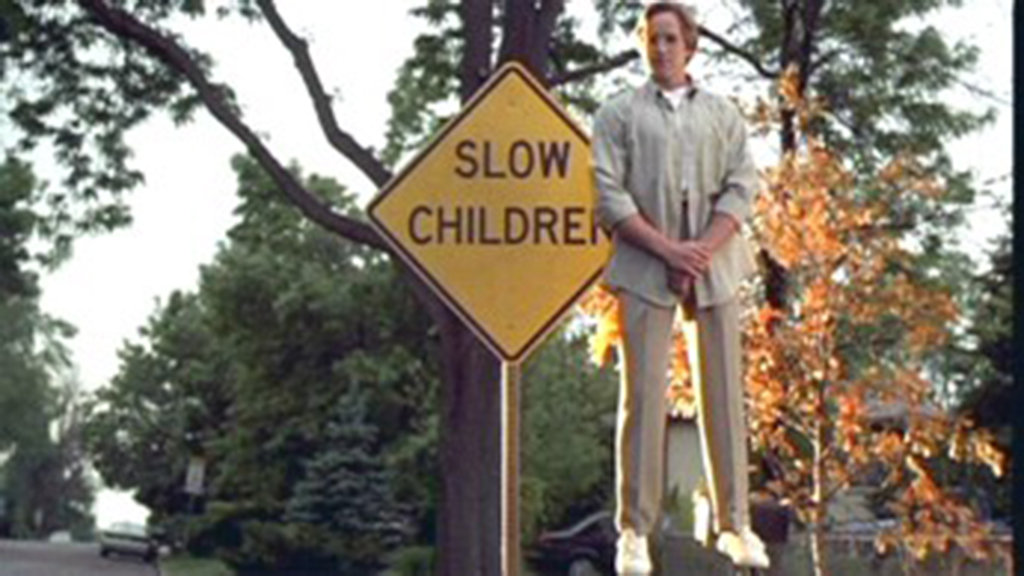
'SUP, DANNY? REMEMBER TO WATCH FOR SLOW CHILDREN. OH, AND DON'T GO TO THE OVERLOOK BECAUSE IT'S FILLED WITH MURDER-GHOSTS. PEACE OUT. *WHOOSH*

‘SUP, DANNY? REMEMBER TO WATCH FOR SLOW CHILDREN. OH, AND DON’T GO TO THE OVERLOOK BECAUSE IT’S FILLED WITH MURDER-GHOSTS. PEACE OUT. *WHOOSH*

At every turn, King chose to portray in his film the story exactly as he had originally written it, and at every turn, this was shown to be a mistake of plodding literalism over filmic mythmaking. King’s only sop to the novel I actually kind of liked was the fact that, as in the book, Halloran didn’t get killed at the end. I actually understand (and even agree with) the reasons Kubrick chose to kill off Halloran immediately after he arrived at the Overlook; after all, it showed that even despite Halloran’s own supernatural gifts and his tireless race to rescue Danny and Wendy, the evil of the hotel was just too powerful for him. It was still kind of a bummer, though. So yay for Halloran not dying.

I will say that the acting was actually decent for this type of thing, by which I mean, it wasn’t awful, but it was okay in a TV-movie sort of way. I didn’t get the sense that these were real people the way I did in Kubrick’s version; say what you will about Jack Nicholson and Shelly Duvall (and I happened to think the casting was pretty spot-on), but they played those roles with conviction, son. The little boy who played Danny in King’s version had a very distracting mouth that he never seemed to be able to close and he always talked like he had a sinus infection, but I’m not gonna pick on a kid for shit he probably can’t help. He was fine, even though I didn’t believe him as a real character either, mostly because of his oddly stilted dialogue.

WHAT'S WRONG WITH MY MOUTH, YOU MEAN LADY?!?

WHAT’S WRONG WITH MY MOUTH, YOU MEAN LADY?!?

Which brings me to another of the film’s glaring weaknesses: THAT dialogue, because of course you knew I would come to that. King, even in his books, is actually fairly adept at writing relatable characters, but he does have a well-documented habit of putting weird regionalisms and repeated “catchphrases” into the mouths of his protagonists. I can forgive this in his novels, as it’s usually not frequent enough to be grating; even though I don’t know a single person who talks like a Stephen King character in real life, on the page it’s an acceptable aspect of the unique world King has created with his stories. Hearing these “cute” verbal touchstones spoken aloud many, many times over the course of a mere six hours, however, is quite another matter. I swear I thought I was going to strain something from wincing so hard in empathetic embarrassment with Steven Weber as he had to repeatedly refer to Danny as a “pup” and incessantly scream at him to “take his medicine.” Over and over and over again. And that whole “kissing/missing” thing was so egregious that I almost felt like King was trying with all his might to forcefully wedge a catchphrase into the public consciousness so he could sell it on T-shirts or something. In that way it was kind of like the “Bazinga!” of its day, if you catch my meaning.

I WILL NOW GO TOTALLY META AND LET SHELDON COOPER HIMSELF ATTEMPT TO CLEANSE THAT ANALOGY FROM YOUR MEMORY.

I WILL NOW GO TOTALLY META AND LET SHELDON COOPER HIMSELF ATTEMPT TO CLEANSE THAT ANALOGY FROM YOUR MEMORY.

And then there was that epilogue, which as far as I can remember did not appear in the novel (and please correct me if I’m wrong). Ten years later, Wendy and Halloran are watching Danny graduating from high school, and we can see that (surprise), the grown-up Danny is actually the previously floating but now sadly earthbound Tony. As Danny collects his diploma, he sees his father standing there, and Jack repeats that horrible “kissing/missing” line and then they blow a kiss to each other in what is probably the creepiest and most unrealistic father-son moment ever captured on film. Yeesh.

Look, I understand that The Shining was a very personal story for King, based as it was on many of his own struggles with alcoholism, and I can even see why, when he made the film after having been sober for so long, he’d want to add in that little “hooray for redemption” fillip at the end there, as if to say, “See, the alcohol made us both monsters but we came through it and made everything okay and we’re still good guys, even if it’s only in the Jedi afterlife like Jack here.” I get that. But keep it out of your movies, man (and your books, wherever possible). It’s self-indulgent, sappy, and frankly sort of tawdry, the kind of ending I’d expect to see in a Nicholas Sparks movie or one of those Lifetime disease-of-the-week deals. Don’t cheapen what was originally a great story with manipulative mawkishness, yo.

In summation, the reason Kubrick’s adaptation is widely adored and generally considered one of the top five scariest films ever made is precisely because he restrained his emotional impulse and chose to elevate its source material to make an artistic statement. He trusted the audience to fill in their own blanks. He took what was a good story about a decent man being tragically consumed by demons, and he added layers and layers of subtext and symbolism, universalizing the story far beyond its dysfunctional family roots and turning it into a terrifying, complex fable that can be (and has been) interpreted in myriad ways. King’s 1997 adaptation, by contrast, simply took what was on the page and slapped it on the screen in an ordinary way, more or less word-for-word, thereby draining the narrative of any vitality or visual impact. It left no room for the viewer; everything was painfully laid out in front of you and over-explained to the rafters. An argument could be made that it is theoretically possible to craft a more faithful adaptation of King’s novel that is still a fantastic film, but unfortunately, this mini-series isn’t it.

THAT'S IT, I'M AUDI. LATER, BITCHES.

THAT’S IT, I’M AUDI. LATER, BITCHES.

Here are the Witches, Bitches!

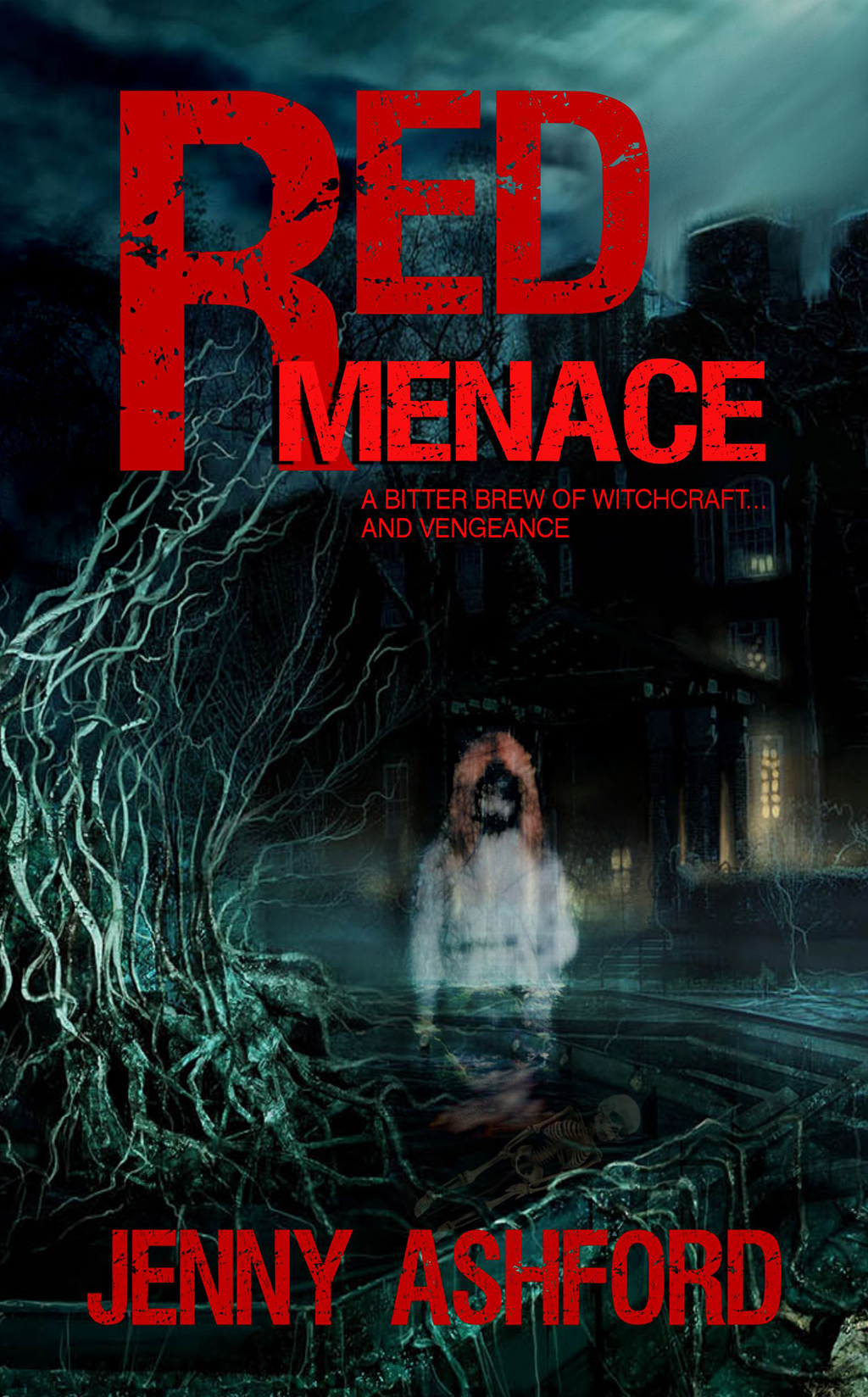
IT’S OFFICIAL! My novel Red Menace is out today! And best of all, there is a SALE! If you buy the ebook version today (PDF, ePub, MS Reader, Mobi Pocket, or Palm formats) directly from Damnation Books, it is absolutely FREE!!! You heard me, FREE. Can’t get any cheaper than that, can ya? If you need the Kindle version, it’s available from Amazon right here, for the low, low price of $5.95. If you’re an old fashioned girl like me, the print version will be available shortly.

If you have a horror mag/blog and would like a review copy or to set up an interview with the Goddess herself, please contact me at hecate80@hotmail.com. And if you read the book and enjoy it, would you please be so kind as to write a glowing review on the website of your choice? Thanks ever so much. If you need further incentive, there is a short excerpt from the novel below the pic. As always, thank you for your support! Goddess out.

RedMenaceCoverBlog

Excerpt from Red Menace
©2014 Jenny Ashford and Damnation Books

As Paige pulled the lid up to close it, she noticed a slight shift in weight that she hadn’t noticed before. There was a large elastic-topped pocket on the inside of the lid, and there was something inside it.

By this point, Paige’s earlier trepidation had nearly vanished. She didn’t know what she had expected to find when she came barging into the attic, but a suitcase of moldy old jars was certainly anticlimactic and had largely put her at ease, even though she remained dimly aware of the clock and the window holding her in the beams of their disapproving glances. She hardly hesitated in pulling aside the worn elastic and sticking her hand into the lid pocket, drawing out what her questing fingers found there.

It was a canvas bag, about the size of a pillowcase, and very dirty, with a thin rope drawstring. It emitted an earthy smell from between its fibers, and in a flash of insight from somewhere seemingly outside herself, Paige knew what was in the bag, knew it as surely as she knew her own name. Once this realization had dawned, Paige pictured herself placing the unopened bag gently back into its pouch, then closing the suitcase, fleeing the suite and locking its door behind her. In reality, she watched in helpless horror as her hands, acting on orders other than her own, parted the mouth of the canvas bag wide, exposing its contents to the shadowy, crimson light of the Black Room.

Bones. A whole skeleton, it looked like, jumbled in the bottom of the bag like grisly puzzle pieces, marred with clumps of soil that released a pungent odor into Paige’s nostrils, putting her reluctantly in mind of burials, of the smell of freshly turned earth at Daniel’s mother’s funeral.

The skull was staring up at her with a half-jawed grin. It was a small skull, surely that of a child. It looked yellow and brittle with age, though a sudden shift in sunlight outside the scarlet window made it blaze momentarily with life, as though the red light had animated the face, furnished it with muscle and flesh.


The Goddess’s Favorite Creepy Movie Scenes, or Home is Where the Haunting Is

In my previous post on Burnt Offerings, I mentioned that haunted house movies were my very favorite subgenre of horror film. I’ve also discussed on more than one occasion my belief that the best horror is achieved through suggestion and subtlety, through the principle of “less is more,” through manipulating the viewer’s (or reader’s) imagination to engineer the scares. I think I’ve also mentioned once or twice (in my entry on The Tenant, for example) that I love ambiguity in horror films, of never being sure if what we’re seeing is really happening to the protagonist or is simply a figment of his/her fevered brain.

In this entry, I’d like to focus on a film that is sort of the ultimate distillation of all of these themes. Even though — at odds with my loose “rules” about posting discussions of better-known movies — this film is generally considered to be one of the scariest ever made, and even though scenes from it have appeared on other lists around the internet, I really, really want to talk about it anyway because it’s probably my favorite horror movie of all time and it’s my blog anyway and SO THERE.

You can complain about having to read this, but no one will hear you. In the night. In the dark.

You can complain about having to read this, but no one will hear you. In the night. In the dark.

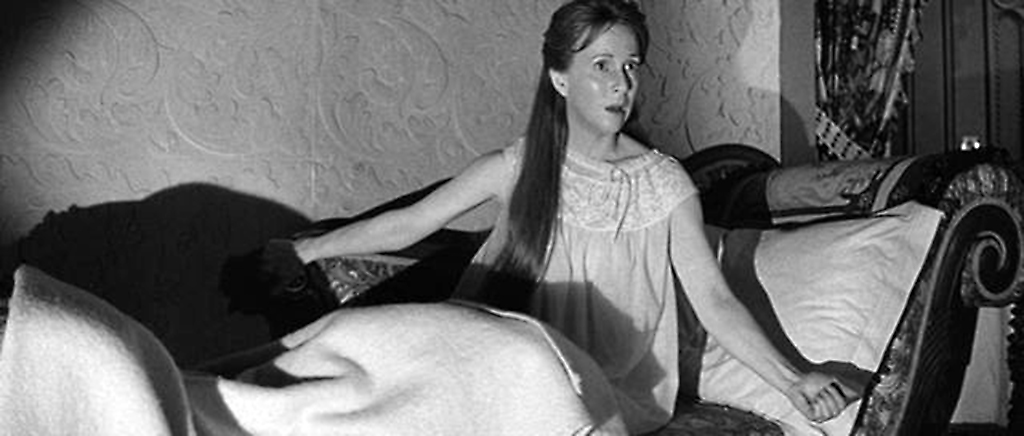
The 1963 film The Haunting (masterfully directed by Robert Wise) is like the granddaddy of creepy, atmospheric haunted house films that achieve their effect through nothing but insinuation. The movie appears on pretty much every legitimate list of the scariest films ever, but, spoiler alert: IT NEVER SHOWS A THING. There are no phantoms drifting through the hallways, no blood dripping from the walls, no demons leering from the mirrors. That overwhelming feeling of dread you feel as you watch it is entirely down to camera angles, strategic shadows, sound design, and the terrified reactions of the actors.

Haunting-4

I will, for a moment, deign to acknowledge that there was an intensely stupid (and Razzie-nominated!) remake of this film in 1999, directed by Jan de Bont. I am only mentioning its vile existence in order to draw a stark contrast with the original. The remake essentially showed EVERYTHING…there were CGI ghosts flitting around everywhere, I think some dragonlike something-or-other flew out of the fireplace at one point (I honestly can’t remember and I refuse to rewatch it to check), there was a big purple mouth in a ceiling or some shit, I really just can’t even. This right here is a cautionary tale: the remake saw everything that was atmospheric and spooky and frightening about the original and took a giant ectoplasmic dump all over it. MOAR GHOSTS!!! MOAR FIRE!!! MOAR MONSTERS!!! CAN WE PUT SLIMER FROM GHOSTBUSTERS IN THERE??? HOW ABOUT A BED THAT’S LIKE A BIG-ASS SPIDER OR SOMETHING??? WHY THE FUCK NOT? HERP DERP. Okay, I’m exaggerating, but as you can tell, the emotions are still a little raw. So let’s just go back to forgetting that festering pile of feces pieces ever got made and get on with the good stuff, shall we?

Seriously? Just knock it off.

Seriously? Just knock it off.

The Haunting was of course based on Shirley Jackson’s spectacular 1959 novel The Haunting of Hill House, which I heartily recommend. Stephen King rightly chose it as one of the best horror novels of all time, and discusses its themes at length in a chapter of his 1980 book Danse Macabre. The 1963 film hews very closely to the plot of the book. It’s a fairly standard haunted-house type of story: Dr. Markway (Richard Johnson) is doing a paranormal investigation of the infamous Hill House, which has been the scene of many mysterious deaths and creepy happenstances since it was built. Joining his ghostbusting posse are heir-to-the-owner Luke Sanderson (played by Russ Tamblyn of West Side Story fame), free-spirited lesbian psychic Theodora (Claire Bloom), and sheltered, mentally unstable poltergeist focus Eleanor (Julie Harris). Markway’s wife Grace (Lois Maxwell) joins the fun later on in the film.

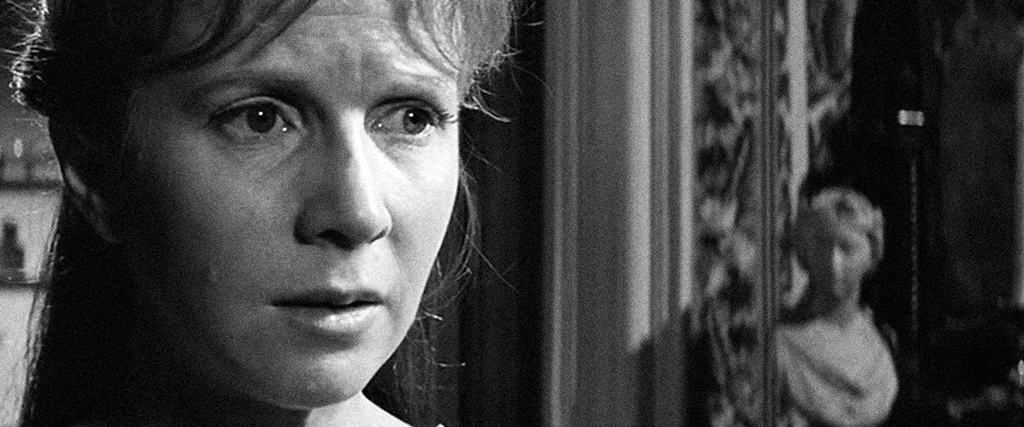
Elevating the story from a run-of-the-mill spooky-house romp into an artful masterpiece of terror are not only the gorgeous cinematographic flourishes, but also the layers of uncertainty surrounding the character of Eleanor, and the way her own past seems to mirror that of the dreadful house. She is summoned to the investigation by Dr. Markway because of an incident in her youth where stones fell on the roof of her house in an apparent poltergeist attack, though she never experienced paranormal activity again until arriving at Hill House. Eleanor herself is intensely reflective, perhaps even self-absorbed, and insecure to an almost monstrous degree. She is working through her feelings of guilt and inadequacy following the death of her mother, who she had wiled away years of her life caring for. Because Hill House’s history boasts a similar situation of a suicidal companion, Eleanor feels an immediate affinity with the house, and senses that her destiny is there, and that she has “come home.” The house, for its part, seems to play upon this connection she feels, as Eleanor becomes the main focus of the activity. There is banging on the walls that reminds her of the way her mother would bang on the walls to call to her, and at one point writing appears on the walls of Hill House, chillingly reading, “Help, Eleanor, come home.” Is the entity in the house using Eleanor for its own nefarious purposes? Or is Eleanor unconsciously projecting her own fears and insecurities onto the house and manifesting an entity that was never really there? The film never takes a stand either way, and this is one of its great strengths.

haunting_21

Filmed in luminous black and white, the whole movie is a study in atmosphere and escalating tension. The vast interior of the house itself is often shot from unsettling angles and skewed perspectives, and there are always eerie shadows populating the corners. There are many, many scenes of skin-crawling dread, but there are really two I’d like to discuss here. In the first, Markway and the two women are downstairs. Luke has come downstairs to raid the bar (as you would), and as he stands there chugging straight out of the bottle (classy), suddenly we see (and hear) a door slam by itself. All four of our heroes are naturally wigged out, and as they stand there frightened, wondering what to do, they begin to hear another sound, a sort of strange, windy shuffling that then resolves itself into a steady bang…bang…bang. Like loudly echoing footsteps, coming toward them down the hall. Markway initially thinks it may be his wife Grace wandering the halls (she had been sleeping in the nursery) and goes to open the door, but Luke stops him, saying that the sounds were not coming from anywhere near the nursery. The steady banging gets louder and closer. Eleanor and Theodora are huddled up in blankets on the couch, terrified. The banging is joined by that weird windy noise again. Eleanor thinks to herself (in voiceover), “It knows my name. This time it knows my name.” Markway, fearing that his wife is in danger from whatever is out there, lunges toward the door. Eleanor leaps to her feet to stop him. “NO! NO! It hasn’t hurt me, why should it hurt her?” Markway points out, “She may try to do something about it.” Before Markway can get the door open, though, the noise stops, and he hesitates. Eleanor turns and addresses Theodora. “Is it over, Theo?” Theodora says no, that she still feels cold, and that she senses that “it’s going to start everything all over again.” And sure enough, the next second there comes a volley of metallic-sounding blows on the back of the door that Markway and Luke are still standing in front of. “Don’t let it get in!” Eleanor pleads. Then…silence. Everyone looks at the door, their faces hopeful but still contorted with fear. And then the doorknob begins to rattle, ever so slightly. Luke’s eyes get as big as saucers. Eleanor, her hands clutched in front of her mouth, mews, “Oh God, it knows I’m here!” The doorknob stops rattling, but then the door itself starts to…breathe. There is no apparition, there is no sound other than a slight creaking. There is only that door, bulging weirdly out and then back in. Out, and then back in. It’s such a creepily affecting visual, and so simply done. There is a closeup of Luke’s hand as he drops the liquor bottle on the floor, and then he attempts a little levity by choking out, “Hey Doc. I’ll let you have the house cheap.” There is another moment of silence when they think the terror has passed, but then the banging starts up again, moving across the floor above them this time. All four stare at the ceiling, following the progress of the thing that haunts Hill House. Eleanor thinks that the entity will keep going on until it finds her. Bang…bang…bang…and then there is a strange, sort of rolling metallic sound, almost like thunder but more like someone plowing through pieces of sheet metal. Dr. Markway is staring up at the ceiling and following the sound, and he suddenly knows where the entity is heading. “It’s at the nursery!” he says, and then lunges for the door. Spoiler alert: when they get to the nursery, Grace has disappeared, and we don’t find out what happened to her until the very end (or do we?). Mwahahahaha.

the_haunting_2

The second scene is even better. It starts with a gorgeous night shot of the exterior of Hill House, accompanied by a creepy soundtrack that sounds sort of like church bells. We pan into Eleanor’s shadowy bedroom, and focus on a sort of raised floral pattern on the wall. Eleanor wakes up and peers over her shoulder at the section of wall. She thinks she hears a man’s muffled chanting coming from behind there, though she can’t make out the words. The camera closes in on the pattern as the voice gets louder, and we start to imagine we can see things in the wall, like a single disapproving eye in the top right corner. In reality there is nothing there, but the way the sequence is shot makes you think there may be. Closer still, and we can almost see another eye, and perhaps even a gaping mouth in the floral pattern. Frightened, Eleanor whispers for Theo, who is sleeping in another bed across the room, though it is too dark for Eleanor to see her. “Are you awake?” she whispers. “Don’t say a word, Theo, not a word. Don’t let it know you’re in my room.” Theo doesn’t answer, but then Eleanor hears a woman’s eerie laugh coming from behind that creepy-ass wall. Eleanor, the covers pulled up to her chin, sticks her hand out into the darkness. “Hold my hand, Theo,” she whispers. “And for God’s sake, don’t scream.” The muffled chanting gets louder, and there’s more of that laughing, and now the pattern on the wall REALLY looks like a horrible face, even though it’s exactly the same pattern as it was before. The noises stop, and Eleanor asks the psychic Theo if it’s over. Then she winces. “You’re breaking my hand!” she says. Then she hears a child crying from behind the wall, and the way the shadows fall on the pattern now makes it clear that there are two eyes and a mouth. She thinks to herself how monstrous and cruel the entity must be, to hurt a child, and how no one should ever do such a thing, and how it’s probably only doing it to scare her but it isn’t succeeding. Then she thinks again that Theo is hurting her hand by squeezing it so tight. She thinks that she will put up with a lot from the house for the sake of the experiment, but that the house hurting a child to get to her is going too far, and she insists she’s going to yell, and indeed, that she does; she screams, “STOP IT!” And then the shot quickly pulls back to show her in her bed, and the lights come on, and there’s a spinning shot across the room to show that Theo is still in her bed across the room, and has just woken up, disoriented. Eleanor gazes down in horror at her hand, which is still extended out and loosely closed, exactly as if someone had been holding onto it. She gets out of bed, still staring, transfixed and disgusted, at her hand. “Oh God,” she says, extending her fingers. “Whose hand was I holding?”

haunting01-2

Meeeeeeeeeeep. Think about THAT next time your foot comes out from under the covers in the middle of the night. Yes, it’s true, everybody…THE MONSTERS UNDER YOUR BED WILL GRAB YOUR SHIT IF IT COMES OUT FROM UNDER THE COVERS.

And with that, I bid you adieu. Goddess out.

The Goddess’s Favorite Creepy Movie Scenes, or If Chauffeurs Ruled the World

Allow me to briefly expound upon my love of haunted house movies. They are, bar none, my go-to genre of horror film, and my list of favorites includes many stellar examples: The Haunting, The Others, The Changeling, The Innocents, The Shining, The House by the Cemetery, Let’s Scare Jessica to Death, Ghost Story, The Legend of Hell House. There is just something so inherently nasty about the haunted house story. Your house, after all, is where you sleep, where you get naked, where you’re the most vulnerable, where you’re supposed to be able to relax and live your life safe from the prying eyes of the public. When this feeling of safety is subverted by a haunting, you feel doubly violated, as you have nowhere to go to escape the terror; it has literally invaded the place where you live. The haunted house film, when done well, gives the viewer a sense of claustrophobia and unease that cannot be matched by any other subgenre. Intense atmosphere can be wrenched from every shot of a darkened hallway, a locked door, a dusty basement or attic. Our houses are our outer shells, and when they turn on us, the results can be horrifying.

936full-burnt-offerings-poster

One of my favorite haunted house films of the 1970s, and one that typifies the “house as living entity” trope apparent in many films of the period, is 1976’s Burnt Offerings. Based on Robert Marasco’s novel and directed by Dan Curtis (well known as the creator of the 1960s vampire soap, “Dark Shadows”), the film tells the story of a married couple, Ben and Marian Rolf (Oliver Reed and Karen Black) who rent a gorgeous neo-classical mansion for the summer, along with their 12-year-old son David (Lee Montgomery) and Ben’s delightfully sassy aunt Elizabeth (Bette Davis). The beginning of the film sees the couple arriving at the house, unable to believe that this enormous estate is the same one offered for a “reasonable” price in the ad they answered. The first person they meet is the obligatory toothless hick caretaker, Walker, and shortly afterward they come face to face with the owners of the house, the weirdly intense brother and sister team of Arnold and Roz Allardyce (Burgess Meredith and Eileen Heckart). The siblings offer the Rolfs the unheard-of rental price of $900 for the entire summer, provided the Rolfs are “the right people.” Ben is skeptical, thinking the whole situation is too good to be true, and monumentally freaked out by the Allardyces’ strange way of talking about the house as if it’s alive. The viewer is pretty much on Ben’s side too, at this point, since we have already seen Arnold watching hungrily out the window as David falls and cuts his leg as he’s playing in the garden. We have also seen that one of the dead plants in the greenhouse has developed a new, young shoot.

Marian, however, has no reservations at all about renting the place, as she has already been seduced by its beautiful interior, full of shining wood, sparkling chandeliers, priceless antiques, and creepy old photos in ornate frames. Her enthusiasm is hardly dampened at all when the siblings throw in one final “catch”: their 85-year-old mother will be staying in the house with the Rolfs. The Allardyces insist that their mother will be no trouble at all, that she never leaves her room and that they will probably never even see her. All they ask is that Marian make a tray of food three times a day and leave it on the table in their mother’s sitting room. Ben is extremely put out by this condition of their rental (what if the old woman dies on their watch, he rather reasonably points out to his wife), but he finally gives in when he sees how much Marian loves the house. They move in on July 1st, planning to stay until Labor Day.

From there, little things conspire to make the house seem creepier and creepier. Marian begins to spend all her time cleaning and fixing the house up, and insists that no one is allowed into Mother Allardyce’s quarters but her. Ben and David find an old cemetery on the grounds, in which all the graves are Allardyces, but none of the death dates is more recent than 1890. Ben also finds a mysterious pair of broken spectacles at the bottom of the swimming pool. The trays of food that Marian dutifully leaves for the mother are never eaten, and the old woman never responds to Marian’s knocks. Marian herself slowly begins to dress more primly, as if she is from the era when the house was built. She also takes to mooning around for hours in Mrs. Allardyce’s sitting room, listening to an antique music box and staring longingly at the old woman’s collection of photographs. Her hair is also slowly beginning to turn gray.

As the tension builds, the weirdness gets weirder: while horsing around in the pool, Ben succumbs to an uncontrollable bloodlust and almost drowns his son. Marian notices that certain things around the house and grounds seem to be regenerating themselves. The windows and doors in David’s room close and lock, and the gas heater somehow turns on and almost kills him. The formerly perky Aunt Elizabeth begins to quickly decline from some mysterious ailment, and eventually dies.

And then, there’s Ben’s nightmare.

burnt_b&w

The night after almost drowning his son in the pool, Ben has a dream, filmed in spooky black and white, of himself as a little boy attending his mother’s funeral. In this nightmare, there is an unsettling figure of a lanky chauffeur, clad in a black uniform and dark glasses, lurking around the outer edges of the funeral party, and standing by the door of an old-fashioned black car to usher Ben inside. Ben gets into the car, and then the chauffeur’s creepily smiling face appears in the car window. The chauffeur is so eerie looking that one wonders if it was an actual person that Ben remembers from the funeral, or just a product of his subconscious. In either case, what the hell is that freaky-looking chauffeur smiling at?

As if the dream scene wasn’t bad enough, there comes a chilling sequence later in the film where Ben, who has been out working in the garden, is taking a break, sitting on the grass and drinking a beer. Suddenly, he sees the grille of a car approaching through the trees. It’s the same black car from his nightmare. It comes ever so slowly up the drive, and Ben is just sitting there watching it, shaking like a leaf. The car stops several yards away, and the chauffeur’s pale face can be seen through the window, watching Ben with that horrible smile. Ben loses his shit and covers his eyes, and when he looks up again, the car is gone.

The third appearance of the chauffeur is also a cracker. Ben is sitting with his dying aunt one night and hears a car pulling up outside. Creeping to the window, he sees the telltale black car coming around the drive. He wigs out and backs slowly away from the window back toward Elizabeth’s bed. Both Ben and a nearly incoherent Elizabeth begin to hear a noise at the door, as of someone trying to get in. Then there’s a close-up of the door, and then a loud bang as the door opens, then there’s that damn chauffeur in the doorway, grinning, his eyes invisible behind his dark glasses. There’s a full-length shot of him standing on the threshold, a shot of Elizabeth screaming, and then the chauffeur pushes a coffin into the room toward the camera, and everything goes black. Brrrrrrrrrrrrrrr.

I’d like to add here, on a personal note, that the first time I saw this film was when I was about thirteen. I was at a slumber party at an old mansion owned by the wealthy parents of a friend of mine. This house was straight out of a movie itself, with a giant sweeping marble staircase, crystal chandeliers, back staircases for servants, and endless twisting hallways leading to rooms upon rooms. I had never seen such a house in real life, and it was probably not the best environment to see Burnt Offerings in, for as soon as the chauffeur made his first appearance, I and all the other girls at the slumber party were scrambling to hide under the blankets on the sofa or hightail it out of the room. The house around us just seemed a little too similar to what we were seeing on the screen, and we could all imagine glancing behind us and seeing that smiling motherfucker standing in the doorway and pushing a coffin at us. It’s a memory that’s stayed with me for almost thirty years.

As for the rest of the film, as you can probably guess, things don’t go well for the Rolf family. Spoiler alert: everybody, including the kid, dies in various horrid ways, except for Marian, who becomes the formerly non-existent Mrs. Allardyce in the end, a living embodiment of the house.

When I was doing research for this recap, I noticed that reviews of the film were very mixed, as many filmgoers felt the ending was too obviously telegraphed, but I’ve always found that the atmospheric creepiness of the journey makes up for any pedestrian aspects to the plotting or theme. One also has to take into consideration that many aspects of the film that seem old hat to people nowadays weren’t quite the clichés they are now, and in fact, some themes in this film were quite original, but later co-opted for later films in a similar line. I also really think the acting is terrific; Karen Black is always great, and Oliver Reed is splendid, especially in scenes featuring the fun, smart-ass bickering between Ben and Elizabeth. So if you’re in the market for a classic slice of 1970s haunted house eerieness, you could certainly do worse than Burnt Offerings. The book is great too, by the way, and with that, I’ll bid you pleasant, chauffeur-free dreams.

Nope. I'm here as an emissary of your demise.

Nope. I’m here as an emissary of your demise.

Goddess out.