horror
The Goddess Picks Her Top Five Books and Stories That Desperately Need Film Adaptations
As we all know, the book is almost always a thousand times better than the movie, but sometimes that doesn’t stop me from seeing a movie in my head as I read and desperately wishing I had unlimited funds and some measure of directing talent so I could bring my vision of these stories to the masses. My choices may be a bit idiosyncratic, but if any Hollywood execs are reading this, you’d have at least one ticket sale right here, so think about it, won’t you? For the Goddess. Oh, and by the way, if any of you aforementioned execs want to option any of MY wonderful books or stories for film, give me a shout. We’ll have a cappuccino and a chat and then maybe you can fork me over a largish check. The movie can even suck, I don’t care, so no pressure on you from my end. Thank you, and on with the list:

5. And the Ass Saw the Angel by Nick Cave
Nick Cave is like the mad genius of all media. He’s a singer/songwriter, film score composer, screenwriter, novelist, actor, and lecturer, and miraculously, he is ridiculously brilliant at all these endeavors. It’s really not fair to the rest of us, as infinitely less awesome mortals, but I content myself with believing that Nick is actually Satan himself and has chosen to capture human souls through the sheer dark force of the splendid entertainment he produces. Nick’s first novel, And the Ass Saw the Angel, is a whacked-out, Faulkneresque brew of Old Testament fury and Southern Gothic excess, and any adaptation would of course have to be scripted and scored by the man himself. I’m seeing it done in sepia tones, perhaps with a hand-cranked camera to give it that otherworldly feel; bonus points if it’s also done as a silent film (since main character Euchrid Euchrow is a mute). In theaters, it should be preceded by a short film: a sinister, stop-motion animation adaptation of Nick’s 1986 song, “The Carny.”
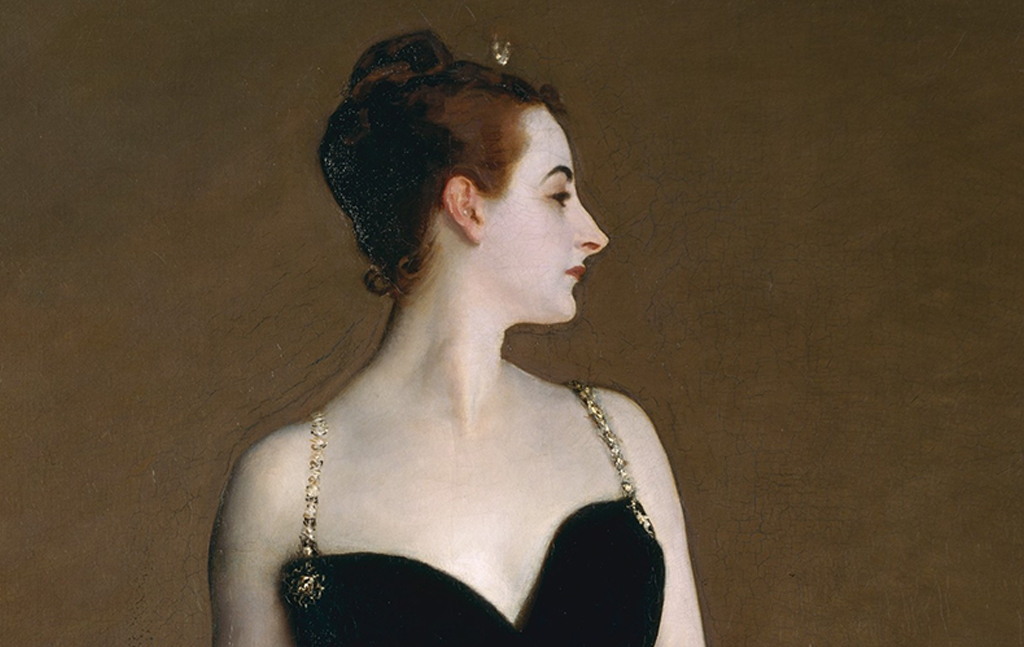
Perhaps an unusual choice, as it’s non-fiction, but I have long been enchanted with the story of Virginie Amélie Avegno Gautreau, the haughty society woman who posed for John Singer Sargent’s most famous painting, Madame X. (I even wrote an article about her on this very blog.) It could be a fascinating study of vanity and how pride goeth before a fall, and the set design and costumes would be FANTASTIC. In fact, I wanted to see this on film so badly that I actually wrote a (not very good) screenplay a couple of years ago that interwove Virginie’s biography with a modern tale of an unstable woman participating in an art heist, but screenwriting isn’t really my strong suit, so if anyone out there would care to take the reins, I swear I won’t be mad.

Dan Simmons’s gigantic novel, a Victorian medley of supernatural horror, drug abuse, and fictionalized biography, sees Charles Dickens and Wilkie Collins on the trail of the mysterious man-creature known as Edwin Drood (who was, in real life, the main character of Dickens’s final unfinished novel). This would be a fabulously spooky cobblestone-streets-and-top-hats film in the line of From Hell or The Prestige. Missed opportunity alert: back in 2009, Universal Pictures hinted at a Drood adaptation that would possibly be directed by Guillermo del Toro (TAKE ALL MY MONEY. ALL OF IT), but sadly, that project seems to have gone nowhere.
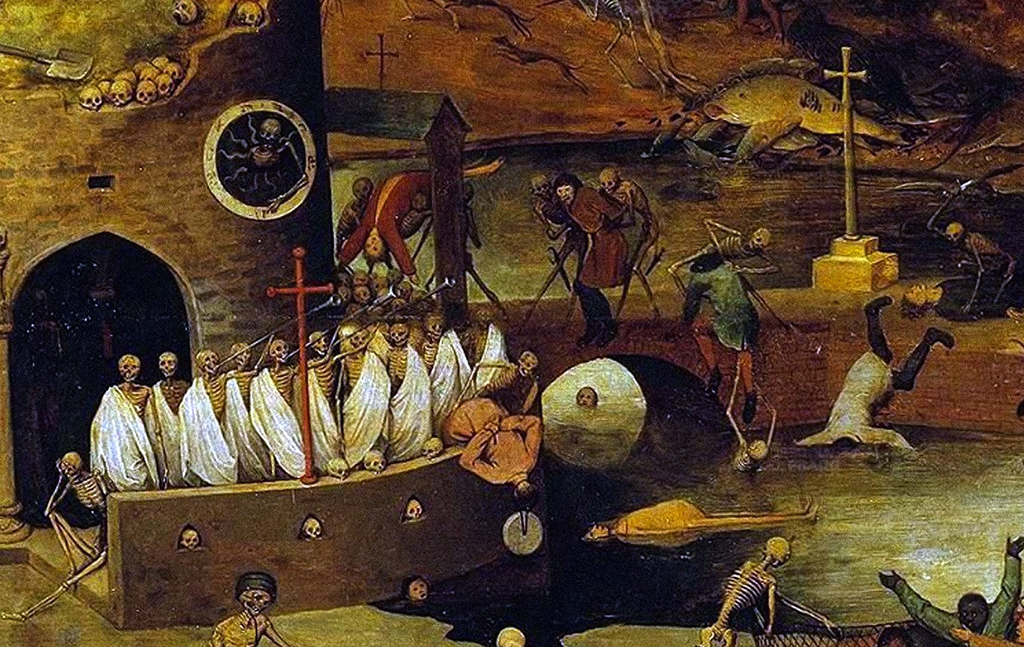
2. “The Triumph of Death” by H. Russell Wakefield
Early 20th century author Herbert Russell Wakefield is considered one of Britain’s finest writers of supernatural horror. His 1949 short story “The Triumph of Death” is one of my favorite stories of all time, and although it was adapted once for British television in 1968 as part of an anthology series called “Late Night Horror,” I really feel that its themes of cruelty, madness and revenge could be expanded to a feature-length movie. The story isn’t really set in a specific time or place, but I’d like to see the action unfold maybe around the 1920s, in either an English village or a small colonial-style enclave in Massachusetts or somewhere like that. It should be understated, but the flashes of Gilles de Rais-style torture shouldn’t be overlooked. The vile Miss Pendleham should be played like the high-collared stepmother from Disney’s Cinderella, but in human form, perhaps by Judi Dench or Maggie Smith. This is another story that I’ve actually been itching to write a screenplay for, and I even went so far as to try to contact various people about obtaining the adaptation rights, but I seem to have hit a dead end in that regard. More’s the pity.

1. The House with a Clock in its Walls by John Bellairs
With the unbelievable explosion in popularity of films based on YA literature that occurred in the wake of Harry Potter, I must say that I am absolutely flabbergasted that no one has thought to adapt this as a film. This and The Westing Game were absolutely my favorite books growing up, and I read them again and again. They both hold up amazingly well even when read as an adult. There should probably also be a good, big-budget adaptation of The Westing Game, now that I think of it, but The House With a Clock in its Walls is such a wonderfully creepy and fun story, and it could be done super dark or a tad more lighthearted, either as live action or perhaps as Tim Burton-esque stop-motion. It would actually be great if a filmmaker could capture the eerie look of Edward Gorey’s delightful illustrations, which for me added so much to the magic of the book. I feel that it should be set in a sort of mythical 1950s, and that the main character of Lewis should be a straight-laced but likable boy whose chubby awkwardness makes him at once pitiable and relatable. Uncle Jonathan should be his affably wizardly self, and witch neighbor Florence should be like a cool grandmother type. I’m seeing the resurrection scene, when Lewis accidentally raises evil wizards Isaac and Selenna Izard from the dead, as super, super scary, like maybe with a Sleepy Hollow kind of vibe. Also, the house itself should be a rambling, creepy, Victorian pile (perhaps they could even shoot the film in the real-life house the story was based on, Cronin House in Michigan), and the interiors should be suitably gothic. The sound design would of course have to include the constant ticking of that terrible doomsday clock. It would make a terrific film for kids and adults, and it’s even the first book in a series (cha-ching, Hollywood execs), though the rest of the books didn’t grab me the way this one did. Amazingly, the only filmed adaptation of this book that I know of was as one lame, cheesy third of a Vincent Price-hosted 1979 TV anthology, “Once Upon a Midnight Scary.” YOU GUYS, THIS NEEDS TO HAPPEN. Gather up all of your money and diamonds and cookies and gold bars and Red Lobster gift cards and send them to whoever can greenlight this. DO IT NOW. Thank you, and Goddess out.
The Goddess’s Favorite Creepy Movie Scenes, or My Big Fat Giant Wedding (With Witches)
Children are often frightened by inexplicable things. When I was but a wee goddess, for example, I was sent into paroxysms of terror by the bubbling cauldron sound effect at the beginning of the song “The Monster Mash,” and to this day I still have no idea why. Without fail, whenever the song came on the radio around Halloween, I would bolt from the room, trembling, with my hands clamped over my ears. Similarly, I have very vivid memories of a large, papier-mâché dragon mask made by my uncle sometime in the late 1970s. He kept it in his bedroom at my grandfather’s old house (which was a huge, dark, mysterious pile whose corridors and overgrown gardens still feature in many of my dreams), and I absolutely refused to go upstairs the entire time the mask was there. After all, It might have been watching me with those horribly blank eyeholes, and planning to gobble me up. The mask made such an impression, in fact, that many years later I used it as the basis for a short story called “Heartworms” (which can be found in my 2011 book The Associated Villainies, if you’d care to read it).
On the other hand, a great deal of ostensibly “children’s” entertainment is purposely made to be straight-up nightmare fuel, from the days of Grimm’s Fairy Tales to the more modern frights dished out by the likes of Neil Gaiman’s Coraline and the Harry Potter series. Most kids absolutely love to be scared, or at least I did when I was that age, as I rented age-inappropriate slasher flicks from our local video store and checked out every Alfred Hitchcock horror anthology from the library that I could get my sticky little fingers on. Often, when you see or read your childhood terrors again as an adult, you’re sort of shocked that kids turn out as relatively normal as they do, having processed images like that when their brains were still not fully formed (there’s also that corollary of “Why the hell did my parents let me watch/read that, for fuck’s sake?”). Think of the witch’s transformation scene from Disney’s Snow White, for instance, or the Heffalumps and Woozles from Winnie-the-Pooh and the Blustery Day, or the “Night on Bald Mountain” sequence from Fantasia. Think of Augra and the creepy Skeksis from The Dark Crystal, or the “Wembley and the Terrible Tunnel” episode of “Fraggle Rock.” When you really stop to think about it, a startling amount of children’s entertainment from my era is chock full of horrors, from the poor little cartoon shoe getting slowly lowered into the Dip in Who Framed Roger Rabbit to the nightmare scene in The Brave Little Toaster to the boat ride in Willy Wonka and the Chocolate Factory to pretty much the entirety of Watership Down. I don’t really have any definitive theories as to why writers and filmmakers often go so dark with material that is supposedly meant for children. It may be because, as creative people, they remember all too well how new and real everything feels when you’re a kid; scary things are ten times scarier and tend to stick with you for years in a way they fail to do as you get older. Adult filmmakers know very well that they’re terrifying the pants off the rugrats, but I don’t think they’re doing it out of sadistic glee. Quite the contrary, I feel that it’s a tremendous gesture of respect toward children, a way to say, “I know what I’m putting on the screen in front of you is scary, much scarier than it would be if you were a grown-up. But I also know that you’re strong enough to handle it.”
There were many, many cartoons that left an indelible imprint on my young and fragile psyche, but I’d like to discuss this particular one, simply because for many years I thought I had maybe imagined it. I remember seeing it several times on HBO or Cinemax somewhere around 1978 or 1979, but then not seeing it again for many, many years. Every now and then, a memory of a scene would drift through my consciousness, and I would ask whoever I happened to be with at the time if they knew what cartoon I was talking about. None of them did, and I began to feel as though the whole thing had been a fever dream. But then came the advent of the internet, and at last I was able to confirm that yes, it was a real animated movie, and yes, of course you can now watch the entire thing on YouTube. Big high five to the 21st century.
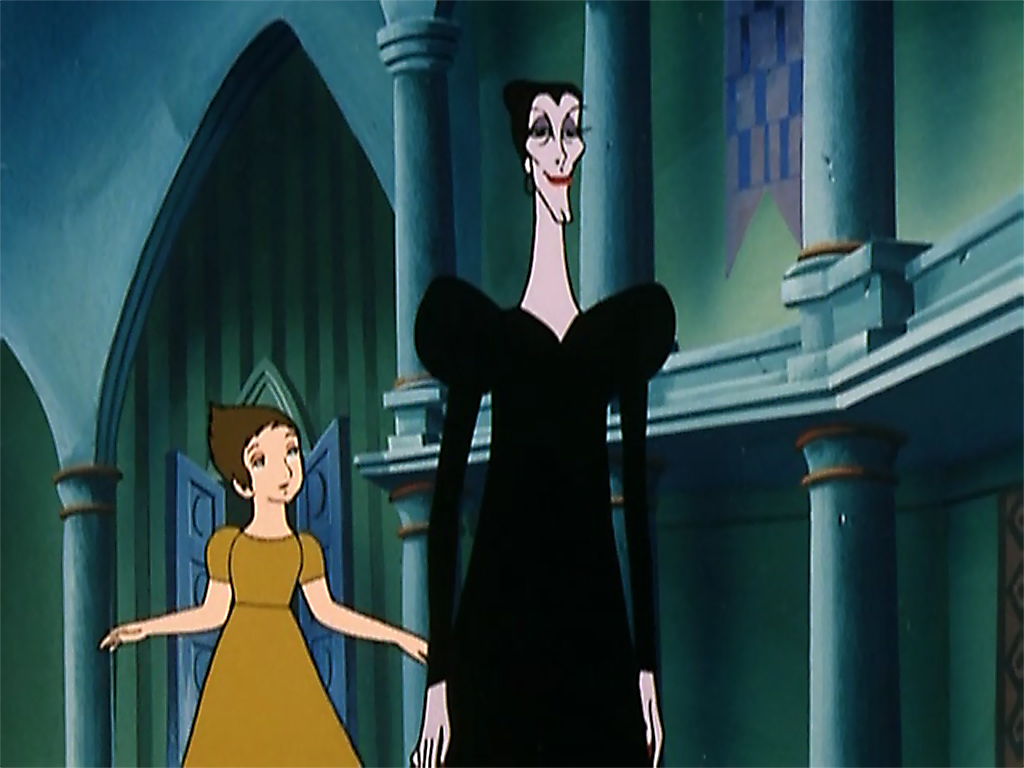
Jakku to Mame no Ki, better known by its English-language title, Jack and the Beanstalk, was a 1974 Japanese attempt at replicating a more Western, Disney-style musical animated film. It was directed by Gisaburö Sugii, and was of course based on the well-known fairy tale, though because it was Japanese, it seemed like it couldn’t help but go off in some fairly strange directions.
There’s the standard fairy-tale opener of Jack buying some magic beans and climbing up the subsequent stalk, and there is a giant involved, but here’s where things get sort of weird. The first person Jack meets when he gets to the castle in the clouds at the top of the beanstalk is Princess Margaret, a big-eyed, pointy-haired beauty who seems ever-so-slightly out of it. She’s very wispy and serene, floating around on little cloud puffs and humming contentedly to herself. She takes Jack into the seemingly deserted castle and shows him a glowering portrait of a giant, hulking brute named Tulip, who she is going to be marrying the next day. She is clearly blissfully happy about this development, swirling around the empty castle rooms like a super mellow hippie chick on a massive dose of E, but Jack just seems wigged out by the whole situation. His unease only grows when he is introduced to the giant’s mother, an Evil Queen/Maleficent/Cruella DeVil simulacrum named Madame Hecuba, who has a scrawny, terrifying face, huge evil eyes, and a creepy-as-fuck old-hag voice. She can also move things around just by waving her hands, so you know she’s no one to trifle with, although at first she seems rather hospitable, if a tad menacing. Madame Hecuba sends Margaret to her room to “fix her makeup” (we find out later that the witch is using a drug that comes out of a powder compact to control Margaret and get her to marry Tulip so that Madame Hecuba can be queen and run the Land of the Clouds after she offs the princess) and then takes Jack up to the dining hall. They walk through the darkened, cavernous hallways with the weirdly patterned floors, and then they get into an elevator that takes them up to the long, eerie dining room. There, the witch feeds Jack a soup that knocks him out, and then she greedily stashes him in a pot for later eating, gloating the whole time that it’s been twenty long years since she was last able to feast on human flesh.
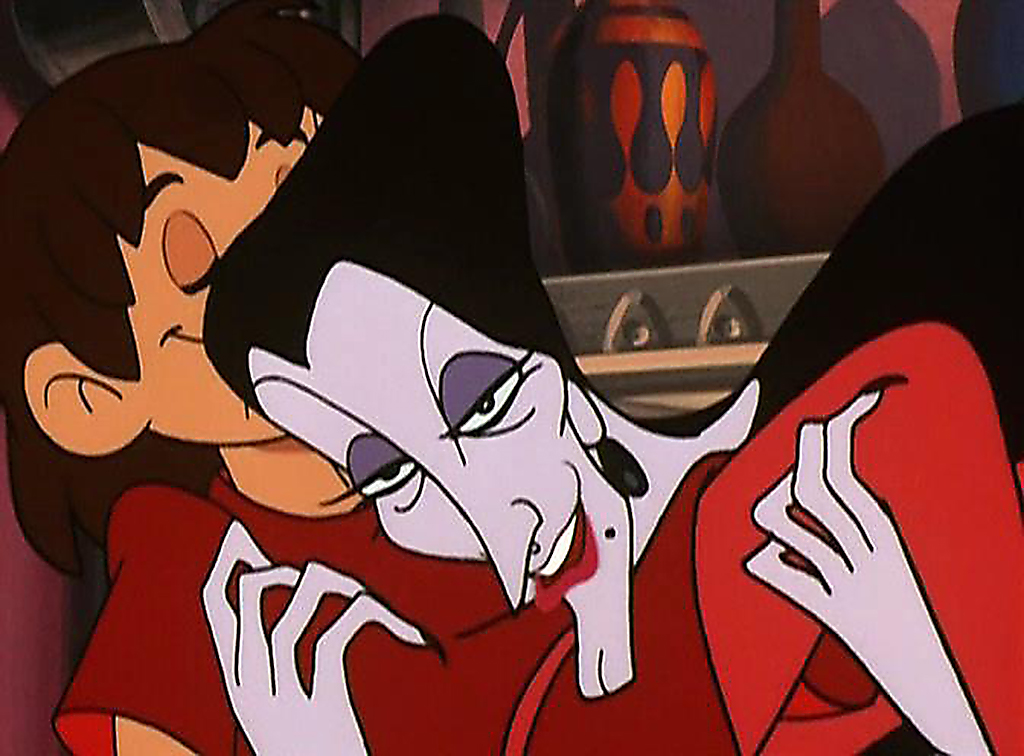
Yummy, yummy human flesh.
The scene I’d like to focus on is the wedding scene between Tulip and Margaret, because it’s sort of trippily disturbing in a way that I couldn’t quite articulate when I was seeing it as a child. We see the stupid, apelike Tulip getting spiffy in his wedding clothes, and then we see Madame Hecuba industriously cutting something or other out of sheets of white paper. There’s a shot of Margaret in her wedding dress, sitting in front of the mirror in her room, totally spaced out and not moving. In the next shot, we see that Madame Hecuba has actually been cutting out life-sized and square-headed paper people, with only slits for eyes and no other facial features, and now she’s draping them lovingly over the pews in the wedding chapel. Did I mention that Hecuba is singing a totally weird song while all this is going on, complete with witchy cackling and lyrics about how she can’t stop laughing because she knows her terrible scheme is coming to fruition? Yeah. Japan. Anyway, Tulip lumbers in in his ridiculous suit, and then Hecuba raises her arms, and all the paper people stand up like reverse dominoes. She spreads her arms again and all the paper people dutifully sit down.
The witch then goes to Margaret’s quarters. Margaret stands up when she enters, as if on cue, but doesn’t look at her or speak. Hecuba tells Margaret that her bridegroom is waiting, and that all the guests are assembled in the chapel, and that Margaret mustn’t keep everyone waiting. The drugged Margaret follows the witch out of the open-air room without saying a word. Then, there is the sound of wedding bells from the tower, and a slow pan down the exterior walls of the castle. Meanwhile, Jack and his dog have found the treasure room, where there are a group of mice in fancy dress crying about the impending wedding (these are the people who rightfully lived in the castle until Hecuba turned them into rodents, you see). Jack threatens a talking harp with an axe to get info about how to break the spell that Margaret is under so he can save her. The harp finally caves and gives the standard answer that the spell can be broken by a kiss from a “brave” man.
Next, we hear those dissonant wedding bells, sounding more like grim funeral tolls, and there’s a green-tinted shot of Tulip walking down the aisle with a very tiny and clearly benumbed Margaret sitting on his arm (the implications of which weirded me out even as a child). Then the priest, who is also a paper person but actually has a freaky-looking mouth that looks like a pulsating butthole in addition to the triangular slit-eyes, begins singing a really unsettling wedding song (that has some bizarre Klaus Nomi moments) as the bride and groom approach. Madame Hecuba is standing at the back of the chapel, her hands clenched in front of her in gleeful anticipation, an evil grin on her face. Margaret slides off the giant’s arm and stands in front of him, only coming up to his enormous crotch (ewwwww). Everything is still colored a sickly looking green, and the paper priest is still singing. The paper people in the pews stand up, and there’s a panning shot of their empty, triangular eyeholes. There’s Tulip again, looking adoringly down at his bride, and there’s Margaret, looking totally slack and unreactive, and then there’s Madame Hecuba’s hungry visage. The screen goes red, and we see Hecuba’s fantasy, where she is dressed in queenly raiment and uses her wand to turn Tulip into a rat. A moment later, the screen goes yellow and we see what is presumably Tulip’s fantasy, he and Margaret swinging on an enormous wedding bell. Then everything’s green again. “He loves her,” Hecuba hisses over a shot of Tulip gazing lovingly down at Margaret. “She loves him,” Hecuba says over another shot of Margaret looking like a zombie. “The perfect match!” she cackles, and then the paper priest, still singing, starts kinda rising in the air, with his little paper bible held in one paper-strip hand. Then all the paper people in the pews are waving around in time with the music, and then everything in the chapel starts lurching and waving, and everything’s green and sort of seasick-looking, and Hecuba keeps insisting in her horrible voice, speaking telepathically to Margaret, “Say that you love him! Say that you love him!” And it’s all very psychedelic and unsettling, and it was kinda freaking me out again as I watched it for this recap, but then the whole wedding comes to a screeching halt when Jack comes crashing in through a stained-glass window to kiss the bride and break the spell. After a harrowing chase around the castle during which Tulip causes easily one hundred million dollars worth of damage, the day is saved.
Oh, and did I also mention that suddenly Hecuba has fangs, Tulip can Hulk out to like ten times his size and wears boxer shorts with hearts on them, and that when Tulip finally gets sick of Hecuba’s shit and steps on her, it turns out that she’s mechanical? Yeah. Japan.
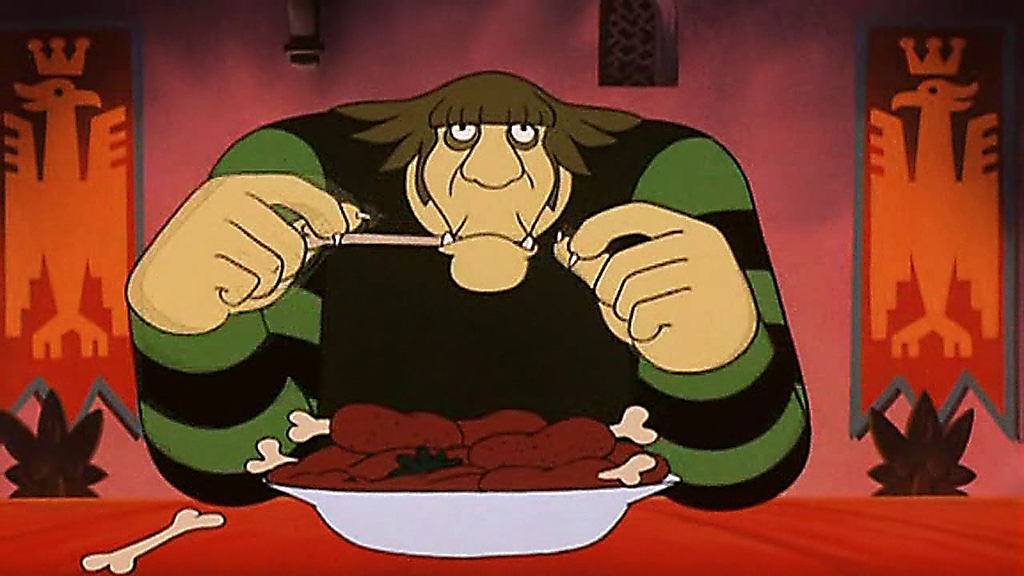
Fee, fi, fo, fum, share some hot wings with me, chum.
I have to say that even as an adult, I still adore this cartoon. The animation is somewhat shoddy, even for the time, and some of the dubbing work (particularly the voice of Jack) is a bit goofball, as happens with a lot of Japanese imports. But there’s just something about the whole eerie atmosphere of it that still gives me a pleasant little shiver. When I originally saw it, I had no idea that it was a dubbed Japanese film, so perhaps that contributed to the otherworldly vibe it gave off that kid-me found so off-putting and appealing at the same time. The music is also weirdly great, and there’s just such an early-70s acid-trip patina coating the whole experience that I can’t help but be captivated all over again anytime I watch it.
Until next time, Goddess out.
A Sample Short Story: “Acacia”

“Are you sure you’re ready for this?”
The doorbell rang. “Too late now, isn’t it?” Debra laughed ruefully. “Don’t worry, I’m fine.”
Kevin answered the door. Anna stood there, dark hair pulled into a bun, bottle of wine in hand. “Sorry, I just remembered she probably can’t drink this.”
Debra, standing behind her husband, smiled and took the bottle. “A small glass won’t hurt me, or the little resident.” She put her hand on her midsection.
Charlotte arrived next, then Jeremy. Once everyone was inside, Kevin disappeared into the kitchen. Debra followed him, but he shooed her out. “Go on, sit with the guests. Everything’s under control.”
Fifteen minutes later, the food was on the table, and wine had been poured into everyone’s glass except for Debra’s; she wanted to save hers for afterwards. “Thanks for coming, everyone. It means a lot to me.” She looked around the table at each of them in turn, with her warmest glance reserved for her husband. Kevin squeezed her hand.
“Least we could do, honestly,” said Jeremy. “I can’t even imagine the shitstorm you must be going through.”
“Well, we can sort of imagine it,” Anna amended. “But it must be a hundred times worse for you.”
As if on cue, there was a sharp banging on the windows, and then the sound of raucous, fading laughter and epithets. Everyone around the table was silent for a few moments, then there was an outburst of uncomfortable chuckling. “Exhibit A, ladies and gentlemen,” said Debra.
“You two get this all the time?” Charlotte was by far the youngest of the group, as her guileless anxiety and acne-scarred face attested. She turned to Kevin. “Door’s locked, right?”
“Yes, it is. And yes, it’s been pretty constant, but it’s nothing we haven’t weathered before.”
Jeremy tore off a chunk from his dinner roll and buttered it thoughtfully. “This case was so much bigger than any of Debra’s others, though. Maybe you should think about going away for a while, or changing your phone numbers at least.”
“It’ll blow over soon enough. It always does.” Debra patted Jeremy’s hand. “Thanks for your concern, though.”
Jeremy smirked. “No problem.”
Later, once Kevin had cleared the dinner dishes and brought out the coffee, Charlotte said. “So how does this work? Now that the trial is over, are you allowed to talk about it?”
“She’d probably rather not.” Kevin gave his wife a sidelong glance. “The point of the party was to try and forget about all that for a while.”
Debra waved a hand at him. “I don’t mind. But there isn’t much to tell.”
“She wants to know if you think Cooper did it.” Jeremy was on his third glass of wine, and his pale blue eyes were shining.
“It wasn’t my place to determine that.”
“You are painfully ethical, Debra,” said Anna. “But I’m technically not a lawyer, so I can tell you I absolutely think he did it.”
Debra raised her eyebrows in mock surprise. “You’re in the majority, then.”
“I think you thought so, too. Just a feeling I got.”
Debra sat back in her chair and pondered this. Kevin asked her if she wanted wine, and she said she did, so he got up to get it. Charlotte got up also. “Excuse me, folks, I have to use the ladies’. Don’t talk about anything interesting until I get back.”
“Same goes for me, except I need the gents,” Jeremy said. He got unsteadily to his feet.
“Top of the stairs,” Kevin said as he went into the kitchen.
When everyone was back at the table, Debra said, “Honestly, I was kind of ambivalent about Cooper. I’m not sure he’s capable of the brutality he was accused of. But I didn’t like him personally. He gave me the creeps. I felt like he kept trying to push our relationship in inappropriate directions.” She frowned into her wine glass, and then laughed. “Was that diplomatic enough for you?”
“You can’t blame the guy, Debra. You are by far the hottest and blondest of all the defense attorneys in town,” Jeremy said. “I’m still sorry I fucked all that up.”
Debra’s voice was gentle and a little teasing. “Let’s not go there, Jeremy. No more wine for you.”
Jeremy ducked his head and mumbled an apology.
The clock struck ten, then eleven, and still the guests made no motions to leave. Jeremy had sobered up but kept mostly quiet as the others discussed topics other than the Cooper murder trial: Debra’s pregnancy, Kevin’s impossible class load, Charlotte’s master’s thesis, Anna’s dying mother. Debra listened and conversed pleasantly, but as the night wore on, the exhaustion began to take a toll on her. The party had been her idea, but perhaps the stress of the trial and the ensuing media skewering had affected her more than she thought. She gave an inward sigh of relief when Kevin finally said, “Let’s wrap this up, everybody. Debra’s about to pass out.”
“God, we’re so uncouth,” Anna said. “Sitting here yapping until all hours.” She grabbed her purse from under her chair and stood up, rounding the table to set a hand on Debra’s shoulder. “Get some rest, honey. You’ve really been through the wringer.”
Jeremy spoke at last. “Anna’s right. Matter of fact, you should blow off next week, let Anna and I handle things. Just until the frenzy dies down.”
Debra raised her hand to protest, but Kevin headed her off. “I’ll make her take a break, I promise,” he said, even as Debra was shaking her head. “Good night, everybody. And don’t you dare offer to stay and help clean up. I’ll do that tomorrow.”
“We weren’t going to offer anyway,” Charlotte said with a wink.
The guests dispatched into the night, Debra tumbled into bed at just past one without even brushing her teeth. She had no idea when Kevin came to bed.
When she awoke six hours later, the sheets were covered in blood.
****
“I’m not leaving you alone.”
Kevin stood at the foot of the bed, arms crossed, face bathed in morning light.
Debra propped herself up on her pillows, wincing at the pain in her abdomen. “I’m not an invalid, Kev. You took care of me all weekend. You’ve got your classes, it’s finals week. I’ll be fine.”
He sighed. “Debra, for Christ’s sake. This isn’t a biggest badass competition. You’ve been crucified by the public since that damn trial ended, and now this…” His voice faltered, but he recovered quickly. “You’re staying in that bed getting some goddamn rest like you should have been doing before, and I’m staying right here with you.”
Debra recognized the finality in his tone. Normally she would have countered this with a more commanding finality of her own and gotten her way, but she was too drained to argue with him. She had to remind herself that he, too, was suffering a loss. With a nod, she relented.
The next day, though, she put her foot down. It wasn’t that she didn’t want him around, but she disliked the feeling of being someone’s burden. Kevin grudgingly gave in to her, on the condition that she take the entire week off from the firm, as Jeremy had suggested. She wasn’t happy about it, but maybe everyone was right, and she was only hurting herself and others by trying to be superhuman.
Once Kevin had gone to work and the house was quiet, she found herself thinking of the potential child that had suddenly vanished on Saturday morning, in a torrent of blood and agony. The pregnancy had been accidental, and at first she’d been as ambivalent about it as she’d been about Kenneth Cooper’s guilt. But in the three months since she’d found out, the idea of motherhood had become more appealing, not least because Kevin had started to change too, rediscovering a tenderness that she hadn’t even realized she’d been missing from him until it returned. It wasn’t as though they had been having problems before, but there had been a distancing, perhaps inevitable given their demanding careers and long marriage. The baby, she thought, could have been just what they needed to draw them back together.
And now it was gone.
She pulled the covers up to her chin and closed her eyes. It wasn’t the end of the world, she thought. They could always try again. She surprised herself by smiling, and then drifted off to sleep.
An insistent pounding on the front door awakened her hours later. Scowling, she turned onto her side, but then noticed that her cell was flashing from the nightstand. She grabbed it, expecting another prank call, but instead there was a text from Jeremy: “Just me. Open the door.”
Debra shrugged into a robe and picked her way downstairs. When she opened the door, Jeremy was standing there in his trim gray suit, a green-wrapped pot of bright yellow, ball-shaped flowers nearly concealing his face.
Debra couldn’t help grinning as she leaned against the doorjamb. “You shouldn’t have.”
Jeremy peeked around the blossoms. “I would take credit for these, if they didn’t look like something Dr. Seuss dreamed up. They were delivered to the office this morning.”
“Who are they from?” Debra stood aside so Jeremy could bring the flowers into the house.
“I’ll let you uncover that fun fact.” He set the pot down on the dining room table.
She pulled the card free from its envelope and read the crabbed scrawl aloud: “Thank you for everything you did for me. And so sorry for your loss. Best, Kenneth Cooper.” She looked up into Jeremy’s face. “My loss? Does he know about the miscarriage? How would he know?”
“It’s the internet age, Ms. Thorne. Everybody knows everything about everybody.”
“Hm.” She brushed her hand across the flowers, sending a fine rain of yellow powder down onto the tabletop and the slight scent of cinnamon and vinegar into her nostrils.
Jeremy tilted his head. “I’m glad you took some time off. You don’t look so great.”
“Thanks, smooth talker.”
“You know what I mean. You needed the rest.” He paused, staring down at his shoes. “And I’m sorry. You know, about the baby, and about being kind of an asshole at your party.”
“You weren’t an asshole, and it’s fine. Don’t get sentimental, it gives me hives.”
He smiled, still not looking at her. “Same old Debra.” Finally he met her eyes. “I gotta split. Go back to bed. I don’t want to see you at the office until at least next week. Deal?”
“You men, always conspiring to keep a lady down. I promise to be scarce.”
“Good. Get better, sweetheart.” He gave her an awkward hug and showed himself out.
After the sound of his car engine had faded into the distance, Debra poured some coffee and stared at the cheerful riot of blossoms. She hadn’t heard from Kenneth Cooper since the trial had ended, but he was still thinking of her, it seemed. She pulled her robe tight and tapped her foot against the floor, not sure if this was a worrying development or not. Had the card simply thanked her, she would have written it off as genuine appreciation laced with a little flirtation, but the fact that he’d mentioned her “loss” was troubling.
She was still deep in thought when Kevin came through the front door, startling her. She looked at the clock and realized it was nearly eight. Kevin answered her unasked question: “I had some catching up to do, sorry I’m late. I stopped and got Chinese, figured you’d be hungry.”
She was. They ate at the table in silence as the yellow flowers bobbed softly between them. After a few minutes, Kevin pointed. “Should I ask?”
“They’re from Cooper.”
He plucked the card from the pot and read it. His brow furrowed. “He knows our address?”
“They were at the office. Jeremy brought them by.”
He looked at her. “Is this something we should be concerned about?”
“I don’t know yet.”
Kevin nodded. “Do you need me to stay with you while you’re home?” He paused a beat. “Never mind, I already know.” He laughed, a little sadly. “Just thought I’d offer.”
She reached for his hand and twisted his fingers in hers. “I appreciate it. But let’s not freak out just yet.”
“Okay. Just let me know.” He slipped his hand from hers and went into the living room. Debra heard the TV come on.
****
The next day Debra was beginning to feel almost back to normal, which meant she also felt unbearably useless. She woke early, shortly after Kevin left, and paced around the kitchen and dining room for an hour, the flowers always skirting the edges of her vision, reminding her of her enforced quarantine. At last she grabbed the blooms and took them into the garage, where she chucked them unceremoniously in the trash.
Then she called Anna, hoping there would be some catastrophe at the firm she’d need to sort out, but Anna was unequivocal: “We don’t need you, Thorne. Stay the hell home.”
Finally Debra gave up and collapsed onto the couch, flipping the TV on. Even now, all the news networks were still harping about Cooper’s exoneration, repeating the lurid details of the crime again and again: Pretty 22-year-old victim, found in her car with her head blown off, her body a horror show of bruises and stab wounds. Cooper admitting he’d dated the girl briefly, admitting he’d been enraged when she dumped him. Debra stared at the screen flatly as her own picture appeared beside those of Cooper and the victim. Here is the apex of the sick triangle, the news seemed to whisper, the woman responsible for the monster going free. Debra turned it off and went back to bed.
It was dark when she awoke, and the house was completely silent. Blearily, she reached for her phone. Nine-thirty. She scanned her messages; all were cranks. She dialed Kevin, but got his voicemail. “Where are you? It’s late.” She hung up, feeling disembodied.
An hour later, Kevin had still not replied. Debra threw on some clothes and grabbed her keys.
As she opened the front door, something white caught her eye. She turned.
Pinned there on the door was a baby bootie, splashed with red. She slammed the door and locked it.
She called Kevin again first, but he still wasn’t answering. Next she dialed Jeremy. “Can you come over here? I think something bad is happening.” She told the same to Anna, and both told her they were on their way over. Then she called Doug, an old friend in the police department, explaining tersely about the bootie, the flowers, Kevin’s uncharacteristic absence. Doug was audibly alarmed, and promised to send an officer right away. After that, there was nothing to do but wait.
Anna arrived first, followed closely by the officer and Jeremy. As calmly as she could, Debra repeated the events in a voice that sounded robotic to her ears. Spoken aloud, the string of incidents struck her as laughably insignificant: The flowers could have been a simple well-wishing gesture, the bootie could have been one of the innumerable crazies who had harassed her in the wake of the trial, Kevin’s lateness could have a million explanations. Debra regarded her three-person audience balefully. “Sorry to make such a big deal, it sounds paranoid.”
Jeremy began to protest, but was silenced by the simultaneous sounds of Debra’s phone chirping and the officer’s radio erupting in a burst of static. Debra snatched up the phone. “Got a call,” said Doug. “Body found in a car in a parking lot off 47th. Registered to Kevin Thorne. ID on the body is his too. I’m so sorry.…”
She ended the call without answering. The officer was talking into his radio, occasionally glancing at Debra with an expression of grim consternation mixed with pity.
Debra’s legs threatened to crumble beneath her, but she managed to stay upright. Her vision swam.
“Mrs. Thorne,” the officer said, “the victim was found shot and stabbed in a manner consistent with the Cooper murder. There’s an APB out for Cooper now. Victim’s wallet was untouched, but his keys are missing. Do you have somewhere else you can stay?”
Jeremy put his hand on her elbow. “She can stay with me for a few days.”
Debra was shaking her head before she’d even fully processed his words. “That’s not a good idea, Jeremy. Cooper knows you, and Anna. If he found me, he can find either one of you. I can’t put you two at risk.”
“A hotel then. I can stay with you,” Anna said.
Debra’s phone chirped again, startling her so much she nearly dropped it. She looked down at the screen. Charlotte. She answered, and immediately the young girl’s voice was a keening litany in her ear: “Debra, have you seen Kevin? I’ve been trying to call him for hours and he’s not answering and his secretary said she hadn’t heard from him since he left today and I…”
Debra interrupted, gently. She told Charlotte everything that had happened as coherently as she could, steeling herself against the hysteria that threatened to engulf her. There was a long silence on the other end when she had finished, so long that Debra thought she’d been disconnected. Then she heard a faint sniffle. “But I just saw him, Debra. In class today.”
“I’m sorry.” She wasn’t sure why she was apologizing, but there it was.
“Do you need to stay with me?” Charlotte’s voice was barely there, a forlorn ghost. “Cooper wouldn’t think to look for you here.”
Debra hadn’t gotten to know Charlotte as well as she could have over the two years she’d been Kevin’s grad student, but the thought of commiserating with someone who knew a side of Kevin that Debra herself rarely got to see was strangely appealing. “I’d like that.”
Debra went upstairs, gathered some clothes and went back down to the living room. The officer was posted at the front door, the radio on his shoulder crackling and squawking. Jeremy’s and Anna’s faces were distorted masks.
“We’ll find Cooper, Mrs. Thorne,” said the officer.
“Yes. All right.”
Jeremy offered to drive her to Charlotte’s, and she accepted. She hugged Anna, and allowed the officer to escort her to Jeremy’s car. Neither of them spoke on the short drive, and Debra was glad.
Jeremy waited on the curb until Charlotte had opened the door. She waved to him, and then ushered Debra inside. It was a typical student pigsty, littered with dirty laundry and empty food containers, but Debra barely registered the mess. Charlotte had clearly been crying. Wordlessly, she motioned Debra into the postage-stamp kitchen, where she poured them both a glass of wine. They drank in companionable silence.
“I’m sorry all I’ve got is the couch,” Charlotte said between sniffles, once her glass was drained. “I wanted to stay up and talk, but I think we both need to sleep. Maybe we’ll wake up and things will be okay again.”
Debra had been keeping tears at bay until now, but Charlotte’s bare naiveté pushed her over the edge. “Maybe so,” she managed to say.
Once she had settled onto the musty-smelling sofa and Charlotte had disappeared into her bedroom and closed the door, Debra found herself drifting off immediately, even though she had slept for most of the day. She dreamed of her picture on the news, in a lineup that also comprised Cooper and his first victim. There was also a fourth photo, of Kevin, but half his face was obscured by a spray of red.
She wasn’t sure what time it was when she awoke, with a stiff neck and what felt like a slight hangover. The first thing she became aware of was a cheery dash of yellow on the cluttered coffee table directly in her line of sight. She focused, with effort, but for a long time she couldn’t make any sense of what she was seeing.
It was a yellow, ball-shaped flower.
Confused, she tried to struggle into a sitting position, but her limbs felt leaden. She stared at the flower, comprehension slow in coming, and then noticed that beside the flower was a white baby bootie, and propped against that was a printed photo, a blurry image that looked as though it had been taken with a cheap cell phone. The flesh tones in the photo soon separated themselves into two naked figures, Kevin and Charlotte.
There was a sniffle off to her right, and she whipped her head toward the sound. Charlotte was leaning against the kitchen door, her face red and swollen. The pistol in her hand shook slightly, but it was aimed directly at Debra’s head.
“I’m sorry,” Charlotte said, her voice thick.
She pulled the trigger.
The Goddess’s Favorite Creepy Movie Scenes, or Do You Kiss Your Mother With That Mouth?
I’m back from my vacation (which was fun and blissfully unproductive, thank you for asking), so I’m slowly getting back to work on this series, among other things. This sixth entry will be slightly different, as I’m going to highlight two creepy scenes whose visual impact has stuck with me since the eighties. They’re both very short scenes and have a similar theme, so I thought I’d just lump them together, if that’s all right with everyone.
I’d like to talk a bit here about things that scare us, or scare me in particular, since part of the appeal of writing this series was, for me, a desire to examine why I find particular images or situations disturbing, when perhaps other people may not. In regards to the two short vignettes I want to discuss, I’d like to focus on a particular subset of body horror, particularly facial “wrongness.”
It seems reasonable to assume that from an evolutionary standpoint, human brains developed with an instinctive ability to assess the physical “normality” of our fellow humans, if only in order to identify genetic fitness in potential mates. It’s why studies that have been done all over the world show that the humans consistently rated as the most attractive are the ones that are the most symmetrical. I’m simplifying here, but you get the gist. Humans know when someone looks okay, and when they don’t, even if they can’t articulate why.
This feature of the human mind can, of course, be subverted. Take, for example, the concept of the “uncanny valley,” that unsettling grey area where a human simulacrum looks so similar to a real human that we are almost fooled, but is ever-so-slightly “off” in a way we can’t quite put our finger on, causing us intense discomfort.
Horror filmmakers, consciously or not, have been playing with the concept of subverting physical normality since horror movies first began. Sometimes it’s blatant, like Regan’s 360-degree head-spin or her freaky “spider walk” down the stairs in The Exorcist, or the strange, jerking movements of long-haired female ghosts in many an Asian horror film. And sometimes it’s more subtle, like simply taking one facial feature and changing it in a way that upsets our deep-seated sense of physical regularity.
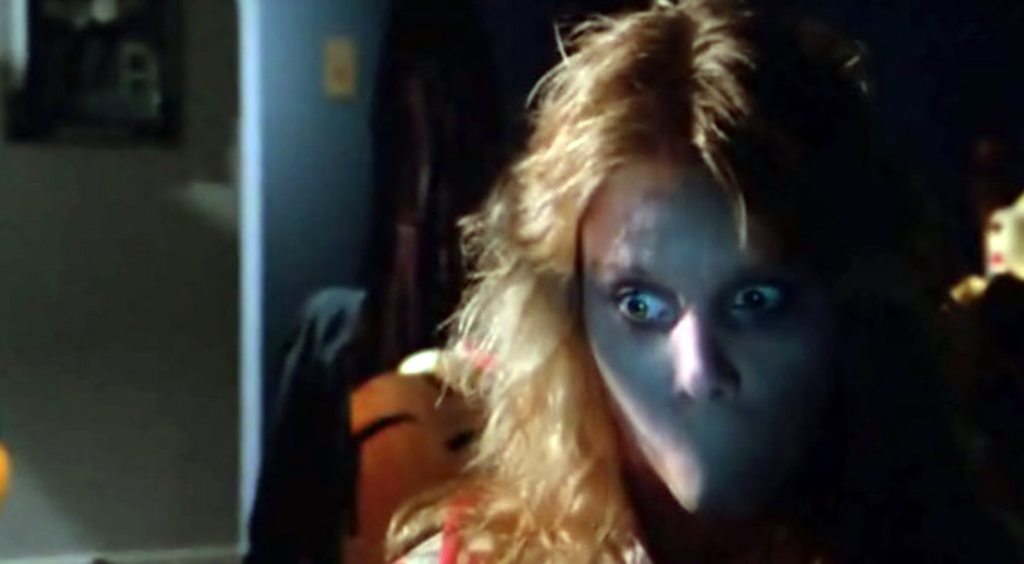
Twilight Zone: The Movie (1983) was an anthology film featuring several stories by different directors. The bulk of the stories were adapted from episodes of the classic “Twilight Zone” television series. One of these, the Joe Dante directed “It’s a Good Life,” was a loose remake of one of the most famous TZ episodes of all time (which had been in turn based on a short story by Jerome Bixby), the one that starred Bill Mumy as a functionally omnipotent child who could “wish people into the cornfield” if they did something to displease him.
In the 1983 film version, a schoolteacher named Helen (Kathleen Quinlan) stops at a café while on a road trip and there meets a young boy named Anthony (Jeremy Licht). She intervenes when he is being harassed by bullies, and then ends up giving him a ride home after she “accidentally” hits his bike with her car in the parking lot. Upon arriving at his cavernous mansion of a house, she quickly discovers that something is very amiss with Anthony. His entire family seems deathly afraid of him, and take great pains to bend to his every whim, whether that’s serving candied apples and peanut-butter-topped hamburgers for dinner, or allowing cartoons to play endlessly on every television in the house. It turns out that the family’s fear is well-placed, as Anthony has the supernatural ability to wish anything he desires into existence, and severely punishes anyone who interferes with his wishes.
One of the recipients of Anthony’s wrath is his sister Sara (Cherie Currie, who is perhaps best known as the lead singer of the band The Runaways). As Helen is wandering the vast halls of the mansion Anthony calls home, she stops to peer into a long, darkened bedroom. She smiles indulgently at the rows of identical single beds with their identical stuffed pandas, and then she notices a girl sitting in a wheelchair at the far end of the room. The girl’s back is to her; she seems to be wearing pajamas and is staring at a flickering television screen playing a loop of a black and white cartoon. Helen calls out to her, but the girl doesn’t answer or turn around. Anthony comes up beside Helen in the doorway and explains that this is his sister Sara. “She was in an accident,” he says, and then he and Helen proceed down the hall.
We then see a shot of Sara from the front, though half her face is concealed by the angle of the television set. Her eyes are wide and a bit crazed as they frenetically follow the cartoon action on the screen in front of her. And then the camera tips upward to reveal the bottom half of the girl’s face. She has no mouth, only smooth flesh where the lips should be. It’s a very short but pleasantly chilling moment, and all done very simply. There is no gore, no blatant deformity, just that disturbingly empty expanse where the girl’s mouth should be. Later in the story, we learn that Anthony crippled his sister and took her mouth away so that she wouldn’t “nag” him anymore. The other sister who reveals this information (played by Nancy Cartwright, the voice of Bart Simpson) has an even more horrifying fate; Anthony puts her into a cartoon, where she is pursued and eaten by a dragon.
Don’t fuck with Anthony, is the message there, folks.
The second example of disturbing facial distortion is far more ostentatious, but it affected me mightily just the same. The Tom Holland-directed Fright Night (1985) was one of the best horror comedies of the decade, faultlessly combining hilarity, pathos, and terror into a wildly entertaining whole. Charley (William Ragsdale) is a regular high school kid who lives with his single mother (Dorothy Fielding), has a goofball horror-nerd best friend named Evil (Stephen Geoffreys), and a goody-two-shoes girlfriend named Amy (played by Amanda Bearse, who would later achieve great fame as neighbor Marcy on the long-running and much-beloved TV show “Married…With Children”).
Apparently, Charley also has a vampire as a new neighbor, though naturally no one believes it. Through binoculars, Charley has been watching neighbor Jerry Dandridge (suavely played by Chris Sarandon) evidently picking up high-class prostitutes and later carrying suspiciously body-shaped garbage bags out of the house next door with the help of his carpenter/houseboy/manservant Billy Cole (Jonathan Stark). After trying to alert family, friends, and then police, all to no avail, Charley gets desperate and enlists (well, buys) the services of his hero, has-been TV horror host Peter Vincent (portrayed with great sensitivity and humor by Roddy McDowall) to help stop the bloodsucker.
At one point, the charismatic Dandridge has put his vampy moves on the virginal Amy, chasing her to a downtown nightclub and dancing with her seductively before biting her. Later on in the film, Charley comes across Amy in the basement of Dandridge’s house. She is nearly unrecognizable, her formerly good-girl demeanor completely transformed into a feral sexpot (a giant upgrade in my opinion, but that’s neither here nor there). She approaches him in her see-through white gown and bares her fangs at him, then cruelly teases him: “What’s wrong?” she says, running her hands through her wild red hair. “Don’t you want me anymore?” Charley, frightened by this frankly sexual creature who used to be his withholding girlfriend, thrusts a crucifix at her. She shrieks and turns from him, then tries another tactic. “It’s not my fault, Charley,” she cries pitifully in her good-girl-Amy voice. “You promised you wouldn’t let him get me! You promised!”
Charley, dope that he is, falls for it and drops the crucifix, moving toward her. “Amy…” he says. And then we pan over to Amy’s face, only to see this:

There is a terrifying rictus of a mouth, huge and impossibly wide and filled with sharp teeth. When I first saw that mouth in 1985, I think my heart stopped a little bit; it was just the enormity of it, the way it consumed the lower half of her face. Between the mouth and the round red eyes, I was put in mind of a giant anaconda about to swallow someone’s head. That image has stayed with me from that day to this. For his part, Charley, upon seeing Amy’s bloodcurdling visage, screams and tries to fight her off, foxy vampire or no. He is profoundly relieved when she is transformed back into her ordinary self after Dandridge is killed.
And so Fright Night leaves us with a question for the ages: Better to have a slightly annoying girlfriend who won’t put out, or a supernatural, oversexed hellbeast who wants to eat your face off? Charley chose the safer option; would you? 😉
Until next time, Goddess out.
The Goddess’s Favorite Creepy Movie Scenes, or Hypnosis Can Go Catastrophically Wrong, You Dig?
All right, I lied. I’m actually going to post one more of these before I start my vacation, only because I’ve really wanted to give this movie some love for a very long time and all my feelings about it came flooding back as I rewatched parts of it on the inter tubes this afternoon. I realize that I took a bit of a turn toward the obvious in my last post about A Nightmare On Elm Street, but I’d now like to make amends for that transgression by going back and giving a hearty shout-out to what I feel is one of the most underrated horror films of the past twenty years.


Stir of Echoes (1999), directed by David Koepp and starring Kevin Bacon, is based loosely on Richard Matheson’s terrific short novel. Its plot is pretty standard horror movie fare—a creepy psychic kid, hypnosis, disturbing visions of a violent crime—but its execution is deft and chilling, and it still pains me to this day that the film tends to fly a bit under the radar when the best scary movies are discussed, even in fairly well-informed company. I’ve talked to many horror fans who have never even heard of it, and this is a great shame.
Stir of Echoes’s disappearing act from the public consciousness has very little to do with the quality of the film (which is very, very good), and almost everything to do with timing. You see, Stir of Echoes had the misfortune of coming out at pretty much the exact same time as that supernatural juggernaut, The Sixth Sense (in fact, I seem to recall seeing both films in the theater within a couple days of each other). Since movie audiences can evidently only handle one ghostly spookfest per release cycle, Stir of Echoes was left in the dust while The Sixth Sense went on to become a monster hit, the second highest-grossing film of 1999, to be precise (The Phantom Menace was number one, in case you wondered).
Again, this annoys me probably more than it should. It isn’t that The Sixth Sense isn’t a good film; it’s actually pretty decent, and frankly the only one of M. Night Shyamalan’s films that I really enjoyed (and before you ask, no, I didn’t really think Signs or Unbreakable were that great, and all his other films were objectively terrible). But I have to say that I think a large part of its success can be attributed more to that breathtaking “twist” and the word-of-mouth it subsequently generated than any inherent excellence of the film as a whole. And now that everyone and their mother knows what the twist is, the film loses much of its impact upon rewatch.
No such burden dogs Stir of Echoes. While it’s certainly a much more intimate, low-key film than The Sixth Sense, it is also darker and much, much creepier than its more-successful rival. As a matter of fact, I saw a late-night showing of Stir of Echoes with my friend Jen, who often took me along to scary movies because she loves them but is usually unbearably terrified by them at the same time. I was there as the “tough” girl, the horror aficionado who was rarely fazed by anything and could talk her out of her fear if necessary. And yet, ironically, even I absolutely did NOT want to walk across the darkened parking lot after the movie let out after midnight. Not after seeing that.
In brief, the film tells the story of a working class joe from Chicago with a pregnant wife and a psychic son. Said working class joe (whose name is actually Tom) gets hypnotized by his sister-in-law as a party trick, and thereafter begins to see disturbing visions of a neighborhood girl who had gone missing some time earlier.
There are actually two scenes I’d like to discuss, as they sort of bookend each other. In the first one, new-agey sister-in-law Lisa (Illeana Douglas) is hypnotizing skeptical Tom (Kevin Bacon) and establishing the methods she uses to get her subjects to visualize. “Close your eyes,” she tells him. “Certainly, Lisa,” he says, a little condescendingly. Then we’re thrown right into Tom’s perspective: We see Lisa through his eyes, and the screen goes black from top and bottom, as if we are closing our own eyes. Then we are staring at a black screen and listening to Lisa’s voice, exactly as if we were listening to her hypnotizing us. It’s a simple, but pleasantly eerie effect.
“I want you to pretend you’re in a theater,” Lisa says, and a traditional “live-action” theater stage appears in our field of vision, with patrons sitting in the seats in front of us. “A movie theater,” Lisa specifies. A movie screen descends from the ceiling with a strangely portentous sound (the sound in this whole sequence, I should point out, is very Lynchian in its effectiveness and contributes a great deal to the otherworldly, disquieting feel of the scene overall). “There’s no one there,” says Lisa, and the people in front of us fade away, leaving rows of empty seats. “It’s one of those great old movie palaces,” says Lisa, and sure enough, the plain movie screen transforms into one of those red-curtained beauties, the empty seats before us glowing mahogany in the darkness.
Upon Lisa’s instructions to look around, the camera pans swiftly back with another creepy sound so that we can take in the whole of the gorgeous space. Then things get a little more sinister: “You notice that the walls of the theater are painted in black.” Darkness descends and covers the walls as she speaks. “The seats, covered in black,” Lisa says, and the blood-red seats fall under a shadow. Now that the entire theater is black, Lisa prompts us to focus on the only thing we can see, the white movie screen. It pops out at us with another unnerving sound. Lisa begins to describe letters on the screen that are out of focus, and a word duly begins to appear on the screen, though it is still too blurry for us to read. Lisa tells us to drift closer to the screen, and the camera pans forward, a little unsteadily. As we move closer to the screen with its blurry lettering, Lisa is going on and on about how comfortable and relaxed we are, lulling us into complacency with her soothing voice. Finally, when the white screen encompasses our entire field of vision, the word suddenly comes into focus. “The letters spell ‘sleep,’” Lisa says, and there is the word ‘sleep’ in a typewriter font across the white screen. It fades out as Lisa intones again, “Sleep.” There is a brief moment of blackness. Then, a sudden, startling vision: The front of a house, with vague shadowy figures moving on the porch in a way that suggests violence. Then follows a blue-cast closeup of what appears to be a face in a black mask, and then comes the briefest flash of a distressed girl with her hands clamped on either side of her head.
We are abruptly thrown out of the vision and back to our own perspective with an extreme closeup of Tom’s closed eyes. He snaps out of his trance, sweaty and disoriented. “What the hell was that?” he asks, and then there is a burst of raucous laughter. Another shot from Tom’s point of view reveals that everyone at the party who had been watching Lisa hypnotize Tom is standing there laughing their asses off at his confusion. It’s a fantastically affecting sequence.
The second scene is structured similarly to the first, but takes it to a darker place. Lisa is hypnotizing Tom again, though they’re in the house alone this time, and both are visibly tense because of all the strange phenomena that Tom has been experiencing in the interim. He is impatient with her, as he simply wants to get to the bottom of his visions while she is trying to establish the relaxing state of mind she coaxed out of him during the earlier session. The camera lingers on her face as she again tells Tom to visualize the black theater with the white screen. Then we are seeing things from his point of view again, the white screen before us as in the earlier scene. We drift closer to the screen. There is another shot of Lisa and she tells him that, again, there are letters on the screen. Both we and Tom see blurry letters appear, and even though they are too out of focus to read, it is clearly a different, shorter word than before. Tom gasps. “There’s someone here,” he says, his eyes still closed. “No, the theater’s empty,” says Lisa. “There’s someone else in here,” Tom insists, and in his hypnotic state we see the back of a woman’s head. She is sitting in the front row of the theater as we get closer to the screen. “There’s no one in the theater, Tom,” Lisa argues, perhaps sensing that this session is getting out of her control. She tries to get him to relax by using her standard spiel, but Tom is fighting her, getting closer and closer to the woman in the theater. Finally, amid protestations from Lisa, Tom puts his hand on the woman’s shoulder. “I want you to look at the screen. Look at the screen!” Lisa begs. The woman in the theater turns her face partially toward Tom, and it looks perfectly normal, but then there is a closeup shot of Tom. Suddenly a hand darts out and grabs his face, and we see that the hand is attached to the figure of someone who appears to be wrapped in plastic. The figure makes a weird, distorted roar that almost sounds like a word, though it happens too quickly to make out what the word is. Then we are back in front of the house from the first vision, and there are several quick edits of hands, of Tom’s panicking face, of a figure in plastic, of a screaming girl with missing front teeth being brutalized. There’s a brief shot where it appears that Tom has become either the victim or the perpetrator in his vision.
While all this chicanery is going on, Lisa is frantically trying to salvage the session. “Tom! Tom!” she’s yelling. “LOOK AT THE SCREEN!” Tom finally does as she says and whips his head around to look. And the white screen suddenly looms large in our vision, accompanied by the girl’s screams, and on that screen is a single, chilling word: “DIG.”
That. Freaks. Me. The. Fuck. Out.
It has a similar effect on Tom, I gotta say, who immediately after being confronted with the word, rockets straight out of his trance, out of his chair, and into the kitchen, where he stands in front of the open fridge and just downs an entire can of beer while Lisa harangues him.
We feel your pain, Kevin Bacon. You earned your beer.
The Goddess’s Favorite Creepy Movie Scenes, or Let’s All Follow the Body Bag
I know, I know. I did say, in my previous piece on The Tenant, that I was going to try to avoid discussing the better-known horror fare as much as possible, and yet here I am, sorta already breaking that rule. My justification for what follows is two-fold: Firstly, I love this damn scene and I still vividly remembered it years after first seeing the film; and secondly, it’s not usually one of the scenes that people single out as being the scariest in the movie.
Wes Craven’s A Nightmare On Elm Street (1984) is a horror behemoth that not only spawned fifty squintillion sequels and spinoffs, but also established one of the most recognizable horror baddies of all time. There probably isn’t a horror fan alive who hasn’t seen it. While the merits of the sequels can (and have been) debated to death—and I for one tend to be one of those people who feels that most of them, while good films, veered too far into self-parody to be effectively frightening—I think it’s pretty much universally accepted that the original was one of the scariest horror films of the 80s.
The scenes that fans and reviewers tend to point to when they talk about “scary parts” are usually the more splashy ones (in both senses of the word), like the blood geyser that erupts when Johnny Depp is sucked into his bed (during the Miss Nude America pageant, no less), or Tina’s gorily and gloriously airborne murder. Another popular choice is Freddy’s appearance in Tina’s dream, his shadowed figure approaching through the alley, his freakishly long arms causing his finger-blades to scrape unsettlingly across the walls. These are all great options, but the one I want to feature is much less ostentatious, since as I keep repeating, the creepiest scenes for me are ones that are predicated on suggestion and atmosphere.

Main protagonist Nancy (Heather Langenkamp) is sitting in her English class, wearing a tragic combo of pale pink sweater-vest and high-waisted beige slacks (ahh, the eighties). Since her terrible dreams have been keeping her up nights, she’s understandably a mite drowsy. She struggles to keep her eyes open as the teacher drones on, and then as a student gets up in front of the class and begins to read from Shakespeare’s Julius Caesar.
She blinks sleepily, but for a moment we don’t realize that she has dozed off. And then things start to get weird. She happens to glance to her right and sees that her murdered friend Tina is standing in the doorway of the classroom, ensconced in a bloody body bag. Tina’s hand reaches out inside the plastic. “Help me,” she says. And then Nancy turns back to survey the classroom, perhaps to check if anyone else is seeing this crazy shit. The boy is still standing at the front of the class reading Julius Caesar, but now he is staring straight at Nancy and reading in a flat, menacing whisper.
The first time I heard that whisper, I honestly got goosebumps, because for whatever reason, one of the things that disturbs me the most in films is when a character inexplicably starts speaking in a different voice. Incidentally, other examples of similar movie scenes that had the same chilling effect on my psyche were Danny’s croaking “Redrum” getting suddenly higher-pitched in The Shining, the Judge’s normal voice jumping into screeching cartoon mode in Who Framed Roger Rabbit, and the little old woman talking in the voice of Nicole Kidman’s daughter in The Others. I realize that this is a particular bête noire of mine, so readers’ mileage may vary, but for my money, the boy in Nightmare On Elm Street reading Shakespeare in the slow, hissing whisper is easily the most unnerving part of that scene, and for me it added a nice little fillip of terror.
Moving on, Nancy looks back at the doorway. Bodybag Tina is gone, but there’s still a big ol’ blood puddle on the floor to mark her presence. Nancy gets up from her seat and goes into the empty hallway. There’s a wide blood trail allllll the way down the hall, and at the end of it, there’s Tina lying in her body bag. Her feet are raised as though an invisible person is holding them up, and then she is dragged slowly out of the frame.
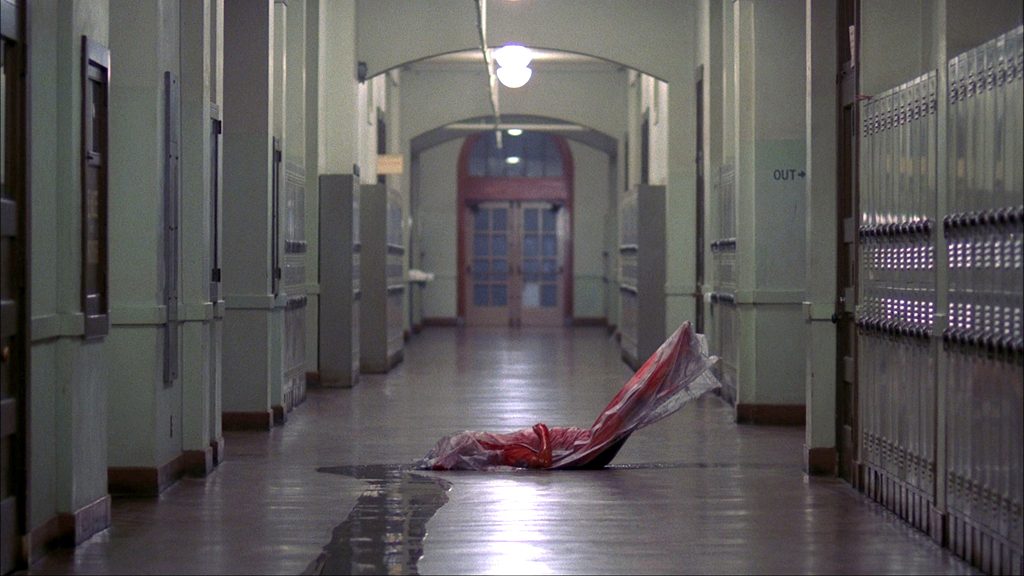
High school can be such a bloody drag.
The entire scene is five minutes long, but it’s really only these first two minutes that are effectively scary. Once Nancy runs around the corner and crashes into the snotty hall monitor in the telltale striped sweater, and then descends into the boiler room where she confronts Freddy, big as life and oozing with green chest-goo, the frightening part of the scene has already happened. The little details of the buildup are what make the scene eerie for me; after that, it’s just a comedown from the high.
Stephen King, in his excellent 1980 non-fiction book Danse Macabre (which I read so many times that its pages eventually fell out) describes this principle with the following example: Say you have a scene where the protagonist is walking down a dark, creepy hallway toward a closed door. He knows there is something behind that door, and the viewer knows it too. The tension builds as the protagonist gets closer and closer to the door. Eventually, he gets to the end of the hallway and opens the door, but once the door is opened, the terror is basically dissolved. King imagines that a ten-foot bug is behind the door. The viewer might jump or scream when he sees the bug, but King argues that this is actually a sign of relief. “Oh, it’s a ten-foot bug,” the viewer may think. “That’s pretty bad, but I thought it would be a HUNDRED-foot bug.” What the viewer imagines is behind the door is always going to be much, much worse than what is actually there. Another relevant and obvious analogy would be a roller coaster; the scariest part of the ride is the slow ascent to the top of that first drop. Once you go over the hill, you can deal with the consequence and enjoy yourself, but the ride, while exhilarating, isn’t really scary anymore.
King then went into a discussion about how various horror writers and filmmakers had dealt with this principle in their work, and how effective they had been. Is it better to never show your monster? Only show it vaguely, so its true form is never really grasped? Or should you simply go balls to the wall and slap that bitch up on the screen and into everyone’s face in as unexpected a manner as possible? Readers of this blog should know where I stand on the issue (hint: somewhere between the first and second of those things), but I’m curious to hear different perspectives, if anyone would care to share them.
I may or may not be posting more of these in the next few days; I’m on vacation until after Labor Day, and the God of Hellfire and I are having an out-of-town guest who will need to be entertained, so I may not have as much time to do writeups. But whatever happens, the series will continue in due time. As always, thanks for reading, and I hope you guys are enjoying the posts. Goddess out.
The Goddess’s Favorite Creepy Movie Scenes, or Maybe Next Time You Should Take the Stairs
I’ve spoken before about my love of atmospheric horror, of those rare film scenes that get under your skin using nothing but suggestion and subtlety to evoke a feeling of overwhelming dread. The next scene I’d like to feature is a prime example of this, a scene that is simple but devastating in its chilling effectiveness.
The excellent Pang brothers film The Eye (2002; I shouldn’t have to warn anyone against bothering with the vastly inferior American remake) is one of the standouts of the Asian horror renaissance that began sometime around the mid-1990s. It is also one of the newer films I wanted to discuss, because it is a sterling illustration that not all modern filmmakers are content to rely on visceral shocks or over-the-top computer-generated imagery to deliver their impact.
The premise of The Eye is straightforward, I daresay even unoriginal: Mun is a classical musician who has been blind since early childhood. Upon receiving a corneal transplant, she gets a little more than she bargained for; namely, the ability to see ghosts. Did I mention that the ghosts she sees are also portents of impending deaths? Yeah, that too.
As I was researching this writeup, I discovered that I am absolutely not alone in singling out one particular scene as one of the scariest in cinema; if you have seen the film, you know the scene I’m referring to.

That. Elevator.
Elevators make fairly frequent appearances in horror films and thrillers, perhaps because many people, including me, find them at least a little unnerving. You are, after all, confined in a tight metal box that could conceivably trap you in the limbo between floors or suddenly send you plunging into the basement to your doom. Added to this is the unease we often feel when we are forced into close quarters with strangers. The elevator scene from The Eye takes all our rather mundane anxieties about elevators and ramps that shit up into the stratosphere.
Mun has returned to her apartment building and is waiting for the elevator, as you do. The door glides open, but when she peers inside, she is confronted with the eerie sight of what appears to be an old man in pajamas, standing in the back corner with his face turned toward the wall. She glances nervously up at the CCTV cameras and sees that the clearly occupied elevator is actually empty, leading her to the obvious conclusion that the man she’s seeing has shuffled off his mortal coil. Wisely, she decides to wait for the next elevator, but as she stands there, a young couple blithely rushes past her and into the ghost-o-vator, unaware of who they’re sharing the car with. The couple looks at her strangely as her terrified gaze flickers from them to the CCTV cameras and back again. The door glides closed.
The next elevator arrives. Mun peeks apprehensively into the car and makes another check of the cameras. This elevator appears to be wraith-free, so she reluctantly gets on board. There are tense close-ups of her hand pushing the floor button, and of her wide, frightened eyes. The elevator begins to climb. Ever. So. Slowly. Mun is still intensely nervous, almost expecting the inevitable.
And soon enough, her fears are realized. A hazy reflection appears in the steel wall of the elevator. It’s the old man. His back is still to her, which makes the whole thing a thousand times creepier. She knows he is back there, and she is visibly petrified, but she resolutely does NOT turn to look. She just stands there, rather stoically losing her shit as the old man glides behind her, back to back. There is a creepy shot of the man’s bare feet hovering inches above the floor behind her, and then the old man begins to turn around, unbearably slooooooowly, and we see that there is a horrifying CANYON where half of his face should be, and then he’s gliding toward her and his toes are just about to touch the back of her ankles and GAAAAAAAAHHHHH!!!

insert “footage” joke here.
Sorry, I had to stop the video for a second.
Okay, I’m all right now. Moving on.
So the elevator door opens and she sprints right the fuck out of there and goes tearing down the hall, as you would. She gets to her door and frantically tries to get in, but her key won’t work, and then she realizes that in her panic she’s gotten off on the wrong floor. She goes bolting toward the stairwell and stumbles up the steps, passing a little boy in a baseball cap who’s on the landing. When she reaches the top of the stairs, she turns to look at the boy, who suddenly runs toward the window and jumps right the hell out.
This scene really hits all the right notes: There’s the tight, tense closeups of the terror in Mun’s face, the flat bluish-silver light the whole scene is washed in, the trapped feeling of helplessness and of wishing the elevator would HURRY UP AND GET TO HER FLOOR, the languid menace of the old man as he drifts unhurriedly behind her, the slow reveal of his frighteningly disfigured face, the creepy details of the metallic reflection and the eerie floating feet. There’s also the kicker of the scene, the incongruity of the decidedly un-creepy little boy inexplicably jumping out the window after the main danger has apparently passed. It all adds up to one of the most perfectly realized scary scenes in modern horror cinema, and a shining example of the principle that sometimes, less is more.
The Goddess’s Favorite Creepy Movie Scenes, or Why You Should Keep Your Finger Out of That Hole in the Wall
There are a few parameters I’d like to establish with this series, now that I’ve thought about the scenes I’d like to feature and everything they have in common. As far as possible, I want to avoid including scenes that are nothing more than “jump scares.” Don’t get me wrong, these can be terribly effective when done right, and I’m not saying that I will never feature one in this series (in fact, I can already think of one or two I might want to do a writeup on at some point), but the bulk of the scenes I’ll describe will fall more into the category of subtle, creeping dread, simply because I find these types of scenes scarier and more prone to haunt the memory than scenes of shocking gore, for example (although I like my shocking gore as much as the next girl). I’ve always been of the opinion that the best horror comes completely from suggestion and atmosphere; once you’ve shown the monster in all its tentacled and bloody glory, you’ve effectively pissed the scare down your leg. Real terror comes from the not-knowing.
Additionally, I’d also like to focus more on scenes that don’t get quite as much attention as some of the better-known “scariest horror scenes.” It’s universally accepted, for instance, that many scenes from The Shining are sinister as fuck (redrum, the twins, room 237, the furry blow job, all work and no play), but since many of these appear on lists all over internet-land, I will probably refrain from beating a dead horse here. Everything I would have liked to say about these scenes has already been said better by someone else. I’m also probably going to stick with older, more “classic” films, not only because they’re the ones I tend to prefer, but also because I’m far more familiar with them as a whole.
With that housekeeping out of the way, let’s get on with the next entry in the series!
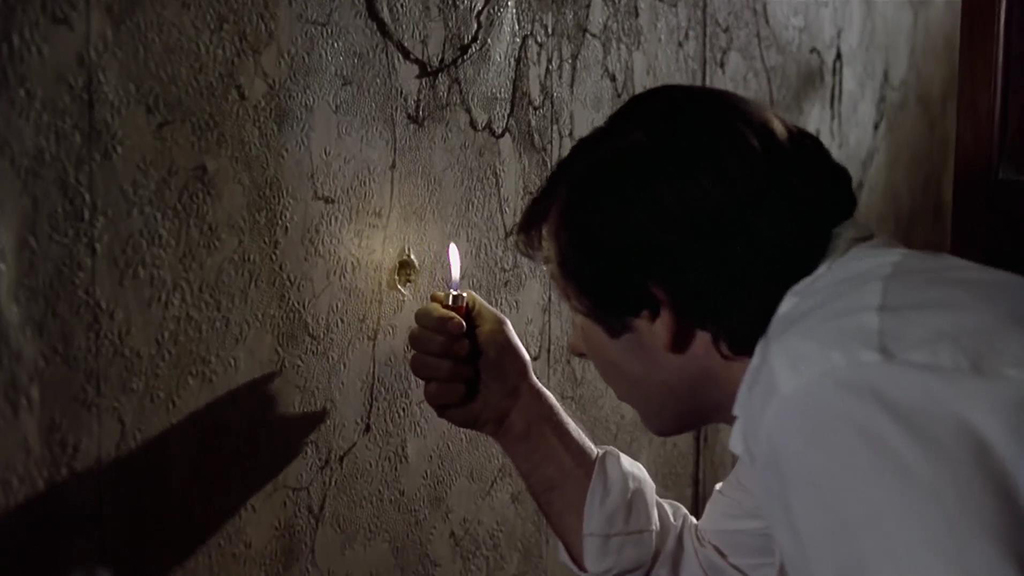
Roman Polanski, despite his rather grave personal failings, has made some absolutely champion horror films, his particular genius lying in his portrayal of claustrophobic paranoia and spiraling descents into madness.
The Tenant (1976) was the third film in Polanski’s so-called ‘apartment trilogy,’ which also included Repulsion (1965) and Rosemary’s Baby (1968), both of which will likely turn up in this series at one time or another. The reader can check Wikipedia for a complete plot synopsis, but in brief, The Tenant is the story of a Polish immigrant, Trelkovsky (played by Polanski himself) who moves into a Paris apartment that was previously occupied by an Egyptologist named Simone who slowly went batshit and tried to end it all by leaping out of the apartment window. As the movie goes on, it becomes clear that Trelkovsky is either on his way to repeating the cycle of madness, or he has the most relentlessly malevolent neighbors on earth.
This ambiguity, also present in the other two films in the ‘trilogy,’ is one of the best aspects of The Tenant, and also one of my favorite horror themes in general. Is Trelkovsky simply losing his mind as Simone apparently did (raising the possibility that the apartment itself is somehow causing the crazy), or was there some kind of organized plot by the other tenants to eventually drive them both to suicide? Judging from what happens in the film, it could go either way, though I tend to fall into the “descending madness” camp.
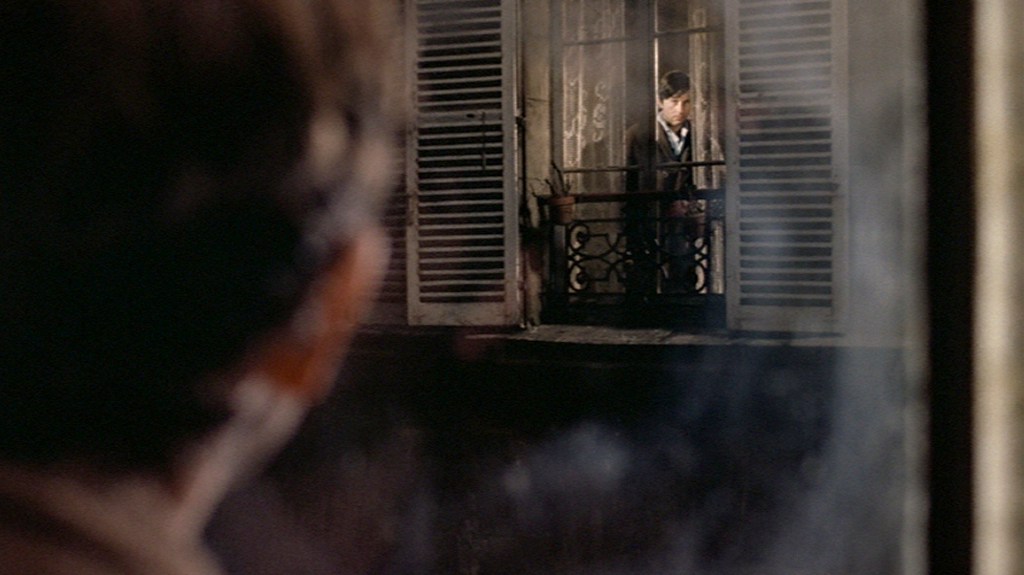
Contact your physician if you notice yourself appearing in two places at once.
There is really just one scene I’d like to call out, though the film is really an embarrassment of riches on this score. An atmosphere of close, dingy dread infuses every scene with jittery unease, and there is ample terror conveyed by simple shots of grungy shutters or twitching curtains. It’s bad enough that Trelkovsky has already discovered that the wardrobe in the apartment is still full of Simone’s clothes, that he can clearly see into the bathroom across the courtyard, and that the glass awning a couple floors beneath his window still bears a ragged hole where Simone’s body crashed through it. But then comes this unsettling development…
Trelkovsky is moving the wardrobe when he happens to glance out the window. He freezes. For there, standing in the bathroom window across the courtyard, is a woman. She is just standing there, staring at him. She is dressed in a long black coat and a black hat. Her face is blurred, but she looks startlingly like his crotchety landlady (played by Shelley Winters), feeding his burgeoning paranoia that the landlady and the other tenants are actively trying to freak him out. Troubled, he turns back to the wardrobe, and it’s then that he spots a hole in the wall that looks to be stuffed with a wad of cotton. He pulls the cotton out and peers into the hole with his lighter. He thinks he sees something, so he pokes his finger in there. And what he yanks out is a tooth.
A FUCKING TOOTH. A long, white canine tooth, clearly extracted at the root. Trelkovsky stares at it for a moment before dropping it into a nearby ashtray. Then, looking down at the tooth with a slightly disgusted expression on his face, he picks the tooth back up and sticks it back into the hole in the wall, and replaces the cotton.
The reason I love this scene so much is that it’s done so elegantly. There is no dialogue, and the background score (which sounds like an oboe) is suitably downbeat and eerie. Besides that, finding a vaguely squicky object left by persons unknown in a place where you weren’t expecting to find such a thing is a fantastic way of building suspense and keeping the viewer guessing. What is the tooth doing in a hole in the wall behind a wardrobe? Is it Simone’s? Did she pull it herself or did someone else do it? And why did she keep it? The imagination races to make sense of the grisly little relic. The appearance of the tooth is never fully explained, and that is what gives the scene this disquieting aura of menace.
There is a later, similar scene that I’d like to touch on as well. Trelkovsky is lying in bed, sick and slightly delirious. Eventually he leaves his apartment to visit the bathroom, making his way through the shadowed halls. When he gets there, a slow pan around the room reveals that someone has very meticulously carved hieroglyphics all over the walls. This is ominous enough to make Trelkovsky bolt from the room and hightail it back to his apartment, but when he gets back there, he glances out the window and sees someone standing in the bathroom he just left seconds before. And this someone is completely wrapped in bandages, like a mummy. Just standing there. Then, the figure slowly begins to unwrap the bandages from around her head, and it’s a weirdly smiling woman, Simone. Her smile reveals a missing canine tooth. This scene is also a great thematic callback, as not only was Simone an Egyptologist, but she was also in a full body cast the first time Trelkovsky saw her (though she died later from her injuries).
Please keep reading and I’ll keep putting these up as I think of them! You can also send me suggestions for scenes you like and why you thought they were particularly scary, or argue with me about the ones I picked. Thanks for your patronage. 😀
Coming Soon…

 Goddess of Hellfire