The Goddess’s Top Ten Horror Movies Based on True Stories

Time for more list-based goodness from The Goddess, and I promise I’m not really gonna make this an ongoing thing; these are just easier for me to do when I’m pressed for time, you dig? I thought you could. When things calm down around here I swear I’ll get back to my more in-depth content.

Similar to my last post, where I picked my favorite horror films adapted from novels, this time around I’m picking my ten favorite horror films based on true events. Now, here’s where it gets a tad sticky, so I had to make a few loose rules for myself. What constitutes “true,” after all? There are a shit-ton of movies based on supposed “real-life” haunted house cases, alien abductions, poltergeist infestations, and demon possession, for example; any self-respecting list would include The Amityville Horror, A Haunting In Connecticut, Fire in the Sky, The Mothman Prophecies, The Exorcism of Emily Rose, and many, many others. I’m disqualifying those because I don’t think most of them are “true” in the sense that they really happened; in other words, I don’t believe in ghosts or demons, so for me, these movies are not based on reality at all. I’m also avoiding films that were based on novels that were in turn based on true stories (for instance, 2007’s The Girl Next Door, which was based on Jack Ketchum’s fictionalized novel of a true event, doesn’t qualify, and I wrote about it last time anyway). Rule of thumb, the movie can be based on a book, as long as the book is non-fiction. I’m also discounting films that so drastically veered away from the stories that inspired them that they are no longer recognizable as the original event, and ones that were sorta loosely based on a particular person, but didn’t have much else to do with a true account of said person (the villains in both Psycho and The Texas Chainsaw Massacre, for example, were inspired by serial killer Ed Gein, but both took so many liberties with the guy’s real biography that it no longer counts as anything but fiction; plus Psycho was based on Robert Bloch’s novel, so). I realize that by their very nature, movies are fictional entities, so there’s a lot of gray area here, and I’m sure I might break a few of my own rules with the movies I picked, but those are my standards and I’ll try to stick to them. I also realize that a few of these aren’t strictly horror films per se, so don’t bust my balls. They’re horror friendly, bitches. So here we go.

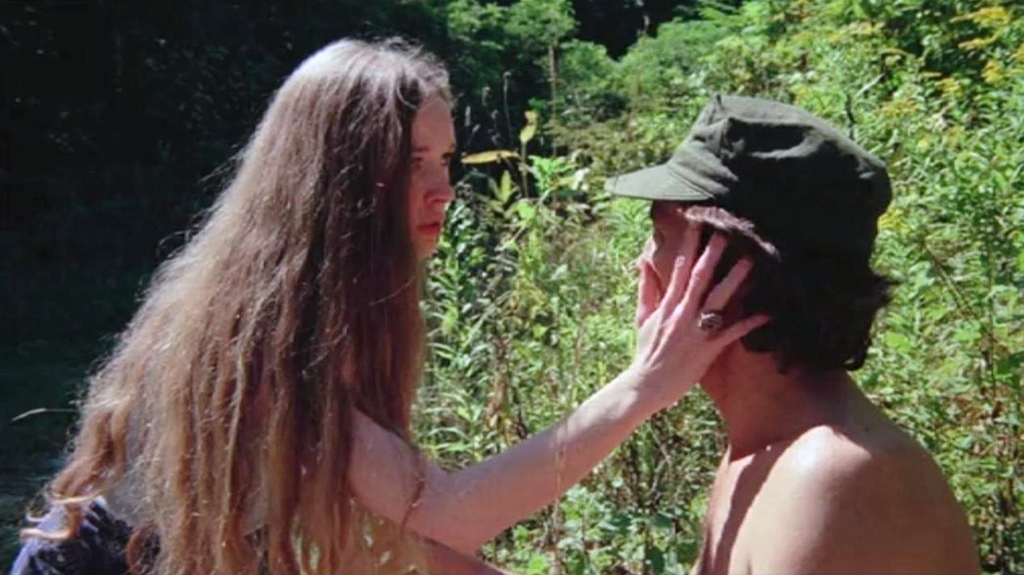
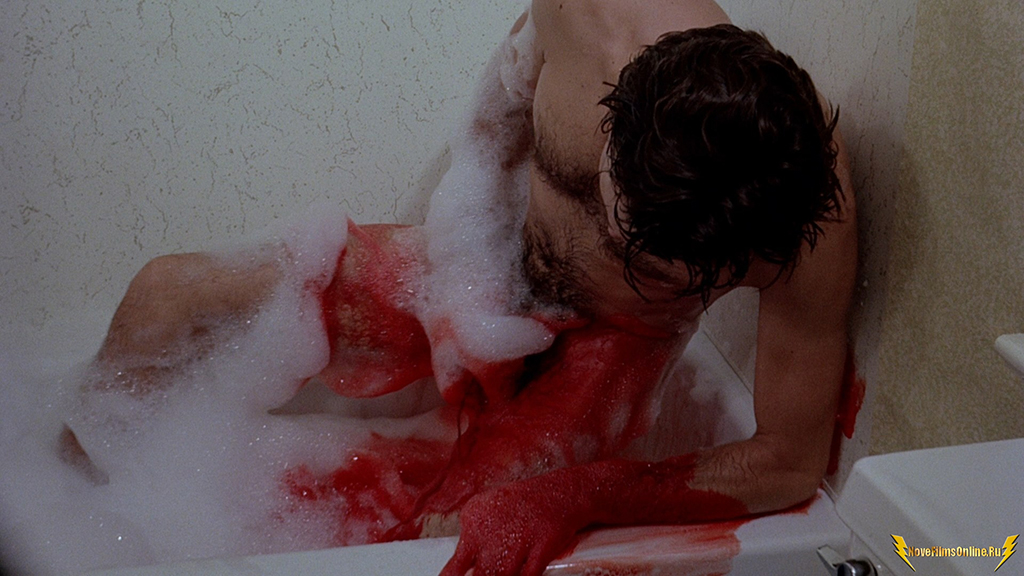
Dahmer

10. Dahmer (2002)

I wasn’t expecting much from this one, to be honest, since it came out right around the same time as a bunch of other direct-to-video serial killer flicks that weren’t much shakes, but I have to admit it really surprised me. Jeremy Renner is great in his complex, nuanced portrayal of rapist, murderer and cannibal Jeffrey Dahmer; he’s pitiful and vomit-inducing by turns.

FromHell

9. From Hell (2001)

Kind of a cheat, since it’s loosely adapted from Alan Moore and Eddie Campbell’s graphic novel, but it’s also based on real theories surrounding the Jack the Ripper case, and I really liked it, so I’m gonna give it a pass. The thing looks great, drenched in gothic atmosphere, and Johnny Depp is his usual rad self as real-life Ripper investigator Frederick Abberline.

Ravenous

8. Ravenous (1999)

This blackly comic horror film, a sadly underrated one, takes aspects of the Donner Party and the case of cannibalistic gold prospector Alfred Packer and mashes them together into a grimly hilarious tale of man-eat-man during the Mexican-American War of the 1840s. Directed by Antonia Bird and featuring great performances from Guy Pearce and Robert Carlyle, this one’s not for all tastes (sorry), but it has a large cult following for a reason, and I thought it was terrific.

SerpentAndTheRainbow

7. The Serpent and the Rainbow (1988)

This one obviously takes some liberties with the source material to ramp up the horror factor, but it’s rooted enough in non-fiction to qualify for the list. Based on anthropologist Wade Davis’s 1985 book of the same name, in which he described the practices of Haitian Vodou and specifically the case of real-life “zombie” Clairvius Narcisse, the film veers into the supernatural, but retains the scientific trappings of the real events.

InColdBlood

6. In Cold Blood (1967)

Nominated for four Oscars and starring the suspected real-life wife-killer Robert Blake, this one stays pretty faithful to Truman Capote’s classic non-fiction work about the 1959 murders of the Clutter family in Kansas. It’s another film that uses a stark, documentary-style feel to make the horrific crime as chilling as possible, and Blake and Scott Wilson (who portray the killers) are eerily believable.

ShadowOfTheVampire

5. Shadow of the Vampire (2000)

A sort-of realistic retelling of the making of the 1921 silent classic Nosferatu, this stylish film (directed by E. Elias Merhige, also responsible for the disturbing 1991 silent film Begotten, which I covered here) uses many techniques from the silent film era to great effectiveness. John Malkovich is fantastic as driven director F.W. Murnau, who will stop at nothing to get his vision on celluloid, and Willem Dafoe turns in a skin-crawling performance as Max Schreck, who may just be a REALLY hardcore method actor or may be an actual vampire. Totally meta and wonderful.

Henry

4. Henry: Portrait of a Serial Killer (1986)

Probably one of the most uncomfortable films I’ve ever watched, simply because the crimes are so unflinchingly presented. Michael Rooker is skeezy perfection as real-life drifter and serial killer Henry Lee Lucas, and the scenes of him unemotionally watching videos of his killings with scumbag partner in crime Otis (based on Henry’s real-life sidekick Ottis Toole and played by Tom Towles) are intensely disturbing. One of the ickiest films ever made, but also one of the best.

Zodiac

3. Zodiac (2007)

David Fincher’s chilling thriller is based on the famous series of random murders that took place in the San Francisco area in the 60s and 70s. He chose to focus on the police investigation of the case rather than the killer (which I guess he had to, since Zodiac was never caught, heh heh), but that only serves to make the film even creepier, since the identity and motivations of the murderer remain unknown. The scenes of the actual killings are matter-of-fact and completely horrifying, striking from out of the blue and giving the viewer the visceral feeling that no one is safe, ever. Brrrrr.

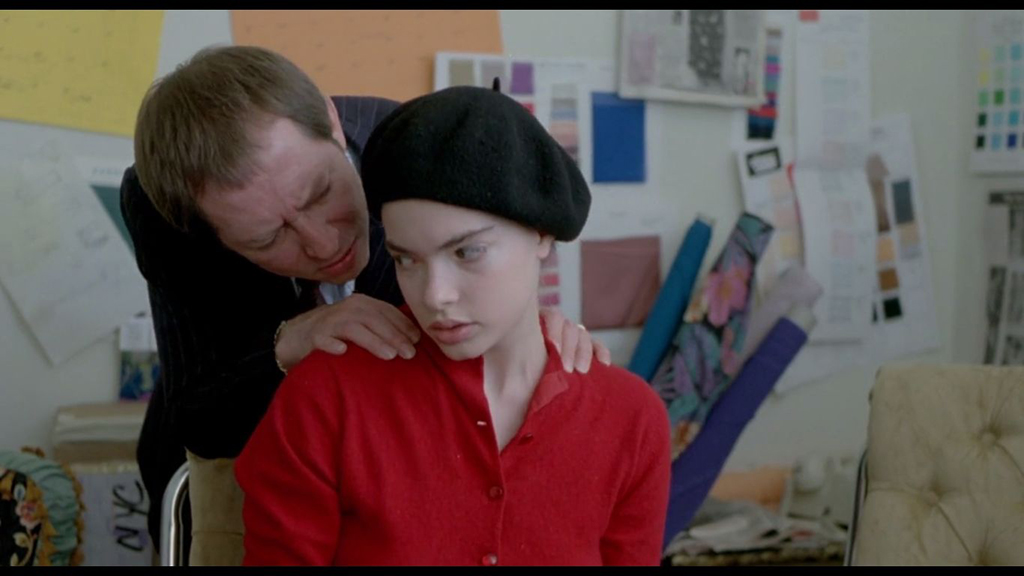
DeadRingers

2. Dead Ringers (1988)

I’ve written about this film before, as it’s my favorite of all of Cronenberg’s body-horror epics. As disturbing as this movie is, it’s made even more so by the fact that the creepy Mantle twins were based on real dudes, specifically twin gynecologists Stewart and Cyril Marcus, who practiced together in their New York City clinic and were both found dead in the apartment they shared, presumably from barbiturate withdrawal.

Monster

1. Monster (2003)

A brutal, gritty take on the crimes and trial of female serial killer Aileen Wuornos, this one is a twisted masterpiece, elevated to classic status by Charlize Theron’s unbelievable turn as Aileen. I saw this in the theater, and had to keep reminding myself that Aileen Wuornos was actually dead and not appearing in this movie; Theron embodied the character in a way I don’t think I’ve ever seen in another film (except maybe for Martin Landau portraying Bela Lugosi in Tim Burton’s Ed Wood). A complex film that dares you to sympathize with its protagonist even as you revile her. Astonishing.

And ten more, just for the hell of it:

The Hills Have Eyes (1977)
Based on a real family of cannibals in 15th-century Scotland, headed by Alexander “Sawney” Bean.

The Elephant Man (1980)
David Lynch’s fictionalized biography of deformed Englishman Joseph Carey Merrick.

Rope (1948)
Based on a 1929 play that was in turn based on the famous 1924 Leopold and Loeb murders.

The Lodger (1944)
Somewhat fictionalized retelling of the Jack the Ripper case, based on a novel by Marie Belloc Lowndes.

Jaws (1975)
Adapted from Peter Benchley’s novel, but inspired by a real 1964 story about fisherman Frank Mundus catching a monster great white shark off the coast of Long Island.

Helter Skelter (1976)
Based on Vincent Bugliosi’s 1974 account of the Charles Manson murders.

The Black Dahlia (2006)
Brian de Palma’s histrionic film was based on the real-life, grisly murder of actress Elizabeth Short in 1947.

Hollywoodland (2006)
More a detective thriller than a horror film, this is a speculative adaptation of the mysteries surrounding the death of Superman actor George Reeves in 1959.

Ed Wood (1994)
Definitely not a horror film, but one of my favorites, this loving film sort-of-accurately eulogizes famed terrible horror and sci-fi film director Edward D. Wood, Jr.

Heavenly Creatures (1994)
Also not a horror film, but a great account of the real 1954 Parker-Holme murder case in New Zealand.

The Goddess’s Top Ten Horror Novel Adaptations

I can’t believe it’s been a week since my last post! Sorry about that. I really do try to keep up with this thing, but sometimes I get busy with all my other endeavors (writing, book promotion, graphic design work) and run out of hours in the day. When it finally came time to do a new post, I was scrabbling for a subject, so I just decided to do something fairly pedestrian by discussing my ten best horror films based on novels. I’m not dropping my nuts here and proclaiming that these are the BEST ADAPTATIONS EVAR, but they’re certainly my favorites, and before anyone argues, YES, I know there are lots of other great horror films that were based on books, but I wanted to showcase great movies that were made from novels that were themselves fantastic and familiar to me (for example, while John Carpenter’s The Thing is one of my favorite horror movies of all time, I’ve never read the book it was based on, and as far as The Exorcist goes, I actually thought the movie was light years better than the novel). So now that we’ve got all that out of the way, allons-y.

GirlNextDoor

10. The Girl Next Door (2007)
Based on Jack Ketchum’s horrific, you’ll-need-a-shower-afterwards novel (made all the more squicky by the fact that it was based on a true story), this 2007 adaptation mostly doesn’t shy away from the more terrible aspects of the book, and is all the more powerful for it. While I admit I found the novel a great deal more disturbing, the film is a worthy addition to the evil-that-humans-do canon. Some of it is a little too aw-shucks, fifties-stereotypical, but Blanche Baker is chilling as Aunt Ruth, and the mostly young actors are great, particularly 21-year-old Blythe Auffarth as the doomed Meg.

Hellraiser

9. Hellraiser (1987)
Adaptations of Clive Barker’s infernal works are generally hit or miss, but I think we can all agree that this is the best by a mile (though I have to say that Candyman is also in the running). Based on his 1986 novella The Hellbound Heart, and directed by Barker himself, Hellraiser is filled to the brim with sadomasochism, buckets of gore, that genius puzzle box conceit, and one of the most recognizable horror baddies of all time. While the sequels couldn’t begin to approach the original classic, it’s easy to see how the detailed world Barker created in his short work demanded much more screen time. Jesus wept, indeed.

GhostStory

8. Ghost Story (1981)
As much as I adored the spooky, low-key adaptation of Peter Straub’s 1975 novel Julia (known as The Haunting of Julia in the US and Full Circle in the UK; you can find my analysis here), I find that Ghost Story, based on his 1979 book of the same name, just barely edges it out. The novel is so rich, complex, and over the top that the film couldn’t help but streamline the thing and leave several plot tendrils out, but I love it anyway, and I think director John Irvin was wise to focus solely on the central conflict of the book, that of the men of the Chowder Society battling the shapeshifting she-demon known by different names through the years. Some fantastically eerie scenes, and it was nice to see a band of dignified old codgers playing the heroes.

StirOfEchoes

7. Stir of Echoes (1999)
I’ve talked about this criminally underrated film before, but I try to pimp it at every opportunity, because it’s so great and I’m still pretty bummed that it sorta got lost in the shuffle due to its simultaneous release with The Sixth Sense. Somewhat based on Richard Matheson’s short 1958 novel A Stir of Echoes, the film takes the basic plot of the book and builds an intensely frightening tale of hypnosis, psychic visions, and murder upon it. I’m not scared easily, but seeing this film in theaters gave me the heebie-jeebies big time, and it holds up remarkably well. Props also for the very Lynchian sound design, which ramps up the scare factor considerably.

TheInnocents

6. The Innocents (1961)
Directed by Jack Clayton and starring Deborah Kerr as governess Miss Giddens, The Innocents is one of those rare films that wrings the scares from subtle atmosphere. Based on Henry James’s classic 1898 novella The Turn of the Screw, with a screenplay co-written by Truman Capote, the movie is chock full of spooky children, secrets, ghosts, and eerie goings-on, amplified into skin-crawling terror by the use of music, lighting, and ambiguity.

TheOther

5. The Other (1972)
Based on former actor Thomas Tryon’s 1971 debut novel (and if you’d like to read a rundown of the lackluster adaptation of another of his fabulous novels, Harvest Home, I’ve got you covered), this Robert Mulligan-directed film is one of the best examples of the good/evil twin trope. Set in 1935 and starring Chris and Martin Udvarnoky as the conflicted Holland twins, the movie is a golden-drenched slab of uncanny mystery and horror, painted in hues of perverse nostalgia. Tryon, who wrote the screenplay, was reportedly not happy with the adaptation, but for my money the film more than did the novel justice.

HellHouse

4. The Legend of Hell House (1973)
Another Richard Matheson adaptation (this time of his 1971 novel Hell House), this one takes obvious cues from The Haunting, but goes in a splashier direction with much effectiveness. Directed by John Hough and featuring great performances from Roddy McDowall and the impossibly adorable Pamela Franklin, the story takes the standard horror-movie plot of a group of ghostbusters investigating a scary house and does all kinds of weird shit with it. Baroque, overwrought, and lots of creepy fun.

RosemarysBaby

3. Rosemary’s Baby (1968)
Capturing the sly, blackly comic edge of Ira Levin’s 1967 book while maintaining a sense of slowly building tension and paranoia, there’s a reason this Roman Polanski-directed classic ends up on so many “best horror films” lists. I absolutely love Ruth Gordon as the lovably terrifying Minnie Castavet, and Mia Farrow is perfect as the fragile, waifish Rosemary, a protagonist you can’t help but sympathize with and be afraid for as everyone in her life seems to turn against her. If you’re a fan of Polanski’s films, check out my previous writeup on his deliciously creepy 1976 movie The Tenant.

TheShining

2. The Shining (1981)
What can I say about this masterpiece that hasn’t already been said? (Well, I said this and this, but y’know.) Taking what is arguably Stephen King’s best novel and using it as a springboard to explore universal themes, myths, and existential terror, Stanley Kubrick created a timeless, iconic piece of art that still has the capacity to enthrall and horrify, more than three decades later. Easily one of the five best horror films ever made.

TheHaunting

1. The Haunting (1963)
You just knew this was gonna be my number one, didn’t you? I admit I talk about this book and film a lot (such as here and here, for example), but that’s only because I am in awe of the subtle dread and psychological depths this story plumbs in both mediums. Based, of course, on the hands-down best haunted house novel ever penned, 1959’s The Haunting of Hill House by Shirley Jackson, the casting in Robert Wise’s masterful adaptation is spot-on, and he deftly drenches the film in chills and atmosphere while essentially showing nothing, an astounding feat and one that is right in line with the source material. I really can’t recommend book or film enough, in case you hadn’t noticed. Oh, and I mentioned this before, but skip the lame-ass remake.

And just because I can, here are twenty more that were eliminated for the sake of brevity:

The Exorcist (1973, based on the 1971 novel by William Peter Blatty)
The Hunger (1983, based on the 1981 novel by Whitley Strieber)
The Birds (1963, based on the 1952 short story by Daphne du Maurier)
Nosferatu (1922, based on Bram Stoker’s Dracula, 1897)
Frankenstein (1931, based on Mary Shelley’s 1818 novel)
The Phantom of the Opera (1925, based on the 1910 novel by Gaston Leroux)
The Picture of Dorian Gray (1945, based on Oscar Wilde’s 1890 novel)
House of Usher (1960, based on Edgar Allan Poe’s short story “The Fall of the House of Usher,” 1839)
Duel (1971, based on Richard Matheson’s 1971 short story)
Something Wicked This Way Comes (1983, based on Ray Bradbury’s 1962 novel)
The Entity (1981, based on the 1978 novel by Frank De Felitta)
Village of the Damned (1960, based on John Wyndham’s The Midwich Cuckoos, 1957)
Masque of the Red Death (1964, loosely based on Edgar Allan Poe’s short story, 1842)
Re-Animator (1985, based on the H.P. Lovecraft novella Herbert West—Reanimator, 1922)
Cemetery Man (1994, based on the 1991 novel Dellamorte Dellamore by Tiziano Sclavi)
Misery (1990, based on Stephen King’s 1987 novel)
Carrie (1976, based on Stephen King’s 1974 novel)
The Prestige (2006, based on the 1995 novel by Christopher Priest)
The Lair of the White Worm (1988, loosely based on Bram Stoker’s 1911 novel)
Horns (2014, based on Joe Hill’s 2010 novel)

Keep it creepy, my friends, and until next time, Goddess out.
Scary Silents: “The Haunted Castle”

The Goddess is a busy hellspawn, as I’m sure you all know by now. For the past couple weeks, I’ve been running my little cloven hooves off, doing promotional radio shows for The Mammoth Mountain Poltergeist (such as here and here), researching and writing an upcoming book I’m collaborating on with parapsychologist Steve Mera about one of his poltergeist cases, formatting and uploading ebook versions of some of my other books (here, here, here, and here), as well as doing my regular full time job and all the other freelance graphic design and club promotion stuff I do. In short, minions, I’m tired, and I’m very much looking forward to the upcoming three-day weekend, over which I have ambitious plans to simply lie around like a slug, eat copious amounts of food that’s bad for me, and occasionally rouse myself, put on pants, and go out to dance and drink myself silly until the wee hours. I’m going for the gusto here, folks.

But I didn’t want to go into the long weekend before posting a little something something on this here blog, and since it’s been a week or two since I did a “Scary Silents,” that seemed the logical choice. However, since it is also Friday and I’m really antsy to get the party started but also kinda bummed out that the air conditioning in the Hellfire home busted last night and won’t be fixed until Thursday (and we live in central Florida, y’all, so this is a horrible tragedy and even though you’d think that I’d be all about the heat, being a minion of hell and all, you’d be WRONG, I’m a motherfuckin’ COLD demon, dammit, so don’t question me), I wanted to choose a silent film that would fulfill the requirements for the series but wouldn’t be too taxing on my overworked and overheated brain. Enter The Haunted Castle.

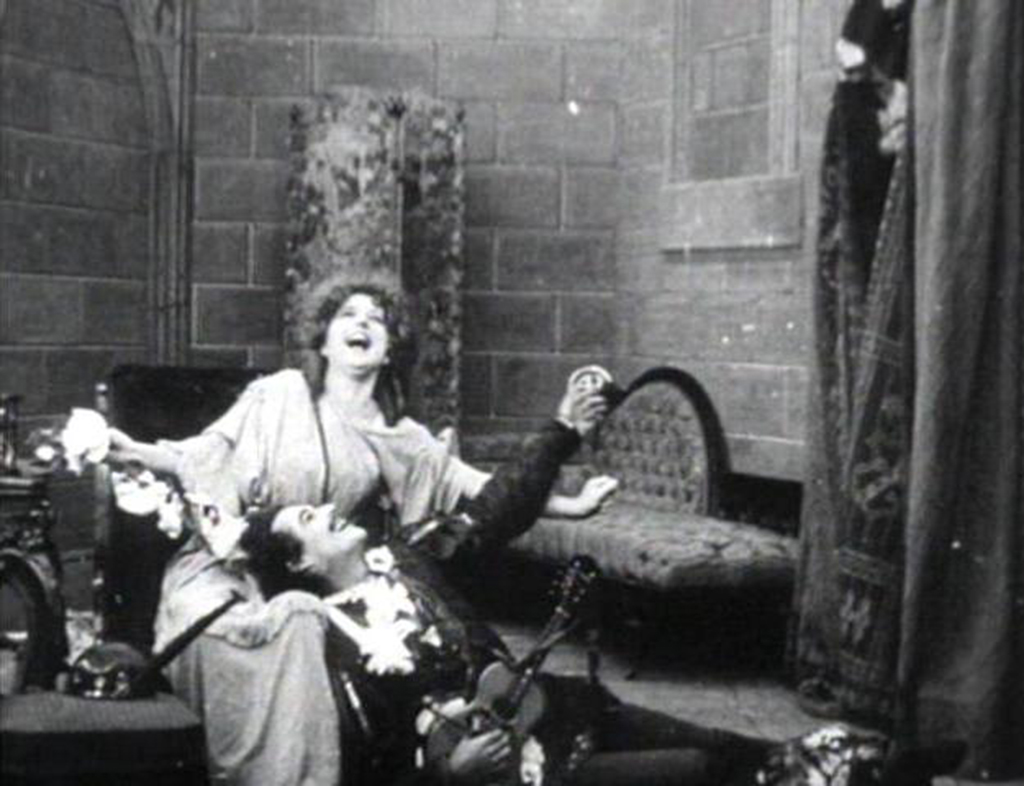
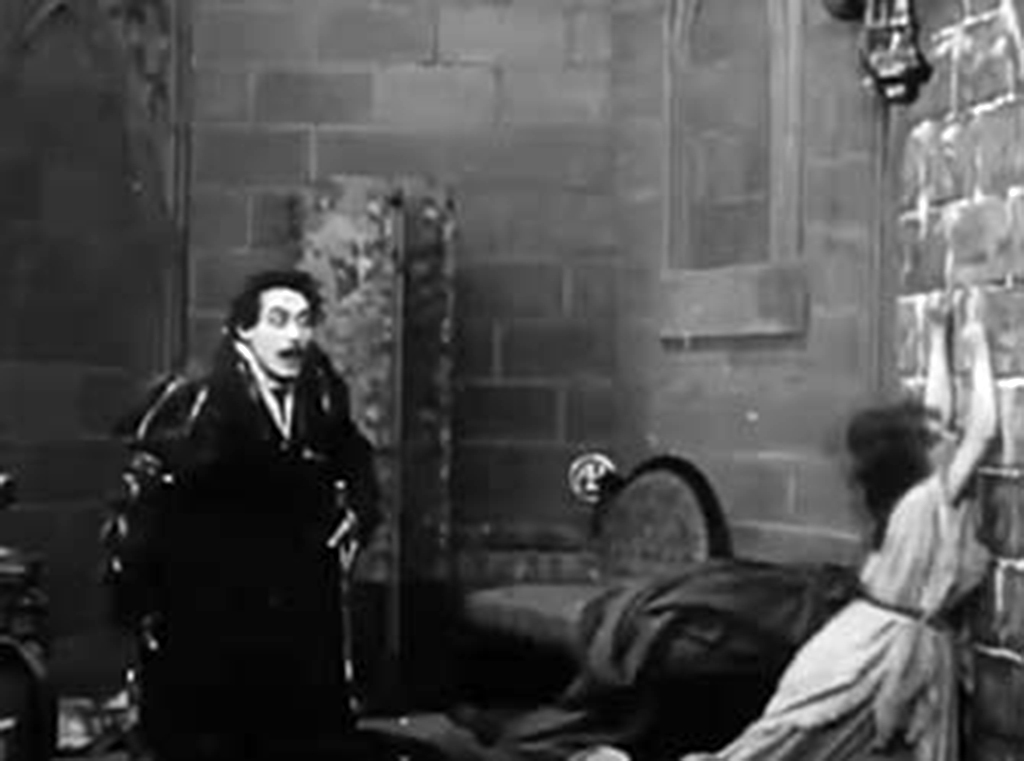
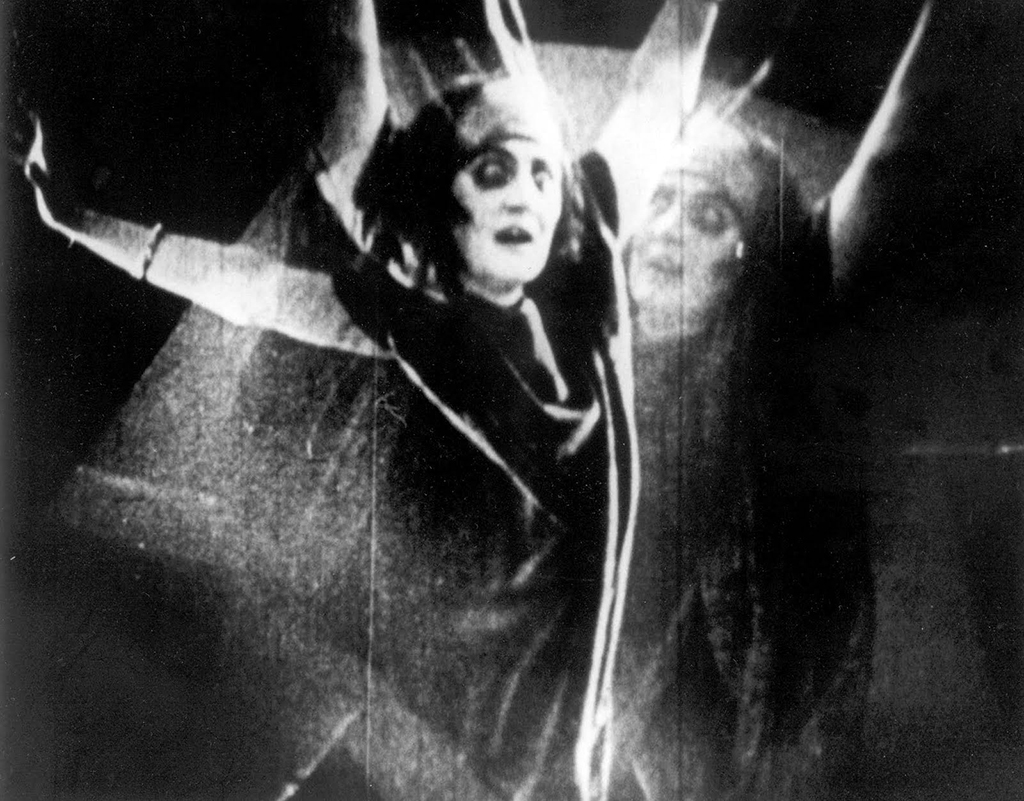
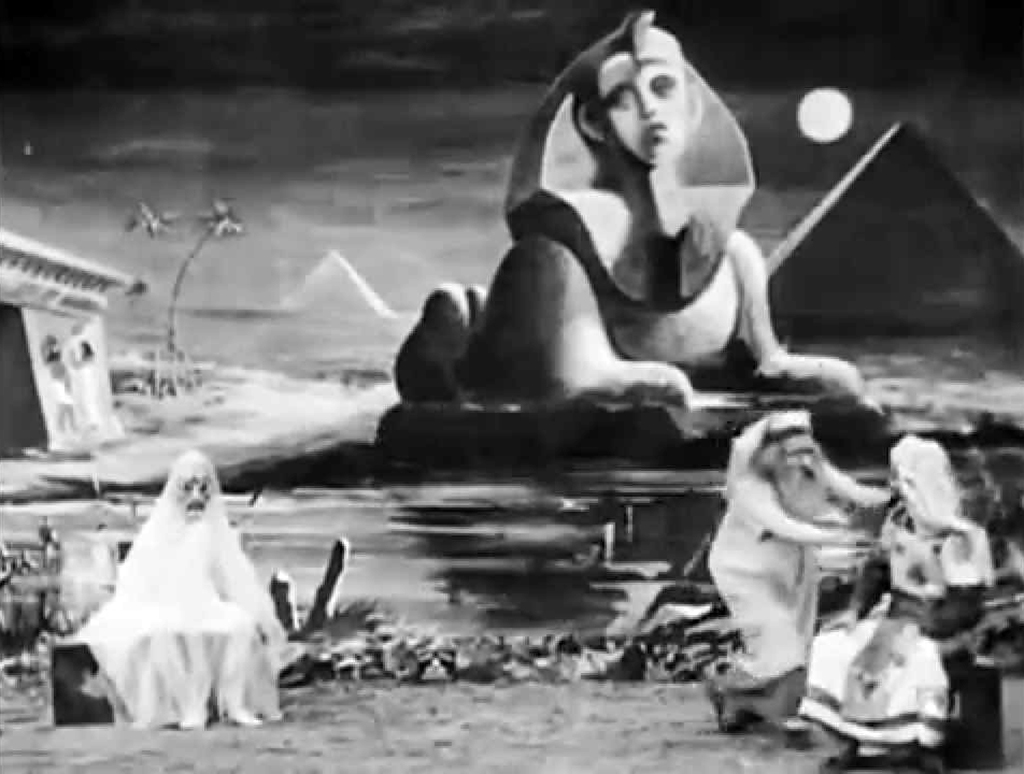
Released in 1896 (!!!), directed by the über-famous George Méliès, and considered the first horror film ever made (even though it’s more funny than scary), The Haunted Castle (French title Le Manoir du diable, ooh la la) was a massive influence on early horror films, particularly the German expressionist classics and the subsequent Universal films in the 1930’s. Even though audiences of the time had probably seen similar effects performed live on a stage, I’m thinking that seeing the same thing in a moving picture must have blown their minds in an OMG MAGIC TECHNOLOGY kinda way. The fact that the movie is only a little over three minutes long doesn’t lessen its importance or influence, and here I’d like to give a shout-out to the New Zealand Film Archive, which located a copy of this film in 1988 after it had been presumed lost for decades.

The film opens, obviously, on a static set of the cavernous halls of a haunted house. A huge bat comes sailing into the frame and flaps around a bit before poofing into a fabulous caped figure, who has a cool top hat kinda thing and some wicked Peter Pan shoes and a sweet Van Dyke beard. This is Hipster Mephistopheles, bitches. With a wave of his eeeevil hand, he materializes a big-ass cauldron at center stage. Then he produces a wand from somewhere in his dance belt, draws some Satanic-ass shit on the floor, and another poof reveals his sidekick, Imp Boy, who proceeds to stoke the flames under the cauldron, causing smoke to pour out the pot.

Drink me in, sinners.

Drink me in, sinners.

And from the smoke emerges: VOILA! A LADY! She has a flowy white outfit on like a Greek cauldron bitch, and she’s all TA DA, and then Mephy (that’s what I call him, we’re tight) magically edits her to the floor. Then he puts his hand on her shoulder and tells her some shit, and kinda pushes her into the closet so she doesn’t embarrass the guests he has coming over or something. Greek Cauldron Bitch has a tendency to get handsy when she drinks, that’s all I’m saying.

Then he goes to the imp and sorta pets him on the head like he’s a faithful bull terrier, and Mephy’s all DO THAT THING, so then an open book appears in the imp’s hands, and Mephy writes in it. “Dear Diary: Today I made a cauldron and my imp appear in a puff of smoke, and then materialized a Greek goddess out of the cauldron and shoved her ass in a broom closet. LOL. Productive day.”

Then the imp disappears again, because he’s an imp so he has to go chill in another dimension when his services aren’t required, and then Mephy prances a bit and HUZZAH makes the cauldron disappear again. Then he’s like listening for something, and seems to hear what he expected, because he puts his cape back on and disappears. And then, sure enough, two of the three musketeers come sashaying into the castle, pointing around the place and talking between themselves like they’re assessing the property for “Flip This House,” all OOOOH, GIRL, CHECK OUT THAT WAINSCOTING, OOPS, SORRY I BEANED YOU WITH MY BITCHIN’ BELL SLEEVES THERE and then the imp poofs back with a big forked stick and starts poking them in their fey asses. They’re both looking around like WTF but the imp keeps disappearing before the musketeers can see him, so presumably they’re each thinking that the other musketeer has butt-poking feelings for him that he has not revealed until this point. I ONLY LIKE YOU AS A FRIEND, PORTHOS, GOD.

The musketeers quibble and argue and shove each other, and I may be imagining some sexual tension here (BOW CHICKA WOW), until finally one of them is all FUCK THIS SHIT, I’M OUT and the other one’s like GO THEN, YOU ASS-POKING FREAK, THE HELL WITH YOU. And then the remaining musketeer is all OOH, LOOKIT THIS BENCH, IMMA TAKE THIS FANCY SHIT ON ANTIQUES ROADSHOW, and then it disappears because Mephy doesn’t want his furniture turning up on PBS for everyone to gawk at, for heaven’s sake. Musketeer is all K THEN, I’LL JUST PARK MY ASS ON THIS OTHER BENCH OVER HERE but then POOF that one disappears too! Mephy is all about spreading evil through minor inconvenience, you see, all de-apparating the chairs you were just about to sit on. Dick.

Musketeer is all exasperated, but then he turns around and the first bench is back, and he doesn’t even find this particularly strange, he’s just OH THERE YOU ARE, GET READY BENCH, YOU’RE FIXING TO GET GRACED BY ATHOS ASS, and before he sits he points at the bench like NOW DON’T YOU GO ANYWHERE, and it doesn’t go anywhere this time, but just as Athos settles his legging-clad shanks on the bench, a skeleton appears there and he scoots booty right into a bony pelvis. FACE!

'Sup, flesh sack.

‘Sup, flesh sack.

And then, because Athos is clearly a paragon of rationality, he whips his sword out of its scabbard, all IMMA SLICE THAT SKULL LIKE BUTTA, but when he swings the sword, the skeleton turns into the giant bat and flaps at him while he puts his sword back into its sheath all like K, I’M DONE WITH THIS WEIRD ACTION, but then he reconsiders and grabs the bat, and POOF, it’s Mephy again! Athos is all SHIIIIIIIT and backs away, and then Mephy conjures up more smoke in which the imp makes a repeat appearance. And Athos seems like he’s scared, but also kinda like HUH, WOULD YOU LOOK AT THAT.

They see me impin', they hatin'.

They see me impin’, they hatin’.

Mephy points the imp to the floor, where he does a kinda tumble and disappears YET AGAIN, in a way that kinda makes it look like an accident. OH, THAT’S RIGHT, I FORGOT I CAN’T TUMBLE THAT WAY, THAT SENDS ME RIGHT TO THE OTHER DIMENSION. DAMN.

And then Athos, looking very put out, attempts to stomp like a manly man away from these devilish shenanigans, but ALAKAZAM! The way out is blocked by four white-clad babes! Instead of being all LLLLLADIES, Athos falls to his knees and begs them not to touch him with their ovary cooties, but they just push into him like an impenetrable wall of vampitude, and Athos JUST CAN’T EVEN and passes out. The ladies, their job done, disappear.

Mephy jumps over the prone Athos and then wafts his hands at the guy, and Athos acts all histrionic like he’s been blinded maybe, and then Mephy reaches into the closet and brings out Greek Cauldron Bitch. Athos is all WELL HELLO THERE and sorta bows to her and takes her hand, then gets down on one knee and kisses the hand, the whole schtick. But as soon as he kisses her hand, ABRACADABRA, she turns into…um…someone else? Another lady in a long white gown and maybe white angel wings, and she seems to be holding a staff. Athos is perturbed about this for some reason, and is all LET’S GO, ANGEL HO and he draws his sword again, but angel-woman raises her staff, and then a bunch more ladies appear beside her. Athos is all UH OH, but then apparently Porthos has recovered from his butthurt because he returns and starts helping his fellow musketeer fight the woman-wall. And I guess they’re supposed to be witches, because a bunch of them have brooms. The witches run around in a circle and then go out the door, but then troop back into the room through another entrance, like some kind of Wiccan conga line. Porthos has had enough and runs from the room and leaps over a railing with a hearty WHEEEEEE while Athos is back there all WTF MAN YOU’RE SUPPOSED TO BE HELPING ME, BROTHERS IN ARMS MY ASS.

Away with your foul womaniness, temptresses! My ass is not yours for the poking!

Away with your foul womaniness, temptresses! My ass is not yours for the poking!

The ladies kinda feint at Athos, and he just doesn’t know what to do, but then the witches kinda circle again and crouch down to the floor and disappear. I feel like Mephy is just messing with the musketeers at this point, and all because Athos and Porthos were considering renovating Mephy’s sweet infernal castle into a charming bed and breakfast. (Lake views, full buffet meals, and just a hint of Stygian atmosphere, all for very reasonable rates.)

Athos searches the ground where the witches disappeared as if to say WELL, I CAN’T FIGURE IT OUT, even though all he’s seen so far in this joint is magical appearances and disappearances of various non-human entities, so at this point you’d think he’d just be going with the flow. Finally he’s like WELL, I’M DONE and makes to leave, but of course Mephy is still there in the doorway and makes laser-finger gestures at Athos while Athos cowers and chews scenery. Then Athos pulls the old HEY, LOOK AT THAT DISTRACTING THING UP THERE and he climbs up on the bench and pulls down a big wooden cross that was conveniently hanging over a doorway. Now, not to judge, Mephy, but why on earth would you decorate your house with crosses when crosses are anathema to a diabolical being such as yourself? Maybe it isn’t Mephy’s castle after all. Maybe he’s just house-sitting for Cotton Mather or something.

Predictably, Athos wields the cross at poor Mephy, Mephy does the old OH WHAT A WORLD, WHO ARE YOU TO DESTROY MY BEAUTIFUL WICKEDNESS routine, and then the movie abruptly stops. Christianity wins, Mephy scampers back to Heck, and Athos buys the haunted castle for a song and razes the whole thing to the ground to build a Super WalMart. The end.

I hope you’ve enjoyed this installment of Scary Silents, and I hope you have a lovely Memorial Day weekend. Don’t forget to grill a nice rare steak for the Goddess, and keep it creepy, my friends.

Parchment to Pixel: “The Enfield Haunting”

Readers should not be surprised to find that I’ve had poltergeists on the brain recently. Not only have I been doing radio shows to promote The Mammoth Mountain Poltergeist (such as here and here), but I’ve also been working on a new book in conjunction with parapsychologist Steve Mera about one of the poltergeist cases he investigated in the 1990s. So those “noisy spirits” have been the overarching theme for the last few weeks of my life, if you catch my drift.

And because I love nothing so much as overkill, I decided to mine the poltergeist thang for this newest entry in my Parchment to Pixels series. Sky Living in the UK recently began airing a three-part miniseries based on the very famous 1977 Enfield Poltergeist case (which I actually summarized in my own Mammoth Mountain book, in the chapter on related cases). I’ve only seen the first two parts so far, but I thought I’d share my impressions, and perhaps edit this post or write a new one after the final installment airs. We’ll see how it goes.

ljkmzoN1pv

Called “The Enfield Haunting,” the miniseries features an impressive cast of British acting heavyweights, like Timothy Spall, Matthew Macfadyen, and Juliet Stevenson (as Maurice Grosse, Guy Lyon Playfair, and Betty Grosse, respectively), as well as some terrific child actors portraying the put-upon Hodgson brood. Eleanor Worthington-Cox (of Maleficent fame) as Janet Hodgson is especially good.

The series is very loosely based on Guy Playfair’s paranormal classic This House Is Haunted, and Playfair himself shares writing credit on the show (with Joshua St. Johnson). Having read the book myself about a year ago when I was researching my own book, I will say that this series is definitely not the place you want to go if you simply wish to see the tale told realistically; the show is heavily, heavily dramatized, features several big scares that were not in the book, and hews to a more traditional horror movie structure. There’s nothing wrong with that, of course, as long as you know what to expect, but I have to say it was a little jarring for me at first, until I just relaxed and went with the flow instead of going, “Uh, no, that didn’t happen like that” every five minutes. By the way, if you’d like to see a more low-key rundown of the purported facts in the case, there’s a documentary here that’s actually pretty interesting. Oh, and from here on out, I’m likely gonna be spoiling some shit, so if you haven’t watched the series yet, YOU HAVE BEEN WARNED.

The Enfield Haunting Sky Living Episode 1 Doug Bence played by Tommy McDonnell shows Maurice and the Hodgsons the headline. Timothy Spall plays Maurice Grosse. Rosie Cavaliero as Mts Hodgson. Fern Deacon as Margaret. Credit: Photograph by Nick Briggs

You can read about the Enfield case on Wikipedia or in Playfair’s book, so I’m not gonna summarize it here, but I’d like to point out a few places where the series very obviously hyped up the terror and the drama from the fairly matter-of-fact reports of the paranormal investigators who worked on the case.

Though it is true, for example, that Janet supposedly channeled the spirit of a man named Bill who had died in the house (he’s named Joe in the series, for some reason), I don’t recall that she ever actually claimed to have seen an apparition of him. Bill manifested himself mostly as a creepy voice that would issue from Janet’s throat (or from behind her, as she claimed) and say nonsensical things, swear profusely, or occasionally come up with some tidbit about his death that actually did check out later. In the series, though, the spooky old fuck is everywhere, first appearing (in a pretty effective jump scare, I have to admit) when Janet is looking through her sister’s Viewmaster, and subsequently popping up outside of windows and so forth. Once he even turns up in the living room downstairs, puts his hand over Janet’s mouth as though to suffocate her, and (presumably) kills the family’s pet canary. And when Janet speaks in Joe’s voice, it is portrayed as possession, more or less.

Enfield Poltergeist 2

In fact, so far in the series, it seems as though the horrible Joe (who, it is hinted, was a molester/abuser when he was alive, according to his son, who Maurice Grosse interviews at one point) is painted as the main antagonist and a definite evil presence in the home who is on a quest to hurt Janet. In the second episode of the series, Guy brings in a psychic who makes contact with Joe, and after doing so, warns the family and the investigators not to try to contact or interact with him again, because he is the literal worst.

This is quite different to the book, in which it’s pretty much understood from the get-go that the “poltergeist” is not the spirit of a dead person at all, but rather the psychokinetic energy produced by Janet and, to a lesser extent, her sister Margaret, evidently triggered because the children were under intense duress after the departure of their father and their subsequent fall into further poverty. I don’t remember a psychic being called in by the investigators in the book, but if there was, then the psychic certainly didn’t channel a demonic old man or give the investigators such a grave warning. EDITED TO ADD: I was a bit mistaken in this. After discussing the book last night with the God of Hellfire, who read it at the same time as I did (I read it aloud to him after buying it for him for his birthday, matter of fact), he says that the investigators called in several psychics, none of which were much shakes, mostly just spouting useless “I feel a presence” type stuff, as most psychics are prone to do. Interestingly, though, the GoH remembers the last psychic that was brought in actually stopped the phenomena from occurring for good, or at least happened to be present when the phenomena stopped on their own.

The paranormal experiences portrayed in the series, in fact, pretty much take the gist of what was actually reported in the case and then ramp it up a hundredfold to make it as scary as possible. The splashiest things reported at Enfield in 1977 were things like furniture moving on its own, small objects (books, LEGO bricks) flying about the room, Janet’s weird “Bill” voice, some possible levitation, and a couple of apportations. In the series, though, Guy Playfair gets bodily thrown against a wall by an unseen force, Janet is nearly strangled by a possessed curtain (which actually only wrapped itself around her midsection briefly in real life), and sister Margaret begins speaking in the Joe voice as well, as though the “spirit” is moving from person to person.

David Soul seems unimpressed by the flyin' Guy.

David Soul seems unimpressed by the flyin’ Guy.

The relationship between Grosse and Playfair in the series is also far more contentious than it was in reality, and while I understand this was done to heighten drama and turn the whole thing into a more typical film narrative, it still struck me as strange, especially since Playfair himself was a co-writer on the series. In the actual case, Grosse and Playfair were both members of the Society for Psychical Research, and were casual friends. Grosse began working at Enfield, and at a meeting of the SPR asked the assembled members for assistance. Playfair volunteered, as he had at that point written several books and articles on paranormal topics and was experienced in the type of phenomena being reported. That’s about as conflicted as I remember their relationship being, i.e., not at all.

The Enfield Haunting Episode 1

In the series, though, Grosse begins camping out at the Hodgson home, doing his investigation thing, when Playfair shows up unexpectedly, offering help. It comes to light later that the bigwigs at the SPR have sent him to keep an eye on Grosse, since the SPR are thinking that Grosse has become too credulous and unstable since the death of his daughter, and is maybe going to screw up the case and make the SPR look like idiots. While it is certainly true that the real Grosse’s interest in the paranormal was sparked by his desire to contact his daughter (also named Janet), who died young in a motorcycle accident, in all the interviews I saw with him and in everything I read about him, he never struck me as any more credulous than anyone else in the field, and in fact seemed pretty level-headed, maintaining a healthy skepticism about the paranormal in general.

In a way, I almost wish I could just watch “The Enfield Haunting” as is, without knowing anything about the actual case, because I think I would enjoy it a lot more. It’s certainly a top-notch production, from the stellar acting performances to the fantastic cinematography to the wonderfully eerie vibe that permeates the entire endeavor. It’s creepy and pretty great, as a matter of fact; it’s just a shame that I’m so familiar with the source material that such a drastic fictionalization of it is sort of bothersome for me to watch (I’m sure I’ll feel the same way about the upcoming film The Conjuring 2, which will also be based on Enfield). It’s no fault of the series, really, and I actually do recommend it to those with an interest in such things. Besides all that, as I was watching it I couldn’t help but wonder what a Hollywood adaptation of my own book The Mammoth Mountain Poltergeist would look like, and I can’t decide if the thought is hilarious or horrifying. Anyway. More to come later, possibly, when I’ve seen part three of the series, so come back next time, same bat time, same bat blog. Until then, Goddess out.

UPDATE! Okay, the GoH and I actually did watch the third and final part of this last night, and I have to say, I think in my previous viewing I was being a bit too kind vis a vis the series wildly deviating from the source material. While I still stand by my statement that the series is good and well-made if you don’t happen to know anything about the original case, the final segment really went flying off the rails and abandoned any semblance of reality. It seemed as though as the series neared its climax, the writer(s) no longer felt the need to simply sex up the reported facts of the case and instead went whole hog with just making shit up. Interestingly, the GoH tells me that he located an interview with Playfair on the internet (I can’t find it at the moment) in which Playfair said that he was unhappy with how the series had turned out, and that when he had been given partial writing credit he had been promised that the series would closely follow the actual facts of the case as he had written them in his book. He claimed that the actual facts he had reported were scary enough without having to go all Hollywood on the thing, and if that’s true then I kinda feel bad for him. As I said, I can’t find the interview myself, but the GoH read me bits of it last night, so make of that what you will.

As I said before, the series ran with the theme of making the poltergeist phenomena attributable to a ghost of some kind, although it did pay some lip service to the idea that Janet was causing the manifestations using psychokinetic energy powered by her repressed rage (there is one amusing scene, for example, where Grosse takes Janet to an airport and lets her scream out her frustrations to her heart’s content as the planes roar overhead).

Let the hate flow through you.

Let the hate flow through you.

This reasonable hypothesis is undermined, however, by pretty much everything else in part three of the series. There is crockery flying around everywhere, sinks full of blood, a tiny Tinkerbell-like light that torments and burns the girl, multiple apparitions, full-on possession of both Janet and the returning psychic; the shit just gets ridiculous. I think the most egregious example of this is when Janet is taken to the hospital after she breaks her thumb during a particularly violent poltergeist attack. In the real case, Janet (with no broken bones, it should be said) is simply sent to the hospital to have a standard examination, to rule out any mental or physical illness. She is given a clean bill of health and is sent home. In the series, however, she is put in a private ward, drugged all to hell (with the nurses soberly intoning that she can somehow withstand a HUGE amount of sedatives without seeming fazed), strapped to a bed, and threatened with electrical brain zapping. Later the bed dramatically flips over with the restrained Janet still on it. The girl’s mother, perhaps to save her from the suggested brain zapping, tells the hospital administrators that the family simply made the whole poltergeist thing up for publicity and that all she has to do is have a word with Janet and the whole thing will stop. Playfair and Grosse are both present at this meeting, and feel betrayed, though I guess the family didn’t really make it up because everything is okay with them later, though this is not shown. It’s a tad confusing, but whatever. It should be unnecessary to point this out, but none of this even remotely happened in the book; as far as I can recall, this was made up by the series writers from whole cloth.

There is also a rather silly scene where Playfair attempts to “exorcise” Joe by showing Janet the man’s ashes in a jar and trying to get his spirit to move on. Nothing like this happened in real life either, especially not the bit where Janet seemingly made the jar levitate up to the ceiling and then shattered it, showering everyone present with dead people ashes. The investigators never attempted an exorcism, and wouldn’t have attempted one in any case, since they were operating under the assumption that Janet herself was causing the phenomena.

Another aspect in which part three deviates quite a lot from the source material is Janet’s apparent channeling of Grosse’s daughter, and Grosse’s subsequent mental breakdown. He blames himself for his daughter’s death, you see. His wife leaves him (they make up at the end, though), he pretty much falls apart, and begins using Janet as a sort of surrogate daughter. Grosse in real life seemed like an okay dude, and I feel this does him a disservice. Of course the real Grosse was devastated by his daughter’s death, but he never once claimed that his daughter had contacted him, either through Janet or otherwise. And yes, he did become very fond of Janet and her family, as you would any group of people you remained in close contact with for more than a year, but I did not get the impression that he felt Janet Hodgson was trying to give him messages from his daughter. In the series, it almost seemed as though Grosse ultimately became the catalyst for the poltergeist and not Janet; at one point, Janet tells Playfair that Grosse is the one keeping the poltergeist there because he has unresolved issues about his daughter’s death, and indeed, the poltergeist phenomena doesn’t stop until Janet, speaking in Grosse’s daughter’s voice, tells Grosse that she is fine and that there is no need to forgive him for her death because it wasn’t his fault. It all just seemed very pat and more typical of a horror movie than a real, documented case, which generally has no rhyme or reason at all. So that rankled more than the earlier instances of embellishment, which at least bore some resemblance to the real reports.

Do I still recommend it? Sure, if you like poltergeist movies. But don’t expect it to be anything like what actually happened. If you’re okay with that, then go to town. The series definitely had some eye-rolling moments, but on the whole it was decently creepy, and the acting was mostly quite good. So, for the second time, Goddess out.

Our “Beyond the White Noise” Show!

Here’s the show we were on last night if you missed us! This was a super fun show to do; the guys were really funny and chill. Enjoy, and subscribe to Beyond the White Noise Paranormal on YouTube!
And FYI, we don’t actually look like a single white Fisher-Price person on a pale blue background; seems the visual feed of us from Google+ kinda shit the bed (maybe poltergeist forces prevented us from appearing on video, haha), but you can hear us just fine, and you bitches probably know what we look like anyway.

This and this, respectively.

This and this, respectively.