Horror Double Feature: I Am the Pretty Thing That Lives in the House and We Are Still Here

As regular readers will recall, I had a series on this blog titled Hulu Horror Double Feature. You may have noticed I haven’t written any of those in a while, and you may have also deduced that I stopped doing them right around the time that Hulu went to an entirely subscription-based format and got rid of all its free content. Since our household already pays for a Netflix subscription, I wasn’t gonna pay for Hulu as well, especially since I unfortunately don’t have loads of time to watch stuff. So from this point forward, whenever I do more recent double feature posts, the reviews will be of horror films that are featured on Netflix (or, for older ones, on YouTube‘s or Amazon‘s pay-per-film service). I do realize that this limits my options somewhat, as Netflix isn’t actually known for having a vast horror movie library (though they have improved somewhat this year, and hell, I may pony up for a Shudder subscription one of these days), they have enough decent-looking recent flicks that I can probably squeeze at least a few long-form posts out of ‘em. So consider my Hulu Horror Double Feature category to now be a more generic Horror Double Features. And that’s all I have to say about that.

With that requisite housekeeping out of the way, let’s settle in for our opening salvo in the new improved Double Feature category. The first movie I’m discussing is one I’d been hearing a great deal about since its premiere at the Toronto Film Festival last year, and although reviews were somewhat mixed, most of the negative reviews I read complained only that the movie was too slow, spare, and minimalist. Well, to me, that’s like an open invitation. Because if there’s one thing I love and can’t stop harping about on this very blog (see my reviews on The Haunting, Soulmate, House of Last Things, Yellowbrickroad, and pretty much any ambiguously creepy ghost story), it’s eerie, slow-burn, vaguely surrealist ghost stories that show very little but leave a lingering impression on the patient viewer.

By now you may have guessed that I’m going to be talking about 2016’s I Am the Pretty Thing That Lives in the House. Directed by Oz Perkins (son of the legendary Anthony), and starring Ruth Wilson (best known in the US for her work on the Showtime series The Affair) and Paula Prentiss (best known, at least to me, for starring in the dynamite 1975 movie adaptation of Ira Levin’s The Stepford Wives), the movie is a master class in using subtle cinematography and sound design to engender a cloying atmosphere of dread that pervades every frame of the film, even though nothing particularly terrifying appears to be happening. One review I read stated that the film was what it would look like if David Lynch decided to adapt a Shirley Jackson novel, and to me that seems to hit it right on the head.

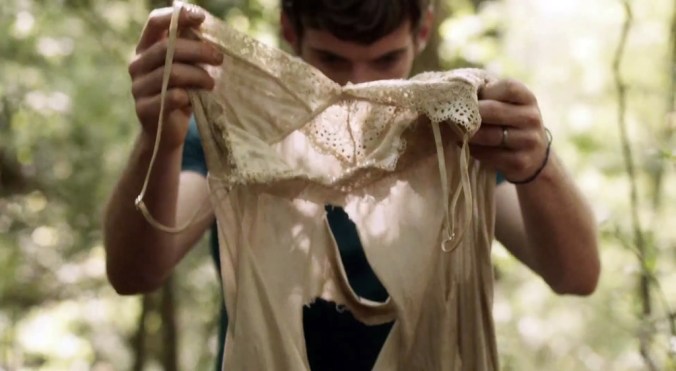
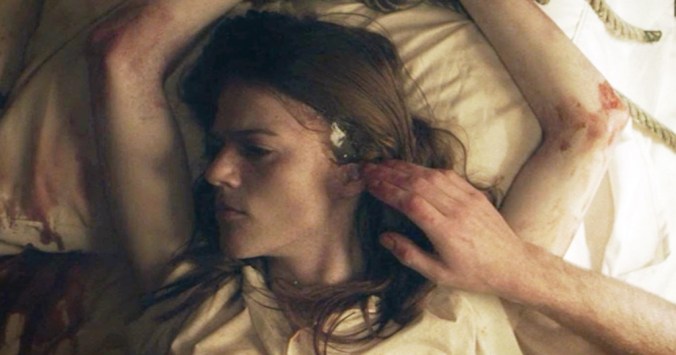
The rather simple plot involves a neurotic hospice nurse named Lily Saylor who is sent to a remote old house to care for Iris Blum, a retired author of pulp thrillers, who suffers from dementia. During Lily’s eleven-month tenure, it comes to light that the house may or may not be haunted by a spirit named Polly Parsons, the subject of Iris’s most famous novel, The Lady in the Walls, whose ghost supposedly told the story of her tragic murder to Iris some years before.

Complicating matters somewhat is the fact that right in the first few minutes of the film, Lily herself breaks the fourth wall and tells the audience straight out that she is going to die, and the fact that Iris insists on calling Lily by Polly’s name, as well as the fact that the theme of ghosts forgetting how they died comes up several times, suggests that something more ambiguous than a simple haunting is taking place, and that perhaps our protagonist Lily is not exactly what she seems.

PrettyThing1

The movie is essentially a story inside a story inside a story. Was Polly a real person who was murdered in the house and whose ghost still remains there? Or did Iris just make her up, and is Lily conjuring the spirit out of her nervous imagination? Is Lily, in fact, dead the whole time and acting as the ghost herself throughout the entire film? I Am the Pretty Thing could be read in myriad ways, which is one of the aspects contributing to the creeping unease infusing its entire run-time.

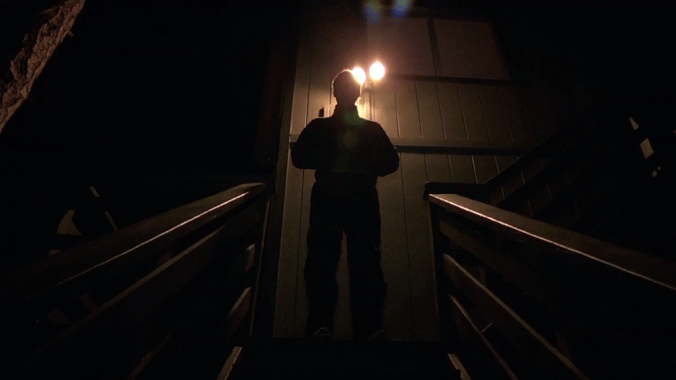
The plot of the film, though, such as it is, is really not the star of the show. That would be the almost unbearable buildup of uncanny dread which makes the viewer feel unmoored in a waking nightmare. The gorgeous cinematography (by Julie Kirkwood) focuses on the house’s stark, neutral interiors to great effect, wringing eerieness out of every unsettling, off-center shot of white walls juxtaposed against blackened doorways beyond, of a stubbornly folded corner of carpet, of an empty chair pushed against a wooden table. The movie’s portentous framing of ordinary objects as sinister is quite Lynchian and very, very effective in building up tension, as the viewer is never sure what they’re going to see. Even though standard “jump scares” are almost non-existent, we are kept constantly on edge waiting for something awful to happen, just because of the way the cinematographer plays with our expectations.

PrettyThing5

PrettyThing4

Also contributing to the film’s sense of free-floating anxiety is the fact that its time frame is never firmly established (though judging by the clothes Lily wears, the phone in the house, and the presence of cassette tapes, I’m guessing it’s the early to mid eighties), and that Lily herself is an almost painfully awkward character, a prissy, repressed throwback to an earlier era. Her uncomfortable interactions with estate manager Mr. Waxcap (played with an almost undetectable straight humor by Bob Balaban) ramp up our anxiety on her behalf, a very intriguing way of making us relate to her situation. In this way, Lily is very much like the character of Eleanor in Shirley Jackson’s brilliant Haunting of Hill House. And similar to that novel, the “haunting” in the Blum house seems to be analogous to the slow unraveling of Lily’s mental state, or alternately her slow-dawning realization that she herself is a ghost, either literally or metaphorically. The fact that most of her early voice-overs are later revealed to be paraphrases from Iris’s novel about Polly Parsons drives this point home rather succinctly, as do the recurring images of rot and fragmented reflections.

PrettyThing3

While I will admit that for those who enjoy more straightforward, plot-driven horror, I Am the Pretty Thing might seem like a boring, overly-indulgent slog to nowhere with few big scares, no huge payoff, and long, lingering shots of furniture and faces with very little dialogue or action. But for those like me, who enjoy more cerebral horror that is more interested in building a mood and getting underneath the viewer’s skin with its nebulous oddities, there is much to recommend here, though I would add that it is best watched alone, at night, with no distractions, so that you can get entirely lost in its world and lulled into its creepy spell. It’s definitely a movie that sticks with you long after you’ve seen it, and that in itself is a wonderful thing for any horror film to do.

Next up on the double feature is a far less experimental film that had its premiere at another recent film festival (in this case South by Southwest back in 2015), and although the movie was highly lauded, favorably compared to the splendid It Follows, and ended up on a lot of critics’ “ten best horror films of the year” lists (including Rolling Stone’s), I honestly wasn’t all that crazy about it, though it did have some entertaining moments.

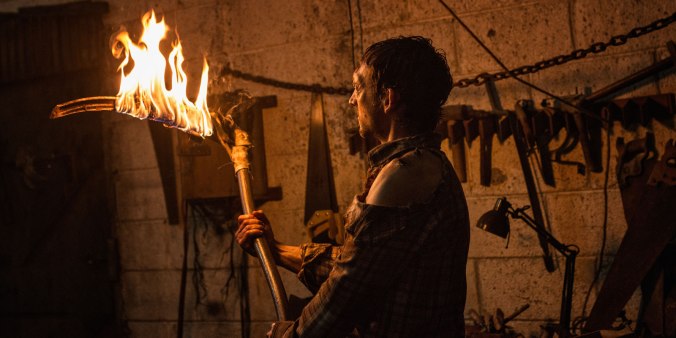
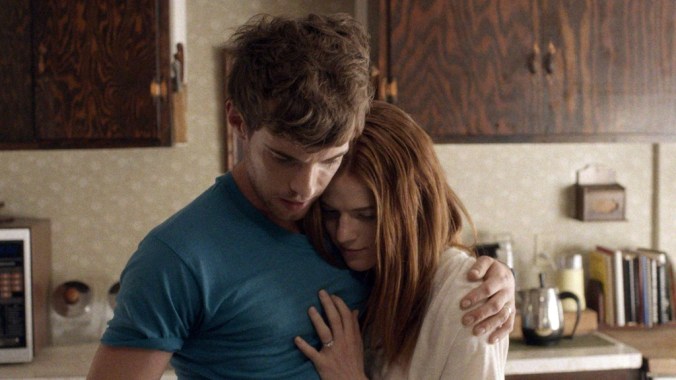
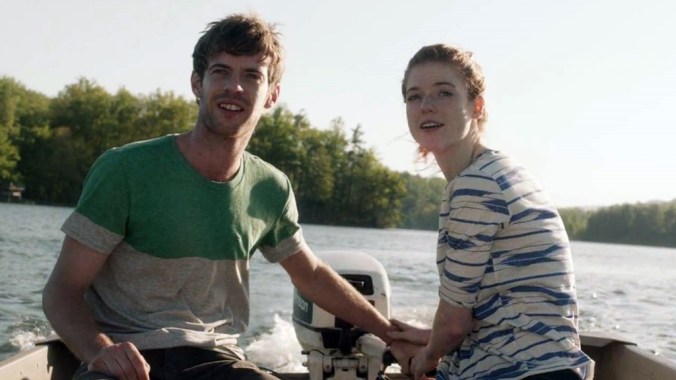
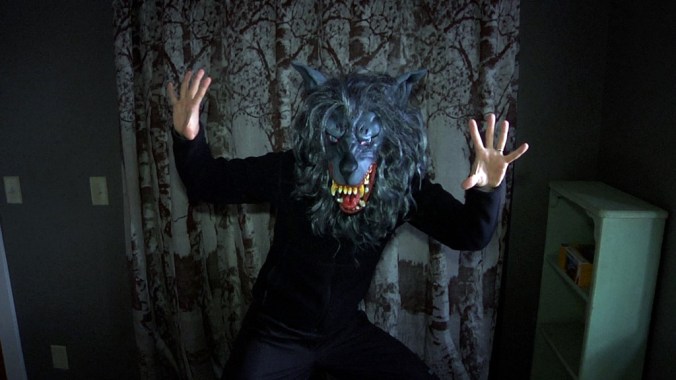
Directed by Ted Geoghegan and packed with horror movie all-stars (Barbara Crampton from Body Double and Re-Animator; Lisa Marie from Ed Wood, Mars Attacks, and Lords of Salem; writer/actor/director Larry Fessenden from Session 9 and much, MUCH more), We Are Still Here has a fairly standard horror movie set-up. The main characters are a middle-aged married couple, Paul and Annie Sacchetti, who move out to a remote house somewhere in New England following the death of their college-age son Bobby in a car accident. Shortly after they move in, a few little things happen around the house that suggest maybe Bobby’s ghost has come along for the ride, but it doesn’t take long at all before the audience realizes that something far more infernal is going on than a harmless lingering spirit.

WeAreStillHere4

It is in fact this nearly immediate blowing of the entire horror wad, as it were, that I think is one of the film’s main weaknesses. It gets off to a promising, low-key start, with some effectively eerie shots of the roads and the isolated house all covered with a blanket of snow, with very spare dialogue that nonetheless conveys the deep grief the couple is feeling, and with very understated hints that something in the house might not be quite right: a picture falling over, a strange noise in the cellar, a ball rolling down the stairs.

The choice to set the film in 1979 was also a decision I’m on board with, as not only does it help to evoke a golden era in horror cinema (also evidenced by a few subtle references to classic horror films of the period, such as The Changeling and The Shining), but it also gives it an otherworldly feel and more of a sense of dread, since the problems that arise can’t be solved by Googling stuff or calling for help on a cell phone.

WeAreStillHere3

But really, as soon as the couple’s obviously not-to-be-trusted neighbors show up about ten minutes in and start going on about the house having been a mortuary and the family living there supposedly being run out of town for stealing corpses back in 1859, and making reference to the house needing “fresh souls,“ it all just gets a bit too on the nose and seems to move along too quickly with no regard for subtlety or restraint. And then once the electrician comes and the audience is pretty much shown exactly what happens to him, all sense of anticipatory dread is lost, for we have already seen everything there is to see. From that point on, it’s just more of the same, only bloodier.

Clocking in at only an hour and twenty-three minutes (and a not insignificant chunk of that is the long end-credit sequence), I think the movie might have actually benefited from being a bit longer, so that the characters and story had more room to breathe before everything went all demonic and wacky.

WeAreStillHere5


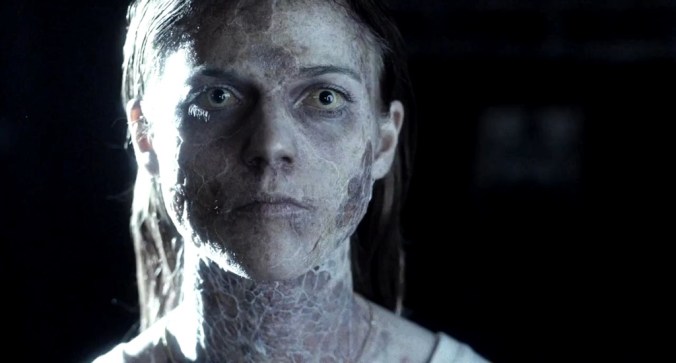
That said, I think the film also would have REALLY benefited from taking everything down a notch or ten. While I generally don’t have a problem with copious gore or jump scares per se, there is a point at which you’re going so far over the top that the story is just not scary anymore and veers over into unintentional comedy. The burned-looking ghosts were cool, for example, but I didn’t need to see them in my face every few minutes, which significantly lessened their impact. The gore was fairly well-done, but I didn’t need everyone to die in enormous, ridiculous sprays of blood and chunks like the second coming of Dead Alive.

In fact, I think the entire reason that this movie didn’t really click with me was because its tone seemed all over the place: on the one hand, it seemed to want to be a serious horror film, but then on the other hand you had these kinda goofy, over-acting characters who shamelessly chewed the scenery and dropped boatloads of exposition at pretty much every opportunity when the audience could have figured out the story just fine without all the over-explaining. Either do a serious horror film or do a horror comedy; it takes a very deft hand to make a decent film balancing elements of both, and I just felt like this wasn’t really getting there.


WeAreStillHere2

WE-ARE-STILL-HERE_Dagmar

I admit I did like the séance scene with Paul and stoner dude Jacob, and I sort of liked the overall premise of the movie, which was marginally in the vein of a 70s-style, small-town folk horror type deal, and I sort of liked the creepy weirdness of all the townsfolk being in on this big secret, but other than that, I kinda found my attention wandering during the movie, since I pretty much knew where it was going, and when I was paying attention, I was cracking jokes about it, which I can assure you did NOT happen while I was watching I Am the Pretty Thing. While I can see why a lot of horror fans dug it, it was just way too obvious and over-the-top for my tastes, trying to smack you in the face with HORROR, and it seemed like it was trying to be too many things at once at far too frenetic a pace. Your mileage, of course, may vary.

Until next time, keep it creepy, my friends. Goddess out


I’ve Been Flapping My Gums on Some Shows

For those of you out there who simply can’t get enough of me talking about poltergeists and generally making a nuisance of myself, here I am talking about my latest book The Unseen Hand on the Conspirinormal Podcast with Adam Sayne, here I am on Me & Paranormal You with Ryan Singer, and here I am discussing the same book on Where Did the Road Go? with Seriah Azkath. Keep in mind that I also recorded a part two and three for the Where Did the Road Go show, plus some extra stuff for their Patreon listeners, so if you’re so inclined, you will be able to listen to me talk until the heat death of the universe. Enjoy!

13 O’Clock Episode 46 – A Brief History of Life on Mars

Ever since Mars was first observed through a telescope in the 17th century, there has been rampant speculation that the mysterious Red Planet could harbor life. Once the stuff of sci-fi stories, Mars exploration is now a reality, and scientists theorize that there could indeed have once been primitive life on Mars, and even that Martian microbes might have even seeded the early Earth. Further out on the fringe are those wacky conspiracy theorists, some of whom believe that everything from snakes to primates to child slaves to entire civilizations now live or once lived on Mars and that NASA is covering it up. On episode 46, Tom and Jenny delve into the fascinating world of life on Mars, from the earliest speculations to the most recent scientific discoveries to the craziest conspiracies. Fire up your Illudium Q-36 Explosive Space Modulator and listen in as 13 O’Clock goes searching for Martians.

Download the audio file from Project Entertainment Network here, or watch the YouTube version here. Also, don’t forget to follow the 13 O’Clock Podcast blog, subscribe to our YouTube channel, like us on Facebook, and follow us on Twitter.

13 O’Clock Episode 45 – Villisca and the Unsolved Axe Murders of the 1910s

The horrifying massacre that took place in Villisca, Iowa in 1912 is among the creepiest mass murders in American history. Eight people — a couple with four children and two young girls who were staying the night — were brutally slaughtered with an axe while they slept, for seemingly no reason whatsoever. The crime was never solved, and what’s worse, that dreadful slaying might not have been the only one. Some researchers point out that there was a disturbing trend of gruesome axe murders going on in the Midwest from the period of 1911 through 1914, and it’s possible that some of these crimes were perpetrated by the same person. On this episode of 13 O’Clock, Tom and Jenny return to the most terrifying corners of the true crime genre to take a look at the infamous Villisca Axe Murders, as well as the disturbing series of similar crimes that terrorized the American heartland in the early twentieth century.

Download the audio file from Project Entertainment Network here, or watch the YouTube version here. Also, don’t forget to follow the 13 O’Clock Podcast blog, subscribe to our YouTube channel, like us on Facebook, and follow us on Twitter.

13 O’Clock Episode 44 – A Haunting In Florida

In 2001, Edd and Beth Dunham moved into a nondescript home in Deltona, Florida, thinking it would be a great place for their family to grow. But little did they know that before long, they would begin to see apparitions and experience disturbing poltergeist activity, and in the end would come face to face with an evil entity that seemed bent on attacking their baby daughter. On this show, Tom and Jenny are returning once again to their exploration of the real stories behind the best episodes of the series “A Haunting,” and this particular case, aired in 2006, has some personal significance, since it happened very close to where Jenny grew up and to where Tom and Jenny now live, and since Tom has met Edd Dunham in real life and has spoken to him at length about the paranormal activity that befell his family. So sit back and enjoy this tale of a particularly Floridian haunting.

Download the audio file from Project Entertainment Network here, or watch the YouTube version here. Also, don’t forget to follow the 13 O’Clock Podcast blog, subscribe to our YouTube channel, like us on Facebook, and follow us on Twitter.

Apples Come In Chocolate Brown, Apples Come in Taffy Gold: It’s a 1970s Haunted House Double Feature!

Long time no review, Goddess fans! As usual, I’m having to open this post by apologizing for my woeful lack of recent long-form film reviews on this blog. But as most of you will have surmised, I’ve been up to my forked tail in other projects, including promoting my latest book The Unseen Hand, working on my upcoming true crime book The Faceless Villain, and recording and promoting the 13 O’Clock Podcast, as well as trying to establish a new offshoot channel called 13 O’Clock In Minutes, which will, when it goes online, serve as a more bite-sized version of the show as well as a promotional vehicle for the main podcast.

So as you can imagine, I unfortunately haven’t had much time to sit down to watch and analyze some of the underrated horror flicks I adore so much. But today, a Saturday, fate intervened: the God of Hellfire and I had actually planned a small party this afternoon, but as it happened, when we awoke this fine morning, we discovered that our air conditioning had crapped out yet again (we just had it fixed two weeks ago, but Florida is nothing if not murder on air conditioning units), so we had to call off the get-together so our friends wouldn’t have to spend their Saturday sweating their asses off in our eighty-degree foyer.

Therefore, left at sixes and sevens with no plans, and confined to the bedroom where the emergency window unit is at least keeping the small area around the bed comfortable until the repair guy can come out several days from now, I decided I might as well put my sudden free time to use by watching some horror flicks and writing about ‘em. So after that enormous and probably unnecessary introduction (but hey, I’m the queen of too much information), let’s get to the actual movies!

I decided to return not only to my favorite decade for horror movies, but also to my favorite horror subgenre for this post. In short, I’m reviewing two haunted house films from the 1970s, both of which have made numerous appearances on various “underrated” lists around the internet, and both of which happen to have been made for television.


First up is 1972’s Something Evil, a TV movie directed by none other than Steven Spielberg (and airing not long after his much-better-known, classic made-for-television film Duel) and starring a bunch of familiar 1970s faces, such as Darren McGavin (of Kolchak fame, among many other things), Sandy Dennis (who was also in God Told Me To, which I wrote about here), and famously ginger-haired “Family Affair” kid Johnny Whitaker.

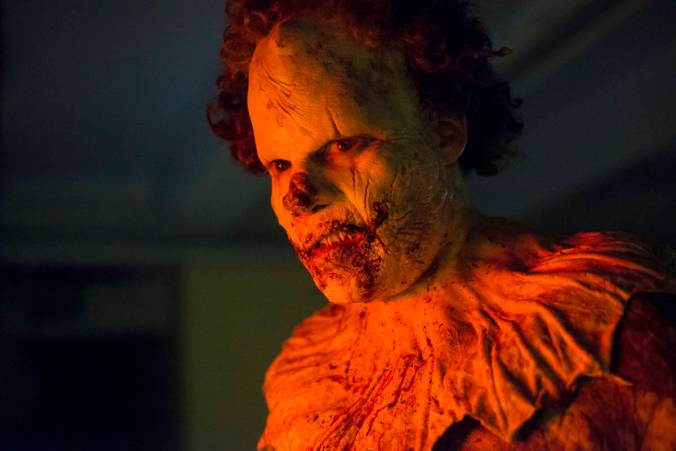
The story is a fairly standard haunted-house-slash-possession yarn, concerning a city slicker ad exec, his hippie-esque artist wife, and their two children moving from New York City out to a “charming” rural house in Pennsylvania Dutch country which turns out to be infested with demons.

While Something Evil, due to its subject matter, bears some superficial resemblance to other devil-possession films of the period, such as Rosemary’s Baby and The Exorcist, I found myself comparing it more to other rural or folk horror stories from the 60s and 70s, such as The Other, The Wicker Man, Burnt Offerings, or Harvest Home.

After a cold open which sees an old man (presumably the home’s former owner) being pursued through a hex-symbol-adorned barn by an invisible force and then falling to his death from the hayloft, the Worden family purchases the property after wife Marjorie falls in love with the place while they’re on vacation. Not long afterward, things start to go south, though it isn’t clear at first whether something is wrong with the house itself or with the flaky and seemingly unstable Marjorie.

se04

Despite the movie’s short runtime, clocking in at only 73 minutes, it’s still a pretty effective slow burn, and does a lot with its simple story. At first, there are just minor hints that something is amiss; for example, locals tell the family that something is odd about the place, and the townsfolk all seem to sincerely believe that devils are real. Additionally, the Wordens’ neighbor seems to make a point of ritualistically killing chickens in the yard and flinging their blood around, which disturbs Marjorie greatly, as it would.

As if that isn’t unsettling enough, Marjorie thinks she hears a baby crying out in the barn, but nothing is there when she goes to check. She also begins to grow increasingly interested in the occult and with the hex symbology prevalent in the area. Early on in the film, a couple attending the Wordens’ housewarming party is killed in a mysterious car accident on the way home, adding to Marjorie’s increasing paranoia that something evil has been unleashed in the house through her actions.

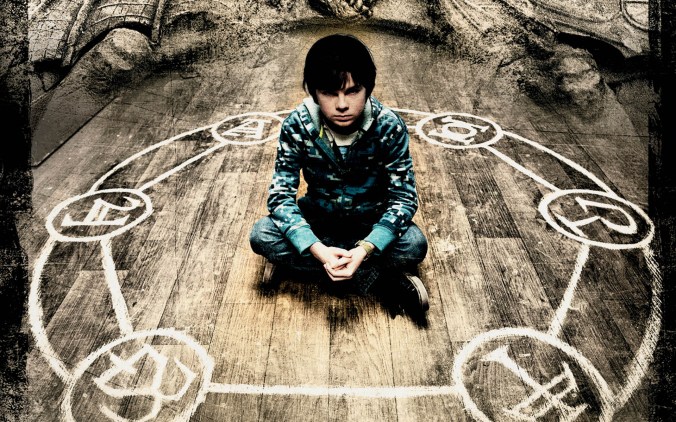
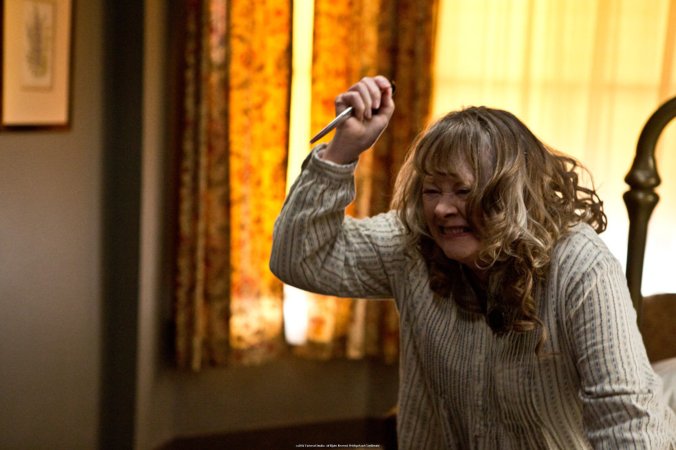
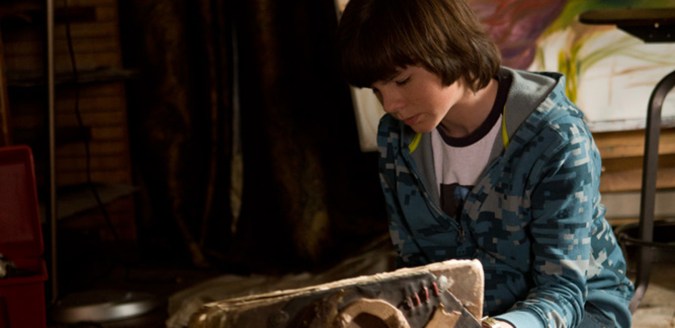
Naturally, Marjorie’s husband Paul thinks she is losing her mind, as he is often away at work and doesn’t see any of the phenomena that Marjorie claims is taking place. And indeed it does seem as though Marjorie herself is essentially the problem, as she grows depressed, suicidal, and even violent toward her children. It gets to the point where she paints a hex symbol on the floor as protection and keeps her children locked away from her, as she no longer trusts herself around them, sincerely believing that she has become possessed by demons. In a final twist, though, it comes to light that Marjorie is not the target of the demons’ evil at all, and in fact the only possessed person in the farmhouse is the couple’s son Stevie, whose demon-hosting status is revealed at the end in a well-staged scene complete with levitation and scary voices.

While the plot of Something Evil will be extremely familiar to anyone with even a passing knowledge of horror films from the era, Spielberg’s direction really elevates what could have been just a forgettable, throwaway 70s TV movie into something quite intriguing, using its presumably tiny budget to great effect. Everything is kept very understated, but slightly off-kilter, giving the film a pleasing sense of dread-laden believability. The ambiguity is also very well-done, and adds to the unnerving atmosphere. The movie additionally boasts some eerie, surreal touches, such as the creepy discovery of a mason jar full of red goo from which the ghostly baby crying apparently emanates, and the unexpected appearance of a pair of glowing red eyes in a photograph at Paul’s advertising agency. No rotating heads or pea soup vomit, sure, but the low-key effects work well within the movie’s framework.

I would unreservedly recommend Something Evil, not only to Spielberg fans curious about his early work, but also to connoisseurs of 70s horror in general. The film certainly isn’t reinventing the wheel, but it’s still an enjoyable little occult thriller with some effectively haunting imagery. It’s just a shame it isn’t better known and more widely available.

stonetape-main

Next on our double feature is a British teleplay from 1973 called The Stone Tape. Written by Nigel Kneale (probably most famous for writing the Quatermass series), the movie was broadcast on BBC 2 as a Christmas ghost story, though it’s actually more of a mashup between old-school Victorian ghost story and tech-driven sci-fi, somewhat similar in concept to The Legend of Hell House.

The tale concerns a gaggle of laddish, wisecracking scientists who are in the process of moving into their new research facility in a partially renovated and reputedly haunted mansion called Taskerlands. The scientists are apparently trying to develop a new recording medium to wrest the cutting edge away from their Japanese competitors. But the only female member of the team, a computer programmer named Jill who is also evidently somewhat psychic, almost immediately sees a ghost in the unrenovated portion of the mansion, and shortly afterward, the male members of the team all hear bloodcurdling screams emanating from the same area. It comes to light that the ghost is very likely that of a maid named Louisa who died by falling down the stairs many years before, and that the part of the house that’s home to the ghost is also exceedingly old, perhaps dating back to the era of the Saxons.

While the entire team is disturbed by the haunting, they’re also quite curious and keen to use their state-of-the-art research equipment to record and study the mysterious phenomena. After much theorizing and jiggery-pokery, they figure out that the stone walls of the old room are acting as some sort of crude recording device that takes impressions of extreme emotions that occurred in the room, but that instead of just recording like one of those newfangled magnetic tapes, the mechanism is actually dependent upon the sensitivities and emotional states of the living people present, i.e. that the humans witnessing the haunting are analogous to amplifiers for the titular “stone tape.”


The scientists are quite intrigued by this hypothesis, hoping that it might be a scientific breakthrough that can put them ahead of their technological rivals. But the more they try to get the phenomena to perform for their tests, the more frustrated they get, until at last it seems that they have accidentally erased the recording of Louisa’s death, and most of the team decide to abandon the project, since they believe the “haunting” is gone.

Jill, though, isn’t having it. Being more sensitive than the men, she feels there may be something deeper lurking at Taskerlands, hypothesizing that Louisa’s ghost might have been only the top layer of the recording, and that older recordings might have been overlaid by the most recent one. Bolstering her theory is a local priest, who informs her that an unsuccessful exorcism was performed on the land in 1760, before the house was even built, suggesting that the land has been haunted for far longer than anyone thought. She also has a frightening episode in which she hears and feels a malevolent presence, but no one else hears it.

Jill tries to tell the remainder of the team about her discovery, but no one wants to listen, and her friend and director of the project Peter Brock tells her to take a two-month leave because he thinks she’s losing her marbles. Before she leaves, though, she goes in the room one last time, and is summarily killed by the entity. The men find her later, her eyes frozen open in terror.

In a final little “fuck you,” Brock informs the authorities that Jill was emotionally unstable, and he shreds all the research she was doing that showed that the evil presence might have been there for seven thousand years. But Jill gets some small measure of revenge from beyond the grave when Brock goes into the haunted room at the end and is subjected to the most recent recording: Jill’s voice screaming his name before her death and begging for him to help her.

I have to admit, I didn’t like this one quite as much as Something Evil, but it was still an entertaining sci-fi ghost story that was a bit heavier on the sci-fi than the ghosts. The acting was a tad stagy, and the beginning of the film almost felt like a Vaudevillian routine, but that’s to be expected for a British teleplay of this era, and once it moved past that, it was a fairy effective scare-fest, though also like a lot of films of the time, it takes a while to get where it’s going, and the full impact of the story doesn’t come to fruition until the final couple of minutes.

If you liked The Legend of Hell House but thought it needed more focus on the haunting machine, then you’ll probably love this, as it’s a pretty similar concept, and in fact, the hypothesis that ghosts are simply recordings of past events that have somehow been captured by surrounding materials is still known in paranormal circles as the “stone tape theory.” I’d also recommend it if you liked the Quatermass movies or other 70s British sci-fi horrors, such as The Asphyx (which I wrote about here) or The Projected Man (which made a fantastic MST3K episode).

That’s all for now, minions! Keep it creepy, my friends. Goddess out.

13 O’Clock Episode 43 – Scientology Update with the Angry Gay Pope

Grab hold of your e-meters and prepare to body route your thetans (or something), because the Angry Gay Pope has returned to give an update on what’s been going on in the wild, wacky world of Scientology! Hear all about AGP’s stealth raid of the Inglewood org, the latest gossip about sexy cult security guards, and the possibility of Shelly Miscavige being held prisoner at the Twin Peaks secret base, plus lots more hilarious anecdotes and digressions. Fetch a tall glass of milk in which to dip your Oreo cookie of supremacy, and prepare for an extra-special episode 43 of the 13 O’Clock Podcast!

Download the audio file from Project Entertainment Network here, or watch the YouTube version here. Also, don’t forget to follow the 13 O’Clock Podcast blog, subscribe to our YouTube channel, like us on Facebook, and follow us on Twitter.

13 O’Clock Episode 42 – A Collection of Cryptids!

The world is full of amazing creatures great and small, but crypozoologists are convinced that there are even more bizarre and amazing-er critters out there that science has so far been unable to pin down. From Bigfoot to Nessie, from the chupacabra to the Jersey Devil, from the Aswang to the Pukwudgie, cryptids have been reported by all cultures in every era of history, and even though a few reports of mysterious unknown creatures turned out to have a basis in fact, many of the current sightings still retain more than a whiff of legend. How likely are some of these fascinating varmints to exist? On this episode, Tom and Jenny take a fun, whirlwind romp through the shadowy corridors of cryptozoology, exploring some of the better-known and lesser-known creatures. Pour some plaster of Paris into that giant hominid footprint and join us for episode 42.

Download the audio file from Project Entertainment Network here, or watch the YouTube version here. Also, don’t forget to follow the 13 O’Clock Podcast blog, subscribe to our YouTube channel, like us on Facebook, and follow us on Twitter.

13 O’Clock Episode 41 – The Dark Side Haunting, From the Files of Ed and Lorraine Warren

In 1978, Bobby and Addie Wilcott bought an old New England house to fix up. Little did they know that a few decades later, enough creepy shit would happen in their humble abode to warrant a pretty damn good episode of A Haunting titled “The Dark Side.” The haunting started small — doors opening and closing by themselves, a broken player piano suddenly belting out tunes willy-nilly — but eventually cockroaches, child endangerment, and the Warrens got involved. On this episode, Tom and Jenny return to their discussion/review of A Haunting episodes, talking about the re-enactment itself, and also taking another opportunity to talk about the Warrens, because you know how we always have fun doing that. Spray around some odor of sanctity and enjoy episode 41.
Download the audio file from Project Entertainment Network here, or watch the YouTube version here. Also, don’t forget to follow the 13 O’Clock Podcast blog, subscribe to our YouTube channel, like us on Facebook, and follow us on Twitter.