“The Nightmare Collective” Now Available for Pre-Order

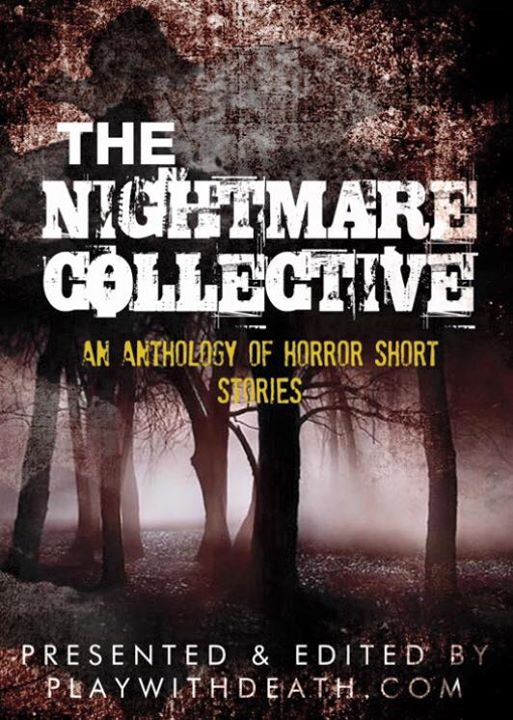
Horror anthology The Nightmare Collective, featuring my short story “The Mother of Foresight,” is now available for pre-order! You may choose to order it now, though if you wait until its official release on April 3rd, you will be able to download it for free for the first week of its release. Also, if you’d be willing to write a review of the book for Amazon, please let me know and I can send you a free .mobi or .epub file for your perusal. Thanks!

NightmareCollectiveCover

The Nightmare Collective

e726fa72a0a57aed0ba4b9d0228ca71fcebf74a6

As I mentioned in a previous post, my short story “The Mother of Foresight” will be appearing in an ebook anthology called The Nightmare Collective published by Play With Death. The anthology also includes stories by Tom Wortman, M. B. Vujačić, Manen Lyset, Kyle Yadlosky, G. T. Montgomery, Ari Drew, Patrick Winters, Trevor James Zaple, John Teel, Dexter Findley, and Kyle Rader. For the first week after its release, the book will be a FREE DOWNLOAD! Click this link and sign up to get notified when the ebook is released!

The Goddess Has Gobs of Exciting News!

Well, kiddos, it’s been a crazy week, hence my relative dearth of posts, but you’ll be edified to know that a bunch of stuff has been going on behind the scenes, so here’s a brief wrap-up!

Bellwether_AssocVillain

If you happen to live in the central Florida area (and I know I do), then put on your charity panties and head on down to the Whole Planet Music & Art Festival at Bombshell’s Tavern! It’s a big ol’ concert event put on by a few good friends of mine, and all proceeds will benefit the Whole Planet Foundation. There will be bands and art and general debauchery (probably), plus there will be a raffle in which you may WIN music and art from local performers, or perhaps even a SIGNED copy of either my novel Bellwether or my short story collection The Associated Villainies! Please try to make the trip if you can!

Pageflex Persona [document: PRS0000038_00060]

The book I coauthored with the God of Hellfire himself, The Mammoth Mountain Poltergeist, should be out by next week! The proof copy is making its way toward me as we speak, and provided there are no terrible fuckups, the book should be for sale on Amazon and the regular channels very soon. By the way, if you or someone you know has a paranormal blog, podcast or suchlike on which you’d be willing to review the book and/or interview its charming authors, shoot me a message and I’ll get you a free copy and all the info you may need. I’m also planning on doing a giveaway for free copies on Amazon sometime in the next few weeks, so keep watching this space!

Remember, my short story “The Mother of Foresight” will be appearing in the new ebook horror anthology coming next month from Play With Death. More details as I have them.

And finally, please remember I still have that Patreon campaign going, so if you’d like to contribute a few bucks and get yourself some sweet writer-style swag, click the link and give until it hurts. Or at least until it mildly stings, y’know the kind of sting you get when you just scrape your knee and can make it feel better by spraying some Bactine on it. Let’s not get too insane here.

NoahZombies

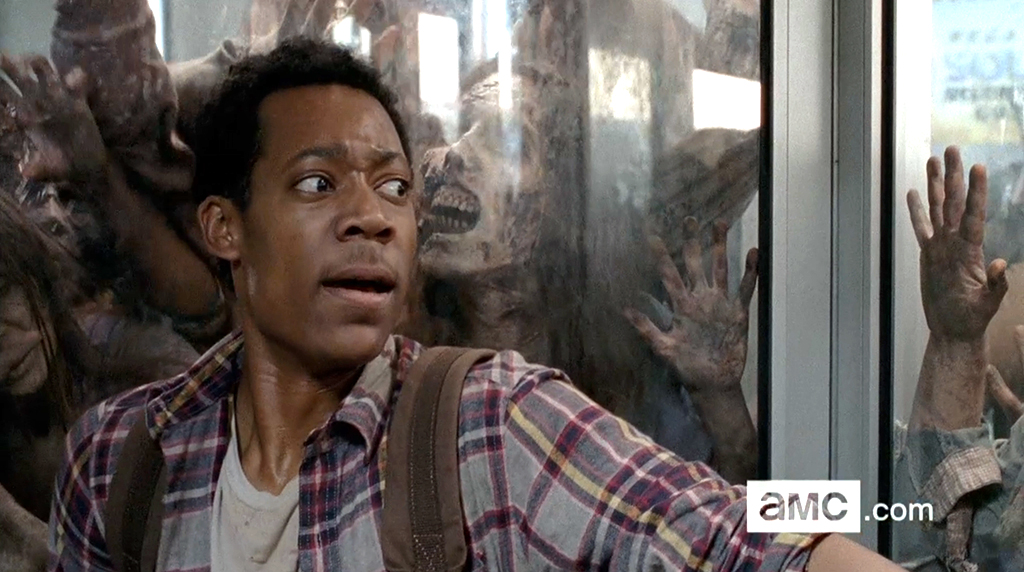
Oh, and speaking of insanity, did you guys see “The Walking Dead” this past Sunday? Holy FUCKBALLS, y’all. Shit’s getting real. I think I may need therapy. Hold me.

Until next time, Goddess out!

Ergotism and the Salem Witch Trials

Some scholars assert that the mass hysteria in Massachusetts in the 17th century could have been triggered by a common fungus.

Witchcraft_at_Salem_Village

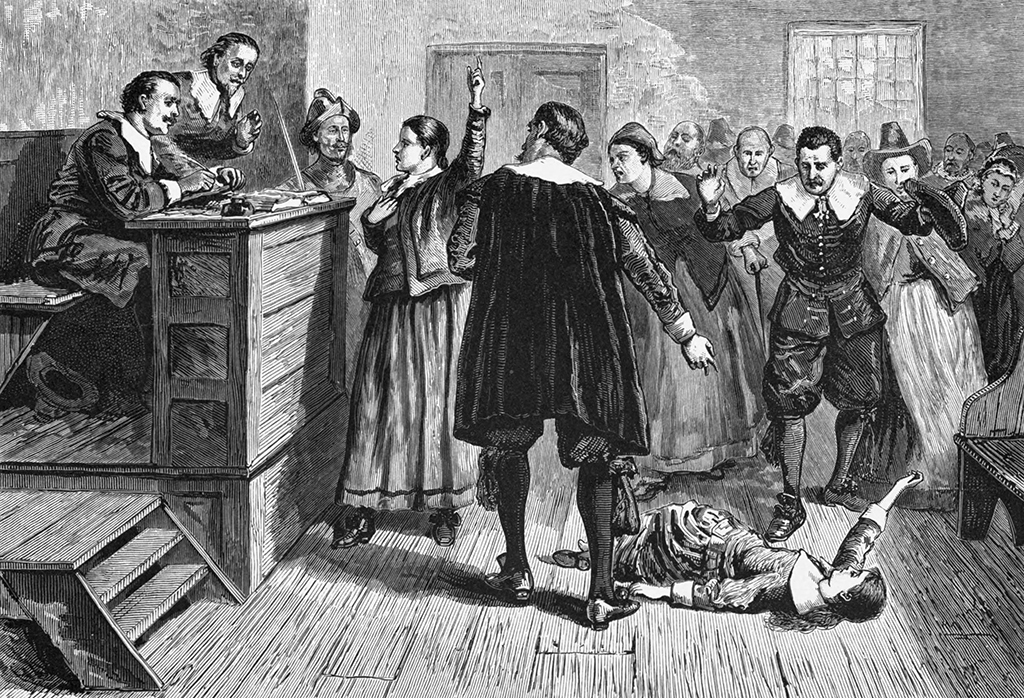
The events are familiar to most Americans and have been dramatized dozens of times on stage, page and film. The tragic episode was set into motion in 1692 by the strange behavior of two young girls, and snowballed into a panic of almost unbelievable proportions. The Salem Witch Trials, as they came to be known, lacked the staggering body count of many of the European witch hunts; nonetheless the series of events was sufficiently dire to cause many people then and now to question how such a thing could have happened.

An Overview of the Salem Witch Panic

It was February 1692. Nine-year-old Betty Parris and her eleven-year-old cousin Abigail Williams suddenly began displaying bizarre behavior akin to epileptic fits. They screamed and raved, twisted their bodies into strange positions, and complained that an unseen assailant was pinching and pricking them. Doctors were called to examine the girls, but no physical cause could be found for their distress, and what was worse, when word of the girls’ mysterious ailment spread through Salem village, other girls began behaving in a similar fashion.

At this point, authorities had raised suspicions of witchcraft, and Betty and Abigail obligingly pointed accusing fingers at a slave girl named Tituba, who they claimed had taught them spells for seeing into the future. Other accusations followed, and more “victims” came forward, accusing still others. When all was said and done, the hysteria had spread across three counties and resulted in the arrest of more than 150 people, twenty of whom were eventually executed for witchcraft. What possible reason could there have been for such a terrible tragedy to unfold? Many theories have been put forth, but Professor Linda Caporael, in 1976, suggested we need look no further than the Salem villagers’ breadboxes.

Hordeum_vulgare_Claviceps_purpurea_23-7-2009

Ergot a Poisonous Fungus, Catalyst for Accusations

In a 1976 article inScience, Caporael theorized that the initial catalyst for the witch craze — the seemingly “possessed” behavior of Betty, Abigail, and the other girls — could have been caused by a reaction to ergot. There are about fifty known species of the ergot fungus, but the one Caporael implicated in the witch panic was Claviceps pupurea, which grows on rye plants and can cause poisoning when consumed by humans or other mammals. If indeed the girls had eaten bread contaminated with ergot, they could have experienced symptoms that were perceived as possession: Seizures, a sensation of itching or crawling on the skin, muscular contractions, nausea, and even hallucinations, triggered by an alkaloid called ergotamine, which is similar in structure to LSD.

Caporael argued that not only were the symptoms of ergotism consistent with those noted in the victims of the “bewitchment,” but that the area around Salem grew a great deal of rye, and that climatic conditions were favorable to the growth of the ergot fungus. It would not even have been necessary for all of the “victims” to have been afflicted with ergotism; a few cases might have started the ball rolling, and psychological and sociological factors could have accomplished the rest.

Arguments Against the Ergot Theory

Many scholars have disputed the claims that ergotism played a major role in the witch panic. Historians Jack Gottlieb and Nicholas Spanos, for example, contend that had ergotism been responsible for the accusers’ symptoms, we should have expected to see members of entire households afflicted, rather than just a few individuals here and there. They also argue that ergotism has other symptoms that do not correspond with the recorded behavior of the “bewitched” persons. Finally, they and other scholars have pointed out that ergotism had been a recognized malady at least since the Middle Ages; it even had a name, St. Anthony’s Fire. Anthropologist H. Sidley in particular doubted whether authorities in Salem in the 17th century would have mistaken the supposedly familiar symptoms of ergot poisoning with signs of supernatural possession.

Despite the voluminous research on the subject, the exact causes of the Salem witch panic are still murky. It is not controversial to speculate that the episode was probably triggered by an unfortunate cascade of converging factors—social, political, psychological, and perhaps pharmacological.

Additional Source:

Macinnis, Peter (2004). Poisons: A History From Hemlock To Botox. MJF Books. ISBN 1-56731-814-2.


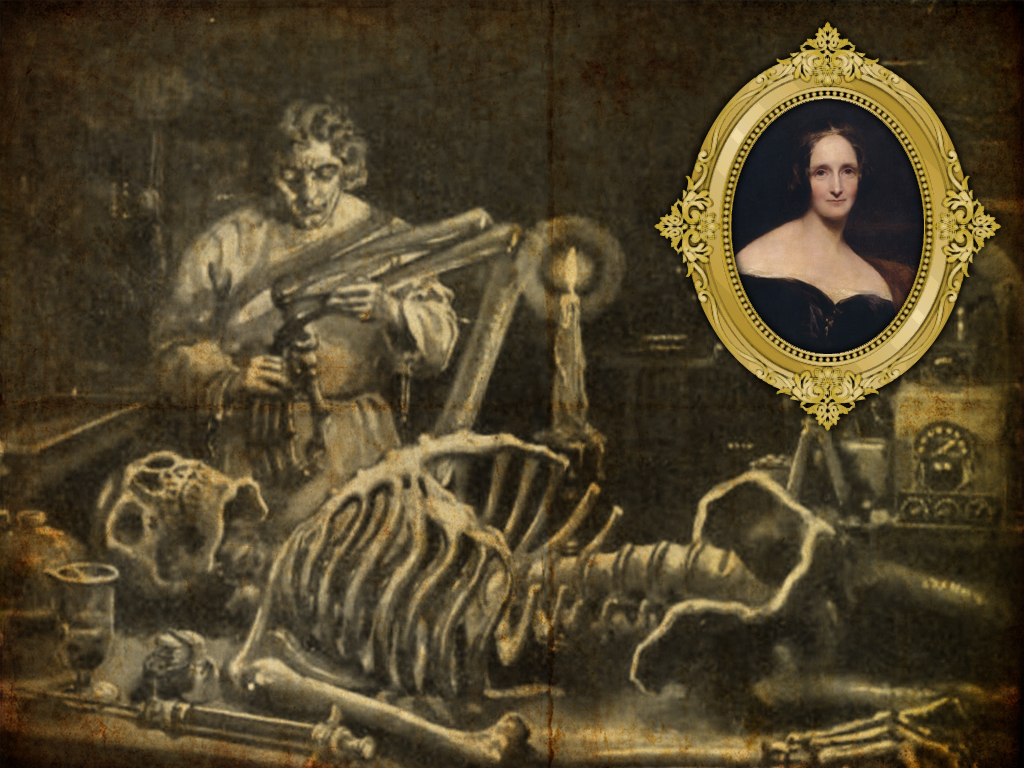
Mary Shelley, Frankenstein & the Summer of 1816

A strange gathering of intellectual luminaries during one “haunted summer” produced one of literature’s most enduring creations.

MaryShelleyFrankenstein

Frankenstein’s monster is one of the most ubiquitous characters in popular culture, appearing everywhere from movies and novels to children’s toys and cereal boxes. Though the image we have of the lumbering creature today—greenish skin, square head, beetling brow, ropy scars and neck bolts—has been largely formed by Boris Karloff’s stunning portrayal in the Universal horror films of the 1930s, in the beginning, the monster was literally dreamed into existence under rather eerie circumstances by an eighteen-year-old girl.

Summer in Switzerland

It was May 14, 1816. Romantic poet Percy Bysshe Shelley and his “wife” Mary (the couple only married later that year, though Mary already used his last name) had been invited by friend and fellow poet Lord Byron to visit him at a rented chateau, Villa Deodati, on Lake Geneva in Switzerland. Also joining the festivities were Mary’s stepsister Claire Clairemont—who was pregnant with Byron’s child and was trying to get back into his good graces—and Byron’s personal physician John Polidori.

The gathering apparently started out quite idyllic—the friends spent long hours writing, discussing weighty ideas, and boating in the lake. But a short time after the group arrived, the weather took a bizarre turn, and it seemed the streaks of lightning and the torrents of rain would never cease. Mary and the others were confined to the house for many days.

Ghost Stories

More reading and discussion ensued. Particular topics of conversation included the early evolution theories of Erasmus Darwin, as well as the new science of galvanism. Also contributing to the entertainment of the group was a book of German ghost stories called Fantasmagoria, which the friends took turns reading aloud.

The combination of the macabre tales and the isolating weather seemed to have strange effects on everyone present; Percy Shelley, at one point, succumbed to visions that sent him screaming from the room. Later, Shelley claimed that Byron’s reading of the Samuel Taylor Coleridge poem “Cristabel” had brought to mind the image of a woman with eyes instead of nipples, which horrified him.

Setting to Work

Some time after this incident, the group decided that they would each try to write their own ghost story. Most set to work immediately and produced tales of varying quality. Byron wrote a story fragment titled “The Burial,” which was later published as a postscript to his narrative poem Mazeppa. Shelley wrote a tale called “The Assassins,” which apparently never saw the light of day (though his poem Mont Blanc, written around the same time, was published later that year). Dr. Polidori wrote “The Vampyre,” later expanded to novel length, which was the first vampire story published in English and which some speculate might have been an inspiration for Bram Stoker’s Dracula, written 78 years later.

The Monster Is Born

Mary Shelley, however, couldn’t think of an idea for a story, and had to respond with a frustrated “No” when asked by the others if she had begun work on it. But then, one night, she had a terrible nightmare. She woke violently amid the sounds of the storm howling outside. The dream had been so vivid that she had a difficult time believing it hadn’t been real. Since she was too shaken to sleep, she began writing down her dream, in which “a pale student of the unhallowed arts” used bits of corpses to create a man. “By the glimmer of the half-extinguished light,” she wrote, “I saw the dull yellow eye of the creature open; it breathed hard, and a convulsive motion agitated its limbs.”

Mary’s terrifying dream was described verbatim in the story she presented to the others. Though the first draft was only about 100 pages long, Percy loved the story and encouraged Mary to flesh it out. She did, and two years after the strange events at Lake Geneva, the story was published as Frankenstein, or the Modern Prometheus, thus introducing one of literature’s most frightening figures to the world at large.

The Goddess’s Favorite Creepy Movie Scenes, or Down in the Mines with Mina

One of the main underlying themes of a lot of these blog posts is an examination of why particular moments in horror film, literature or music made a lasting impression on me while others did not. Why, for example, was I terrified by the bubbling cauldron sound at the beginning of “The Monster Mash”? Or the schlocky scene in My Bloody Valentine where the homicidal miner pops out of the closet with the pickaxe? Or the part in Fright Night where Amy reveals her horribly wide terror-mouth? I still have no idea, but it’s been fun reliving all this stuff from my wayward youth and trying to find some kind of perspective on it, or contemplating the threads that might tie all these disparate things together.

The next scene I want to discuss is another one of those that, for whatever reason, has stuck with me for 35 years, even though I don’t remember much about the rest of the film. The scene itself was only a couple of minutes long, but I can still vividly remember the heart-stopping shudder that traveled through my body the first time I saw it, and further recall how I studiously covered my eyes during the scene on subsequent re-watches of the movie.

Before I get to the main feature, allow me another short commercial break. I still have a Patreon campaign going to fund my writing work, and there are lots of neat rewards just for pledging a few bucks a month, so check it out, won’t you? Thank you. And now back to our regularly scheduled programming.

Seems to me I live my undeath like a candle in the wind.

Seems to me I live my undeath like a candle in the wind.

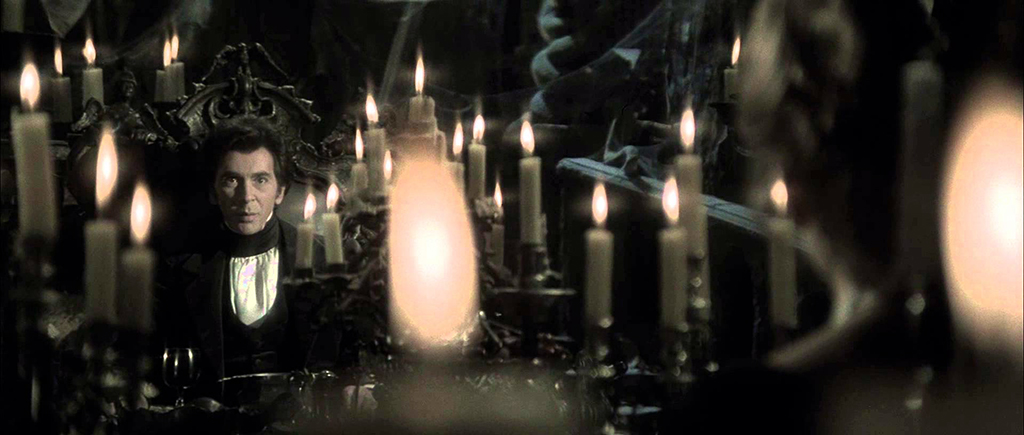
John Badham’s version of the classic Dracula (1979), starring Frank Langella as the titular Count, came out around the same time as a few other vampire films, notably Werner Herzog’s elegant remake of Nosferatu. Badham’s adaptation wasn’t horribly reviewed, but apparently audiences were experiencing some vampire fatigue, and it only did so-so business at the box office. I was only seven when it was released in theaters, so I didn’t catch it until it ran on television a year or two later; in fact, I’m fairly sure it was the first of the major Dracula film adaptations I ever saw, even before the more-famous Bela Lugosi and Hammer versions.

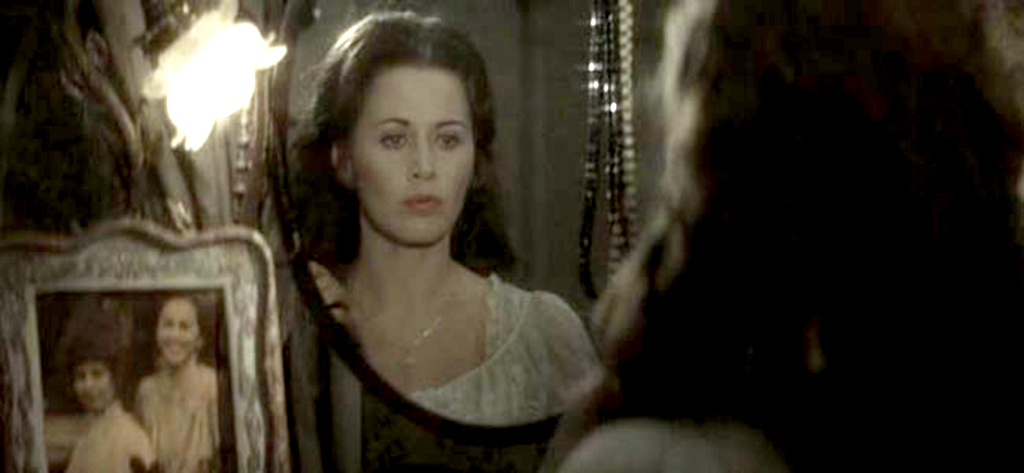
Like the 1931 Bela Lugosi film, Badham’s Dracula was based on the stage play rather than the novel, and followed a lot of the tropes of the Universal version. For example, Dracula is portrayed as a seductive, romantic figure rather than a ratlike monster as in the book, and the entire first part of the novel (where Harker is kept prisoner in Dracula’s Transylvanian castle) is scuttled, allowing the movie to start with the Count’s arrival on English shores. Something the Badham film does that I thought was odd, though, is that it reverses the characters of Lucy and Mina; Mina is the first one attacked and vampified by Dracula, for example, while Lucy is Harker’s fiancée, and is attacked later but ultimately saved when the vampire is staked. The film also portrays Mina as the daughter of Van Helsing and Lucy as the daughter of Dr. Seward. These changes don’t ruin the story or anything, but they also don’t really add to it, so I’m not sure why they were made. Perhaps because some characters were eliminated for brevity (like poor old Quincey Morris, who hardly ever gets a part in these adaptations), the screenwriter thought it would increase the drama and emotional coherence of the characters to make them all related somehow, but I’m just speculating about that. Still doesn’t explain why Lucy and Mina were reversed, but whatever.

Pictured: Identity crisis.

Pictured: Identity crisis.

As I said, I don’t remember a great deal about the film as a whole; I remember enjoying it, and being quite taken with Langella’s graceful performance as the Count, but even though I saw the movie several times when I was about nine years old, very little of it made a lasting impression. Except for that one, very brief scene.

If my quick Google search is any indication, I’m not the only one that has had this scene burned into my memory for more than three decades. I’m not entirely sure why the scene is so memorable; it could be simply because in the context of the film, it is so shockingly unexpected. This version of Dracula, after all, was marketed more as a supernatural romance than a horror film, and played rather like a staid English parlor drama (with fangs). There was little to no gore that I remember, and nothing that was outright frightening. But then this happens:

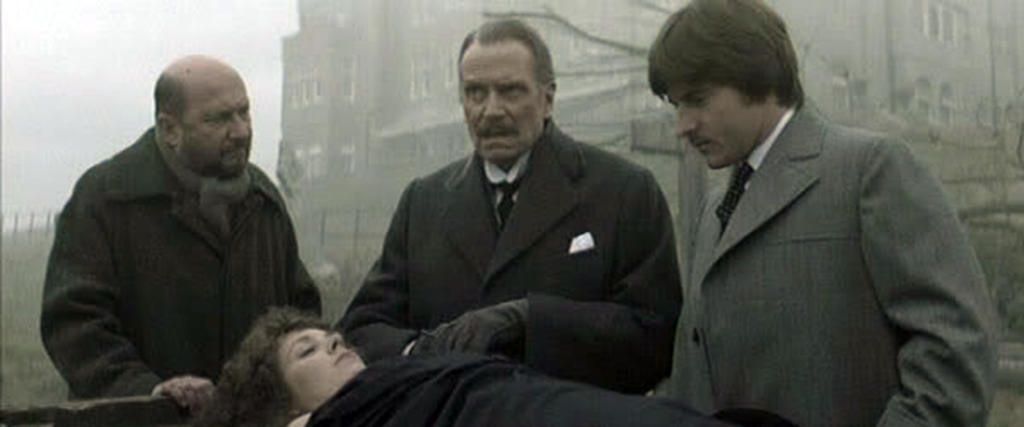
The lovely Mina (Jan Francis) has been exsanguinated by the foxy Count one night while her friend Lucy (Kate Nelligan) is out tramping it up with Jonathan (Trevor Eve). It makes me feel weird to even type that, you guys. It’s like they were cheating or something, what with the character reversal and all. Though now that I think about it, how great would a Mina/Lucy catfight scene have been? Anyway. The next morning, Mina is pale and gasping for breath, and dies as a horrified (and guilty) Lucy looks on. Dr. Seward (Donald Pleasance) has no idea what could have killed Mina, and summons Dad Van Helsing (Laurence Olivier) to help solve the mystery.

It’s clearly lupus.

It’s clearly lupus.

No slouch, Van Helsing immediately jumps to the most obvious conclusion, that eine nosferatu is running loose in the vicinity. As an aside, though, this is Van Helsing we’re talking about. He probably blames a vampire every time one of his socks disappears from the washing machine. Sure, he was correct in this case, but even a stopped clock, yadda yadda.

I’m not saying it was vampires. But it was vampires.

I’m not saying it was vampires. But it was vampires.

Anyhoo, Seward and Van Helsing visit Mina’s new grave in the cemetery, and find that her coffin is not only empty, but contains a ragged hole where she presumably dug herself out. The hole leads underground into some old mining tunnels, and they crawl down there to investigate, pretty sure of what they’re going to find. As they peer into the darkness, visions of the beautiful Mina probably uppermost in their minds…

Like so.

Like so.

…they begin to hear a shuffling sound coming toward them. They raise their lamps or candles (I can’t exactly remember which, and can’t find the scene on YouTube to check), and there, emerging from the darkness, is this horror, reaching for them and begging for a kiss:

At least she has a good personality. Well, aside from the bloodsucking.

At least she has a good personality. Well, aside from the bloodsucking.

This shit scared me SO BAD, you guys. And in this sense maybe it was a sound storytelling idea to make Mina Van Helsing’s daughter, because the tragedy of the scene is very apparent here, and underscores the horror with great effectiveness. The figure of the undead Mina is terrifying but also heartbreakingly pitiful, and the viewer really feels it when Van Helsing has to put down the monster his daughter has become. The rest of the film isn’t nearly as powerful, but that one scene is a stunner.

Keep watching this space for more of my horror-related wanderings, and news on my upcoming poltergeist book! Until then, Goddess out.

A Heart Full of Love and Devotion, a Mind Full of Tyranny and Terror: The Goddess Does an Extended Nick Cave Fangirl Squee

It occurs to me that I have been somewhat neglectful in this blog series, which I admit I first started with the intention of focusing on horror movie scenes that had made an impact on me and influenced my own work in some way. As readers may have noticed, however, the series sort of got away from that narrow focus pretty quickly, as I delved into literature as well, and after a while I figured that my horror influences were far too broad to confine to just film. Matter of fact, I feel as though books and other things have ultimately had more impact on my writing than movies have. And in my desire to keep to a theme, I feel like I’ve been giving short shrift to what is probably my main influence in this area: namely, music.

As befits a horror writer, I delved into the gothic subculture at a fairly young age, when it was still something of an underground phenomenon in the early to mid 1980s. So well did its musical and aesthetic parameters fit my personality that I stayed with it far past the point when many abandoned it, and even now, at the ripe old age of 42, I find myself still continually entranced with the scene, and very active in my little central Florida pocket of it. I’m not going to lie and say that the fashion wasn’t a large draw for me, because it always has been, but then as now, my primary love is for the music, which has been a constant and steadfast companion of mine for more than three decades.

I’m an admirer of many dark sounds, from the bleakness of post-punk to the syncopated angst of synthpop, but I’d like to expound at length, if I may, about a singular figure in music who has had more influence on my work than probably anyone else, whose music and words have filtered so far into my psyche that they now seem an integral component of my very cells. He speaks to me and for me, and has conjured more extreme emotions in me than almost anyone else in my life, even though I have never met him. This near-mythical figure is none other than Nick Cave.
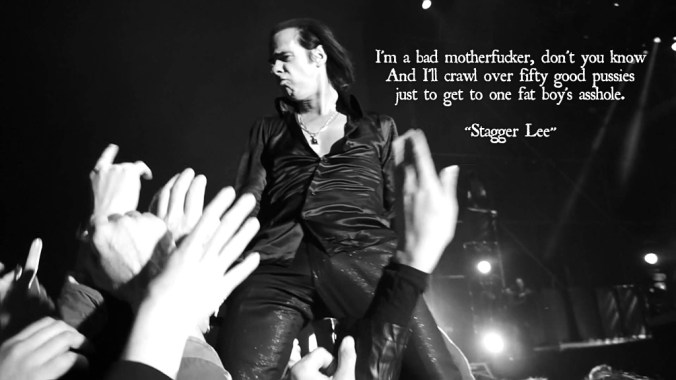
StaggerLee

I have briefly mentioned him on this blog before (when I insisted that someone adapt his insane novel And the Ass Saw the Angel to film), but so intense is my admiration, so insidious is his influence, and so steeped in horror is much of his work, that I felt he deserved his own blog entry. I was inspired to write it now because this past weekend, I was finally able to view the outstanding quasi-documentary about the legendary artist, 20,000 Days On Earth. I watched that spectacular thing twice straight through, fascinated anew by the man’s keen insight into his own creative process and aghast at his staggering, prolific genius. At one point in the documentary, he says that everyone has an innate desire to be someone else, to be transported and transformed into something greater than oneself. He achieves this through performance, his father achieved it through his intense love of literature, and in turn, I achieve it through listening to his music. Nick Cave is not simply a singer, songwriter, novelist, screenwriter, and actor; he is a goddamn force of nature, one that is terrible and beautiful and all-encompassing.
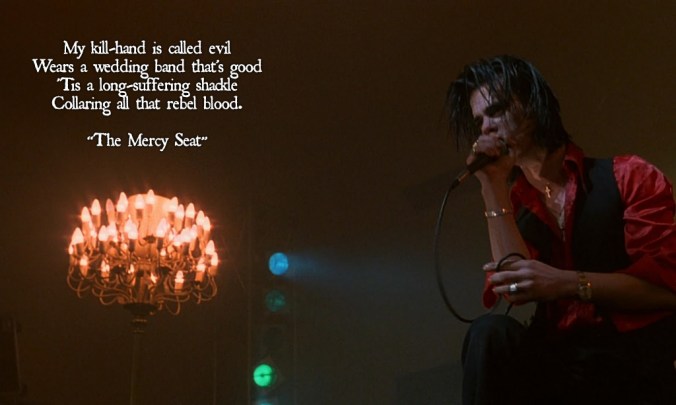
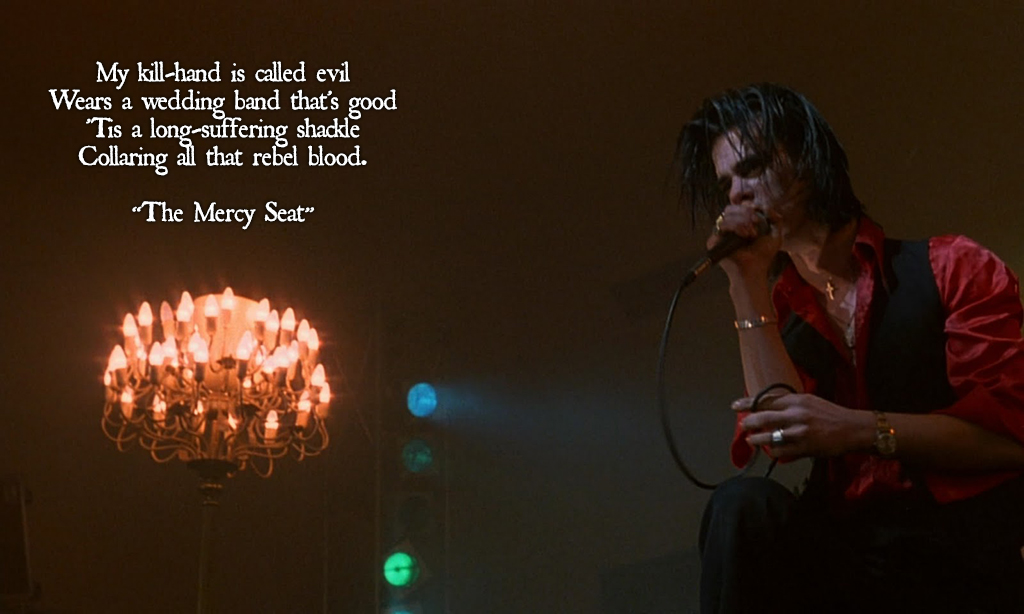
MercySeat

I first stumbled across Cave’s work in 1987 or thereabouts, after seeing the video for “The Mercy Seat” on MTV’s sadly defunct alternative music show, “120 Minutes.” The song, an epic, terrifying slab of gorgeous noise told from the point of view of a convicted murderer contemplating God’s judgment as he waits to die in the electric chair, made an instant impression, as did Cave himself: a tall, gaunt, crowlike figure with a shock of black hair and an intensity that blazed out through the television screen like a demon supernova. Who the fuck WAS this? I had sort of heard of him, I suppose, though at the time I was wrapped up more in the glam/deathrock end of the musical spectrum (Bauhaus, Alien Sex Fiend) and had largely neglected the more noisy/no wave/experimental corners of the alt landscape. Nick changed all that in seven minutes of enthralling hell.

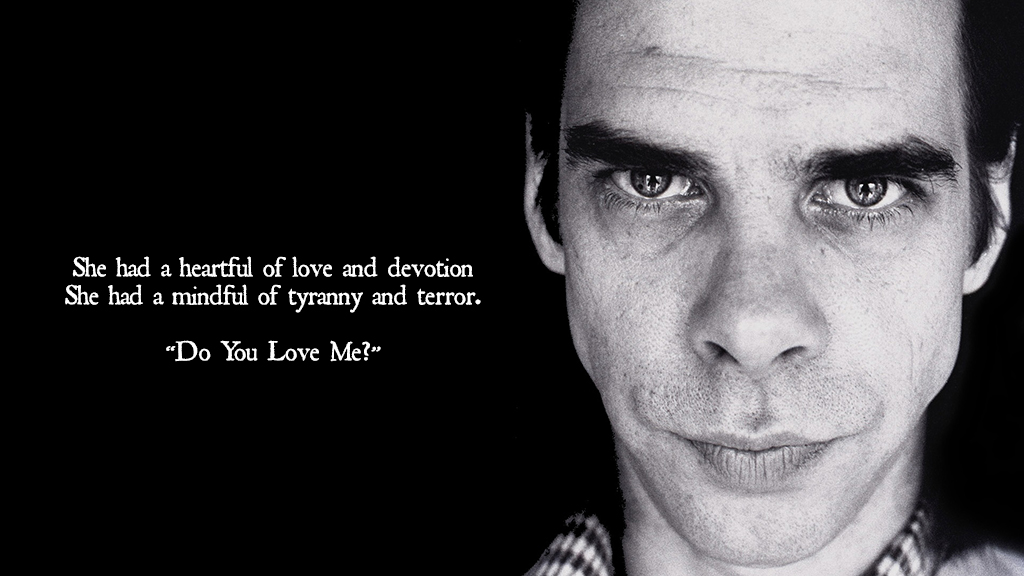
DoYouLoveMe

Over the next couple of years, I used whatever money I could scrape together and purchased his entire back catalog, including all the albums by his previous band, The Birthday Party, whose feral lunacy served as a seductive counterpoint to the more introspective direction of his later work. As I burrowed further into the world Nick had created — lurid, profane, and ugly, yet strangely transcendental for all of that — his vision began to spill over into my own. My first published short story, a runner-up in my local newspaper’s Halloween story contest, was based on his 1986 song “Jack’s Shadow,” and the first novella I ever completed, Bully Bones, was named after the Birthday Party song, and contained a few strategic Cave name-checks.

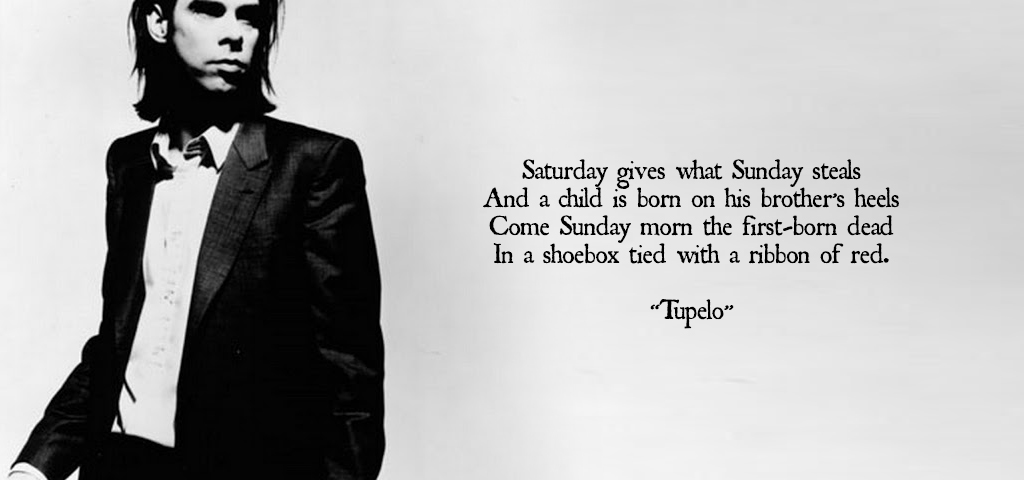
Tupelo

As the years went on, my relationship to his music grew ever more complex. While I was initially disappointed by the more subdued Cave who emerged on 1997’s The Boatman’s Call, as I aged and matured I began to realize that the intensity of his early days was still very much present; only the method of attack had changed. Whereas before he wore his passion and ferocity on his sleeve, shrieking to the heavens like a possessed madman, he had now found a quieter outlet to exorcise his devils, and the resulting songs were indescribably beautiful, as every nuance of his extraordinary voice conveyed oceans of sadness, anger, loss, and yes, even redemption.

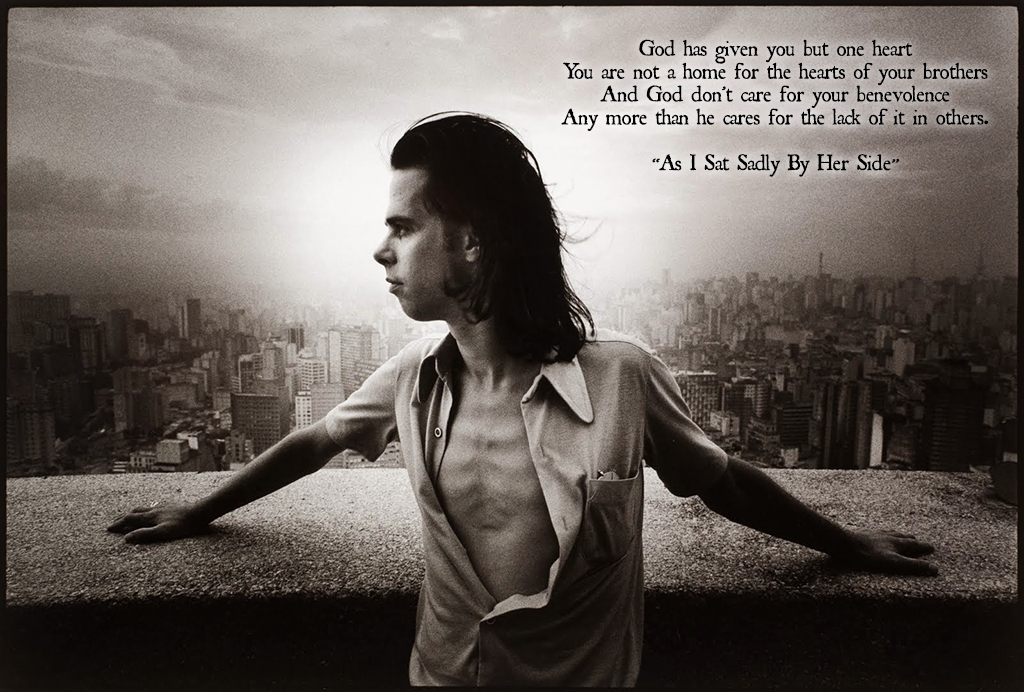
SatSadly

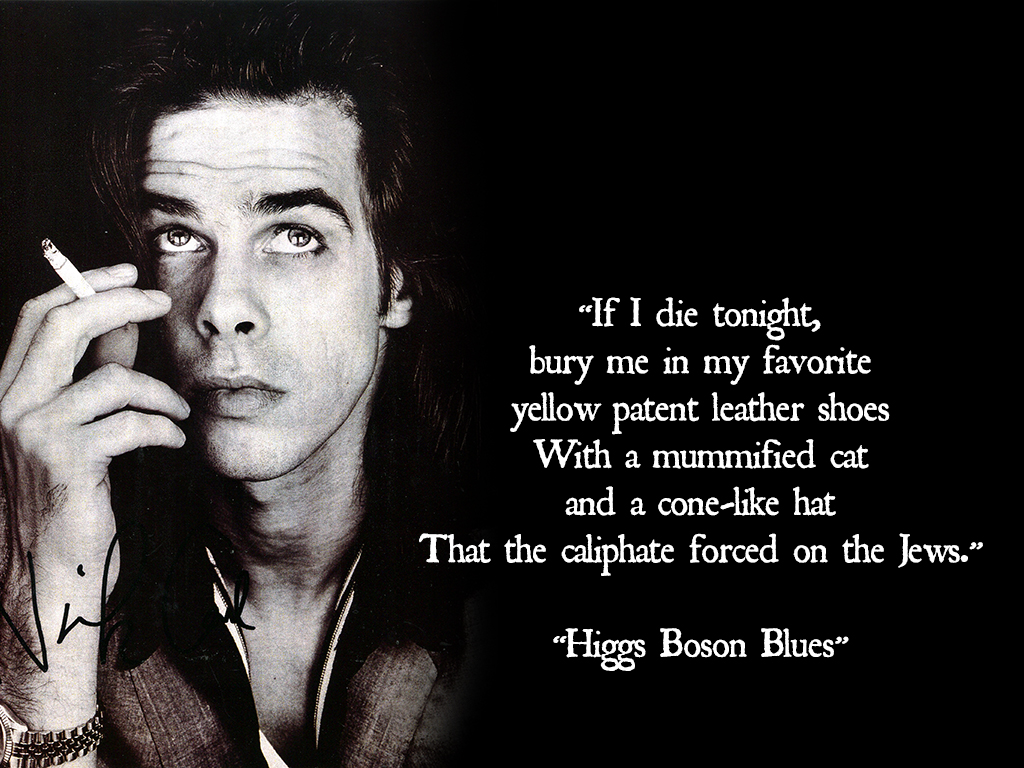
And his words. Oh god, his beautiful words. His phrases are like a form of magic, by turns profound and ridiculous, lofty and vulgar, sly and forthright, astonishingly heartfelt and blackly comic. He is a poet in the very truest sense of the word, a master not only on par with musical stalwarts like Dylan, Cohen, and Reed, but also with literary giants like Faulkner, Joyce, and Yeats. His words are passion and perfection.

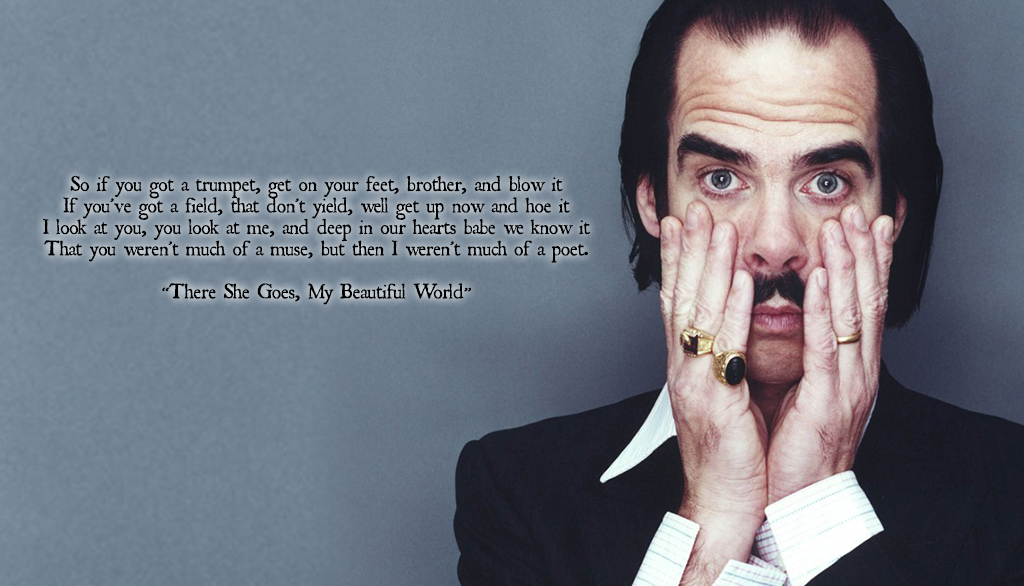
BeautifulWorld

I feel as though Nick Cave occupies a unique place in musical history, a true “rock star” in an industry that doesn’t really produce them anymore. He somehow manages to bare his soul for everyone to see, but still maintains a sort of godlike mystique, as though the truth of him can be better approached through the construction of his own artifice. His arrogant, too-cool swagger is delightfully undercut by his arch self-mockery, making him nearly immune to accusations of excessive self-regard. His universally recognized brilliance allows him to get away with things that no other musician I can imagine would get away with, and he does it with a characteristic, unerring aura of giving-no-fucks. Yet he clearly gives ALL the fucks, about his work, about his legacy, about how he is perceived. It’s a tremendous balancing act, and Cave accomplishes it with seemingly no effort at all, with a suave flick of his be-ringed hand and an unflappable smooth-down of his sharp black suit. He is like an alchemist of old, a hellfire preacher and a broken supplicant, a silver-tongued angel and a gutter-mouthed devil, all in one chimerical package.
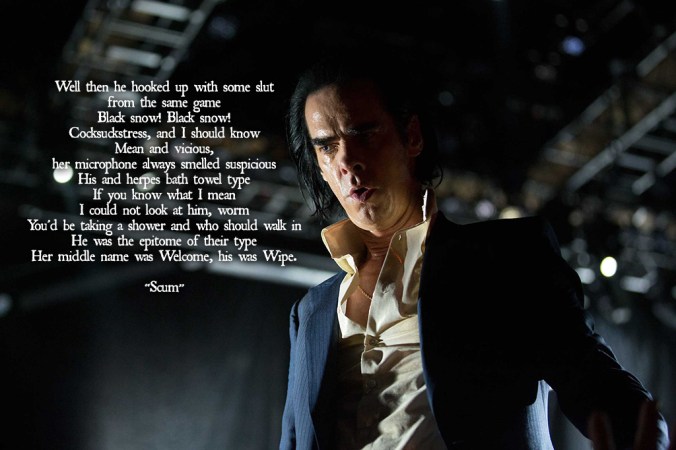
Scum

I’ve written so many words here to try to convey my feelings about the man and his music (“Prolix! Prolix! Nothing a pair of scissors can’t fix!”), but I fear that I have still fallen far short, and for that I apologize, not only to him, but to the entire universe that conspired to create him. In sum, if there can be such a thing as a creative muse, suffice it to say that I consider him mine, and for that I will be eternally grateful. Thank you, Nick, and long may you wave. Goddess out.

HiggsBoson


The Goddess Picks Her Five Favorite Horror Novels by Women

WomenInHorrorHeader


February, in case you hadn’t heard, has been designated Women In Horror month, and even though I gotta admit I’m kinda longing for a future where female horror writers will be so commonplace that it will be unnecessary to even remark upon them, I do feel like we vagina-havers still need our own month for now. That’s because, for whatever reason, women who write horror are still thought of as something of a novelty, or at very least a tad oddball. It’s a lot better than it used to be, sure, but even in this enlightened year of 2015, it’s not unusual for a horror anthology to come out containing no women authors at all, and there’s still a lingering perception that women don’t like horror as much as the guys do, or they don’t write it as well, or something, since apparently we’re all just precious delicate flowers who could never possibly enjoy the song of the chainsaw, the call of Cthulhu, the visceral thrill of seeing someone’s spine forcefully extricated through their mouth. I guess there’s a similar bullshit thing going on with female comedians and “girl geeks,” but I’m not really gonna go into all that because this is a horror blog, and I gotta stay focused on the topic without going off on a rant. Anyway, since I’m a woman who has always loved everything to do with the horror genre, I’ve decided to celebrate Women In Horror Month by honoring a few of my favorite “girl” writers in the genre with this humble blog post. So here we go.

WomenInHorrorNovels

Shirley Jackson – The Haunting of Hill House

I know I talk about this book a lot (and I wrote a whole blog post about the fantastic film adaptation as well), but that’s because it is probably my favorite horror novel of all time, and easily one of the best horror novels of the 20th century. In Ms. Jackson’s capable hands, something as pedestrian as a haunted house story becomes a multilayered, intensely terrifying study of psychological breakdown. Her masterful characterization of Eleanor Vance is one of the best in literature of any genre, and I would defend that statement to the grave. If you love Haunting of Hill House, and I know I do, also check out her other novels The Sundial and We Have Always Lived in the Castle, which explore similar themes.

Anne Rivers Siddons – The House Next Door

Another haunted house story (because you know how much I love those), but from the completely opposite side of the spectrum as Jackson’s novel. The haunting in The House Next Door takes place in a fancy, newly-built contemporary pad thrown onto an odd-shaped lot by a hot-shot architect in a chi-chi Atlanta suburb. The main players are agonizingly upper-crust, status-conscious, and at times completely snobbish and obnoxious, but their unlikeability makes their fates that much more devastating. The cursed-from-birth house next door doesn’t contain anything as gauche as a spirit, exactly, but more like a force that somehow knows and plays upon the residents’ deepest fears and insecurities, and dishes out scares accordingly. A fresh take on the subgenre, and a satisfying one.

Doris Lessing – The Fifth Child

A supremely literary horror story, and a short one clocking in at only 150 pages, but its tentacles grasp tightly. Somewhat reminiscent of Rosemary’s Baby, The Fifth Child sees “perfect” married couple David and Harriet pushing out one kid after another, much to the consternation of their extended families, who fear that the couple cannot care for the ones they already have. The first four kids are pretty much okay, but that fifth one, as the title suggests, is a doozy. A concise and terrifying examination of family dynamics and the social expectations surrounding the bearing of children.

Poppy Z. Brite – Exquisite Corpse

Perhaps this isn’t a fair choice for a “women in horror” post, since Poppy (born Melissa Ann Brite) has since undergone gender reassignment and now prefers to be known as Billy Martin, but at the time this novel was written she was still identified by a female pronoun as far as I know, so I’m going to include it. It’s a shockingly sick tale of two serial killers (based on real-life nutcases Dennis Nilsen and Jeffrey Dahmer) who join forces in order to find “the perfect victim.” They find their unicorn in the form of a pretty Vietnamese boy named Tran, and the story spirals into horrific madness from there. All of Brite’s trademarks are present, from the obsession with twisted killers to a fixation on the darkest and seediest underbellies of New Orleans. This is an intensely gory and profoundly fucked-up (but fantastic) novel.

Caitlín R. Kiernan – The Red Tree

Kiernan has written a lot of great books, including several pleasingly Lovecraftian ones. The Red Tree is the creepy tale of a woman named Sarah who moves to an old house in the woods after a terrible breakup and becomes obsessed with the ancient tree growing in the backyard, and the manuscript she finds that seems to hint that the tree conceals some terrible secret. If you like this one, I’d also recommend Silk and Low Red Moon by the same author.

Until next time, Goddess out.