I can’t believe it’s been a week since my last post! Sorry about that. I really do try to keep up with this thing, but sometimes I get busy with all my other endeavors (writing, book promotion, graphic design work) and run out of hours in the day. When it finally came time to do a new post, I was scrabbling for a subject, so I just decided to do something fairly pedestrian by discussing my ten best horror films based on novels. I’m not dropping my nuts here and proclaiming that these are the BEST ADAPTATIONS EVAR, but they’re certainly my favorites, and before anyone argues, YES, I know there are lots of other great horror films that were based on books, but I wanted to showcase great movies that were made from novels that were themselves fantastic and familiar to me (for example, while John Carpenter’s The Thing is one of my favorite horror movies of all time, I’ve never read the book it was based on, and as far as The Exorcist goes, I actually thought the movie was light years better than the novel). So now that we’ve got all that out of the way, allons-y.
10. The Girl Next Door (2007)
Based on Jack Ketchum’s horrific, you’ll-need-a-shower-afterwards novel (made all the more squicky by the fact that it was based on a true story), this 2007 adaptation mostly doesn’t shy away from the more terrible aspects of the book, and is all the more powerful for it. While I admit I found the novel a great deal more disturbing, the film is a worthy addition to the evil-that-humans-do canon. Some of it is a little too aw-shucks, fifties-stereotypical, but Blanche Baker is chilling as Aunt Ruth, and the mostly young actors are great, particularly 21-year-old Blythe Auffarth as the doomed Meg.
9. Hellraiser (1987)
Adaptations of Clive Barker’s infernal works are generally hit or miss, but I think we can all agree that this is the best by a mile (though I have to say that Candyman is also in the running). Based on his 1986 novella The Hellbound Heart, and directed by Barker himself, Hellraiser is filled to the brim with sadomasochism, buckets of gore, that genius puzzle box conceit, and one of the most recognizable horror baddies of all time. While the sequels couldn’t begin to approach the original classic, it’s easy to see how the detailed world Barker created in his short work demanded much more screen time. Jesus wept, indeed.
8. Ghost Story (1981)
As much as I adored the spooky, low-key adaptation of Peter Straub’s 1975 novel Julia (known as The Haunting of Julia in the US and Full Circle in the UK; you can find my analysis here), I find that Ghost Story, based on his 1979 book of the same name, just barely edges it out. The novel is so rich, complex, and over the top that the film couldn’t help but streamline the thing and leave several plot tendrils out, but I love it anyway, and I think director John Irvin was wise to focus solely on the central conflict of the book, that of the men of the Chowder Society battling the shapeshifting she-demon known by different names through the years. Some fantastically eerie scenes, and it was nice to see a band of dignified old codgers playing the heroes.
7. Stir of Echoes (1999)
I’ve talked about this criminally underrated film before, but I try to pimp it at every opportunity, because it’s so great and I’m still pretty bummed that it sorta got lost in the shuffle due to its simultaneous release with The Sixth Sense. Somewhat based on Richard Matheson’s short 1958 novel A Stir of Echoes, the film takes the basic plot of the book and builds an intensely frightening tale of hypnosis, psychic visions, and murder upon it. I’m not scared easily, but seeing this film in theaters gave me the heebie-jeebies big time, and it holds up remarkably well. Props also for the very Lynchian sound design, which ramps up the scare factor considerably.
6. The Innocents (1961)
Directed by Jack Clayton and starring Deborah Kerr as governess Miss Giddens, The Innocents is one of those rare films that wrings the scares from subtle atmosphere. Based on Henry James’s classic 1898 novella The Turn of the Screw, with a screenplay co-written by Truman Capote, the movie is chock full of spooky children, secrets, ghosts, and eerie goings-on, amplified into skin-crawling terror by the use of music, lighting, and ambiguity.
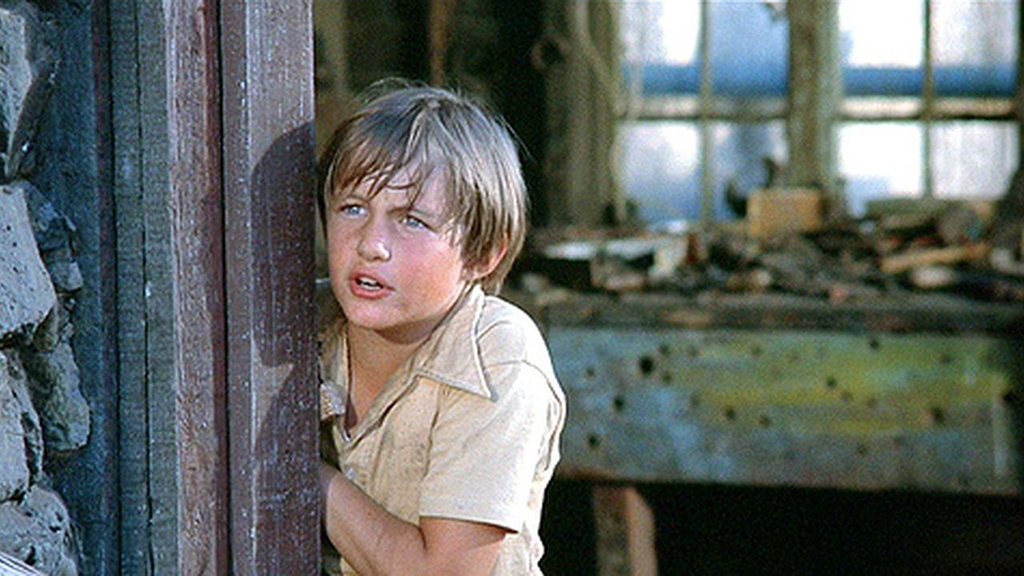
5. The Other (1972)
Based on former actor Thomas Tryon’s 1971 debut novel (and if you’d like to read a rundown of the lackluster adaptation of another of his fabulous novels, Harvest Home, I’ve got you covered), this Robert Mulligan-directed film is one of the best examples of the good/evil twin trope. Set in 1935 and starring Chris and Martin Udvarnoky as the conflicted Holland twins, the movie is a golden-drenched slab of uncanny mystery and horror, painted in hues of perverse nostalgia. Tryon, who wrote the screenplay, was reportedly not happy with the adaptation, but for my money the film more than did the novel justice.
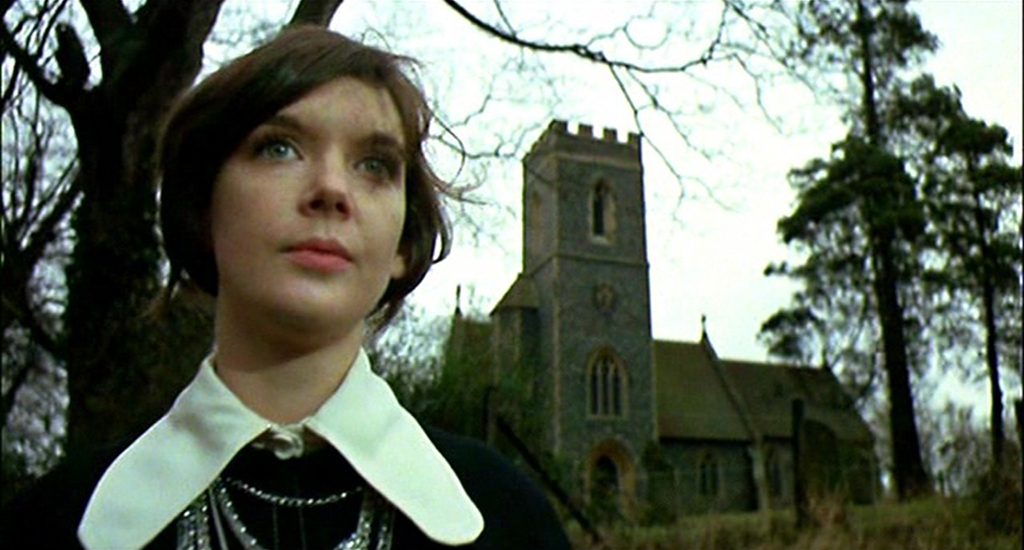
4. The Legend of Hell House (1973)
Another Richard Matheson adaptation (this time of his 1971 novel Hell House), this one takes obvious cues from The Haunting, but goes in a splashier direction with much effectiveness. Directed by John Hough and featuring great performances from Roddy McDowall and the impossibly adorable Pamela Franklin, the story takes the standard horror-movie plot of a group of ghostbusters investigating a scary house and does all kinds of weird shit with it. Baroque, overwrought, and lots of creepy fun.
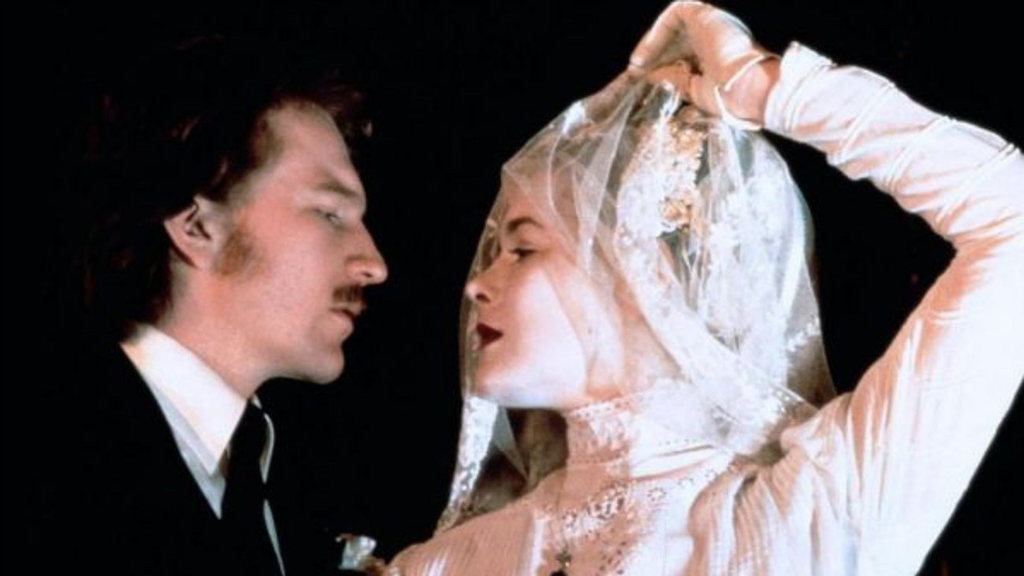
3. Rosemary’s Baby (1968)
Capturing the sly, blackly comic edge of Ira Levin’s 1967 book while maintaining a sense of slowly building tension and paranoia, there’s a reason this Roman Polanski-directed classic ends up on so many “best horror films” lists. I absolutely love Ruth Gordon as the lovably terrifying Minnie Castavet, and Mia Farrow is perfect as the fragile, waifish Rosemary, a protagonist you can’t help but sympathize with and be afraid for as everyone in her life seems to turn against her. If you’re a fan of Polanski’s films, check out my previous writeup on his deliciously creepy 1976 movie The Tenant.
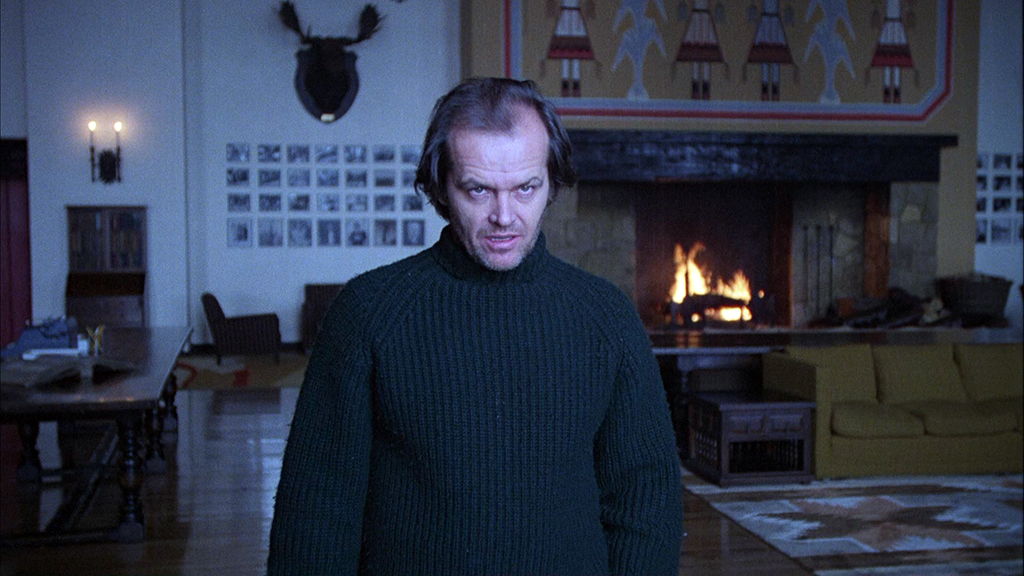
2. The Shining (1981)
What can I say about this masterpiece that hasn’t already been said? (Well, I said this and this, but y’know.) Taking what is arguably Stephen King’s best novel and using it as a springboard to explore universal themes, myths, and existential terror, Stanley Kubrick created a timeless, iconic piece of art that still has the capacity to enthrall and horrify, more than three decades later. Easily one of the five best horror films ever made.
1. The Haunting (1963)
You just knew this was gonna be my number one, didn’t you? I admit I talk about this book and film a lot (such as here and here, for example), but that’s only because I am in awe of the subtle dread and psychological depths this story plumbs in both mediums. Based, of course, on the hands-down best haunted house novel ever penned, 1959’s The Haunting of Hill House by Shirley Jackson, the casting in Robert Wise’s masterful adaptation is spot-on, and he deftly drenches the film in chills and atmosphere while essentially showing nothing, an astounding feat and one that is right in line with the source material. I really can’t recommend book or film enough, in case you hadn’t noticed. Oh, and I mentioned this before, but skip the lame-ass remake.
And just because I can, here are twenty more that were eliminated for the sake of brevity:
The Exorcist (1973, based on the 1971 novel by William Peter Blatty) The Hunger (1983, based on the 1981 novel by Whitley Strieber) The Birds (1963, based on the 1952 short story by Daphne du Maurier) Nosferatu (1922, based on Bram Stoker’s Dracula, 1897) Frankenstein (1931, based on Mary Shelley’s 1818 novel) The Phantom of the Opera (1925, based on the 1910 novel by Gaston Leroux) The Picture of Dorian Gray (1945, based on Oscar Wilde’s 1890 novel) House of Usher (1960, based on Edgar Allan Poe’s short story “The Fall of the House of Usher,” 1839) Duel (1971, based on Richard Matheson’s 1971 short story) Something Wicked This Way Comes (1983, based on Ray Bradbury’s 1962 novel) The Entity (1981, based on the 1978 novel by Frank De Felitta) Village of the Damned (1960, based on John Wyndham’s The Midwich Cuckoos, 1957) Masque of the Red Death (1964, loosely based on Edgar Allan Poe’s short story, 1842) Re-Animator (1985, based on the H.P. Lovecraft novella Herbert West—Reanimator, 1922) Cemetery Man (1994, based on the 1991 novel Dellamorte Dellamore by Tiziano Sclavi) Misery (1990, based on Stephen King’s 1987 novel) Carrie (1976, based on Stephen King’s 1974 novel) The Prestige (2006, based on the 1995 novel by Christopher Priest) The Lair of the White Worm (1988, loosely based on Bram Stoker’s 1911 novel) Horns (2014, based on Joe Hill’s 2010 novel)
Keep it creepy, my friends, and until next time, Goddess out.
The Goddess is a busy hellspawn, as I’m sure you all know by now. For the past couple weeks, I’ve been running my little cloven hooves off, doing promotional radio shows for The Mammoth Mountain Poltergeist (such as here and here), researching and writing an upcoming book I’m collaborating on with parapsychologist Steve Mera about one of his poltergeist cases, formatting and uploading ebook versions of some of my other books (here, here, here, and here), as well as doing my regular full time job and all the other freelance graphic design and club promotion stuff I do. In short, minions, I’m tired, and I’m very much looking forward to the upcoming three-day weekend, over which I have ambitious plans to simply lie around like a slug, eat copious amounts of food that’s bad for me, and occasionally rouse myself, put on pants, and go out to dance and drink myself silly until the wee hours. I’m going for the gusto here, folks.
But I didn’t want to go into the long weekend before posting a little something something on this here blog, and since it’s been a week or two since I did a “Scary Silents,” that seemed the logical choice. However, since it is also Friday and I’m really antsy to get the party started but also kinda bummed out that the air conditioning in the Hellfire home busted last night and won’t be fixed until Thursday (and we live in central Florida, y’all, so this is a horrible tragedy and even though you’d think that I’d be all about the heat, being a minion of hell and all, you’d be WRONG, I’m a motherfuckin’ COLD demon, dammit, so don’t question me), I wanted to choose a silent film that would fulfill the requirements for the series but wouldn’t be too taxing on my overworked and overheated brain. Enter The Haunted Castle.
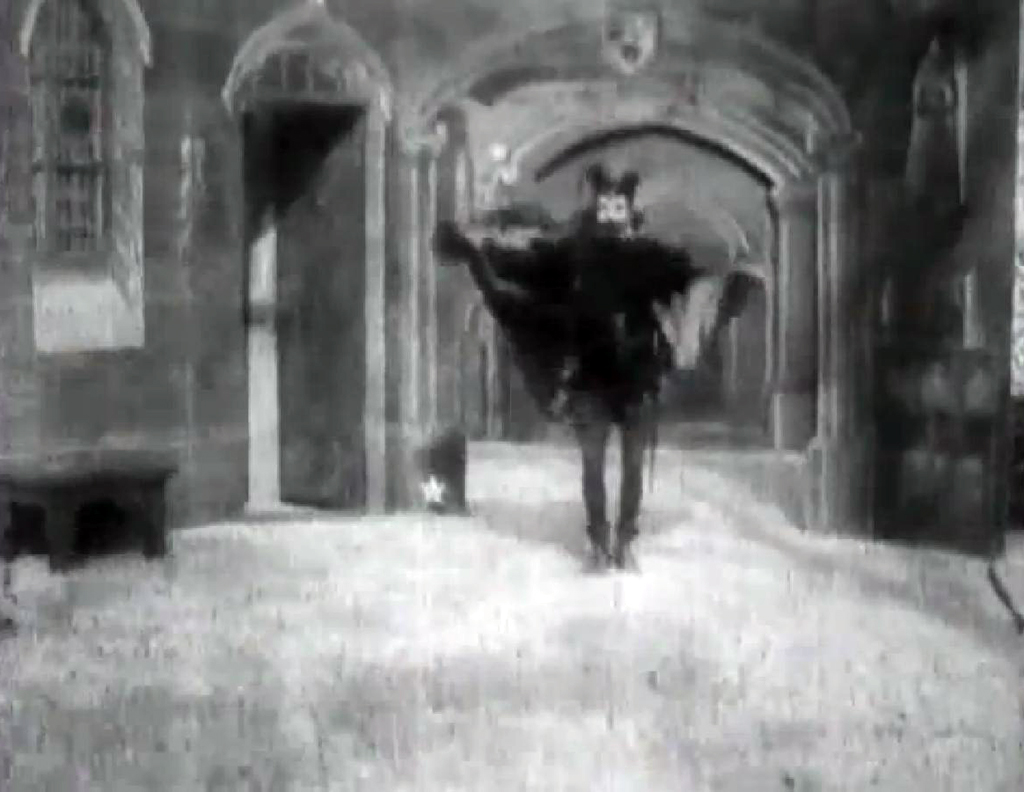
Released in 1896 (!!!), directed by the über-famous George Méliès, and considered the first horror film ever made (even though it’s more funny than scary), The Haunted Castle (French title Le Manoir du diable, ooh la la)was a massive influence on early horror films, particularly the German expressionist classics and the subsequent Universal films in the 1930’s. Even though audiences of the time had probably seen similar effects performed live on a stage, I’m thinking that seeing the same thing in a moving picture must have blown their minds in an OMG MAGIC TECHNOLOGY kinda way. The fact that the movie is only a little over three minutes long doesn’t lessen its importance or influence, and here I’d like to give a shout-out to the New Zealand Film Archive, which located a copy of this film in 1988 after it had been presumed lost for decades.
The film opens, obviously, on a static set of the cavernous halls of a haunted house. A huge bat comes sailing into the frame and flaps around a bit before poofing into a fabulous caped figure, who has a cool top hat kinda thing and some wicked Peter Pan shoes and a sweet Van Dyke beard. This is Hipster Mephistopheles, bitches. With a wave of his eeeevil hand, he materializes a big-ass cauldron at center stage. Then he produces a wand from somewhere in his dance belt, draws some Satanic-ass shit on the floor, and another poof reveals his sidekick, Imp Boy, who proceeds to stoke the flames under the cauldron, causing smoke to pour out the pot.
Drink me in, sinners.
And from the smoke emerges: VOILA! A LADY! She has a flowy white outfit on like a Greek cauldron bitch, and she’s all TA DA, and then Mephy (that’s what I call him, we’re tight) magically edits her to the floor. Then he puts his hand on her shoulder and tells her some shit, and kinda pushes her into the closet so she doesn’t embarrass the guests he has coming over or something. Greek Cauldron Bitch has a tendency to get handsy when she drinks, that’s all I’m saying.
Then he goes to the imp and sorta pets him on the head like he’s a faithful bull terrier, and Mephy’s all DO THAT THING, so then an open book appears in the imp’s hands, and Mephy writes in it. “Dear Diary: Today I made a cauldron and my imp appear in a puff of smoke, and then materialized a Greek goddess out of the cauldron and shoved her ass in a broom closet. LOL. Productive day.”
Then the imp disappears again, because he’s an imp so he has to go chill in another dimension when his services aren’t required, and then Mephy prances a bit and HUZZAH makes the cauldron disappear again. Then he’s like listening for something, and seems to hear what he expected, because he puts his cape back on and disappears. And then, sure enough, two of the three musketeers come sashaying into the castle, pointing around the place and talking between themselves like they’re assessing the property for “Flip This House,” all OOOOH, GIRL, CHECK OUT THAT WAINSCOTING, OOPS, SORRY I BEANED YOU WITH MY BITCHIN’ BELL SLEEVES THERE and then the imp poofs back with a big forked stick and starts poking them in their fey asses. They’re both looking around like WTF but the imp keeps disappearing before the musketeers can see him, so presumably they’re each thinking that the other musketeer has butt-poking feelings for him that he has not revealed until this point. I ONLY LIKE YOU AS A FRIEND, PORTHOS, GOD.
The musketeers quibble and argue and shove each other, and I may be imagining some sexual tension here (BOW CHICKA WOW), until finally one of them is all FUCK THIS SHIT, I’M OUT and the other one’s like GO THEN, YOU ASS-POKING FREAK, THE HELL WITH YOU. And then the remaining musketeer is all OOH, LOOKIT THIS BENCH, IMMA TAKE THIS FANCY SHIT ON ANTIQUES ROADSHOW, and then it disappears because Mephy doesn’t want his furniture turning up on PBS for everyone to gawk at, for heaven’s sake. Musketeer is all K THEN, I’LL JUST PARK MY ASS ON THIS OTHER BENCH OVER HERE but then POOF that one disappears too! Mephy is all about spreading evil through minor inconvenience, you see, all de-apparating the chairs you were just about to sit on. Dick.
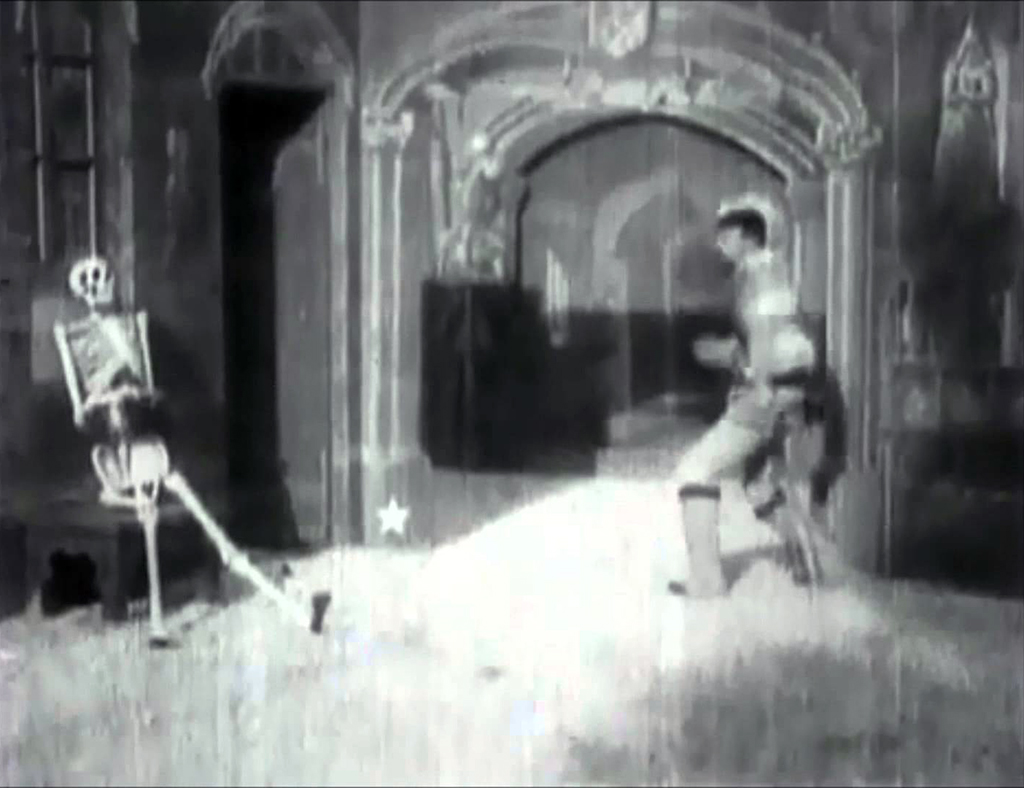
Musketeer is all exasperated, but then he turns around and the first bench is back, and he doesn’t even find this particularly strange, he’s just OH THERE YOU ARE, GET READY BENCH, YOU’RE FIXING TO GET GRACED BY ATHOS ASS, and before he sits he points at the bench like NOW DON’T YOU GO ANYWHERE, and it doesn’t go anywhere this time, but just as Athos settles his legging-clad shanks on the bench, a skeleton appears there and he scoots booty right into a bony pelvis. FACE!
‘Sup, flesh sack.
And then, because Athos is clearly a paragon of rationality, he whips his sword out of its scabbard, all IMMA SLICE THAT SKULL LIKE BUTTA, but when he swings the sword, the skeleton turns into the giant bat and flaps at him while he puts his sword back into its sheath all like K, I’M DONE WITH THIS WEIRD ACTION, but then he reconsiders and grabs the bat, and POOF, it’s Mephy again! Athos is all SHIIIIIIIT and backs away, and then Mephy conjures up more smoke in which the imp makes a repeat appearance. And Athos seems like he’s scared, but also kinda like HUH, WOULD YOU LOOK AT THAT.
They see me impin’, they hatin’.
Mephy points the imp to the floor, where he does a kinda tumble and disappears YET AGAIN, in a way that kinda makes it look like an accident. OH, THAT’S RIGHT, I FORGOT I CAN’T TUMBLE THAT WAY, THAT SENDS ME RIGHT TO THE OTHER DIMENSION. DAMN.
And then Athos, looking very put out, attempts to stomp like a manly man away from these devilish shenanigans, but ALAKAZAM! The way out is blocked by four white-clad babes! Instead of being all LLLLLADIES, Athos falls to his knees and begs them not to touch him with their ovary cooties, but they just push into him like an impenetrable wall of vampitude, and Athos JUST CAN’T EVEN and passes out. The ladies, their job done, disappear.
Mephy jumps over the prone Athos and then wafts his hands at the guy, and Athos acts all histrionic like he’s been blinded maybe, and then Mephy reaches into the closet and brings out Greek Cauldron Bitch. Athos is all WELL HELLO THERE and sorta bows to her and takes her hand, then gets down on one knee and kisses the hand, the whole schtick. But as soon as he kisses her hand, ABRACADABRA, she turns into…um…someone else? Another lady in a long white gown and maybe white angel wings, and she seems to be holding a staff. Athos is perturbed about this for some reason, and is all LET’S GO, ANGEL HO and he draws his sword again, but angel-woman raises her staff, and then a bunch more ladies appear beside her. Athos is all UH OH, but then apparently Porthos has recovered from his butthurt because he returns and starts helping his fellow musketeer fight the woman-wall. And I guess they’re supposed to be witches, because a bunch of them have brooms. The witches run around in a circle and then go out the door, but then troop back into the room through another entrance, like some kind of Wiccan conga line. Porthos has had enough and runs from the room and leaps over a railing with a hearty WHEEEEEE while Athos is back there all WTF MAN YOU’RE SUPPOSED TO BE HELPING ME, BROTHERS IN ARMS MY ASS.
Away with your foul womaniness, temptresses! My ass is not yours for the poking!
The ladies kinda feint at Athos, and he just doesn’t know what to do, but then the witches kinda circle again and crouch down to the floor and disappear. I feel like Mephy is just messing with the musketeers at this point, and all because Athos and Porthos were considering renovating Mephy’s sweet infernal castle into a charming bed and breakfast. (Lake views, full buffet meals, and just a hint of Stygian atmosphere, all for very reasonable rates.)
Athos searches the ground where the witches disappeared as if to say WELL, I CAN’T FIGURE IT OUT, even though all he’s seen so far in this joint is magical appearances and disappearances of various non-human entities, so at this point you’d think he’d just be going with the flow. Finally he’s like WELL, I’M DONE and makes to leave, but of course Mephy is still there in the doorway and makes laser-finger gestures at Athos while Athos cowers and chews scenery. Then Athos pulls the old HEY, LOOK AT THAT DISTRACTING THING UP THERE and he climbs up on the bench and pulls down a big wooden cross that was conveniently hanging over a doorway. Now, not to judge, Mephy, but why on earth would you decorate your house with crosses when crosses are anathema to a diabolical being such as yourself? Maybe it isn’t Mephy’s castle after all. Maybe he’s just house-sitting for Cotton Mather or something.
Predictably, Athos wields the cross at poor Mephy, Mephy does the old OH WHAT A WORLD, WHO ARE YOU TO DESTROY MY BEAUTIFUL WICKEDNESS routine, and then the movie abruptly stops. Christianity wins, Mephy scampers back to Heck, and Athos buys the haunted castle for a song and razes the whole thing to the ground to build a Super WalMart. The end.
I hope you’ve enjoyed this installment of Scary Silents, and I hope you have a lovely Memorial Day weekend. Don’t forget to grill a nice rare steak for the Goddess, and keep it creepy, my friends.
My 2014 novel The Five Poisons is now available on Kindle for $2.99! And this concludes my Kindle project; I’m not doing a Kindle version of The Tenebrist because it’s all graphically designed and shit and you really need to see it in print to appreciate it, so nyah. But other than that, have at it, ebook peeps!
Readers should not be surprised to find that I’ve had poltergeists on the brain recently. Not only have I been doing radio shows to promote The Mammoth Mountain Poltergeist (such as here and here), but I’ve also been working on a new book in conjunction with parapsychologist Steve Mera about one of the poltergeist cases he investigated in the 1990s. So those “noisy spirits” have been the overarching theme for the last few weeks of my life, if you catch my drift.
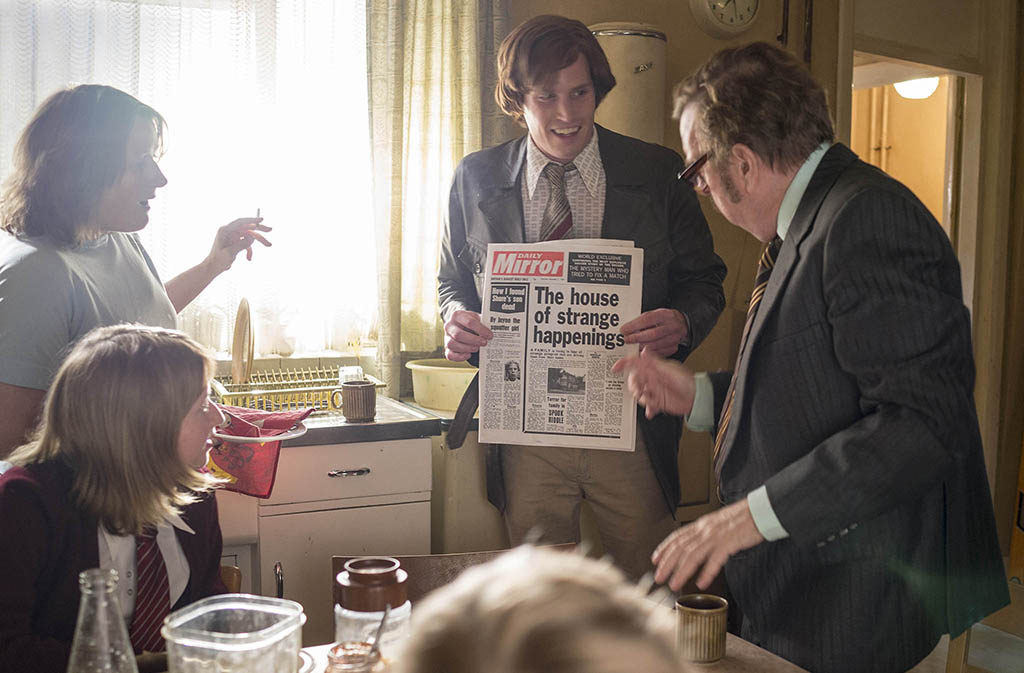
And because I love nothing so much as overkill, I decided to mine the poltergeist thang for this newest entry in my Parchment to Pixels series. Sky Living in the UK recently began airing a three-part miniseries based on the very famous 1977 Enfield Poltergeist case (which I actually summarized in my own Mammoth Mountain book, in the chapter on related cases). I’ve only seen the first two parts so far, but I thought I’d share my impressions, and perhaps edit this post or write a new one after the final installment airs. We’ll see how it goes.
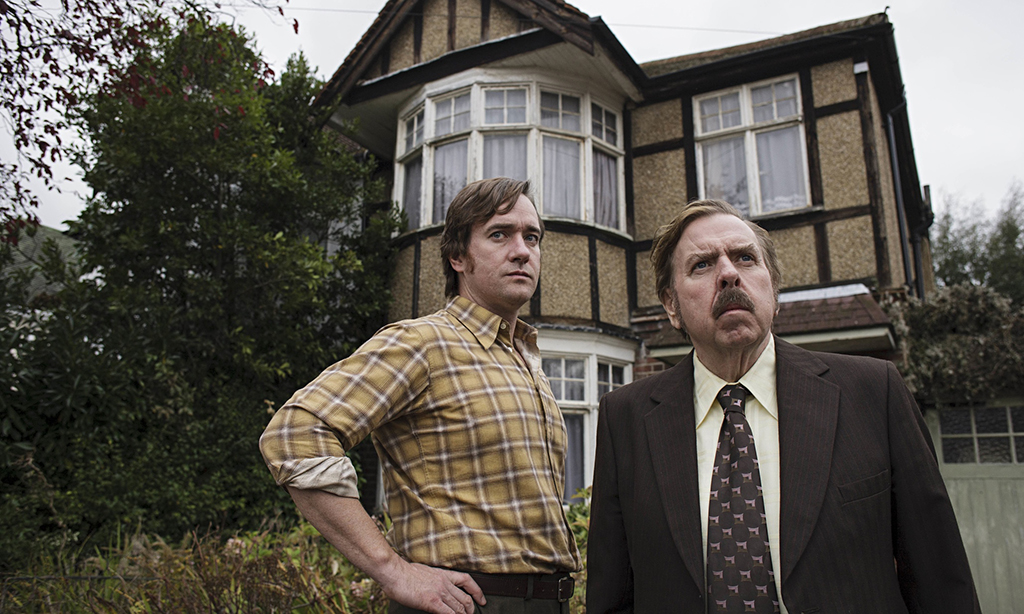
Called “The Enfield Haunting,” the miniseries features an impressive cast of British acting heavyweights, like Timothy Spall, Matthew Macfadyen, and Juliet Stevenson (as Maurice Grosse, Guy Lyon Playfair, and Betty Grosse, respectively), as well as some terrific child actors portraying the put-upon Hodgson brood. Eleanor Worthington-Cox (of Maleficent fame) as Janet Hodgson is especially good.
The series is very loosely based on Guy Playfair’s paranormal classic This House Is Haunted, and Playfair himself shares writing credit on the show (with Joshua St. Johnson). Having read the book myself about a year ago when I was researching my own book, I will say that this series is definitely not the place you want to go if you simply wish to see the tale told realistically; the show is heavily, heavily dramatized, features several big scares that were not in the book, and hews to a more traditional horror movie structure. There’s nothing wrong with that, of course, as long as you know what to expect, but I have to say it was a little jarring for me at first, until I just relaxed and went with the flow instead of going, “Uh, no, that didn’t happen like that” every five minutes. By the way, if you’d like to see a more low-key rundown of the purported facts in the case, there’s a documentary here that’s actually pretty interesting. Oh, and from here on out, I’m likely gonna be spoiling some shit, so if you haven’t watched the series yet, YOU HAVE BEEN WARNED.
You can read about the Enfield case on Wikipedia or in Playfair’s book, so I’m not gonna summarize it here, but I’d like to point out a few places where the series very obviously hyped up the terror and the drama from the fairly matter-of-fact reports of the paranormal investigators who worked on the case.
Though it is true, for example, that Janet supposedly channeled the spirit of a man named Bill who had died in the house (he’s named Joe in the series, for some reason), I don’t recall that she ever actually claimed to have seen an apparition of him. Bill manifested himself mostly as a creepy voice that would issue from Janet’s throat (or from behind her, as she claimed) and say nonsensical things, swear profusely, or occasionally come up with some tidbit about his death that actually did check out later. In the series, though, the spooky old fuck is everywhere, first appearing (in a pretty effective jump scare, I have to admit) when Janet is looking through her sister’s Viewmaster, and subsequently popping up outside of windows and so forth. Once he even turns up in the living room downstairs, puts his hand over Janet’s mouth as though to suffocate her, and (presumably) kills the family’s pet canary. And when Janet speaks in Joe’s voice, it is portrayed as possession, more or less.
In fact, so far in the series, it seems as though the horrible Joe (who, it is hinted, was a molester/abuser when he was alive, according to his son, who Maurice Grosse interviews at one point) is painted as the main antagonist and a definite evil presence in the home who is on a quest to hurt Janet. In the second episode of the series, Guy brings in a psychic who makes contact with Joe, and after doing so, warns the family and the investigators not to try to contact or interact with him again, because he is the literal worst.
This is quite different to the book, in which it’s pretty much understood from the get-go that the “poltergeist” is not the spirit of a dead person at all, but rather the psychokinetic energy produced by Janet and, to a lesser extent, her sister Margaret, evidently triggered because the children were under intense duress after the departure of their father and their subsequent fall into further poverty. I don’t remember a psychic being called in by the investigators in the book, but if there was, then the psychic certainly didn’t channel a demonic old man or give the investigators such a grave warning. EDITED TO ADD: I was a bit mistaken in this. After discussing the book last night with the God of Hellfire, who read it at the same time as I did (I read it aloud to him after buying it for him for his birthday, matter of fact), he says that the investigators called in several psychics, none of which were much shakes, mostly just spouting useless “I feel a presence” type stuff, as most psychics are prone to do. Interestingly, though, the GoH remembers the last psychic that was brought in actually stopped the phenomena from occurring for good, or at least happened to be present when the phenomena stopped on their own.
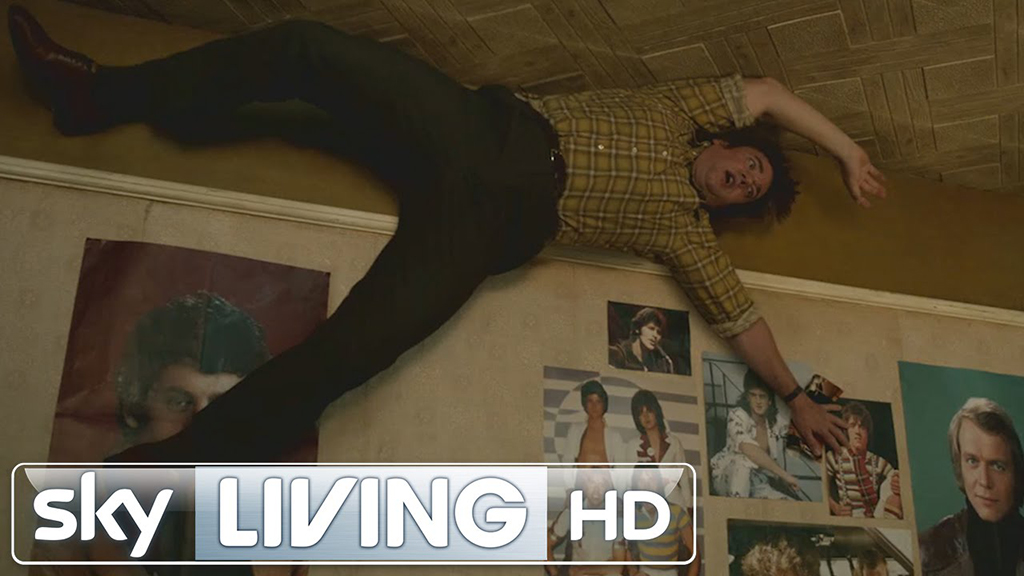
The paranormal experiences portrayed in the series, in fact, pretty much take the gist of what was actually reported in the case and then ramp it up a hundredfold to make it as scary as possible. The splashiest things reported at Enfield in 1977 were things like furniture moving on its own, small objects (books, LEGO bricks) flying about the room, Janet’s weird “Bill” voice, some possible levitation, and a couple of apportations. In the series, though, Guy Playfair gets bodily thrown against a wall by an unseen force, Janet is nearly strangled by a possessed curtain (which actually only wrapped itself around her midsection briefly in real life), and sister Margaret begins speaking in the Joe voice as well, as though the “spirit” is moving from person to person.
David Soul seems unimpressed by the flyin’ Guy.
The relationship between Grosse and Playfair in the series is also far more contentious than it was in reality, and while I understand this was done to heighten drama and turn the whole thing into a more typical film narrative, it still struck me as strange, especially since Playfair himself was a co-writer on the series. In the actual case, Grosse and Playfair were both members of the Society for Psychical Research, and were casual friends. Grosse began working at Enfield, and at a meeting of the SPR asked the assembled members for assistance. Playfair volunteered, as he had at that point written several books and articles on paranormal topics and was experienced in the type of phenomena being reported. That’s about as conflicted as I remember their relationship being, i.e., not at all.
In the series, though, Grosse begins camping out at the Hodgson home, doing his investigation thing, when Playfair shows up unexpectedly, offering help. It comes to light later that the bigwigs at the SPR have sent him to keep an eye on Grosse, since the SPR are thinking that Grosse has become too credulous and unstable since the death of his daughter, and is maybe going to screw up the case and make the SPR look like idiots. While it is certainly true that the real Grosse’s interest in the paranormal was sparked by his desire to contact his daughter (also named Janet), who died young in a motorcycle accident, in all the interviews I saw with him and in everything I read about him, he never struck me as any more credulous than anyone else in the field, and in fact seemed pretty level-headed, maintaining a healthy skepticism about the paranormal in general.
In a way, I almost wish I could just watch “The Enfield Haunting” as is, without knowing anything about the actual case, because I think I would enjoy it a lot more. It’s certainly a top-notch production, from the stellar acting performances to the fantastic cinematography to the wonderfully eerie vibe that permeates the entire endeavor. It’s creepy and pretty great, as a matter of fact; it’s just a shame that I’m so familiar with the source material that such a drastic fictionalization of it is sort of bothersome for me to watch (I’m sure I’ll feel the same way about the upcoming film The Conjuring 2, which will also be based on Enfield). It’s no fault of the series, really, and I actually do recommend it to those with an interest in such things. Besides all that, as I was watching it I couldn’t help but wonder what a Hollywood adaptation of my own book The Mammoth Mountain Poltergeist would look like, and I can’t decide if the thought is hilarious or horrifying. Anyway. More to come later, possibly, when I’ve seen part three of the series, so come back next time, same bat time, same bat blog. Until then, Goddess out.
UPDATE! Okay, the GoH and I actually did watch the third and final part of this last night, and I have to say, I think in my previous viewing I was being a bit too kind vis a vis the series wildly deviating from the source material. While I still stand by my statement that the series is good and well-made if you don’t happen to know anything about the original case, the final segment really went flying off the rails and abandoned any semblance of reality. It seemed as though as the series neared its climax, the writer(s) no longer felt the need to simply sex up the reported facts of the case and instead went whole hog with just making shit up. Interestingly, the GoH tells me that he located an interview with Playfair on the internet (I can’t find it at the moment) in which Playfair said that he was unhappy with how the series had turned out, and that when he had been given partial writing credit he had been promised that the series would closely follow the actual facts of the case as he had written them in his book. He claimed that the actual facts he had reported were scary enough without having to go all Hollywood on the thing, and if that’s true then I kinda feel bad for him. As I said, I can’t find the interview myself, but the GoH read me bits of it last night, so make of that what you will.
As I said before, the series ran with the theme of making the poltergeist phenomena attributable to a ghost of some kind, although it did pay some lip service to the idea that Janet was causing the manifestations using psychokinetic energy powered by her repressed rage (there is one amusing scene, for example, where Grosse takes Janet to an airport and lets her scream out her frustrations to her heart’s content as the planes roar overhead).
Let the hate flow through you.
This reasonable hypothesis is undermined, however, by pretty much everything else in part three of the series. There is crockery flying around everywhere, sinks full of blood, a tiny Tinkerbell-like light that torments and burns the girl, multiple apparitions, full-on possession of both Janet and the returning psychic; the shit just gets ridiculous. I think the most egregious example of this is when Janet is taken to the hospital after she breaks her thumb during a particularly violent poltergeist attack. In the real case, Janet (with no broken bones, it should be said) is simply sent to the hospital to have a standard examination, to rule out any mental or physical illness. She is given a clean bill of health and is sent home. In the series, however, she is put in a private ward, drugged all to hell (with the nurses soberly intoning that she can somehow withstand a HUGE amount of sedatives without seeming fazed), strapped to a bed, and threatened with electrical brain zapping. Later the bed dramatically flips over with the restrained Janet still on it. The girl’s mother, perhaps to save her from the suggested brain zapping, tells the hospital administrators that the family simply made the whole poltergeist thing up for publicity and that all she has to do is have a word with Janet and the whole thing will stop. Playfair and Grosse are both present at this meeting, and feel betrayed, though I guess the family didn’t really make it up because everything is okay with them later, though this is not shown. It’s a tad confusing, but whatever. It should be unnecessary to point this out, but none of this even remotely happened in the book; as far as I can recall, this was made up by the series writers from whole cloth.
There is also a rather silly scene where Playfair attempts to “exorcise” Joe by showing Janet the man’s ashes in a jar and trying to get his spirit to move on. Nothing like this happened in real life either, especially not the bit where Janet seemingly made the jar levitate up to the ceiling and then shattered it, showering everyone present with dead people ashes. The investigators never attempted an exorcism, and wouldn’t have attempted one in any case, since they were operating under the assumption that Janet herself was causing the phenomena.
Another aspect in which part three deviates quite a lot from the source material is Janet’s apparent channeling of Grosse’s daughter, and Grosse’s subsequent mental breakdown. He blames himself for his daughter’s death, you see. His wife leaves him (they make up at the end, though), he pretty much falls apart, and begins using Janet as a sort of surrogate daughter. Grosse in real life seemed like an okay dude, and I feel this does him a disservice. Of course the real Grosse was devastated by his daughter’s death, but he never once claimed that his daughter had contacted him, either through Janet or otherwise. And yes, he did become very fond of Janet and her family, as you would any group of people you remained in close contact with for more than a year, but I did not get the impression that he felt Janet Hodgson was trying to give him messages from his daughter. In the series, it almost seemed as though Grosse ultimately became the catalyst for the poltergeist and not Janet; at one point, Janet tells Playfair that Grosse is the one keeping the poltergeist there because he has unresolved issues about his daughter’s death, and indeed, the poltergeist phenomena doesn’t stop until Janet, speaking in Grosse’s daughter’s voice, tells Grosse that she is fine and that there is no need to forgive him for her death because it wasn’t his fault. It all just seemed very pat and more typical of a horror movie than a real, documented case, which generally has no rhyme or reason at all. So that rankled more than the earlier instances of embellishment, which at least bore some resemblance to the real reports.
Do I still recommend it? Sure, if you like poltergeist movies. But don’t expect it to be anything like what actually happened. If you’re okay with that, then go to town. The series definitely had some eye-rolling moments, but on the whole it was decently creepy, and the acting was mostly quite good. So, for the second time, Goddess out.
I told you guys I was Kindle-izing all my older books, and here is another one! My 2009 short story collection Hopeful Monsters is now available on Kindle for the low, low price of $2.99! More to come, so keep an eye out.
My 2011 short story collection The Associated Villainies is now available on Kindle for $2.99! If you always wanted to read it but didn’t want to kill trees with the print version, well, here you go. I’ll be adding more of my books on Kindle as the weeks go by, so keep watching this space.
At this point I almost feel like I should start a separate series called “Book To Movie” or something instead of just cramming these types of posts into my “Favorite Horror Scenes” series, but fuck it. Maybe I’ll get around to it; it doesn’t make much difference, I guess, but my anal-retentiveness really likes to have everything categorized neatly and correctly. The Goddess is nothing if not fastidious.
EDIT: Okay, I went ahead and did it. Not that anyone cares, but there are a couple new categories called “From Parchment to Pixel: Great Horror Books on Screen” to encompass these kinds of posts, and a “General Genre Musings” category as a catch-all for stuff that didn’t fit in any of the other classifications. Everything is correctly categorized, and I feel better now.
All that aside, here’s another discussion about a great horror novel that got turned into a mildly disappointing TV movie! If you’ll recall, I’ve done similar posts on Thomas Tryon’s Harvest Home and Stephen King’s miniseries version of The Shining. And if you’ll further recall, I highlighted today’s book in an earlier post about my favorite horror novels written by women. As you might have guessed, the subject of this post is Anne Rivers Siddons’s stellar 1978 novel The House Next Door and the surprisingly-not-terrible 2006 Lifetime TV adaptation of same. Into the breach!
Because this was made for Lifetime, the shoe-buying, chocolate-scarfing menstrual cycle of TV networks, I was expecting this adaptation to be far more cheeseball than it turned out, particularly because the source novel contains such sordid, over-the-top plot points (albeit presented in an oddly toned-down sort of way). But the movie—starring Lara Flynn Boyle and her surgically unfortunate upper lip as Col Kennedy, Zack from “Saved by the Bell” as Kim the architect, and a few other familiar faces—is actually relatively restrained, which was kind of nice to see. The book handily pulled off its ridiculously melodramatic incidents because of Siddons’s matter-of-fact delivery and pacing, but I’m not sure some of the crazier, modern-Southern-Gothic stuff would have flown in the movie; it could have easily slipped into camp. So points to Lifetime for tamping down on the more lurid aspects of the novel (although I admit I did enjoy those on the page).
The story has been modernized, obviously, to reflect the twenty-eight years between page and screen. The suburb in the movie is just presented as a generic yuppie enclave, so the more specific “old South vs. new South” themes of the book (which was set in a fancy suburb of Atlanta) are no longer in evidence. I feel like main protagonist Col Kennedy (never referred to in the movie by her full book name of Colquitt) is a bit younger than in the book, as is her husband Walker (who was named Walter in the book, which I guess seemed like an old-fashioned name, so okay), but that’s pretty standard as adaptations go. The horribly class-conscious, shallow and backbiting characters of the novel actually make pretty good fodder for a Lifetime movie, so I’m awarding more points there; some of the characters in the movie, in fact, were more likable than their novel counterparts.
The plot follows that of the novel pretty closely (and by the way, if you haven’t read the book, I’m gonna spoil it for you, so go read it real quick and then come back, okay? It’s pretty short; I’ll wait). Done? Okay, moving on. The House Next Door is basically a frame story, with the Kennedys watching a succession of three families moving into the gorgeous, newly-built house next door, and slowly coming to the realization that the house is evil and destroys everyone who lives within it by pinpointing what the residents value or fear most and then dismantling their lives in the most spectacular ways possible. The movie is only an hour and a half long, so obviously the plot had to be substantially compressed, with incidents being combined, or one horror coming quickly on the heels of the last one. Characterization suffers, of course, and to someone who’s read the book it will seem as though shit is happening at lightning speed, but that’s a failure of the medium, really, so I’m not going to fault the movie for that. It seems they did okay within the time constraints.
The novel is told from Col’s point of view, but despite this, she remains on the periphery of the action for a good part of the book, mostly hearing things about the house next door second hand, and not witnessing anything herself until quite late in the story. In the movie, though, Col is the main character, so this outsider status wouldn’t really work. However, the screenwriter came up with what I thought was a fairly elegant solution: as in the book, Col is an interior decorator, and in the movie she gets to spend a lot of time with the families next door because they hire her to help them decorate. A totally believable approach, and a good way to get her more directly involved in the shenanigans.
As in the book, there’s a short flash-forward introduction where Col and Walker are shown leaving copies of their wills conspicuously at their house before heading over to the house next door, with Col’s voice-over explaining that they know what they’re going to do is terrible, but that it won’t matter because they probably won’t live long enough to get into trouble for their actions. Then we cut to eighteen months earlier, as Col, Walker and the neighbors express their understandable displeasure that a house is being built on the beautiful wooded lot next to the Kennedy house, and then there’s the same change of heart as they meet the hot-shit, tormented genius architect Kim (a shockingly well-cast Mark-Paul Gosselaar) and the couple that will be moving into the house, Pie and Buddy Harrelson.
The Harrelson family section of the movie was the most different from the novel, and I think most of the changes made were probably the right ones (though I’ll have more to say on that in a minute). In the book, Pie was a very young, naïve, perky cheerleader type with a bizarre, quasi-sexual relationship-cum-competition with her old-fashioned father; in the movie, only the competitiveness and spite are highlighted, with Pie telling Col that she’s basically basing her whole life around showing her father up, since Daddy never thought her husband was good enough. Movie Pie is actually much less annoying than Book Pie, which I thought was a good decision, as portraying Pie on screen exactly as she was in the book may have made her not only less realistic, but also much less sympathetic.
We’ve got spirits, yes we do; we’ve got spirits, how ’bout you?
As in the book, Pie is happily pregnant and unable to believe her luck at how her life is progressing. Also as in the book, Buddy buys her an adorable puppy that you just know something bad is going to happen to (especially as we’ve earlier seen Col finding a torn-up animal in her garden). Shortly afterward, the puppy is found ripped to pieces (RIP puppy), and though Pie is heartbroken, she goes ahead with a planned housewarming party, so that she can schmooze with her neighbors and show Daddy how high up the social ladder his little girl has climbed.
So here is where the movie parts ways with the book rather significantly. In the movie, everything bad that happens to the Harrelsons comes crashing down all at once; the party seems to be going swimmingly, but partway through, Pie can’t find Buddy and goes to look for him. As she is standing at the top of the basement stairs, Buddy pushes her to the bottom, possessed by some evil within the house. Col finds her and rallies the troops, Pie is carried off in an ambulance (she ends up having a miscarriage, naturally), Buddy is carted off in handcuffs and charged with attempted murder, Pie’s Daddy screams at him that he always knew Buddy was a piece of shit, and that’s the end of the Harrelsons.
In the book, however, the events had a darker and much more batshit quality. Pie actually does fall down the stairs and lose her baby at one point, but it happens earlier in the story, and she is alone in the house at the time. She is found by neighbor Virginia (if I recall correctly), and Col is summoned to help. Despite the miscarriage, Pie decides to go on with the party, since displaying her status to her Daddy is of utmost importance to her. At the party, she loses track of Buddy, but she finds him in a much less murderous frame of mind; in short, he’s indulging in some intensely ass-slapping gay sex with his law partner on the bed where all the guests have been leaving their coats. Not only that, but Pie’s Daddy has found the fuckers first, and is in the process of dying from a shock-induced stroke on the bedroom floor. Now, I can see why the movie chose to downplay the novel’s scenario; public infidelity aside, homosexuality is not shocking or immoral to anyone anymore (aside from a few knuckle-draggers), so the scene would not have played out the same in 2006 as it did in 1978. Additionally, the screenwriter likely thought that the incidents portrayed in the book would have just been too much for audiences to swallow. A caveat, though. The whole M.O. of the house, both in the book and in the film, was that it systematically took away everything that was most important to the people who lived there or came in close contact with it. In the book, the house was very specific in how it chose to destroy the Harrelsons: It took their beloved puppy, then it took Pie’s baby, then it shit all over Buddy’s professional reputation by involving him in a sex scandal with his law partner (which everyone at the party saw, by the way), then it not only had Pie’s Daddy see Buddy in such a compromising position, but it killed Daddy off too, thereby leaving Pie with her life in complete and utter shambles. So while I can see why the movie went in the direction it did, it also seemed to soften the blow for Pie somewhat, as her father didn’t die in the movie, leaving her with something of her old life left to cling to. The book left her no such consolation.
Crabgrass! My life is over! #firstworldproblems
Anyway, as in the book, after the Harrelsons beat cheeks, a new couple called the Sheehans (Anita and Buck) move in. Buck seems pretty similar to how he did in the book, but the character of Anita is quite different. In the book, Anita was a delicate, dark-haired beauty who seemed haunted by something unspoken in her past, but was eager to make friends in the neighborhood despite her still-fragile mental state. During the course of the story, we discover that the Sheehans’ son Toby was killed in a helicopter crash in Vietnam, and Anita had to be institutionalized to deal with her grief. Buck, unable to deal with what had happened, had an affair, which Anita found out about. Through counseling, the couple had reconciled and were well on their way to getting their shit together; Anita was in a much better mental place, Buck had made his amends and had newly committed to their marriage, and things seemed to be looking up when they moved into the house next door, looking for a fresh start.
In the movie, Anita was an average-looking, matronly type with short mom hair and nothing of the ethereal or mysterious about her; in fact, she seemed completely open and friendly when Col and a couple of the other neighbor ladies showed up with flowers and cake to welcome the couple to the neighborhood. Immediately, though, things start going to shit; Anita orders a pizza for the ladies, and when the pizza guy comes to the door, she freaks out, thinking her dead son (killed in Iraq in the movie) is standing on the doorstep. As in the book, she begins to receive mysterious phone calls where she thinks she hears Toby calling to her, and she eventually starts to see the helicopter accident which killed him playing on the television in the living room; unlike in the book, Col is actually a witness to one of these horrific telecasts from beyond. As I said, the plot had to be substantially speeded up due to time constraints, but it was still jarring that Anita flipped out so quickly; in the book it was a much slower progression. And in the book, this was the point where Col only started to suspect that maybe something was wrong with the house; Book Col didn’t actually see the helicopter crash on the TV, but after Buck told her about it, she checked the TV listings and saw that no war movie had been on TV at the time when Anita had seen the vision, thereby making her wonder if something more sinister was going on over there. The rest of the Movie Sheehans’ arc plays out similarly to the book; Anita keeps seeing visions of Toby and loses her marbles, then is pushed over the edge when she sees Buck and Virginia in flagrante delicto. Anita kills herself, Buck moves away, and Virginia flees the neighborhood in shame at what the house made her do.
Part three, with the Greenes, is also fairly similar. Norman Greene is a self-important, tight-assed, abusive asshole with OCD issues, his cowed wife Susan vainly tries to be perfect for him while attempting to maintain a pleasant social face, and their daughter Belinda (who I think was named Melissa or Missy in the book) suffers from some unspecified illness that causes her to have stomachaches and vomit at times inconvenient for her jackwad father. (In the book, Norman is her stepfather, and the girl’s gastrointestinal disease is a source of intense embarrassment for him, so much so that he denies that she has it, claiming that she is simply faking illness for attention. This is touched on in the movie, though it is never explicitly stated that Belinda is anything other than his biological daughter.) As in the book, the Greenes have a party which few people attend because the invitations mysteriously never get mailed, even though Susan is shown getting ready to mail them; also as in the book, Susan is blamed for her “stupidity” in not getting the invitations out. Norman makes the most of the awkward vibe at the party, though, and pontificates at length to his captive audience about how awesome he is and how put-upon he feels at being burdened with such a sub-par and useless family. In the film, the party comes to a screeching halt when Belinda pees herself in front of the party guests (shades of The Exorcist), horrifying her father’s sense of neat-freak propriety. This scene is also substantially toned down from the book, but that’s probably for the best, because it would have been pretty gross to portray as written. In the novel, everyone at the party is alerted by a scream from the kitchen. When they go to investigate, they find Melissa-or-Missy cramped up in a fetal position on the floor, spraying diarrhea all over her white dress, the floor, and her mother, as the illness her father frightened her into ignoring comes to a spectacular head. If I recall correctly, the capper on the evening is the power going out (ruining the “perfect” party Norman had planned), and then coming back on just at the moment when Norman is standing over the blender, which Susan has conveniently left the top off of. Norman is drenched by whatever was in the blender, filthifying him and making his public embarrassment complete. In the book, he furiously runs everyone out of the party, and it comes to light later that after everyone left, there was a blistering argument between Norman and Susan which resulted in Susan finally flipping her shit, and shooting him, her daughter, and then herself. In the movie, this is also toned way down; Susan does end up shooting Norman and herself, but Belinda escapes, fleeing to the Kennedys’ house for help. Lifetime didn’t want to kill off the cute little girl, I guess.
So, what are your qualifications for becoming my new mommy?
The rest of the movie plays out in pretty much the same way; architect Kim returns from the trip to Italy he took to get his mojo back, and he buys “his” now-empty house. When he and Col are in there alone, the insidious evil of the house causes them to uncharacteristically act on their previous light flirtations and start going at it, Walter/Walker witnesses the infidelity and attempts to kill them both, but Walker and Col manage to drag themselves out of the house before anything too horrible happens. As in the book, it is this shattering event that finally shows Walter/Walker how evil the house is, and cements his decision to join with his wife and destroy the thing. In the book, Col and Walter actually went to the press to warn people about the house and subsequently had the entire neighborhood shun them; in the movie they never go to the press, but are kinda given slight pariah status just the same because of their theories about the house next door. In the movie, they destroy the house by blowing it up (which I think is pretty much the same thing that happened in the book) and making it look like an accident. Kim is killed in the explosion, which I think also happened in the book, though I’m not entirely sure and don’t have the book with me to check. Similar to the book, the movie ends with Pie and Buddy’s contractor from the beginning of the movie talking to an idealistic new couple about these fantastic house plans he still has from some hot-shit but now deceased architect, and he tells them that he can build the house for them if they want it, because the house on the plans looks “magical and alive.” And thus the cycle of evil continues, even after its emissary is dead. I think the movie was a lot less subtle in its portrayal of Kim as the definite agent of the evil, making him almost seem a willing participant. In the book, it is understood that there is something inside of Kim, a curse of some kind, that causes everything he designs to cause misery and death, but he doesn’t seem complicit in the evil, simply an innocent conduit (though I could have been misreading the text on this score). As in the book, Col and Walter eventually leave their house and move permanently to their beach house to escape the sneers of their neighbors (in the book they also escaped a substantial media frenzy surrounding the haunting; this isn’t really touched on in the movie); unlike in the book, they seem to adopt the surviving Belinda Greene, neatly tying up the several hints in the movie that the Kennedys (or at least Walker) were somewhat bothered by their childlessness. End film.
As I said, not really a bad adaptation at all, especially considering it was a Lifetime movie. It never got too eye-rollingly silly, and moved along at a pretty good clip. Some of the changes made from the novel I agreed with, and some I didn’t, but I can understand why certain changes were made, even though I might not have liked them. Worth checking out if you’re bored and have ninety minutes to kill, but as always, the book is light years better and would obviously be a much more satisfying investment of your time.
Until we meet again, keep it creepy, my friends. Goddess out.
Top of the afternoon, minions! I just realized I hadn’t posted anything in either of my movie series for several days, and I felt sorta bad about that. I also realized that I have come down with the plague and don’t really feel like doing anything other than lying in my bed and wallowing in a cold-medicine-fueled delirium. But because I love you guys and have a pathological need to do something productive even when I’m in the throes of deathly illness, I’ve decided to compromise by discussing a nice, short little silent film known as The Red Spectre. Here it is:
Released in France in 1907, The Red Spectre was directed by Segundo de Chomón and is one of the few surviving examples of early-twentieth-century “trick” films. It’s only ten minutes long and doesn’t have a “plot” per se, but I gotta admit, for 1907, this thing looks fucking amazing. How is it in color, Goddess? You may be asking. Glad you asked. It’s in color because it was painstakingly hand-tinted, frame by frame. That’s hardcore, Goddess, you may be saying. And yes, I would have to agree. Also, the effects are pretty damn cool-looking, and honestly, since I don’t know much about early film technique and can’t really figure out how they did some of them, I’m just gonna assume MAGIC IS REAL.
Does this red grotto make my hips look big?
We open in a little flaming hell-grotto with a happy dancing coffin. The coffin fades away and reveals a skeleton dude with horns and a fabulous cape, which he proceeds to open all TA-DA, BITCHES, I’M THE DEVIL. WELCOME TO MY WORLD OF EVIL AND KICK-ASS SPECIAL EFFECTS. He swishes back and forth a couple times, since that’s evil’s prerogative, and then the rocks in the background part, and then there’s like a cave background with stalactites and shit. He poses some more, like CHECK OUT THE BATCAVE, PUNY MORTALS, and then he waves his bony arms and there’s smoke and fire, and oh, I guess he’s holding a torch or a bottle rocket or something, and then he holds the torch down near the floor and GIRLS APPEAR! I get the feeling that he really digs showing off his magical girl-appearing fire wand. Evidently the girls are his harem of captured souls, and even though there are only five of them I’m not gonna hate. Maybe he’s just a minor demon, after all, or maybe he’s just starting out in the soul-capturing biz. Or maybe it’s the beginning of the month and he had a shitload of souls that he dispatched earlier and this is the new batch. I don’t know the protocol, so far be it from me to dis the Red Spectre’s meager soul count at this juncture.
The girls dance around in a circle all pagan-like, and the Spectre stands behind them with his arms crossed all like WORD. Then the girls disappear and turn into little flaming will-o-the-wisps. He dances around with his cape like he’s trying to wrangle them, but he can’t quite do it, or maybe he just doesn’t want to set his cape on fire. Then he magicks his torch back again, and with it he materializes two elaborate gold cauldron thingies which he lights with flame like it’s the Devilympics up in here. Then he does the WORD pose again, and then girls appear in the flames in the Olympic bowls. They hold their hands out and he takes one girl in each hand and helps them down to the floor, all gentlemanly, and guides them to the back of the grotto. Then he’s all IMMA BLOW YOUR MIND and draws his arms together and the gold cauldrons scoot close together in the middle of the stage. From beneath his voluminous cape, he produces a huge roll of what looks like black Hefty bag material. He lays the roll across the cauldrons and rolls out a length, then picks up one of the girls and puts her on the barbecue and wraps her up like a Triple Steak Burrito from Taco Bell. Then he waves his caped arms again, all EENIE MEENIE CHILI BEANIE and the girl-burrito floats up in the air, then catches fire and suddenly disappears, much like the contents of your intestines do after eating a Triple Steak Burrito from Taco Bell. He then repeats the procedure with the second woman, because where girl-burritos are concerned, you really need to see the whole thing twice to get the full effect.
Behold my gold-plated hibachis of death!
Then he makes another TA-DA gesture with his hand and produces a pitcher outta THIN AIR. This is better than Mindfreak, you guys, for real. He takes what are presumably the girls’ ashes out of the cauldrons and puts them in the pitcher. Then HUZZAH the cauldrons disappear, and then at stage left there’s a puff of smoke and VOILA, Peter Pan appears! Okay, not really Peter Pan, I think it’s a girl who’s supposed to be a good spirit or a wood sprite or something, but y’know, she has some Mary Martin action going on. And the Spectre looks at her all SO WE MEET AGAIN, MY NEMESIS, and she waves her hand like Vanna White and some curtains part in the back and there are more girls back there, and Peter Pan seems to be showing Spectre something and he’s pretty indignant about it, but she’s all DEAL WITH IT and waves her hand to close the curtains again. She points at him and then points at herself, all GIRLS RULE AND SPECTRES DROOL, and he looks all huffy with his ash-filled pitcher, because he just wants to do a little spot of evil in peace, for fuck’s sake, and he doesn’t need no womany do-gooder wood sprite cramping his nefarious style and being a nag, man. She keeps pointing at him and then he starts to come at her all YOU’RE GONNA GET IT NOW, HO, but she ducks behind a rock and disappears. Minx.
Anyway, Spectre is all FINALLY, SHE’S GONE, NOW I CAN GET ON WITH THINGS, and he poofs a properly Satanic-looking pedestal into existence. The base of the pedestal looks like a caduceus, and the top of the pedestal holds three bottles. Spectre picks up the pedestal and carries it really close to the camera. I don’t know why he didn’t just poof it into existence closer to the camera in the first place, but maybe he carved that pedestal and wanted everyone to appreciate his handiwork. He spent a long time making that, you guys. Sure, he could have just magicked it, but he likes to work with his hands sometimes, do things the old fashioned way. It relaxes him, dontcha know.
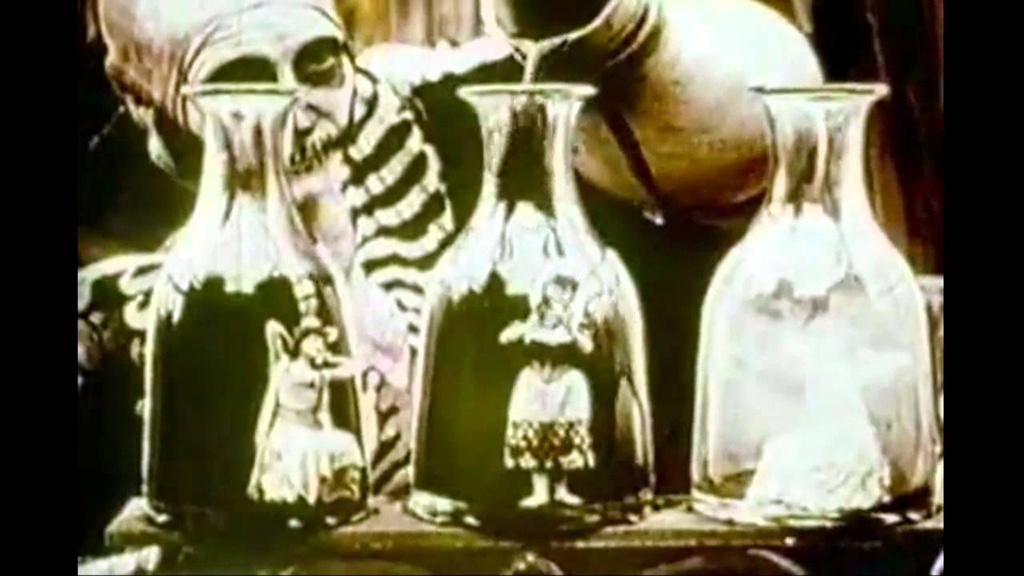
He pours the ashes, which are now liquid somehow, into the first bottle, and hey, there’s a tiny girl in the bottle! I guess he likes to shrink down his ladies and keep them in bottles to maintain their freshness. Turns out there are girls in all the bottles, revealed as he pours the black liquid in over them. Spectre is all smiles as he surveys his bottled ladies, and then he turns the bottles until they’re white and we can’t see the teeny girls anymore. Then he carries the pedestal back to the center of the stage, and then POOF the Wood Sprite is back! She seems a bit put out, all YOU CAN’T KEEP GIRLS IN BOTTLES, WTF ARE YOU EVEN THINKING WITH THAT and Spectre’s all YOU’RE NOT THE BOSS OF ME, but I guess she is because Wood Sprite poofs the pedestal away herself. Spectre’s all BITCH, I WAS USING THAT and chases her around, but she disappears again and Spectre is all FUCK THIS SHIT, I JUST CAN’T DEAL.
Pictured: Bottle blondes.
But he recovers quickly from his tantrum, and then poofs another thing into existence. The pedestal base looks the same, but now the top of it looks like some kind of fancy screen or whiteboard in three sections. He drags the pedestal close again and starts turning the sections around one by one. There’s another girl on the back of each screen, so this is like a screen-in-screen effect, which seems pretty high-tech for 1907. The girl on the screen bows and sniffs a flower like she’s the queen of England, and Spectre turns the screen sections back around because he just can’t stand any more of her attention-whoring. The pedestal is taken back to the center of the stage, where a newly apparated Wood Sprite appears again and magicks it away. GOD, PETER PAN, I AM JUST TRYING TO DO MY ONE-DEMON TRIBUTE TO DAVID COPPERFIELD, WHY YOU GOTTA BUST MY CHOPS. She just laughs like Nelson Muntz (I presume) and runs away from him and disappears again. I know this is probably not what the filmmakers intended, but I’m starting to feel a little sorry for the devil here.
But, being the consummate professional, the Spectre knows that the show must go on. He does a dramatic gesture and causes another big screen to appear, but this one is super fancy and gold, with a big devil head at the top and devil hands on the sides. The screen has another three girls posing and dancing around on it. Spectre goes around behind the screen and then rolls under it, which is the cutest thing, and then he’s lying on his back and waving his arms, and the picture on the screen changes to a single smiling woman in a really over-the-top feathered chapeau. Then another wave of the skeleton arms, and the picture changes to what looks like an old couple indulging in some modest PDA. And then ABRACADABRA, the screen disappears and there’s that troublesome sprite again, and Spectre is REALLY mad because that was his greatest illusion, goddammit! He tries to throw down on her and enfold her with his Liberace cape, but she keeps disappearing and he’s all FUUUUUUUUUUUCK.
Getting on with things again, Spectre waves at the backdrop and it lifts up with much flame and smoke and rock & rollery, like KISS are about to come out. Then he starts dancing, and I guess the film is running backwards because his cape is moving all weirdly, and then boxes start flying in from off-screen like he works at the world’s most aggressive post office and it’s the Christmas rush. He catches them like a pro, and begins stacking them, and then they magically cohere into a big square and they’re a screen too, because in the hell-grotto, everything is a TV showing episodes of “Real Housewives of the Underworld.” The box-stack-screen is showing a dowdy old woman in another crazy feathered hat feeding a dog, and Spectre stands there presenting it with his hand like he’s super proud of the dog thing, y’all. Then he runs his hand up the side of the boxes, and there’s another puff of smoke and then it disappears, and then, you guessed it, up pops Peter Pan. They have an altercation, Peter Pan waves her arms and all the cave curtains in the back raise up and there’s just fire and explosions everywhere like we’ve stepped into a proto-Michael Bay movie and Spectre, defeated, lets Peter Pan lead him toward the rear of the stage, where he spreads his arms like he won a trophy and acts all like YEAH, I WON ALL THIS SHIT, and then all the girls that he burritoed and bottled up earlier come rising up out of the stage at Peter Pan’s mystical gesturing. So I guess Spectre got his evil butt kicked and all his trapped girl souls got released by Peter Pan. ALL THAT WORK FOR NOTHING.
And then there’s one girl remaining, and Spectre tries to enfold her with his cape like he’s gonna give her a noogie, and she looks like she’s into it, but then BAM the girl turns into Peter Pan and everything turns red and the cave rocks come back and Peter Pan knocks the poor Spectre on the ground and just stomps the shit out of him with her little fairy shoes, and then as a final fuck you, she pours some stuff from his pitcher onto the poor fella, and then he’s just a cape, which she lifts up to reveal that our previously spry Spectre is now just a lame-ass skeleton from Mrs. Fisher’s second period bio class. She throws the skeleton on the ground and then puts on his cape, all OOH, THIS IS QUITE FETCHING AND I HAVE YOUR PITCHER TOO SO I’M YOUR GOD NOW, SATAN. SUCK IT. And then that’s the end.
Like I said, this is pretty incredible for being more than a hundred years old, what with all the really pretty decent screen effects and the hand-coloring and the devilish shenanigans. A fun little experiment in early film, all the more valuable because it’s one of very few that survived the years.
Welcome back to Scary Silents! Even though this series is relatively new, I’m already changing things up a tad, so I hope none of y’all mind. Yes, this is still a silent film I’m discussing, but it isn’t from the sanctioned “silent film era” (hence the reason I also cross-posted it in my “Creepy Scenes” category). It’s a notorious experimental film from 1991 called Begotten, directed by Edmund Elias Merhige, who was also responsible for the fantastic film Shadow of the Vampire (which of course focused on the making of F. W. Murnau’s Nosferatu). I became intrigued with Begotten because of its persistent appearance on pretty much every “Most Disturbing Films EVAR” list circulating on the internet, so being something of a masochist, I decided to check it out and write down my thoughts for posterity. If you would like to follow along, here is the linky-poo:
The first thing I gotta say is that this certainly does look like a legitimate silent film from the era. It’s filmed in very stark black and white, and the film stock is all grotty and the camera work shaky, so kudos for realism. There is also no sound other than the constant drone of crickets, and the occasional grunt. The first shot is a shack in the woods, and already I’m digging the whole look of the thing; it really conveys that creepy, otherworldly feel I look for in my old silent films. I have a creeping suspicion that the entire production is going to be intensely arty-farty, but I don’t have a huge problem with either arts or farts, so it’s all good.
Inside the shack is a man in an eerie Leatherfacey mask and a white robe. He has blood all down his front and he’s coughing up even more of the stuff as he shakes and twitches, so I’m guessing it isn’t really his day. From the Wikipedia entry, I’m led to understand that this is supposed to be God™, so I’m rolling with it and calling him that. He produces a straight razor and begins to disembowel himself, pretty enthusiastically, I thought. He’s pulling viscera out from between his ribs and just merrily hacking away, chucking organs on the floor all willy nilly and wiping blood on the walls, because fuck it, he’s God™ and he knows he’s not the one who’s gonna have to clean up the place. That’s what worshippers are for. And just as a final dick move, he poops himself a lot (I think; since the movie’s in black and white, poop and goopy organs look the same) and lets it splooge all over his feet and everything. OH MY GOD, GOD™, GET A DIAPER.
I have no bowel control and I must scream.
Then, from out of the mess of fabric and innards and fecal matter, a woman’s arm emerges, and the rest of the woman invariably follows. This is Mother Earth, and she’s wearing a black mask over her eyes like it’s Mardi Gras all up in here, and she can’t seem to keep her hands off her perky ta-tas. She wanders around for a bit, her head thrown back. Then, because why not, she begins giving DeadGod™ a handie. He jizzes on her tummy and she rubs it in like Oil of Olay, because the protein in semen is like REALLY good for stretch marks (claim not evaluated by the FDA). She then smooshes her man-battered hand into her impressively furry bush, making sure it gets alllllll up in there so that she may preggify her bad self with DeadGod’s™ SuperSperm™. Is anyone reminded here of The World According to Garp? Just me? Okay, moving on.
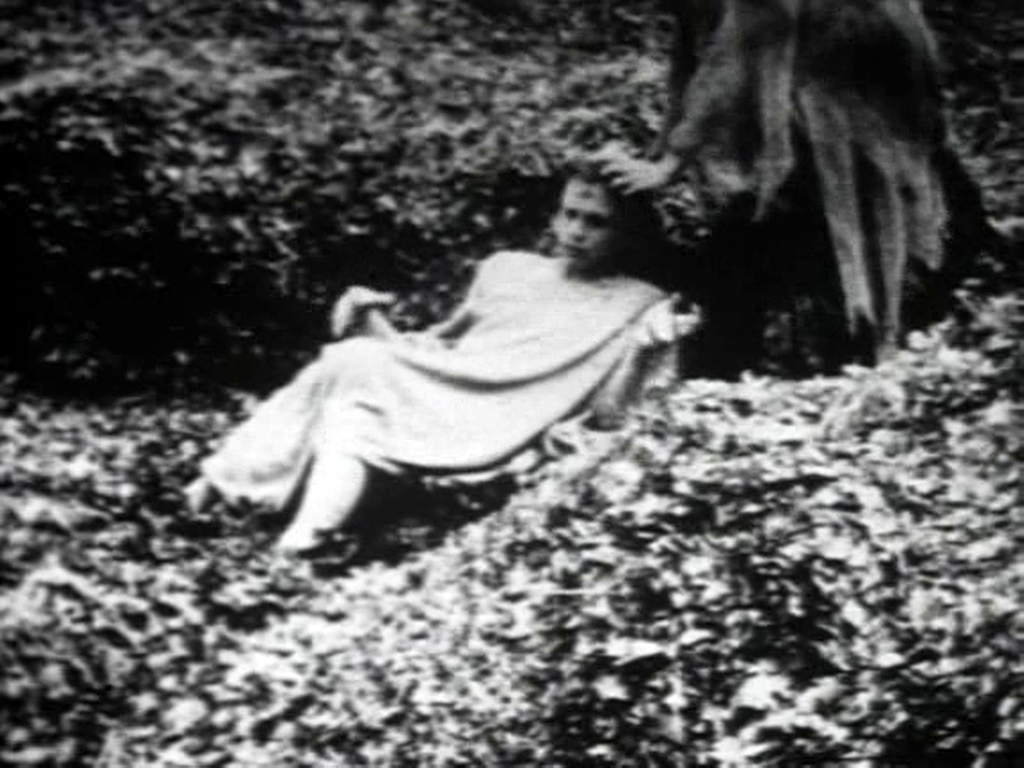
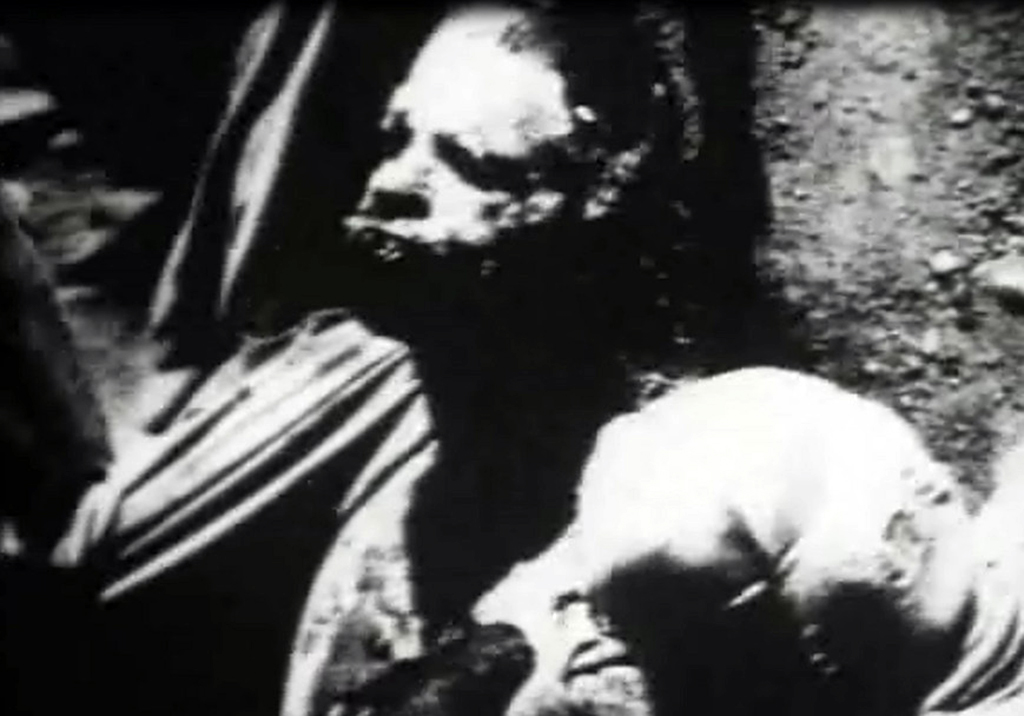
We next see a black coffin appearing at various points in an empty field, and then Mother Earth is standing next to the coffin, rubbing her preggo belly. There are some quickly-edited shots of what looks like blood on skin, and I think I saw a fetus hand in there, and then suddenly there’s a fully-grown man lying all bloody on the ground, and what looks like a janky umbilical cord connecting him to Mother Earth. She wanders off and leaves him there, all WELL, YOU’RE ALL GROWN UP NOW SO GO GET A JOB, and he’s all twitching and hyperventilating and looking like a victim of the Mount Vesuvius eruption, and I wonder if he’s gonna have abandonment issues from here on out. WTF MOM, NOT EVEN ONE SIP OF BREAST MILK? Mother Earth is super harsh, you guys.
Well, my work here is done.
Game of peek-a-boo? Bedtime story? Anything?
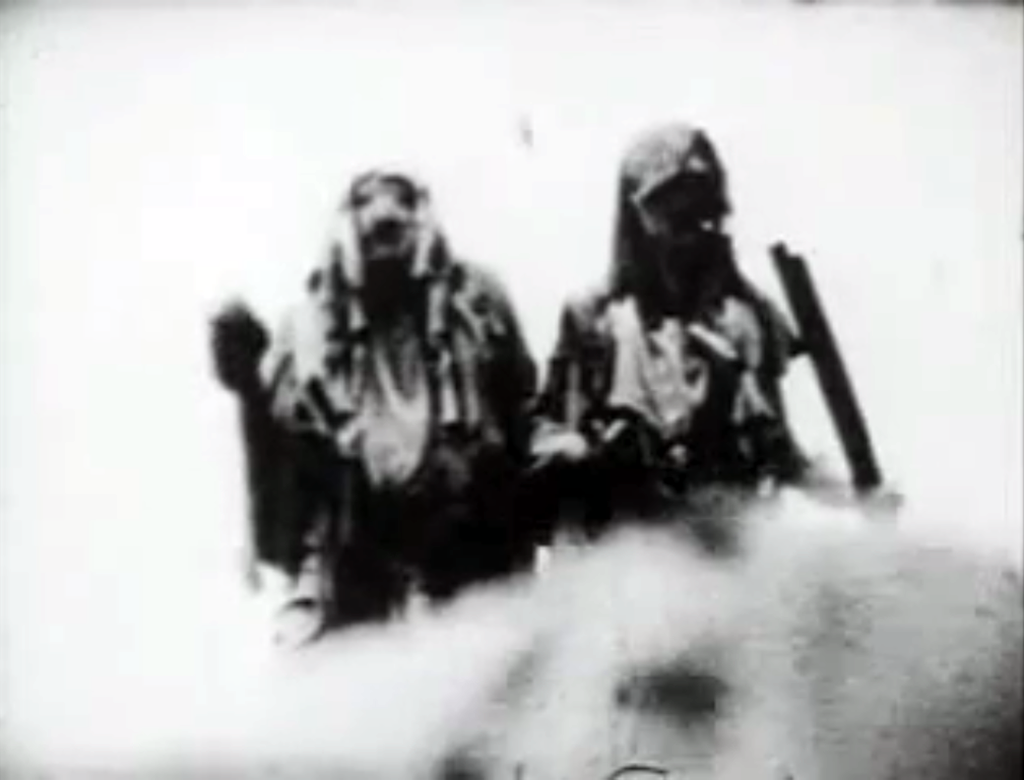
And then there are a bunch of hooded men shown in shadow, and I guess they’re nomads because they look like they’re all laden down with merchandise from Pier One, and they come across the Son of God, and they’re all like HEY, FREE NAKED DUDE while he writhes around. They scoop him up and tie him with ropes (or maybe this is the umbilical cord, hard to tell) and bring him along on their nomadery, because maybe they’re bored out there wandering in the barren landscape or maybe they’re gonna eat him later, who knows. Son of God (henceforth SOG) doesn’t appear to be having too fun a time, convulsing his limbs and struggling and being all WHERE ARE YOU GUYS TAKING ME, SHIT’S NOT FUNNY ANYMORE and the nomads just drag him around like it ain’t no thang. SOG begins vomiting up organs or something, and the nomads are all FUCK YEAH and start collecting the stuff in their bags, and then, because they apparently can’t wait until he yaks up some more of his insides, they start pulling the goo right out of his midsection while he’s going SO I GUESS YOU GUYS AREN’T GONNA HELP ME THEN and they’re like NOPE, JUST GONNA SWIPE ALL YOUR INNARDS AND THEN PUT YOU IN A SLING AND DRAG YOU UP A CLIFF. THAT’S HOW WE ROLL.
Pictured: Traumatic childhood.
They make a fire and drag him to it, because presumably this is like The Hills Have Eyes and they’re all cannibals too, because they really needed that last little push to cement their dickery. They stab the shit out of him while he writhes and vomits, and the nomads aren’t even fazed, man, they’re like WHATEVER, VOMIT JUST TENDERIZES THE MEAT and then they drag him around some more while a bunch of his meaty bits hang out his mouth, while the sun glares down, impassive.
Then he’s lying on the ground alone, still twitching but now all clean again, so I guess they didn’t barbecue him after all, and Mother Earth comes back and puts a collar on him and starts dragging him around too, because nothing like rubbing salt into the wound, right, MOM? SOG really hasn’t had the most pleasant introduction to the world, in case you hadn’t noticed.
The nomads, apparently peeved that someone made off with their toy, begin following, gesturing at her like GET THAT UPPITY WOMAN WHO TOOK OUR FREE NAKED MAN, BUT FIRST LET’S BASH THE MAN’S HEAD IN WITH A STICK WHEEEEE and then it looks like they punch him in the dick too, and then maybe pull it off, but the way the film is shot it’s kinda hard to tell. Sounds like something they would do, though. Fuckin’ nomads.
Hi, we represent humanity, and we’re just the worst.
Then they gang rape Mother Earth, because of course they do, all the while beating on her with their sticks and just tearing her all up and jizzing on her by the gallon. This bit was actually kind of upsetting to watch; even though it’s not particularly gory because of the black and white and because it’s so shaky and grainy that it’s hard to tell exactly what’s happening, in a way that makes it worse because you can see enough of what’s going on to imagine the rest. The flashes of them just pounding the shit out of her labia with their big mace-like staffs (not a euphemism) especially had me going:
Then Mother Earth is lying there, and SOG is kneeling between her legs, so I guess he’s still alive despite the head-bashing, and I’m thinking OH, ARE YOU GONNA RAPE HER TOO? MIGHT AS WELL, EVERYONE ELSE HAD A GO, FUCKING HELL, but I guess he’s just mourning or something. Two nomads come and drag Mother Earth away from him while he’s all WHYYYYYYY.
Therapy. He’ll need some.
And then it looks like they’re nailing her to a rock face while feeling her up some more because they’re just shameless, these nomads. Then they cut her into pieces, so that’s nice. They put the pieces into a big barrel that they’ve evidently brought along for that very purpose, so it’s good to know they were planning ahead, and at least had the wherewithal to stop by Home Depot on the way to the dismembering.
Then there’s a sunrise, and we see SOG still crawling around like a worm in the dirt, and because the nomads are nothing if not thorough, they scoop up SOG again, put him in a sack, and beat the stuffing out of him with a huge clown hammer and poke at him with sticks. It starts to rain, and there’s some waterfall action going on, then the nomads are stabbing and punching all the guts into the ground, because FUCK THOSE GUTS, and I mean, really, this all seems a bit like overkill at this point. Then I guess they’re planting the guts, and the next scene is of plants and flowers blooming. So everything worked out okay in the end, and only three beings had to be raped and eviscerated, but they’re like not even people, they’re just like representations, man, so no big. Circle of life, folks, nothing to see here. Good times.
So what was my final impression? The film is certainly nightmarish, that’s for sure, and seems to spring from some dark, primitive place of savagery miles removed from most people’s day-to-day lives. As a metaphor, it’s pretty brilliant, examining as it does the tortures that the earth and our gods go through to satisfy our human whims (or at least that’s what I understood the film to mean). I didn’t find the film particularly hard to watch, other than the rape scene (because rape scenes always give me the squicks), but that’s mostly because the shots were deliberately grainy and obscured, leaving most of the violence to the imagination. I think the horror comes more from the idea of what’s going on, rather than what the viewer can actually see. It was a strange experience for sure, and the imagery was rather haunting. I might actually give it another watch when I’m not distracted by office noises and having to stop it every few minutes to write this silly crap about it. Heh.
Please stay tuned for more Scary Silents! I will probably go back to the more traditional silent films for the next installment, but I wanted to do this one as an experiment because it was so highly recommended. Keep creepy, my friends, and until next time, Goddess out.
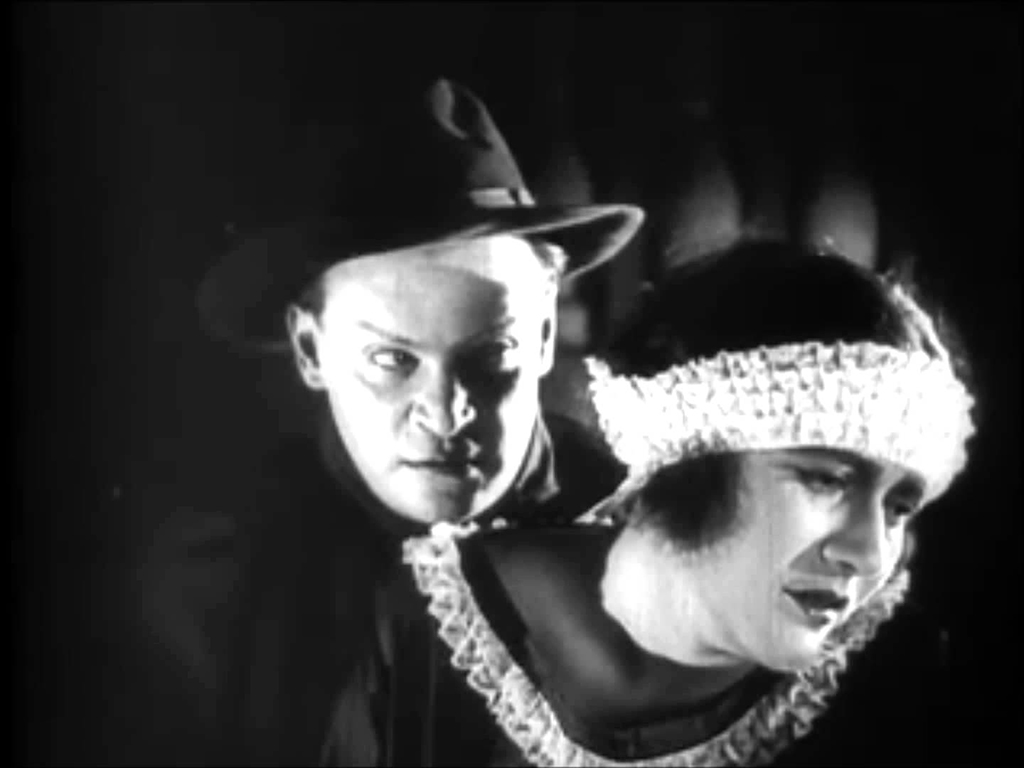
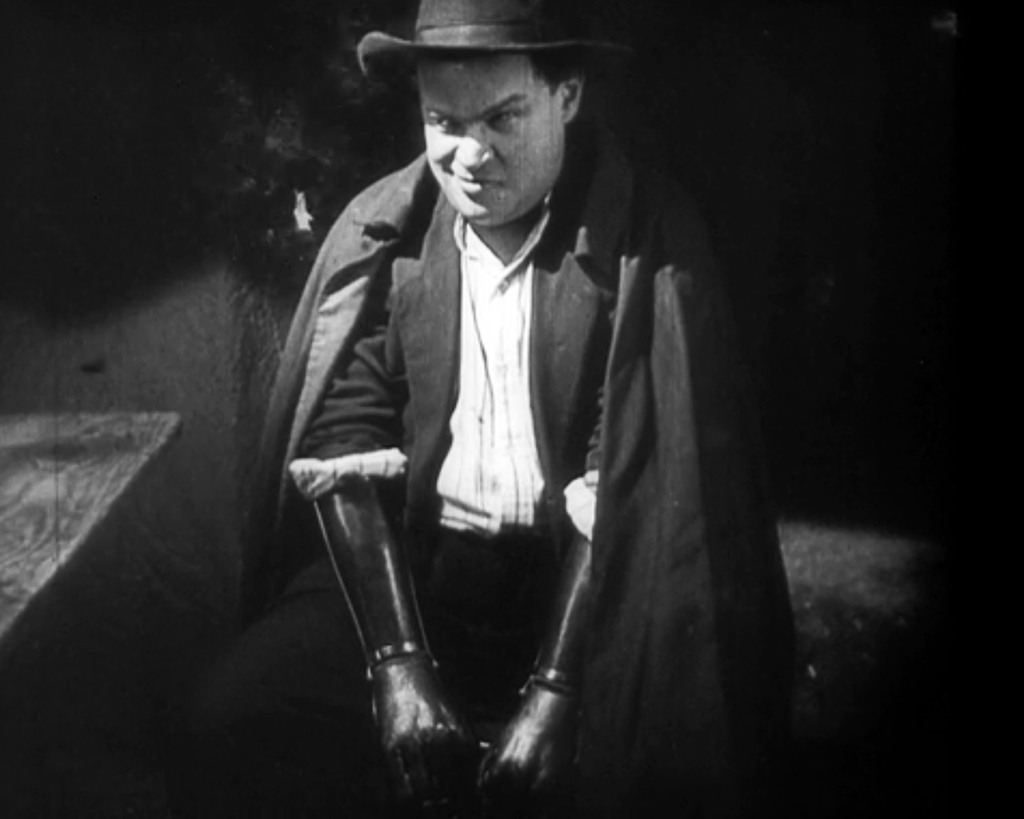
Welcome back to “Scary Silents!” Our film today is a classic one, the 1924 Austrian film The Hands of Orlac, directed by Robert Wiene, starring Conrad Veidt (who also starred in The Cabinet of Dr. Caligari and The Man Who Laughs, incidentally), and based on a book by Maurice Renard. Not only is it wonderful and properly eerie, but the fact that it’s Austrian means I get to put umlauts on just EVERYTHING. Onwärd. (Sëe? It’s fün!)
Orlac was probably the first horror film to use the now well-worn trope of the “rogue transplanted body part,” seen in later films like The Hand (1981), The Eye (2002), Idle Hands (1999), and that watershed of horror cinema, Killer Tongue (1996). The basic plot revolves around world-renowned pianist Paul Orlac, who loses his hands in an accident because fate has a cruel sense of irony, then gets a set of transplanted hands from an executed murderer and begins to misbehave in spectacular ways as the hands’ murderous impulses take over his presumably perfectly good sense. As always, if you’d like to watch along with the Goddess, I got your link right hëre:
In the opener, we see Orlac’s wife Yvonne reading a letter from her beloved. He will be returning from his final concert the following evening, and she is super jazzed about him and his skillful pianist’s fingers returning to her side IFYOUKNOWWHATIMEAN. In the next scene, she’s getting ready to go pick him up at the train station, all twitterpated. She even takes some flowers for him, because these two like to keep romance alive, yo. But when she gets to the train station, everyone is milling around and freaking out, and she hears the words “accident” and the name of a town where the train derailed, so she runs right out to her driver and demands that he take her there. And I gotta say, I immediately really like Yvonne. When the car pulls up next to the horrible train accident, she leaps right out and climbs onto the train wreck, taking no heed of her own safety or her eighty layers of clothing, and starts looking for her husband. She’s a firecracker, that one. She finds Orlac and he’s alive! ALIVE! She gets some guys to help put him on a stretcher and take him to their car and drive him to the hospital, because I guess ambulances weren’t a thing in 1924.
In the next scene, we see her talking to the döctor, who tells her that Orlac’s skull is kinda jacked, but that it can probably be fixed with some gumption and copious amounts of duct tape. Bigger problem, though: You know those fingery things he had at the end of his arms? The things he played piano with and made all the money? Yeah, he kind of doesn’t have those anymore. Yvonne goes into full drama queen mode, swooning around and begging PLEASE SAVE HIS HANDS, HIS HANDS ARE HIS LIIIIIIIIIIFE and the doctor’s like, DAMMIT, JIM, I’M A DOCTOR, NOT A…OH, WAIT, THAT’S RIGHT, I’M A DOCTOR, I’LL SEE WHAT I CAN DO. His subsequent “meh” shrug doesn’t inspire much confidence, though, to be honest.
As Yvonne carries on with her theatrics, the döctor glances out the window and sees the body of executed murderer Vasseur fortuitously being unloaded from a carriage in the street below. You can almost see the wheels turning in his lumpy Austrian head: AHA! I HAVE ONE PATIENT WITH ZERO HANDS, AND THERE’S A DEAD GUY WHO WAS A MURDERER, SO PRESUMABLY HAD TWO HANDS, BECAUSE IF HE DIDN’T HAVE HANDS THEN WHAT DID HE DO THE MURDERING WITH? HIS FEET? HIS ELBOW? I MEAN, I GUESS THAT’S POSSIBLE, BUT IT WOULD JUST BE WEIRD. HAHA, KILLER ELBOW. ANYWAY. So he does the math (1 murderer {2 unused hands} – 1 pianist {0 hands} = 1 pianist {2 useful hands, yay}) and sets to wörk!
In the next scene, we see the döctors pulling off Orlac’s mummy wrappings like it’s Christmas morning, and Yvonne comes in to see her patched-up hubby and everything is just gonna be sunshine and roses from here on out, right? I mean, Orlac has murder-hands dangling from two of his limbs and all, but I don’t see how that could possibly go awry in any way. It’s a miracle of mödern science, is what it is. Yvonne and Orlac make gooey eyes at each other, and for a second I thought Yvonne was just gonna jump right onto the hospital bed and start riding him like a carousel horse, but then she starts cooing about his “tender, beautiful hands,” which at this point are still bandaged up. While she is otherwise occupied with the hand appreciation, Orlac happens to glance up and past her, and HOLY FUCK THERE IS A SCARY DISEMBODIED HEAD FLOATING UP NEAR THE CEILING.
‘SUP, PIANO MAN.
The head is smirking, and rather than simply wetting his jammies in terror like a normal person, Orlac has the wherewithal to realize that the head is specifically smirking at his brand new, factory-wrapped hands. He tells Yvonne and she turns to look, but of course the head has disappeared, so she just stares at him like he’s high.
The next day, Orlac is out on the balcony cönvalescing, holding his hands stiffly out before him like the first coming of Boris Karloff, and you can tell he hasn’t really gotten over the smirking floating head incident, because he’s asking the doctors WTF IS GOING ON UNDER THESE BANDAGES, YOU QUACKS and they’re like YOU’RE TRIPPING, LOOK, IMMA TAKE OFF THE BANDAGES AND YOU’LL SEE WHAT A SILLY PERSON YOU’RE BEING and they snip off the wrappings all professional-like and DUN DUN DUUUU – well, not really, there are just two ordinary looking hands under there. I’m not sure what Orlac was expecting, maybe that they were gonna be covered with fur or tipped with claws, or maybe he was just looking for warts or liver spots or something, but he’s giving the hands some major side-eye and asking the döctors whether he’ll be able to play the piano with these creepy things, and they say, sure, with perseverance one can overcome anything, even having murder-meat at the end of your wrists, and some other motivational horseshit. They leave, and Orlac stares at the hands so hard and for so long that I thought he was trying to set them on fire with his mind.
That night, his last one in the hospital before he gets to go home, Orlac has a dream wherein the floating head, now grown to wrecking-ball size, floats and looks pissed off above Orlac’s bed. Then we see a disembodied fist that descends toward the teeny little Orlac, and this is actually a pretty effective image.
GHOST FISTS WERE FAST AS LIGHTNING.
Orlac wakes up and looks wildly around his expressionist hospital room, but nothing is there, so he lies back, relieved. But then he’s all HEY, WHAT’S THIS THING IN MY LAP, I DON’T REMEMBER MAKING A GROCERY LIST BEFORE I FELL ASLEEP, but turns out it’s a note from someone-or-other informing him that his fresh new hands belonged to a murderer. I was under the impression he already knew that, but I guess Orlac thought the doctors had popped his own hands back on him like fleshy Duplo blocks. No wonder he was so put out by the floating head. Orlac flips the fuck out and gets out of bed, trying to hold the hands as far away from himself as possible, and then he passes out. Man, everyone in these movies makes such a federal case out of everything. LOOK, YOU JUST HAVE SENTIENT KILLER-HANDS, GUY, SOME OF US HAVE REAL PROBLEMS.
got a booger on my finger and i can’t get it off.
In the next scene, Orlac wanders stiffly into the döctor’s office and walks right past his desk like a weirdo, holding his hands rigid as though they’re covered in snot, and then he just stands there and stares with his sunken eyes, all IS IT TRUE, DO I HAVE MURDER-HANDS and the doc’s like YEAH, BUT DON’T THANK ME FOR SUCCESSFULLY REATTACHING SOME VERY DELICATE LIMBS OR ANYTHING, and then Orlac just stares and silently freaks out, veins threatening to burst out his forehead.
HNNNNNNNGGGGGGGG
Meanwhile, Yvonne is preparing for Orlac’s return home, and has flowers for days. She can hardly wait the thirty minutes it will take before he arrives. SHE JUST CAN’T WAIT TO GET HER HANDS ON THOSE HANDS. Oh, and probably his other parts too, which are presumably not murderous. I hear his spleen is a bit of a bastard, though.
Angsty Orlac decides that his iniquitous appendages will not be allowed to touch another person, which will likely make Yvonne’s vagina reassess its life situation. I’m sort of digging the idea of everyone’s body parts in this movie having their own separate desires and motivations, so I’m just gonna pretend that’s what’s going on. Orlac tries to put his wedding ring on his new hand, but it doesn’t fit, because aside from being a murdering scumbag, Vasseur evidenly also suffered from fingular gigantism. This scene actually kind of gave me the sads for some reason. Orlac slips the ring in his pocket and heads dejectedly home to greet his wife. She gives him a flower, but he just stands there staring with his hands by his sides, and he won’t even hug her or anything, and she’s a bit put out, understandably. Her vagina begins to whisper to her that perhaps they should start considering other options.
In the next scene, Orlac slooooooowly approaches his piano and begins to play, as his wife watches stealthily from the doorway. There isn’t any dialogue, but it looks like it’s not going too well, because Orlac slumps back and puts the cover back down over the keys. His wife creeps up from behind and embraces him, telling him she loves him, because Yvonne is just a sweetheart, yes she is. Orlac kinda reaches for her, clearly wanting to embrace her in return, but he holds back, not wanting to touch her with Vasseur’s icky murder-tainted hands. She hugs and kisses the hell out of him anyway, and it’s all very tragic. Seriously, it is a pretty affecting scene, because how weird would it be to be doing stuff you used to do with hands that hadn’t previously belonged to you? That’s some straight up body dysmorphia shit right there.
MUST…NOT…CRUSH…WIFE’S…HEAD…
Then, a shifty-looking Orlac stops by a newspaper shop and asks the clerk if she got him the paper from January 15th. She’s all FUCK YEAH I HOOKED YOU UP and he passes her the money like he’s scoring PCP. Then he goes to a dark-as-hell café and sits down to read it. The article he’s interested in, obviously, is about Vasseur being taken to court, and relevant information includes the fact that Vasseur pleaded not guilty, but that his FINGERPRINTS (*dramatic gopher*) were all over just everything, including the body, the walls, the kitty, the toilet seat, a half-eaten Reuben in the fridge, and the vaulted ceilings, somehow. More significantly, the “treacherous” prints decorated the murder weapon, a knife with an X on the handle, and thus was Vasseur sent to his fate. Orlac rides a major bummer about this, and then has a vision of a hand stabbing a dude in the heart while the confused café owner gives him the stinkeye, probably wondering if he’s got a potential dine and dash on his hands. (Pun intended and immediately apologized for.)
Orlac skulks home, but when he gets there, he sees an X-handled knife stuck in the door. He reaches for it and I thought it was gonna disappear, but nope, he snatches it right up, which leads me to believe that someone is fucking with him at this point. Maybe Yvonne isn’t quite as awesome as I imagined her to be and is trying to drive her husband batshit so she can have him committed and take all his dough. DAMN THOSE SILENT FILM FEMME FATALES. Orlac hides the knife inside the piano and goes through another CURSE YOU HANDS tirade.
The next scene shows a distraught Yvonne in her nightie, writing a letter that’s making me go WHUT because it’s saying stuff like I DON’T WANT TO OBEY YOU and DON’T COME AGAIN and YOU CAN KILL ME BUT I’M NOT DOING YOUR TERRIBLE SHIT ANYMORE and stuff like that. So maybe someone ELSE is fucking with Orlac and forcing Yvonne to be complicit? I’m sorry I doubted you, Yvonne. You’re clearly just a cog in the man’s machine, girl.
Next, Orlac is lurking around his house again with his hands outstretched like a freak, and really he should quit doing that because it’s not helping matters. The hands make him retrieve the knife out of the piano. Yvonne hears Herr CrazyHands messing about and goes into the music room to find him thrusting the knife at thin air. You know, for practice. She’s all WTF, YOU’VE CHANGED, MAN and he’s all GET OUTTA HERE ‘FORE THESE HANDS THROW DOWN ON YOU KNIFE-STYLE and she flees the room and descends into her patented histrionics. Then Orlac tries to stab his own hand, but the other hand is like NOPE, WE A TEAM, SON and makes him drop the knife. Orlac collapses, again, because he just can’t even.
Then we see the maid having a complete nervous breakdown as a man in a black cloak and hat approaches her in the house. She tells him the same stuff that was in the letter, that she wasn’t going to obey him anymore, and wait a minute, was that her or Yvonne writing that letter a couple scenes back? The two women look sort of similar, especially with all that thick 1920s silent-movie eye makeup. I guess I’ll figure it out at some point. The man gets all up on her threatening-like and we finally see his face, and I think it’s the same guy whose head was whizzing around Orlac’s hospital room, who I had thought was supposed to be Vasseur’s ghost, but I guess not…? Is Vasseur alive but just lay there playing possum while the döctors lopped his hands off? WHAT NEFARIOUS PLOT IS THIS?!? Creepy Maybe-Vasseur is all IMMA CALL HIS DAD IF YOU WON’T TALK HIM INTO THIS SHIT and the maid is all NOOOO DON’T WANNA and then Maybe-Vasseur tells her to “seduce his hands” (um, okay, I guess some people are into that) and the maid slouches off a little way before turning back to him and going DO I GOTTA and he’s all YUP, and then the maid comes into Orlac’s music room, where Orlac is moping on the couch in his usual state of existential misery. SO HEY, THOSE ARE SOME SEXY-ASS HANDS YOU GOT THERE and Orlac’s all THE HELL YOU DOING WOMAN but then he reaches for her and puts his hands on her head, one on top of the other, and even though he’s not really moving them I guess he’s like massaging her head to death because her eyes get as big as billiard balls and she’s like YOUR HANDS ARE HURTING ME CUT THAT SHIT OUT so I guess the hands maybe have some kind of magical retracting spikes or a powerful electric current or something. Which would actually be pretty rad. Orlac is all MY BAD and pulls his hands away in horror before sprinting out of the room. Then the maid collapses, because evidently there’s a carbon monoxide leak somewhere in the house that causes everyone to drop like potato sacks at the slightest distress.
JUST GO AHEAD AND FAINT, YOU KNOW YOU WANNA.
Orlac busts into his döctor’s office with his hands splayed crazily outward and is all FETCH YOUR BONESAW, PHYSICIAN, AND KINDLY REMOVE THE OFFENDING ANATOMICAL COMPONENTS and the doctor just looks at him like ARE YOU KIDDING DO YOU KNOW HOW HARD IT WAS TO SEW THOSE ON but really all the title card says is “the creditors,” which makes no damn sense at all. Is he implying that Orlac would want his money back for the hand-attaching surgery and the doc is all NO REFUNDS MATE, or is he saying that if Orlac doesn’t have any hands at all, then he won’t be able to play piano and won’t be able to make any scratch to pay his creditors? I don’t get Austrian medicine.
After this baffling scene, there’s a shot of Yvonne praying in a chair as four barbers (?) stand behind her holding towels at the ready. She asks for another month, so I guess the barbers are the creditors, all arrayed there like an old-timey dance troupe asking for money. Still doesn’t explain the towels, though. They all shake their heads NOPE in unison, so I guess that answers her question. If this had been a talkie I would have expected the barbers to sing NO WAY JOSE in perfect four-part harmony.
Then Orlac is still in the döctor’s office trying to pull off the hands and going YOU GOTTA UNDERSTAND, DOC, THE HANDS WANT BLOOOOOOOOD and the doc is all YOU SO CRAZY and then I guess the carbon monoxide followed Orlac to the doctor’s office, because he collapses in a heap across the desk.
The creditors NOPE Yvonne again, and then we’re back with the doc, who is all UH, YOUR BRAIN IS IN CHARGE OF YOUR HANDS, DUMMY, THAT’S LIKE BIOLOGY 101 and Orlac’s like BUT…BUT…MURDER HANDS and then Yvonne talks the barbers into one more day, and Orlac sags out of the doctor’s office because DOCTORS JUST DON’T UNDERSTAND.
Next, Yvonne commands the maid BRING ME MY COAT JEEVES I’M OFF TO PROSTRATE MYSELF BEFORE MY FATHER-IN-LAW, who is super wealthy and can presumably give them some money to pay the sinister barbers and their debt-towels. Maid’s all DON’T DO IT, GIRL, ORLAC SENIOR IS A HATER but Yvonne just looks all huffy and determined. We next see her knocking at the door of Herr Orlac Dad, and this spooky old man pokes his head out and says he’s not allowed to let anyone in, especially not anyone from THERE, which I guess means Orlac’s house, that den of iniquity where a respectable pianist lives in relative comfort with his loving wife and faithful maidservant. Hedonists. But plucky Yvonne manages to charm her way in and they make their way down this long, arched hallway which is dark and completely devoid of furniture, which seems like a waste of some prime square footage. At least install some bookshelves or something. Even a suit of armor would liven up the place.
Frankenbutler leads Yvonne to another empty room where another old man is sitting on some kind of throne (no, not THAT kind, gross). She’s all HEY, YOU KNOW HOW YOUR SON LOST HIS MONEY-MAKIN HANDS IN AN ACCIDENT AND COULD YOU PUT ON YOUR DECENT DUDE PANTS AND BORROW US A COUPLE BUCKS but of course Orlac Dad is a stone-cold Republican who just mumbles something about bootstraps and welfare queens before dozing off in front of Fox News. Yvonne’s tears and pleas fail to penetrate his scab-encrusted shell of hatred and bitterness, and he takes great pleasure in telling her NOPE, ALWAYS HATED THAT KID, HOPE Y’ALL STARVE and Yvonne is all WHY YOU GOTTA BE A BITCH THAT WAY and leaves empty-handed.
Orlac, unaware that his wife has been trying to help him by appealing to the non-existent humanity of his buttheaded Y-chromosome contributor, is staring longingly at some of his old records. Startled by the maid, he breaks one, and then the maid is all up in Yvonne’s face saying YOU SHOULD TELL ORLAC TO GO SEE HIS DAD, THAT SHOULD TOTALLY GO WELL, and Yvonne is all SOMEHOW I DOUBT THAT, but the maid has some kind of plot going with the whizzing head fellow, so she gotta play her part in the drama. Orlac is mooning over the letter he wrote to his wife just before the accident, marveling over what his handwriting used to look like. He picks up a quill and starts to write with the murder-hands, and the writing is all jacked-looking, quite unlike his previously perfect Palmer script. Somewhere, a penmanship teacher gives him a virtual rap across the knuckles with a ruler.
Yvonne tells Orlac to go see his dad before they’re down to their last pack of ramen, and in the face of his reluctance, she’s all DUDE, YOUR DAD IS A DICK, AND ALSO, IT’S COLD IN HERE, HOW ABOUT WE TURN UP THE HEAT, OH THAT’S RIGHT WE CAN’T BECAUSE WE’RE BROKE BECAUSE YOUR DAD IS A DICK. Orlac flexes his hands and looks all tweaked when she starts to cry, so you can probably guess where this is going.
The murder-hands knock at Orlac Dad’s door, and Orlac goes inside. He makes his way down the expressionist hallway of doom and then the hands begin pulling him toward the throne room (no, not THAT one). On the floor, he finds his dad deader than Vaudeville with the X-handled knife poking out of his chest. He’s all WAIT, DID I DO THAT and streaks away to report the murder to the police, who follow him back to the house and are all like WTF IS WITH VASSEUR’S KNIFE and then the inspector is Sherlocking about the place with his magnifying glass, and can somehow tell that the fingerprints all over the table belong to Vasseur also, since I guess he spent so long looking at those damn prints during the investigation that he’s memorized every arch and whorl. Orlac looks on from the shadows, losing his shit.
The manservant shows the police a letter he received that told him his sister was ill and that he had to come see her, which is written in Vasseur’s handwriting and was apparently a ploy to get him out of the house while all that patricide was going on. The investigators are befuddled, but the main guy is actually pretty on the ball because he’s all VASSEUR KICKED THE BUCKET YEARS AGO (I thought it was just like a couple months, but okay) BUT HIS HANDS ARE STILL KILLIN’ which seems like a weird conclusion to come to on the evidence presented, but I’ll give him a pass because he’s probably right this time. Orlac hides his hands behind him, whistling and trying to look inconspicuous as he slooooowly backs out of the house.
As he’s creeping through the streets, he’s approached by whizzing head guy, who asks him to follow. They go to a tavern or something and sit down. Orlac’s like THE FUCK ARE YOU and head guy says YOU GETTIN ALL YO DADDY’S MONEY, GIMME SOME OF THAT SHIT and Orlac’s like YOU SERIOUS? YOU ALL FLOATING AROUND IN MY DREAMS AND SHIT AND ALL YOU WANTED WAS MONEY? THE FUCK IS YOUR PROBLEM and he laughs and laughs at the absurdity of it all, and head guy smirks and says I DID IT FOR MY HANDS, MAN, so I guess this is Vasseur and he’s alive somehow, PRAISE JEEEEZUS! He pulls his arms out from under his cloak and they look like they’re made of wood from elbow to fingertip. He explains that he really is Vasseur, and that he really was executed when they said he was, but that the same doc who replaced Orlac’s hands TOTALLY GAVE VASSEUR A HEAD TRANSPLANT, so where’s this döctor’s Nobel Prize, is what I’d like to know. Head transplant is pretty hardcore. Vasseur’s all CHECK OUT THIS BOSS NECK SCAR and Orlac suddenly isn’t laughing anymore. I have to say at this point, though, that this is a REALLY convoluted way of extorting someone out of a million francs, you know? Don’t get me wrong, I’m no criminal mastermind, so I’m not judging. It just seems like there would be easier ways of going about this.
a man. a plan. a wooden hand.
So Vasseur is all GIMME THE MONEY OR I’M GONNA TELL ERRYBODY WHO KILLED YOUR DAD and Orlac’s all UM…WHO DID KILL MY DAD BTW and Vasseur’s all DUH, YOU DID and Orlac’s like FUNNY, I DON’T RECALL DOING THAT, WE’LL HAVE TO AGREE TO DISAGREE and Vasseur’s like MY FINGERPRINTS ARE ALL OVER JUST EVERYTHING, EVEN IN THAT LITTLE GAP UNDER THE STOVE, HOW DO YOU THINK I MANAGED THAT, BITCH I’M MAGIC and Orlac’s all K, PRETTY GOOD TRICK I GOTTA ADMIT, BUT FOR REAL, HOW THE FUCK YOU DO THAT and Vasseur just smirks and drinks and won’t tell him, but is all EVEN IF YOU DIDN’T DO IT YOU CAN’T PROVE SHIT, ALL EVIDENCE POINTS TO YOU, SUNSHINE and then Orlac seems to have a brainwave vis-a-vis proving his innocence, and departs the bar while Vasseur looks after him with the smuggest expression ever to grace a transplanted head.
Orlac races home and begins rummaging around in his piano, presumably looking for the knife which would prove he didn’t kill his dad, but you don’t think Magic Armless Wonder Vasseur was THAT sloppy, do you? The knife isn’t there, of course, and Orlac’s all WELL THERE GOES MY PLAN, BETTER BRUSH UP ON MY PRISON LINGO and collapses yet again. Yvonne rushes to his side and he’s all I FEEL LIKE I’M TAKING CRAZY PILLS and she’s all WTF IS GOING ON, BABE, YOU SEEM EXTRA DEMENTED TODAY and he’s all THE HANDS ARE MAKING ME DO BAD SHIT and the maid listens to them from behind the closed door. Yvonne’s all THERE THERE, MAMA WILL MAKE IT BETTER and she pulls his hands to her breast and he pulls them away, all NOPE, DON’T TEMPT THEM, THEY GOT A MIND OF THEIR OWN FOR REAL, and the maid listens guiltily. Orlac says that he has to give Vasseur the money, but Yvonne’s all TELL THE PROSECUTOR EVERYTHING THAT HAPPENED and Orlac’s like YOU CRAY? THEY WON’T BELIEVE THIS SHIT and she grabs his hand and is all like THEY’LL BELIEVE YOU LIKE I BELIEVE YOU, and I’m just like, damn. Good ol’ Yvonne. She’s a keeper, that girl.
We next see Orlac and Yvonne in their Sunday best, meeting with the inspectors. He tells them the whole loony story, even acting out some parts, and the inspectors are like PULL THE OTHER ONE, CHUM and snicker at each other like assholes before writing out an arrest warrant. One of the inspectors is like YEAH, THANKS FOR THAT, and I thought he was being sarcastic, but maybe he does kinda believe Orlac, because he tells him to take the money to Vasseur that evening and they’ll take care of things from there. And lickety-split, that’s what happens: Orlac goes to the bar, Vasseur waggles his wooden arms at him, and then all the cops jump out of the shadows, guns drawn. One of the inspectors says that the guy calling himself Vasseur is really a Mr. Nera, who is the accomplice of the doctor who did the transplant, a known crook named Dr. Serral. The inspector then pulls the wooden arms off Pretend-Vasseur and shows that he has normal arms just like everyone else. So I guess he never got a head transplant either. What a gyp. It’s all very Scooby Doo, but there are still unanswered questions! Orlac’s dad is still dead, and the fingerprints found at the scene still belonged to the dead Vasseur, SO EXPLAIN THAT ONE, FLATFOOT. ORLAC STILL GOT VASSEUR’S MURDER-HANDS. So Orlac gets arrested for murder anyway.
But just then, Maid Deus Ex Machina runs in and says, NOPE, NERA WAS THE MURDERER TOO and everyone’s like HOW THE FUCK DOES THAT WORK and she’s all PIPE DOWN, IMMA TELL YOU. Turns out that Nera made wax casts of Vasseur’s fingertips before he died, and made rubber gloves with those fingerprints on them, and the maid then produces the gloves, and holy SHIT, this is even more complicated than I thought. Couldn’t Nera just have…I dunno, kidnapped Yvonne and ransomed her, or something? This kind of criminality takes COMMITMENT, man. And how does that explain how Nera was appearing as the floating head and the gigantic kung-fu fist? That dude’s got some serious connections in the afterlife, I guess.
Oh, and also it turns out that Vasseur wasn’t even really a killer at all, since Nera used the Vasseur-gloves to kill the guy whose murder sent Vasseur to the gallows in the first place. The plot has thickened so much at this point that it’s totally like that ketchup commercial from the 70s with that Carly Simon song where the ketchup was so thick it like wouldn’t even come out of the bottle, you guys. So now Orlac is all like HOORAY, I DON’T HAVE MURDER HANDS I HAVE HAPPY HANDS and Yvonne collapses, predictably, and everyone lives happily ever after, except for Vasseur, who was wrongly executed, and Orlac Dad, who was stabbed but also kind of a dick, and Nera, who’s going to prison but who cares because fuck him. Orlac runs his hands all over his wife’s face and smooches the hell out of her, and my heart, she is well and truly warmed. Awwww.
Stay tuned for more of my “Scary Silents” series, same bat time, same bat blog. Until next time, Goddess oüt.