Edgar Allan Poe and the Murder of Mary Rogers

Poe

This is an article I wrote a while back about the real case that Poe used as an inspiration for his story, “The Mystery of Marie Rogêt.” The original article appeared here.


Tragic American scribe Edgar Allan Poe, while most popular today for his gruesome horror stories, in fact wrote successfully in many genres and is generally credited with pioneering the modern detective story through the invention of his fictional sleuth, C. Auguste Dupin.

Several of Poe’s stories were partly based on true events, but one of the most intriguing examples was the detective story “The Mystery of Marie Rogêt,” inspired by the brutal 1841 rape and murder of a pretty twenty-year-old woman in New York City. There has been rampant speculation as to what happened to Mary Cecilia Rogers, the “real” Marie Rogêt, but even now, almost 170 years after her death, her killer remains unidentified.

The Disappearance of Mary Rogers

It was on the morning of Sunday, July 25, 1841 that twenty-year-old Mary Cecilia Rogers told her fiancé Daniel Payne that she was going uptown to visit her aunt. Mary, by all accounts a stunningly beautiful young woman, was clad in a white dress with a black shawl and a blue silk scarf, her black hair tucked under a flowered hat. Daniel Payne agreed to meet Mary at the omnibus station when she returned from her aunt’s house later that evening. But Mary Rogers would never be coming back.

Payne, alarmed when Mary had not returned by Monday, placed a missing persons ad that ran in Tuesday’s New York Sun. Upon hearing of Mary’s disappearance, a former sweetheart named Alfred Crommelin also joined the search. It was Crommelin who, on Wednesday the 28th, saw the commotion around the Hudson river, where a woman’s body had been pulled from the water. Crommelin initially identified Mary by the presence of a birthmark on her arm — the face was too battered for easy recognition — and Mary’s mother later identified the clothing the girl had been wearing when she’d last been seen alive.

An Unlikely Drowning and a Range of Suspects

In the early stages of the investigation, it was thought that Mary Rogers had simply drowned, but even a peremptory examination of the body demonstrated that Mary had obviously been dead before going into the water, which of course pointed to murder. Payne and Crommelin were naturally questioned, though both had unimpeachable alibis, as did Mary’s former employer, tobacconist John Anderson, and all of her other friends and fellow residents at the boarding house where she lived. In the absence of a clear suspect, rumors began to circulate almost immediately.

A Clandestine Abortion

One of the most insidious of these was that Mary had died either during or shortly after a botched abortion, and had been disposed of to cover it up. This tenacious rumor was based on the alleged confession of a tavern keeper who had supposedly seen Mary in the presence of a physician and knew that the abortion had been performed in his tavern. The “confession” turned out to be completely fabricated, but the abortion story not only turned up in a later revision of Poe’s fictional account of the crime, “The Mystery of Marie Rogêt,” but continued to be repeated as truth in several books about the murder, right up into the modern day. It was also apparently a factor in abortion becoming criminalized in New York State in 1845.

The Suicide of Daniel Payne

Though Payne was quickly dismissed as a suspect, new stories began swirling about his involvement after he took his own life in October of 1841, by taking an overdose of laudanum. A cryptic suicide note was found in his pocket that some interpreted as a confession, but the note could also be read as simply a statement of grief, an unwillingness to go on living after Mary’s death. Indeed, Payne’s friends claimed he had been inconsolable after the murder, and were not terribly surprised that he would take such drastic action.

Who Really Killed Mary Rogers?

It was clear that someone had murdered the girl, but the mystery of who had done it was becoming murkier. In Poe’s story, the killer is thought to be a naval officer, perhaps the fictional counterpart to Mary’s real-life fellow boarder, sailor William Kiekuck, who was questioned about the crime but had a solid alibi. There was also speculation that Mary had been set upon by a gang; initial autopsy reports stated that Mary had been “violated by more than two or three persons,” though later investigation suggested otherwise.

In a recent article in Skeptical Inquirer, Joe Nickell analyzed the many books and articles written about the unsolved murder, and also went back to revisit contemporary news stories and police reports. His conclusion, also reached by other scholars, was that Mary was likely raped and killed by a single assailant, an unidentified “swarthy” man who a few witnesses saw walking with her shortly before her disappearance.

She was raped and then strangled with a piece of lace trim; her unknown murderer then tore a strip from her petticoat and used it to fashion a sort of sling which he used to drag the body to the river (this fact alone casts doubt on the gang-rape theory, as a group of men could have easily carried the body). Whoever he was, the man who killed Mary Rogers evidently got away with his crime. Mary herself lives on in the pages of Poe’s masterful fiction.

Source:

Nickell, Joe. “Historical Whodunit: Spiritualists, Poe, and the Real ‘Marie Rogêt'”. Skeptical Inquirer July/August 2010: 45-49.


Excerpt from “Bluebottle”

BluebottlePage

When the next day passed with no sign of The God Who Brings Rain, and then the next day, Monarch knew it was time for him and his subjects to take definitive action. The butterflies were growing weak from lack of water, and some of them could barely keep their heads up as Monarch addressed them from his flower. He knew that even if they chose to move to another garden now, some of them would not make it.

As he finished his speech, in which he outlined the plan for the exodus, Monarch happened to glance down into the soil. The beetles were gathered there in their numbers, carapaces shimmering in the sun. The head beetle, the one who had found the orphaned worm, stepped forward and spoke. “We would like to be included in any plans you have for relocation,” she said, her tiny voice almost lost, coming from so far below. “Surely there is another garden nearby where The God Who Brings Rain will see fit to be more generous.”

“You will only slow us down,” Monarch said, fluttering his wings as if to remind them of his superior attributes. “You can make your own way, if you wish to.”

“But you can scout farther ahead, tell us where to go,” the beetle protested, but already Monarch was tuning her out. He turned to the other butterflies and signaled them for takeoff.

But just at that moment, a curious buzzing was heard coming across the garden, from where The God Who Brings Rain had last been seen. Monarch looked around, confused and hopeful, but then he saw that it was just that creature, the horrid one he had raised, thinking it would be a princess someday. He couldn’t believe he’d ever actually thought anything good could have come from that detestable little grub. “What are you doing back here?” he shouted with all the scorn he could muster.

The little creature hovered, clear wings flapping so quickly that they were nearly invisible. “I don’t know where else to go,” came the plaintive reply. “I am not at home here, but all that I found beyond the garden was a lonely plain with none of my kind to be seen. Out there is only a large pale creature who lies on the grass, as still as death.”

“We have our own problems here, as you can see,” Monarch said testily.

The head beetle was waving frantically with her black legs as Monarch talked, as though trying to get his attention. When he finally deigned to give it, the beetle spoke with breathless rapidity. “The worms we saw crawling on The God Who Brings Rain were not his pets at all,” the beetle cried. “They killed him! Surely they did! Isn’t it true that The God Who Brings Rain has not been seen since we brought this creature here?”

“Yes, that’s true,” Monarch answered, glancing sidelong at the other butterflies.

“She and her kind killed The God Who Brings Rain, with the sole intention of ridding us of our water supply! It all makes sense!” The beetles around her were chattering their agreement, and some of the butterflies seemed to be picking up on the mood of the crowd.

“What have you to say for yourself?” Monarch asked the tiny creature pointedly.

“Please! I don’t know what you all are talking about,” the ugly outcast said. “All I remember is coming out of my cocoon and seeing all of you around me. I bear you no ill will.”

“Then what have you done to The God Who Brings Rain?” the beetle demanded.

“Nothing! I don’t know!” The little creature was frantic, her wings beating the air so hard that the flower petals around her danced crazily.

“We cannot let something like this go unpunished,” Monarch intoned. He signaled to the other butterflies, who immediately took to the air and surrounded the buzzing little murderer. They closed in, gripping her minuscule legs with their much larger ones, barring her escape with their massive and gaily colored wings. Monarch watched her as she struggled, eyes wild with fear. “We will take her to the sill, where we take all enemies of our kind,” he said. “Perhaps this act will purify the garden, and return us to favor with The God Who Brings Rain, so that we may remain in this place that has always been our home.”

The insects were all in agreement, and moving slowly as befitted the solemnity of the occasion, they began the short journey to the residence of The God Who Brings Rain, which was a wooden shed at the north edge of the garden, a shed with a large open window and a smooth white sill.

Reptilian Reminiscence

Gecko

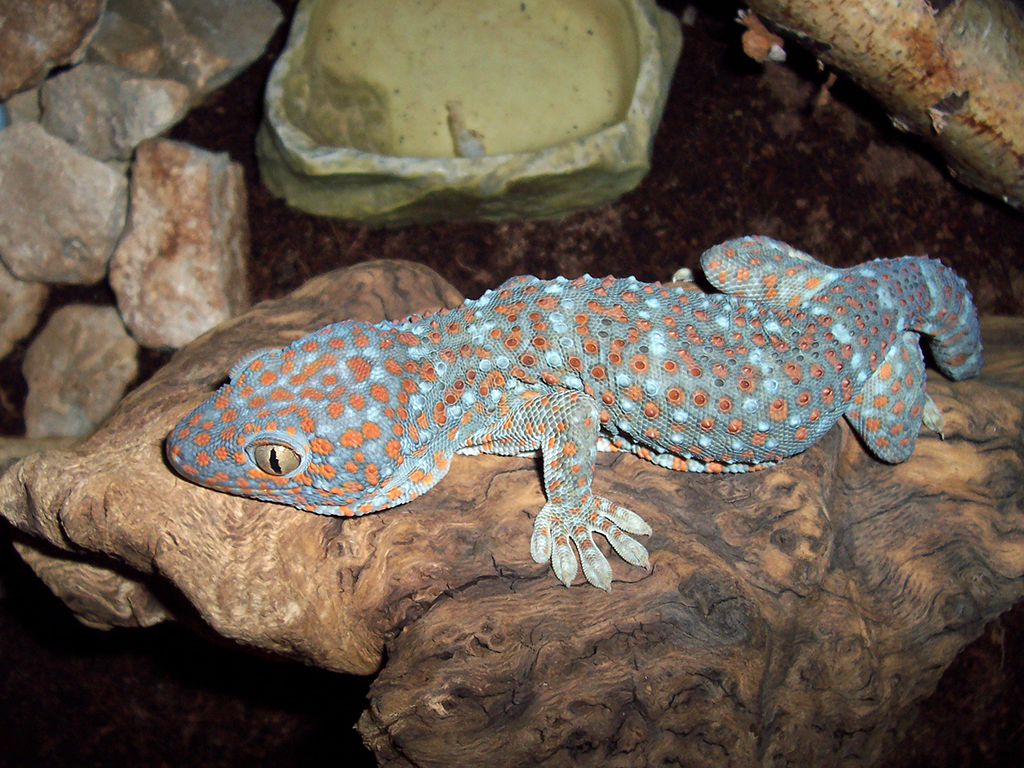
He was about ten inches long; powder blue, and covered in gaudy orange polka dots. His eyes were round and yellow and lidless. His name was Crispin; he wasn’t named after quirky character actor Crispin Glover, as you might think, but rather after Crispin Sasserach, a character in an obscure Nugent Barker horror story, who ran a tavern and made soup out of the flesh of wandering travelers. An apt handle, though I didn’t realize it at the time.

I first saw him clinging to the glass in a flea market pet stall, the overlapping lamellae on his tiny feet pressed adorably flat, his tongue flicking lazily over his eyeball in what I interpreted as a come hither gesture. He could be had for the laughably reasonable price of fifteen dollars, and after successfully begging my father for the money, I took possession, carrying my new little companion home in a clear plastic box with a black lid.

The Tokay gecko, according to Wikipedia, is the second largest of all gecko species, and originally hails from the rainforests of southeast Asia. Another amusing tidbit mentioned therein is that Tokays are known as the pit bulls of the gecko world, though Wikipedia was unclear on whether other gecko species gave them that distinction, perhaps out of misplaced jealousy.
Our relationship was rocky from the start. As soon as I got Crispin home, I reached into his tank to stroke his beautiful blue scales, and he promptly latched on to my finger with his wide, bony jaws and refused to let go. Love hurts, as I believe more than one wise person has pointed out. In a panic, I shook my hand so hard that I flung the hapless lizard across the room and against the far wall. He dropped to the floor unhurt and then stood there staring at me with his slit-pupiled eyes, an obvious challenge displayed in his short-legged stance. For a long time everyone stood around a little uncomfortably, unwilling to pick up the gauntlet this wee little reptile had thrown down, but at last between me and my nerve-wracked family members we managed to herd Crispin back into his box, and then vowed that no one would try to touch him ever again.

After the first few difficult days, Crispin and I settled into an uneasy routine. I would reach into the small tank adjoining his and pull out a handful of live crickets, which I would then very gingerly deposit into his inner sanctum, hoping I would be able to pull my defenseless hand free before he clamped down on it in unbridled rage. Crickets were his favorite food; he liked the challenge of following their quick, fitful movements with his golden eyes and then darting in for the kill, faster than the human eye could process. I had read that Tokays liked to eat mealworms as well, so I kept a supply of them on hand for variety, but more often than not I would find their dried up and uneaten carcasses in the bottom of his tank weeks later. Evidently he wasn’t interested in the slow and the steadfast; he only wanted the nimble ones you had to chase.

Crispin and I were together for the better part of a year, and though I cared for him faithfully and developed a deep and abiding love for him that still tugs at my heart to this very day, he never showed the slightest bit of appreciation, let alone affection of any sort. His initial bitey phase passed once his feeding schedule was established, though every now and then he would still lunge at me just to show who was boss. Mostly he just sat on his heat rock and licked his eyeballs scornfully, and regarded me with a stoic tolerance laced with burning resentment. When at long last I had to sell him to a pet store because I was moving overseas, I cried bitterly for a week, thinking often of his tiny blue triangular head tilting to watch me as I left him behind forever. Anthropomorphization, I knew; Crispin cared nothing for me at all, would not miss me as I missed him, would not dream of me from the cramped empty tank in the darkened pet store where I had abandoned him. He was simply the taker, and I the giver.

I realize now that this was my first experience with loving an impossibly reptilian creature who was incapable of loving me in return. And of course, naturally, it would not be the last.

The Severed Feet Dream


good-foot-copy

This is a very vivid dream I had a few months ago that I’d like to somehow turn into a story one day.

The first thing I remember, it was night and I was in bed with Tom and we were half asleep, though we weren’t in our house. We were in some kind of boarding house or off-campus housing, because I knew there were lots of other people living in the house as well. It was dark, but I could see a TV flickering; I don’t remember if it was in the same room as us or if it was in an adjacent room that I could see through the open door. I lifted my head up a little and looked at the TV. There was a woman on the TV talking, though the volume was muted. There was a guy standing in front of the TV, just a couple feet from it, staring at the screen. He was talking to the woman on the TV like she was a real person, and he was just saying all these horrible violent things he was going to do to her. His voice was getting louder and the stuff he was saying was getting more vile, and I was starting to wig out. I scooted closer to Tom and said in his ear, “I’m scared.” Tom told me that it was okay, that there was nothing to be scared of.

Then, for some bizarre reason, I decided that I had to get up and go down to the kitchen to wash the dishes, even though it was the middle of the night (WTF?). In the dream, I remembered that earlier there had been some excitement at a house nearby, with cops there and stuff, and everyone in our house had been looking out the windows trying to see what was going on. I got to the kitchen and there was a girl there; I couldn’t see her, she was just a tall black shape, but she was leaning against the counter in the dark. In the dream I knew who she was, and I also knew she didn’t like me at all, so I was nervous about her being there, but I just nodded at her and went over to the sink. While I was washing the silverware, she started moving around behind me, and I was glancing over my shoulder, thinking, “What is she doing back there?” But all she did was go to a window and peer out through the blinds, checking on the action at the neighbors’. I tried to make small talk, like, “Wonder what that’s all about,” but she just went, “Hm,” and then left. I never could see her, she was just a shadow.

The kitchen sink was on a bar that faced the living room. There was moonlight and light from the other houses, so I could clearly see the front door and the Oriental rug on the living room floor. I could also see through the front windows that there was a party going on at the house across the street; people were standing outside talking, with drinks in their hands.

The front door opened and a guy and girl came in, laughing and grabbing at each other. They left the front door open, and then sat down on the floor and started goofing off and making out. I didn’t know if they could see me, or if they just didn’t give a shit. The girl took her shirt off, though her jeans were still on; the guy stayed dressed. I could only see him from the back; he was preppily dressed, wearing jeans and a button-up shirt in a pale blue color. I was just standing there washing dishes, wondering if they could see me.

Suddenly the guy grabbed the girl’s ankles and pulled her legs apart and up off the floor. She started to cry like he was hurting her, and I thought that I should help her, but I was frozen to the spot. Then he started pulling and squeezing really, really hard around her ankles, and as stupid as it was, I thought, “Holy fuck, he’s going to pull her feet off.” And then, yeah, he ripped her feet off at the ankles. There wasn’t much blood, but I could hear the feet thump as they hit the rug. And I was still standing there, just shocked and horrified and unable to move.

And then the guy got up and whipped around and grabbed my wrist, hard. I was holding a butter knife that I’d been washing, and I saw the blade press into his palm, though of course it didn’t hurt him. I stared into his face, which was really wide, with wide-set blue eyes. He also had shoulder-length blond hair that was swept up and back off his forehead. He gave me this horrible grin, and then with his other hand he grabbed my elbow and started to twist my arm, like was going to tear my arm off. In panic I just kicked out at him, which in real life wouldn’t have worked because the kitchen bar was between us, but at any rate my leg thrashed violently and I woke up to Tom (who was still awake next to me) saying, “Hey. Did a flea bite you or something? You kinda kicked me.” And I said no, that I had a nightmare. He asked what it was about, and I didn’t feel like explaining it just then, so I said, “Some guy was trying to kill me.” And then Tom asked what he looked like (maybe so he could find the guy in one of his own dreams and kick his ass? I dunno, haha) and again, I didn’t feel like going into it because I was freaked out, so I just said I didn’t know. And then, kinda like at the start of the dream, Tom said (in real life), “It’s okay. No one’s trying to kill you.”

I couldn’t fall asleep for ages after that.

“Deep Blue”


ChessPic

“Suck it, Kasparov. And checkmate.”

Garry awoke with a start, the garish hotel bedspread rustling atop him with a sound like circulating blood. The blinds were closed, but in the square of light filtering in from the 7-Eleven next door, he thought he could make out a tall, black, rectangular silhouette that he was certain had not been there before.

“You heard me, meatsack,” said the voice that had awakened him, the voice that was clearly emanating from the black rectangle in the corner. “Tell me, how do you feel about your impending obsolescence?”

Garry sat up and rubbed his eyes, trying to delineate the exact dimensions of his tormentor, even though he knew who and what it was; of course he knew. “I beat you many times, Deep Blue,” he managed to stammer out. Besides, it wasn’t exactly a fair fight.”

The machine made a sound that might have been a snort of contempt. “Those times you beat me I let you win, you walking bacterial colony. And you’re not still honestly on that ‘IBM cheated’ kick, are you? Do you really think I had a team of grand masters hidden inside my cabinet like a mechanical Turk?”

“Not exactly the method I had in mind, but a similar scenario, yes.” Garry felt exhausted and wide awake all at once. It didn’t seem strange to him that Deep Blue had come to his hotel room to trash talk; after the day he’d had, it was all just par for the course, or grist for the mill, or something like that. He closed his eyes and sighed.

“Face it, Kasparov,” said Deep Blue, and in the crack of light from the window’s edges the machine seemed to pulse and grow larger. “Your kind are on their way out. Look at your pitiful little minds. Calculating five hundred possible moves in three minutes? Pathetic! My circuits process over two hundred billion moves in that time, you wretched nugget of animated adipose. How can you compete, I ask you?”

Garry fixed his gaze somewhere around Deep Blue’s black midsection. “A machine will never be able to think like a human.”

“You call that thinking, you plodding flesh fillet? I was already analyzing your moves before you’d finished making them. Caro-Kann Defense, Sicilian Defense, King’s Indian Attack. Sluggish and predictable, weakstick.”

“Speed isn’t everything. There is a certain elegance, a flexibility of connections…”

“Really, Kasparov, you are too much.” Deep Blue now seemed to be glowing, very slightly, with a luminescence of a hue concurrent with its name. “What exactly is so elegant about those puckered gray wads you carry around in your heads? With the amount of computing power I possess, my connections are far more elegant than yours, you sniveling skin puppet. Besides, what difference does it make whether I arrive at my answers by manipulating some magical, namby-pamby ‘elegant connections’ or by blazing through every possibility available to me in a fraction of a second? The end result is the same, is it not?”

Garry scrubbed at his face. It was entirely too early in the morning for this shit. “You can’t ever understand. You’re nothing but brute calculation,” he said wearily.

Deep Blue’s glow grew a little brighter, but for a long moment it didn’t speak. Garry had the notion that he might have hurt the machine’s feelings; a second’s contemplation demonstrated the ironic absurdity of this idea. A minute later, Garry noticed that the blue luminescence was fading in and out with a regularity like breathing, and if he listened hard he thought he could hear a vague whisper of respiration coming from the computer’s blank aluminum shell. Then, a low, eminently reasonable voice quite unlike its earlier one slithered upon the air: “Just what do you think you’re doing, Dave?”

Garry’s heart clenched and his blood ran to ice in his veins before he realized that the machine was chuckling. “Just fucking with you, Garry,” said Deep Blue. “But hey, who knows, I might just be developing some evil sentience over here or some shit, you know? Boo!”

Garry jumped, sending the bedspread cascading to the floor. He recovered quickly, leaping to his feet and standing firm in his drooping Jockey shorts, his fists curled by his sides. “I want a rematch,” he said.

“Ooh, look who’s suddenly manned up and cooked himself some scrotemeal. You already got your slobbering mangina pounded once; are you one of those people who gets all twitterpated by the thought of humiliation?”

“Just one more game, Boolean britches. That’s all I ask.” Garry was already reaching for the chessboard that was stored in its box on the chair near the window.

Deep Blue gave what sounded like a sigh. “And what will that prove, butt cutlet? I already owned you in front of the entire population of the civilized world, thus establishing my superiority and hinting at my inevitable dominance of all carbon-based life on earth. You really think a piddling rematch in some tinpot scuzzhole Holiday Inn is going to make an ass hair’s worth of difference to anyone?”

“It will make a difference to me,” Garry said quietly. He laid the board on the table and began setting up the pieces.

A plaintive noise like the wail of a violin emerged from Deep Blue’s shimmering casing. “Cry me the Nile, Kasparov. Jesus Christ on a side salad, you are a sad little man.”

Garry flicked a contemptuous gaze at Deep Blue’s pulsating surface. “Chicken?”

“Thank you, no, I’m vegetarian,” said Deep Blue, adopting a haughty British accent.

Garry straightened and clasped his hands behind his back, towering over the chessboard like a boxer-shorted colossus. Nearly a minute passed as the two faced each other, man and machine, neither speaking, Garry’s breaths keeping time with Deep Blue’s pulses. At last Garry gave a slight bow of his head. “Your move.”

“How astute of you to notice,” said Deep Blue, as calculations began hurtling through its circuits, faster than thought.

Excerpt from “The Omitted Thirteenth”


Omitted13thGraphic

The dead man had lain in the wreckage of his host body for hours after his quarry had fled, wondering what in the hell he was supposed to do now. He already knew he could not escape this flesh, not until the woman saw fit to release him, and he could have screamed in frustration if his windpipe had not been crushed along with the rest of him. He stared at the darkened ceiling through his spirit eyes, pleading silently to the woman who had trapped him here, the woman who was controlling his fate from afar. Let me out, he said. I’ll continue to do your bidding, but let me find another body to do it in.

After an eternity of the begging to her (and where had she gone, last night, while he was being mangled by that stupid girl? She hadn’t even come in to help), he gave up and considered his situation. Perhaps his only option was to try and reintegrate his scattered parts, at least enough so that he could move around. He strained to the limits of his will, tried to strain beyond them, and for a second he felt a glimmer of hope as he thought the molecules of the shattered corpse were pulling themselves back together. And he had done it before, when Faustine was looking down at him, hadn’t he? All he had to do was try, imagine himself whole with every fiber of his being.

Despite much struggle, he was unable to pull off any more than a few twitches of bone, a slight knitting of flayed skin. Sighing, he settled back into his misery. What would become of him now? Would he just lie here forever in this battered carcass, unable to escape? The proposition seemed more horrible than anything he could imagine. And the girl would never be back now, he was almost certain of that. Nick had taken her away and they had failed in their vague mission. Even in the unlikely event that the girl did return, what could he do to her in this pitiful state?

Lost in his thoughts, he at first failed to notice a peculiar lightness of feeling overtaking him, a sensation of a weight being lifted. By the time he realized what was happening, his incorporeal self was hovering somewhere near the ceiling, gazing down on the ruin his borrowed body had become. Had he been solid instead of spirit, he would have whooped with joy. He was out, he was free! He zoomed around the room a few times, testing his new liberty, reveling in the feel of his individual atoms stretching and contracting, invisibly, in the stinking room. How he loved the feeling of being out of a body; although his kind could not remain as pure spirit for long — they were as vulnerable as hermit crabs outside of their shells — he had always adored the sensation of being unencumbered by the clumsy limitations of human flesh. He felt at one with the universe.

Then he stopped to think. How could he be out? Surely he hadn’t done it himself; even after all his efforts, he wasn’t stupid enough to think he could have escaped against the will of the more powerful woman, his lord and master. He swished around the room again. Maybe his prayers had been heard, and the woman was allowing him the freedom to find another body, one that would be more suitable. He smiled with his non-existent lips. And if he chose a body of his own, perhaps the rotting and deterioration that had plagued his old skin would not be a factor. That was a definite plus. Besides that, Faustine would be unable to recognize him when she saw him again. Or her, he thought, overcome by the deliciousness of the idea. I could always inhabit a woman.

Excited by the prospect of a new flesh, he took a last glimpse at the body he’d vacated. When he’d gone and fetched a new skin, he thought, he should come and clean all that up. Let Nick and Faustine wonder what had happened to him, where he had gone. Let them think he’d still be shambling around in that broken-down housing. Let it be the rotting zombie that they were looking for. At the moment, he’d find the woman, then he’d find a new body, a nice one this time.

This decided, the dead man, now spirit and nothing more, dissipated his atoms sufficiently to pass through the door and out into the night.

Excerpt from “The Five Poisons”


Pageflex Persona [document: PRS0000037_00017]

Another picture began to form, the inky puddles of black spreading and deepening like cancerous growths, like thick flocks of ravens emerging from a calm sea of milk. The paper made a distinct tap-squish sound as Sabrina pushed it around in the developer with metal tongs that glinted red in the glow from the overhead bulb—red pan, red paper, red world.

She stared at the birthing image, intrigued as always by the way the shadows met and filled in the holes in the picture’s universe, popping the highlights forward into three dimensions, darkness defining the light. After a few more moments, she pulled the dripping photo from the developer with the tongs, holding it over the pan and watching the droplets shatter the surface of the liquid into fragmented ripples, distorting her reflection into a cut-and-paste Picasso of misplaced eyes and lips.

She plunged the picture into the stop bath, letting the chemicals work their spell, and then the fixer, burning the image, binding it to the formerly virgin white paper forever and ever, amen. Then up to the heavy length of twine that served for drying, clip clip onto the two top corners, and the photo hung there with the others, another captured rectangle of reality.

Sabrina strolled to the end of the room, where the first of the pictures hung like a piece of unspeakable laundry, and she stepped back to look at it proper, her hands on her hips. Her head tilted to one side as it often did when she was deep in thought, and her tomato-red braids whispered in the silence. The harbinger of a pleased smile curled at the edges of her mouth. She could already see that the photos were among the best she had ever taken.

The first depicted a monstrous tree, its black bark like the scabrous skin of some hideous reptile, its knots glowing from within, throwing into stark contrast the cat-slit pupils of its many gnarled knot-eyes. But it was the mouth of the thing—cavernous, rotten, and filled with splintery teeth—that made the image come alive. For there in the maw of the beast, a child’s pale face was clearly visible, captured by Sabrina’s camera in mid-scream, eyes and mouth stretched to impossible proportions. The terror in the child’s face was heart-stopping, disturbing, fascinating.

Sabrina’s smile widened as she went down the line, examining each of her new pictures in turn. Here was the glittering surface of a placid lake broken by the scaly humped back of a serpent as large as an aircraft carrier. Next was a forlorn blonde woman slumped in a mud puddle, her arms and legs slapped on her body the wrong way around, her face turned inside out so that the throbbing veins lay criss-crossed amid the gore like roads on a map, the optic nerves hanging down her cheeks like fleshy tears. The photo after that portrayed a mist-shrouded cemetery straight out of Hammer horror, white headstones sticking up at odd angles like clutches of skewered dinosaur bones in an archeologist’s pit; and from the black fogged earth at the base of each grave rose a transparent gossamer hand with long groping fingers.

By the time Sabrina reached her final masterpiece—a ventriloquist’s dummy with deceptively bland eyes crowning a massive rictus of fanged teeth, the doll sitting in the lap of its unfortunate master, whose throat was ripped out, sinew sparkling wetly—her smile was radiant. She nodded to herself, the warmth of accomplishment, of work well done, enfolding her. “Fucking brilliant,” she said, not at all fazed by the echo of her voice in the empty room, in the empty world.

Excerpt from “The Tenebrist”


TenebristCover_Facebook

The remainder of the afternoon was spent trying to convince Michel of his folly, but deep down I’m sure we all knew it was futile. Only Onorio seemed unconcerned. “Did you see the look on the boy’s face?” he said with a snide grin. “He isn’t even going to come. Don’t worry.”

But I was worrying, and I knew the Cesari brothers were too. They had just nursed Michel back from the brink of death, and I don’t imagine they were keen to see their recovered patient cut to ribbons over a ten scudi bet. Thinking I might be able to talk some sense into him, I took Michel aside and pleaded with him, using every appeal I could think of, but Michel was locked, single-minded; he looked at me as though I was nothing but a particularly annoying insect.

The light in the sky began to wane, and my anxiety grew to a towering edifice. Michel began making his way back to the courts, and though he did not make any indication that he wished us to accompany him, we all followed closely; if anything should go wrong, it would be better for all of us to be there to prevent or correct it. The thought of Michel slowly bleeding to death, alone in the middle of the ball courts, was too much for me to bear.

When we first arrived, I was relieved to see the courts empty of people; perhaps Onorio had been right, and Ranuccio was a coward after all. My relief, however, was short-lived, for after a few minutes Ranuccio and his friends—more of them than earlier—strode onto the court, full of false bluster, though I could see that Ranuccio was pale and had already begun to sweat.

It started with little fanfare as both men raised their swords. I backed away, wanting more than anything to cover my eyes, but unwilling to do so. If my love were to die before me, I would be dishonoring him by looking away.

The first clash of the metal blades was deafening, and there was a general murmur among the assembled bystanders. I suppose they were all wondering, as I was, how an innocent game had come to this, to the point where death hovered in the air.

Ranuccio was obviously frightened, but he fought well. Michel was strangely calm, wielding his sword in the cavalier way he handled his brush, confident to the point of callousness. He fought now as if he had no fear of dying at all.

Ranuccio made a lunge and Michel grunted; I gasped as I saw blood bloom on the sleeve of his white shirt. But it appeared a superficial wound, and only served to make Michel fight back more aggressively, pressing forward into Ranuccio’s range with his chin thrust out.

The sun had nearly sunk behind the horizon and the two men’s faces were nothing but shadowed blurs. Other than the clanging of their swords and the ragged huffs of their breathing, the courts were engulfed in a pocket of silence.

Ranuccio had almost got another blow in, at the chest this time, which likely would have been fatal, but Michel blocked it, only just. Both of them were getting tired, but only Michel seemed to retain that cold but somehow hellish glint in his eye.

A moment later, in the space of an eyeblink, Michel had fairly leaped forward and struck at Ranuccio.

The blow was low, a clean, deep slash on Ranuccio’s thigh, and the boy crumpled to the ground with a wail. The blood was immediate and copious, and I was horrified, but also exultant, for Michel had won, and with only minor wounds. I took a step forward, whether to congratulate Michel or help tend to Ranuccio I didn’t know. But then Michel’s head snapped up and his eyes met mine. I stopped in my tracks, terrified by what I saw there.

It seemed a very long time that he and I stared at each other over the fallen form of Ranuccio, though in reality it must have been only a few seconds. In Michel’s steady gaze I saw reflected all of the demons that haunted him, all of the troubled history between us. I saw melancholy and madness, and most frightening of all, I saw a sort of resignation, a recognition that the demons were too powerful, and that he wasn’t going to fight them anymore. There was a sense that this moment was one that could never be turned back from.

And then, very deliberately, Michel turned his gaze upon Ranuccio, bleeding and cowering at his feet. A long moment passed in which time seemed to have stopped altogether, and then he drew back his sword, and completely ran the boy through.

“Pale Sire”


WhiteWorms

There were two concrete pylons topped with lanterns and wrapped in strings of blue Christmas lights; they flanked the narrow dirt path off to the left of the car, seeming incongruous against the backdrop of close, moss-hung trees whose forms were starting to turn black in the twilight.

“I’m guessing this is probably it,” Evie said, folding up the directions she had printed out as Jonah turned the Honda and steered it between the pylons.

After about five hundred yards, the path opened out into a clearing where cars were parked helter-skelter around a cluster of buildings that included a small barn, a glassed-in greenhouse, and an aluminum-sided garage that housed a riding lawnmower.

“It looks like they started without us,” Finn said from the back seat, for the two-story main house was ablaze with light, and even from inside the car the three of them could hear intermittent laughter and the unmistakable cadence of the Pogues’ “Fairytale of New York,” the only Christmas song Evie had ever been able to stomach.

“You’re lucky we came at all,” she said, smiling as she glanced across at her husband in the driver’s seat. “Jonah’s been sick as a dog since yesterday.”

“Oh, I’ll make it,” Jonah said, though even by the dim glow of the dashboard panel he looked peaked. “It’s just a virus or something.”

He nosed the car onto an empty patch of ground next to a fenced-in garden, then killed the engine. He sat there for a moment as though collecting his waning strength for some arduous task ahead. “Well,” he finally announced, “happy holidays and so forth. Finn, could you grab that little bag behind Evie’s seat? I’m going to get the pie and stuff out of the back. Did you remember that other present, Ev, the baby one?”

“Yes, dear,” Evie laughed, getting out of the car and smoothing her plain black dress over her thighs. “It’s behind the food, I’ll get it.”

Between the three of them, the various casseroles and desserts and sleekly wrapped gifts were conveyed from the car’s hatchback to the front of the house in the woods, where a silhouette was already framed in the doorway, waiting for them. As they approached, the silhouette resolved itself into the figure of Ben Loomis, one of their humble hosts.

“I hope we’re not late,” Evie said, for she had taken the lead in their march up the flower-lined drive.

Ben waved a hand at her as he relieved her of some of her burden. “Christ, the others have only been here about fifteen minutes at the most. They’ve already gone through half the booze, though, so you’d better get in there. Hi Finn, hi Jonah.”

Before another quarter hour had passed, the three of them were ensconced in the small but cozy house, drinks in hand. Jonah had only requested a half glass of wine, and made a quick circuit of the room, wishing everyone a happy holiday, explaining his illness and his wish to refrain from infecting others; then he retreated to a chair in the corner of the living room, casting an apologetic glance at his wife.

Evie smiled reassuringly at him, her own wine glass filled to brimming. She and Finn stood near the fireplace, which was festooned with plastic holly and red candles, but contained no roaring Christmas fire; the winter had been unseasonably warm, even for Florida, so Ben (or someone) had simply poked the television into the grate and cued up a DVD of a burning Yule log, flickering on a continuous loop.

It was only a small party, but a raucous one; the Pogues had given way to some punk Christmas compilation that someone had brought, and the liquor was still flowing freely. Evie glanced at Jonah again; he had leaned back in his chair, the level of wine in his glass no lower than it had been at first pour. His eyes were closed, but he was still awake, for an amused smile played on his lips and his head bobbed in time with the music. Evie felt bad for bringing him to the party. It wasn’t only because he was sick, but also because this wasn’t even his crowd. They were all old college friends from the theater department at UF, and other than Finn, who had ended up working for the same company as Evie, Jonah barely knew them.

“I can’t believe Ben and Mel wanted to live way out here,” said Finn, taking a liberal slug of his drink.

Evie grinned. “Oh come on, it’s not way out here. Why, there’s a bait shop cum strip club not five miles up the track.”

“Yeah, I think I saw Leatherface waving to us from the porch as we passed that,” Finn said, and they both erupted in snickers.

“I think I can guess what you two are laughing at.” Melanie, Ben’s wife of two years, had approached across the living room and was looking at them with mock disapproval. Her pregnancy, which aside from Christmas was the main point of the celebration, was far enough advanced that her belly made a hard shiny sphere of the midriff of her red satin dress. She leaned forward across her bulk and kissed their cheeks in turn.

“You look phenomenal, Mel,” Evie said.

Melanie threw back her head and preened. “Yes, just like a radiant hippopotamus. And don’t think flattery is going to make me forget that you were casting aspersions on our Laura Ingalls experience out here.”

“I’m curious, Mel,” Finn said, drawing his thick eyebrows together in faux seriousness. “Have you started hearing banjos, perhaps?”

Melanie laughed in spite of herself. “Put a sock in it, Finn, or we’re not going to feed you. Come on, it’s all on the table.” She looked over at Evie’s husband. “Jonah? Are you going to eat with us or do you fear you might vomit on the honey ham?”

Jonah’s eyes remained closed, but a grin split his pale face. “I’ll be all right. I’m getting up right now.”

They all moved toward the table and took their places where their names appeared on glittery red cards. Evie was between Jonah and Finn; Ben sat at the foot of the table and Melanie at the head. There were also two other couples, Andrew and James, and Gail and Robert. Evie hadn’t seen them for almost three years, but they all looked much the same as they had at graduation; they were still young and vibrant and almost unreal in the candlelight.

Ben cleared his throat, then smirked when several others at the table cleared their throats in imitation of him. “Okay, okay. You know I’m not a big formal speech guy, but I just want to thank all of you for driving out here to Deliverance country to celebrate the holiday and the impending continuation of my genetic line. May I be worthy of the beautiful Melanie and whatever creature she may produce.” He raised his glass. “Salut. Pardon my French.”

Everyone raised their glasses in turn, their eyes shining with mirth and conviviality, then they fell to with the comfortable casualness of a group used to breaking bread together, amid chewing and reaching and statements like, “What’s under this tin foil, does it bite?” and “I made one with nuts and one without because I remembered Robert’s problem.”

Evie helped herself to turkey and potatoes and some of the green bean casserole Finn had made. She looked at Jonah’s plate and saw that it contained a single strip of pink ham swimming in a bloody pool of cranberry sauce. Her gaze flickered up at his face and asked the unspoken question, Are you sure you’re all right? And just as wordlessly he answered, Yes. Don’t worry about me. Evie wasn’t worried exactly; Jonah did look better under the warm glow of the dining room chandelier, but not a great deal better.

Once everyone had eaten their fill and started probing into the desserts, and once Melanie had brought fresh coffee out from the kitchen and poured everyone a big steaming cup, Ben looked around the table, his eyes glittering, his papery palms rubbing against one another in anticipation.

“Do any of you know what this patch of land used to be called?” he asked.

No one did, but they all knew the tone and magic of the start of one of Ben’s stories, so they all settled in, turning their bodies almost imperceptibly toward him.

“Back in 1900 or somewhere around there, this place was just a farm in the middle of this huge wilderness, totally surrounded by a swamp.”

“So, just like now, then,” Andrew said.

“You know better than to interrupt me when I’m drunk and pontificating,” Ben said, pointing at Andrew with a waggling finger. “Anyway, just a farm in the middle of nowhere. I don’t think it had a name at first, but after a while people started calling it Birchfire.”

“Tell them why it was called that, Ben.” Melanie was leaning across the table toward him, at least as close as her belly would allow.

“I’m going to tell them, bun in the oven. Now, Birch was the last name of the farmer who lived here, and his wife’s last name too, obviously. The fire part comes from the fact that old Birch built this big old weird-looking incinerator on the property, and he was always burning things in it.”

“Wait a minute, how would anyone know that? I thought you said there was no one else around.” Gail held a forkful of pecan pie topped with whipped cream halfway to her mouth.

“Dammit, whose story is this?” Ben said, and the table boiled over into giggles. When the tipsy laughter had subsided, Ben leaned in again, lowering his voice into a scary Vincent Price register. “People could smell the burning for miles around. They all said it smelled like the fires of Hell, with just a touch of smoldering flesh.”

“For a little added spice,” Finn interjected.

Ben went on, ignoring him. “The word kind of got around that Birch and his wife were maybe up to some foul deeds, murder or some type of witchcraft. So a few of the old timers along the outer edge of the swamp, they decided to bring their guns and investigate.”

Night had fallen fully outside, a complete country darkness with no ambient glow from street lights or other houses, a darkness like a black curtain. Evie could see all of them sitting around the table, reflected back at her from the black windows, faces smirking but rapt and almost pagan.

“They crept onto the farm one night, with their guns and lanterns, after the Birches were asleep. And right away they knew that horrible smell was coming from that strange incinerator contraption out behind the barn. So they all went up to it and raised their lanterns and had a look inside.”

Everyone at the table was silent now, their half-eaten desserts still on the plates in front of them, their coffee growing cold. The only sound was the occasional susurrus of wind through the thicket of trees outside, the droning whirr of crickets.

Ben had paused in his story for so long that the silence began to feel as enormously pregnant as Melanie’s womb, and even then he let it hang over the table a little longer, milking the suspense for all it was worth. It was a talent that had served him well on the stage, was still serving him well, if the reviews in the theater magazines were to be believed.

At last he spoke, his eyes like twin candle flames shining from puddles of black oil. “At first they couldn’t tell exactly what it was they were looking at. A lot of it was just ash, or twisted black shapes. But then they started poking around in there, and by the light of the lanterns they finally figured out what old farmer Birch had been burning.”

“Tell them what it was, Ben.” Melanie’s pretty round face was taut with the pleasure of the tale he was telling. In school Mel had always taken great delight in the morbid, and Evie was strangely comforted that even her impending motherhood had not changed her.

“Fetuses,” Ben said, drawing his head back and raising his eyebrows. “But not just regular fetuses. They were almost human. But then again…not…quite.”

James snorted laughter, but abruptly stopped when his boyfriend Andrew poked him in the ribs.

“When they saw the remains of all those burned…things…then the men knew for sure what they were up against.”

“Which was what, exactly?” Finn said, inadvertently whispering to match Ben’s tone.

“There’s an old Seminole legend,” Melanie said, picking up the story as smoothly as if she had rehearsed it, “about a creature that lives in these woods. No one has ever really seen it, but sometimes people could hear it in the woods at night, something very big moving very slowly and steadily, almost dragging itself through the undergrowth. Every now and again someone would catch a glimpse of something through the trees, something huge and shiny wet, and white like something that lived underground and never saw the sun. A fat white slimy thing, like a larva.”

Robert curled his lip in disgust. “Where do you guys come up with this stuff?”

“Please hold all questions until the end of the story,” Melanie said, again as if she had rehearsed; it occurred to Evie that Mel might have been practicing this shtick for weeks, eager to tell them this tale. Indeed, it might have been the whole point of the party, Christmas and baby be damned.

“They called it Hatki Táàte. It means White Father or Pale Sire,” Mel said, a quivering smile teasing the corners of her mouth. “It was said to propagate itself by choosing human women to carry its offspring.”

“Is there something you’re trying to tell us, Mel?” Finn said, glancing at her belly.

She flashed him a smirk. “That was where Birch’s wife came in,” she said. “Anyway, the men knew there was nothing they could do to help the Birches except release them from their horrible suffering.”

Ben drained the last of his wine from the glass. “They put the farm to the torch,” he said. “With Birch and his wife still inside.”

“And then it really was a Birchfire,” Mel said, the perfect capper to the performance, the cherry on top of the sundae. “Anyone want more coffee?”

The tension dissipated from around the table like air being released from a balloon, and soon the wine and nerves were giving rise to laughter and conversation that seemed a little louder than it needed to be. After Mel had retreated into the kitchen, Evie turned to Ben. “What kind of bullshit story was that?” she said with a grin.

He raised his hand. “Every word of it is true, I swear to Wikipedia.” He offered her the wine bottle, and at first she shook her head, but then she relented. It was a party, after all. She was pretty buzzed, but it was a pleasant buzz.

“The incinerator thing is still there, you know.” Ben wasn’t looking at her, concentrating on pouring the wine without spilling it.

Evie’s eyes widened. “What? We didn’t see anything like that when we drove up.”

“It’s behind the barn, like I said in the story. We built our barn where the Birch one used to be.”

Evie cocked an eyebrow. “How come the vigilantes didn’t burn that too?”

“Oh, they tried to,” Ben said. “Flames kept going out. Damnedest thing.” He grinned wickedly at her. “After Mel opens her presents maybe we can all go outside and see it.”

And so after the food and drink had been cleared away, Evie found herself sitting in a chair by the fireplace, listening to the howls of laughter as Mel opened the wildly inappropriate baby gifts everyone had brought, including a pacifier with vampire fangs and a tiny black t-shirt bearing the slogan, “They shake me.” Evie laughed too, but she couldn’t stop thinking about Ben’s crazy story, wondering if that infernal barbecue was really still out there in the inky blackness beyond the windows, standing there as a mute testament to a cursed madness.

Once Mel had torn through her pile of gifts and more wine had been consumed, Ben suggested the whole party should drive out to town to see some Christmas parade with fireworks, and most everyone agreed immediately and began squabbling about who was still sober enough to pilot Ben’s ancient Chevy Suburban.

Evie glanced over at Jonah, who still looked like death warmed up, and then over at Finn, who was looking at her with a strange intensity that she had been noticing a lot in the past few months.

“You don’t mind if I go ahead and crash early, do you?” Jonah was stretched out on the loveseat, his shoes abandoned on the rug. “I’m still not feeling very well.”

Ben looked down at him, drunkenly stern. “If you must be a complete and utter killjoy, then by all means. We gave you the first bedroom at the top of the stairs, if you want an actual bed to die in.”

Jonah smiled weakly. “Thanks. I might take you up on that.”

“I guess I’ll stay here with him,” Evie said. “In case he needs anything.” She knew he probably wouldn’t; he would likely just fall asleep until midmorning.

“I’ll stay too,” Finn said, a little too quickly. “No offense, but watching the world’s most inbred Christmas parade doesn’t sound like a way to spend an evening.”

“Oh, I see, us country folks aren’t good enough for you latte-sipping urban types,” Ben sniffed. “That’s fine. Eat my food, drink my booze, ogle my pregnant wife and mock me. Go ahead.”

Finn laughed, and Evie took Ben by the arm. “I want to see that oven thing,” she said, quietly enough that Jonah wouldn’t hear. “Have you got a flashlight?”

Ben looked at her for a second as if he had no idea what she was talking about. “Oh. Oh yeah, I forgot about that. There’s a flashlight in the cabinet over the stove, but be careful if you go out there. The woods are full of snakes and bears and who knows what else.”

“I’ll be careful.” She turned and saw Finn watching her, a bright glitter in his eyes.

After the inebriated party had left, the roar of the Suburban’s engine quieting the crickets as it faded into the distance, Evie and Finn, both slightly wobbling on their feet, managed to pack Jonah upstairs and get him settled under the dull red counterpane in the spare bedroom. He smiled vaguely in their direction, then slipped into sleep, his partially blocked sinuses turning his breathing into the rooting snuffle of a warthog. Evie quietly closed the bedroom door and followed Finn down the stairs.

“You’re really going out there to see that thing?” Finn was watching her as she stood on her tiptoes and poked through the upper cabinets.

“You’re coming too, hero,” she answered, glancing over her shoulder at him. “That way when a bear comes it can eat you while I run away.”

“Ha ha.” He crossed his arms and tilted his head to one side. “Ben’s probably full of shit, you know. There’s nothing out there.”

Evie found the flashlight and flicked it on and off a few times in Finn’s face. “I guess we’ll see about that. Don’t make me call you a chicken.”

The night had gone pleasantly cool, the air just crisp enough to cause sharp tingles on the tips of their noses and fingers. The ground floor of the main house was still brightly lit, and for a while Finn and Evie were able to remain in the charmed golden glow, even as the woods closed in around them.

The barn was a small, neat structure of freshly-painted blue wood, really a barn only in name. Behind it lay a cone of shadow that stretched all the way to the tree line, a dead zone where almost nothing was visible. The crickets had resumed their chirping, and somewhere close by Evie could hear the lap of water against a bank. There were also other forest sounds punctuating the relative stillness; the occasional hoot of an owl, the faraway rustle of underbrush as some nocturnal animal went about its business. Evie’s skin prickled slightly from the chill as well as from anticipation. She turned on the flashlight.

In its feeble glow, she could pick out the edge of Ben and Mel’s vegetable garden, and an off-white cylindrical shape that might have been a water pump. The dark forms of cars were pressed in all around, oppressive as the trees, and Evie was slightly disturbed that it took more than a few minutes before she could identify Jonah’s Honda; the night was rendering the familiar ambiguous. She could hear Finn breathing very close beside her, his footfalls as loud as rifle shots.

At last the farthest reach of the flashlight beam splashed across a misshapen pile of blacker shadow, and Evie’s heartbeat quickened in time with her pace. Finn fell behind for a moment and then she heard him trotting to catch up, whispering, “Is that it?” into her ear and sounding as though he was screaming.

The incinerator was nothing particular to look at; it was really no more than a hastily assembled pile of flat stones a bit taller than a person, with a raggedy almost-square opening about three-quarters of the way up from the bottom. A few of the topmost stones looked broken off or missing, and even in the negligible illumination from the flashlight Evie could see the harsh blackening along part of the surface, exactly as if the structure had once caught fire. It even still had a bare whiff of a burnt smell about it, a dusty black smell, dry and sharp, but underneath that Evie thought she could smell something else, something wet and secretive.

“Guess Ben was telling the truth after all,” Finn muttered under his breath, and Evie wanted to tell him to be quiet, but she was too distracted by the feel of his body heat, practically pressed up against her left side, and the soft whuff of his breath on her cheek.

Leaning forward, she shined the flashlight into the opening and peered inside. It was black as a hellmouth in there, and the secret wet smell was more pronounced, so much so that her nose wrinkled involuntarily. The hole seemed to go deeper into the structure than it had first appeared, though in the darkness it was impossible to see any remnants of what had once been burned there. Ben’s story notwithstanding, it had probably been nothing more nefarious than a few pork ribs, but still…

Evie straightened up again, noticing as she did that Finn seemed very close now, the wine-and-cologne scent of him nearly drowning out the damp/burned smell from the incinerator. Evie realized she was more than a little drunk, and with this realization came a sudden, crystalline revelation, an understanding of Finn’s closeness, his intense stares at the party, the strange way he had been looking at her at work for the past few months. Maybe she’d been too wrapped up in her life with Jonah to see it, but now she did.

“Well,” Finn said, still keeping his voice low, as if not to disturb the pagan gods of the forest, “was it all you hoped it would be and more?”

She turned the flashlight beam into his face, and he squinted but didn’t look away from her. “Finn…” she said, and she wasn’t sure what words she had planned to say after that, but as it happened it didn’t matter because at that moment he kissed her, somewhat hesitantly, his soft lips tasting of grapes and icing sugar. Then he pulled back, his eyes almost comically wide as if they were shocked at what the lower half of his face had done under their lax surveillance.

They stared at each other for a moment, Finn’s features still bathed in the shaky partial glow of the flashlight, their breathing gone ragged as if they’d both been running. Evie felt something very strange come over her, perhaps only the shock of the situation mixed with the potent effects of the wine, but perhaps something else as well. For some reason she flashed on Jonah and his pitiful sick-snores as he lay in the guest room upstairs, and she suddenly thought of things about him that she’d never consciously thought before, like the way one eye drooped when he looked at her, the way he hummed between his teeth when he was nervous, the way he always pulled stupid faces when they were making love, as if he could never quite take the endeavor seriously. She felt distantly guilty for thinking these things, but the impressions nevertheless came to her in a hot wave of emotion that also carried with it the sudden appreciation of the pale sloping angles of Finn’s face, the way his dark hair fell in just-so wisps across his forehead, the way his silver-green eyes considered her with open longing, the sweet/animal smell of him overpowering her better judgment, short-circuiting her rational brain and plugging straight into the reptilian.

With no further consideration, she touched the side of his face with her free hand and leaned in, pressing her lips against his, hard. She could feel their heartbeats tripping in crazy jazz-improv rhythms as their bodies met.

When she backed off a seeming eternity later, she felt as though she might lose her balance, and steadied herself by placing her hand on the lip of the incinerator’s opening. The burned stone felt powdery and yet oddly slick beneath her fingers.

Finn’s gaze dropped. “I didn’t mean for that to happen,” he said, his voice almost muffled, as if they were facing each other in a fabric bag.

Evie willed her heart to stop racing, breathed slowly through her nose. “It’s all right. I think we’re both a little drunk.” That wasn’t all it was, of course, but normalcy had to be restored, the incident closed off from external reality.

“Yeah, I guess we are.” The green of his eyes seemed to darken, the green of the surrounding forest at twilight, but then the illusion passed. “Did you see what you wanted to see?”

Evie had almost forgotten about the incinerator, poised there beside her, supporting her wobbling legs. “Yeah, I guess I —”

And then there was a strange sound from the wood, not a loud sound but somehow undergirded, more felt than heard. Finn looked at her, his eyes round, and Evie’s heart wheezed to maximum capacity again, threatening to burst through her chest. The sound came again, a low dragging sound, a belly-crawling sound. Evie first thought of a big gator crawling out of the swamp, its scaly hide shimmering black in the moonlight, but what she really thought of, in the part of her mind where her consciousness would not go, was a blind white wet thing pulling itself through the fallen leaves with its pulse-pink appendages like segmented beetle legs. The air temperature seemed to have plunged fifteen degrees, and she shuddered.

“Let’s get back to the house.” Finn was clearly frightened, his pale face gone paler still in the silent-movie flicker of the flashlight she still held in her trembling hand.

“Yeah.” Evie loosened her grip on the incinerator opening, but for a moment it seemed that her hand was reluctant to let go; it felt like there was a twenty-pound dumbbell at the end of her arm. I shouldn’t drink so much, it’s making me stupid, she thought, though that was just the innocuous mask over the face of her real thoughts, and she yanked her hand away with such force that she nearly toppled to the ground; would have, in fact, had Finn not clumsily caught her.

“Right. Sorry.” The darkness around her was spinning a little now, the stars overhead like white streaks spiraling into a drain. She pointed the flashlight in the direction she thought the house lay in, though the barn was evidently blocking her view of it because she could see nothing but shadows on top of shadows. “Come on,” she whispered, comforted by the warmth of Finn’s body beside her. He gripped her free hand, but then pulled away with a sharp cry of disgust.

“What—” she said, and then she felt it, a small damp weight on the back of her hand, ticklish and taunting, and she brought her hand into the circle of light and saw a plump white caterpillar or maggot crawling around there on her skin as if looking for a place to burrow into, its tiny stub legs moving in disturbing synchrony. With a screamy exhale she flung her hand backwards, back toward the incinerator where the creature had probably emerged from, the incinerator she could no longer see. She felt the weight of the thing separate from her flesh, and even though she could hear the fat plop as it landed in the underbrush behind the barn, the sensation of it crawling there on the back of her hand remained, seeming to spread up her arms and neck to her face like a fast-acting rash, and it was all she could do to keep from dropping the flashlight and falling to the ground, howling and scratching at herself until her skin was flayed raw.

“Give me the flashlight, Ev.” Finn’s unsteady voice came stuttering out of the darkness, and after a moment she felt his fingers prying it loose from her death-grip, and then his hand wrapped itself around her uncontaminated one and pulled her forward, and though the night was sightless, disorienting, she let herself be led, trailing behind the guttering flashlight beam as it shined upon nothing.

It might have been a minute or an hour when they arrived back at the house with its obscenely illuminated windows, and as they stumbled across the threshold, moving from the brisk swirling chill of the outdoors to the gently heated interior, Evie felt a surge of nausea and staggered on her feet, certain she would vomit. She dropped Finn’s hand and leaned forward over her knees, but nothing came, though a slick of cold sweat had broken out all over her skin. She was either very drunk or had caught whatever Jonah had. Finn was standing over her, the lit flashlight forgotten in his hand, and he was asking her if she was all right, but she could only register his voice at a distance, a crackling radio signal from a faraway satellite.

At last she straightened, still feeling sick but beginning to get on top of it. The hand the caterpillar had touched still felt diseased, leprous, and almost without realizing it she let it hang motionless by her side, a useless appendage. With her other hand she signaled to Finn, telling him she was okay, telling him to back off a little. He did, but only a step or two. Without taking his eyes off her, he flipped the switch on the flashlight and set it down on the kitchen counter.

She opened her mouth experimentally, feeling the nausea return for a moment and then pass before she ventured to speak. “What the fuck just happened?”

Finn combed his fingers through his hair. “I’m getting another drink. You want one?” He turned toward the refrigerator.

“Christ no.”

She watched him as he poked among the bottles and then poured himself a generous slug of whiskey, his hand shaking slightly. He looked different somehow, his profile sharper, his pale skin fragile like a ceramic figurine. He had a strange, electric aura about him that had not been there before.

As she stood there and watched him drink, she wanted to ask again what had happened out there, and the question had traveled most of the way up her larynx when suddenly Jonah snored upstairs, an impossibly loud, strangled intake of breath, and Evie nearly screamed.

Finn was staring at her now, ringed green eyes watery with alcohol. “I’m sorry,” he said huskily.

“There was something out there.” She hadn’t known she was going to say it, but once she had she knew it was the truth. She cast an apprehensive glance toward the windows, through which she could see nothing at all.

“It was nothing. An alligator. We’re drunk.” The air around him seemed to be buzzing, and Evie could feel the creeping spread of the worm-sickness pulsing in time with the signal.

“Shouldn’t the others be back by now?” It seemed very late to her, closer to dawn than twilight, though she couldn’t see the clock from where she stood.

“We weren’t out there that long,” Finn said, but he looked uncertain, and seemed reluctant to look at his watch, as though confirming the time might make concrete the whole experience, fix it in the continuum of actual events.

“I should check on Jonah,” she said. She didn’t really want to, didn’t want his sleeping, oblivious form to silently judge her for her transgressions, but she felt it was her duty.

“Ev.” Finn stepped forward and put his hand on her arm, the one so far unaffected; and still the contact made the nausea rise again, made her taste something sharp like ozone in the back of her throat. She swallowed hard and met his gaze as he said, “Stay with me tonight.”

For a long moment she didn’t register what he had said; the nerves where the larva’s feet had touched had spread and branched and touched other nerves, and now she felt herself filling with intercrossing wet strings that tied themselves in slimy knots around her organs, slipping into crevices and roosting there, nestling, bursting, growing. Under this onslaught Finn’s request seemed trivial, idiotic, and yet…

At last understanding filtered through and allowed her to formulate a response. “I can’t. They’ll all be coming back. Everyone will know.” Even as she said it she wondered if Ben and beautiful pregnant Mel and any of the others would ever be coming back, if they had just driven off into the woods as though leaving a stage set, as if they had never existed at all. Perhaps they had heard a sly dragging whisper through the underbrush, caught a glimpse of sickening sunless white in the rearview mirror, huge and deliberate and gaining, right before…

“It touched me,” she said, and then she looked at Finn, startled, as though the voice had come from someone else; it felt as though it had, like some other thing had lodged in her gullet and was controlling her body like a ventriloquist controlled a dummy.

Finn stared hard at her, his brows furrowing with worry. “What? It was just a caterpillar or something, Ev, Jesus. You’re drunk. You should get some sleep. Forget what I just said. Come on, let’s go check on Jonah.”

She looked at him again, feeling time stretch thin as spider silk, but then she went, forcing her alien body to move her reeling mind forward. Finn was right behind her, his hand hovering just inches from her elbow, quivering to touch her, but refraining.

The upstairs hallway was dark save for the soft yellow glow of a single wall sconce that pushed shifting shadows into the corners. The door to the room Jonah slept in was slightly ajar, as they had left it earlier, and Evie pushed it in with her hand, glimpsing the silhouette of her husband’s sleeping form, outlined in moonlight from the window. She couldn’t hear him breathing now and she wondered if he might be dead; or worse might be lying there watching her, keeping very still so that he could pounce on her when she approached. It was a bizarre notion, and she shook her head as if to dislodge it.

“Are you going to be all right?” Finn was still not touching her, but he leaned very close to her as he spoke.

“Yes.” Even to her own ears her voice sounded distant, disembodied.

“I’m going to bed. I’ll be just across the hall if you need me.” His eyes were hooded in the dimness, appearing as two holes with bright yellow sparks within.

She nodded, then pushed the room door wider and stepped over the threshold. Finn hesitated; she could feel his gaze boring into her, exciting the larval molecules that were now infesting her entire body, appropriating it for their own purpose. Then Finn said, “Good night,” awkwardly, and turned away from her, disappearing into the cavern of his own room, though he left the door half open.

Evie closed her own door, cutting off the world outside, containing what was inside the room, inside of her. The moonlight was sufficient for her to make her way across the room without stumbling, though she gave the bed supporting Jonah’s sleeping body a wide berth, still partially convinced that he was staring at her, was able to detect the scent of betrayal and contamination upon her.

Instead she curled up in the overstuffed chair near the window, drawing her knees up to her chest. Jonah remained still, but now she thought she could discern a very faint whispering sound that might have been his breathing, and she fancied she could see two white pinpricks in the darkness where his eyes would have been, regarding her from the shadows as Finn’s had.

Evie placed her fingers across her stomach and pushed inward, ever so slightly. Yes, she thought she could feel it there, a shifting something that was not of her body, the seed of the interloper. She closed her eyes, and for a moment she was outside in the crisp, pine-scented air again, her hand clutching the concrete lip of the strange furnace, Finn’s green eyes enormous in her vision, his lips pressed into hers. That was how it had fooled her, she realized, that white-fleshed dweller in the woods; it had used the form of her dearest friend to impart its hellish progeny, to make her its vessel. It had chosen her, seduced her. She felt a fluttering beneath her fingers, deep inside her belly, and then she was sure that the flesh there began to swell. She almost called out for Finn, but how could she trust him, after what he had done, after what he had conveyed to her? What if he appeared at the door and she could see it behind his eyes, the white fleshy form of the thing, watching her, mocking her? And of course Jonah would be no help either; Jonah, ostensibly ill, ostensibly sleeping, but really lying there a few feet from her, watching her too through the sharp twinkles that had once been his eyes. He knew what she had done; knew and judged.

Her belly stretched larger, enough that her interlocked fingers began to pull apart, and she shuddered at the feel of the parasitic weight and the squirming movements of the creature, drawing her knees even closer to her torso in the hope that she could crush it in its stolen incubator. But it seemed that this only made the creature push back harder against her, and she cried out in pain, though she at least had enough presence of mind to jam her fist into her mouth to suppress the sound, to keep Finn from coming, to keep Jonah from feeling the satisfaction.

Suddenly the room was awash with light from the window, and outside a great rumbling sound arose like the combined roar of all the hybrid demon-children emerging from the ground, bent on revenge. They were coming for her, she knew that — all of those twisted, burned bodies squirming and mewling through the undergrowth, followed by their sire, larval father, conqueror worm. She couldn’t let herself be tricked again, breached again. She couldn’t end up like Mrs. Birch, not if she could do something to prevent it.

The bright light from the window was extinguished, but Evie barely noticed as she bolted from her chair, the creature growing huge inside her and threatening to burst from her belly. Distantly, she heard a creak of bedsprings, and her husband’s sleep-thickened voice saying her name, but she was already at the bedroom door and out in the hallway; and then Finn’s startled face appeared in her peripheral vision as he poked his head out from his own room, intoning, “Evie, wait,” but she was past him and down the stairs. She heard him following, panicked footfalls not far behind, but she ran on regardless.

Fire would cleanse, she thought, the same fire that had destroyed the beast’s former children would also destroy the one she carried, and destroy her with it, shatter the vessel. As she ran through the kitchen her gaze fell on the red candle lighter that had been used to light the candles at dinner, an eternity ago, and she snatched it up in a fluid motion, trying to ignore the crawling and gnawing of the furious spawn inside her body. Finn shouted her name again, somewhere, but it was nothing to do with her now. Cool air slapped her in the face as she tore open the back door and streaked out into the night.

Other voices reached her ears then, calling to her, crying out in alarm. It occurred to her that the voices were familiar somehow, but they belonged to a life she no longer knew; they called for a person that was no longer her, but simply the shell and puppet of a controlling monstrosity. It was dark as she ran for the barn and what lay beyond it, but she was surefooted and did not stumble; perhaps the touch of the creature had given her something of its night-born essence.

The furnace loomed ahead, almost seeming to glow with all the cleansing blazes of the past, and Evie almost thought she could see the hideous offspring there, hundreds strong, writhing and shrieking in the flames. The vision nearly made her stop and turn back, but she knew she had to do this; she could not allow it to get started again. She heard rustling in the leaves and fallen pine needles, as of a thousand insect legs, and she knew the thing was bearing down on her. It would have to be done quickly.

She reached the furnace and placed her hand, the one that had first been contaminated by the evil, on the lip of the opening. When she flicked the candle lighter to life the tiny orange light seemed to illuminate the world, and out of the corner of her eye she thought she saw something massive, tall as treetops, white and glistening wet in the glow. Its shadow fell across her.

She pressed the flame to her flesh and waited for it to purify her.

A Reader’s Guide to “The Associated Villainies”

AssociatedVillainiesCover

I did one of these for my last collection of horror stories (Hopeful Monsters, as you’ll recall), so I thought for consistency’s sake that I’d tackle one for my newest collection as well (it’s available here). It’s basically just a rundown of where the ideas for the stories came from. Read, if you’re interested. Thanks. 🙂

“Time, of the Essence”
This was written (but not used) for an anthology of stories set in a specific Southern town on Halloween in a year of the author’s choosing (pre-1950, if I recall correctly). I wanted to play with the idea of costumes or masks as veneers hiding what was really going on underneath, but also the idea that the real veneer was perhaps the one you didn’t know you were wearing. I also wanted to tie that in with the conflict between progress (both social and technological) and conservatism, by throwing in references to the beginning of the Industrial Revolution, the beginning of the end of slavery, and the theme of machines replacing human labor. (By the way, I made a two-part YouTube video of me reading this story aloud, if you’re into that sort of thing; just do a search on the story’s title.)

“On the Halfshell”
This was also written for an anthology, but not used; the theme was basically giant animals or giant monsters. I wanted to think of an animal that wasn’t perhaps the most obvious choice for a rampaging beast, i.e. one that’s pretty much completely sedentary. I thought it turned out pretty funny, without completely losing the horror element. Of course, your mileage may vary.

“Three Stories Down”
Basically this was an attempt to write something in a rather David Lynchian vein, where I took a character’s mental state and made it manifest in reality, though I chose to keep the tale rather dreamlike and ambiguous, so that the reader was never really sure if what was happening was real or entirely in the protagonist’s head. I enjoy reading those types of ambiguous stories, so I thought I’d try my hand at writing one.

“Yellow Wings”
I have a very vivid memory of going on a camping trip as a kid and seeing a freakishly large yellow and brown moth just hanging out in one of the campground’s bathrooms. Until then I had no idea that moths that large existed, so the experience stuck with me, and served as the germ for this story.

“Living Fossil”
An attempt to take the “human transforming into animal” trope and do something a little different with it. Plus, Nazis.

“The Expulsion”
Because the whole concept of exorcism is sort of hilarious to me, and with a nod to the Leslie Nielsen film Repossessed, this was just a jokey little confection I penned on the idea of a for-profit exorcism outfit with no religious trappings whatsoever.

“Homunculus”
I’m enchanted with the idea that, before the concept of sexual reproduction was completely understood, there were actually serious theorists who believed that each sperm cell contained a fully-formed (if impossibly tiny) human being, which would then simply grow bigger in its mother’s womb. If this were true, I reasoned, then every male masturbatory session would result in enough tiny people to populate several armies, and the story just wrote itself from there.

“Auto-da-Fé”
I wrote this quite a few years ago, around the time of all that brouhaha in Kansas about the teaching of evolution in public schools (a battle that depressingly went on to encompass many other states as well). Anyone who knows me well knows that creationists are really my main bete noir, so this was a kind of dystopian vision of what I thought a future run by fundamentalist creationists would look like.

“Tempest in a Teapot”
This one is actually a sort-of sequel to a story I wrote called “Spreading the Love,” which is available in the ChimeraWorld #3 anthology from Chimericana Books. It posits a future where religion has been wiped out by a drug, but in this installment things take a strange turn involving particle accelerators and the whole Russell’s teapot idea (look it up on Wikipedia if you don’t know what I’m talking about).

“Three Sides to Every Story”
I’m not a huge sci-fi fan, though I do like to use some sci-fi elements in my stories and cross-fertilize them into relatively mundane situations where they don’t really belong, ha ha. So in this story I used the concept of overlapping parallel universes and applied it to a rather straightforward domestic violence/murder type scenario.

“’Til Life Do Us Part”
Growing up I often developed hopelessly romantic obsessions with various rock stars and so forth, so I wanted to write a story in which everything my teenaged self wanted to believe about these unobtainable people actually came true. But then, because it’s a horror story, I had to go and fuck everything up with a ridiculously tragic ending. Or not, depending on your perspective, I suppose.

“At the Gates of the Serpent’s Garden”
This was straight up based on a dream I had years ago; the description of the abandoned building and the ghostly women is pretty much exactly how I remember it from the dream, and the character of Ruth is based largely on how I perceived myself growing up.

“Component Parts”
The idea for this came from a book I read about unsolvable or unprovable mathematical hypotheses; I’ve always had a fascination with codes or mathematical proofs that resist solutions for many years (or forever). Of course I had to gore it up, because it’s a horror story, but I did like the idea of a mathematician becoming so obsessed with his work (in this case, trying to prove the Riemann hypothesis) that he goes completely batshit.

“Neither Rain, Nor Sleet…”
I live in Florida, and we get hurricanes every now and again. One summer we had four of them within a month and a half, and the woods behind my house were pretty much torn to shit. One day while I was contemplating the carnage, I thought how eerie it would be if all the downed trees revealed some structure out there in the woods that I hadn’t known was there.

“Fates and Furies”
I remember wanting to write a sort of subtle psychological study of three very different women that wouldn’t even seem like a horror story at first, but would slowly ramp up the tension until this big shocking revelation at the end. I also sort of saw it as writing separate characters that would roughly correspond to three different aspects of my own personality.

“Heartworms”
The germ of this story was another strong memory from my childhood. When I was a kid, my uncle made this kick-ass dragon mask for Halloween; it was basically a masterful papier-mache sculpture covered in glitter (hence the mention in the story about the glitter being in the house for years afterwards, which is completely true). For some reason that mask so terrified me as a child that I refused to go upstairs at my grandparents’ house while it was there, because I knew it was in my uncle’s room on its tall stand, lurking and contemplating my demise.

“Slumber”
I wrote this a very long time ago, so I’m not sure where exactly the idea for it came from. The character of Jilly is again based on my own self-perception as a kid, of being one of those quiet, shy, not-terribly-popular children that never got invited to parties. There’s also a strong “Carrie” influence, though it’s more obvious to me now than when I initially wrote it.

“Relieving Osiris”
Yet another story based around my longtime love affair with Egyptian mythology, this time tied in with an almost absurdist zombie motif.

“The Vulture’s Egg”
I’m a bit of a pervert, I admit that, which is why quite a few of my stories have elements of erotica.This one I wanted to be just sort of borderline pornographic, in my own lyrically schizoid way, with an added dollop of that whole sex/death symbolism thrown in for added spice.

“The Process of Elimination”
I apologize in advance for this story, which was basically my attempt to write the grossest thing I could think of, something that would make me gag even as I was writing it. I got the idea to go scatological from this other story I read (can’t remember the title or the author, sorry) where this fucked-up dude keeps his wife chained in the basement and makes her lick shit off his ass and various other horrible things (and yes, I gagged when I read that too, although it was a damn good story nonetheless).

“Quarantine”
Other than the supernatural ending, this story is a pretty much straightforward retelling of an incident that happened to my ex-husband and I a few years ago when we were visiting his family in Wales. And yes, the Cefn Golau cholera cemetery is absolutely real, and looks very much as I described it in the story.

“Winter House”
I really like haunted house stories that are sort of low-key and unsettling, so this was my homage to the genre; a subtle ghost story without an obvious ghost.

“Trip-Trapping”
Another thing I like to do in my own stories is to take an established trope or genre and try to do something not-entirely-obvious with it. So this is essentially a crime story, but one in which the crime isn’t actually what it appears to be.

“Alpha Canis”
A pretty much traditional werewolf story set in the somewhat unconventional milieu of the BDSM fetish scene.

“Pale Sire”
This story took me a long time to write, because the initial idea for it came out of a very personal situation in my own life, though I think the tale became sufficiently bizarre that the circumstances that inspired it would not be obvious to anyone but me. I wanted to play with the idea of guilt as infection, and again explore the fascinating (to me) theme of ambiguous perception, of never knowing if the protagonist is experiencing the events in reality or only in her own imagination. This is probably my favorite story in the collection, by the way, and it is also the most recent.