The Goddess’s Favorite Creepy Movie Scenes, or Maybe Next Time You Should Take the Stairs

I’ve spoken before about my love of atmospheric horror, of those rare film scenes that get under your skin using nothing but suggestion and subtlety to evoke a feeling of overwhelming dread. The next scene I’d like to feature is a prime example of this, a scene that is simple but devastating in its chilling effectiveness.

The excellent Pang brothers film The Eye (2002; I shouldn’t have to warn anyone against bothering with the vastly inferior American remake) is one of the standouts of the Asian horror renaissance that began sometime around the mid-1990s. It is also one of the newer films I wanted to discuss, because it is a sterling illustration that not all modern filmmakers are content to rely on visceral shocks or over-the-top computer-generated imagery to deliver their impact.

The premise of The Eye is straightforward, I daresay even unoriginal: Mun is a classical musician who has been blind since early childhood. Upon receiving a corneal transplant, she gets a little more than she bargained for; namely, the ability to see ghosts. Did I mention that the ghosts she sees are also portents of impending deaths? Yeah, that too.

As I was researching this writeup, I discovered that I am absolutely not alone in singling out one particular scene as one of the scariest in cinema; if you have seen the film, you know the scene I’m referring to.

3575332_l3

That. Elevator.

Elevators make fairly frequent appearances in horror films and thrillers, perhaps because many people, including me, find them at least a little unnerving. You are, after all, confined in a tight metal box that could conceivably trap you in the limbo between floors or suddenly send you plunging into the basement to your doom. Added to this is the unease we often feel when we are forced into close quarters with strangers. The elevator scene from The Eye takes all our rather mundane anxieties about elevators and ramps that shit up into the stratosphere.

Mun has returned to her apartment building and is waiting for the elevator, as you do. The door glides open, but when she peers inside, she is confronted with the eerie sight of what appears to be an old man in pajamas, standing in the back corner with his face turned toward the wall. She glances nervously up at the CCTV cameras and sees that the clearly occupied elevator is actually empty, leading her to the obvious conclusion that the man she’s seeing has shuffled off his mortal coil. Wisely, she decides to wait for the next elevator, but as she stands there, a young couple blithely rushes past her and into the ghost-o-vator, unaware of who they’re sharing the car with. The couple looks at her strangely as her terrified gaze flickers from them to the CCTV cameras and back again. The door glides closed.

The next elevator arrives. Mun peeks apprehensively into the car and makes another check of the cameras. This elevator appears to be wraith-free, so she reluctantly gets on board. There are tense close-ups of her hand pushing the floor button, and of her wide, frightened eyes. The elevator begins to climb. Ever. So. Slowly. Mun is still intensely nervous, almost expecting the inevitable.

And soon enough, her fears are realized. A hazy reflection appears in the steel wall of the elevator. It’s the old man. His back is still to her, which makes the whole thing a thousand times creepier. She knows he is back there, and she is visibly petrified, but she resolutely does NOT turn to look. She just stands there, rather stoically losing her shit as the old man glides behind her, back to back. There is a creepy shot of the man’s bare feet hovering inches above the floor behind her, and then the old man begins to turn around, unbearably slooooooowly, and we see that there is a horrifying CANYON where half of his face should be, and then he’s gliding toward her and his toes are just about to touch the back of her ankles and GAAAAAAAAHHHHH!!!

insert "footage" joke here.

insert “footage” joke here.

Sorry, I had to stop the video for a second.

Okay, I’m all right now. Moving on.

So the elevator door opens and she sprints right the fuck out of there and goes tearing down the hall, as you would. She gets to her door and frantically tries to get in, but her key won’t work, and then she realizes that in her panic she’s gotten off on the wrong floor. She goes bolting toward the stairwell and stumbles up the steps, passing a little boy in a baseball cap who’s on the landing. When she reaches the top of the stairs, she turns to look at the boy, who suddenly runs toward the window and jumps right the hell out.

This scene really hits all the right notes: There’s the tight, tense closeups of the terror in Mun’s face, the flat bluish-silver light the whole scene is washed in, the trapped feeling of helplessness and of wishing the elevator would HURRY UP AND GET TO HER FLOOR, the languid menace of the old man as he drifts unhurriedly behind her, the slow reveal of his frighteningly disfigured face, the creepy details of the metallic reflection and the eerie floating feet. There’s also the kicker of the scene, the incongruity of the decidedly un-creepy little boy inexplicably jumping out the window after the main danger has apparently passed. It all adds up to one of the most perfectly realized scary scenes in modern horror cinema, and a shining example of the principle that sometimes, less is more.
The Goddess’s Favorite Creepy Movie Scenes, or Why You Should Keep Your Finger Out of That Hole in the Wall

There are a few parameters I’d like to establish with this series, now that I’ve thought about the scenes I’d like to feature and everything they have in common. As far as possible, I want to avoid including scenes that are nothing more than “jump scares.” Don’t get me wrong, these can be terribly effective when done right, and I’m not saying that I will never feature one in this series (in fact, I can already think of one or two I might want to do a writeup on at some point), but the bulk of the scenes I’ll describe will fall more into the category of subtle, creeping dread, simply because I find these types of scenes scarier and more prone to haunt the memory than scenes of shocking gore, for example (although I like my shocking gore as much as the next girl). I’ve always been of the opinion that the best horror comes completely from suggestion and atmosphere; once you’ve shown the monster in all its tentacled and bloody glory, you’ve effectively pissed the scare down your leg. Real terror comes from the not-knowing.

Additionally, I’d also like to focus more on scenes that don’t get quite as much attention as some of the better-known “scariest horror scenes.” It’s universally accepted, for instance, that many scenes from The Shining are sinister as fuck (redrum, the twins, room 237, the furry blow job, all work and no play), but since many of these appear on lists all over internet-land, I will probably refrain from beating a dead horse here. Everything I would have liked to say about these scenes has already been said better by someone else. I’m also probably going to stick with older, more “classic” films, not only because they’re the ones I tend to prefer, but also because I’m far more familiar with them as a whole.

With that housekeeping out of the way, let’s get on with the next entry in the series!

Cjb68h6

Roman Polanski, despite his rather grave personal failings, has made some absolutely champion horror films, his particular genius lying in his portrayal of claustrophobic paranoia and spiraling descents into madness.

The Tenant (1976) was the third film in Polanski’s so-called ‘apartment trilogy,’ which also included Repulsion (1965) and Rosemary’s Baby (1968), both of which will likely turn up in this series at one time or another. The reader can check Wikipedia for a complete plot synopsis, but in brief, The Tenant is the story of a Polish immigrant, Trelkovsky (played by Polanski himself) who moves into a Paris apartment that was previously occupied by an Egyptologist named Simone who slowly went batshit and tried to end it all by leaping out of the apartment window. As the movie goes on, it becomes clear that Trelkovsky is either on his way to repeating the cycle of madness, or he has the most relentlessly malevolent neighbors on earth.

This ambiguity, also present in the other two films in the ‘trilogy,’ is one of the best aspects of The Tenant, and also one of my favorite horror themes in general. Is Trelkovsky simply losing his mind as Simone apparently did (raising the possibility that the apartment itself is somehow causing the crazy), or was there some kind of organized plot by the other tenants to eventually drive them both to suicide? Judging from what happens in the film, it could go either way, though I tend to fall into the “descending madness” camp.

Contact your physician if you notice yourself appearing in two places at once.

Contact your physician if you notice yourself appearing in two places at once.

There is really just one scene I’d like to call out, though the film is really an embarrassment of riches on this score. An atmosphere of close, dingy dread infuses every scene with jittery unease, and there is ample terror conveyed by simple shots of grungy shutters or twitching curtains. It’s bad enough that Trelkovsky has already discovered that the wardrobe in the apartment is still full of Simone’s clothes, that he can clearly see into the bathroom across the courtyard, and that the glass awning a couple floors beneath his window still bears a ragged hole where Simone’s body crashed through it. But then comes this unsettling development…

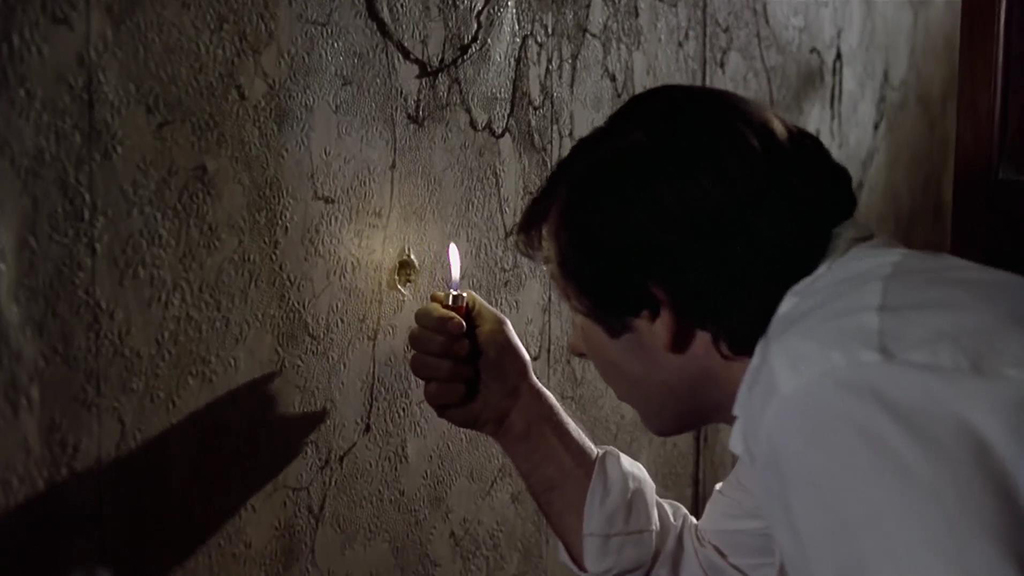
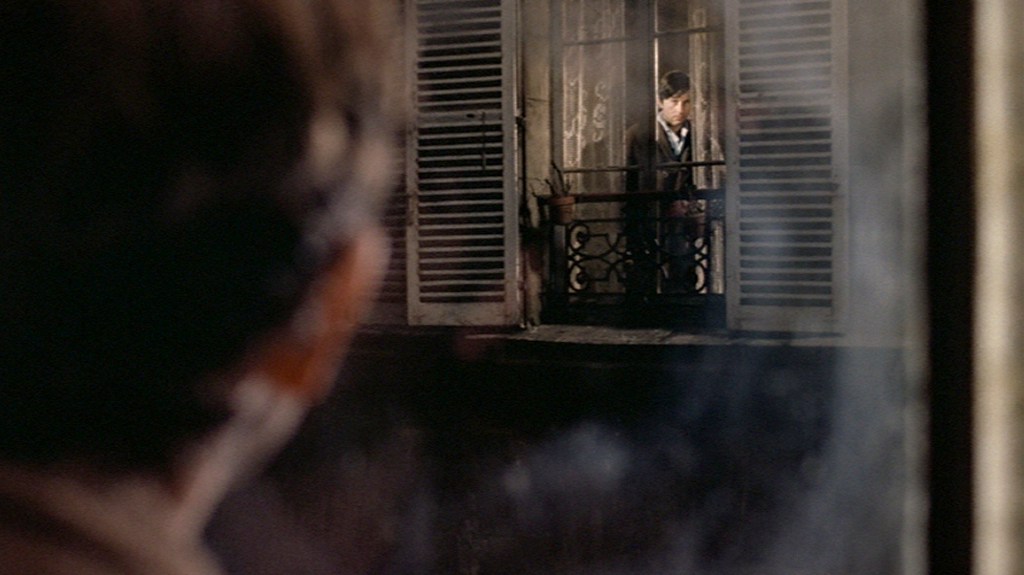
Trelkovsky is moving the wardrobe when he happens to glance out the window. He freezes. For there, standing in the bathroom window across the courtyard, is a woman. She is just standing there, staring at him. She is dressed in a long black coat and a black hat. Her face is blurred, but she looks startlingly like his crotchety landlady (played by Shelley Winters), feeding his burgeoning paranoia that the landlady and the other tenants are actively trying to freak him out. Troubled, he turns back to the wardrobe, and it’s then that he spots a hole in the wall that looks to be stuffed with a wad of cotton. He pulls the cotton out and peers into the hole with his lighter. He thinks he sees something, so he pokes his finger in there. And what he yanks out is a tooth.

A FUCKING TOOTH. A long, white canine tooth, clearly extracted at the root. Trelkovsky stares at it for a moment before dropping it into a nearby ashtray. Then, looking down at the tooth with a slightly disgusted expression on his face, he picks the tooth back up and sticks it back into the hole in the wall, and replaces the cotton.

The reason I love this scene so much is that it’s done so elegantly. There is no dialogue, and the background score (which sounds like an oboe) is suitably downbeat and eerie. Besides that, finding a vaguely squicky object left by persons unknown in a place where you weren’t expecting to find such a thing is a fantastic way of building suspense and keeping the viewer guessing. What is the tooth doing in a hole in the wall behind a wardrobe? Is it Simone’s? Did she pull it herself or did someone else do it? And why did she keep it? The imagination races to make sense of the grisly little relic. The appearance of the tooth is never fully explained, and that is what gives the scene this disquieting aura of menace.

There is a later, similar scene that I’d like to touch on as well. Trelkovsky is lying in bed, sick and slightly delirious. Eventually he leaves his apartment to visit the bathroom, making his way through the shadowed halls. When he gets there, a slow pan around the room reveals that someone has very meticulously carved hieroglyphics all over the walls. This is ominous enough to make Trelkovsky bolt from the room and hightail it back to his apartment, but when he gets back there, he glances out the window and sees someone standing in the bathroom he just left seconds before. And this someone is completely wrapped in bandages, like a mummy. Just standing there. Then, the figure slowly begins to unwrap the bandages from around her head, and it’s a weirdly smiling woman, Simone. Her smile reveals a missing canine tooth. This scene is also a great thematic callback, as not only was Simone an Egyptologist, but she was also in a full body cast the first time Trelkovsky saw her (though she died later from her injuries).

Please keep reading and I’ll keep putting these up as I think of them! You can also send me suggestions for scenes you like and why you thought they were particularly scary, or argue with me about the ones I picked. Thanks for your patronage. 😀

First in a Possible Series: The Goddess’s Favorite Creepy Movie Scenes, or Why the Fuck Does David Lynch Freak Me Out So Much?

Yesterday, as I was indulging in that great American pastime of frittering my workday away on the internet, I suddenly and quite inexplicably became obsessed with reading various publications’ rankings of the top 100 horror films and scenes. Unlike a large majority of the commenters on these pieces, I don’t so much read these types of posts to quibble with the films that were chosen or get into a lather about ones that were left off; I am, rather, simply very interested in what films other people chose and why they felt the way they did about them. The list I liked the best, incidentally, was this one from TimeOut London that was ranked according to votes from various horror heavy-hitters. It is, in my opinion, a great, diverse list that pretty equitably spans all genres and eras of horror and even threw in a few curveballs and non-traditional choices. Besides that, the recaps of the films were in-depth, informed, and insightful.

Reading all these lists inspired me to do a similar thing on this blog, though frankly I think I will stick to just calling out particular scenes in horror films that stuck with me through the years, and try to analyze why they made such an impact on me. That’s not to say that I might not do a “Goddess’s Top 100 Horror Films of All Time” one of these days, but at the moment I have a lot of other projects pending and don’t have enough free time to rewatch all the films I’d like to feature just so I can remember specifics. So consider this the first in a series of however many of my favorite creepy movie scenes that I’d like to write about. 🙂

The scene I’m going to feature first was a no-brainer for me; it was the first one that popped into my head when I decided to do this series. I have always said (to myself, mostly) that many of the scariest scenes in film don’t even come from what would normally be considered horror films. For a long time, I thought I was pretty much alone in this opinion, but then, in all my horror-list wanderings, I came across retroCRUSH’s 100 Scariest Movie Scenes. And right there, at number one, was SWEET VINDICATION.

WinkiesSign

Winkie’s. Fucking. Diner. *shudder*

If you have not seen David Lynch’s masterful 2001 mystery Mulholland Drive, kindly do yourself a favor and get on that shit tout suite. For real, I’ll wait. It’s a sinister layer cake of creepy-awesome that rewards multiple viewings, like a rich, nightmarish puzzle that taunts you with its dark, schizophrenic glamor.

The setup of the five-minute diner scene is mundane in the extreme. Minor characters Dan (Patrick Fischler) and Herb (Michael Cooke) are sitting in Winkie’s Diner in broad daylight. Dan is telling Herb about a recurring dream he’s had that took place in the very diner they’re sitting in. It all sounds fairly humdrum until Dan says that there is a man behind the diner. “He’s the one who’s doing it,” Dan says, though he doesn’t elaborate on what ‘it’ might be. “I can see him through the wall.” He then tells Herb that he hopes he never sees the man’s face outside of a dream, with the implication that the face is too horrible for him to describe. Dan looks sweaty and intense and apprehensive as he talks, haltingly. Later in the scene, Herb takes Dan outside in an attempt to show him that the man in his dream is not really back there, and this goes about as well as you’d expect.

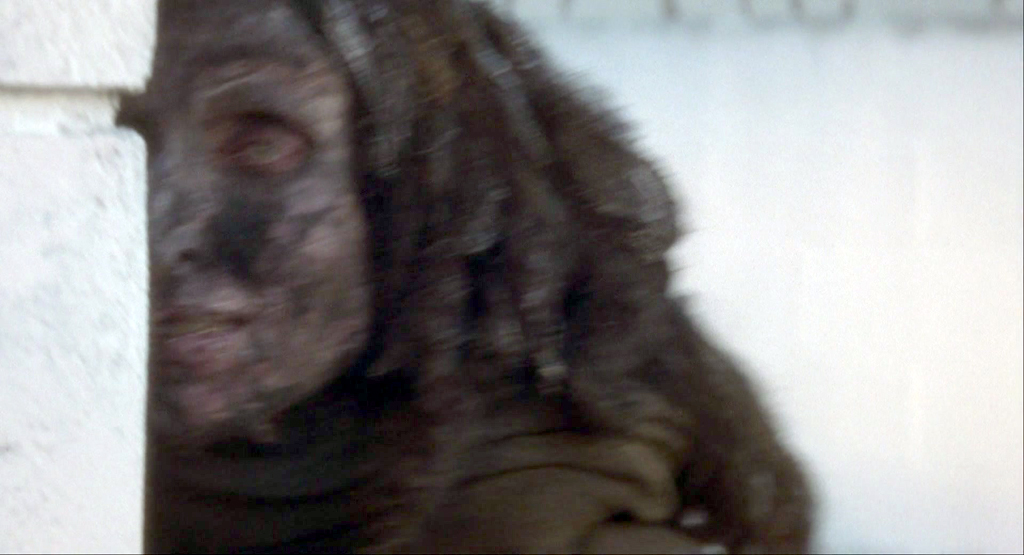
PEEKABOO!

PEEKABOO!

What is it about this scene that gives me the heebie-jeebies every single time I watch it? It isn’t the most obvious “scare,” the sudden appearance of the nightmare man from behind the dumpster. That’s sort of freaky when it happens, in a jump-out-of-your-seat way, but it’s not particularly dread-inducing. No, the scariest part of the scene is everything leading up to that: Dan’s strangely rubbery facial expressions and lopsided nervous grins, the flat affect of his voice as he describes the dream, the way he seems to say a great deal without saying much at all. One particular moment that actually caused a chill to rocket up my spine was when Dan was saying that Herb had also made an appearance in the dream. “You’re standing right over there…by that counter.” The camera pans slowly over to the counter, at which no one is currently standing, then focuses back on Dan’s anxious face. “You’re in both dreams, and you’re scared.” A few minutes later, Herb goes to pay for their lunch, and thus actually is standing right where Dan saw him standing in the dream. The men share an extremely unsettling glance across the diner. Also rather nerve-wracking is the men’s walk out to the dumpster behind the diner. Every shot, every camera angle, every edit as they walk seems pointedly calculated to be as skin-crawlingly sinister as possible, but without being obvious or overtly frightening in any way. It’s a fantastic trick, and I wish I could figure out how Lynch so effortlessly achieved it.

The retroCRUSH rundown also pointed out that this scene should absolutely not be as eerie as it is, because Dan basically describes exactly what’s going to happen, and then it happens. Normally structuring a scene like that would only serve to take away any tension, but in this scene it’s precisely the opposite. There is an inevitability to the scene; both Dan and the viewer know that something bad is going to happen, but neither are able to prevent it, and the dread the viewer feels in Dan’s stead makes the scene, for me at least, very difficult to watch without looking away.

I am amazed that Lynch managed to film such an ominous scene out of elements that are anything but scary at first glance (other than the nightmare man’s horrible face, that is), but I’m even more amazed by the fact that he’s done it more than once. Lynch is a master at something I tend to call time displacement, for lack of a better term. He has filmed several scenes in which the line between reality and nightmare is blurred, of course, but he also seems to have a similar predilection for playing with overlapping timescales, characters being in two places at once, and that type of thing. In 2006’s Inland Empire, for example, the intensely freaky-looking Grace Zabriskie (as Visitor #1) points to an empty couch in Laura Dern’s house and tells her that if it was tomorrow, she would be sitting right. Over. There. And then suddenly it is tomorrow, and Laura Dern is sitting exactly where the old woman said she’d be sitting. There is also the famous scene from Lost Highway (1997), where a white-faced Robert Blake tells Bill Pullman that not only is he standing there talking to him, but at the same time, “I’m at your house right now.” Every single scene Lynch has filmed like this has freaked me right the hell out, and I can’t quite put my finger on why that might be. Perhaps because when done well, these scenes serve to undermine the fulcrum of reality and make the viewer feel completely adrift in a universe that makes no rational sense. Or maybe it’s the fact that Lynch, better than any other filmmaker in my opinion, is cursedly skilled at portraying the incongruity of dreams on film, so that we almost feel as though he’s directly tapped into our collective subconscious and forced us to look unflinchingly at what’s lurking there. Or it could be his consummate talent for utilizing slightly off-kilter facial expressions, camera shots, voice inflections, and background sounds to convey an unsettling mood. Whatever the reason, I suppose it just goes to show that in the right hands, traditional horror movie monsters and situations have nothing on a simple shot of the back of someone’s head, or a strangely intense glance, or a daylight stroll through a diner parking lot.