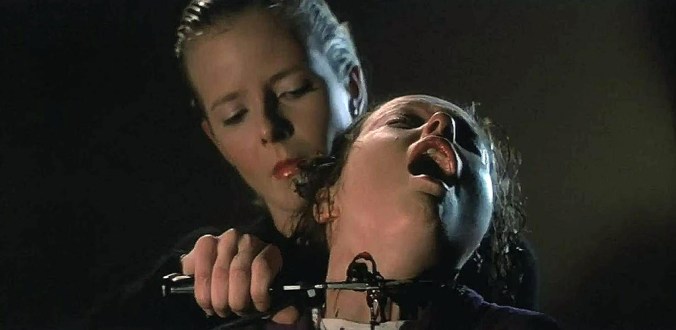
Even Those Representing God Must Rely on Advertising: An Appreciation of “Seven Blood Stained Orchids”

It’s a stormy Saturday afternoon here in central Florida, and as I often like to do on wet weekends such as these, I decided to while away a couple of hours with a strangely comforting European cult flick from the 1970s and then tell the internet how I felt about it, whether the internet wants to hear it or not. Did I mention I’m back on the giallo kick? No? Okay, consider it mentioned.

Anyway, I’ve obviously written about a few gialli before, and the funny thing about the genre is that you don’t have to see too many of them before you start getting into what I call “endless giallo recursion,” or alternately, “The Giallo Small World Hypothesis.” To wit, the movie we’re discussing today is another one with bloody flowers prominent in the title and the plot (just like the subject of my older post, The Case of the Bloody Iris), and another one featuring Marina Malfatti (who was also in a couple of other gialli I wrote about, The Night Evelyn Came Out of the Grave and All the Colors of the Dark), albeit in a fairly small role.
seven-blood-stained

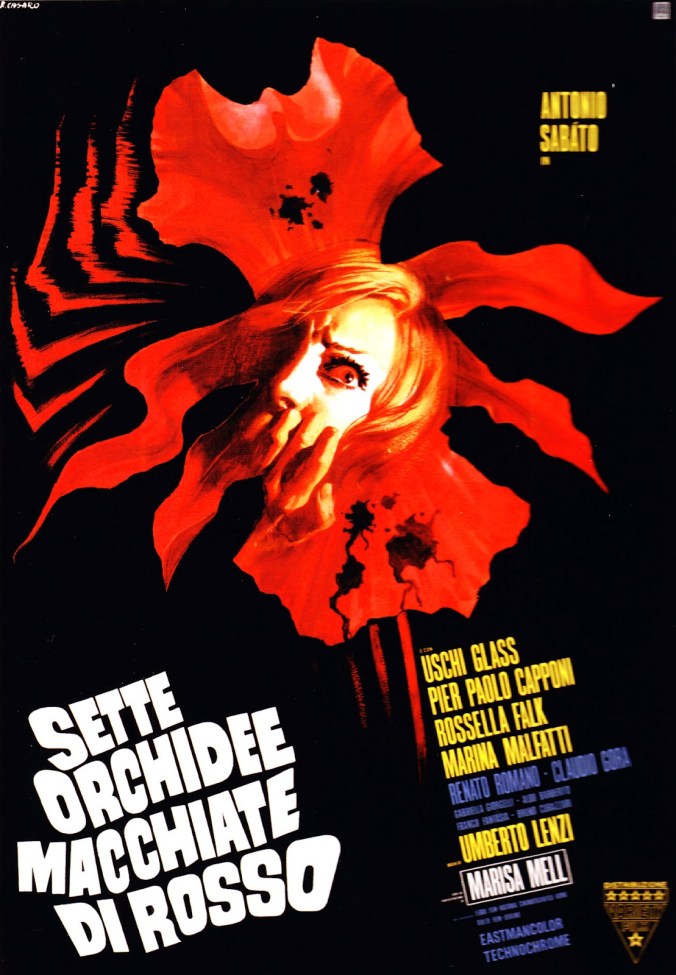
Seven Blood Stained Orchids (Sette orchidee macchiate di rosso) was released in 1972 and was the last of a series of four Italian/German co-productions (fun fact: in Germany, the equivalent of gialli is “Krimi”) based upon the works of prolific British crime writer Edgar Wallace. It was directed by Umberto Lenzi, probably most infamous (at least in the U.S. and U.K.) as the director of a couple of the most notorious “video nasties,” Eaten Alive and Cannibal Ferox. Now, before you go getting any ideas, Seven Blood Stained Orchids is pretty much a textbook giallo and has very little in common with Lenzi’s gore films; in fact, the violence here is exceptionally tame, with the bloodiest scene probably being a relatively mild murder with a whirring drill (and you know you’re a horror junkie when a grisly drill-through-the-heart scene barely raises an interested eyebrow). So whether that makes you more or less likely to want to watch it is entirely up to you.

het_verfoltos_orchidea_2

NEEDS MOAR NEEDLES TAPED UNDER EYEBALLS.


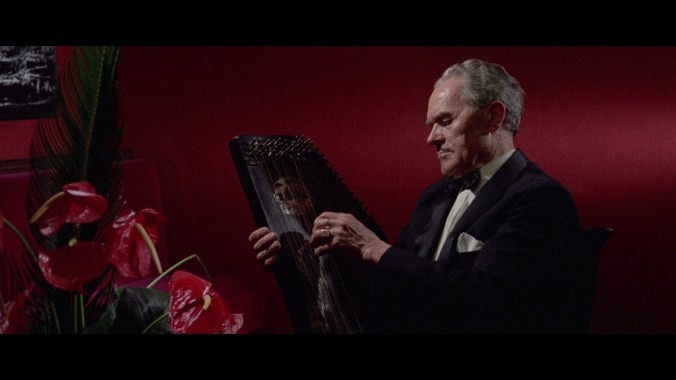
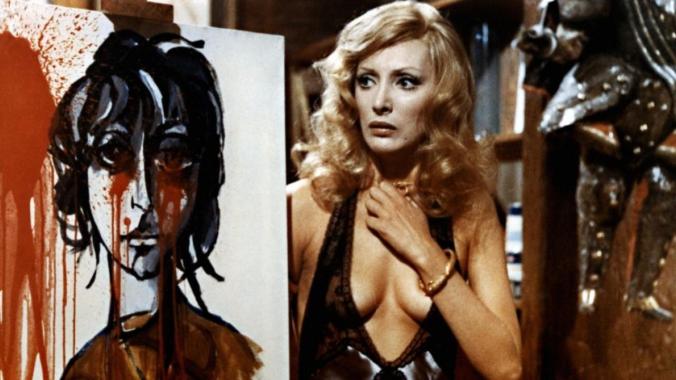
As I said, this movie ticks pretty much all the blood-spattered little giallo boxes: there’s a black-gloved killer stalking and killing scantily-clothed women with a knife, there’s a strange calling card left at the murder scenes (in this case, an occult-looking silver half-moon pendant), there is an investigation undertaken by one of the target victims when police prove less than useful, and there is the standard parade of shifty motherfuckers who drift through the story and serve as red herrings until the mystery slowly becomes resolved. Could the killer be the enigmatic old man babbling in German in the cemetery? The heroin-shooting Jimi Hendrix fan who does nothing but host open-door naked orgy parties at his zebra-print hippie pad? Or perhaps it’s his blouse-wearing boyfriend, who is a dead ringer for Rufus Wainwright? Or how about that hard-faced old battle-axe in the lunatic asylum who gives one of the potential victims a whole faceful of stinkeye and keeps a thermometer under her chair cushion, the way you do?
seven-blood-stained-orchids

“I DON’T CARE WHO IT IS, AS LONG AS THE STAB WOUNDS DON’T MAR MY CHESTICULAR PERKINESS.”


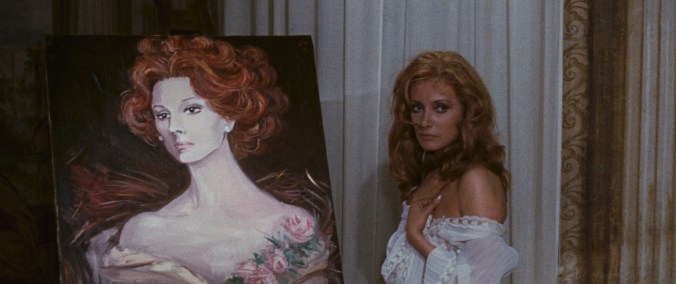
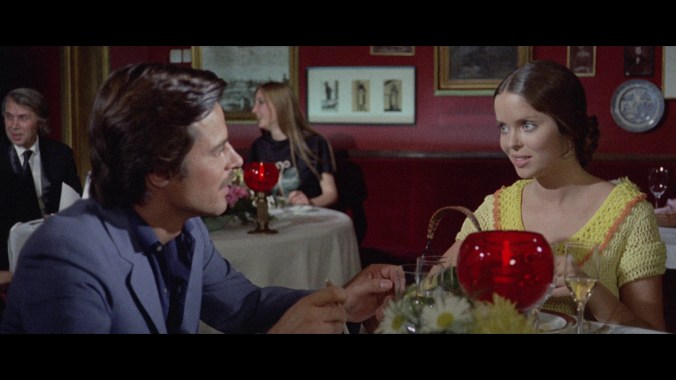
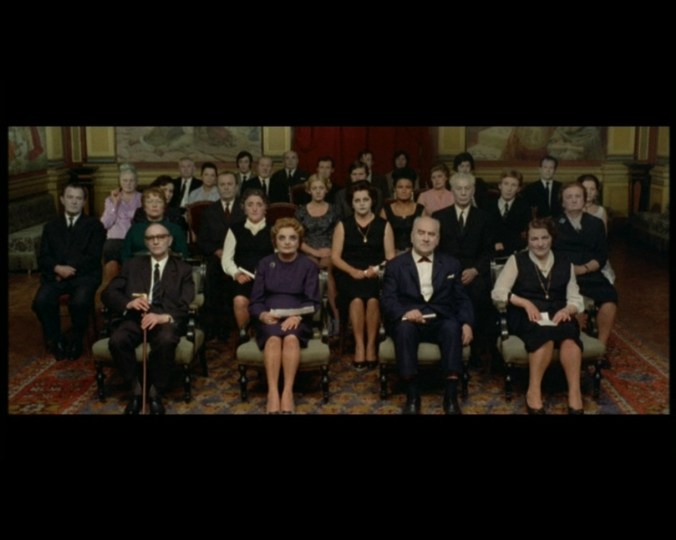
Briefly, the main plot revolves around a woman named Giulia (Uschi Glas) and her new husband, fashion designer and bossy-boots Mario (Antonio Sabato), as they attempt to get to the bottom of a mysterious series of killings, linked by the aforementioned half-moon pendant. After the murder of a prostitute (Lina Franchi) and an artist (Marina Malfatti), Giulia is targeted for death while she is on a train with Mario, heading toward their honeymoon destination. She survives, but because the killer beat cheeks before checking to make sure she was dead (rookie mistake), the police stage a mock funeral for her and keep her in hiding while they try to draw the murderer out. One of the repeated motifs of the film, though, is the general ineffectiveness of the cops, as they time and again fail to protect the marked women, even after Giulia and Mario have figured out the tenuous connection between the victims and helpfully provided a list of who is likely to meet the killer’s knife next. So fuck the police, the movie seems to be saying, since they apparently can’t manage to catch a cold even when all the legwork is done for them.

2314_raetsel-des-silbernen-halbmonds-das08

“YEAH, THEY’RE STANDING RIGHT HERE…YEAH, THEY JUST ASKED ME TO WIPE THEIR ASSES FOR THEM TOO.”


During the course of the film, we learn a great number of interesting facts. Among these are that serial killers become infinitely less sympathetic when they stoop to poisoning a bunch of kittens; that “The American Hospital” actually refers to the name of a medical facility in Rome and is not an admission that the Italians think there is only a single hospital on the entire American continent; that confessional booths in Catholic churches really need a better security detail; that a drugged-up sex soiree can’t be complete without poorly-applied body paint and a poster of Marilyn Monroe somewhere in the mix; and that not wearing a kicky purple scarf with your mod ensemble will make everyone think you’re a straight-up hooker who deserves to be bludgeoned to death in a cornfield.

the-more-you-know

All in all, this was a fairly solid example of the genre, not mind-blowingly awesome, but quite enjoyable, well-paced, and rather elegantly shot. The central plot device of the authority figures in the movie being powerless to protect the victims added a nice little undercurrent of dread to the entire affair. While the reveal of the killer was something of a surprise, the untangling of the murderer’s motive was not as splashy or madness-fueled as in other examples of the genre, so it frankly fell a little flat for me, since I’m more into the excesses of Argento. But I would still recommend this to giallo fans as a decent, middle-of-the-road entry into the annals of Italian crime thrillers.

Until next time, keep it creepy, my friends. Goddess out.
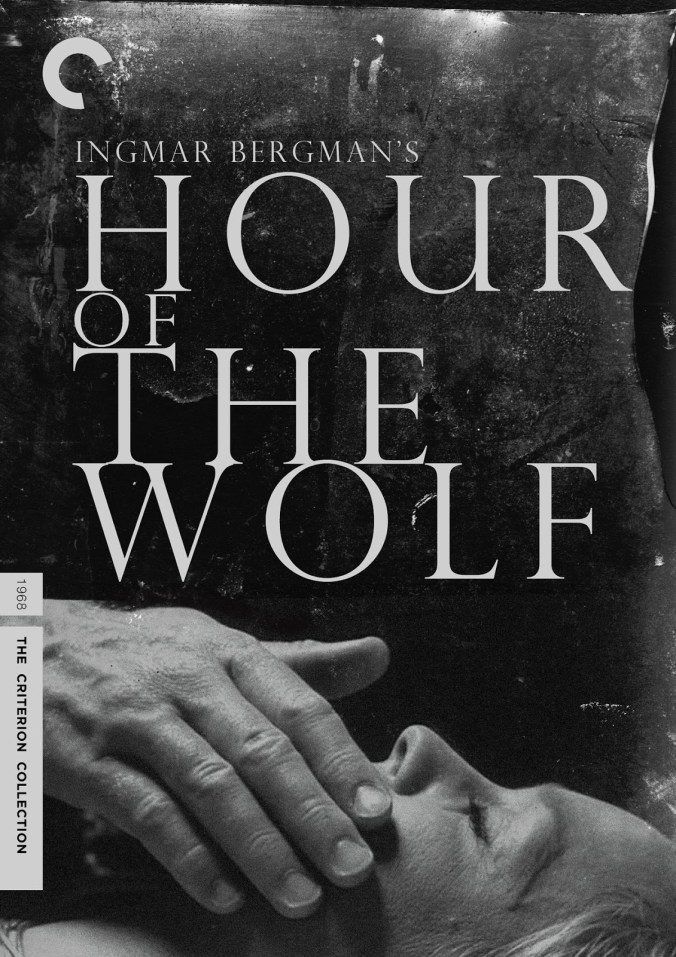
The Limit Has Finally Been Transgressed: An Appreciation of “Hour of the Wolf”

Hälsningar, minions! Today we’re delving into the surreal and arty waters of the Ingmar Bergman oeuvre, and even though I’m gonna try REALLY hard to not make any Swedish Chef jokes, I’m not going to promise anything, because y’all know how I roll.

criterion

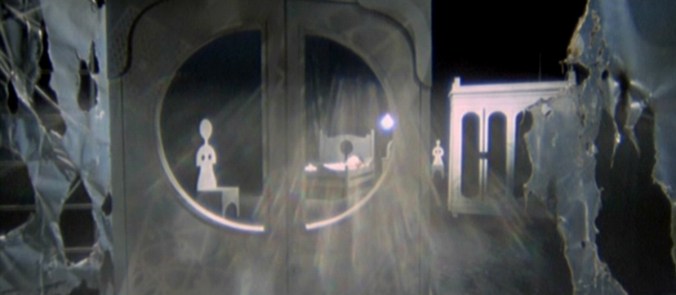
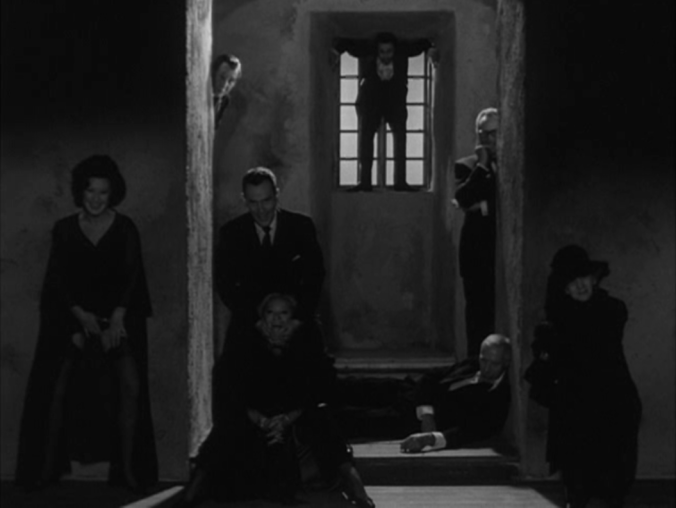
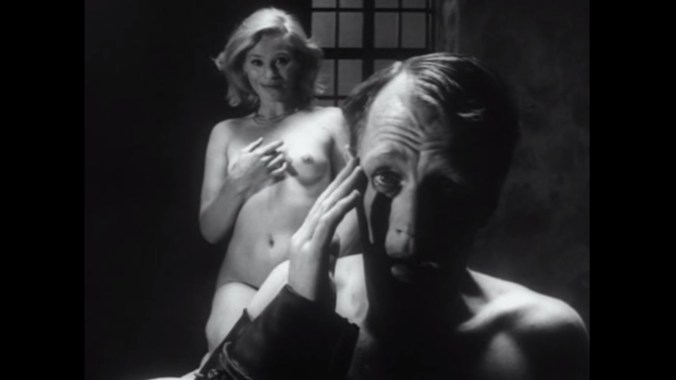
Hour of the Wolf (or Vargtimmen in Swedish) was released in 1968, and is probably the closest thing to a straight horror movie that Bergman ever did. That said, it’s still miles away from a traditional horror flick of the era, being more like an intensely eerie, psychological mindfuck with some really, really disturbing imagery; essentially, it’s film as wide-awake nightmare. Regular readers of this blog will be familiar with my love of ambiguity and surrealism in horror, and here is one of the best examples I have yet seen; in execution and implication, it’s absolutely skin-crawling. It’s also fairly obvious that this film was a pretty big influence on David Lynch’s Eraserhead, and in its themes of spiraling madness it also bears something of a resemblance to Roman Polanski’s Repulsion.

The story concerns an artist, Johan Borg (Max von Sydow), who is vacationing at a remote island cottage with his pregnant wife Alma (Liv Ullman). At the beginning of the movie, Alma is talking directly to the camera about the disappearance of her husband, as if she is being interviewed for a documentary. The remainder of the film is told in flashback; we see the bizarre disintegration of Johan’s mental state, and wonder how much of what we’re seeing is real.

screen-shot-2010-10-20-at-12-28

What makes this film so unsettling is its resolute refusal to explain itself. Johan interacts with strange people as he walks around the island, and he seems to think that they are demons, even though Alma can see them too; and for most of the movie, they seem like real people, albeit really skeevy ones. Johan has drawn all of them in his sketchbook, though the viewer never sees the drawings, but only Alma’s horrified reactions to them. He also has names for them, like the Bird-Man, the Schoolmaster, and The Lady with a Hat (about whom Johan once tells Alma that you don’t want to be around when the lady takes the hat off, because the whole face comes off with it. NOPE).

At one stage, a man named Baron von Merkans invites Johan and Alma to his nearby castle for a party, and when they attend, it’s the trippiest get-together ever, as all the guests laugh bizarrely, yammer on about meaningless topics, and overpraise Johan’s art to a really uncomfortable degree. Everyone seems hostile and cruel, as though they’re mocking him, but no reason for this is apparent. One of the women at the party shows Johan and Alma her bedroom, in which hangs a huge portrait of a woman named Veronica Vogler, who was apparently Johan’s ex-lover, though it is never clarified if she was a real person, or another figment of Johan’s crumbling imagination.

pichourofthewolf

Johan suffers terribly from insomnia, and Alma often stays awake with him in support. During the long nights, they have some extremely disturbing discussions. In one very eerie scene, Johan tells Alma about a trauma from his childhood in which he was locked up in a closet with what he thought was a small person who wanted to gnaw his toes off. He also confesses to a possibly fictitious incident some time before whereby he murdered a little boy while out fishing. During this conversation, he clarifies the meaning of the phrase “hour of the wolf,” which according to folklore is the hour in the middle of the night when most deaths and births take place. Much of the horror in the movie is conveyed in these weird conversations, though there are plenty of uncanny visuals to highlight the nightmarish narrative, like a man suddenly walking up a wall and across a ceiling, or a woman pulling off her face and popping her eyeballs into a wine glass.

max-von-sedow-hour-of-the-wolf

tumblr_ngmga12luk1rkh6xoo1_1280

If you’re getting the sense that this is a really bizarre, disjointed film, then you’re entirely correct, but its inexplicable strangeness is very, VERY effective in making this one of the most haunting and genuinely unnerving films I’ve ever seen (and that’s saying a lot). The underlying themes of the film seem to tie in with the fine line between artistic genius and madness, with the power of deep-seated fears and shameful desires to unhinge the mind, and with the possibility that insanity may be contagious, as Alma wonders at the end whether her love for Johan caused her to share in his delusions. There is also a repeating motif of eating or biting—the demonic people that Johan sees are portrayed as something akin to vampires or birds of prey, and during the flashback scene where Johan is recounting his murder of the boy at the seashore, the boy bites him several times during the struggle. Indeed, the working title of the manuscript was “The Maneaters,” so perhaps there is some reference here to the way that fears and traumas, whether real or imagined, can eat away at one’s sanity.

All in all, not a film for everyone, obviously, but I found it an intense experience, so disquieting and ominous that it was sort of distressing to watch. Its slow pace and stark cinematography only added to the uncomfortable atmosphere. If you haven’t seen it, and are a fan of Bergman’s other films, or just like surrealistic horror in general, I would definitely recommend it, even though it legit creeped me the fuck out. In fact, I know I said I was gonna try not to, but I need a laugh after watching it, so here we go.

Sorry, Sweden.

Goddess out.

Strange Men Have Been Following Women Since the Stone Age: An Appreciation of “All the Colors of the Dark”

Welcome back to our regularly scheduled programming, horror hounds. We’re traveling back to Italy for this one, and back to the giallo genre; we’re also revisiting some familiar faces from previous blog posts, because today’s movie features Edwige Fenech and George Hilton (from The Case of the Bloody Iris), as well as Marina Malfatti (who starred in The Night Evelyn Came Out of the Grave). So, without further delay, let’s jump right into the psychedelic cauldron of Satan, shall we?

allthecoloursofthedark-silverferoxdesignweb

All the Colors of the Dark (Tutti i colori del buio, 1972) was an Italian/Spanish co-production, but set in London, and directed by Sergio Martino. It’s essentially a groovier, less satirical, and WAY more surreal take on Rosemary’s Baby, with similar themes of black magic, ambiguous reality, and crushing paranoia.

Beautiful but mentally fragile protagonist Jane has been going through some shit; not only was her mother murdered when she was five years old, but a year before the events of the film, she was in a car accident in which she suffered a miscarriage. Her boyfriend, pharmaceutical rep and raging jackwad Richard, was driving the car, and sorta feels responsible for the whole losing the baby thing, although he still kinda treats Jane like crap anyway. Ever since the tragedy, Jane has been plagued with horrific, Fellini-esque nightmares in which toothless old ladies cackle in close-up and a mysterious man with ice-blue eyes repeatedly stabs women in their beds.

all2bthe2bcolors2bof2bthe2bdark2b039

DAVID LYNCH TO THE WHITE COURTESY PHONE.

In true “Yellow Wallpaper” fashion, Richard has been pooh-poohing Jane’s wishes to see a psychiatrist, insisting she just needs to keep ingesting the weird blue toilet-tablet vitamin concoction he’s giving her to flush away the crazy, since he clearly subscribes to the Tom Cruise School of Psychiatry Is Evil and Scientology Solves All the Things With Vitamins and OT Powers. But since playing with the Ty-D-Bol Man doesn’t seem to be doing her any damn good, Jane finally takes her sister Barbara’s advice and goes to see the psychiatrist Barbara works for, a kindly old man called Dr. Burton. Doc seems more understanding, but her nightmares are not going away, and what’s worse, she’s starting to see the blue-eyed man stalking her in real life, or so it would appear.

Fearing she might be going batshit insane, she finally confides in foxy new neighbor Mary, whose first suggestion, obviously, is for Jane to accompany her to a black magic ritual, which should clear that whole mental illness thing right up, with the well-known healing power of Beelzebub. Jane gives this course of action about ten seconds of thought before going, “Sounds like a plan,” and after a festive afternoon of dog-blood drinking and gang rape, she seems right as rain again.

all2bthe2bcolors2bof2bthe2bdark2b099

BLACK CANDLES AND WHITEFACE: THE CURE FOR WHAT AILS YOU.


But not so fast! In a stunning twist, it turns out that demonic cults headed by fey bearded men wearing fabulous gold Lee press-on nails may not actually be conducive to one’s overall well-being! Who’da thought? From here on out, the movie takes on the aspect of a fever dream, as we’re not really sure who we can trust and what is really happening. Is the blue-eyed psycho real or imaginary? Is everyone Jane knows conspiring with the cult to push her off her rocker for good? Has Richard fucked every woman in the immediate vicinity, including Jane’s sister? What’s the over/under on how long it would take to murder a couple of German senior citizens and prop them up at the breakfast table as though they’re still alive? Will Jane ever learn to cook bacon and eggs properly? The surrealistic touches come hard and fast, and the viewer will be left confused and on edge until the very end.

a13

WAKING UP ON THE LAWN OF A SATANIC MURDER MANSION; WE’VE ALL BEEN THERE.


I really dug this one a lot; I loved the psychedelic weirdness and the ambiguity, and it had a really unsettling undertone of claustrophobia, as the world seemed to close in around poor Jane, leaving her with no one to trust. The cinematography was also lovely and strange, if a little heavy on the wacky camera effects. Definitely one of the more unique gialli, and one I’d definitely recommend to fans of Satanic cult movies as well.

That’s all for this installment, so until next time, keep it creepy, my friends. Goddess out.
Revenge of the Deathless Guinea Pig: An Appreciation of “The Asphyx”

Cheerio, old chaps! Today’s movie is another kinda obscure 1970s flick from Europe, but we’ve temporarily travelled from Italy to Old Blighty. Bizarrely, and completely coincidentally, it also concerns a fucked up aristocratic family by the name of Cunningham, just like my last entry on The Night Evelyn Came Out of the Grave. I swear I did NOT do that on purpose. Clearly, mysterious cinematic forces are at work here.

asphysx

Directed by Peter Newbrook and released in 1972, The Asphyx was also known under the titles Spirit of the Dead and The Horror of Death. Set in 1875, it explores many of the same themes as Frankenstein, what with all the hubris about scientists tampering in God’s romaine and suchlike. Sir Hugo Cunningham (Robert Stephens) is a widower, a gentleman scientist, and a cheery, progressive sort of bloke, using his money and expertise in service of the betterment of mankind. At the beginning of the movie, he is bringing his fiancée Anna (Fiona Walker) back to the family estate to introduce her to his two grown children Clive (Ralph Arliss) and Christina (Jane Lapotaire), as well as a young fella named Giles (Robert Powell), who he introduces as his adopted son, but who also has a thing going with Christina, so…huh. Yeah, technically they’re not blood relatives, but still, eeeewwwww. Moving on.

maxresdefault

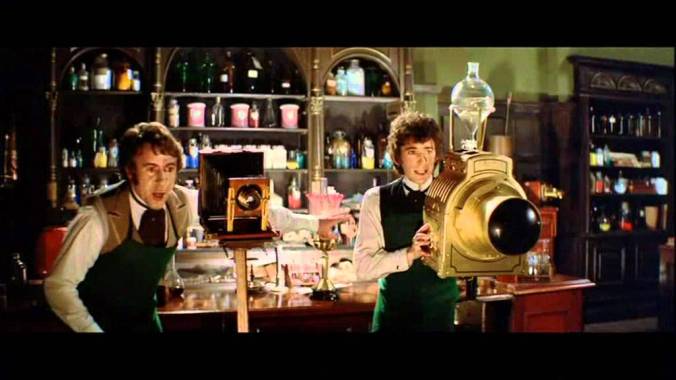
One of Sir Hugo’s main scientific pursuits involves working with a psychical research society, photographing people at the moment of their deaths. A few of their photographs seem to show a strange black smudge near the dying people, which the psychical society believes are the souls leaving the bodies. Sir Hugo is excited about the implications of this research, but his ward/assistant/daughter-banger Giles is all kinda meh, skeptical of the society’s conclusions and not really seeing the point of it all.

Things start going to shit about twenty minutes into the festivities. Clive and Anna are killed in a freak boating accident, and Sir Hugo happens to capture their deaths on his newfangled video camera. Beside himself with grief, he insists on watching the footage to see his beloved Anna and his only son Clive one final time. He is simultaneously horrified and ecstatic to find that he can clearly see that telltale black smudge appearing on the film right before Clive gets beaned with the fatal tree branch, but now that he can see it as a moving image instead of a static one, he can’t help but notice that the smudge is not moving away from Clive, as his soul presumably would, but toward him. Dun dun duuuuuun.

the2basphyx2b-2basphyx2bclose2bup

This doesn’t seem like a great deal to go on, but from this single piece of evidence, Sir Hugo formulates a theory that obviously, this black thingamabob isn’t really a soul per se, but an entity from Greek mythology called an asphyx, something like a grim reaper deal that comes to claim your ass when you’re fixing to bite the big one. He’s eager to do more research into the matter, and fortuitously, an opportunity soon presents itself: the president of the psychical society, Sir Edward Barrett (Alex Scott) arrives at Sir Hugo’s house, all in a lather because the barbaric British government has decided to reinstate public executions in order to try to stem the tide of a supposed explosion of violent crime. Sir Edward and Sir Hugo are both vehemently anti-capital punishment, and Sir Edward wants Sir Hugo to film the first hanging, hoping that the horror of the images will rally the public to their cause. Sir Hugo pretends that he doesn’t really want to do it, but secretly he’s all like AWWWW YEAH and metaphorically rubbing his hands together in anticipatory glee. He finally agrees, though he doesn’t tell Sir Edward what his true intentions are, vis-á-vis recording dying people’s repo-demons.

During the hanging, Sir Hugo uses a “light booster,” essentially a spotlight using phosphorous crystals, to illuminate the gallows as the condemned man meets the noose; but to the surprise of himself and everyone assembled, the criminal’s asphyx is clearly visible to all, and seems to be trapped within the phosphorous beam. When Sir Hugo reviews the footage later, both he and Giles realize that if a person’s asphyx could be halted by the phosphorescent light, and further, if the asphyx could then be transferred to a purpose-made lock-box with a phosphorous beam shining indefinitely into it, then a person could, theoretically, never die, provided the asphyx is never released. They try the experiment on a guinea pig and meet with rousing success, so of course the next logical step is that Sir Hugo, growing increasingly mad with the potential power of everlasting life, decides to immortalize himself, because his awesomeness cannot be contained within a single lifetime, goddammit.

If you know anything about this type of movie, you’ll know that the situation is going to go drastically, horrifically sideways from that point forward, and you may find yourself asking the following questions: Is it ever morally justifiable to toy with immortality? What lengths will a man go to to preserve his family and his legacy? Is it really prudent to have to live forever when your noggin is hanging on by a single sinew like Nearly Headless Nick? Some pretty fucked up shit happens at the end of this, folks, and here is yet another example of a Cunningham family who really, desperately need some kind of psychiatric intervention. Happy Days this ain’t.

asp6

As with a lot of British films from the early 70s, this one moves at a snail’s pace and is ridiculously talky, so it’s definitely not for all tastes. The characters, further, are all intensely twee, upper-class-twit types, but I found myself kinda liking them in spite of myself. Plus I was so interested to see what new, profanely impious schemes Sir Hugo was gonna come up with next that I was utterly transfixed through the entire two-hour running time. I also found the ending wonderfully cruel, ironic, and immensely satisfying.

That’s all for this installment, so until next time, keep it creepy, my friends. Goddess out.
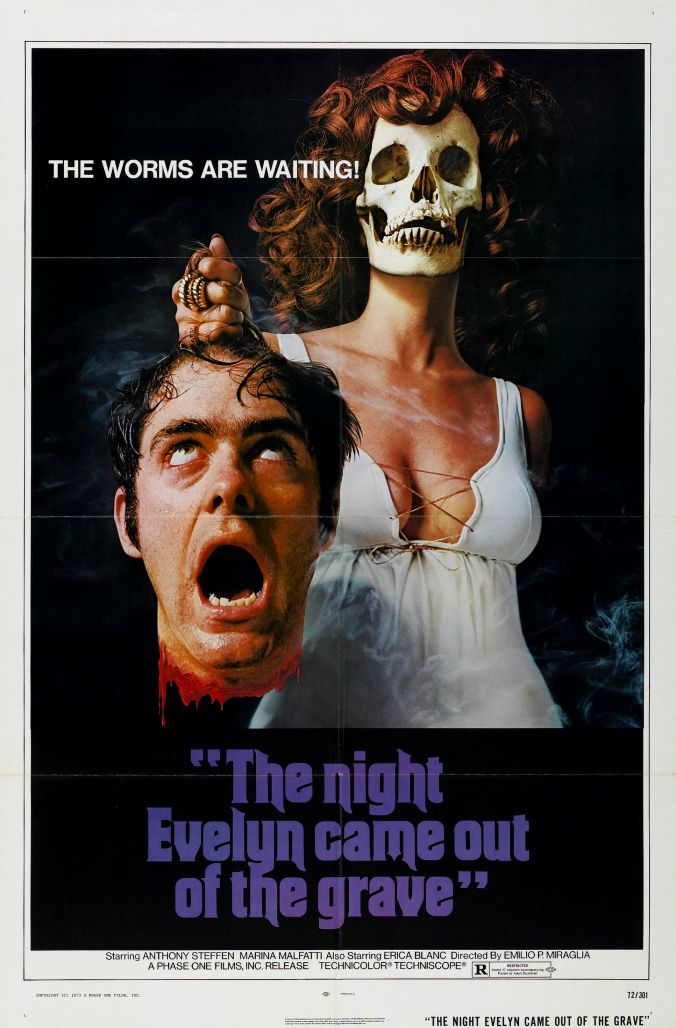
It’s Not Uncommon for a Man to Want to Do Strange Things to Get His Kicks: An Appreciation of “The Night Evelyn Came Out of the Grave”

In the mood for more Italian? Excellent; let’s mangia. Our movie today is one I actually thought I hadn’t seen before, though when I got to one of the later scenes, I felt a definite tingle of recollection. See, when I was a kid, I saw a movie with this one scene that really stuck in my memory, of a guy going into a tomb and seeing a creepy skeleton woman sitting up in a coffin. For many years afterward, I thought of the scene often, but damned if I could remember what movie it came from. Initially I thought it might be Children Shouldn’t Play With Dead Things, but I revisited that recently, and nope, no dice. Then I got it into my head that it might have been an episode of “Night Gallery,” so I watched the entire run of the series. And although the pilot episode with Roddy McDowall, “The Cemetery,” contained a scene that kinda reminded me of the one I was thinking of, it didn’t immediately smack me in the face with recognition.

But then, in all my wanderings through the giallo universe, I stumbled across a flick with the wonderfully outlandish title The Night Evelyn Came Out of the Grave (aka La notte che Evelyn uscì dalla tomba), released in 1971. And bingo was his name-o — THERE was that elusive scene I remembered. Long story short (too late), I said all that to say that I actually thought I had never seen this movie, but I guess I did. Which then led me to think, holy crap, my parents let me watch this movie when I was naught but a nugget? Because yeah, it’s a little smutty.

night_evelyn_came_out_of_grave_poster_01


Anyway, The Night Evelyn Came Out of the Grave (um…spoiler alert?) was directed by Emilio Miraglia, and it’s a pretty fun little gothic horror romp that features many of my favorite things. There’s a creepy old mansion with a family tomb! There’s a spooky portrait of an ostensibly dead first wife! There are dastardly double and triple crosses! There are red-headed strippers with perky boobies! There are ghosts and séances! There’s sadomasochism! Fabulous “I Dream of Jeannie” outfits! A disabled woman gets eaten by foxes! It really does have something for everybody.

1463920337_1

The plot revolves around main character/colossal fuckstick Lord Alan Cunningham (Anthony Steffen), a wealthy aristocrat who flipped his shit after the death of his (perhaps unfaithful) wife Evelyn in childbirth. He was institutionalized, but has been released back to his crumbling, palatial estate under the care of his family physician and close friend Dr. Richard Timberlane (Giacomo Rossi Stuart). It’s not made entirely clear whether the good doctor is aware of the…ahem…unconventional methods Alan has concocted to help him come to terms with his grief. Said methods include picking up carrot-topped prostitutes using slick come-ons like viciously yanking their hair and then saying, “Sorry, I thought it was a wig,” then taking the hapless whores back to his castle and engaging in a bit of Torquemada-style roleplay before killing them stone dead. “In other ages, prostitutes were branded with a hot iron. It was an excellent system,” he tells one victim, charmingly. If Dr. Timberlane does know about his patient’s itchy murder finger, he seems incredibly blasé about it, but hell, what’s a little strumpet slaying between friends? Also, Alan is a titled lord with boatloads of cash, so y’know, peasant laws don’t apply, obviously.

1463920337_2

One person who definitely does know about Alan’s extracurricular activities is dead wife Evelyn’s brother Albert (Roberto Maldera), who lives in a house on the grounds and often spies on Alan’s hooker extermination project. Every time a new floozy goes down for the count, Albert asks for hush money, at one point requesting the lavish sum of thirty pounds sterling. Albert: the budget blackmailer.

So Alan has apparently been on this murderous treatment program for nigh on a year, trolling for trollops with his only male relative, cousin George (Enzo Tarascio), who wears a giant hoop earring and swishes around like Paul Lynde, yet is shown banging luscious ladies on multiple occasions, because he is one hundred percent heterosexual, no doubt about it. Shockingly, all of this whorin’ and killin’ isn’t helping Alan’s mental state, since he is still haunted by visions of Evelyn, who’s always turning up in his head all naked and persistent. Dr. Timberlane suggests that if Alan were to marry again, then all of his violent urges would magically disappear, and I’m left wondering if this guy got his doctorate from some online diploma mill or something, because that is some really wack advice. But Alan is on board, all, no problemo, I’ll find a girl and get hitched, and then I can put all this pesky murder business behind me. Moments later, he goes to a party with George, where he meets an intriguing redhead with the unlikely name of Gladys (Marina Malfatti), and before he’s even given her a taste of his spicy Italian sausage, he’s proposing marriage. She’s all, “You’re trippin’, but…sure, sounds legit.” And thus Gladys becomes the second Lady Cunningham.

1463920337_3

There then follows a convoluted series of events typical of the gothic genre. Is Evelyn really haunting the castle, or has Alan jumped on the express train back to crazytown? What’s going on in the family tomb that Alan refuses to let his new wife see? Who keeps murdering Alan’s family members and worse, stealing the silverware? What’s the deal with the troop of identical maids who all wear the same blonde afro wigs? Will George ever come out of the closet? I won’t spoil any of the surprises, but suffice it to say that the Cunningham clan could do with some serious family counseling.

1463920337_4

I really enjoyed this one a lot; it had a great, Hammer-esque atmosphere and was pleasingly drenched in over-the-top campiness. It’s not really a traditional giallo, I guess, but it was an entertaining, creepy slice of early 70s sleaze-horror nonetheless. Recommended for those who like their gialli served up with a large side-dish of old-school gothic goodness.

Until next time, keep it creepy, my friends. Goddess out

Insane People Seem to be Graced with Incredible Powers: An Appreciation of “God Told Me To”

A horrorific Monday to all of you fiends out there! I’ve returned once again to my favorite horror decade for today’s post, though I’m putting the gialli down for a brief rest so that I can discuss one of the weirder American horror flicks from the 1970s, one that I’d seen pop up on a lot of people’s “best underrated 70s horror” lists but had only just got around to seeing.

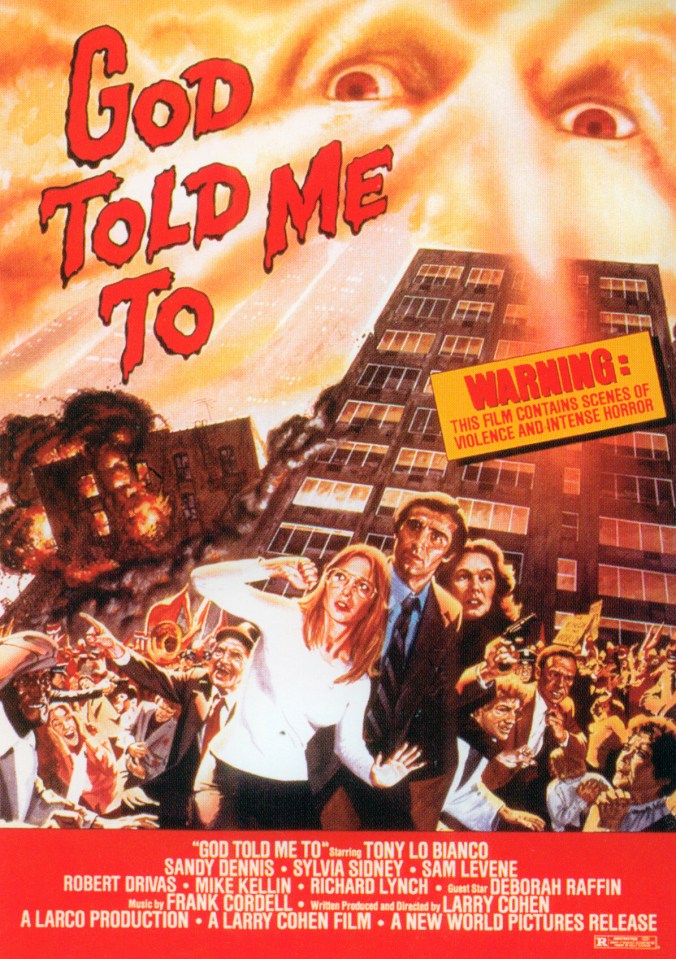
God Told Me To (1976) aka Demon

Directed by Larry Cohen

Shown: Poster Art

Larry Cohen is probably best known to horrorphiles as the director of the It’s Alive killer baby series, as well as a few other cult classics like The Stuff and Q: The Winged Serpent (and, it must be said, one of the better episodes of Mick Garris’s “Masters of Horror” series, the Fairuza Balk-starring “Pick Me Up”). But the film I want to discuss today is one of his stranger and more subversive ones, a film that actually had some pretty complex things to say about religious belief, violence, racial tensions, and gender fluidity. I’m speaking, of course, of 1976’s God Told Me To (also known as Demon, for some unfathomable reason).

The movie centers around New York City police detective Peter Nicholas (Tony Lo Bianco), who is investigating a bizarre series of crimes in which seemingly random people suddenly snap and go on mass killing sprees around the city, always giving the excuse that “God told me to,” right before they meet their own ends. You would think that this film, then, would progress something like a thriller or police procedural, and you’d be partially right, but honestly, if you’ve never seen it, I don’t think you could ever imagine the batshit directions this thing wanders off into. If you’d like to approach this movie cold, though, I suggest you not read any further here, as I’m inevitably going to spoil some key aspects of the plot. You have been warned.

godtold8big

Detective Nicholas lives with his girlfriend Casey (Deborah Raffin), telling her that his devout wife Martha (Sandy Dennis) will not let him divorce her, even though in reality it’s his own Catholic guilt that prevents him. It is his very conflicted faith that causes him to obsess about the ostensibly religion-motivated mass murders occurring regularly around New York, but as he delves deeper into the crimes, he discovers some mightily disturbing facts about the motives of the killers, and also that he himself might somehow be involved in what appears to be some mass hysteria or conspiracy.

godtold2big

And yes, that is indeed Andy Kaufman in his first film role!

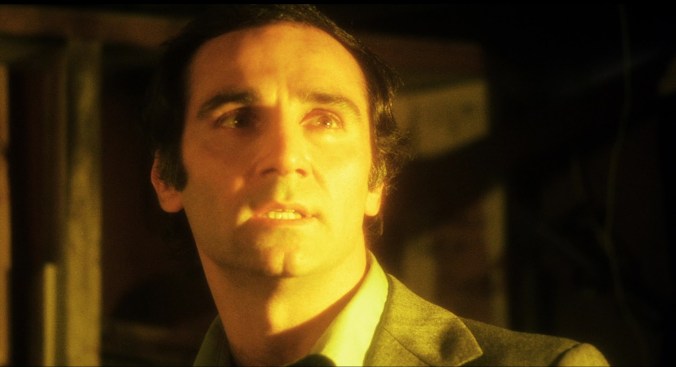
It turns out that all of the murderers had fallen under the spell of a mysterious, androgynous cult figure known as Bernard Phillips (Richard Lynch), who seems to have the power of mind control over his subjects. As Nicholas digs into Phillips’ murky past, he finds that Phillips’ mother was supposedly a virgin when she bore him, and further, that she had reported being abducted by a ball of light and subsequently impregnated by what amounted to extraterrestrials. After Nicholas locates the elusive Phillips in a dark basement ringed with flames (obviously a stand-in for Hell), he finds that Phillips wants to control him most of all, but cannot do it, for some reason he can’t fathom.

As the investigation goes on, Nicholas finds that Phillips’s history mirrors his own; the detective’s own mother was also knocked up by visitors from beyond the stars, and the only reason that Nicholas wasn’t aware of it was that his human genes turned out to be more dominant than the alien ones. In the final battle between the half-alien “siblings,” Phillips attempts to persuade Nicholas to impregnate him via a pulsating vagina in his abdomen, but Nicholas ain’t having none of that freaky extraterrestrial action and kills the being, repeating the mantra that “God told me to” when he is later arrested for murder.

god-told-me-to-1976

I have to say that this is probably the strangest of all the religion-themed horror flicks of the decade, and I haven’t even really scratched the surface of all the insane shit that goes on in this movie. The weirdest thing about it is that it isn’t lurid or funny at all; it’s played completely straight and serious, and is all the more unsettling because of it. God Told Me To is almost like a whacked-out mashup of Dog Day Afternoon, Rosemary’s Baby, Xtro, and the book Chariots of the Gods, and as such, it has many layers of satirical social commentary that are just as relevant today as they were in the 1970s. For example, what is the nature of religious belief, and is it detrimental to the individual and to society as a whole? What is God, and if God supposedly speaks to someone, who’s to say that what God says is right or moral? Where is the line between male and female, and does it even matter? These may seem pretty heavy questions for a little B-horror movie to be tackling, but God Told Me To does so with a surprisingly deft hand. The entire feeling the film evokes is one of a society teetering on the edge of chaos as conflicting forces—of good and evil, masculine and feminine, black and white—all clash in one enormous and yet insidious paroxysm of violence.

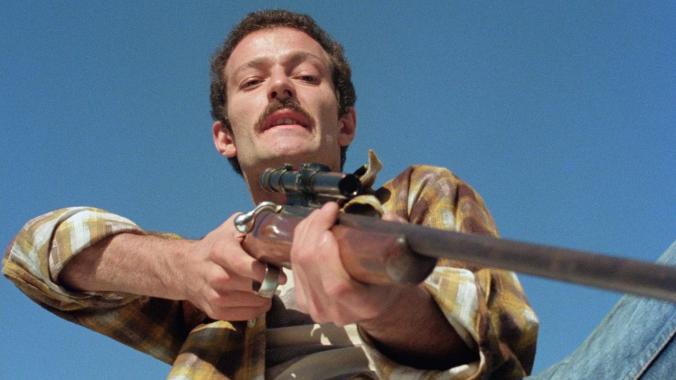
It also has some wonderfully frightening scenes, from the fantastic opener as a lone sniper atop a water tower calmly picks off random pedestrians on a city street; to Nicholas’ harrowing visit to Phillips’ mother, who suddenly attacks him in a knife-wielding frenzy; to the movie’s best and most chilling sequence, where Nicholas questions a man who has just massacred his entire family in cold blood at Phillips’ psychic behest. The lucid, almost beatific way the man describes the murders is disturbing in the extreme.

So if you’re a fan of religion-themed and/or gritty urban horror from the 1970s that’s cross-pollinated with a hint of sci-fi, then God Told Me To should definitely be added to your must-see list. Until next time, keep it creepy, my friends. Goddess out.

Tomatoes Feel Pain When You Poke Them: An Appreciation of “Short Night of Glass Dolls”

Greetings once again, my creepy companions! If you read my last post on The House with the Laughing Windows, you will perhaps have surmised that I’ve gone off on a bit of a giallo kick lately. Sure, I’ve always been a big fan of the best-known films in the genre, your Argentos and your Bavas, but recently I’ve gotten a bee in my bonnet about writing my own giallo-type story as a lark, and as such I decided to seek out a few of the lesser-known examples of the genre that I hadn’t seen, just to give me some additional inspiration. (And speaking of which, do you guys know about this random giallo generator? Because it is delightful.)

345744-giallo-short-night-of-glass-dolls-wallpaper

So today I chose a 1971 film that has appeared on a few lists around the internet as one of the classics, though I admit I had never heard of it before I went hunting around. Originally known as Short Night of the Butterfly (which actually makes more sense to the plot), the film was eventually released under the title Short Night of Glass Dolls (or La Corta notte delle bambole di vetro, if you prefer) due to another movie with “butterfly” in the title being released around the same time. It was the directorial debut of Aldo Lado, who also directed another classic giallo, Who Saw Her Die? (which I might do a post about one of these days).

schnappschuss-2022-04-24-mit-13_01_33-pm-9223


In the film, an American journalist named Gregory Moore (Jean Sorel) has been covering political unrest in Prague, and is planning to pull some strings to smuggle his smoking hot Czech girlfriend Mira (played by a very young Barbara Bach) out of the country and back to London with him at the end of his assignment. But one night after a party, he is called away on a story tip which turns out to be a distraction, and when he returns to his apartment, he discovers that Mira is missing. The weirdest thing about her disappearance is that she didn’t take her handbag, her passport, or apparently any of her clothes; even the dress she wore to the party is still in the apartment, flung over a chair as if she had just taken it off and then gone parading out into the night stark naked. The remainder of the main plot is Gregory’s investigation into what happened to Mira, which of course involves a bevy of shady characters who either stonewall him completely or mysteriously end up dead shortly after giving him information; police hostility and suspicion about his role in the disappearance; the discovery that Mira’s odd vanishing act isn’t the only such case by a long shot; and troubling hints at some pretty sinister forces lying just beneath the veneer of Prague’s supposedly respectable ruling class.

ShortNightOfGlassDolls1

I also neglected to mention that this film has an unusual conceit: The entire search for the lost Mira is detailed in flashback, as Gregory lies in a morgue awaiting autopsy. See, at the very beginning of the movie, he is found, apparently dead, in a public park, but a voiceover lets the audience know that he’s actually still very much alive, but frustratingly unable to let anyone else know about his terrifying predicament. The film flips back and forth between the doctors’ fruitless attempts to revive him and his memories of looking for Mira and falling into the big conspiratorial clusterfuck that led him to the sad state of affairs he finds himself in. It’s actually a great plot device, as not only is the viewer intrigued by the mystery of the missing girlfriend, but also held in nail-biting suspense over whether Gregory will be snapped out of his deathlike trance before the autopsy knife ends his life for real.

shortnight3big-e1457713843131-1024x430


Like The House With the Laughing Windows, Short Night of Glass Dolls has a definite political undercurrent, though it is much more overt than the former film, so much so that I would classify it less as an undercurrent and more as a pretty obvious allegory, which is why I believe its original title was more relevant. In the resolution if its mystery, I would actually hazard a guess that it was a precursor and/or inspiration for Stanley Kubrick’s Eyes Wide Shut, as it exposes the perverse and almost vampiric nature of those in society’s top echelons, as they drain the life, both literally and figuratively, from those unfortunate souls beneath them.

schnappschuss-2022-04-24-mit-13_00_27-pm-26945

Also like the formerly discussed film, the pace of the movie is rather slow, but there is a much more lurid sexual nature to the crimes than House with the Laughing Windows had. The Prague backdrop is also a highlight, oppressive and beautiful at the same time, which handily ties in with the movie’s themes. In addition, there is some lovely imagery of butterflies and glass chandeliers and those gorgeous baroque interiors that are often a fixture of these movies. I also liked some of the seemingly random, unsettling details, like the scientist who was experimenting on plants and trying to determine if they could feel pain. And as I mentioned before, the suspense throughout the film is fantastically well-done, as the whole story becomes something of an unbearable race against time. And I won’t spoil the ending, but I will say that it was quite wonderfully cruel and shocking, and something I really didn’t expect. Highly recommended.

Until next time, keep it creepy, my friends. Goddess out.

My Colors Are Hot Like Fresh Blood: An Appreciation of “The House with the Laughing Windows”

Ciao, bambini! I know I’ve been writing more about newer movies recently with my Hulu Horror Double Feature series, so I figured it was about time to return to the decade that spawned most of my favorite films, the funky fly 70s, and also delve a bit deeper into that rich vein of goodness that is the Italian giallo genre.

I’ve written about Italian movies before (Suspiria, The Psychic, House of Clocks), and I even wrote a short overview of the history of the giallo film, in which I happened to mention the movie I want to talk about today, which is right here with English subtitles, if you want to watch along:

1976’s The House with the Laughing Windows (aka La casa dalle finestre che ridono), aside from its completely rad title, is considered a classic of the genre, even though many of the more lurid, baroque elements present in the better-known giallo films of Dario Argento and others are notably absent. Directed by Pupi Avati, the movie actually bears some resemblance to Lucio Fulci’s Don’t Torture a Duckling, as well as the restrained but unsettling vibe of Nicholas Roeg’s Don’t Look Now. In other words, it’s actually more of a low-key mystery than a straight horror film, and as such it might be a tad too ponderous for some, but it does feature a subtle sense of dread as a constant undercurrent, and the final few minutes are fantastic.

tumblr_nwgbi0u4nN1qzphgoo6_1280

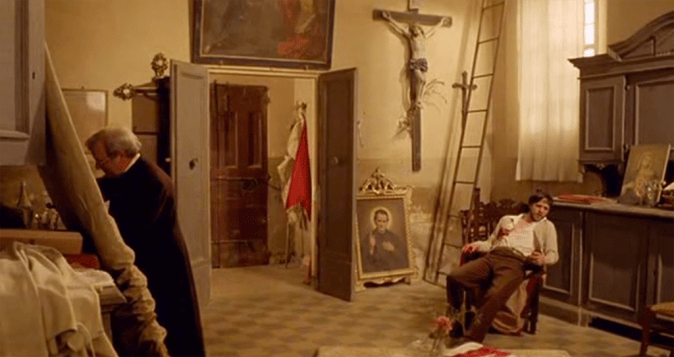
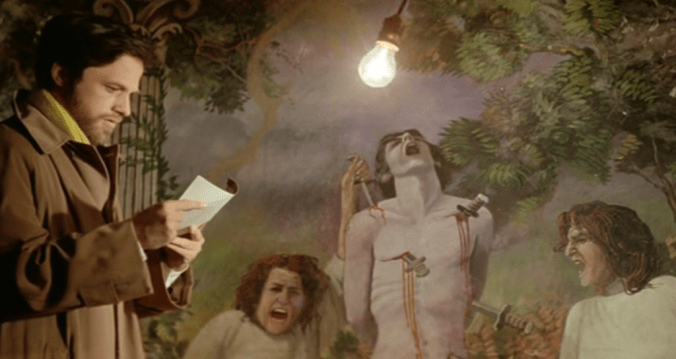
In brief, art expert Stefano (Lino Capolicchio) is summoned to a small village in rural Italy to restore a fresco of St. Sebastian on a wall of the town church. The rather macabre painting was done by a local artist named Legnani (Tonino Corazzari), who committed suicide two decades before and is known around town as the “painter of agony,” because he preferred to depict his subjects in terrible pain or in the final moments before their death. Stefano tries to get to work on the restoration, but to a man, every townsperson seems secretive and vaguely hostile, and someone keeps calling Stefano at his hotel, warning him against altering the fresco. The only friendly faces are Stefano’s longtime friend Antonio (Giulio Pizzirani), who mysteriously dies before he can tell Stefano what he knows about the painting, and a new schoolteacher, Francesca (Francesca Marciano), who arrived on the same ferry as Stefano did. Stefano and Francesca quickly become entangled, and their budding relationship constitutes a significant facet of the plot as it moves toward the discovery of the town’s secrets.

tumblr_nxf3j6Ga211sh4itto5_1280

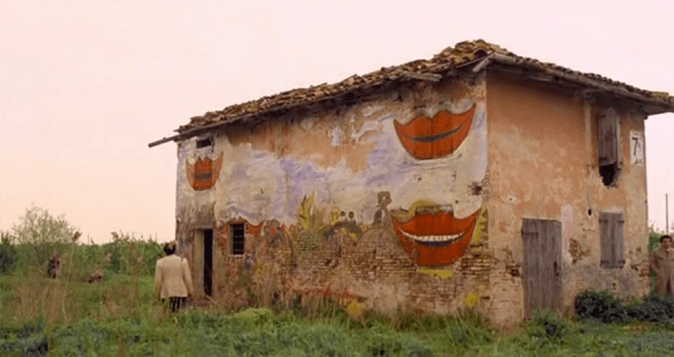
Despite its rather subdued narrative, The House with the Laughing Windows does boast many of the hallmarks of a stereotypical giallo: The protagonist is thrust into a mystery he becomes obsessed with solving, there are numerous red herrings which are never explained, there is a somewhat dreamlike logic at work surrounding certain plot points, and the heart of the mystery deals with madness and sexual deviance (though any actual sex in the movie is generally implied rather than shown). Additionally, the house with the laughing windows itself serves as something of a metaphor for the plot, signifying as it does a decay of happiness, a loss of innocence, a hole of insanity that sucks in everyone in the vicinity. More historically-astute reviewers than I have also noticed the film’s inferred references to shame about Italy’s fascism during the war; this isn’t really relevant to the conventions of the giallo, but I thought I’d mention it here, as the subtext does elevate the film above lesser examples of the genre.

tumblr_nwgbi0u4nN1qzphgoo5_1280

Where the movie differs from better-known giallo films is in the absence of the trademark black-gloved killer, the unerotic nature of the murders (there is one rape preceding a murder, but it is not really shown, and the other murders are simply workmanlike and not fetishized), and the dearth of any particularly Grand Guignol moments like you’d see in many other typical gialli.

That said, the ending is fairly shocking and grotesque, especially since the rest of the movie is so slow-moving and understated. I’m not sure I’m completely on board with the final reveal of one of the troublemakers, and in light of the mystery’s resolution I’m not entirely certain why the townspeople behaved the way they did toward Stefano, but these are minor quibbles that contributed to the Polanski-esque feeling of paranoia that pervaded the whole enterprise, so I’m willing to forgive the inconsistencies. It really is a masterpiece of the genre, helped along immensely by its eerie, sepia-toned vistas and its steady ramping up of tension. A must-see for fans of gialli and atmospheric European horror.

Until next time, keep it creepy, my friends. Goddess out.

I Too Love the Sound of Cats in Boiling Water: An Appreciation of “Rock & Rule”

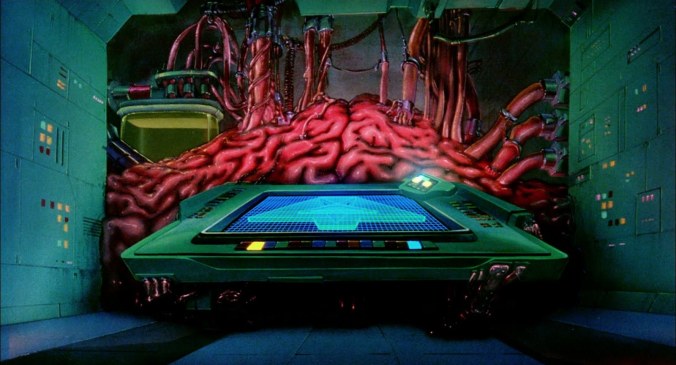
I’ve written before (such as right here) about how my formative years corresponded almost perfectly with the rise of home video, cable television, the new wave and post-punk explosion, and MTV, and the film I want to talk about today is sort of a culmination of all those cultural touchstones coming together in one dark, delightful, and musical package. I’ve also discussed a weird animated film before (Jack and the Beanstalk, right here), but the subject of this post is definitely not for kids, and although it’s more sci-fi fantasy than horror, I’m giving it a pass because of its Blade Runner-esque aesthetic, its grandly creepy villain, and a premise that hinges on a Lovecraftian demon invocation. It’s along the same lines as Heavy Metal, though not as raunchy, and it has a rad as hell soundtrack (unfortunately not available) featuring Lou Reed, Debbie Harry, Iggy Pop, and Cheap Trick. I must have seen it at least a zillion times after it came out in 1983, and to this day I have never gotten sick of it.

I’m speaking, of course, of fuckin’ Rock & Rule:

If you haven’t seen this, do yourself a favor and click that linky up there because this movie is awesome and I love it more than it should be legal to love an animated flick about mutated rat-humans in a small-town punk band who are being pursued by a scary magical rock star who needs their singer’s voice to summon an evil being from another dimension. It was the first full-length feature made by the Canadian animation studio Nelvana, who up to that point had been known for making cartoons for little kids, like Care Bears and shit like that. Matter of fact, Rock & Rule itself started conceptual life as a children’s film called Drats!, before taking off in a more adult-oriented direction in light of the success of Heavy Metal and Ralph Bakshi’s animated films. It’s a shame that distribution fuckups with MGM relegated Rock & Rule to box office failure and relative obscurity, because it’s really something of an underrated gem. By the way, if you’re looking for the movie outside of North America, apparently it’s known by the title Ring of Power, which…whatever. Yeah, the bad guy has a magic ring that identifies the frequency of the voice that will summon the demon, but I still think Ring of Power is a little too Tolkein for my liking. YMMV.

Rock and Rule Blu-Ray 7

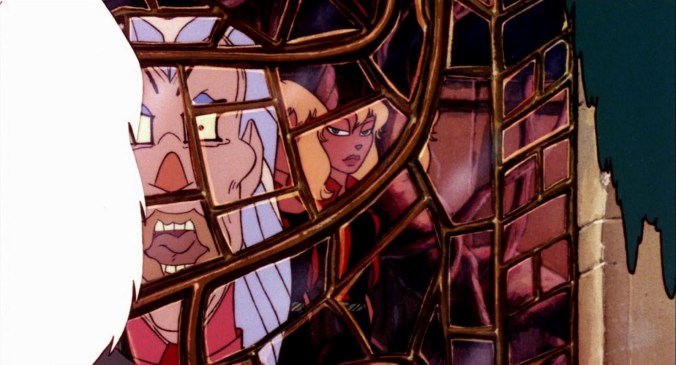
Anyway, let’s talk about that bad guy for a bit, because he is easily the best thing about this entertaining slice of new-wave wonderment, and indeed, he might be the best villain in any animated film of the eighties, and no, I’m not exaggerating even a tiny bit. Cavernous and pale, with leonine hair, enormous window-shade eyes, huge lips, and pointed eyeteeth, Mok Swagger (aka Mok the Magic Man) is obviously a post-apocalypic cartoon version of Mick Jagger, with hints of Thin White Duke-era David Bowie thrown into the mix. His singing voice is mostly provided by Lou Reed (except for one song done by Iggy Pop), which is bitchin’, but it’s his speaking voice that really makes the character; Don Francks imbues Mok with such over-the-top, wheedling, gravelly menace that his every pronouncement simply dominates whatever scene he’s in, whether he’s being seductively charming, stern and commanding, or completely losing his shit in a total shrieking meltdown. Just a fantastic voice performance all around, funny and terrifying all at once, that comes damn near to making the movie all on its own. Mok’s songs are great too, very Lou Reed-ian, obviously, and hilariously self-aggrandizing.

vlcsnap-2010-08-11-00h43m21s88

Also awesome is Paul LeMat as Omar (note: the original Canadian cut of the film featured a different voice actor, Greg Salata, for Omar’s character), whose dry smart-assery clearly covers some deep insecurities, and Susan Roman as the no-nonsense and kick-ass Angel; the interaction between their two characters is another highlight of the film. Angel was also something of an anomaly in fantasy films of this type from this era, as she was an independent, self-reliant female character with a strong personality who didn’t need the boys to come to her rescue. Sure, she was somewhat sexualized, but in a realistic, empowered kinda way, not in the exaggerated, Frank Frazetta kinda way.

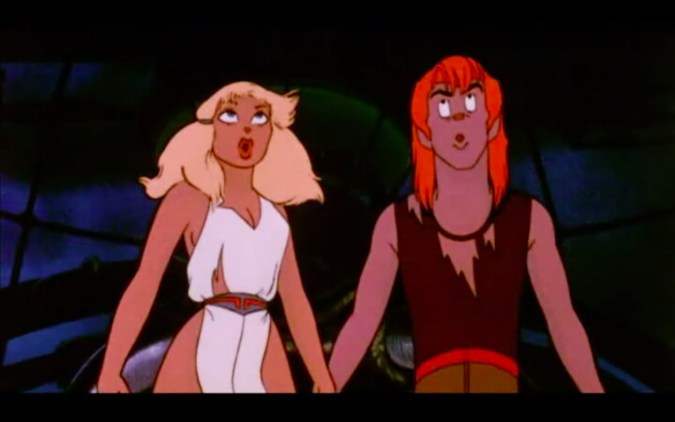
I also adore Debbie Harry doing Angel’s singing voice; “Send Love Through” is a fantastic song, and I love how it bookends the movie, representing something different each time: The first time Angel sings it, she’s desperately trying to reach Omar, who has stalked off stage because he thinks Angel is trying to steal his spotlight, but the second time, she is trying to send back the demon that her voice has summoned, and it’s only after Omar joins her in harmony, singing the song she wrote, that the demon is vanquished. I’m not gonna lie, that final duet with Omar and Angel standing hand in hand before the howling demon, as they sing united in one voice, still kinda makes me tear up a little bit. Is that dumb for a bunch of animated rat-people in a cheesy eighties cartoon? Eh, sue me.

maxresdefault

And although I just called it cheesy (albeit in a loving way), I have to say that the animation on this thing was really gorgeous for the time, and very ahead of the curve. It can be a little uneven, true, since it uses a few different techniques (traditionally-drawn frames, rotoscoping, and even a touch of computer-generated animation, which was still  very much in its infancy at the time), but the overall look of the film is quite cool, particularly the backgrounds, which as I mentioned earlier have a very Blade Runner look to them. Nelvana took more than 4 years and 300 animators to produce this, and it certainly shows.

Rock and Rule Blu-Ray 4

Rock and Rule Blu-Ray 17

sIQgS4NvQ2vv23Bmi7FkoNnys6J

In summation, you owe it to yourself to see this. If you don’t, Mok may put a heck on you, or worse, fetch the Edison balls, and no one wants that. So until next time, keep it creepy (and rocking), my friends. Goddess out.
Mary O’Toole O’Riley O’Shea’s Lifestyles of the Rich and Undeserving: An Appreciation of “April Fool’s Day”

So I’ve been writing this blog for a while now, rabbiting on the way I do, reminiscing about some of my favorite books and movies from my youth and trying to figure out what made certain things stick with me over the years. But in all that time, it never occurred to me to write about this movie, and I honestly can’t goddamn believe I forgot it (*slaps dumbass self in face*), since I probably watched it about a gazillion times on cable and battered VHS tape in the late eighties. For real, I had the shit memorized; dialogue from it is still firmly etched into the wrinkles of my prefrontal cortex, I’m sure. The only thing that recently reminded me of the movie, in fact, was that duh, it was April Fool’s Day last week, and one of the movie channels decided to be as literal as it is possible to be and show a marathon of this under-appreciated, sorta-horror flick of the same name in some kind of bizarre celebration of this lamest of holidays. So I settled in to watch it for the first time in many years. And know what? Shit holds up, and I still remembered pretty much every single line as though I last saw the thing yesterday. Such is the spongelike nature of the teenaged brain.

april-fools-day-1986-movie-featured

HANG ON, WHO’S THAT BLONDE NEXT TO HARV (HAL)?

Directed by Fred Walton (who also directed the 1979 classic When a Stranger Calls), and released in 1986, April Fool’s Day was something of an odd duck in the horror film landscape of the mid-eighties. Not really gory or violent enough to be a slasher, and played a bit too straight to be a horror comedy, April Fool’s Day could in fact be seen as something of a precursor to the self-aware, ironic horrors of the 1990s that kicked off with Scream, though it’s not so patently meta as Wes Craven’s series, and also much less zany than some of the horror parodies (i.e. the Scary Movie franchise) that followed in its wake. Most of the humor in April Fool’s Day is comparatively subtle, like the hilariously WASPy names of the main characters and their rather wry interactions with one another. The movie’s only really wacky flourish, in fact, came during the end credits, with the use of the quasi-vaudevillian Charles Bernstein-penned tune, “Too Bad You’re Crazy,” which I kinda love the shit out of, if I’m being completely honest. One of the things I like best about April Fool’s Day, actually, is that it was essentially a horror parody without obviously being one; it could be enjoyed as a straight horror flick or as a comedy, but with none of the self-conscious or self-referential schtick of a more overt parody.

april3

SORRY, BUT EYE DO NOT FIND THIS EVEN MILDLY AMUSING.

Starring a handful of familiar eighties teen-movie faces like Deborah Foreman (Valley Girl), Amy Steel (Friday the 13th Part 2), Clayton Rohner (Just One of the Guys), and Thomas “Biff Tannen” Wilson (Back to the Future), the movie follows a standard slasher setup whereby a group of privileged college kids are invited to their friend Muffy’s private island one spring weekend, and then proceed to get mysteriously offed one by one.

april-fools-day

THE LAST SUPPER OF BARBIES AND BEENIE-WEENIES.

Most of the eighties slasher laundry list is dutifully checked off: There’s a red herring concerning the killer’s identity, there is a purported “evil twin” angle, there is the expected scene where a survivor stumbles across the (alleged) corpses of her compatriots as she desperately tries to escape the murderer. All par for the course, or so it would seem. What made this film stand out from the pack — for me, at least — was not only that the movie largely refrained from the gratuitous violence and nudity common in slasher flicks of the era, but also that the acting was fairly above par for this type of thing. The characters were genuinely funny and likable, and there was a sort of easy chemistry among the ensemble that made their on-screen relationships feel natural, believable, and entertaining to watch. Plus you have to admit it had some great lines, from Nicki laconically cataloguing a list of names that Muffy might be short for (The Muffster, Muffinstuff) to Chaz referring to himself as “the birdman of S&M” to every delightful pronouncement by Thomas Wilson’s character of Arch, who was probably worth the price of admission all by himself.

Of course, the major aspect of the film that set it apart was — SPOILER ALERT FOR A 30-YEAR-OLD MOVIE INCOMING — that none of the “victims” of the slasher were actually dead. The entire murderous scenario endured by the guests was simply a well-planned dry run for a murder mystery weekend Muffy wanted to implement when she eventually turned the house into a country inn. As each of her friends was “killed,” Muffy would let them in on the secret, until the whole scheme was revealed to “final girl” Kit when she ran screaming away from her “killer” into a room that was just chock full of her supposedly dead buddies, all of whom were very much alive and amused by Kit’s terror. As is customary in this type of movie, there is also a “gotcha” ending, as it appears that after the festivities, wallflower guest Nan has snapped and killed Muffy for real, but this turns out to be just as fake as the rest of the murders.

1361296472-vlcsnap-2013-02-19-

NAN IS CLEARLY NOT PRO-LIFE.

Does this essentially slashless slasher work? I think it does, though I can understand if other viewers might have felt it was a cheat. Personally, I thought that the humor and fun creepiness of the story carried it to such an extent that it didn’t really matter that the murders had all been staged in the end. And if you’ll indulge me as I put on some pretentious film-school pants for a moment, in a way you can argue that April Fool’s Day is really one of the most honest slashers ever made, because it showed the strings on the puppet, the zipper on the monster suit. Yes, all the murders in the movie were shown to be fake, but the murders in all slasher movies are fake; the difference with other slashers is that they want the viewer to take them as contextually real. Huh, maybe this movie was as meta as Scream after all. Or maybe I’m just talking out of my ass again. Could be either thing, really.

Until next time, I’ll be looking forward to dessert (please God let it be Ding-Dongs) and trying to keep my Hostess Twinkie from hanging out. Keep it creepy, my friends. Goddess out.