The Mammoth Mountain Poltergeist Has Officially Been UNLEASHED!

AHEM.

*drum roll*

IT’S HERE! IT’S HERE!

Our poltergeist book is officially ON SALE!!! Please buy copies for yourself and everyone you know! Write reviews if you like it! And if you or someone you know has a paranormal-type blog/podcast/whatever, let me know and I’ll get you a copy for review or set up an interview about it with both of its charming authors! Thank you for your time and patience, and I hope you all enjoy it!

Pageflex Persona [document: PRS0000038_00060]

The Nightmare Collective

e726fa72a0a57aed0ba4b9d0228ca71fcebf74a6

As I mentioned in a previous post, my short story “The Mother of Foresight” will be appearing in an ebook anthology called The Nightmare Collective published by Play With Death. The anthology also includes stories by Tom Wortman, M. B. Vujačić, Manen Lyset, Kyle Yadlosky, G. T. Montgomery, Ari Drew, Patrick Winters, Trevor James Zaple, John Teel, Dexter Findley, and Kyle Rader. For the first week after its release, the book will be a FREE DOWNLOAD! Click this link and sign up to get notified when the ebook is released!

Mary Shelley, Frankenstein & the Summer of 1816

A strange gathering of intellectual luminaries during one “haunted summer” produced one of literature’s most enduring creations.

MaryShelleyFrankenstein

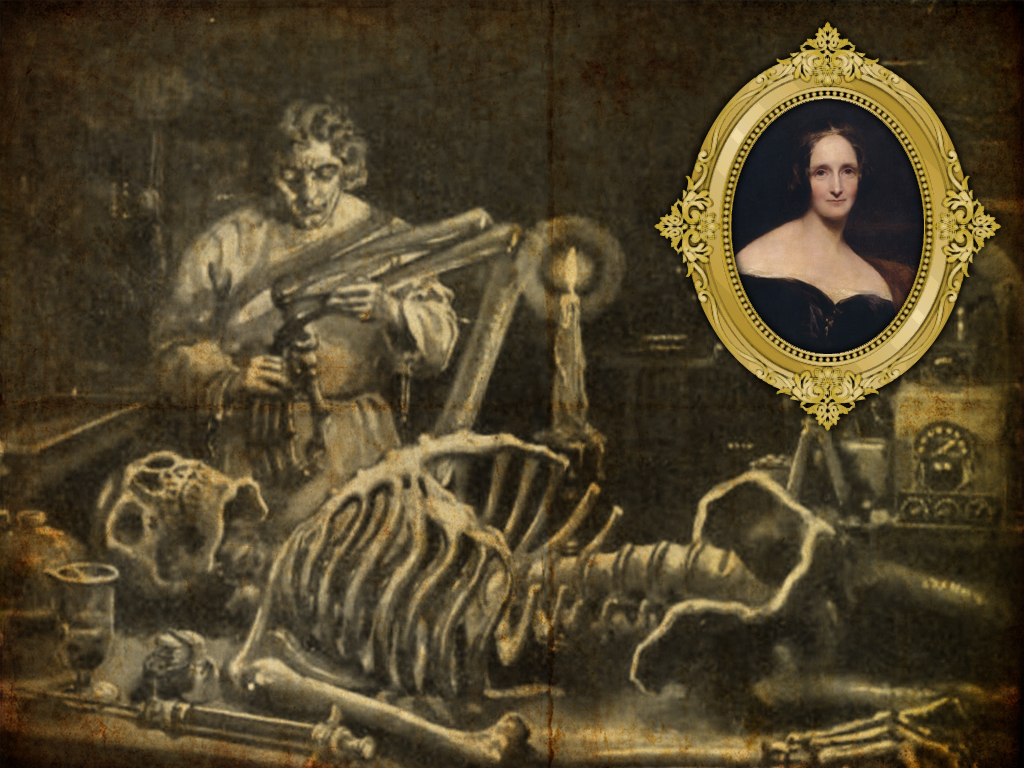
Frankenstein’s monster is one of the most ubiquitous characters in popular culture, appearing everywhere from movies and novels to children’s toys and cereal boxes. Though the image we have of the lumbering creature today—greenish skin, square head, beetling brow, ropy scars and neck bolts—has been largely formed by Boris Karloff’s stunning portrayal in the Universal horror films of the 1930s, in the beginning, the monster was literally dreamed into existence under rather eerie circumstances by an eighteen-year-old girl.

Summer in Switzerland

It was May 14, 1816. Romantic poet Percy Bysshe Shelley and his “wife” Mary (the couple only married later that year, though Mary already used his last name) had been invited by friend and fellow poet Lord Byron to visit him at a rented chateau, Villa Deodati, on Lake Geneva in Switzerland. Also joining the festivities were Mary’s stepsister Claire Clairemont—who was pregnant with Byron’s child and was trying to get back into his good graces—and Byron’s personal physician John Polidori.

The gathering apparently started out quite idyllic—the friends spent long hours writing, discussing weighty ideas, and boating in the lake. But a short time after the group arrived, the weather took a bizarre turn, and it seemed the streaks of lightning and the torrents of rain would never cease. Mary and the others were confined to the house for many days.

Ghost Stories

More reading and discussion ensued. Particular topics of conversation included the early evolution theories of Erasmus Darwin, as well as the new science of galvanism. Also contributing to the entertainment of the group was a book of German ghost stories called Fantasmagoria, which the friends took turns reading aloud.

The combination of the macabre tales and the isolating weather seemed to have strange effects on everyone present; Percy Shelley, at one point, succumbed to visions that sent him screaming from the room. Later, Shelley claimed that Byron’s reading of the Samuel Taylor Coleridge poem “Cristabel” had brought to mind the image of a woman with eyes instead of nipples, which horrified him.

Setting to Work

Some time after this incident, the group decided that they would each try to write their own ghost story. Most set to work immediately and produced tales of varying quality. Byron wrote a story fragment titled “The Burial,” which was later published as a postscript to his narrative poem Mazeppa. Shelley wrote a tale called “The Assassins,” which apparently never saw the light of day (though his poem Mont Blanc, written around the same time, was published later that year). Dr. Polidori wrote “The Vampyre,” later expanded to novel length, which was the first vampire story published in English and which some speculate might have been an inspiration for Bram Stoker’s Dracula, written 78 years later.

The Monster Is Born

Mary Shelley, however, couldn’t think of an idea for a story, and had to respond with a frustrated “No” when asked by the others if she had begun work on it. But then, one night, she had a terrible nightmare. She woke violently amid the sounds of the storm howling outside. The dream had been so vivid that she had a difficult time believing it hadn’t been real. Since she was too shaken to sleep, she began writing down her dream, in which “a pale student of the unhallowed arts” used bits of corpses to create a man. “By the glimmer of the half-extinguished light,” she wrote, “I saw the dull yellow eye of the creature open; it breathed hard, and a convulsive motion agitated its limbs.”

Mary’s terrifying dream was described verbatim in the story she presented to the others. Though the first draft was only about 100 pages long, Percy loved the story and encouraged Mary to flesh it out. She did, and two years after the strange events at Lake Geneva, the story was published as Frankenstein, or the Modern Prometheus, thus introducing one of literature’s most frightening figures to the world at large.

The Goddess’s Favorite Creepy Movie Scenes, or Down in the Mines with Mina

One of the main underlying themes of a lot of these blog posts is an examination of why particular moments in horror film, literature or music made a lasting impression on me while others did not. Why, for example, was I terrified by the bubbling cauldron sound at the beginning of “The Monster Mash”? Or the schlocky scene in My Bloody Valentine where the homicidal miner pops out of the closet with the pickaxe? Or the part in Fright Night where Amy reveals her horribly wide terror-mouth? I still have no idea, but it’s been fun reliving all this stuff from my wayward youth and trying to find some kind of perspective on it, or contemplating the threads that might tie all these disparate things together.

The next scene I want to discuss is another one of those that, for whatever reason, has stuck with me for 35 years, even though I don’t remember much about the rest of the film. The scene itself was only a couple of minutes long, but I can still vividly remember the heart-stopping shudder that traveled through my body the first time I saw it, and further recall how I studiously covered my eyes during the scene on subsequent re-watches of the movie.

Before I get to the main feature, allow me another short commercial break. I still have a Patreon campaign going to fund my writing work, and there are lots of neat rewards just for pledging a few bucks a month, so check it out, won’t you? Thank you. And now back to our regularly scheduled programming.

Seems to me I live my undeath like a candle in the wind.

Seems to me I live my undeath like a candle in the wind.

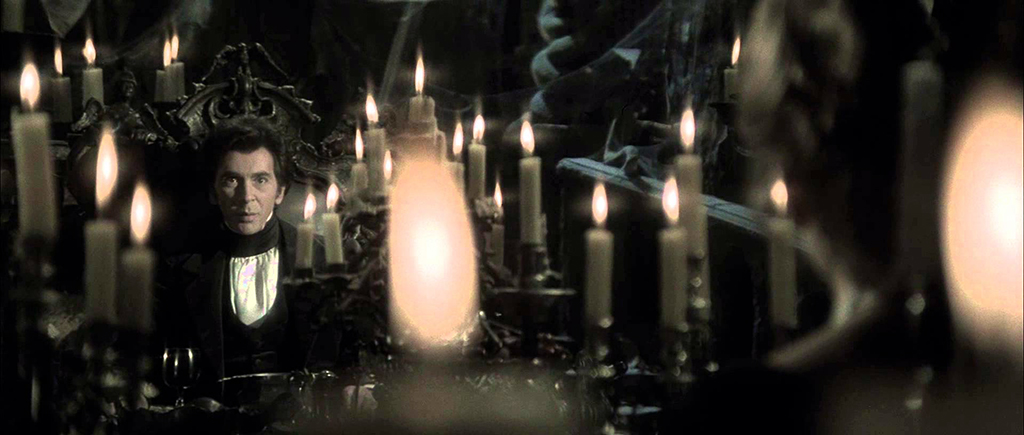
John Badham’s version of the classic Dracula (1979), starring Frank Langella as the titular Count, came out around the same time as a few other vampire films, notably Werner Herzog’s elegant remake of Nosferatu. Badham’s adaptation wasn’t horribly reviewed, but apparently audiences were experiencing some vampire fatigue, and it only did so-so business at the box office. I was only seven when it was released in theaters, so I didn’t catch it until it ran on television a year or two later; in fact, I’m fairly sure it was the first of the major Dracula film adaptations I ever saw, even before the more-famous Bela Lugosi and Hammer versions.

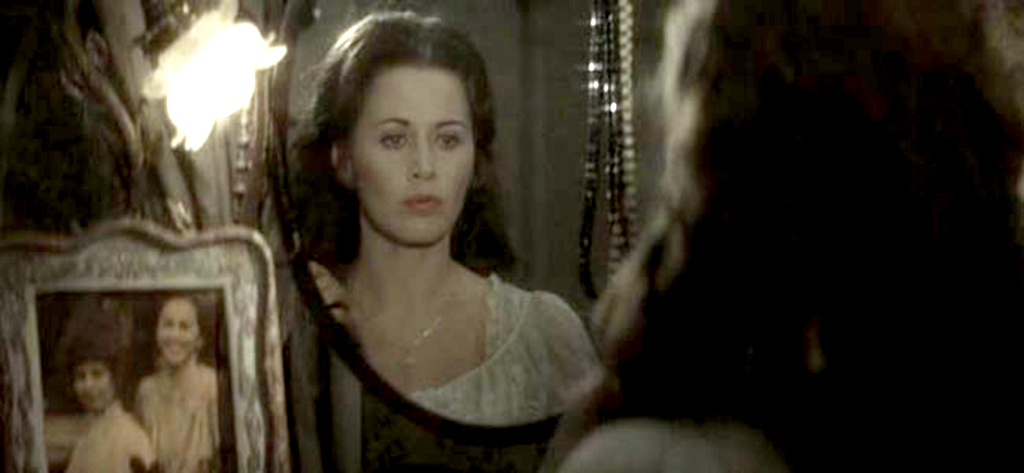
Like the 1931 Bela Lugosi film, Badham’s Dracula was based on the stage play rather than the novel, and followed a lot of the tropes of the Universal version. For example, Dracula is portrayed as a seductive, romantic figure rather than a ratlike monster as in the book, and the entire first part of the novel (where Harker is kept prisoner in Dracula’s Transylvanian castle) is scuttled, allowing the movie to start with the Count’s arrival on English shores. Something the Badham film does that I thought was odd, though, is that it reverses the characters of Lucy and Mina; Mina is the first one attacked and vampified by Dracula, for example, while Lucy is Harker’s fiancée, and is attacked later but ultimately saved when the vampire is staked. The film also portrays Mina as the daughter of Van Helsing and Lucy as the daughter of Dr. Seward. These changes don’t ruin the story or anything, but they also don’t really add to it, so I’m not sure why they were made. Perhaps because some characters were eliminated for brevity (like poor old Quincey Morris, who hardly ever gets a part in these adaptations), the screenwriter thought it would increase the drama and emotional coherence of the characters to make them all related somehow, but I’m just speculating about that. Still doesn’t explain why Lucy and Mina were reversed, but whatever.

Pictured: Identity crisis.

Pictured: Identity crisis.

As I said, I don’t remember a great deal about the film as a whole; I remember enjoying it, and being quite taken with Langella’s graceful performance as the Count, but even though I saw the movie several times when I was about nine years old, very little of it made a lasting impression. Except for that one, very brief scene.

If my quick Google search is any indication, I’m not the only one that has had this scene burned into my memory for more than three decades. I’m not entirely sure why the scene is so memorable; it could be simply because in the context of the film, it is so shockingly unexpected. This version of Dracula, after all, was marketed more as a supernatural romance than a horror film, and played rather like a staid English parlor drama (with fangs). There was little to no gore that I remember, and nothing that was outright frightening. But then this happens:

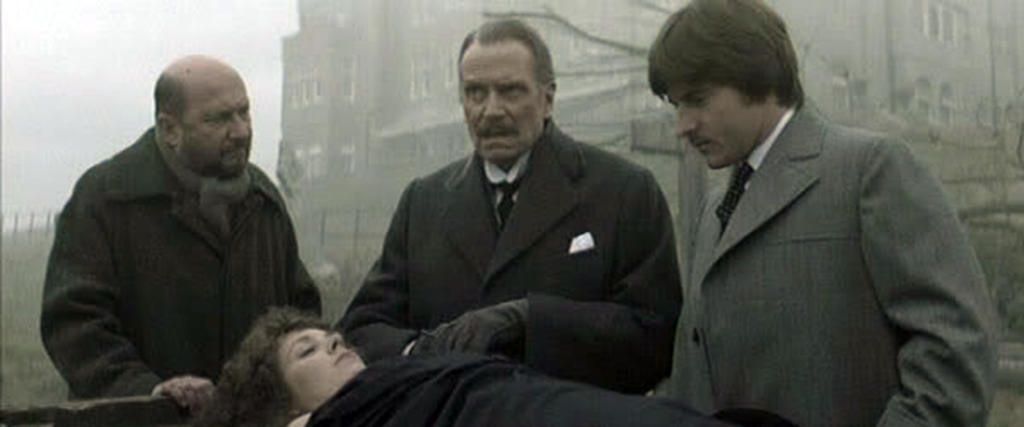
The lovely Mina (Jan Francis) has been exsanguinated by the foxy Count one night while her friend Lucy (Kate Nelligan) is out tramping it up with Jonathan (Trevor Eve). It makes me feel weird to even type that, you guys. It’s like they were cheating or something, what with the character reversal and all. Though now that I think about it, how great would a Mina/Lucy catfight scene have been? Anyway. The next morning, Mina is pale and gasping for breath, and dies as a horrified (and guilty) Lucy looks on. Dr. Seward (Donald Pleasance) has no idea what could have killed Mina, and summons Dad Van Helsing (Laurence Olivier) to help solve the mystery.

It’s clearly lupus.

It’s clearly lupus.

No slouch, Van Helsing immediately jumps to the most obvious conclusion, that eine nosferatu is running loose in the vicinity. As an aside, though, this is Van Helsing we’re talking about. He probably blames a vampire every time one of his socks disappears from the washing machine. Sure, he was correct in this case, but even a stopped clock, yadda yadda.

I’m not saying it was vampires. But it was vampires.

I’m not saying it was vampires. But it was vampires.

Anyhoo, Seward and Van Helsing visit Mina’s new grave in the cemetery, and find that her coffin is not only empty, but contains a ragged hole where she presumably dug herself out. The hole leads underground into some old mining tunnels, and they crawl down there to investigate, pretty sure of what they’re going to find. As they peer into the darkness, visions of the beautiful Mina probably uppermost in their minds…

Like so.

Like so.

…they begin to hear a shuffling sound coming toward them. They raise their lamps or candles (I can’t exactly remember which, and can’t find the scene on YouTube to check), and there, emerging from the darkness, is this horror, reaching for them and begging for a kiss:

At least she has a good personality. Well, aside from the bloodsucking.

At least she has a good personality. Well, aside from the bloodsucking.

This shit scared me SO BAD, you guys. And in this sense maybe it was a sound storytelling idea to make Mina Van Helsing’s daughter, because the tragedy of the scene is very apparent here, and underscores the horror with great effectiveness. The figure of the undead Mina is terrifying but also heartbreakingly pitiful, and the viewer really feels it when Van Helsing has to put down the monster his daughter has become. The rest of the film isn’t nearly as powerful, but that one scene is a stunner.

Keep watching this space for more of my horror-related wanderings, and news on my upcoming poltergeist book! Until then, Goddess out.

The Goddess Picks Her Five Favorite Horror Novels by Women

WomenInHorrorHeader


February, in case you hadn’t heard, has been designated Women In Horror month, and even though I gotta admit I’m kinda longing for a future where female horror writers will be so commonplace that it will be unnecessary to even remark upon them, I do feel like we vagina-havers still need our own month for now. That’s because, for whatever reason, women who write horror are still thought of as something of a novelty, or at very least a tad oddball. It’s a lot better than it used to be, sure, but even in this enlightened year of 2015, it’s not unusual for a horror anthology to come out containing no women authors at all, and there’s still a lingering perception that women don’t like horror as much as the guys do, or they don’t write it as well, or something, since apparently we’re all just precious delicate flowers who could never possibly enjoy the song of the chainsaw, the call of Cthulhu, the visceral thrill of seeing someone’s spine forcefully extricated through their mouth. I guess there’s a similar bullshit thing going on with female comedians and “girl geeks,” but I’m not really gonna go into all that because this is a horror blog, and I gotta stay focused on the topic without going off on a rant. Anyway, since I’m a woman who has always loved everything to do with the horror genre, I’ve decided to celebrate Women In Horror Month by honoring a few of my favorite “girl” writers in the genre with this humble blog post. So here we go.

WomenInHorrorNovels

Shirley Jackson – The Haunting of Hill House

I know I talk about this book a lot (and I wrote a whole blog post about the fantastic film adaptation as well), but that’s because it is probably my favorite horror novel of all time, and easily one of the best horror novels of the 20th century. In Ms. Jackson’s capable hands, something as pedestrian as a haunted house story becomes a multilayered, intensely terrifying study of psychological breakdown. Her masterful characterization of Eleanor Vance is one of the best in literature of any genre, and I would defend that statement to the grave. If you love Haunting of Hill House, and I know I do, also check out her other novels The Sundial and We Have Always Lived in the Castle, which explore similar themes.

Anne Rivers Siddons – The House Next Door

Another haunted house story (because you know how much I love those), but from the completely opposite side of the spectrum as Jackson’s novel. The haunting in The House Next Door takes place in a fancy, newly-built contemporary pad thrown onto an odd-shaped lot by a hot-shot architect in a chi-chi Atlanta suburb. The main players are agonizingly upper-crust, status-conscious, and at times completely snobbish and obnoxious, but their unlikeability makes their fates that much more devastating. The cursed-from-birth house next door doesn’t contain anything as gauche as a spirit, exactly, but more like a force that somehow knows and plays upon the residents’ deepest fears and insecurities, and dishes out scares accordingly. A fresh take on the subgenre, and a satisfying one.

Doris Lessing – The Fifth Child

A supremely literary horror story, and a short one clocking in at only 150 pages, but its tentacles grasp tightly. Somewhat reminiscent of Rosemary’s Baby, The Fifth Child sees “perfect” married couple David and Harriet pushing out one kid after another, much to the consternation of their extended families, who fear that the couple cannot care for the ones they already have. The first four kids are pretty much okay, but that fifth one, as the title suggests, is a doozy. A concise and terrifying examination of family dynamics and the social expectations surrounding the bearing of children.

Poppy Z. Brite – Exquisite Corpse

Perhaps this isn’t a fair choice for a “women in horror” post, since Poppy (born Melissa Ann Brite) has since undergone gender reassignment and now prefers to be known as Billy Martin, but at the time this novel was written she was still identified by a female pronoun as far as I know, so I’m going to include it. It’s a shockingly sick tale of two serial killers (based on real-life nutcases Dennis Nilsen and Jeffrey Dahmer) who join forces in order to find “the perfect victim.” They find their unicorn in the form of a pretty Vietnamese boy named Tran, and the story spirals into horrific madness from there. All of Brite’s trademarks are present, from the obsession with twisted killers to a fixation on the darkest and seediest underbellies of New Orleans. This is an intensely gory and profoundly fucked-up (but fantastic) novel.

Caitlín R. Kiernan – The Red Tree

Kiernan has written a lot of great books, including several pleasingly Lovecraftian ones. The Red Tree is the creepy tale of a woman named Sarah who moves to an old house in the woods after a terrible breakup and becomes obsessed with the ancient tree growing in the backyard, and the manuscript she finds that seems to hint that the tree conceals some terrible secret. If you like this one, I’d also recommend Silk and Low Red Moon by the same author.

Until next time, Goddess out.

A Valentine’s Day Horror: “Here Comes the Bride”

It is the eve of the day of looooove, my dears, and to get you in the proper mood for the big red-drenched event, here is a properly horrific love story I wrote called “Here Comes the Bride.” It’s as fitting as a wedding dress on a rotting corpse; I think you’ll agree. It is also available in my short story collection Hopeful Monsters, which you may purchase if you so desire. Also remember that I still have that Patreon campaign going, so if you’ve any love left over after your V-Day load is spent, spare a drop or two for the Goddess, and you will be amply rewarded. And now, on with the dripping red love…

 

GoddessValentine

“You’re not bringing that girl here.”

Troy’s father was yelling, and even though Troy curled his body down as small as it would go, burrowing under the covers and clapping his hands over his ears, the man’s voice still resonated through his head like the toll of a great bell.

“Your father’s right, Troy.” Mother had gotten into the act too, and even though Troy couldn’t see her from his position, he could imagine her glossy pursed lips, her deeply furrowed brow. “We don’t even know this girl. And you know what happened those other times.”

Troy had a feeling his older sister would chime in next, and he was not disappointed. “How could you even get a girl anyway?” Sue sneered as Troy pressed his palms harder against the side of his head, trying to block out the sounds. “You sure you didn’t pay this one?”

Troy felt a single tear trickle down his cheek, and in its wake came a hatred made stronger by the knowledge of his fierce love for them—his family, his eternal tormentors. Their voices were all mixed together now, raining down on him from above, hemming him in with their ridicule until he was closed into an atom-sized box that he could see no escape from. He might have screamed, but because of the din of mingled shouts he couldn’t be sure. He pushed at his temples as hard as he dared, making flashbulbs of white light explode into the darkness behind his eyes. He knew they would stop berating him eventually, knew there would be blessed silence after they’d exhausted their vocabularies of disgust for him; but in the meantime there was only noise and pain, infinite in its intensity.

He wasn’t sure how much time had passed when the voices finally started to dwindle—perhaps only minutes had gone by, perhaps lifetimes. Slowly, Troy removed his hands from his ears; the fingers were numb and sluggish, feeling as though they belonged to someone else. He pulled the covers away from his face and opened one eye a crack, peering into the gloomy dusk of his bedroom. Everyone was gone, and quiet reigned at last; the only sounds he could hear now were the reassuring hum of the central air conditioning and the distant buzz of a plane passing overhead. He sighed and fell back against the pillows, letting the cool air from the vents dry the layer of sweat on his skin. His family was upset, he knew, but he also knew that they would soon get over it. They would have to; Sonja was coming tomorrow. And when they met her, all their negative feelings would evaporate. They would love her, just as Troy loved her, and perhaps in her glow they would come to see Troy himself in a different light.

“She’s already on her way,” he whispered to his empty room, hugging himself with his long, pale arms. “Wait until you all see her.”

****

Candy Rattner, otherwise known as Sonja Andropova, threaded her way through the airport, a large duffel bag slung over one shoulder. She’d just flown in from Cleveland, but she had to hustle over to the international terminal, where the sap was picking her up. She’d told him she was arriving from Moscow, and of course he’d bought it. Why shouldn’t he?

As she walked, she practiced some Russian phrases under her breath, paying special attention to her accent. In her experience, Americans were generally not very observant about languages as long as she sounded suitably exotic—hell, most of them wouldn’t know a Russian word if it bit them on the ass. But each new scam was different, and one could never be too careful.

Candy hopped on the tram that ran between terminals, holding on to the silver bar with both hands and ignoring the appreciative glances of the rumpled businessmen leaning against the back of the car. She knew she was beautiful—her body tall and lithe, her olive skin flawless, her abundant black hair swept dramatically back from her sculptured face. She supposed she enjoyed the attention to a point, but deep down she understood that her appearance was simply a tool of her trade, a means to an end. She stretched, catlike, giving the businessmen a show, then switched her bag to her other shoulder.

The tram shuddered to a halt and Candy disembarked, moving smoothly through the crowd on her long legs. Her dark eyes scanned the signs, and when she saw one pointing toward the main terminal, she headed down a carpeted gangway, her jeweled sandals—shabby and a few years out of style—slapping against her heels. She glanced at her watch and frowned. Her flight from Cleveland had been delayed, but she still thought she could make it to the meeting point before Troy did.

Sighing, she thought of her latest mark. She had never met him before, of course—their most in-depth conversations had occurred over the Internet. She’d never even heard his voice. He had emailed her pictures of himself, though. He was a handsome young man, a little intense; not that it particularly mattered to her what any of them looked like. He had also sent her pictures of his house, and these she had scrutinized with great interest. The guy was clearly loaded, or at least his parents were. She remembered sitting in front of the computer in her two-room Cleveland apartment, grinning from ear to ear as she stared at that marvelous spread. If she could pull off this one gig, she had thought to herself, then maybe she’d be able to retire from the racket for good.

There was a large fountain in the middle of the terminal, its blue waters spewing foam high above the heads of the passing travelers, its rushing roar muffling all sound within a hundred-yard radius. Candy scanned the fountain’s marble lip, searching for a lanky, sandy-haired figure whose facial expression would suggest expectation, desperation, and perhaps just the faintest touch of shame. She saw no one, and her tense muscles relaxed a little. She felt around in her pants pocket, coming up with a crumpled five-dollar bill, then ducked into a nearby Starbucks for a latte to drink while she waited.

****

Troy spotted his beautiful bride at once. She was even more radiant than he had hoped, her taut figure perched gracefully on the edge of the fountain, her demure profile seeming to shimmer against the dull gray backdrop of the passersby. She was drinking coffee and peering down at an open book in her lap; a closer inspection revealed it to be an English phrase book.

For a moment Troy was loath to approach her, afraid she would twinkle out of existence like the crystalline falls of water that framed her angelic form. So much was riding on this meeting—what would Mother and Father say? They hadn’t come with him, but he could still hear their scornful voices echoing in his head. He clenched his fists by his sides and straightened his back, quickening his pace. He would make his family accept Sonja as his wife, that was all there was to it. She was right there in front of him, like a dream become flesh. She was perfect.

****

Candy felt his presence before she saw him.

When she looked up, he was standing no more than two feet from her, leaning slightly forward, his expression a little dazed. She was taken aback at his sudden nearness, but managed a quick smile. “You are…Troy?” she said in her practiced, broken accent.

There was a longer pause than was warranted, and Candy’s inner alarm seemed poised to jingle, warning her to abort the mission, which was how she always thought of these deals. But finally, after what seemed like an eternity in which the pounding water of the fountain served as the only distraction, Troy answered, “Yes.”

She smiled again, more broadly, hoping to conceal the uneasiness that had sprouted in her stomach. She couldn’t give up on this one, she thought; it might be her ticket out. She felt like she should say something more to him, but she couldn’t think of a single thing. “We go?” she asked at last, not wanting to sound too eager but wanting to fill the pounding silence up with words, however meaningless.

“Yes.” Troy seemed to snap out of whatever trance had held him, and he began looking around at her feet. “Do you have any other bags?”

Candy scowled prettily, as if trying to parse the sentence he’d just uttered, then brightened as pretended understanding dawned. She patted the duffel bag by her side. “This is only bag.”

Troy’s face seemed to sag a little at that, but he quickly recovered, holding out his hand. “Here, I’ll carry it for you.”

She let him take it, then got to her feet. She was nearly the same height as he was. As he headed for the signs marked Parking Garage, she kept a few steps behind him, smiling brilliantly whenever he glanced over his shoulder at her, which was unsettlingly often.

Candy studied him as they made their way out of the terminal. He was a little thinner than his pictures had suggested, but clearly in good physical shape. He was clean and well-groomed, his slacks and white dress shirt freshly pressed. He’d given his age as twenty-five, but to Candy he seemed a little younger than that, earnest and eager to please.

They reached the parking garage, neither having spoken. Candy gazed admiringly at the pearl gray Infiniti as Troy loaded her bag in the trunk. He came around and opened the door for her, which she thought was very sweet; as she got into the passenger seat, she rewarded him by lifting her skirt with a subtle hand motion, exposing a few inches of smooth upper thigh.

They exchanged few words on the drive; Candy was afraid of giving too much away, of slipping up in her finely crafted persona, and Troy, for his part, simply seemed nervous. He adhered strictly to the speed limit, she noticed, and his knuckles were white on the steering wheel.

After about forty minutes of silence, with not even a radio playing softly to fill the gap, the uneasy feeling began creeping into Candy’s stomach again. She opened her mouth to say something, anything, when suddenly Troy flipped on his blinker and turned off the road onto a narrow paved track surrounded by thick, overhanging trees. He turned toward her in the ensuing dimness. “Almost there,” he said.

She smiled and nodded, forgetting about making small talk in her eagerness to see her new surroundings. She leaned forward a little in her seat, peering intently through the windshield.

The house, when it emerged from the dense foliage, was far more fantastic than she had imagined. It was a palace, plain and simple, comparable to those sprawling English country estates she’d always lusted after in those old Merchant-Ivory movies. There was an enormous pond in front, grown over with algae but still dazzling, with a stone statue of a cherubic boy in its center, frolicking under a fountain of water that no longer flowed. The gardens were extensive, if a little overgrown; the flowerbeds needed weeding and some of the hedges were due for a prune, but otherwise the expanse was magnificent.

And then there was the house itself. Candy couldn’t help gaping at it as Troy guided the car around the circular gravel driveway. The main structure was made of a softly glowing stone of a speckled caramel color that blended organically with the surroundings. There appeared to be a massive center hub flanked by two wings, each with an octagonal tower topped with distressed castellations. There were numerous small square windows, many of them bearing intricate stained glass designs. The entire spread bore the unmistakable aura of vast wealth and power.

After a few moments, Candy became aware that Troy had stopped the car and turned in his seat to look at her with his rather unnervingly open expression. She could see that he wanted very much to please her. That was good, very good. “Do you like it?” he asked.

Candy was so overwhelmed by her unbelievable luck that she almost forgot to speak with a Russian accent. Catching herself just in time, she said, “It is so…beautiful. I did not know America looked like this.”

Troy laughed, and there was a hard edge to it that Candy didn’t like. “Most of it doesn’t. But this is your home now. Your life.” He smiled widely, and his teeth were very white in the shadows of the car’s interior.

****

If the outside of the house was beyond imagination, then the inside was almost surreal. As she entered through the carved wooden doors, she felt like an ant who had just stumbled over the threshold of Notre Dame—the ceilings soared high above her, inlaid with complicated tile patterns and alternating colors of polished stone. She held her breath, afraid that even the sound of a sigh would bounce back to deafen her.

“I’ll take your bag upstairs,” Troy said, his voice coming from all directions at once. “You can look around some if you want to. Don’t get lost, though.” That predatory smile again.

“I will just sit in here,” she said, gesturing to a sitting room on her left. She didn’t want to admit it, but the sheer vastness of the house frightened her. She had targeted quite a few rich guys in her time, but none of them had been this rich. She felt as though she might pass out at any moment. “Is okay?”

Troy shrugged. “Sure. When I come back down I’ll make us some tea and we can talk. Later on I’ll give you a tour, and then you can meet the family.”

Candy nodded and watched as he disappeared up the curving staircase with its iron banisters. When he’d gone, she wandered into the sitting room, which was filled to brimming with fussy claw-footed furniture that looked as though it had never been sat on. She poked into a couple of the drawers and highboys, but found nothing of interest. A few of the vases in the corners looked terribly expensive; perhaps they were Ming or something like that. There was even gold flocked wallpaper, of all things; Candy stepped toward the wall for a closer look, and noticed that there were lighter gold rectangles at even intervals along the walls, as though pictures had once hung there. She wondered what they had been, and why they had been removed.

A few moments later she heard raised voices, and ducked her shoulders guiltily before realizing they were coming from upstairs. She crept back out into the hallway to listen, removing her shoes on the way so their heels wouldn’t flap and echo. She couldn’t really tell what was being said, but she heard Troy, a reedy, defensive whine, and then another male voice, deeper, authoritative. There were women’s voices too—one or two of them, Candy wasn’t sure. She assumed the family was not too pleased about her arrival, and her uneasiness ramped up another few notches. Surely Troy had worked this all out before arranging for her to come here? She hoped this whole gig was going to run smoothly; she hadn’t really bargained on uncooperative relatives sticking their noses in.

The voices died down, and then she heard footsteps reverberating over her head. She darted back into the sitting room and installed herself on the edge of one of the settees, snatching an architectural magazine from an end table and pretending to leaf through it. When Troy appeared on the threshold, she looked up expectantly, as if she’d been waiting for him all along. “Okay?” she said. She didn’t want him to know what she had heard; it might complicate matters.

His jaw seemed tight, but otherwise he gave no outward sign of distress. “Your things are in one of the guest rooms for now,” he said, and then his face reddened as he realized the implications of his statement. “I mean, there are lots of empty rooms. You can stay in whichever one you want.” He grinned awkwardly, then made a stiff gesture for her to follow him. “We’ll have tea out on the sundeck.”

After flashing him a look of pleasant blankness, as though she hadn’t the foggiest idea what he was talking about, she began trailing along behind him, soon losing all sense of direction in the maze of twisting corridors. At last they entered a kitchen big enough to park a 747 in, and Troy set to work, pulling cups and saucers from one of a long phalanx of cabinets. Candy wondered why there were no servants, but she thought it better not to ask just yet.

While he worked, Candy made her way down the small hallway he’d indicated, which terminated in a pair of blue glass doors. She opened these and proceeded out onto a huge wooden deck that overlooked part of the gardens. Candy sat at one of the umbrella-covered tables, staring out at the early fall blossoms and wondering what in the hell she’d gotten herself into.

****

After tea and an awkward conversation in which the main thing Candy learned about her future “husband” was that he was the most socially inept person she had ever met, Troy cleaned up the dishes and led Candy on a rather perfunctory tour of the house. The doors of most of the rooms were closed, and stayed closed, usually with Troy explaining that the rooms were empty or only used for storage.

The house was vast and beautiful, and Candy tried to work up the requisite enthusiasm as she followed him around, but the flight and the stress of beginning a new con had finally caught up with her. “I am sorry, Troy,” she said haltingly. “I am very tired. Maybe finish another time?”

A deep, thunderous frown crossed his face so quickly that Candy wasn’t even sure if she had seen it. “That’s all right,” he said, taking her arm gently and leading her back down the hallway they’d just traversed. “You can rest in your room for a while, if you want. Then later we’ll have some dinner, and meet the family if they’re around.”

Candy’s stomach lurched at the prospect, but she only nodded and let herself be led through the already unfamiliar corridors.

At last Troy stopped before a door, opened it, and guided her inside. For one uncomfortable moment, it seemed as though he was going to follow Candy into the room, but with a jolt he stopped just a few paces over the threshold. He stood there, fists opening and closing by his sides.

“Thank you,” said Candy, hoping he’d take the hint, too tired to even look around at her new digs.

After a moment, Troy bowed his head at her once, formally, like a butler, then turned and left the room, closing the door behind him. Candy let out a sigh of relief, immediately making for the massive bed that dominated one corner of the room, slipping off her shoes and setting them next to the duffel bag that Troy had brought up earlier. She wondered if he had looked through it, then decided she didn’t much care if he had. Let the sad bastard get a few jollies sifting through her unmentionables, she thought with a wry grin.

She stretched out on the bed, which was almost criminally comfortable, if a tad musty-smelling. She thought she’d fall asleep right away, but she just lay there, aching muscles slowly unfurling but her exhausted brain refusing to settle.

She assessed her situation. First of all, this was the biggest con by far that she’d ever attempted, and she had to fight the vaguely queasy feeling that she was in way over her head. The con would work the same, she told herself—how rich the guys were didn’t matter. And one look at handsome, sheltered Troy convinced her that he’d be a piece of cake to manipulate. He was clearly desperate for a woman; she speculated that he might be a virgin, which would make her job even easier.

She was worried about his family, though. From the sound of their shrieking this afternoon, she deduced that they were none too pleased with this whole situation, with her presence here. If they were able to get to him, to poison him against her…

But no, she couldn’t let that happen. She’d just have to play it cool—be nice as pie to the family when she met them, but then try to subtly undermine their influence whenever she was alone with Troy. Make it seem like it was him and her against his meddling relations. Yes, that was the smartest way to play it. She’d have to be careful that she didn’t get the idiot disowned, but hopefully she’d have made the haul and taken off before things got to that point.

Candy slowly realized that the same shouting she’d heard earlier had started again; she’d been so lost in thought that she hadn’t noticed it, so for all she knew it could have been going on for a while. Still tired, but galvanized by curiosity, she slid off the bed and crept toward the door, pressing her ear against the wood, listening.

It was the deep male voice speaking, which she assumed belonged to Troy’s father. Candy could only make out random phrases and stray words, but the man’s tone was one of obvious rage, but also, she thought, a hint of resignation.

“How is it…different?” the man bellowed, and Candy could almost imagine Troy cowering under the authority of that booming voice.

She heard Troy uttering something unintelligible that ended with “marry me,” then he said, “She’ll…I ask.”

Candy cursed under her breath. What had he meant by all that? She’ll do whatever I ask? Her frown deepened. Man, if he thought that, he was dealing with the wrong Russian mail-order bride.

The father was speaking again, louder. “We can’t…for you,” he said, and Candy clenched her fists in frustration. What the hell were they saying?

There was another exchange that she caught none of, and then there was the definite sound of a door slamming and heavy footsteps coming closer through the hallways. Quickly, Candy climbed back onto the bed and feigned sleep. A moment later, there was a firm knock on the bedroom door. She thought if she ignored it then Troy would go away, but the knocking persisted. Angry and strangely fearful, she got up again and slipped back into her shoes—because it seemed vulgar to converse in one’s bare feet in a house as grand as this one—and opened the door.

It was not Troy who stood there. This man seemed taller and broader, with a strong resemblance to Troy but with something harder behind the eyes. The blonde hair was shot through with gray, the skin around the eyes and mouth darkened by fine wrinkles. “You’re Sonja,” he said. It wasn’t a question.

Candy thought it odd that he had addressed her by her first name, but she let it go. “Yes.”

“And you are here to marry my son.” The flinty eyes narrowed, taking in her face, her body, her entire being.

Candy hesitated, her mind racing, but then said, “If your son will…accept me.” She lowered her gaze and then raised it again, like a deferential bow.

This seemed to be the correct answer, because the man’s features visibly softened. His eyes still glinted like steel, though. “You may have noticed that my son is a little…shy.” He was seemingly embarrassed to be discussing something as feminine as emotions. “He’s had his problems, I’ll admit that. But I hope that this time he’s found someone who can relate to him. Someone who will…stick around.”

Candy remembered to look pained, to pause as though struggling to understand the language. “Yes,” she said, thinking that the man’s use of the phrase ‘this time’ pointed to her not being the first, wondering how much harder that was going to make matters. “I think…I will like Troy.”

The man brightened, and suddenly he seemed much younger, more like a man than an obdurate brick wall. He even reached toward her, briefly, before catching himself, glancing in horror at the hand that had seemingly betrayed him. Then he backed up a few steps before turning and lumbering down the hall, not saying another word.

Candy closed the bedroom door, disturbed and relieved in equal measure. She was glad to see that Troy’s father wasn’t the ogre she’d been expecting, but that strange gesture just now, when he’d wanted to touch her… She shook her head. She’d have to watch herself around him, that was certain.

The exhaustion hit her again, more insistent this time, so, not even bothering to take off her shoes, she flopped across the bed and was asleep in an instant.

****

Troy was rooting around in the attic, sneezing uncontrollably at the clouds of dust he was kicking up, sending squealing rodents from corners with his clumsy maneuvering. He wasn’t worried about the noise he was making; Sonja’s room was two floors below in the opposite wing, and besides, when he’d peeked in on her earlier she had been sound asleep.

Troy tried to put the image of the beautiful Sonja stretched across the bedclothes out of his mind so that he could concentrate on the task at hand. He knew the key to the special room was around here somewhere; he had kept it well hidden for years, saving it for the momentous occasion of his marriage. He poked his fingers into the drawer of an antique jewelry box, but came up with nothing except dust and the desiccated carcass of a dead silverfish. Scowling, he wiped his hands on his trousers and opened the next drawer. Nothing there either. He was beginning to worry that someone had moved the key, but who could have possibly done that? Nobody knew about it but him, nobody came up to the attic but him. He had just forgotten where he put it, that was all. He was always misplacing things, and anyway, it was a long time ago.

At last he came across the key in the bottom of an empty violin case, tucked under a flap of decaying velvet. He didn’t remember putting it there, but that didn’t matter now. Curling the rusty metal into his fist, he made his way to the narrow staircase, leaving the attic in disarray behind him.

Once back in the hallway, he found himself so excited that he couldn’t keep from running down the carpeted corridors, taking the servants’ stairs down from the third floor to the second. His special room was in the very farthest corner of the east wing, a large oval chamber that looked out into the closed-in back garden. He tried to picture it now, as he hurried toward it, tried to set it in his mind before he saw it, to test himself. Over the years he had lovingly assembled every piece of furniture, every tiny detail in the room, in preparation for his wedding night. He could hardly believe the day was almost here; his heart felt as big as a bass drum in his chest.

At last, breathing hard, he reached the door to the room that he would share with his wife. He had always kept it locked; even when the maids had been here, they had been under strict orders never to enter it. Troy was the only one allowed inside; once he had arranged it to his satisfaction, he had sealed it up tight, only checking it every three months or so, cleaning and airing out.

He thought a ceremonial pause would be in order, but his excitement was too great. He thrust the key into the lock and turned it, simultaneously pushing the door inward and breathing in the scent of the place, the enchanting combined fragrance of rosewood and iron, old incense and fresh industrial rubber.

****

When Candy awoke she had no idea where she was for the first few minutes. Night must have fallen; the stained glass windows were black behind their colors. She sat up in bed, wincing at the pain in her stiff neck, and groped for the lamp on the end table. In its glow she could see the secretive contours of the room, strange but slowly becoming familiar. She caught a tang of perfume and wondered if someone had looked in on her.

After she had washed up in the adjoining bathroom and changed into a clean dress from her duffel bag, she decided she’d better track down her host. The house around her seemed deathly silent, but she supposed that wasn’t surprising given its great size. Perhaps the family had gone out.

As soon as she was in the hallway, she caught the unmistakable aroma of meat cooking, and she quickened her pace, suddenly ravenous. It took her a few false turns and dead ends, but she finally found the marble staircase leading to the ground floor, and from there she followed her nose to the kitchen.

A woman stood at the stove, her back facing Candy. This was Troy’s mother, she presumed, as the woman was also blonde, slim like Troy was, with long spindly arms and legs. She apparently hadn’t heard Candy come in, for she didn’t turn. Candy cleared her throat, loudly, and the woman jumped.

“Oh. Sonja.” The woman smiled and wiped her hands on a tea towel, approaching Candy with an open, friendly expression. Candy found it hard to square this woman’s demeanor with the shrill harridan she’d heard berating Troy earlier, but maybe she was just very good at hiding her true feelings. “You startled me, dear. I’m Alice, Troy’s mother.”

“Sonja Andropova.” Candy shook the woman’s hand. “Very nice to meet.”

“So, you’re from Russia.” Alice glided back to the stove, stirring something in a large silver saucepan. “What part?”

“Moscow.” Candy had considered telling the marks she was from some remote part of Russia, some village with an unpronounceable name, but she found that people were far more accommodating if they’d heard of the place she mentioned. Besides, she’d been to Moscow once, as a student, so she figured she knew enough about the place to bluff a little if she had to.

“Ah. Lovely place.” Alice didn’t say any more about Russia, and Candy was glad. “Have you met Leonard?”

“Leonard is…Troy’s father?”

“Yes.” Candy hesitated, thinking of how the man had come to her room. “Yes,” she said. “In…hallway.” She twisted her hands. “Where is Troy?” she asked, not really because she cared, but just trying to make conversation.

Alice continued stirring. “Oh, I’m sure he’s around. You’ll see him at dinner. Why don’t you go ahead and have a seat in the dining room?”

It felt like a dismissal, though the woman’s friendly tone never altered. Candy left the kitchen, not knowing exactly where the dining room was, but wandering around until she found it.

There was a large table in the center, draped with white linen and impeccably set for two people. Candy, confused, slid into a chair before one of the place settings. Wasn’t the whole family going to eat together?

Twenty minutes passed on the mantel clock as she waited, every now and then leaving her seat to study the crystal bowls in the china cabinet, or to stare out one of the long narrow windows at the overgrown gardens, lit at this hour by spotlights mounted on the side of the house.

Finally she heard a noise behind her, and turned to see not Alice, but Troy, his hot-padded hands bearing a huge ceramic bowl that appeared to be filled with a thick stew. He smiled at her as he set the bowl in the middle of the table, then he reached into his pocket and produced a Bic, which he used to light the two red candles in the table’s centerpiece. “I’ll just go get the bread,” he told her, and then disappeared before Candy could ask what was going on. When he returned, he carried a big basket filled with sliced bread that smelled as though it had just come out of the oven. Candy felt her mouth watering; she hadn’t had a decent meal in days.

“Please sit down,” Troy said, and as she did he answered her unasked question. “I thought it would be nice for just the two of us to have dinner together. The others will eat later.”

Candy thought this odd, since she and Troy had already had tea alone together and found not a single thing to talk about, and since she hadn’t been formally introduced to the family at large. But of course she kept her mouth shut. The rich were eccentric, she knew, and this family’s quirks were really no weirder than those of some of her other marks.

They passed the meal in relative silence, Troy seemingly wanting to talk but unable to think of anything to say, Candy concentrating on the food and on not giving herself away by saying something stupid or out of character. At one point, Troy attempted to start a conversation about his childhood, but it sputtered out fairly quickly.

Once Candy had finished two bowls of stew and four slices of the thick bread, she began to feel sleepy again and ready to go back upstairs to bed. To this end, she pushed her chair away from the table and made to excuse herself, but then Troy very suddenly announced, “We’ll be married tomorrow.”

She froze, trying not to let the shock of the statement show on her face. “So soon?” she asked, keeping her voice neutral.

Troy’s expression clouded over. “Don’t you want to?”

“Of course! Is okay.” Candy smiled, placating, hoping he didn’t notice the sweat that beaded upon her brow.

Troy seemed mollified. “It’s all arranged,” he said, and his gaze grew distant, as though looking through reality to what lay beyond.
“I’ve even got a dress for you. And a special room for us. Wait until you see. It will be perfect.”

Candy nodded encouragingly, then chugged half a glass of water in one go, trying to quell the panic. This was not in the plan at all— she’d never had any intention of actually marrying this guy. What was she going to do? Marriage would make everything legal, make her (and the money) easier to track down. On the other hand, if she skipped out tonight, she left with nothing; she’d be abandoning what promised to be the most lucrative score of her life, perhaps the one she could retire on. Her head began to pound.

Troy was saying something else, but she wasn’t really listening. She was so tired, and she had to think. She held up her hand to silence him. “Please. I am sorry. I must go back to bed now. We will talk more in the morning.” He looked to be getting angry again, so she hastily added, “I am very excited to see the dress.”

He was clearly still wary, but he smiled. “Sure, of course you need your rest. Big day tomorrow.” His smile stretched to disturbing proportions.

“Yes.” Candy got up from the table. “Good night, Troy.”

“Good night, darling.”

Candy’s skin crawled as she made her way out of the dining room and back through the profusion of corridors and staircases that eventually led back to her room. Once there, she tried to lock the door, but found she had no key. Instead she wedged a heavy upholstered chair against the door and then sat down on the bed, thinking. She was so exhausted that she could hardly keep her eyes open, but she forced herself to stay awake. She had to figure out a plan.

It was obvious she had to get the hell out of here as quickly as possible. She hated having to abort a mission as potentially enriching as this one, but Troy was seriously weird, if not completely unhinged, and things were progressing to escape velocity too quickly for her. She wasn’t sticking around in order to get embroiled in a legal—not to mention probably sexual—bond with the freak downstairs and his elusive family.

She yawned expansively, then stood up and began moving around. Why the hell was she so damn tired?

Sluggishly, she set about gathering the few items she’d taken out of her duffel bag and repacking them. She thought it best to make her escape right away, while Troy was otherwise occupied in the kitchen. She didn’t think he’d be able to hear her leave. She didn’t have a car, but she remembered it wasn’t far to the main road—once there, she could call a taxi and pay for it with the last of her cash. She’d have to charge a hotel room and figure out what to do from there.

Then an idea managed to filter its way into her muddled brain. It occurred to her that even though she was cutting the con short before it had really begun, she still needn’t leave with nothing. This house, after all, was chock full of valuable knick knacks that could be spirited away without anyone in the family being the wiser. A quick glance around her own room showed nothing promising, but Candy figured she could poke her head into a few rooms on her way out.

Slinging the duffel bag across her shoulder and wincing at the creeping numbness in her limbs, Candy pushed the chair aside and listened at the door for the sound of footsteps. She heard nothing, but became alarmed when her head drooped against the door, her eyes closing of their own accord. She snapped awake, not knowing if she’d been out for a second or an hour. What the hell was the matter with her? The horrible possibility dawned that Troy might have put something in her food, but why would he do that? As far as he was concerned, “Sonja” was here willingly and raring to get hitched. No, she had just eaten too much on top of the jet lag and fatigue, that was all.

She eased the bedroom door open and looked both ways down the hall, which was lit only by a few dim wall sconces. The coast seemed clear, so she forced herself out of the room, closing the door gently behind her.

There were several doors on either side of the hall, all closed, and to Candy the whole thing resembled nothing so much as a fancy hotel corridor. The first two doors she tried were locked; the third opened onto a room containing nothing but an old sofa covered with a plastic dropcloth. Candy’s feet dragged along the carpet as she struggled to stay upright. Her vision was even starting to blur a little. Well, she could have a nap in the cab when she had gotten out of this madhouse.

The next room was empty except for a stack of framed photos and paintings, leaning so the images faced the wall. Candy remembered the blank squares on the wallpaper in the sitting room downstairs and wondered if these were the pictures that had been removed. She considered going in to look, but she was so tired, and besides, it seemed like a waste of time; paintings weren’t the most practical objects to steal. She closed the door again.

The next two rooms were also locked, and Candy was considering simply leaving the house empty-handed, as depressing a proposition as that was. But the next door, the one adjacent to the main staircase, opened easily, and a lamp had been left burning within.

She swayed on the threshold, finally managing to focus her vision. This had to be Troy’s room; there were his dress trousers, folded neatly over the back of a chair, and there was the only picture of herself that Candy had ever sent him, blown up to poster size and pinned to the wall above the headboard. She shuddered.

Candy stepped farther into the room, thinking maybe Troy had left some cash or a fancy wristwatch lying around. As she approached the nightstand, something on the bed caught her eye.

It was about the size of a cat, and furry. At first she thought it was a dead animal of some sort, and her heart skipped a beat, but as she peered closer she saw that it was only a wig, long and blonde and startlingly realistic. Despite her muzzy state, Candy had to smile. So that was one of Troy’s dirty little secrets, was it? Funny, she’d never have pegged him as the transvestite type…

Her smile faded as she realized what lay beside the wig. There, in a rumpled tangle, was a red and white striped women’s blouse and a black denim skirt.

It was the same outfit Troy’s mother had been wearing when Candy had seen her in the kitchen earlier that evening.

Her fogged brain reeled. What the hell kind of sick Norman Bates shit was going on here? Her terrified gaze slid away from the clothes and settled on the dresser, whose surface was littered with cosmetics, men’s and women’s jewelry, and a few bottles of gray hair coloring. Hanging from a peg above the dresser was another wig, this one a darker blonde, and styled in a pert bob. Troy had told her he had a sister, hadn’t he? Jesus Christ.

Forgetting the valuables, she turned to run, but her legs had gone to jelly, wobbling threateningly beneath her. Troy stood in the doorway, beaming at her as though she was the Virgin Mary. Candy heard the duffel bag hit the floor as it fell from her nerveless grasp. Then she heard Troy say, “I see you’re making the family’s acquaintance,” and then she heard and saw no more.

****

Candy was aware of sounds and voices, and for a moment she thought she was back in her apartment in Cleveland, and that she was dreaming. And then suddenly reality came flooding back.

“I told you this one was no different from the others!” hissed a deep voice, very close by. “They’re all the same, didn’t I tell you that? She had her bag, Troy, she was running away!”

Candy didn’t want to open her eyes; the images her mind was conjuring up were horrible enough. The feeling in her limbs had returned enough for her to discern that she was lying flat on her back, and that her wrists and ankles were restrained.

“But I got her to stay, Father!” That was Troy’s voice, plaintive and childlike. “I got Mother to put some medicine in her soup, just to make sure. It isn’t going to be like those other times, I swear it!”

“Technically speaking, none of those other girls ever left either,” said a young female voice, chuckling sardonically.

“Stop teasing him, Sue,” Alice admonished, though of course Candy knew who was really speaking, even without opening her eyes. Troy’s “mother” went on, “All we want is for this girl to work out. We can’t keep covering up for you when they don’t.”

“I know, Mother, I know!” exclaimed Troy, switching back to his regular voice without a pause. “And I appreciate all you’ve done for me. But this is different.”

Candy felt a hand on her arm, and her eyes flew open like a shot. Troy was standing over her, looking down at her with a rather frightening expression of plainly psychotic devotion. Candy raised her head as much as she was able, struggling against her bonds. She was clad in a stiff antique wedding dress, and shackled to what looked like a hospital bed. When she looked beyond herself, beyond the staring face of the doting Troy, and focused on her surroundings, she nearly screamed.

The walls around her were black and shiny, like thick rubber or vinyl-covered pads. Worse than this, though, were the metal instruments she could see suspended from pegs around the room’s oval perimeter. The objects all had long probing rods and sharp points sticking out at odd angles, and Candy didn’t even want to imagine where one would insert them.

She opened her mouth to speak, but no sound came out. She struggled mightily, thinking if she could just get through to Troy maybe she could talk him out of whatever he was planning to do.

Before she could get a word out, Troy put a finger gently to her lips. “I know what you’re going to say, and I’m very sorry about the slight change of plans. But I thought you weren’t quite as enthusiastic about the marriage as I would have liked, so I just gave you a little encouragement.” He reached into his pocket, and now Candy noticed that he was dressed in an old-fashioned tuxedo that smelled vaguely of mothballs. He opened his hand to show her the object her had retrieved: A thin gold band with three square diamonds mounted side by side.

“It was my wedding ring, and my mother’s before that,” Troy said, Alice’s voice emerging from his lips, as though he was possessed by a honey-throated demon.

Candy cried out as Troy slipped the ring onto her finger. “You killed them!” she said, not bothering with the Russian accent anymore. “You killed your whole family!”

Troy’s eyebrows went up almost to his hairline. “I’ll have you know that I, my wife, and my daughter Sue are very much alive,” he said in his Leonard voice. Then he switched to the Alice voice, with a simultaneous change in demeanor. “We did leave Troy alone for a while, we admit that,” Alice said with something that sounded like regret. “But when we saw how much he needed us, well…how could we stay away?” Troy smiled, a feminine, motherly smile.

Candy couldn’t stop the sobs from coming now. “You’re crazy,” she said, pushing and pulling against her bonds, all to no avail.

Troy slapped her, savagely, across the face. “Don’t ever say that,” he whispered, speaking as himself again. He pointed to the ring on her finger. “Do you see that? You’re my wife now, Sonja. And wives do as their husbands ask.”

“I’m not your wife!” Candy screamed, tears backing up in her eyes, blinding her. “My name’s not even Sonja, and I’m not even Russian, I’m from fucking Ohio…” Her chest hitched and she found it hard to catch her breath. This could not be happening, there was just no way…

“Listen to her, poor dear,” said the Alice-voice.

“Yeah, you sure she wanted to marry you, bro?” added the Sue-voice.

Troy’s own personality returned. “Sonja and I would like to be alone now,” he said tightly. There was a long pause, then he regarded his captive with something like real affection. “They’re gone now, darling.” He brushed her cheek where he had slapped it, as though trying to heal the wound with his touch. Then his fingers skipped lightly over her chin and her neck, finally coming to rest just at the swell of her breasts. He looked to be in ecstasy. Candy wanted to close her eyes, to make it all go away, but she didn’t dare.

“It’s going to be wonderful, my love,” he said, backing up a few steps and shrugging out of his tuxedo jacket. “Those other girls before, they would do some of what I wanted, go part of the way with me. But there was always a point where they would want to stop.” He was unbuttoning his shirt now, and the removing it to reveal his pale torso. “They were never as devoted to me as a wife would be,” he went on. “And I never brought them here, to this room.” He had stepped out of his pants and underwear, and stood before her, his naked form dimly reflected in the shiny black walls. “You’re the first one I ever brought in here,” he said reverently, gesturing around the room at all the instruments glimmering on their pegs. “I’ve been waiting for this for so long.”

Troy grabbed a handful of Candy’s skirt and began shoving the lace and tulle bundle up toward her thighs. Candy did close her eyes then, knowing it wouldn’t help but no longer wanting to see what her fate would be. In the darkness behind the lids she pictured that first day sitting by her computer, answering that stupid personal ad and looking forward to another conquest, another cash-in. Tears leaked from the corners of her eyes. She wished she were back there, safe in her single-girl squalor. She wished she was anywhere. She wished she was dead.

Candy heard a metallic clang as Troy removed one of the instruments from the wall, and then heard his quickening breath as he approached her, preparing himself to test the bonds of matrimony. Candy clenched her teeth, and hoped to Christ her agony would be brief.


The Goddess Picks Her Top Five Most Emotionally Wrenching Moments from “The Walking Dead”

As much as I like to use this blog to discuss older and lesser-known horror films, TV shows, and books, I have to confess that I, like millions of others, am endlessly captivated by The Little Zombie Drama That Could. Every Sunday night during the season, the GoH and I can be found piled in our recliners in front of the TV, bouncing up and down with anxious excitement to see what awful shit is gonna go down this week with characters that at this point almost seem like members of our own family.

I actually find it really cool that a straight-up horror series—with copious gore and a decidedly gray morality—has made such deep inroads into popular culture. Twenty or thirty years ago, proposing a serious drama based on a comic about a zombie apocalypse would have got you laughed out of every TV exec’s office in America, and yet today, “The Walking Dead” is the most successful cable television series OF ALL TIME, regularly pulling in millions and millions of viewers in its Sunday night time slot and even more on DVR. I think the secret to its success, aside from the admittedly awesome gore and violence, is the terrific acting, the depths of the relationships portrayed, and the way it gives viewers the chance to put themselves in the middle of the terrible moral decisions the characters have to face and wonder what they would have done in the same situation. At least that’s what I’ve always liked about it.

I’ve not yet had a chance to read the comics, so I don’t have a point of comparison for the scenes I chose as the most emotionally taxing for me. I don’t care if it didn’t happen that way in the comic, or if it was so much better in the comic, or whatever. This is based on the TV series only, and I guess it goes without saying, but there will be MASSIVE SPOILERS below. You have been warned. Onward.

the-walking-dead-season-5-chad-l-coleman

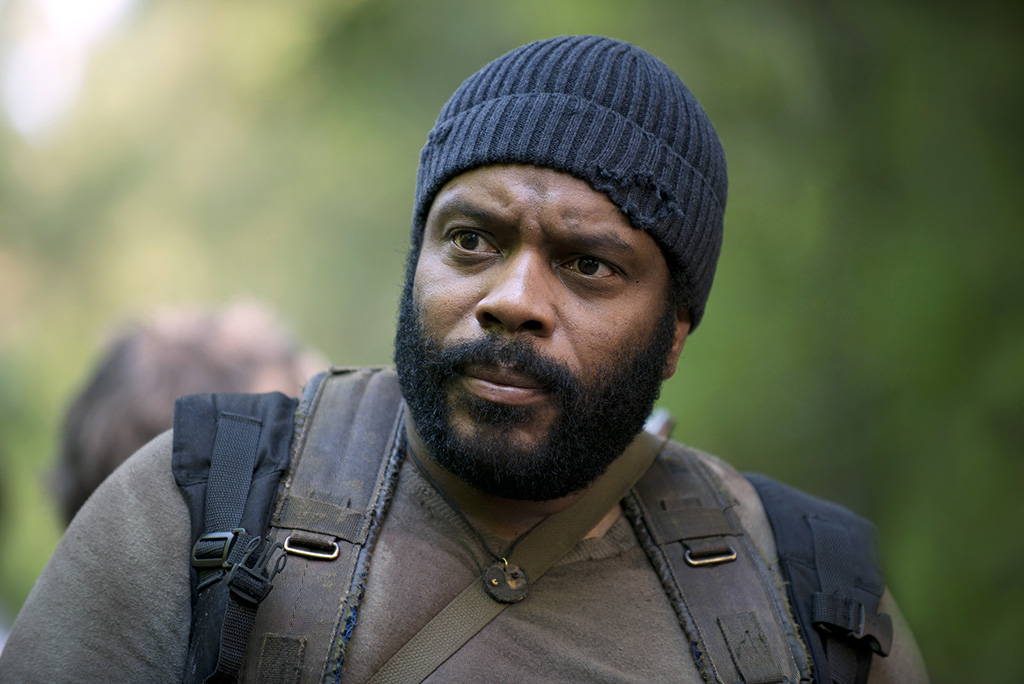
Tyreese Goes Out for a Bite

This is the most recent scene that slayed me, having only occurred on last night’s (as I write this) mid-season premiere of season five. At this point in the show, I really like and root for all the remaining main characters (except maybe Father Gabriel), so ANY death is gonna have me reaching for the tissues, no matter whose it is. This couldn’t have been said for previous episodes, by the way, as Beth’s end earlier this season, while kind of a bummer, didn’t really bother me that much, and Andrea’s death at the end of season three had me cheering, because come on. It was Andrea. Nobody liked Andrea.

Anyway, last night’s episode, titled “What Happened and What’s Going On,” saw Rick, Glenn, Michonne, and Tyreese traveling to Richmond, Virginia to take Noah back home to his family. Noah had helped Beth when they were both prisoners at Grady Memorial, and Rick felt that completing her mission of getting Noah home would be the best way to honor the departed Beth. Unfortunately, this being the show it is, things very quickly turn ugly. The walled neighborhood where Noah had been living has been raided and overrun, and everyone is dead. Noah insists on going into his house to see his dead family, and Tyreese insists on accompanying him. While inside, Tyreese is distracted by photos of Noah’s twin brothers, and is set upon by a walker, who bites him on the forearm (at which point both I and the GoH screamed, “NOOOOOOOOO!!!” simultaneously). The zombie fever begins to set in, and Tyreese starts to hallucinate many of the dead characters, who either chastise him for his failings or tell him that everything is better now that they’re dead. The episode toys with your emotions big time: Tyreese was only bitten on the forearm, you think, and Michonne is right outside the house with her katana. If they find Tyreese in time and chop off his arm (as they did with Herschel’s leg), then maybe he can still survive! COME ON, SHOW, DON’T KILL OFF TYREESE!!! And indeed, the gang do find Tyreese and cut off his arm, as you would. They fight through a horde of zombies and pile Tyreese into their waiting SUV. Rick radios ahead to Carol and tells her to get everything ready so they can cauterize the wound. TYREESE IS GONNA MAKE IT, YOU GUYS!!! YAAAAYYYYY!!! But then, Tyresse begins hallucinating the dead characters again in the car. Uh oh, you think. And indeed, I’m sad to say, your “uh oh” was justified. The next scene shows the SUV stopping in the middle of the road, and the gang dragging the dead Tyreese out of the back seat. Cut to his funeral, with Father Gabriel presiding. Fuck. FUCK. I liked Tyreese a lot, and I felt like he was just coming into his own as a character. FUCK. Rest in peace, ya big teddy bear. Sigh.

Note: There was a lot of foreshadowing in this episode, what with all the zombie torsos in the truck, and the hint that the town was taken down by a group of bloodthirsty humans. Readers of the comic are already speculating that this could portend the introduction of big bad Negan and/or the zombie-skin-wearing Whisperers, so we’ll see how that goes.

Rick-Walking-Dead copy

Rick Goes Full Shane, Gets His Teeth Into It

Holy shit, this scene. Coming from the season four finale, “A,” which was one of the very best episodes of the series in my humble opinion, this stunning sequence sees Rick, Michonne, and Carl camping out in the woods on their way to Terminus. They are set upon by the assholic Claimers, who are seeking revenge on Rick for killing one of their gang. It’s looking pretty bad; our heroes are outnumbered and outgunned, and it looks like both Carl and Michonne are gonna get a raping, and that all three of them are then gonna get blown away or beaten to death. But then Daryl, who had been traveling with the Claimers but had been hanging back in order to make his escape, intervenes and tries to give his life for Rick’s. The Claimers ain’t having it, and proceed to beat the stuffing out of Daryl. But Rick, sent into a Shane-worthy rage by the sight of some fat fuck attempting to rape his son, head-butts main Claimer Joe, then gets the drop on him and TEARS THE GUY’S THROAT OUT WITH HIS TEETH. Holy SHIT, y’all. In the ensuing melee, the good guys kill all the Claimers, and Rick takes the would-be rapist and slowly guts him from stem to stern. Brutal and amazing, and the point at which Rick comes completely to terms with the world as it is now. A great, GREAT scene, and the one that caused the loudest screams from the GoH and myself when we first saw it.

the-grove-carol-to-lizzie-just-look-at-the-flowers

The Problem With Lizzie

Let me just say that Carol is one of my favorite characters on the show. She started out the series as such a shrinking violet, but she has had the most interesting character arc by far, simultaneously embodying the caring mother figure while also being completely willing to make and act upon the hardest decisions when no one else will do it. While I still question her pre-emptive murder of Karen and David at the prison in order to try to stem the influenza outbreak, I feel like her heart is always in the right place, and I think the group needs her to take care of business, particularly when that business is morally repugnant and awful. In a way, she’s almost like a good-guy version of Merle, in that she’ll step up to do the “dirty work,” but with a much more defined moral center and a highly developed instinct to do what she feels will be best for the group.

Her resolve is tested, though, in another of the all-time best episodes, season four’s “The Grove.” Carol and Tyreese have been heading toward Terminus with three children in tow: Lizzie, her sister Mika, and Rick’s baby daughter Judith. There have been hints for several episodes that Lizzie is really not right in the head, but so far Carol and Tyreese have been able to keep her mostly under control. However, it soon becomes clear that Lizzie’s strange ideas about the walkers and her sadly broken brain are making her a terrible danger. While Carol and Tyreese are distracted, Lizzie kills her sister and waits for her to turn, in order to demonstrate to her caretakers that the walkers are still people. She also seems set to murder Judith next. Carol, holding back tears, plays along with Lizzie’s delusions in order to get her into the house and away from the baby. A heart-wrenching conversation with Tyreese ensues, in which they come to the conclusion that Lizzie will have to be eliminated for the safety of everyone else. Can you imagine having to make such a decision about a child in a world in which there is no longer any help or resources for treating mental illness? Carol, badass woman that she is, takes on the mantle of responsibility, telling Lizzie to “look at the flowers” (which was Mika’s calming phrase whenever Lizzie was having one of her panic attacks) and then shooting her right in the head, execution style. Devastating. And not only that, but in this episode, Carol also confesses to Tyreese that she was the one who killed Karen, and bravely hands Tyreese a gun and tells him that he may kill her if he cannot forgive her. Tyreese does forgive her, and they live to fight another day. I fucking love Carol.

maxresdefault

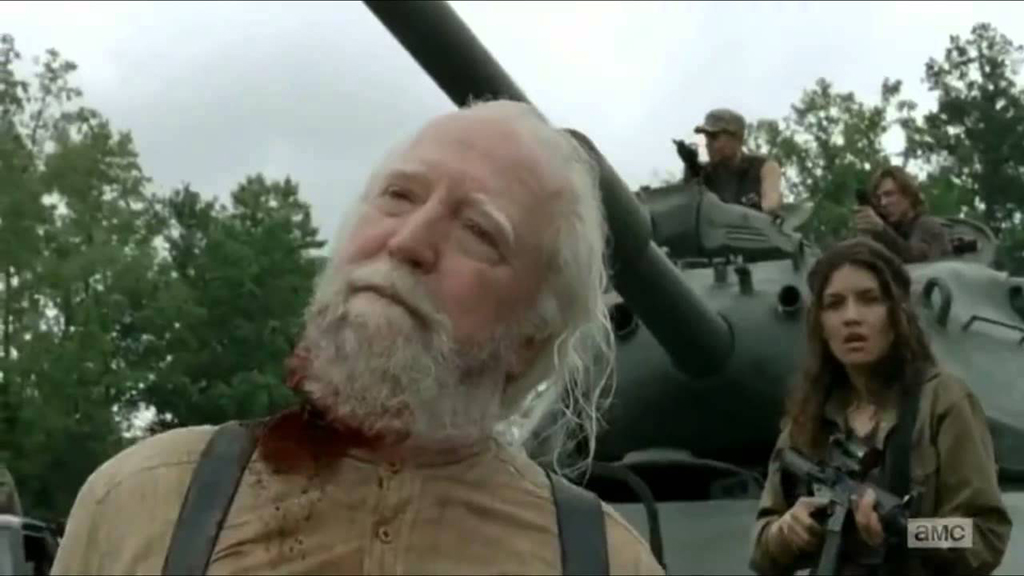
Herschel Loses His Head

It’s really ironic, because when the character of Herschel Greene was introduced in season two, I really couldn’t stand the dude. He was unpleasantly rigid, delusionally religious, and willing to put his own family and Rick’s group in danger because of his stupidly unrealistic ideas about the walkers. Sure, he saved Carl, and his medical expertise was a tremendous boon, but to be honest, if Shane had killed him after the barn clear-out, I wouldn’t have been the least bit upset about it. But then, dagnabbit, Herschel came to his senses and turned into the awesome, grandfatherly, moral backbone of the show, a man who was happily willing to sacrifice his own life to save others and who was always there to take the high road and get things done when Rick lost his shit after Lori’s death. I loved Herschel so much in the later seasons that I actually felt bad that I had once rooted for his demise. And of course, because I loved him, the show had to fuck all that up.

The good guys, still holed up at the prison, fall prey to a second incursion by the Governor, who has taken Herschel and Michonne hostage. Rick tries to reason with the man (never a great idea), telling him that they can all live in the prison and work together for the common good of Rick’s people and the innocent people of Woodbury. The Governor, being a psycho, doesn’t want any part of a sissy-ass compromise, and to demonstrate his commitment to general evil and craziness, grabs Michonne’s katana and chops off Herschel’s head right in front of the horrified heroes. The shots of Maggie’s and Beth’s screaming faces behind the fence was almost too much for me to take, and I ain’t ashamed to admit it. Poor fuckin’ Herschel. He was such a fantastic character, so necessary to the group’s cohesion, and to have him taken out in such an ignominious way was like a punch in the gut. It made me hate the Governor even more (which I suppose was the intention) and feel tremendous satisfaction at his eventual death. Damn. I really should stop watching this shit; I think it’s giving me a hint of PTSD.

vlcsnap-2011-11-28-20h25m50s147

The Search for Sophia

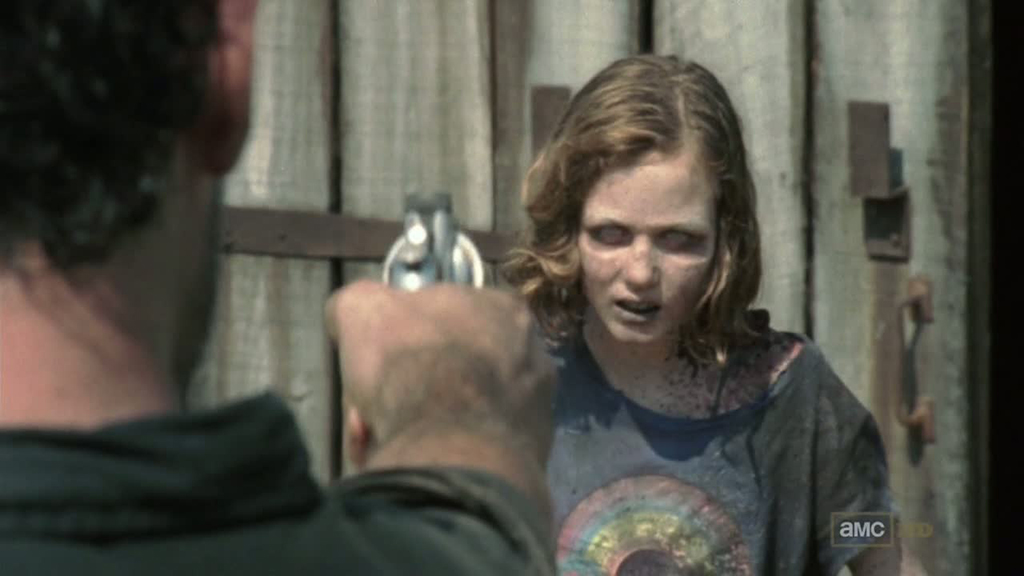
The first half of season two was all but consumed with the endless search for Carol’s lost daughter Sophia, and though some viewers complained that it went on for an unrealistically long time, I think that particular plot arc was an important catalyst for a lot of the interpersonal dramas playing out among the characters. The search finally brought the aloof Daryl completely on board with the group, for example, and it brought the group closer than ever before as they banded together to pursue a noble goal. Besides that, it gave everyone something to hope for, a purpose. It also brought the conflict between the brutally practical but unstable Shane and the still-trying-to-be-the-good-guy Rick to a tragic head as they struggled over leadership and direction of the group.

In “Pretty Much Dead Already,” Shane, who despite his batshittiness is actually correct that the search for Sophia is taking up too much of their time and resources, has learned that Herschel has been keeping (and feeding) a bunch of walkers that had once been his family members and neighbors. The zombies are all locked up in the barn, and much conflict ensues as the group try to reconcile Herschel’s wish to keep the walkers with their own wish to, y’know, not have a horde of zombies milling around only yards from where they sleep. Rick hems and haws, not wishing to piss off Herschel and alienate the only man who can safely deliver Lori’s baby, but finally Shane has had enough and decides to take matters into his own hands. He gathers up the guns and a few people in the group who agree with him, busts open the barn, and mows all the zombies down.

At the end of the carnage, we think the barn is empty, but just then, the door opens a little, and out emerges…a zombified Sophia. She has been dead in the barn for the entire time the group have been looking for her, and if that revelation didn’t hit you like a freight train, then you’re probably dead inside. Rick steps up and tearfully shoots Sophia in the head while Carol howls in grief in Daryl’s arms. Holy SHIT. This scene codified so much of the ensuing story; it made Rick question his leadership, it justified a lot of Shane’s previously questionable opinions, it woke Herschel up to the fact that the world had gone to shit and he’d better pull his head out of his ass and deal with it. It also unified the group once and for all, and directly led to the final showdown between Shane and Rick, which ended up with Rick having to take on some of Shane’s less savory characteristics in order to keep his people alive. Pretty much all the badass character traits that everyone took on in later seasons was directly attributable to that one scene, and as such, it is probably my favorite of the entire series.

Honorable Mentions: This post was long enough as it was, but I also wanted to give a shout-out to two more scenes that got me right in the feels. First was the scene in which a horribly distraught Daryl has to kill the zombified Merle, who had redeemed himself before his death by taking out a bunch of the Governor’s henchmen. The other scene was, surprisingly, the death of Lori. I never really liked Lori as a character, as many viewers didn’t; I thought she was a manipulative bitch who purposely set Rick and Shane against each other for her own bizarre reasons. But the scene where she tells Maggie to go ahead and perform the Cesarean section that she knows will kill her was pretty damn hard to watch. Maggie’s reaction, Lori’s final speech to Carl, and the subsequent reaction of Rick when he first lays eyes on the baby and realizes that Lori is dead, were pretty fucking shattering. So there’s that.

Agree? Disagree? Fight it out in the comments, if you’re so inclined. Until next time, Goddess out.

“Lepidoptera”

butterfly silence

Stephanie Guthrie stood in the center of the pile of blood-soaked bodies, her arms outstretched, her face a blank mask. Children pointed and screamed, animals paced in their cages. Zoo employees gaped like statues, unable to believe what they had just seen. Soon enough, the police came to quell the panic, and then an ambulance came, and bundled the woman inside.

****

“I haven’t been able to get a single word out of her,” said Theresa Hill, the police psychologist. “Looks like partial catatonia.”

Vic Unger, the lead investigator on what was sure to be the most bizarre case the city had ever seen, made a disgusted sound. “Typical. And wait ‘til you hear what we got back from the lab guys.”

“What’s that?” The halls were nearly empty in this ward, and Theresa’s voice echoed like a snatch of memory.

“Cause of death for all fifteen people at the zoo,” Vic said, “was evidently a mass poisoning. In other words, they were gassed.”

Theresa raised her eyebrows at him. “Terrorists?”

Vic shrugged. “That’s why we need to get a story out of the sole survivor in there.” He scratched distractedly at his three days’ growth of beard. “She doesn’t strike me as the terrorist type, I gotta say.”

“No. Maybe the poison came from somewhere else, and Miss Guthrie was the only one lucky enough to survive it?”

“Could be, although witnesses say the people around her dropped dead as soon as she raised her arms, like the two events were related. Have you done any scans on her or anything? Checked her for brain damage?”

“Yes. Looks like nothing out of the ordinary so far.”

“Damn.” Vic was a handsome man, only in his mid-thirties, but already cultivating a look of hangdog cynicism that Theresa found amusing. They had reached the end of the hall, and the locked room where Stephanie Guthrie was being held for observation. Theresa produced a set of keys from the pocket of her coat and opened the door.

Stephanie was sitting rigidly in the chamber’s only chair, her hands resting stiffly on her lap. She didn’t look up as Theresa and Vic entered, but kept her gaze fixed on a spot just below eye level. A very long moment passed before she even blinked.

“Hello there, Miss Guthrie.” Theresa stood before the woman, her arms crossed. “How are we doing today?”

Stephanie, of course, did not answer.

“The investigator is here, Miss Guthrie,” Theresa continued, gesturing to Vic, who was standing slightly behind and to the left of her. “He’d really like to get to the bottom of what happened at the zoo on Saturday. Do you think you’ll be able to cooperate?”

More silence in which Stephanie’s chest barely rose and fell with her breathing.

Vic stepped forward at Theresa’s urging. “I’m Vic Unger, Miss Guthrie,” he said. “I’d like to help you, but to do that I need to ask you some questions. Is that all right?”

Another blink, another breath.

Vic wasn’t in the mood for this; his impatience was one of his few negative attributes. “Can’t you just hypnotize her or something?” he asked.

Theresa stared down at the top of Stephanie’s head. “That may become necessary, although I have to tell you ahead of time that hypnosis is sometimes not a very effective psychiatric tool. We generally only use it as a last resort.”

“Well, can you get started on all the other resorts? I’d really like to figure out what the hell is going on here.”

“As would we all, Mr. Unger.” Theresa smiled at him. “But cases like this take time. I’m sure you understand.”

Vic nodded. He did understand, but he didn’t like it.

****

The next day, driving up the interstate, Vic ran the facts of the case through his mind again, hoping to stumble upon a detail he’d missed the first few times. Last Saturday at approximately two-fifteen p.m. at the Langford County Zoo, thirty-two-year-old Stephanie Guthrie had been strolling through the butterfly garden in the company of her thirty-six-year-old fiancé, Ray Framington. According to witnesses—the few who were left alive, that is—they had been holding hands, and Stephanie had been smiling. Then suddenly, things had taken a macabre turn. In an instant, the woman had gone white, tilting her head slightly upwards as if she had just heard something that shocked her beyond her capacity to reason. Her eyes apparently
glazed over, and even though Ray Framington had shaken her, trying to discern the problem, she had acted as though he wasn’t even there.

Then, witnesses agreed, she had slowly begun to raise her arms, until they were even with her shoulders. At the moment when she opened her hands, spreading her fingers to their farthest extremes, the fifteen people closest to her—including her fiancé—had simultaneously begun to bleed from every orifice, and after an agonizing moment of this horrifying spectacle, all fifteen had dropped dead to the concrete like sacks of grain. As this was happening, Stephanie Guthrie stood as still as marble in the center of the action, her outstretched hands like white wings, her expression as lifeless as that of a china doll.

When the police and then the ambulance had come, she had said nothing, reacted to nothing. The EMT’s who strapped her onto the gurney said that she was completely docile, but also entirely lacking in humanity, like an empty husk.

Since then, her condition had not changed.

Vic took a swig of black coffee from his thermos, settling it back into the fork of his crotch. His dark mood was getting darker by the minute.

He thought of Dr. Hill’s mention of terrorists. That had been his first thought too, but something about the situation didn’t sit right. Besides that, a search of Stephanie Guthrie’s person had turned up nothing resembling a container in which the toxin could have been carried, and even her skin had only shown trace amounts of the chemical that had killed the others. It was all very odd.

Whatever direction the case was taking, the department was on his ass to put it to bed as quickly as possible, and to that end he was skipping lunch and driving up to Hastings to interview Miss Guthrie’s parents. He hoped they could give him some insight into her history, her personality; from long experience, though, he knew this wasn’t likely. He sighed and turned off the highway.

Vic parked in front of a modest brick townhouse and slid out of the car. He’d called the Guthries yesterday to set up the meeting, and now, as he walked up the driveway, he noticed the curtain twitching as someone peered out at him. He pretended he hadn’t seen.

His knock was answered by a rail-thin man in his mid-sixties, clean shaven with a slick bald head. His eyes were absinthe-green, sharp and wary. “Come in, Inspector…Unger, was it?”

“Call me Vic, Mr. Guthrie. Thanks.” Vic passed over the threshold and immediately spotted Mrs. Guthrie, who stood nervously at the end of the hall. She was also in her sixties, still fairly youthful and fit, though the few lines on her face appeared deep with worry.

At Mr. Guthrie’s invitation, Vic took a seat in the living room, choosing a worn upholstered chair near the unlit fireplace. He
noticed a framed photograph of Stephanie on the mantel, and for a moment he marveled at the difference between the cheerful girl in the picture and the sullen zombie he’d seen back at the hospital. Mrs. Guthrie offered tea, which Vic politely refused. He waited until the couple had settled themselves on the matching sofa across from him, and then he got straight to the point.

“Let me just say that I want nothing more than to see that Stephanie gets the help she needs, Mr. and Mrs. Guthrie,” he began. “As I’m sure you’re aware, the situation is very grave. Fifteen people are dead, and it appears that Stephanie may somehow be involved, as either a victim or a perpetrator. As I told you on the phone, she is refusing or unable to speak, so anything you can tell me would be greatly appreciated.” He pulled a tiny tape recorder from his jacket pocket. “May I?” The couple murmured assent, and he switched it on.

Mrs. Guthrie’s lower lip was trembling. “I just don’t understand how any of this could have happened,” she said. “Stephanie never hurt anyone. And she would never do anything to hurt Ray—she adored him.”

Mr. Guthrie was nodding in agreement. “Yes, there must be some mistake. I’m sure she was just the victim of a horrible attack, or perhaps a freak accident.”

“That’s what we’re hoping to find out,” Vic said with a tight smile. “Please forgive me, but I have to ask some of these questions. Now, about Ray, they were engaged, correct?”

“Yes.”

“Had they been having any problems, though? Arguments? Had her behavior seemed any different recently?”

Mr. Guthrie was shaking his head before Vic had even finished speaking. “We just saw the both of them on Friday night. They came over for dinner. Nothing was wrong; they were happy, laughing. Talking about the wedding plans.”

“I just can’t believe Stephanie would have anything to do with anything so horrible,” Mrs. Guthrie said. Her eyes were glistening, but she spoke firmly. “The poor dear. Especially after—”

“Yvonne!” Mr. Guthrie bellowed.

Vic fixed each of them with a hard stare. “Especially after what?”

“Nothing, Inspector,” said Mr. Guthrie. “My wife was just going to say, especially after we had just seen her the day before.” He shot Yvonne a warning look that he probably thought Vic didn’t notice.

“George…” She reached out and touched the back of his hand.

Vic’s impatience was beginning to flare up again. “It won’t help your daughter’s case if you keep information from me,” he said, trying to tone down the irritation in his voice.

“She’s not our daughter,” Mrs. Guthrie said with a defiant glance toward her husband. “I thought you might have found that out by now.”

“Yvonne, I told you…”

Vic put up his hand to silence Mr. Guthrie, who was clearly approaching a meltdown. “Let your wife talk, sir.”

“He doesn’t like to talk about it,” said Mrs. Guthrie, patting her husband’s hand again. “It was his brother and sister-in-law, you know.”

Mr. Guthrie looked ready to explode, but Vic preempted him with a calming gesture. “Go on, Mrs. Guthrie.”

“It was such a long time ago. Stephanie was only about ten at the time,” Yvonne said. “A very bright child, she was. We didn’t see her often back then, you understand. Her parents—that’s George’s brother and sister-in-law—lived in Rosemere, about ninety miles north of here. But we saw them on holidays, of course.”

Vic wondered if this story would be going anywhere relevant, but he leaned forward in his seat, silently encouraging her to continue.

“Well, it happened at Stephanie’s school,” Yvonne said. She glanced over at George, who had covered his face with his hands. “It was one of those open house nights, you know, where the parents come to meet the teachers and so on. Do you have any children, Inspector?”

Vic did, a baby son, but he shook his head no. He didn’t want Mrs. Guthrie getting sidetracked.

“Well, it was the funniest thing,” Yvonne continued, to Vic’s relief. “Not funny, of course, but strange. I don’t think anyone ever figured out exactly what happened. It was all so sudden. One minute, there were kids and parents milling around the classroom, looking at all the projects the children had made, and then the next minute…”

Mrs. Guthrie waved her hand vaguely in the air. Her bottom lip was trembling again. “I wasn’t there, you understand,” she said, her voice going hoarse. “But I heard all about it. The papers said there was blood everywhere, covering everything. And all those poor little children…” The tears finally came, and Yvonne pressed her hands to her lips, and indication that she could not continue.

Vic looked to Mr. Guthrie, who looked haggardly back at him. “What happened?” Vic asked.

“They all died, what do you think happened?” George rasped. “My brother and sister-in-law, some other parents, teachers, a bunch of kids. Almost everyone in the room, as a matter of fact. Stephanie and one other person were the only ones who survived.”

“But what killed them?” Vic urged, exasperated. “Was it a shooting?”

Mrs. Guthrie had recovered enough to speak again. “I told you, they didn’t know what it was. Everyone just dropped dead, near as I can figure from the news stories. No one was shot, they were sure of that, but…” She trailed off, shrugging. “I guess they didn’t have all the fancy forensic science they have nowadays. Anyway, it was in all the papers back then. The Rosemere Gazette, a couple of others.” She sniffed and wiped at her nose primly with a handkerchief she had produced from her pocket.

Vic made a mental note to check the archives for news stories about the deaths; he didn’t remember hearing about it at the time, but he hadn’t been much older than Stephanie then, and he doubted that any news story, no matter how bizarre, would have made its way into his teenage psyche all those years ago. “Was Stephanie questioned after all this happened?” he asked.

Mr. and Mrs. Guthrie looked at each other. There was a long pause, then Yvonne finally said, “She was never the same afterwards.” Her voice was so soft that Vic had to lean farther forward to hear her. “She just kind of…vanished into herself. Not surprising, I suppose, after such a trauma. George and I got custody—we were the closest relatives, you know, and we were happy to do it—but we couldn’t reach the girl. She had to be…hospitalized for a while.” Yvonne looked as though she might be on the verge of losing it again, but she clenched her jaw and held herself together.

“How long was she hospitalized, Mrs. Guthrie?” Vic had lowered his voice to match hers.

“Oh…almost two years, I think it was.” She sounded almost apologetic, as though the girl’s illness was a personal failing. “I hated to see her in there, I really did, but…well, what else could we do?”

“They did help her in that hospital, right enough,” Mr. Guthrie added. “Stephanie was never the same as before, but once she came out of there she was much better. Not like she was, but still okay.” Now it looked as though George might break down crying again.

Vic thought he had caused the couple enough anguish for one day, so he switched off the recorder, replaced it in his pocket, and stood to go. “Thanks very much, Mr. and Mrs. Guthrie,” he said, reaching out to shake their hands. “I’ll be in touch. And if you think of anything more, give me a call.”

“We certainly will.”

Vic left the pair to their heartbreak, and made his way back to his car, where he finished off the thermos of now lukewarm coffee. His earlier hesitancy, it seemed, had been wrong; he had obtained quite a bit of interesting information from Stephanie’s adoptive parents. And now it seemed like the reticent Miss Guthrie wasn’t quite as above suspicion as she had first appeared.

****

Theresa Hill locked her office door behind her, then retraced her well-worn steps down the hall to Stephanie Guthrie’s room. It had been four days since the incident, and very little progress had been made. The woman was easily the most difficult case she’d ever run across, and as such, was maddeningly intriguing.

Stephanie had not moved during Theresa’s absence. The doctor fetched a chair from an adjacent room and placed it a few feet from Stephanie, then closed the door.

Perhaps hypnosis was the only way to reach the patient, Dr. Hill mused. Certainly nothing else had worked—Theresa had tried cajoling and threatening, withholding food, appealing to Stephanie’s love for her family and her dead fiancé. The woman had sat there through it all, stoic, emotionless. She wasn’t completely out of it, Theresa knew—she had been eating a little, and could be counted upon to get up and use the bathroom when necessary, but beyond that she was a shell of a person, an automaton.

Theresa began today’s session as she had begun the others, talking to Stephanie in low tones, addressing her frequently by name in order to place focus on her core identity. As with all the other times, Stephanie did not react, not even to make fleeting eye contact with the doctor.

After about fifteen minutes of this, Theresa sighed and stopped talking. Clearly it was time for a different approach, one she had been putting off for days. She reached into the pocket of her coat and drew out the small metronome she had brought from her office; she got up and placed it on the seat of her chair. She turned it on, and its winking silver needle began to tick back and forth with a sound like a wooden cane tapping on pavement.

“I don’t know if you can hear me or understand me, Stephanie,” said Dr. Hill, standing off to the side with her hands clasped behind her back. “But if you can, I want you to look at the object in front of you. Concentrate on it very hard, and ignore everything else but it and the sound of my voice.”

Theresa had no idea whether Stephanie was complying or not, since her blank expression did not change. She pressed on. “Good. Just keep looking at it, focusing on the needle going back and forth, back and forth.”

Again, there was no discernible reaction, but Theresa continued on, allowing her voice to become softer and softer until it was a pleasant drone in the drab room. At last, she said, “Now, Stephanie, I want you to close your eyes.”

For a long moment nothing happened, and Theresa’s hopes began to fade. Perhaps they would never be able to reach the woman; perhaps the bizarre deaths at the zoo would remain forever unsolved.

Then Stephanie’s eyes fluttered closed.

Theresa almost leaped for joy, but managed to keep her voice level, even as her heart hammered against her ribcage. “Very good, Stephanie. Now I want you to go back to last Saturday, the day you and Ray went to the zoo. Do you remember?”

Stephanie didn’t answer, but her brow furrowed as though she’d just heard some troubling news. Theresa was so elated to see a change in expression that she immediately moved on to the next question. “What happened that day, Stephanie? Can you tell me?”

The patient’s frown deepened, and her eyelids began to twitch. Theresa thought she saw the woman shake her head, ever so slightly, but it might have been wishful thinking. “Can you tell me what happened, Stephanie?” Dr. Hill persisted, trying mightily to keep from badgering her. “You were walking along with Ray, weren’t you? There were some other people around. And then what?”

Two tears squeezed from beneath Stephanie’s closed lids and trickled down her cheeks. Her face was a mask of horror and sorrow, and Theresa considered waking her up right then, but at that moment Stephanie began to move.

Her arms, which had been dangling loosely by her sides, started to rise, almost as though they were attached to a puppeteer’s strings. Stephanie’s eyes remained closed, but her face contorted, seemingly fighting against the actions of the rest of her body.

Her arms were now outstretched, level with her shoulders, and as Theresa watched, the woman unfurled her fingers like flower petals and spread them wide. The doctor opened her mouth to ask what she was doing, but then Stephanie’s eyes flew open and her gaze fixed fully on Theresa, the zombie stare now replaced by a look of frightening, hyper-aware intensity. The doctor backed up a step.

“The voice,” said Stephanie, the words little more than a creak of muscles long unused.

Dr. Hill was so shocked that the patient had spoken that she stumbled over the next question and had to repeat it. “Whose voice, Stephanie?” she asked, trying to maintain contact with that unsettling stare. “What did it say?”

Stephanie’s eyes widened, becoming round black holes in the midst of her ghostly visage. There was a sound from behind, but Theresa ignored it, intent upon her patient’s words.

“Lepidoptera,” Stephanie said, and then her entire body seemed to collapse in on itself, her arms dropping back to her sides, her head falling forward until her chin rested on her chest. Blood came, first in a trickle and then in a torrent. Frantically, Theresa clapped her hands, attempting to wake the patient from the hypnotic trance, but the sharp sounds of her palms smacking together had no effect other than producing a flat echo against the gray concrete walls.

****

Vic stomped on the gas, urging the car to go faster, even though he was already exceeding the speed limit by a considerable margin. He hoped to Christ his hunch was wrong, but a sick feeling in the pit of his stomach suggested it wasn’t. In fact, if Dr. Hill had gone ahead with the planned hypnosis, then it was probably already too late.

After leaving the Guthries’ the day before yesterday, Vic had gone straight to the Rosemere library and spent the better part of the afternoon examining the newspaper archives on microfilm. And there, just as Mrs. Guthrie had stated, was the entire unbelievable story, laid out in all its puzzling detail, though Stephanie, being a minor, was not mentioned by name. Police at the time had been mystified, and even though Vic had scoured the later records, hoping for some follow-up, he had found nothing further, other than a short article a few months after the event which speculated that the deaths had been caused by some freak chemical seepage into the classroom, since the victims had apparently all succumbed to some unknown poisonous fumes. Just like the fifteen people at the zoo, Vic had thought grimly.

Only one other person had survived the accident twelve years before, and that was a young teacher by the name of Bill Travers. Vic had spent the previous day tracking the man down, only to find out that he had died in an institution, having been in a near comatose state for nearly ten years following the occurrence at the school open house. And after speaking to one of the older nurses who still worked at the hospital where Travers had died, Vic discovered something else—that when a doctor had attempted hypnosis in order to reach the poor man, Travers had ended up dead, the doctor catatonic. Post-mortem examination of Mr. Travers had revealed that his death was caused by the same mysterious chemical that had killed
the parents and children in the classroom, and the same one, Vic knew, that had killed the fifteen people at the zoo last week. He’d had a report back from the lab boys on that, too—they had no idea what the substance was, other than that it was sort of like a pheromone, but deadly poisonous. Yeah, tell me something I don’t know, Vic had said sardonically.

But there was a minor detail that nagged at Vic. The nurse at the institution where Travers had breathed his last had supplied him with a grainy, black and white videotape of the hypnosis session where Travers had died. The similarity with Stephanie’s case was chilling, as the man sat very still in his chair, seemingly insensate, as the doctor stood over him, intoning a list of questions that was meant to draw him out of his traumatized state. But suddenly, the man’s eyes had opened, his face had wrenched apart in a silent scream, and he had uttered a single word: Lepidoptera. The tape stopped just as his lifeless body slithered to the floor.

Vic blew through a yellow light that turned red the second he passed under it. He didn’t understand exactly what the mechanisms behind all this were, but the outcomes seemed abundantly clear. Something was causing these people to transform from normal, functioning human beings into…what? Was it some kind of killer virus triggered by environmental factors? Or even by some internal apparatus that lay dormant in the body until a particular moment caused it to flower?

Vic didn’t know, but he did know that both Stephanie Guthrie and Theresa Hill were in horrible danger. Even though he had abandoned the idea of God long ago, he began reciting a litany in his head, something like a prayer, though to who or what he was praying he couldn’t have said. Please let it not be too late, please let it not be too late…

After what seemed like hours of driving, the unobtrusive sign identifying the Mayflower Psychiatric Hospital loomed through his windshield. He turned the car without slowing down, feeling two tires leave the ground, and then tore down the long, tree-lined road that led to the parking lot. He pulled abruptly to the curb and leaped from the car, leaving the door wide open and the keys dangling in the ignition.

Doctors and nurses turned to stare at him as he belted down the halls, flashing his badge at anyone who looked as though they may try to stop him, squeezing through the digitally locked doors the second the shocked guards had opened them. His shoes squeaked on the linoleum, and his lungs were filled with the mingled odors of urine and sweat and formaldehyde.

He headed first for Dr. Hill’s office, but saw immediately that she was not there. His heart sinking, he continued running, down the endless corridors, deeper into the bowels of the hospital.

At last he arrived at Stephanie Guthrie’s room. He turned the knob and found it unlocked, which made his hopes dim even further. He was almost afraid of what he would see as he pushed open the door.

For a split second it appeared that everything was fine. Dr. Hill was standing in the middle of the room, leaning toward Stephanie, who sat in the chair she had barely moved from for several days, her eyes closed, her arms outstretched. An echo hung in the air, as though Dr. Hill had just asked a question that awaited an answer.

Just as Vic was about to speak and announce his presence, Stephanie’s eyes opened and fixed on the doctor’s. Her lips parted with a soft plip. Vic darted into the room, knowing what she was about to say, but for some reason time seemed to have slowed, the way it does in dreams. Stephanie seemed very far away, her mouth opening like a tiny black O. “Lepidoptera,” she said, and then her entire frame collapsed, and blood began to ooze from her nose and mouth. As Vic watched, she crumpled to the floor, her eyes already beginning to glaze over, the single word she had spoken humming around the enclosed space like a hellbent mosquito.

Dr. Hill was clapping her hands, obviously trying to awaken a patient that would wake no more. She still had not noticed Vic at all. She moved toward Stephanie.

And then Vic felt it, that word the woman had whispered, tunneling into his brain like an earthworm through the loam, lodging in the deepest part of him. He could feel it radiating outward from this command center, infecting his flesh, his entire molecular structure. He could feel it squirming within him, using him for its own devilish purposes, waiting for the moment when it would unleash itself upon the unwary, making of him an unwitting carrier, accomplice, slaughterer.

Dr. Hill finally turned and saw him standing there, and just before his brain began its inevitable withdrawal into its cocoon, he managed to lock gazes with her. She had fallen to her knees next to the corpse of her patient, clearly suffering the same appalling fate as he. Vic tried to smile at her, if only to show that they were now joined in their shared contagion, but he couldn’t quite do it.

At last he felt his body falling, and his thin veneer of rationality dissolved completely, his thumping heart keeping time with the ticking beat of the metronome.