Another excerpt from “Red Menace”

Hey kids, it’s me again, reminding you that my book Red Menace is available for your reading pleasure, both in ebook and print formats from Amazon, and ebook format directly from Damnation Books. Read the excerpt below! Buy the book! Read it, love it, write a review. Thank you, my lovelies.

RedMenaceCoverBlog

Paige’s eyes snapped open in the darkness. She didn’t know what time it was, only that there was no faint sign of dawn yet showing through the windows—and that Daniel was sleeping deeply beside her, his body heavily still.

Just before she had awakened, she was having a horrible dream where she was sitting in the balcony of a dimmed concert hall, looking expectantly at the stage below, which was bathed in the glow from the red footlights. An orchestra was arrayed on the stage, though Paige couldn’t see any of their faces because they all wore red hoods. The effect of the crimson light on the similarly colored hoods was unsettling, making the movement of the fabric seem turgid, liquid, like slowly draining blood.

At last, the orchestra raised their instruments as one body. The music stilled Paige’s heart for several beats. It was an infernal music, and in the dream, Paige thought of a story she had once read about a violinist who had sold his soul to the devil to be able to play like a virtuoso, only to send everyone who heard him spiraling into madness. Surely this orchestra was just as miraculous in their command of tone and timbre, in their deft manipulation of the snaking harmonies, but the miracle, if it was one, was of a satanic nature, just like in the violinist story, welling up from the darkest recesses of the soul. Paige wanted to scream but could not, wanted to cover her ears but could not move her arms. She was rendered motionless by the music, a stone carving from which a trapped consciousness peered out helplessly.

At the crescendo of the piece, just when Paige felt that she could not listen anymore, all the musicians upon the stage turned toward her in unison, the movement causing their hoods to fall back with soft and somehow obscene whispers that could still be clearly heard, though the din of the music carried on uninterrupted. Their faces were all white, grinning skulls, the black of their multitudinous eye sockets made even blacker by the wavering scarlet light, their expressions seeming to mock her.

She suddenly did scream then, feeling the stretch of her lips, the vibration of the sound in her dream-throat just as she would in waking life, though nothing emerged but silence. She just had time to glance down at the audience and see that they had all turned toward her too, accusing her with their skeleton eyes, and then she woke, her breath catching in her throat, making her cough. Daniel stirred a little but then turned onto his side and resumed snoring. Paige’s eyes struggled to identify familiar shapes in the darkness, a curtain rod or light fixture she could focus on so that she wasn’t seeing the endless parade of red-tinted skull faces peering at her with their empty yet somehow malevolent gazes.

As her heart rate calmed, she reflected on the sound that had surely wakened her. Even in the bare, few seconds after launching out of sleep, she heard a telltale echo throughout the house, the remnants of a solid sound that had not issued from her mind, however rattled. The sound could not have been very loud, or it would have woken Daniel also. Paige lay very still, feeling sweat pooling in the hollow of her stomach, straining her ears for the slightest noise.

An interminable stretch of time passed, and Paige began to think the sound had been a product of her fervid imagination after all. She closed her eyes, reluctantly settling back into sleep mode, but then she heard it—a tiny, slight wheeze, like the breath of a mouse behind the walls. Paige wondered what it could be, and as she frowned out at the surrounding darkness, the other sound came—the devilish music of the skeleton orchestra. She leaped out of bed and was halfway to the door of the bedroom before her brain even registered the movement of her body. Daniel was awake now too, his voice thick with sleep, calling her name, but Paige was already out the door and climbing the stairs to the attic room, two at a time. Some part of her must have instinctively known that the horrible sound was coming from the clock in the black room, but it was only now, as she reached the landing, that she became consciously aware of it. Just as she did, the chime came again—a deafening and doom-laden gong seemingly accompanied by the combined screams of all the tormented souls in hell.

The thought of that coffin-tall clock singing its malevolent song to the gleeful audience of that one red-windowed eye in the otherwise abandoned black room filled Paige with a horror that compelled her quickly down the hall and through the door of Helena’s attic aerie, not caring if the old woman thought she’d gone right off her rocker. She just wanted that fucking clock to stop.

Paige tore into the attic room, intending to march straight into the Red Death suite and smash the clock’s smug face with her bare hands; however, she stopped dead in her tracks at the strange sight of Helena, sitting upright and cross-legged on her narrow bed in a small circle of lamp light, her eyes closed, her ogre face bearing the serene expression of a stone Buddha. She was dimly aware of Daniel’s presence behind her, and she felt his breath upon her neck. As she stared at Helena, the echoes of the horrible chimes danced all around them, like whispering little caper-demons scurrying for the corners and concealing their evil laughter behind tiny, clawed red hands. Then, the chime came once again, full and resonant, seeming to shake the house to its foundations. Paige clapped her hands over her ears the way she had been unable to do in her dream, even though this had the awful effect of making the sound closer, more intimate, as if it was coming from inside her own head.

When the last of the chimes had finally died away, Paige cautiously drew her hands away from her ears, listening to the silence that now seemed like the world’s sweetest music. After a moment, she realized her cheeks were wet; the tears had spilled without her knowledge. She stared at Helena’s blissful figure, feeling exhausted, empty, and suddenly afraid.

The old woman’s eyes opened, and the fishy, white one twirled in its socket while the normal eye fixed on Paige, a shimmering jade-green jewel in the lamp light. Helena smiled her sunken smile. “I was afraid it wouldn’t work anymore,” she said.

The Goddess’s Favorite Creepy Movie Scenes, or Evil E.T.’s Eggcellent Adventure

I have to admit that I’m not a huge fan of the sci-fi genre or of horror/sci-fi crossovers. There are some exceptions, of course—the Alien franchise, The Thing, Invasion of the Body Snatchers—but on the whole, aliens are not really compelling baddies for me. So it was with some degree of meh-ness, on Halloween night, that I agreed to give a lesser-known British sci-fi horror flick from the 80s a whirl; the film was the God of Hellfire’s pick for the evening (our other two Halloween screenings included more traditional horrors, The Omen and The House That Dripped Blood, in case you wondered). Despite my initial trepidation, though, I have to say that I am now rather glad that the GoH exposed me to this hidden gem, because I would have likely never sought it out on my own, and it is deeply, intensely fucked up, but in the best possible way.

Released in 1983, the bewilderingly-titled Xtro was directed by Harry Bromley Davenport, and was presumably made to cash in on the wave of popular sci-fi films of the period, like E.T., Alien, and Videodrome. It was pretty resoundingly panned on its first release, but became something of a cult film in the ensuing years, spawning two sequels so far (though the sequels don’t have much of anything to do with the original movie). It’s not difficult to see why the film slowly found an audience, because there is some very, very strange shit going on in this thing, and though it’s a fairly low-budget affair, the special effects are actually quite good for the time, and some of the imagery is pretty disturbing.

SORRY TO BOTHER YOU, BUT IS THERE ANY WAY I COULD MAYBE GET A RIDE TO THE CHIROPRACTOR?

SORRY TO BOTHER YOU, BUT IS THERE ANY WAY I COULD MAYBE GET A RIDE TO THE CHIROPRACTOR?

Xtro tells the story of a boy named Tony (Simon Nash) who is playing with his dad Sam (Philip Sayer) in the yard of their farmhouse when suddenly an intense light blazes out of the sky and apparently drags Sam away with it. Cut to three years later. No one really knows what happened to Sam, but Tony and his mom Rachel (Bernice Stegers) have had to move on with their lives, and now live in London with Rachel’s new boyfriend Joe (Danny Brainin) and a hot French nanny named Analise (Mariam d’Abo), who was presumably shoehorned into the film to provide the requisite titty shots.

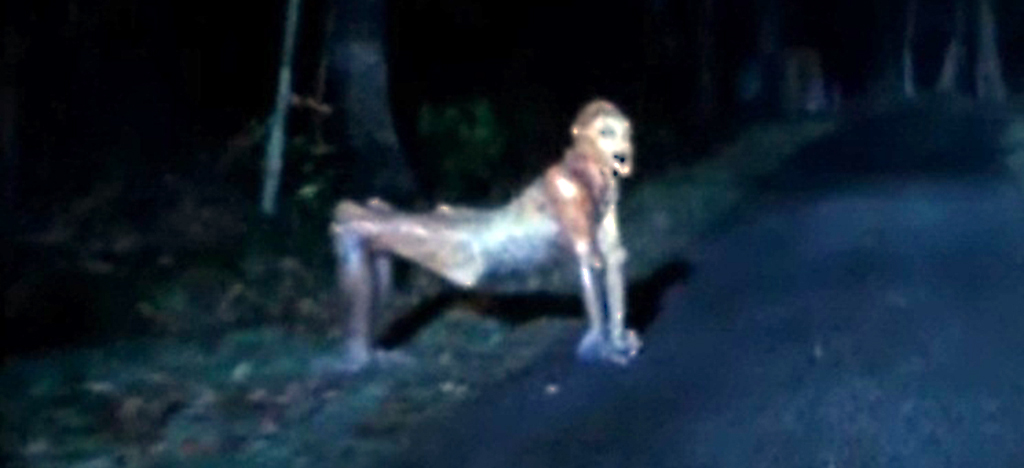
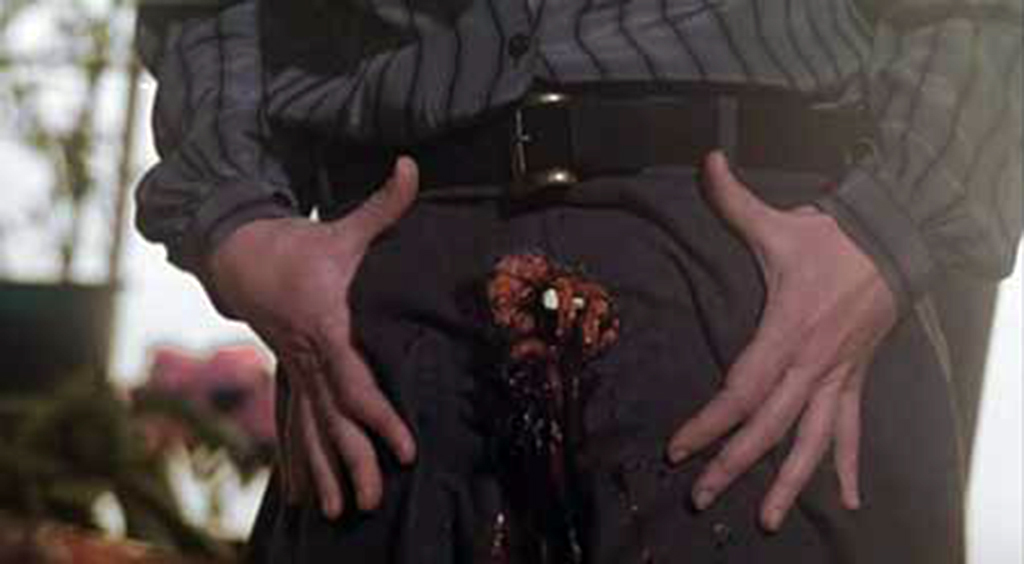
Meanwhile, a light shines out in the woods again. Two people driving down a dark country road hit a freaky-looking creature with their car (in one of the movie’s creepier scenes, and in fact one that made the rounds on YouTube labeled as a “real” monster sighting), and stupidly go into the woods to try to find it. The creature kills the man, goes back to the car and takes care of the woman, then circles around to a house. It attacks the woman living within and impregnates her. Her belly swells to gargantuan proportions in minutes, and then a fully-grown, blood-slick Sam comes crawling out of her monumentally wrecked vagina. After heading back into the woods and stealing the clothes off the car-driving dude he killed, Sam heads to London to try and track down his family.

Here’s where the whole thing gets a little more bizarre. Sam picks up Tony from school, so when Rachel comes to get the boy, she is told that his father has already taken him. She chases them down, and sees that Sam has indeed returned. She’s glad to see him, but angry that he seemingly left them three years earlier with no explanation. He says that he doesn’t remember anything about what happened, so Rachel feels bad for him and takes him back home. Tony is overjoyed to have his father back, but naturally Joe, the new boyfriend, is far less enthused, especially when it becomes clear that Sam doesn’t really have any intention of leaving and Rachel doesn’t have the heart to tell him to take a hike. Joe eventually sort-of moves out, though he’s still sharing the photography studio where he and Rachel both work.

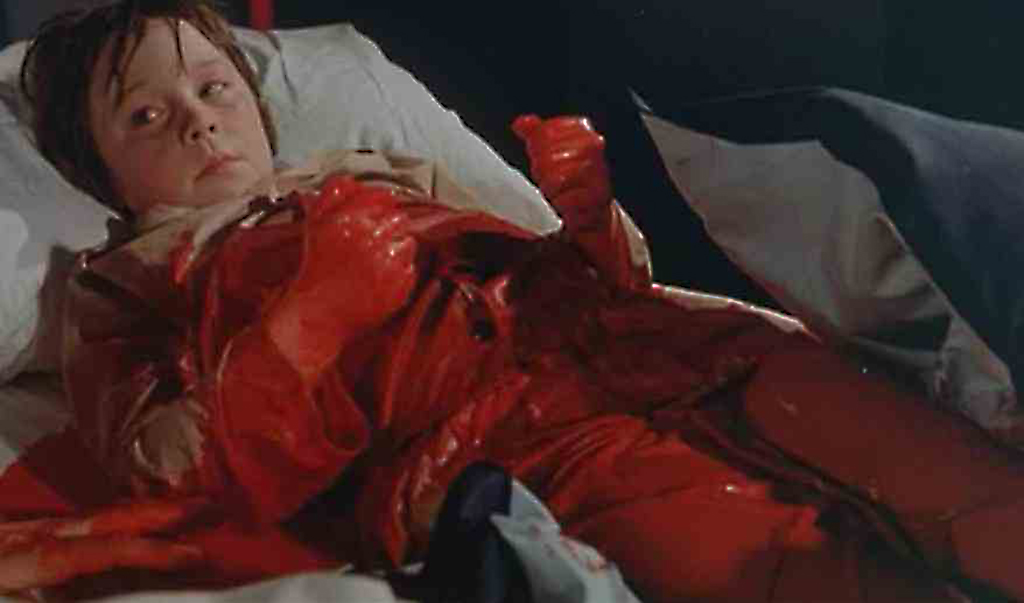
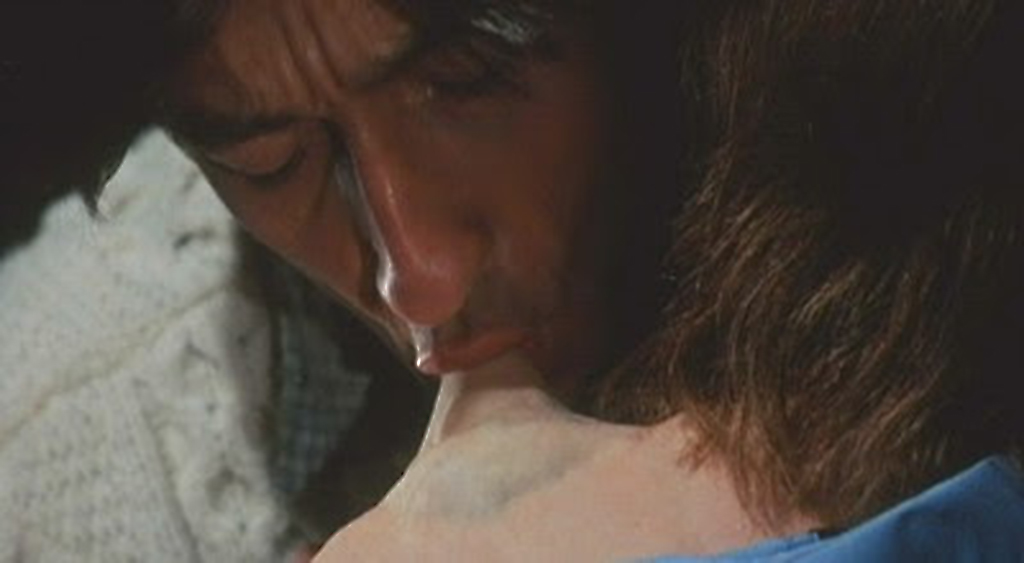
So it’s all a very awkward family drama into which more weirdness soon manifests itself. Tony wakes up in the middle of the night covered in blood that isn’t his. The next day he catches his father eating the eggs of his pet snake, has a freakout, and hauls ass out of the house. Sam chases after him, reassures him that everything is fine and that he just needed to eat those eggs because he’s different now, and wouldn’t Tony like to be different too? Tony seems to relent, because hey, that’s his long-lost dad, so Sam creepily puts his lips on the kid’s neck and either starts sucking blood from him or inserting something into the blister he makes there.

HOW MANY TIMES DO I HAVE TO TELL YOU, DON'T DRINK SO MUCH RED TEMPERA PAINT BEFORE BED???

HOW MANY TIMES DO I HAVE TO TELL YOU, DON’T DRINK SO MUCH RED TEMPERA PAINT BEFORE BED???

ALIEN DADS WHO GIVE THEIR SONS HICKEYS: NEXT ON MAURY.

ALIEN DADS WHO GIVE THEIR SONS HICKEYS: NEXT ON MAURY.

Later on, back at home, Sam tells his son that he has powers now, and can pretty much do anything he wishes to do, and that now Tony can too. Predictably, the first thing the kid uses his powers for is revenge: Tony’s pet snake escapes and turns up in the apartment of their busybody downstairs neighbor (played by Anna Wing), who chops the hapless reptile into pieces. Tony uses his newfound alien magic to animate a toy soldier and make it grow life-size, so that it can troop down to the busybody’s flat and poke her to death with a bayonet. It’s a weird, unsettling scene, not least because it doesn’t make much sense, and also because the actor playing the life-size toy soldier has some creepily inhuman movements to go with his plastic, unmoving face.

KNOWING HOW TO STAB YOUR NEIGHBORS IS HALF THE BATTLE.

KNOWING HOW TO STAB YOUR NEIGHBORS IS HALF THE BATTLE.

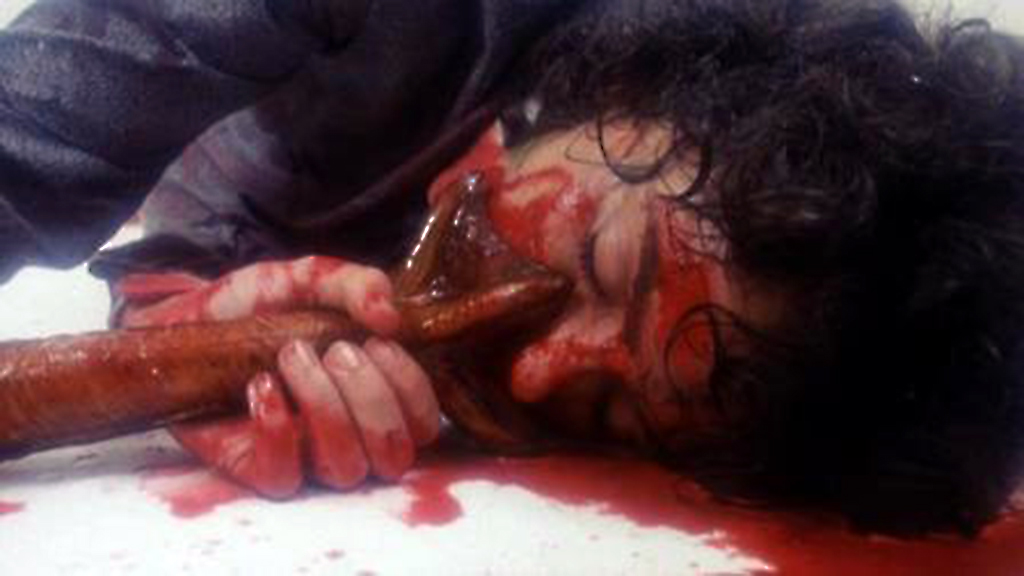
Tony also brings one of his clown dolls to life in the form of a sinister little person (Peter Mandell) who does his bidding. When Rachel decides to take Sam back to the farmhouse to see if he remembers anything about the night he disappeared, she leaves Tony in the care of the often-shirtless nanny. Analise wastes no time in inviting her boyfriend over for some afternoon delight, but Tony keeps pounding on the bedroom door, insisting she play hide and seek with him. Finally she agrees to a short game and begins searching the apartment for the boy, at which point Tony and his creepy clown henchman hit her on the head with a mallet and then drag her into the kitchen, where we later see that she has been attached to the wall in some sort of cocoon. Squishy eggs are squelching out of an ovipositor-type tube where the bottom half of her body was. The clown midget takes these eggs and places them lovingly in the refrigerator after coating the inside with some lumpy green goop. Analise’s boyfriend, by the way, is first chased and shot at by a toy tank, then attacked and eaten by a black panther that is inexplicably wandering the halls. Because aliens.

PREPARE TO TASTE TINY HELL.

PREPARE TO TASTE TINY HELL.

Back at the farmhouse, Rachel and Sam are going at it, but suddenly Rachel notices that Sam’s skin is starting to rot off. He takes off into the woods toward a bright light, and Rachel runs after him. Joe has brought Tony out to the farmhouse after he finds the kid running around outside the apartment alone and everybody else dead. Sam starts alien-ing like crazy, turning back into the creature we saw at the beginning. He makes a high-pitched shriek that apparently ruptures something in Joe’s brain, killing him. Then Sam gets to the light, and he has Tony with him, and Tony is starting to alien out too, hand in hand with his dad, and then they both disappear and Rachel is standing there in the field where the light just was, wondering what the fuck just happened. She doesn’t wonder long, though, because later on, she gets back to the apartment, finds the eggs in the upturned fridge, stupidly picks one up and stares at it until a little hand thing shoots out of it and attaches itself to her face and kills her.

IN 1980'S ENGLAND, OMELET EATS YOU.

IN 1980’S ENGLAND, OMELET EATS YOU.

So everybody dies, pretty much, except for Sam and Tony, who I guess live happily ever after on some alien planet far away, where they fill their days with telepathic toy control, big cat training regimens, and reptile-egg feasts. Did I mention this was a weird-ass movie? It’s kind of like a low-rent Cronenberg flick, what with all the goop and tentacles and vaginal imagery and creatures with backwards legs and what not, and even though the guy who played Joe kept reminding me of a lost member of the Romantics, I actually enjoyed the thing a great deal more than I thought I would. As I said, some of the images—the first sight of the creature scuttling across the dark road, the full-grown man emerging from the woman’s torn hoo-ha, the eerily grinning clown doll come to life—are really effective, and I quite liked the very downbeat, bleak drama of the whole family dynamic, which I guess is pretty typical of British films. It’s definitely an odd little film, but one that I’d recommend to fans of the genre. And with that, until next time, Goddess out.

Another Scary Story for Halloween: “William’s Pond”

It’s the scariest day of the year, and if you’d like to spend some of this glorious holiday indulging in a bit of creepy reading, please take a few moments to read my 2009 short story, “William’s Pond.” It also appears in my book Hopeful Monsters, so if you like what you read, then why not go all out and purchase a copy today? Thank you, and I hope your Halloween is a haunting, howling scream!

UnderwaterGirl

The pond looked dark, even now, even in broad daylight. Muriel remembered it had always looked dark. She had always been afraid of it.

She waded through layers of dead leaves in her worn black flats, keeping her eyes fixed on the still water. The grass around the pond had grown long and wild; Muriel wondered if there were snakes. Her parents had always kept the house and grounds immaculate, and it saddened her to see the neglect, the desolation. Times had been hard for them, since she’d left home. And now they were gone.

A cloud passed over the sun, and in the ensuing grayness Muriel thought she saw a shadow flickering just below the surface of the pond. She stopped and looked harder, but there was nothing. Her parents had always warned her to stay away from the pond, and unspoken but understood in their stern, pale warnings was the knowledge that Muriel’s brother had drowned there, many years ago, when he was no more than a baby. But even if that hadn’t happened, Muriel would have stayed away.

Because when she was a little girl, she thought she’d seen things in the pond.

She scoffed at herself now, standing ankle deep in leaves, wearing a shabby black funeral dress whose cheap fabric stretched taut over her swollen belly. She was a grown woman, with a thirteen-year-old daughter and a second child on the way, a woman who had once been beautiful but now bore the marks of two failed marriages, abandonment, single motherhood. She was no longer the terrified little girl who had peered out her bedroom window under the maple trees and sworn she’d seen shadows moving beneath the water, shadows that looked like people with long, flowing hair. She had left that little girl far behind, perhaps still in this house with its memories.

So why was she still afraid?

“I’m not afraid.” She said it out loud, then reddened and turned to see if her daughter had heard her talking to herself. The house and yard were silent, but her words seemed to echo through the open stillness, coming back to her as oddly warped singsong, a children’s chant repeated like a mantra: Not afraid, not afraid, not afraid…

And she wasn’t, she told herself. She could walk right up to the edge of the pond now if she wanted to, just to show those shadows (those long-haired people who weren’t there) that she was brave.

With every step closer, the shadows seemed to move faster, more erratically. Muriel told herself that she didn’t see them. Instead she thought of her brother’s tiny white body, floating and lifeless, a shock of white against the night-black water. She hadn’t actually seen him drown all those years ago, but her parents had told her what had happened, and after that, she’d seen it every night, in her dreams. The baby’s bluish limbs splayed on the surface of the water, the blacker shadows milling below it, as though making a nest for the egg like little corpse. Muriel had seen it many times, among her many dreams.

She was at the edge of the pond now. The water chuckled and gurgled, then seemed to lunge at her feet with its icy black fingers. Muriel jumped back, then turned around and made her way quickly back to the house.

****

“Do me a favor and stay away from that pond, Angel.” Muriel found herself using the same tone of voice her mother had always used. She smiled, but it was a sad smile, edged with bitterness.

“I know, I know, my almost-uncle died in there.” Angel was only half listening, her head poking into the refrigerator, her tight jeans riding so low on her hips that the waistband of her underwear showed. Muriel had a sudden urge to smack the girl, but she restrained it.

“That’s right.” The fetus in her belly stirred, then kicked, and Muriel winced. Only another week or two, she told herself. She didn’t know if the baby was a boy or a girl; she’d decided to let it be a surprise. Not that it really mattered anyway; its father was long gone, just as Angel’s was. Her luck with men had been little short of catastrophic for as long as she cared to remember.

Angel was smearing jelly on a piece of bread already thickly spread with peanut butter. She sat at the kitchen table across from Muriel, squashing another slice of bread on top of the mess and then bringing the dripping sandwich to her mouth and taking a noisy bite. “Mom, how come you never brought me here?” she asked around a slobbering mouthful.

Muriel didn’t answer at first. What could she say? It wasn’t because she hadn’t gotten along with her parents; she had, even though she’d kept her distance since Angel was born. Was it the house itself that had kept her away, the stately but fading Colonial that had suddenly become a showplace after her brother’s death, the barren fields that had suddenly and copiously borne fruit, the pond with its lapping black life-taking waters? She wasn’t sure. “I suppose I just kind of lost touch with your grandma and grandpa over the years, sweetie,” she finally said. “You know how it is. They had their life, we had ours.”

Angel snorted. “Yeah. Some life.” Despite a face that was still pink and plump with childhood, the girl looked hard, and cynical far beyond her years. Muriel knew that the words were meant to make her feel guilty, and they did, although they made her angry too. She had struggled to give Angel the best life possible under the circumstances, and even though there were times when fate seemed against her, she felt she’d done a decent job. She couldn’t help but resent Angel a little for throwing her failings back into her face.

“I’m sorry.” Muriel wasn’t sure if that was entirely true, but she was too tired to argue. “I should have brought you to meet them. I should have done better.”

Angel shrugged, still chewing, then looked away, out the kitchen window toward the pond. “I wonder how deep it is,” she mused, almost to herself.

****

The baby, a boy, was born less than a week later. Muriel drove herself to the hospital, Angel silent in the seat beside her.

She named the boy William, after her drowned brother, and she brought him home to her parents’ old house and put him in the same room that the first William had slept in before he died. She didn’t know exactly why she did it, although she told herself that it didn’t matter, that her brother’s old room was as good as any other.

William the second was a very good baby, and slept most of the time; nonetheless, Muriel spent hours in the nursery with him, watching him sleep. Sometimes she would sit in the rocking chair by the nursery window and stare out at the pond, which now seemed darker and deeper than ever. Sometimes she thought she saw choppy little waves, disturbances in the middle of the pond, as if as school of piranha were attacking its prey just beneath the surface of the water. She saw this on several successive days, and on each day the disturbance seemed ever so slightly closer to the shore. She wondered if there was a large fish living there, or maybe an alligator.

Muriel moved her bed into the nursery, and slept directly beneath the window.

When William was nearly a month old, there came a night when Angel came to the nursery door, her eyes very white and shiny in the darkness. She was clutching a stuffed rabbit in her arms, just as she had done when she was very small. Muriel beckoned, and the girl came and curled up in the narrow bed next to her mother, deliberately keeping her back to the window. “I thought I saw something,” she whispered, squeezing her eyes shut tight, so the tears popped out through the cracks in the lids. “There was something out there, in the pond.” Muriel stroked the girl’s hair until she fell into a fitful sleep. Then she looked out the window.

There were so many of them—more than she remembered. And as she stared out at them, into their greenish eyes that glowed like fish scales in the night, she realized that she did remember what, all those years ago, had really happened to the first William, her baby brother. The memory was so clear that she didn’t understand how she could have ever forgotten it, how she could have ever believed that the boy had drowned, how she could have believed it so wholeheartedly that she’d had nightmares about it for many years afterwards. She remembered her parents’ chalk-white faces, fearful, horrified—yet was there also resignation behind those expressions, perhaps even acceptance?

The women had come out of the water and ringed the house, just as they were doing now. Their skin was white like fish bellies, and patchy with algae and what looked like barnacles. Their hair hung long and wet and ropy, framing their hideous faces, covering their sagging naked breasts. They were not smiling, but they gave the distinct impression of glee, and Muriel remembered thinking then that if the women opened their mouths, several rows of razor teeth would glimmer in the moonlight.

In a moment, Muriel knew, one of the women would step forward, only this single action marking her as the leader. As a girl, Muriel had watched from her second-story window as her parents stepped forward also, meeting the soaking hag halfway. Muriel could not hear what was said, if indeed any words had been spoken. The moon had been nearly full that night, its pregnant yellow form like a spotlight against the purple drape of sky, a stage setting for the horror unfolding by the pond. The fetid smell from the water was so powerful that it seemed to be oozing through the window glass.

Down below, in the yard, her parents were stretching their arms out to the woman, and at the end of their arms lay William, pink and writhing, his little face squinched up in consternation. Muriel thought she could almost hear him wailing, although it might have
been the wind in the eaves.

The woman took the infant from his parents’ grasp, and cradled it, tenderly, staring down at it with her iridescent eyes. The other women gathered around, craning their necks to get a better look. The leader, the one holding the baby, nodded once to Muriel’s parents, as if to indicate that everything was satisfactory, and then she turned her back to them, holding the baby tight against her slick white body. Muriel’s parents turned away also, and headed back
toward the house.

Muriel had kept watching from her window. And watching from the window now, a grown woman, in her old house with her own two children sleeping beside her, she shivered to think what she had seen then, after her parents had turned away. She glanced over at William the second, snoring in his crib, his tiny hands balled into fists on either side of his nearly hairless head. She could not bear it now, seeing both him and the memory of what had happened to her brother, superimposed in her mind like paintings on translucent paper. It was so horrible. And yet…

Muriel had seen those women in the moonlight, their scaly backs like eelskins. She had seen them all set upon her brother, the first little William, and even though she couldn’t hear anything, she could see their muscles working as they tore him limb from limb, see their jaws ratcheting up and down as they masticated the tender flesh, see the splashes of blood on their clawlike hands, rendered black by the light of the moon. And she could imagine the sounds of meat rending, of the women grunting with satisfaction and smacking their lips. Muriel saw all these things, and she never told anyone.

The next morning her parents told her that William had fallen in the pond and drowned, and they said no more about it. Muriel had simply nodded and kept silent. Perhaps he had drowned, after all. Perhaps what she had seen from her window had been a dream, nothing more.

The day after that, her parents received word that a distant relative had died and left them a substantial sum of money, enough to pay off all their debts and to make the farm prosperous once again. They were overjoyed, but their eyes were still haunted, and would
stay that way until Muriel left home years later. She could not remember a time when their faces were not hollow and furtive, when their glances did not quickly shift back and forth, constantly searching for something that Muriel could never see.

Angel stirred in the bed beside her, and Muriel held her until she stilled. Then she looked out the window again. The women were still there, a phalanx of corpse-white statues, their sopping hair unmoved by the breeze, their peacock-feather eyes raised to meet hers.

Muriel understood. They didn’t want the baby, not yet.

They wanted to bargain with her.

****

She tiptoed quietly down the stairs, wincing every time the wood creaked beneath her weight. She was afraid, but under the circumstances, quite calm. It’s almost as if I’ve been expecting this, she thought. In a way, she supposed part of her had been.

The moonlight looked almost like chalk where it fell upon the floorboards, and the moldy smell of the pond was like a thick fog. Muriel covered her nose and mouth with her hand. Through the downstairs windows she could see some of the women, silhouetted against the darkness, the moonlight giving them pale glowing auras.

Her stomach clenching, Muriel opened the front door and stepped outside. It was a warm night, but her skin was icy, and daubed with beads of freezing sweat. The leader of these horrible women, these water witches, was still standing slightly outside of the ring, closer to the house, and when Muriel emerged, the hag shuffled even closer through the long grass. Muriel noticed that the woman’s fingers and toes bore bluish membranes of skin between them, like frog’s feet. The sight made her gorge rise.

“You know us.” When the woman spoke, her carp-like lips barely moved. Her voice seemed deep and green and coated with slime.

Muriel opened her mouth to respond, but for a moment no sound came out; her throat had gone completely dry. She coughed, nervously. “I…I remember you,” she finally managed.

“Then you know what we want.” The hag’s eyes glittered like sapphires.

Muriel hadn’t known what she was going to say to the woman, but before she knew it, she was sobbing, begging. “Please,” she said, her vision blurred by the unbidden tears, her voice cracking. “Please don’t take my baby.”

The hag looked at her, the monstrous white face expressionless. “We would of course make it worth your while,” she purred. “Just as we did with your parents.”

Muriel recalled the sudden wealth, the farm’s startling prosperity after that horrific night, and for the briefest moment, she was tempted. Even though she also remembered those empty, haunted looks that had thereafter never left their faces, she couldn’t deny it. She was disgusted with herself.

The woman was still staring at her, and the others remained in their moveless ring, infinitely patient, as though the dawn would never come. And perhaps it wouldn’t, through some of their witchery; perhaps the yellow moon would hang there in the velvet sky until doomsday, until Muriel had finally consented to their desires.

“And what if I don’t…” Her voice hitched, her throat threatened to close, but she forced herself to go on. “What if I don’t give him to you?”

The lead hag’s expression didn’t change, but Muriel got the feeling that the air around her had grown thicker, heavier—it pressed into her nose and mouth, smelling like stagnant water and algae, creeping into her lungs and growing there like fungus. She gasped for breath.

“We will take the boy regardless,” the crone hissed through her white, grouper lips. “Had you given him to us willingly, we would have shown you our gratitude. Since you resist, you will incur our wrath, and the boy will die anyway.”

Muriel was shaking all over, but she tried to sound defiant. “All we have to do is l…leave.” She cursed herself for sounding as frightened as she was. It occurred to her that Angel might have awakened and could be watching the entire scene from the nursery window. She didn’t dare turn to look.

The hag’s lips pulled apart in what might have been a smile on a less inhuman face. Her teeth were small and triangular and close together. A piranha’s teeth. “Our curse will find you wherever you go,” she said softly.

Muriel shook her head, seeing the unending row of white witches’ forms as an indistinct blur in the silvery moonlight. “I don’t believe you,” she said, and the minute the words had come out of her mouth, the suffocating pond fog seemed to lift, and she could breathe again. A moment later she realized she was standing in the yard alone in the middle of the night in her bare feet, and that it was cold, far colder than she remembered it being. The grass was wet between her toes.

A moment after that, she was blinking awake, clear sunlight pouring in through the nursery windows, Angel snoring quietly beside her. Muriel lay very still, relishing the morning and the sensation of rebirth it brought, and then William began fussing and she got out of bed to tend to him.

****

When Angel awoke and came down to breakfast a little over an hour later, she seemed to have no recollection of the night before, or if she did, she was choosing to hide it. She gave her mother a cursory glance before sitting down at the table and tucking into a bagel and an overflowing bowl of cornflakes, all the while scanning the pages of a fashion magazine she held in her free hand.

Muriel watched the girl for a few minutes, William perched in the crook of her arm. “Angel,” she said at last, “it’s time for us to be getting back home. School will be starting in a few weeks, and I’d like to get this house put up for sale before too long.”

Angel barely looked up from her magazine. “Mm hmm. When are we going?”

“Today. There’s really no reason for us to stay around here, is there?”

“Nope.” Angel took a long swig of her orange juice.

William began to squirm, and Muriel moved him to her other arm. “We can stay in a hotel tonight, then tomorrow when we get back to the city we can start looking for another apartment.”

“Okay, whatever.” Angel drank the last of the milk out of her bowl, then left the dishes where they lay and stomped back up the stairs to her room. A few seconds later Muriel heard a door close up there, and then the muffled beat from her daughter’s old stereo.

Did she remember anything? Muriel wondered as she picked up the dishes, maneuvering William’s tiny body to accomplish the task. Perhaps the girl had rationalized the events away as simply a bad dream that seemed ridiculous in the sunlight’s cruel glare. Or perhaps
she had done what Muriel herself had done, all those years ago—completely blocked out everything she had seen.

After the dishes were washed, Muriel put William in his carrier where she could keep an eye on him, then proceeded to pack all of their things into her two battered suitcases. She hadn’t brought much; she hadn’t even intended to stay here as long as they had, though she knew there would be practical matters to be sorted out. She felt guilty that she hadn’t even contacted a realtor or the lawyers about the sale of the property, but then she mollified herself with the thought that William had come along early, and caring for him had been taking up nearly all of her time. This was true as far as it went, but she still couldn’t completely excuse herself. She sighed, resenting William’s father—and Angel’s, for that matter—for leaving her to carry the entire burden alone.

As she packed, she tried desperately not to think of the real reason for their swift departure. She didn’t want to think of it, of what would happen if what the hag said had been true—that the curse would follow Muriel wherever she went. But that was silly, wasn’t it? The women lived in the pond, and surely their influence couldn’t extend far beyond its parameters, could it? Besides, how would they even know where Muriel had gone?

As she folded her clothes and laid them in the suitcase, she noticed that her hands were trembling. She glanced over at William, who had dozed off in his carrier. His black eyelashes fluttered against his cherub cheeks, and his lips pouted outward from his sweet, fat little face. Muriel couldn’t imagine handing him over to those horrible women with their blue-metallic eyes and their dripping piranha teeth. She felt a wave of revulsion and hatred toward her parents for their cowardice, for giving the first baby William to the hags without even a single look back, for accepting the rewards the women bestowed upon them—guiltily, perhaps, but definitively. Why hadn’t her parents fought to keep their son? Was it simply fear, or were they also blinded by their greed, their desire for a better life? Muriel couldn’t remember despising her parents as much as she did in that moment, as she watched her own son sleeping in the early afternoon sunshine slanting through the windows, his tiny fists curled at his sides, his expression slack and peaceful. Yes, I’m afraid of them too, Muriel thought. Maybe even more afraid of them than my parents were. But they’re not getting William. Not this time.

****

By six that evening, they were all settled in a shabby but fairly clean motel room a few miles out of town, almost seventy miles from the farm they’d left behind. If Angel wondered about the abruptness of their departure, she didn’t mention it; the second she set foot in the motel room, she tossed her bags on the floor, kicked off her shoes, and flopped onto one of the two double beds, clicking on the TV with a remote that was bolted to the bedside table.

Muriel wanted to ask Angel if she remembered what had happened the night before, but she didn’t quite dare. The house and its black pond were still too close; she could feel the swampy, rancid tang of them still clinging to her skin. She could ask her about it once they were far, far away, once the place had been sold and hopefully razed to the ground, the pond drained and filled and forgotten. For a moment Muriel almost laughed, thinking of those fearsome water witches choking under tons of bulldozed earth, but then she envisioned the shifting pearly eyes of the hags, the sight of their algae-coated fingers reaching for the first baby William, the animal sounds of them tearing the child into bloodied scraps of meat. Muriel’s laugh dried up in her throat.

She fed the baby, then put him in his carrier and propped him up next to her in the second double bed. He’d been fidgeting and crying for most of the drive here, but now he seemed calmer, and stared at the flickering television screen with rapt attention for a little while, until his lids slowly closed. Angel likewise dozed off, fully clothed and still lying on her stomach on top of the covers. Muriel carefully leaned over and turned off the light above Angel’s bed, then pushed the off button on the remote. In the ensuing darkness and silence, she could hear the steady, comforting stream of traffic rushing by outside, as well as the rhythmic snores of her two children. Orange shafts of light from the streetlamps ringing the parking lot etched lines of fire across the walls.

Muriel was so tense that she thought she’d never be able to fall asleep, but she must have at some point, for some unknown span of time later, she snapped out of an amorphous nightmare to find the room in total blackness—the streetlights appeared to have gone out, and even the sounds of the traffic outside had utterly ceased.

Struggling to fend off the creeping panic, Muriel groped in the dark on the bed beside her, searching for William’s carrier. Her frantic hands met nothing but air, and with mounting horror she realized that the bed she lay on felt cold and strange, as if it were covered with slime.

She tried to cry out, to call to Angel, but her tongue seemed to have swollen, filling her mouth, and all she could manage was a strangled gasp. She turned over on her stomach, reaching up toward the light switch that she knew must be there, only inches from her fingers, but in the darkness she could get no bearings, and her hands simply waved blindly, futile, finding no solid purchase.

Panic had set in fully now—Muriel could feel it immobilizing her limbs, sending her rational thoughts swirling and screaming into the abyss. She was no longer in the motel room anymore, she didn’t know where she was, and William and Angel were gone. The smell of the cursed pond assaulted her nostrils and she gagged, rolling to escape it and falling, landing with a thump on one elbow, which made an upsetting crunch before sending shards of jagged-glass pain into the space behind her eyes.

Moaning, she reached out with her good arm and grasped something that felt like wet fabric—the bottom of a bedspread? She almost cried with relief. She was still in the motel room after all—maybe there had been a blackout, and she had awakened in the middle of it. She hadn’t been able to find William on the bed next to her, but it was very dark—she’d been half-asleep, disoriented.

Regaining her senses somewhat, Muriel used the bedspread to help haul herself into a sitting position. Her elbow was throbbing, possibly broken, but her relief was like a soothing tide, blotting out the pain almost entirely. It was still so dark that Muriel may as well have been staring at thick black velvet drapes hanging inches from her on all sides; not a speck of light penetrated anywhere, and the smell of the pond was still as heavy as syrup.

Sweating and cursing, Muriel pulled herself to her feet, and almost immediately went sprawling, unable to orient herself in a world with no visual cues. She finally stood upright, shakily, not daring to move a step. “Angel?” she called. Her voice seemed swallowed by the immensity of the darkness, but the sound was still so startling that Muriel’s heart skipped several beats.

“Angel!” Louder this time. The girl was a deep sleeper, Muriel knew that, but she was disturbed when she got no answer. She held her breath and listened hard in the blackness, craning her head toward where she thought Angel’s sleeping form should be, but there was nothing. She may as well have been the last human alive, floating in the vast nothingness of space.

And then, for a moment, she thought she did hear something—a rush, a sigh. Muriel flapped her arms desperately around in the blackness, nearly losing her balance again. The sound could have been her imagination, or it could have been Angel or the baby. Somehow she knew, though, in the depth of her gut, that it was neither of these things. She knew that something was wrong.

As she stood frozen in her dreadful certainty, there was another sound that could have been a laugh, and then a blast of frigid air rushed past her face—air that stank of the pond, a thick green rotten stench that brought the water-hags’ countless army clearly into her mind’s eye. She flailed again, almost falling, her elbow protesting with every movement. And her hands finally met something solid, slamming up against it with such force that she nearly screamed.

It was a wall, and Muriel leaned against it, pressing her palms flat against the textured wallpaper, silently thanking gods she had stopped believing in on that night when her baby brother had been taken away. Moving slowly, her heart thudding like a jackhammer in her chest, she felt her way along the wall until her fingers met what could only be a light switch. Crowing with triumph, she flipped it, then had to close her eyes for a few seconds at the sudden brightness.

Before she opened her eyes, she realized that the blackout theory was obviously incorrect. Her body felt as though it were filled with lead.

She opened her eyes, reluctantly. The wallpaper was just as she remembered, beige and speckled with tiny shards like diamond chips. It looked blurry this close up. Feeling as though she were in a slow-motion nightmare, she turned and surveyed the room.

The bedspreads and carpet, both an undistinguished shade of orangish-tan, were now spattered with an olive green, mucus-like slime, a stinking layer of algae-covered seaweed coating the surfaces like rancid frosting. The smell of stagnant water hung so thickly in the air that Muriel almost thought she could see the droplets.

Both Angel and William had completely disappeared.

****

Muriel could barely see through foggy tears of loss and rage. She drove as fast as she dared, barreling down the near-empty highway under a bowl of stars that seemed to shine down on her with mocking indifference.

She cursed herself with every filthy word she could imagine, banging her hands on the steering wheel until the skin on her palms split, until her fingers were slick with blood. Why hadn’t she believed them when they said they’d find her anywhere? Would it have made any difference if she had? And why had she felt as though she were being so brave when it was really her children’s lives she was toying with?

She had no ready answers to these questions, and it felt as though her whole body might explode in her frustration and self-disgust. What else could she have done? Stayed at the house and just let them take William, like her cowardly parents? She could never have forgiven herself if she did that. But she grimly realized as she drove that perhaps her parents had understood something that she had not—sometimes you simply had no choice.

Even though it had only been seventy miles to the motel, it seemed to take forever to get back to the house. Time seemed to be warping and bending in bizarre ways, making her entire perception skewed and dreamlike. She had no idea what time it was when she finally turned down the dirt road toward the farm. It was still dark, but at this point that didn’t mean anything to her—she remembered how the women could make it seem as though the night would never end.

The car tires crunched noisily as she steered toward the driveway, her body performing the function of driving with no input from her brain at all. She made no attempt to conceal her approach; the witches would be expecting her, of that she was certain. She was just as sure
of the fact that she would get William back, or die in the attempt.

There were no lights on in or around the house, and its rambling white structure hunkered in the darkness like a massive ghostly reptile tensing to spring. Just beyond the house, Muriel could see the edge of the pond, the moonlight peppering its gentle ripples. There was no sound at all except for the car’s engine, and when Muriel turned the key, the silence fell like a shroud.

She took a cursory glance around to see if there was anything that could be used as a weapon, but she quickly abandoned the search and got out of the car. Even if she’d had a machine gun, she doubted it would be much use.

Muriel had left the headlights on to guide her way, and as soon as she was clear of the car, she broke into a run, her sneakers crashing through dead leaves and shallow mud puddles. Her elbow felt huge, swollen inside her sleeve, but she tried to ignore the pain. As she stumbled through the yard, she thought she heard a splash, and the smell of the pond came into her nostrils like an intruder, a nearly solid wall of stench. She fought back her revulsion and pressed forward.

Muriel rounded the corner of the house at full clip, and now the pond in its entirety came into her view, huge and seemingly bottomless, its surface flat as black glass. The weeds and grasses at its perimeter stirred in the light wind, and their whispers soon resolved themselves into what sounded like words. Muriel skidded to a halt. She swore she heard a baby crying, very far away. “William!” she called, and her voice volleyed back to her with a sinister, watery tinge.

They came out of the pond like bubbles of acid, their reptilian heads emerging slowly and in perfect synchrony. Muriel watched, horrified but transfixed, feeling as though she was under a spell. Perhaps she even was. The hags’ dripping faces were now clear of the pond’s surface, and al of their eyes opened in unison, the moonlight catching the orbs so that they appeared to be a sea of fireflies or will-o-the-wisps. Muriel wanted to run away but couldn’t, wanted to plunge into the filthy water and tear the hags to pieces, but couldn’t. She could do nothing but stare as they rose from the pond, their scaly flesh sparkling wet, their long hair hanging in straight, shimmering ropes.

And then Muriel’s gaze focused at the middle of the pond. Her legs collapsed beneath her.

Angel was hovering there, her lithe naked body already beginning to bloat and go pale, her brown eyes turning coppery, glimmering in the dark like cat’s eyes.

William was squalling in her arms, his lungs gurgling with pond water.

Muriel tried to speak, but found she had no voice. Her knees dug into the ground, cold mud seeping through the fibers of her clothes. She reached out with arms that seemed to weigh a thousand pounds.

The woman approached the shore, their feet skimming lightly over the water, and soon stood in a well-organized knot in the reeds at the pond’s edge. Angel was afforded pride of place, directly in the center of the group. The other women backed away a respectful distance, giving her room. She held the baby and stared down at her mother.

Muriel shook her head, her lips flopping in futile rhythm. No, Angel, she wanted to say. How could they have done this to you? You can’t do this, not you. Not my Angel.

The girl seemed to have understood her mother’s thoughts, for her eyes flickered briefly, and she glanced down at William with what appeared to be uncertainty. But when she met Muriel’s gaze again, all semblance of the old Angel had disappeared. “They’ve given me power,” she said, and her voice, though seemingly choked with the filth and gravel and slime that coated the pond and everything in it, was as clear as a dagger sunk deep into Muriel’s heart. “They would have rewarded you. This is all that they asked for. Just this.” Angel held the baby out slightly—he wriggled and whimpered, and the women looked down at him with plain lust and hunger in their twinkling eyes.

“We could have been rich and powerful together,” Angel went on, her face a mask of mock regret. “You could have had other babies. Other girl babies. They only want the males.”

Muriel clenched her fists in the mud, trying to will away the vision of impossible reality before her, trying to convince herself that she was still asleep, back in the motel room or back in her old room in this house or even back in their old apartment in the city—anywhere
but crouching on the banks of the black pond that had stolen her childhood from her.

“I’m one of them now,” Angel said, clasping the baby closer to her chest. “William is going to make it official.”

“No…” Muriel managed to croak past the paralysis that stilled her throat.

The women were getting impatient now, eager to partake of the sacrifice of the living infant flesh seductively wriggling before them like a worm on a hook. From among the seething crowd came another voice, and Muriel recognized it as belonging to the leader, the woman she’d spoken to a million years ago, or maybe it was the night before. “It has come to this,” she said in her rattling frog-song. “It is your last chance. Join us now and you will be with Angel forever. Refuse us, and you will die like William, and like your brother before him.”

With the last scrap of willpower she possessed, Muriel raised her head and met the eyes of the hag with her own. A wordless look passed between them.

“The choice is made,” the leader said.

****

The van’s tires crunched up the dirt driveway, sending dozing bugs and lizards scurrying for cover. It was a hot day, midsummer, and the sun beat down like a punishment. Thin tendrils of steam rose from the surface of the pond behind the house.

A young man climbed down from the driver’s side, his hair shining like polished copper. A moment later he lifted a little girl—who looked no more than five, and shared her father’s new-penny hair color and soft, kindly features—down to the ground, where she immediately darted around to the passenger side to meet her mother, who was stepping out of the van with a wistful smile on her face. She scooped up her daughter and looked at the house’s crumbling but still grand façade. There was love in her face, and hope, glowing there like a beacon.

Muriel raised her head a little more above the surface of the pond. Her long algae hair dripped water into her opalescent eyes, but she barely noticed it.

The family had gone inside the house. Muriel gazed up to the second floor, to the nursery window where both Williams had once spent the whole of their short lives. For a second, she was sure she saw a little girl’s face behind the glass, staring back at her in pale, silent terror.

Muriel smiled and submerged her head again, clacking her sharp piranha teeth.
“Brilliant Cut”

BrilliantCutPic

The womb is a trap, Philip thought to himself. He caught his reflection in a shop window and slowed his pace, taking in his furrowed brow, his stooped shoulders. The trap was pressing down.

Bonnie was already naked when she answered his knock. He peeled off his pants without a word and followed the promise of her bottomless gaze.

Afterwards, she lay on the sheets, afternoon light making a triangle across her flat belly. She smoked and didn’t look at him.

“Judy’s pregnant.” He hadn’t really meant to say it out loud, but there it was, echoing among the sounds of the traffic from the street below.

“And?”

He swung his legs over the side of the bed and reached down for his socks. “And I don’t know what to do about it.”

“Your part’s already done, champ.” She smirked as she watched the smoke coils hanging in the air.

“Fuck you, it’s not funny. You know Judy, she’ll expect marriage and happy family life and all that.”

Bonnie sighed and crushed her cigarette into the ashtray on the nightstand. “Why are you telling me this, Phil?”

“I don’t know. Maybe I should marry her. Carry on the family line, or something.”

She got out of bed and slithered into a silk robe. “This doesn’t much concern me, you know.”

“I’ve been fucking you for almost as long as Judy and I have been together.”

“You’ve been fucking others for almost that long. Whether you’re married or not isn’t going to stop you from fucking me or anyone else, so why drop all your angst on me today?” Her hands were on her hips, and her face was a perfect mask of bored contempt.

Philip buttoned his shirt savagely. “Okay, sorry. Just thought you might have some advice for a friend.”

Bonnie glided over to the bedroom door and stood on the threshold, clearly ushering him out. “I advise you to quit bothering me with your bullshit. You want to fuck, come on by. You want to bitch, call your therapist.”

Phil stomped the three blocks back to work, hands jammed in his pockets. In the elevator, he stared at his reflection again, noting the dark circles under his eyes, his ever more sloping posture. He didn’t know why he had told Bonnie anything.

For the rest of the afternoon, he simply sat in his office with the door closed, staring at his computer screen as if his own thoughts were projected there. When the clock finally struck five, Phil shrugged into his jacket and drifted out of the building, robotically wishing his co-workers a good weekend.

His walk home was just as automatic, but halfway there he found himself standing in front of a glass door emblazoned with three gold spheres. A bell jingled as he pushed it open.

“Help you?” The woman behind the counter was white-haired and regal, with pale, searching eyes.

He approached, his movements molasses-thick. The jewelry in the case was a riot of color, all seductive winks and fragmented images. His finger tracked along the rows of diamond rings. “That one,” he said. It looked much like the others.

“Very good choice,” the woman said, bending at the knee to slide the blue velvet box from its place in the lineup. “She’ll just love it.”

“I suppose.”

The corner of the woman’s mouth curled upwards. “You don’t sound so sure about this.” She put the box on the counter and peered up at him from beneath her lashes.

“I’m just…nervous. I guess.”

“Of course.”

Phil freed the ring from its plush prison and gave it a perfunctory once-over. It was a solitaire ring, with a brilliant-cut stone and a thin white-gold band. It seemed adequate, classic even. He noticed as he moved the ring back and forth, the diamond flashed and then darkened. He caught a glimpse of his own haggard face in the stone’s depths before it disappeared again. “How much?”

The woman chuckled. “Normally that would be three, but I like your decisiveness. Twenty-five.”

Phil handed over his credit card. The money didn’t concern him; the implications of that tiny white-gold shackle did. He slipped the velvet box into his jacket pocket and left without another word.

Judy was arriving home just as he did, clad in her hospital greens and carrying a plastic grocery bag in each hand. She greeted him with a smile and a kiss on the cheek as he opened the door to the apartment building. “I got a couple steaks for tonight, thought you’d like that,” she said, her bags creaking as she fumbled around for her keys.

“Sounds good. I’d actually love a cocktail, though, if you could fix me one.”

She held the apartment door open with her butt as he went past her. “Sure, baby. Let me put all this stuff down first.”

Phil downed one cocktail in a single gulp and then moved on to a second. The smell of steaks frying permeated the apartment, a secretive, bloody tang. The TV was on, and he sat on the couch looking at it, drink in hand, but nothing on the screen was making any sense to him at all. Judy called him to dinner and he turned it off.

He had a third drink, then a fourth. He had taken off his jacket and slung it across the recliner, but he could still see the square protrusion in the pocket, like the rectangle of dirt covering a fresh grave. Judy, for her part, didn’t seem to notice anything amiss, humming as she washed the dinner dishes, prattling on about some funny incident at work. He half listened, smiled where he was supposed to. After a while she settled on the sofa with her tablet, her pleasant face lit by its blue glow.

He let another two hours pass before he glanced at her. His heartbeat was a death knell. “Judy?”

She looked up. “Hm?”

“I…have something for you.” He reached across and pulled his jacket into his lap. Judy watched him, sweetly curious. When he pulled out the ring box, she sat up straighter, and her eyes filled with tears. She let her tablet slide off to the side. He opened the box and held it out toward her, an offering. “Will you…marry me?” He felt as though he was speaking around a mouthful of sand.

Her tears spilled over and she laughed a girlish laugh, a sound like a tinkling bell. “Oh Phillip, you didn’t have to…because of the baby and everything…”

He realized he was still holding the ring box in one outstretched hand, like an idiot. He took the ring out and slid over to her, taking her hand to put it on her finger. “It’s not because of that,” he said. “I just wanted to. I felt like it was time.”

She stared down at the ring with something like rapture, then met his eyes. “It’s beautiful, Phil. And yes, I will. I love you.” She threw her arms around his neck and kissed his forehead, his ear, the corner of his mouth. Her tears left salty dampness on his skin.

“Love you too, Judy.” He returned her kisses, hugged her tightly around the waist. The ring sparkled in his peripheral vision. In the reflected light from the TV screen, the stone almost seemed to turn black.

****

He was still awake several hours after Judy had fallen asleep beside him. She had been especially amorous after his proposal, and Phil had tried, but the four cocktails and the thoughts of his impending marriage and the shitty day he’d had conspired to prevent even a glimmering of an erection. He’d apologized, shamefaced, but of course Judy had forgiven him. She always forgave him.

In the moonlight streaming in through the blinds, he could see her hands folded across her stomach, see the slyly winking diamond on her finger. Underneath that stone, underneath her folded hands, a piece of him was growing. He shifted his position on the bed, and punched his pillow into a more amenable shape. He imagined Judy’s belly inflating in seconds, like a balloon attached to a helium tank, and then exploding in a rain of blood and gobbets of flesh. Scowling, he closed his eyes, wondering what the fuck was wrong with him.

Judy rolled over in her sleep, and her hand flopped onto his chest. He opened his eyes again. The ring was inches from his face, its facets reflecting the room back at him in insect vision. As he stared at it, he thought he saw a trickle of dark liquid emerging from it and snaking its way down Judy’s finger. He felt wetness on his chest as the fluid dripped. He picked up her hand between two fingers and cast it away in disgust. Judy stirred, but didn’t wake. Phil sat up and looked down at his bare chest, but there was nothing there. Judy’s hand, now resting on the sheet, was clean.

****

On Saturdays, Phil had been in the habit of going to see Bonnie, or sometimes Rachel, while Judy was working her long shift at the hospital. Today, though, he slept until several hours after Judy had gone, and by the time he awakened he felt so dire that leaving the house for any reason was out of the question. He managed to stay on his feet long enough to shower and shave, staring at himself and wondering who the old man in the mirror was.

The sound of breaking glass brought his razor up short. Blood bloomed in a thin line across his jaw.

Swearing, he grabbed for a tissue, pressing it to his face as he stumbled back into the bedroom. He got his pistol from the nightstand and slid the drawer closed, quietly. The sound had come from the kitchen, he was sure.

The silence in the apartment pressed around his ears like a wool blanket. Slanted light painted the hallway as he crept along, feeling vaguely ridiculous with the gun held shakily out before him.

The kitchen was deserted, as was the living room when he peered out across the bar. He set the gun on the counter and let out a breath, scanning the area for the source of the sound. There was nothing fallen, nothing broken. He snatched open the cabinets and stared at the rows of gleaming drinking glasses, innocently intact.

He blinked. The glasses darkened, clouded, as if a shadow had passed before the window, and he spun around. For a moment he thought he saw a sort of shimmer, a bright rain of color bursts hanging in the air. When he blinked again, they were gone. He scrubbed at his face, scowling when his hand came away smeared with blood from his cut.

“Christ,” he said to the empty apartment, and even his voice sounded old, muffled by the close atmosphere. He had to get out.

****

Rachel wasn’t surprised to see him, but she wasn’t thrilled either. “Don’t you ever call?”

“I was just going stir crazy. Haven’t been feeling very well.” Phil sat stiffly on her futon, withering under the gaze of Plato, Rachel’s imperious Maine coon.

“Poor thing. Want some tea?”

“Maybe later. Come here.” He pulled her down into his lap when she approached, and thrust his hand under her shirt. She pressed her body against his, straddling his legs. The cat jumped off the futon with a squall.

Fifteen minutes later, Phil was hunched at one end of the futon, his pants back on but still unbuttoned, a cup of tea growing cold in his hand. Plato had returned to his place, swishing his tail in triumph.

“Well, you did say you were sick.” Rachel’s voice was flat.

“Sorry,” he mumbled. “I don’t know what’s wrong with me the last couple days.”

“It’s no big deal, really. You’d have had to go soon anyway, I have things to do.” She was leaning against the wall, arms crossed, her skin like smooth stone.

“Yeah. So do I.” He finished his cold, gritty tea and set the cup on the coffee table. When he stood up, his pants sagged and slid halfway down his ass. Rachel smirked as he yanked them up and buttoned them.

For the rest of the afternoon, he wandered the streets, not wanting to go back to the empty apartment. It was a pleasant fall day, crisp and sunny, but everywhere he went he felt as though he was enclosed in a dusky fog. He met the eyes of passersby, but their gazes seemed to slide past him. When he grew tired of walking, he ducked into a coffee shop and sat at the window, nursing a latte and watching the huge, indifferent world bustling past on the other side of the glass.

****

“Did you have a good day today?” She asked this every Saturday when she came home.

He threw his head back and emptied his beer down his throat. “Does it look like I had a good day?”

Judy flinched, but when her expression settled there was only concern for him there, no anger. “Sorry, baby. I thought you looked a little sick last night.”

“Yeah, I think I’m sick.” His momentary rage had dissolved, and he felt suddenly exhausted, claustrophobic. “Probably going to be an early night for me.”

“Need me to get you anything?”

Her eagerness to please was giving him a headache. He waved her off and she went into the kitchen, where he heard glasses clinking together and the sound of the water running. He put his beer bottle between his legs and sighed. For a second he entertained the notion of going into the kitchen and telling her about the noises he’d heard earlier, but the desire dwindled as quickly as it had appeared. Instead he staggered into the bedroom and fell asleep without even taking off his clothes.

He awoke a seeming instant later. He was lying on his back, and the room was hot. He moved his head and saw that Judy was also on her back, snoring softly beside him. Her stomach was an enormous mound beneath the covers, and it was then that he realized he was dreaming. Slowly, he reached over and slipped the sheets off her engorged belly. Distantly, he noticed that her diamond ring was now on his finger, the stone like an obsidian eye.

The flesh of her stomach pulsed. Phil watched it, curious to see what would emerge, but then, with the certainty of dreams, he understood. He placed the edge of the diamond against her belly button and sliced downward in one swift stroke. A ragged red fissure opened, blood pooling along the lips of the wound like quivering rubies. Inside was a riot of shifting, refracted light, illuminating the room like floodlights in a swimming pool. Phil curled his fingers around the edges of the chasm and pulled, widening the wound, intensifying the glow. The brilliance was now so blinding that he had to turn his head, and when he did he heard the faint sound of a baby crying, very far away.

Phillip awoke for real, his heart thudding, his sweaty hair pasted to his forehead. He felt his fingers, which were ringless, and a quick glance showed that Judy slept on, her still-flat midriff rising and falling in a steady rhythm. He swallowed and heard his tongue click. Then, another sound.

A baby crying. Phil sat up in bed. It could have been coming from one of the other apartments in the building, of course, but he’d never heard a baby crying in the building before, and it sounded close. He looked down at Judy again, but she hadn’t moved. He slid out of bed. The room seemed darker than usual, with barely enough moonlight to see by, and he felt assaulted by some grey miasma whose tendrils insinuated themselves into his nose and mouth.

The crying grew louder and higher pitched as he made his way toward the kitchen. He couldn’t believe that Judy hadn’t heard it too, and the fact that she hadn’t made him think that perhaps he was still dreaming, but no, everything around him was real and solid, and he could feel the wood floors slick beneath his feet, the cold walls beneath his fingers.

The kitchen was empty, but the sound of the baby crying was very loud. In the perfect square of the window, the moonlight was a solid, featureless white. The air felt suspended.

Phil waited, hardly remembering to breathe. The baby keened and wailed, the sound coming from everywhere at once. He covered his ears, but he still heard it, now as intimate as a sigh. The moonlight around him was flickering, a living thing.

He didn’t know how long he stood there. The baby’s cries eventually waned, like a fading radio signal, and Phil dropped his hands to his sides. It took a while before he was able to place one foot in front of the other, to push against the air that hemmed him in. The hallway before him seemed to stretch into forever, its angles skewed and fractured. He walked it like a blind man, keeping his arms extended for balance, staggering this way and that.

He opened the bedroom door. The darkness was nearly complete, and he strained to see. Swirling clouds moved before his eyes, revealing the bedroom as he had left it.

Except that Judy was standing very still at the foot of the bed, staring at him.

No, not Judy. Something else. Phil froze.

It was a woman, or the likeness of one. Her hair was white, and hung in straight curtains on either side of her face, partly obscuring it. Even so, Phil couldn’t help but feel that she was familiar somehow, her face a barely there memory. She was naked, and her breasts were pale globes that sat atop a monstrously pregnant belly. It was here that Phil’s comprehension of what he was seeing began to break down, for her stomach looked as though it was made of a polished, faceted diamond, all glinting prisms. Below the diamond was simply a smear of white that suggested legs, though at their extremities they seemed to drip, showers of falling stars that sizzled and vanished into the floor beneath her.

But all of that wasn’t the worst. For Phil could see that there was some small squirming thing moving inside the diamond in her belly. Something that seemed to be staring out at him with two shining black eyes.

He thought he screamed, but he couldn’t have, because Judy didn’t stir. The apparition hovered there for no more than a few seconds, but to Phil it seemed like time had stopped. The thing inside her belly pressed closer against its prison, and the facets of the diamond distorted its face into horrible geometric puzzle pieces. Still it stared, its eyes like holes.

Phil didn’t see it fade or wink out of existence. It was suddenly just not there anymore. He blinked and let out a ragged breath. The room appeared completely normal, the objects becoming a little more distinct as the first rays of dawn begin to creep in through the blinds. Judy slept, peacefully oblivious.

He stood very still for a long time, watching, listening, starting at the slightest sound. He stood this way until morning had broken fully and the room was filled with a pleasing, diffuse light. At long last, when nothing happened at all, Phil moved slowly to the bed and settled in beside Judy, resisting the childlike urge to pull the covers over his head. He stared at the ceiling for what seemed like hours, thinking he would never be able to fall asleep again after what he had seen. He was still thinking this when he drifted into unconsciousness.

****

Everything was in pieces when Phil opened his eyes, reality painted on fragments. For a long time he couldn’t understand what he was seeing.

There were the walls of his bedroom, and the ceiling, but they were all awry, the angles a crazy patchwork. Here was a glimpse of the blue comforter, there the sliver of a lampshade. As he struggled to fit the fragments of the picture together, he noticed fractions of flesh; the curve of a jawline, the arch of an eyebrow. Then suddenly he was in motion, his body lifted as though it was no more than an atom’s weight. He threw out his arms to steady himself, but they were boxed in, and his legs were likewise useless, folded painfully beneath him.

All at once, the fragments turned completely flesh colored, and then for a moment he saw nothing but a gigantic ice-blue eye, staring at him like the eye of a god. Another motion, and he realized that he was looking into Judy’s face, enormous above him, her expression uncharacteristically hard and venomous. He thought he screamed, but he heard no sound. He remembered his dream from the night before, and this seemed all of a piece with it, but also achingly real, as the white-haired woman standing by his bed had been. He realized with a start that he was seeing his fiancee from the perspective of the ring upon her finger, the ring he had so carelessly bought, the shackle that would tie him to her symbolically just as the creature growing inside of her tied him to her biologically.

The huge, fragmented woman above him gave a terrible smile, a wide toothed rictus, and then he was moving again, lower and lower, watching her body flash past him in a series of triangular flickers. Then it was all flesh again, growing larger and larger in his vision, and as the ring moved closer he realized he was now poised just above her belly, the midline of her abdomen as stark as an ink line on white paper.

There was very little resistance as the diamond penetrated the skin. For a moment, Phil saw nothing but red, and then the brilliant play of the stone’s light blinded him.

The Goddess’s Favorite Creepy Movie Scenes, or ‘The Vision Thing’

In my previous post on The House of Clocks, I told you guys I was gonna get into some more under-appreciated Lucio Fulci goodness, and here I am making good on that promise, so don’t say I never gave you anything, okay? Okay. As I mentioned in the previous entry, Fulci could make a pretty decent film in any genre you’d care to name, and as fun as his horror gorefests are, some of his best movies fall more into the giallo or thriller genre. One of these, probably my favorite of his thrillers, is the subject of today’s post.

I'M WATCHING YOU. WATCHING AND JUDGING.

I’M WATCHING YOU. WATCHING AND JUDGING.

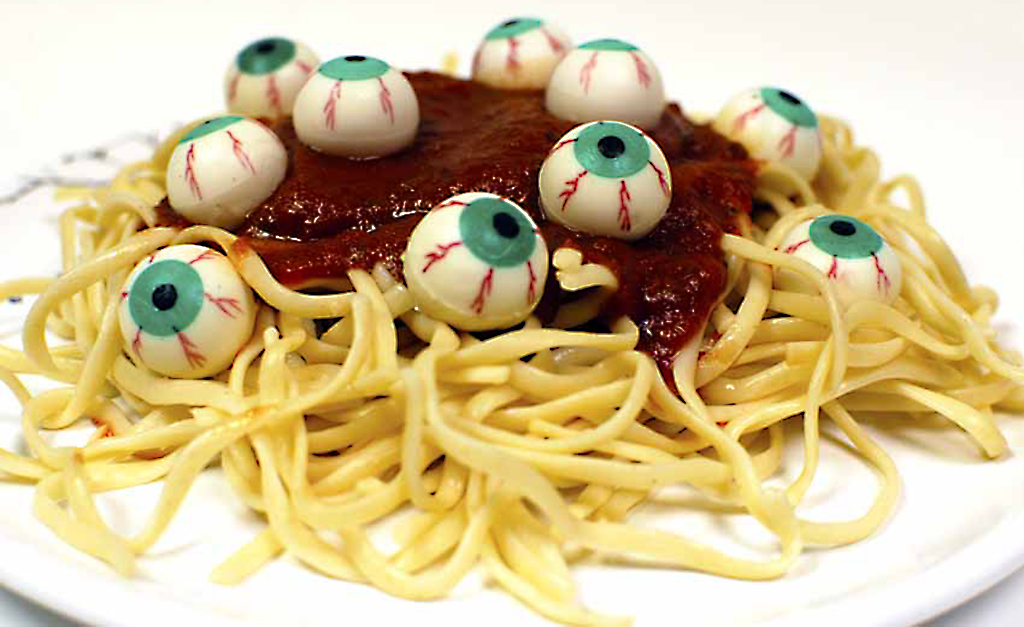
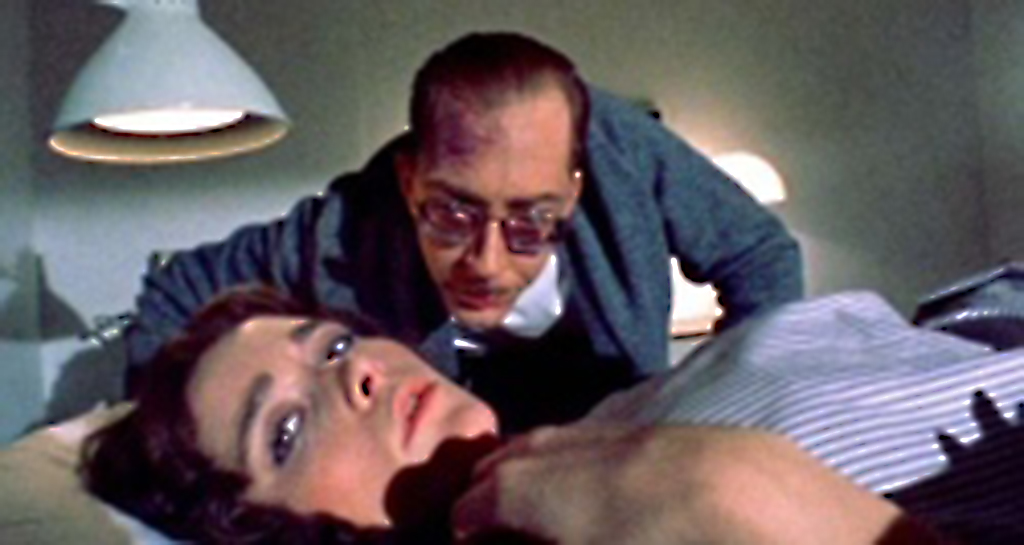
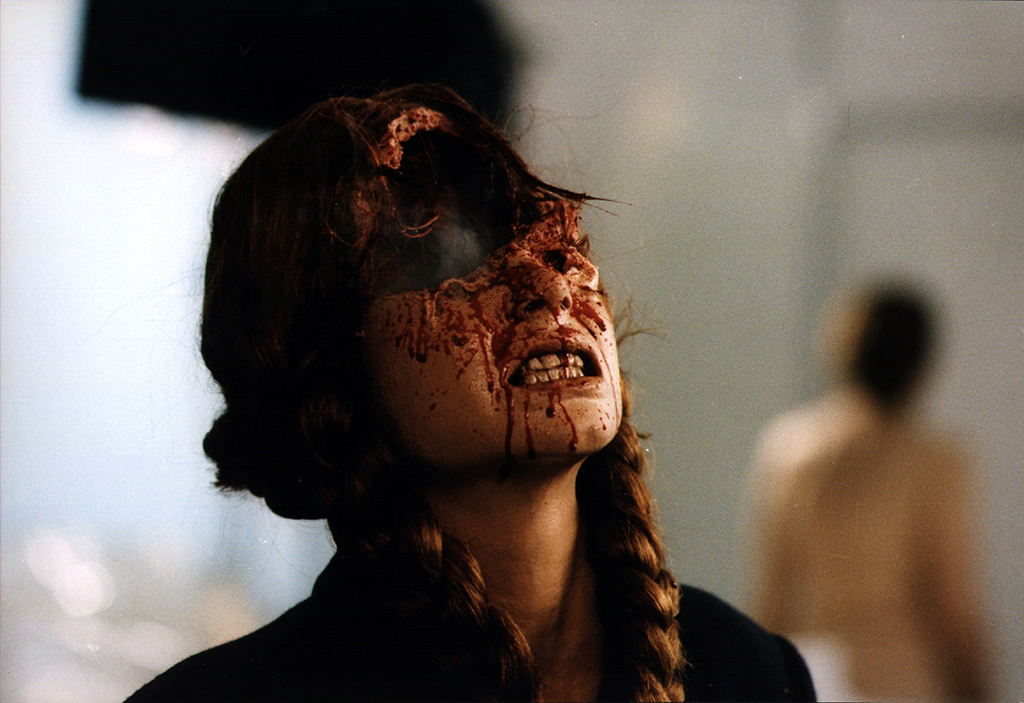
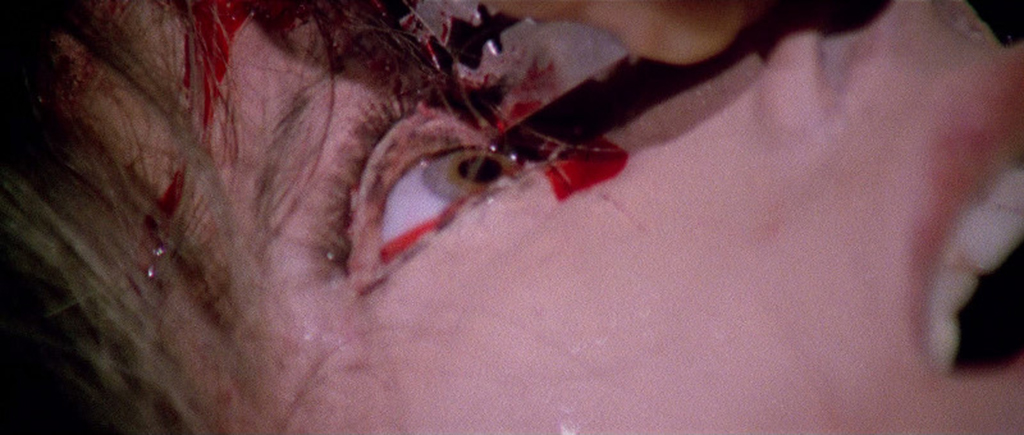
Sette Note In Nero, aka Seven Notes In Black, aka Murder to the Tune of Seven Black Notes, aka The Psychic (damn those foreign distribution deals!) came out in Italy in 1977, though it wasn’t released on DVD in the US until many years later. It’s a tight little supernatural murder mystery that deftly maintains an air of heightening tension throughout the entire film, keeping you on that fabled edge of your seat until the very end. In addition, the set design is gorgeous, and the performances from leads Jennifer O’Neill and Gianni Garko seem to be excellent (the dubbing is a little distracting, but not nearly as bad as some other Italian films of the period). There is very little gore, other than an amusingly Fulci-an moment in the opening flashback scene where a suicidal woman repeatedly sloughs flesh off her face as she jumps to her death off a cliff; other than that, the only blood that appears accompanies a couple of not-terribly-graphic head wounds. So if you’re squeamish about that kind of thing, you may feel free to watch this movie while digging into a huge, glistening bowl of spaghetti marinara; you’ll probably be fine.

MANGIA MANGIA.

MANGIA MANGIA.

The Psychic, like several other gialli, utilizes a plot device I’ve always liked; I don’t know if there’s a name for it, but I’m going to call it “partially spoiling the outcome.” In other words, the viewer already knows more or less what’s going to happen, but the suspense of the film is generated by seeing the way in which the inevitable will come to pass. Even though the film is structured this way, it’s actually still full of surprises, which is one of the reasons I’ve always admired its rather clever screenplay (written by Dardano Sacchetti, who incidentally also penned a bunch of Fulci’s most beloved gore films, like City of the Living Dead, The Beyond, and The House by the Cemetery).

Jennifer O’Neill plays Virginia Ducci, an American interior decorator who has recently married a hotshot Italian playboy named Francesco. It is established in the first scene that Virginia is a clairvoyant; we see a flashback of her as a schoolgirl having a vision of her mother’s suicide. Back in the present, she drops her dashing husband off at an airfield for a business trip, and then drives down a highway punctuated by long, dark tunnels. As she drives through one of the tunnels, she suddenly has a disjointed and unsettling vision. Aspects of her vision include:

  1. Shafts of red light, and what appears to be someone placing a brick in a layer of mortar.
  2. A pretty but sinister little tune, like something from a music box.
  3. A cigarette with yellow paper balanced on the edge of a blue ashtray.
  4. A magazine with an attractive dark-haired woman on the cover.
  5. A yellow taxi parked on a dark street.
  6. A broken antique mirror.
  7. A sumptuously decorated room containing an overturned bust with a letter underneath it.
  8. A glimpse of a man’s feet as he walks with a decided limp.
  9. The clearly visible face of a man with a mustache, emerging from the shadows.
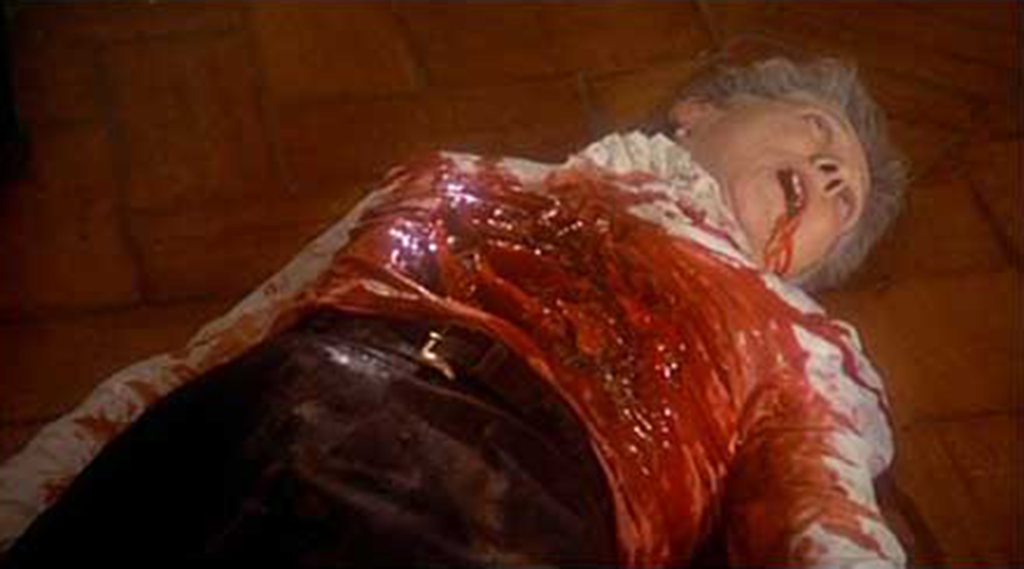
  10. An obviously dead old woman with blood all over her face and head.
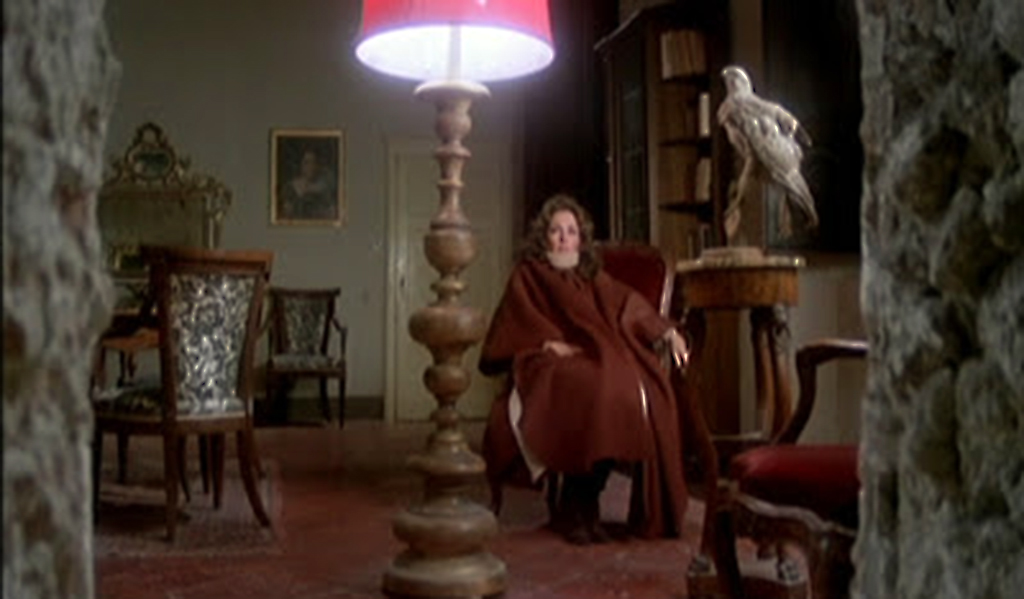
  11. A room with a floor lamp with a red shade, and beyond that a wall with a substantial portion of the masonry removed.
BAROQUE AS FUCK.

BAROQUE AS FUCK.

I'VE FALLEN AND I CAN'T GET UP.

I’VE FALLEN AND I CAN’T GET UP.

REALLY ADDS A NICE "CASK OF AMONTILLADO" VIBE TO THE DECOR, DOESN'T IT?

REALLY ADDS A NICE “CASK OF AMONTILLADO” VIBE TO THE DECOR, DOESN’T IT?

After seeing this seemingly nonsensical collection of images, she awakens on the side of the highway with a police officer knocking on her window and asking if she’s all right. She snaps out of it pretty quickly, but is still troubled by what she’s seen and heard. Despite her unease, however, she continues on to her first destination, the office of her friend Luca Fattori (Marc Porel), who is a parapsychologist and has apparently been counseling Virginia about her visions for many years. She tells him about her latest vision and he records it, though he doesn’t believe it has any particular significance.

"cagna, si prega di"

“CAGNA, SI PREGA DI.”

Virginia’s next destination turns out to be an old palazzo that is owned by her husband Francesco. He hasn’t lived in it for several years, and it looks all but abandoned, but Virginia has decided that she is going to surprise him by starting to restore the beautiful old place. The caretaker lets her in and she begins poking around. In what was previously Francesco’s bedroom, Virginia starts removing the covers from the furniture and stops cold when one of the items revealed is the antique mirror she saw in her vision. The mirror isn’t broken as it was in her psychic episode, but it’s clearly the same one. Disturbed, she starts pulling off other covers, and yes, here is the floor lamp with the red shade. She glances over at the wall behind the lamp, which of course had a large section missing in her vision. It looks normal now, but she gets closer to inspect it. At first she doesn’t see anything and laughs at her own folly, but then she notices a very faint yellowed line and what appears to be a hairline crack. Still not completely sure she should be doing this, she finds a pickaxe in the basement and goes to town on the wall. It takes her forever, and the movie almost makes us think that there’s not gonna be anything back there, but nope, Virginia’s vision is vindicated (alliteration, bitches). She finds a skeleton and summons the polizia.

It seems clear that Virginia has seen a vision of the murder that ended up with a body walled up in her husband’s palazzo. She assumes that the victim was the dead old woman she saw, and that the murderer was the limping, mustachioed man lurking around on a staircase. So she’s a little put out when her husband is picked up for questioning as soon as he arrives back from his business trip. The cops and her lawyer assure her that this is just a formality, since the skeleton was found in Francesco’s house. Virginia is certain that he is not the murderer, not only because she saw another man in her vision, but also because the estimated time of death of the victim partially overlapped with a point in time, several years earlier, when Francesco was provably out of the country. Virginia is determined to clear her husband’s name, enlisting a couple of lawyers, Luca, Luca’s perky secretary Bruna (Jenny Tamburi), and Francesco’s sister Gloria (Evelyn Stewart) in this endeavor.

NOT TO WORRY, THE ITALIANS ARE ON THE CASE. THEY HAVE PIPES. AND PROBABLY MOB TIES.

NOT TO WORRY, THE ITALIANS ARE ON THE CASE. THEY HAVE PIPES. AND MAYBE MOB TIES.

Things get confusing pretty quickly, though. First of all, it’s discovered that the skeleton behind the wall is not that of an old woman at all, but of a 25-year-old woman named Agneta Bignardi. Upon seeing a photograph of her, Virginia realizes that she is the dark-haired woman on the magazine cover in her vision. Francesco admits to having a relationship with her several years back (uh-oh). And that’s not the only fact that seems to contradict her vision: she also sees the old woman, very much alive, outside her window one night and gets several phone messages from her in which she insists she knows something about the murder. Turns out that Francesco’s sister smokes cigarettes with yellow paper, and also gives her a watch that plays the sinister little tune she heard in her vision. The man she saw in her vision that she assumed was the murderer, Emilio Rospini (Gabriele Ferzetti), doesn’t have a limp, though he does seem to know something about the girl’s death and acts sinister as fuck. She finds a photograph of Agneta that was apparently taken several months after Francesco left Italy, meaning that the girl was probably killed by Rospini. Or was she?

SYMBOLISM (PROBABLY).

SYMBOLISM (PROBABLY).

The tense, nail-biting fun of this movie is seeing each of the images in her vision turning up one by one in reality, and trying to piece together how everything fits. The coolest aspect of this narrative structure (and this is a big ol’ SPOILER ALERT) is that for pretty much the first half of the movie, both the viewer and the film characters assume that Virginia’s vision was of the circumstances of the past murder. But as the story goes on, we slowly begin to realize, along with the characters, that Virginia’s vision was actually of the future, and the suspense gets more and more intense as the details begin to fill in and we realize what’s likely to happen and what exactly is at stake. It’s a self-contained and very satisfying narrative, and even though the very end leaves you going a little, “Wha…?” it’s still a taut, enjoyable ride.

Until next time, Goddess out.

The Goddess’s Favorite Creepy Movie Scenes, or Double Your Pleasure

Twins are a well-established feature of the horror genre, and understandably so. Is there anything quite so unsettling to us singular folks as two people who appear more or less identical, but at the same time are still separate entities? Growing up, I had two sets of identical twins in my family (a pair of aunts and a pair of cousins), and while I never found them weird or scary at all, I was always fascinated as to what it would be like to have a clone of yourself living in the same house as you. Would you pull all sorts of switcheroos and other twinly shenanigans? Be able to communicate in your own invented language, or even telepathically? Murder a person and then accuse your twin, just for shits and giggles? The possibilities are staggering.

Obviously I’m not the only person who is intrigued by this stuff, judging by the plethora of horror films that feature creepy twins in either a central or peripheral role. Twins in film are generally made even more disturbing by the addition of some sort of psychic link between the pair, or perhaps a kind of bizarre incestuous relationship, or the designation of one twin as good and the other evil. A short list of films that make good use of this motif would include The Shining, City of Lost Children, The Dark Half, Basket Case, The Other, Twins of Evil, The Black Room, Jack’s Back, and, of course, the twin (ha!) subjects of today’s post.

Sisters_DeadRingers

Two of the best films in the twin-horror canon, I think we can all agree, are Brian De Palma’s Sisters (1973) and David Cronenberg’s Dead Ringers (1988). Both feature a profoundly screwed-up set of identical twins played by the same actor (Margot Kidder in Sisters and Jeremy Irons in Dead Ringers), both bring up some uncomfortably creepy psychosexual issues between the siblings, and both feature a sort of good/evil dichotomy between the twins, with Sisters being the more obvious example of this trope.

GUESS WHICH “TWIN” THIS ONE IS.

GUESS WHICH “TWIN” THIS ONE IS.

Sisters was not Brian De Palma’s first film, but it was the first of the fantastic Hitchcockian thrillers that he would become so renowned for, and it already shows a director with a surefooted grasp of his material. He certainly got a bravura performance out of Margot Kidder, who is absolutely astonishing and wholly believable as French-Canadian model Danielle Breton, complete with spot-on accent. Early in the film, Danielle appears on a New York game show where she meets handsome ad salesman Philip (Lisle Wilson) and charms her way into a date. The pair seem to be hitting it off, though there is the small matter of Danielle’s ex-husband Emil (William Finley) following them around, and then there’s that large, unsightly scar on Danielle’s thigh. But love finds a way, sort of, and Danielle and Philip have an enjoyable night back at Danielle’s apartment in Staten Island.

The next morning, though, things look quite a bit stranger. Philip awakens to what sounds like Danielle arguing with another woman in French. She disappears into the bathroom and scarfs some red pills, then tells Philip that she would really appreciate it if he could just pop down to the pharmacy and get her some more of the drugs, pretty please. He asks what the deal was with the French arguing, and Danielle tells him that her twin sister Dominique has come over to the apartment because it is their birthday, and Dominique is upset that Philip is there. He feels bad and offers to leave, but Danielle tells him to hang around. He agrees to come back after his pharmacy errand, and leaves the apartment. While he’s out, he spots a bakery, and being a considerate kinda guy, he ducks in there and buys a cake for Danielle and Dominique’s birthday.

Meanwhile, Danielle is back at the apartment and doesn’t appear to be doing too well. She’s screaming at someone on the phone that she’s out of pills, she’s writhing around on the bathroom floor as if she’s in terrible pain; the whole thing is just not looking terribly kosher. When Philip returns, he finds Danielle (or at least he thinks it’s Danielle) sleeping on the hide-a-bed in the living room. He quietly lights all the candles on the cake, gets a knife out of the kitchen to cut it with, then sets the cake down on the bed in front of the sleeping “Danielle.”

Wrong move, Philip.

I’M DIABETIC, YOU INSENSITIVE ASSHOLE!

I’M DIABETIC, YOU INSENSITIVE ASSHOLE!

Poor Philip gets ventilated pretty effectively, but before he dies, he manages to crawl to a window and write “help” on it in blood. This turn of events is witnessed by a neighbor across the courtyard, Grace Collier, who happens to be a journalist working for some two-bit newspaper but aspiring to much greater things. Said aspirations had previously prompted her to write a whole newspaper series on police corruption, so as you can imagine, when she calls the cops to report the murder in her apartment building, they’re reluctant to listen to her. They eventually show up, grudgingly, and she argues with them in the lobby. Meanwhile, utilizing one of his beloved split-screen effects, De Palma shows us that Danielle is apparently shocked at the carnage that Dominique has wrought. Her ex-husband Emil, who of course had been watching her the entire time, snaps into action to help cover up the murder. They roll Philip’s body into the hide-a-bed, clean up the blood streaks on the floors and windows, and generally get everything spic-and-span. By the time the cops come knocking on Danielle’s door with a squawking Grace in tow, there is no apparent trace of the murder at all, other than a single blot of blood on the back of the sofa that the annoyed cops don’t even notice. Grace tries to sneak around and do her own investigation, but the cops keep getting more and more pissed off because they don’t see any evidence that a murder has taken place. Grace plays the racial angle, accusing the cops of not caring about the victim because he was a black man killed by a white woman. As she’s snooping around, she finds the birthday cake with both sisters’ names on it in the refrigerator, and tries to bring it out to show the cops in order to claim that the charming Danielle is covering up for a twin sister who is not present. Wouldn’t you know, it, though, Grace slips on the just-cleaned floor and drops the cake before the cops can see what it said. Heh heh.

The remainder of the film has Grace bound and determined to nail Danielle for the murder, even going so far as to hire a private detective (played by Charles Durning) to break into the woman’s apartment and later follow a moving truck that took away the telltale sofa the day after the murder. During Grace’s investigation, she discovers that Danielle’s twin Dominique had actually been a conjoined twin (hence Danielle’s scar), but had died a year previously after the surgery to separate the women. So now we understand that Danielle has taken on the mantle of both the good twin and the evil, and without her pills, she manifests Dominique’s psychopathic tendencies without being aware that she is doing so.

The creepiest part of this film comes toward the end, as De Palma takes us in an unexpected direction. Grace is following Danielle and Emil, and she ends up at some sort of open-door psychiatric hospital out in the country. She watches through a window as Emil drugs Danielle with a syringe. Grace goes into the hospital and tries to use the phone to call the cops, but she is thwarted by staff and by the crazy patients. Emil appears and tells a staffer that Grace’s name is Margaret, and that she is a new patient. Grace, of course, violently protests that she is crazy, but like a dumb ass, she has left her identification in her car, so no one believes her, and the more she protests, the crazier she seems. Emil takes her away, drugs her, and hypnotizes her, giving her a post-hypnotic suggestion that she saw no body and no murder.

YOU SAW NOTHIN’, CAPISCHE?

YOU SAW NOTHIN’, CAPISCHE?

There then follows a very disturbing sequence wherein a drugged Grace has a dream in which she stands in for the insane Dominique, reliving the trials of the conjoined twins’ separation a year earlier. She sees herself on a hospital bed in an operating theater, and as she glances over, she sees that she is attached to Danielle.

WELL, HEY. DIDN’T EVEN NOTICE YOU THERE.

WELL, HEY. DIDN’T EVEN NOTICE YOU THERE.

Emil is hovering over Danielle lovingly, and the two kiss and make out while Grace/Dominique sulks on one side of the bed. “Make her go away,” Danielle begs Emil, and then Grace looks around to see all these freaky-ass looking people in the operating theater, passing a cleaver from hand to hand. Turns out that the twins were ultimately separated because Danielle was miscarrying and would have died if her sister was not detached. It’s all very nightmarish and disturbing, and it all ends up with Emil chopping the sisters apart with the cleaver, and then Danielle killing Emil with a scalpel and freely confessing to his murder (but not Philip’s), and Grace being rescued from the hospital by the police, though the post-hypnotic suggestion Emil gave her stays in effect, and she keeps vehemently insisting that there was never any murder and no body. The final, somewhat farcical shot is of the sofa containing Philip’s body sitting at an abandoned train station.

DON’T WORRY, DETECTIVE MOO MCLANAHAN IS ON THE CASE.

DON’T WORRY, DETECTIVE MOO MCLANAHAN IS ON THE CASE.

As good as Sisters is, however, it can’t begin to approach the skin-crawling weirdness of the quintessential creepy-twin movie, Dead Ringers. David Cronenberg, of course, is the undisputed master of squicky sexual perversion and gross-out body horror, his particular fascination lying in the myriad ways the body can go horrifically wrong from within, through parasitical infection (Shivers), disease (Rabid), disfigurement (Crash), techno-biological enhancement (VideodromeeXistenZ) or some other type of bizarre transformation (The Fly).

Dead Ringers, though, focuses less on the physical and more on the psychological (though there are plenty of uncomfortable Cronenberg flourishes in the form of gynecological instruments for “mutant women”).

YOU KNOW YOU’RE A GREAT DIRECTOR WHEN WE CAN TELL IT’S YOUR MOVIE FROM JUST A SINGLE STILL.

YOU KNOW YOU’RE A GREAT DIRECTOR WHEN WE CAN TELL IT’S YOUR MOVIE FROM JUST A SINGLE STILL.

Jeremy Irons turns in a staggering (and award-winning) performance as twin gynecologists Beverly and Elliot Mantle; his portrayal of the two characters is so effective that the viewer can ALWAYS tell immediately which twin is which, even though they are both played by the same person. Beverly is bookish and sensitive, while Elliot is cocky and borderline sociopathic. Despite their differing personalities, though, the pair are inseparably, creepily attached to each other, living together in a swank apartment and often taking one another’s place with no one around them being the wiser. “Listen. You haven’t had any experience until I’ve had it too,” Elliot tells Beverly at one point, and as the movie progresses, we see the sort of twisted dynamic these two have going on, and witness the havoc it wreaks around them.

HOW EMBARRASSING! WE BOTH WORE THE SAME THING!

HOW EMBARRASSING! WE BOTH WORE THE SAME THING!

The famous Mantle twins are lauded as geniuses in their field, showered with awards and accolades. They own a world-renowned fertility clinic in Toronto, and it is here that they meet the agent of their eventual unraveling: a beautiful, tragic actress named Claire Niveau (Geneviéve Bujold), who is in town shooting a movie. Claire desperately wants a baby, but has had no luck at any of the other fertility clinics she has visited because she is the possessor of a rare mutation, a “trifurcated cervix.” The Mantle clinic is her last hope to get pregnant, but unfortunately, even they can do nothing to help her, although Elliot, cad that he is, is quite happy to seduce her and then pass her on to Beverly when he grows tired of her. Claire, who is from out of town, has no idea that Elliot and Beverly are two separate people, and becomes involved with what she thinks is one sexy (if vaguely schizo) doctor.

Later, Claire is at lunch with a friend who has heard about her dalliance and asks her which of the Mantles she’s been seeing. Claire is shocked at the news that there are two of these freakazoids, and figures out pretty quickly that she’s been unknowingly acting as the gooey filling in a Mantle-twin Oreo. On her next date with Beverly, she asks to meet Elliot. He balks at the idea, but she insists, and in the next scene, we see her sitting down with both of them in a restaurant, clearly ready to tear them both new assholes. “There’s really no telling you apart, is there?” she says as she looks from one to the other of them. Elliot makes a joke about being a bit taller, and Claire says there’s a better way to tell them apart. “Beverly’s the sweet one, and you’re the shit.” She then tells them that she’s been through some creepy things before, but this really takes the whole perverted enchilada, and then she asks them if they have a whole routine going, where Beverly softens up their dupes with his sensitivity and then leaves the girls to be finished off by the cold Elliot, but Elliot lives up to his reputation by saying, cruelly, “Actually I fucked you first, but I passed you to my baby brother because you weren’t very good.”

APPLY OINTMENT LIBERALLY TO BURN AREA.

APPLY OINTMENT LIBERALLY TO BURN AREA.

Claire throws a drink in Beverly’s face and storms out. Elliot thinks it’s all very amusing, but then he notices that Beverly is crying. Yes, Bev has actually fallen for Claire and is heartbroken at what has transpired. Later on, he is able to convince her to give him another chance, but after she leaves town after the movie she is working on is finished shooting, Beverly spirals into depression and sinks further into the drug addiction he’d been exploring with Claire. He begins having delusions about mutant women, inspired by Claire’s cervical mutation, and has frightening-looking tools commissioned so that he can ostensibly work on these women. After attacking one of his patients with one of the tools, Beverly is suspended along with his twin. Elliot tries to straighten Beverly out, but only ends up getting addicted to drugs himself. Claire comes back and Beverly seems to get his shit together, but now Elliot is screwed. In a final, chilling sequence, the twins celebrate a “birthday” with cake and ice cream, Beverly kills Elliot with one of the gynecological tools in a symbolic gesture to “separate the Siamese twins,” and then it transpires that Beverly actually cannot live without his other half, and he dies in his brother’s arms. Creepy, creepy shit.

NOT JUDGING, BUT THEY MIGHT BENEFIT FROM SOME FAMILY THERAPY.

NOT JUDGING, BUT THEY MIGHT BENEFIT FROM SOME FAMILY THERAPY.

Twins, I suspect, are effective in horror movies because as natural döppelgangers, they can encompass the good/evil, Jekyll/Hyde dichotomy in a very direct, compact way, either as both good and evil fighting it out in the same body (as with Sisters), or being split between two “half-people” who cannot survive as individuals (as in Dead Ringers). In any case, I’m sure the twin trope isn’t going away any time soon, as it’s such an easy method to explore universal themes of the light and dark side of human nature. Hope you’ve enjoyed this two-fer post, and as always, until next time, this is the Goddess (and her evil twin) signing off.

I'M CLEARLY THE CUTE ONE.

I’M CLEARLY THE CUTE ONE.

The Goddess’s Favorite Creepy Movie Scenes, or Time Ain’t on Your Side

Despite my oft-repeated love of subtle, atmospheric horror, I will also admit to being something of a gorehound. And I’m assuming that my fellow gorehounds will be intimately familiar with the works of the legendary Italian filmmaker Lucio Fulci. Although Fulci made movies in pretty much every conceivable genre (comedies, westerns, thrillers, cop dramas), he is today primarily remembered as The Godfather of Gore, and widely beloved for scenes like these:

I’M HALF THE MAN I USED TO BE

I’M HALF THE MAN I USED TO BE

HEAD LIKE A HOLE

HEAD LIKE A HOLE

ANDALUSIAN DOGGY STYLE

ANDALUSIAN DOGGY STYLE

NO GUTS, NO GORY

NO GUTS, NO GORY

However, true to my contrarian nature, I’d like to discuss one of Fulci’s lesser-appreciated horror films, one that is perhaps not as colorful as the above examples, but serves as a reminder that the cranky, bespectacled Italian was more than capable of producing a disturbing, relatively low-key scare experience without necessarily resorting to buckets of blood and entrails.

1989’s The House of Clocks (aka La Casa nel Tempo) was actually filmed for Italian cable television, but was considered too violent for TV. It never aired, and was later relegated to direct-to-video hell. Briefly, it tells the chilling story of an elderly couple, Victor and Sarah (Paolo Paolini and Bettine Milne) who are set upon by a group of three robbers in their palatial home in the country. The gang sort-of-accidentally murders the oldsters during the attempted heist, but then they begin to notice that some weird-ass shit is going on in the spooky old mansion. The countless clocks around the place all mysteriously stop at the exact moment the couple are killed, and thereafter follows a bizarre narrative where time itself appears to be running backwards. The crotchety codgers seem to return from the dead to take revenge, but then they are apparently killed again, and then other people are returning from the dead, and then it turns out that the robbers were just high the whole time and never even entered the house at all, but then they get killed in a car crash before the robbery even happens, or something…? Anyway, like many Italian horror movies, the plot doesn’t really make a lick of sense, but if you can just go with the flow and soak up the unsettling, well-constructed atmosphere, then I think you’ll find that House of Clocks is a wonderfully eerie and underrated film in Fulci’s vast canon.*

and if you disagree, someone has a bone to pick with you.

one, you lock the target.

One thing I’ve always appreciated about this movie is its use of one of my favorite horror tropes: Malevolent Old Folks. Sure, lots of movies have spooky children, but fewer utilize the other end of the age spectrum in such an effective way. Creepy old people are creepy, I assume, for one of the same reasons that creepy children are: namely, that people tend to view both children and the elderly as rather innocent and harmless, so when they go bad, it fucks with our sense of perspective about how the world should work. Old people, though, also have the additional creep factor of being far closer to death, thus subconsciously reminding us of our own impending decline and inevitable expiration.

Victor and Sarah are a prime example of this. I find that I almost want to compare them to the evil Castavets from Rosemary’s Baby, though where the Castavets lured the Woodhouses into their web using a sort of potty charm and conscientiousness that bordered on bullying, Victor and Sarah feign a doddering helplessness to throw the gang of robbers off their game. The suspense in House of Clocks comes from the fact that viewers are aware right from the beginning that the old folks are not the sweetly genteel grandparents they appear to be. In the very first scene, for example, the sexually-ambiguous housekeeper creeps around the mansion with clear trepidation, and eventually stumbles upon a hidden chapel containing two rotting corpses in wedding clothes who have been stabbed through the throat with huge nails. And the next scene shows Victor, in his gentlemanly black suit, entering the dining room for breakfast. He picks up and pets a kitty cat, then he notices a pretty little bird sitting on the open windowsill. He feeds the bird some toast and coos at it, looking lovingly down at the tiny creature just seconds before he smashes it to death with his cane. And directly afterwards, there’s a really disturbing sequence where Victor and Sarah are in the chapel with the dead bride and groom. Victor casually hammers the bride’s throat-nail in deeper, and then brushes some dust off the groom’s coat. Sarah peers through her glasses and shakily reapplies the bride’s lipstick, then kisses her forehead. All the while, the geriatric pair are sadly lamenting to the corpses (who are their nephew and his wife, it turns out) that they were ungrateful little shits who were only after the couple’s money. So yeah, Santa and Mrs. Claus these two ain’t.

we could have just put lumps of coal in your stockings, but we decided to throat-stab you instead.

we could have just put lumps of coal in your stockings, but we decided to throat-stab you instead.

By now, you’ve probably got the gist that these fossils are definitely not to be trifled with, but Fulci isn’t done. The very next scene shows the housekeeper, Maria (Carla Cassola) approaching the greenhouse. She passes one-eyed groundskeeper Peter (Al Cliver), who appears to be digging a grave in the garden. She then goes into the greenhouse and finds Sarah fussing over her flowers. She informs Sarah that she will have to be leaving the couple’s employ to care for her mother. Sarah takes this all in stride, making sympathetic and understanding noises right before swiftly turning, grabbing some kind of spear-like garden implement, and stabbing Maria right in the delta of Venus.

YOU CAN’T QUIT, I’M FIRING YOU!

YOU CAN’T QUIT, I’M FIRING YOU!

The cool thing about the first twenty minutes of the film is that Fulci takes his time setting up the couple’s murderous streak in spades, so when the robbers show up, you’re thinking, “Oh man, did you dipshits pick the wrong house to plunder.” But then he toys with our expectations by having Victor and Sarah get blown away almost immediately.

YOU THINK A GAPING CHEST WOUND IS GONNA STOP THIS LADY? HELL NO. SHE’S A PISTOL, THAT ONE.

YOU THINK A GAPING CHEST WOUND IS GONNA STOP THIS LADY? HELL NO. SHE’S A PISTOL, THAT ONE.

It is only then that the viewer realizes that not only can the feisty seniors handily kick ass in this life, but also apparently can bend space and time to their will, making them able to fuck your shit up before you even did anything. There should be some kind of hardcore AARP for these two to join, is what I’m saying.

Also, is it weird that I sort of wish Victor and Sarah were my grandparents? Sure, you’d never, ever ask them to borrow fifty bucks to cover your electric bill, but if you were super nice and appreciative they’d probably have you over to their wicked-cool mansion for tea and scones, and if anybody ever messed with you, your beloved Nana and Pop-Pop could take care of your little problem with a minimum of fuss, even returning from the dead to do so if necessary. Just a tip, though: if Victor and Sarah do you the favor of gorily eliminating one of your sworn enemies, the least you can do is call them on their birthdays or bring them a case of Ensure or tape that Matlock marathon for them or something, for heaven’s sakes. You know, give something back, that’s all they ask.

should have given nana those coffee coupons, shouldn't you? she did ask nicely.

should have given nana those coffee coupons, shouldn’t you? she did ask nicely.

Until next time, Goddess out.

*If you’re a Fulci fan, keep watching this space, because I eventually want to do a writeup on another of Fulci’s underseen gems, 1977’s The Psychic (aka Murder to the Tune of Seven Black Notes).

The Goddess Dons Her Tinfoil Hat and Beats a Dead Horse with a Roque Mallet

In my previous post comparing Stanley Kubrick’s film version of The Shining with Stephen King’s vastly inferior TV miniseries, I offhandedly mentioned the staggering variety of “conspiracy theories” surrounding Kubrick’s film without going into particular detail about any of them. I didn’t think it was necessary to exhaustively catalogue all the crazy interpretations that have appeared over the years, not only because there are endless sites already doing just that (hell, Shining conspiracy theories even have their own wiki, and just last year a documentary called Room 237 outlined the most common ones), but also because I think the great majority of them are utter, overreaching horseshit. No, I do not believe that Kubrick was trying to send us secret messages about faking the moon landing, or about CIA mind control, or about the Holocaust, or about the impending Mayan apocalypse.

This guy probably does, though.

This guy probably does, though.

However…

Artists, particularly ones of Kubrick’s caliber, absolutely do put hidden meanings and subtexts into their work, and it would be silly to argue that they don’t. This doesn’t mean that they’re trying to impart some kind of secret knowledge about the universe’s inner workings or anything; it’s just that they’re trying to make their films or books or whatever a richer experience for their audience by adding “clues” to underlying themes for the viewers to puzzle out on their own. It’s hard to deny that Kubrick’s The Shining is loaded with this stuff, and obviously a great deal of it was deliberate, because that’s what artists, at least good ones, try to do.

After my recent rewatch of the TV miniseries, I spent several hours poring over different people’s interpretations of Kubrick’s film, and then decided to rewatch his 1980 adaptation with the various “conspiracies” in mind. After the film, the God of Hellfire and I were discussing it yet again (and yes, I can totally see why this movie has spawned so much obsessive speculation since it came out, thank you for asking), and suddenly, the GoH had something of a revelation (and this will be kinda funny later, I promise).*

Here’s the deal. Several of the so-called conspiracy theories out there (and I hesitate to call them that; I prefer to call them subtexts or motifs) have hit upon different facets of Kubrick’s overarching theme. But the GoH’s post-film epiphany (and all credit to him, as it was his excited discourse that inspired me to wade into the fray and write this post) seemed to tie together many of the more reasonable theories put forth by others into one coherent whole. I slogged through several pages of Google searches to see if anyone else had come up with this particular angle before, and while I found it hinted at in several places, I found no one who had laid the entire thing out in a clear framework the way the GoH did. If after reading this post you can find someone who has hit upon this exact slant, then kindly point me in that direction, but for now, I’m going give tentative props and kudos to my sexy male counterpart for coming up with what seems to be a pretty original take on Kubrick’s masterpiece. So let me see if I can break this all down.

Screw you, indigenous population!

Screw you, indigenous population!

Exhibit One: Native American Genocide
By far the most common and obvious subtext attributed to The Shining has to do with the slaughter of the Native Americans. Near the beginning of the film, as he is giving the Torrance family a tour of the Overlook, manager Stuart Ullman tells them point blank that the hotel was built over a Native American burial ground, and further, that a few “Indian attacks” had to be “repelled” while the Overlook was under construction in the early 20th century. In addition, the hotel itself is decorated in a Native American theme (Navajo and Apache, according to Ullman), there are several conspicuous placements of cans of Calumet baking powder (Calumet uses a Native American in a warrior’s headdress as its logo, and the word “calumet” means “peace pipe”), and many of Wendy Torrance’s fashion choices bear Native American-style motifs. There is also Jack’s twice-repeated use of the phrase “white man’s burden” to Lloyd the bartender as he is downing his bourbon (with alcohol being yet another purported tool of the natives’ subjugation by whitey).

Other interpreters of this particular thematic element have stated that Kubrick was making a not-so-subtle indictment of the Native American genocide, and it’s easy to see how they come to that conclusion. In this scenario, Jack represents the “white man” who subjugates his wife and son the way the Europeans subjugated the native population. But according to the GoH’s reading of it, this is only tangentially correct. I will go into more detail about this after I’ve laid out all the tendrils, so just be patient.

Where's the little silver ball?

Where’s the little silver ball?

Exhibit Two: The Minotaur’s Maze
Another fairly obvious touchstone in Kubrick’s film is the repeated reference to the Greek myth of Theseus and the Minotaur. The director significantly changed King’s hedge animals to a hedge maze, and Wendy even compares the hotel itself to a maze as Halloran is showing her around the kitchen. In addition, the carpet patterns in much of the hotel’s decor are decidedly mazelike. Further, there is one scene that shows an increasingly bullish-appearing Jack lurking menacingly over a model of the maze, staring down at it as tiny simulacrums of his wife and son navigate their way through the real labyrinth outside. And at the climax, of course, Jack chases Danny through the maze, his speech becoming more and more animalistic as the chase progresses. Danny even finds his way out of the maze by following his father’s footprints in the snow, just as Theseus followed the golden thread (it’s also significant in this context that the main ballroom of the Overlook is called “The Gold Room”).

Hmmmm, could it be...Satan?

Hmmmm, could it be…Satan?

Exhibit Three: The Faust Connection
Right here is where we’re getting close to hitting upon the underlying framework that ties the disparate elements together. It is significant that the phrase Jack utters just before the first appearance of Lloyd the bartender is, “I’d give my soul for a drink.” Seconds after this pronouncement, Lloyd is standing before him and immediately indulges his wish, and it is from here that Jack’s true downward spiral begins. So in this sense, Jack has just made a Faustian bargain with the Devil, or in this case the “spirit” of the Overlook hotel, represented by Lloyd. Further evidence of this particular theme comes in the very final moments of the film, when we see a closeup of the black-and-white photo from 1921 on the wall of the Overlook. Jack is standing before a crowd of jazz-age partygoers, with his right hand raised, palm facing toward us, and his left hand by his side, pointing toward the floor. This strange pose subtly recollects the Tarot figure of Baphomet, aka, Satan, y’all.

'Sup.

‘Sup.

Sure, Goddess, I hear you saying, but all of those theories have been put forth many times, so what the hell is so compellingly new that you felt you had to blather on and on about it? Well, hear me out now. How can these three seemingly different themes be all of one piece? The GoH thinks he knows how, and it can be summed up in two words: Black. Magic. Or perhaps more specifically, ancient pagan religion, fostered through blood sacrifice and ritual.

'Sup.

‘Sup.

I admit it sounds sort of crackpotty at first blush, but consider the following:

1. During his first interview at the Overlook, Jack wonders why the hotel is closed during the winter months, since it seems that the skiing up there would be fantastic. Ullman tells him that it would not be cost-effective to keep the 25-mile road leading up to the Overlook open, and then significantly adds that at the time the hotel was built, its clientele were not interested in winter sports as much as they were the “seclusion” of the Overlook’s location, and its beautiful natural view.

2. As Ullman is showing the Torrances around the hotel’s interior, he mentions that scads of movie stars, presidents, and other prominent folks (including well-known gangsters, though he doesn’t explicitly mention that) have graced the Overlook’s hallowed halls. “Royalty?” Wendy asks. “All the best people,” answers Ullman.

3. Near the end of the film, as Wendy is frantically running around the hotel looking for Danny, she briefly sees an apparition of a clearly Very Important Dude in a tux getting blown by a man in a bear costume. While this is going on, and at several points subsequently as Jack chases Danny through the maze, the soundtrack of the film treats us to background “music” that sounds an awful lot like ritualistic chanting.

So what do these three details mean in relation to the well-worn theories I outlined above? Well, in the GoH’s perceptive scenario, the Overlook itself can be seen as a sort of temple of black magic, or perhaps more concisely, a place of ancient pagan worship much like the sacrificial temples of the Mayans, the Happy Hunting Grounds of the Native Americans, or the Valhalla of the Vikings. It was created, either deliberately or accidentally, to act as a place that “shined,” that used the power of sacrifice — either through blood or the psychic energy of people with the “shining” — as a consecration to create a vortex of eternal debauchery akin to a type of hell (or perhaps a heaven, depending on your perspective).

Just gonna leave this here.

Just gonna leave this here.

Think about it. The Overlook was built as a playground for the wealthy elite. Said elite were keen to make sure that the location was “secluded.” Not only was the hotel slapped right on top of an Indian burial ground, but Native Americans were “repelled” (i.e. killed, sacrificed) during its construction. Further, the hotel was then festooned with Native American symbology. The Colorado Lounge in particular, with its tall stained glass windows, high ceilings, and Jack’s writing desk in place of an altar, looks like nothing so much as a sort of pagan cathedral.

colorado wideshot from 1st floor

Not only was this made to be perhaps a sort of mockery or inversion of the Native Americans’ spiritual beliefs (in much the same way the Satanic Black Mass can be seen as an inversion of Christianity), but also as a type of co-option or embracing of the primal qualities of those that were sacrificed. Why would the wealthy elite who patronized the hotel want it to be so secluded, after all, unless they were planning on using it as a place to indulge their “baser” natures and embrace the primal, the primitive, the savage, the animalistic? Murder, crime, debauchery, decadence, endless partying, wild sex: these were the “rituals” in this new “industrial” tribe of rich white elites. (Incidentally, this may be why Halloran was able to work at the Overlook for so long without being assimilated, because by being black, he was of the wrong “tribe.”) They didn’t just want to plow under the “pagans,” you see, they also wanted to become them, or at least become like their own perception of the “savages” as man close to a state of nature. By indulging in their “primitive” shenanigans and trying to overcome their own detachment from nature, they perhaps inadvertently created something that a tribe of “primitives” would have created on purpose: a cult of nature that was fed with blood and sex magic.

So they built a swanky pleasure palace on sacred ground, tamed the natural landscape into a regimented hedge maze, and then proceeded to out-savage the “savages.” Ullman’s demarcation of the Overlook’s clientele as “all the best people” was perhaps Kubrick slyly insinuating that the rich degenerates who stayed at the hotel were not the “best” people at all. Maybe they weren’t even the worst people. They were just people like any other, prone to brutality and primitivism just like anyone else, though afforded greater latitude in their pursuit of degeneracy because of their exalted status. This is why the “animal” theme recurs, not only in the Minotaur allusions (the child sacrifice theme is clearly pertinent in this myth, and what were the Greco-Romans known for if not pagan debauchery?) and the bear costume, but in subtle animal motifs that appear in Danny’s drawings, background posters, characters’ clothing, and other places around the hotel.

Have you been helped?

Have you been helped?

DANNY!!! AAARRRGGGGLLLLLLRRRRRGGHHH!!!

DANNY!!! AAARRRGGGGLLLLLLRRRRRGGHHH!!!

And this is why the odd chanting on the soundtrack recurs, as a sort of cue to the viewer that the temple is about to accept a new infusion of blood and energy. The Overlook indeed strikes a Faustian bargain with its chosen victims: make a sacrifice of blood (Grady’s daughters, Halloran, the attempted killing of Wendy and Danny) and for you and your sacrificial victims, the “party” will continue forever.

High five, heathens.

High five, heathens.

*One of the more out-there theories that I didn’t go into in this post concerns Kubrick’s supposed use of recurring numbers in the film. While there’s no doubt that certain numbers turn up more than you would expect by chance alone (42 and 12 most prominently), and there is probably some reason why Kubrick chose to do this (especially since he deliberately changed the number of the scariest room from 217 in the book to 237 in the film; as others have pointed out, 2+3+7=12 and 2x3x7=42), I’ve always been of the opinion that the various “numerological” theories put forth about The Shining mostly strain credulity.

But in light of the GoH’s reading of the Overlook as a sort of “Satanic temple” metaphor, I thought I’d toddle on over to some numerology websites and see if those numbers had any particular significance (and yes, since you ask, I am a little embarrassed that those sites are now in my Google cache). I’m not gonna say that there’s necessarily anything to these numerological interpretations, but interestingly, in the Bible, Revelation 13:5 states: “The Beast was given a mouth to utter proud words and blasphemies and to exercise its authority for forty-two months.” The number 42, you guys. Douglas Adams was right!

So…The Shining and ancient magic: yay or nay? Please throw hosannas or brickbats as the case may be. And until next time, Goddess out.

The Goddess’s Tale of Two Shinings

It seems as though I start a lot of these blog posts with a half-assed apology for not sticking to my own arbitrary, self-imposed “rules” for the content I discuss, and I regret to inform you that this is going to be another one of those times. Yes, The Shining and the well-publicized blood feud between Stephen King and Stanley Kubrick has been the subject of nearly endless internet debate, but for some reason it’s a subject I’m obsessively fascinated by and often get into long, rambling conversations about, which means that you will now have to endure said ramblings in my patented type-diarrhea form. Sorry in advance. (Not really.)

I’m going to go in a slightly skewed direction with this, though; rather than discuss the drastic differences between King’s book and Kubrick’s film, and the subsequent 34-year hatefest between them, I’d like to delve more into the contrasts between Kubrick’s film and King’s 1997 mini-series adaptation. Yes, I will obviously have to talk about the book too, so readers may see this as a distinction without a difference, but hey, I’m trying to just carve out a semi-original niche for myself here, so cut me some slack.

PICTURED: SLACK, AND THE CUTTING THEREOF.

PICTURED: SLACK, AND THE CUTTING THEREOF.

Let me just take a few moments to talk about Stephen King as a writer. I would consider myself a fan, though I admit I haven’t read anything of his newer than Under the Dome, which I enjoyed but promptly forgot the second I finished it. I definitely feel as though the quality of his work has declined post-car-accident, and I know I am not alone in that opinion; his more recent work just doesn’t stick with you the way his earlier stuff does. I would never go so far as to call him a hack, as some have done; he’s a very good “popular” writer, and he’s written some absolutely GREAT books, The Shining among them. Is The Shining as great as, say, Shirley Jackson’s Haunting of Hill House, which partly inspired it? Hell no, and only an idiot would argue otherwise. But The Shining scared the ever-loving bejesus out of me the first time I read it, and has held up very well over multiple re-reads over the years. When King is on, he’s really, really on.

Here’s what I find weird, though. I’ve mentioned a few times in previous posts how much I love Danse Macabre, King’s scattershot but surprisingly astute analysis of horror in entertainment. In fact, on this very blog, I have used paraphrases from that book to back up some of my own viewpoints about what works and doesn’t work in horror; namely, that ambiguity and perhaps even obfuscation are necessary for really effective scares. What is unknown and largely unexplained is always more terrifying than what is known. King seems to grasp this, and even singles out books and films that were effective for this very reason, but when he is given the reins of a film project, he never seems to take his own advice. He has never really appeared to understand that literature and film are two completely different (hedge) animals; in a novel, you can, to some degree, get away with huge chunks of exposition and meticulous description of detail, because you are creating an entire world in the reader’s head. In film, everything is paraded right in front of your eyes, which means you have to exercise some measure of restraint, both in what you show and what you keep hidden. This is something that King has never really been able to do, judging both by adaptations of his work that he’s had a hand in (like Maximum Overdrive, which was similar to pro-wrestling in the sense that it was big, loud, and stupid, but also sorta fun, though no one would call it a masterpiece of celluloid), and adaptations done by others that he claimed he enjoyed (Children of the Corn, The Mangler). King is a good writer, and to be frank, sometimes I wish that he would just be content enough with that, and not try to dabble in mediums that are obviously not suited to his (quite prodigious) talents.

All that said, let’s dissect the 1997 mini-series, shall we? I remember seeing it when it initially came out; since I had always been such a big fan of both the book and of Kubrick’s adaptation, and was well aware of King’s tendency to royally whiff any film project he touched, I went into the viewing with some trepidation. And I’m sad to say that most of my worst fears about King’s version duly came to pass, and I ended up not even finishing the series because I hated it so much.

Fast forward to 2014. The God of Hellfire (henceforth GoH) and I were discussing The Shining because of a radio program we’d been listening to about Kubrick’s use of symbolism. I think I happened to mention that I had really detested the 1997 mini-series that King had made, as it seemed like nothing more than a self-indulgent, jealousy-fueled, bitchy dismissal of Kubrick’s singular vision. The GoH said that he’d actually liked the mini-series, mainly because he felt it was closer to the spirit of the book and followed the plot more faithfully (though he still agrees that Kubrick’s version was better). I hadn’t seen the thing in a long time, and I was willing to entertain the idea that the mini-series might not have been quite as terrible as I remembered, so late one night we sat down with our cigarettes and chocolate milk and watched the entire six hours in one go.

I will say straight out that indeed, the mini-series was actually not the atrocity I’d remembered it as. It wasn’t great, by any means, and parts of it were pretty cringe-inducing, but at no point during its run time did I feel as though I wanted to scoop out my own eyeballs or drop-kick a puppy into a wood chipper or anything like that. So…not awful, but a mediocre misfire at best. The problem with the entire production, I think, is what I was alluding to earlier, about King not fully understanding the differing strengths and weaknesses of the film medium as opposed to the literature medium. King’s version of The Shining is certainly far more faithful to the source material than Kubrick’s, perhaps even slavishly so, but that, to me, is the exact reason why it doesn’t really work.

ONE OF SEVERAL REASONS, IN FACT.

ONE OF SEVERAL REASONS, IN FACT.

The main difference between the two adaptations is that King’s was literal while Kubrick’s was mythic. A stark illustration of this is the fact that King’s mini-series was filmed in and around the Stanley Hotel, the real location that the Overlook was based on, while Kubrick’s Overlook, built entirely as a set, had a more otherworldly, dreamlike, and hence mythical quality.

One of King’s main criticisms of Kubrick’s film was that in casting Jack Nicholson, Kubrick presents a man who is clearly a raging lunatic right from the get-go. King tried to rectify this by casting “Wings” star Steven Weber as Jack Torrance 2.0, but I have to say that both King’s criticism and his attempt to realign the character to more suit his tastes is not really fair or effective. Weber is a good enough actor, but it’s obvious he’s striving to play Jack as a fallen “good” guy, and his portrayal suffers from a veneer of forced joviality. This is a character, remember, who was even portrayed in the book as an abusive alcoholic who may have had some redemptive qualities at his core. Nicholson’s Jack, while certainly something of a departure from the novel character, was more effective on screen because he exuded the anger and desperation of a man teetering on the brink of insanity at all times. This made him almost unbearably menacing, and thus the film that much more frightening.

King’s most persistent gripe, though, was that Kubrick’s film was soulless, that the heart of King’s book was ripped out and stomped flat in service to Kubrick’s coldly logical exploration of pet themes. While I can see why King would see it that way, I feel that he’s kind of missing the point. Yes, Kubrick simply used the frame of King’s story to hang his own vision on, and along the way may have altered the original intent of King’s novel (though not as much as King thinks he did, in my opinion). But I don’t think Kubrick was so much concerned with the sentimental, pedestrian tragedy of Jack’s downward spiral as he was with creating an archetypal meditation on isolation, evil, and the fragility of our rational humanity.

PICTURED: MONSTER MASH PARTICIPANT. NOT PICTURED: DIGNITY.

PICTURED: MONSTER MASH PARTICIPANT. NOT PICTURED: DIGNITY.

So Kubrick’s film featured an elegant hedge maze (shades of Theseus and the minotaur!) in place of King’s roving hedge animals (which looked painfully ridiculous in the mini-series when they began walking around like green CGI Scooby-Doos). Kubrick’s film kept aspects of the hotel’s history ambiguous (the woman in the bathtub, the blow job furries) to mirror the confusion and dislocation of the characters, while King drops a pallet-load of exposition about all the horrible things that happened at the Overlook in pretty much the first ten minutes of his adaptation. Kubrick’s film had those creepy twins, King’s had a hose with CGI teeth. Kubrick’s film has Danny talking to the “imaginary” Tony using nothing but his own croaking voice and a bent finger, King’s shows Tony in all his nerdy, floating, special-effect-y glory. Kubrick’s film keeps apparitions to a minimum, making them super-effective and frighteningly real when they do appear. King, meanwhile, populates the Overlook with hundreds of partying guests who appear and disappear in tendrils of smoke, and some of whom are afflicted with tragically bad “ghost” makeup. Kubrick’s film ends with Jack simply freezing to death in the middle of the maze, and the Overlook enduring with Jack’s unredeemed spirit trapped there for eternity, a testament to the fact that evil never dies. King’s film ends with Jack fighting two laughably bumbling spirits for control of the boiler’s vent pipe (and oh, that trite “boiling over/letting off steam” metaphor is hurting me right in my literary gland), then letting the whole hotel blow up with him inside it in a silly, unnecessary “redemption.”

IT'S LIKE AN ARBOREAL JURASSIC PARK ALL UP IN HERE.

IT’S LIKE AN ARBOREAL JURASSIC PARK ALL UP IN HERE.

'SUP, DANNY? REMEMBER TO WATCH FOR SLOW CHILDREN. OH, AND DON'T GO TO THE OVERLOOK BECAUSE IT'S FILLED WITH MURDER-GHOSTS. PEACE OUT. *WHOOSH*

‘SUP, DANNY? REMEMBER TO WATCH FOR SLOW CHILDREN. OH, AND DON’T GO TO THE OVERLOOK BECAUSE IT’S FILLED WITH MURDER-GHOSTS. PEACE OUT. *WHOOSH*

At every turn, King chose to portray in his film the story exactly as he had originally written it, and at every turn, this was shown to be a mistake of plodding literalism over filmic mythmaking. King’s only sop to the novel I actually kind of liked was the fact that, as in the book, Halloran didn’t get killed at the end. I actually understand (and even agree with) the reasons Kubrick chose to kill off Halloran immediately after he arrived at the Overlook; after all, it showed that even despite Halloran’s own supernatural gifts and his tireless race to rescue Danny and Wendy, the evil of the hotel was just too powerful for him. It was still kind of a bummer, though. So yay for Halloran not dying.
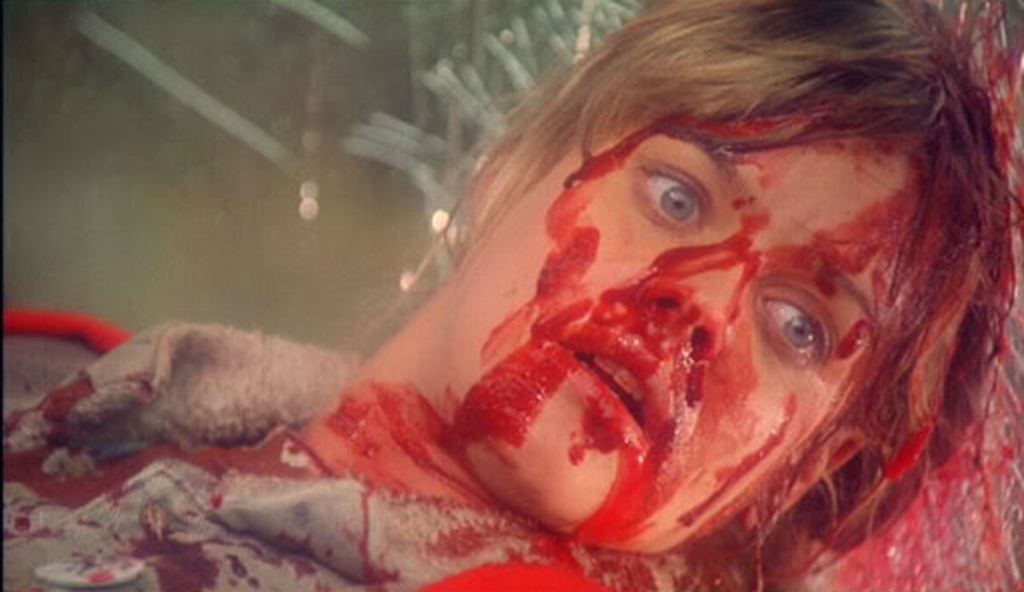
I will say that the acting was actually decent for this type of thing, by which I mean, it wasn’t awful, but it was okay in a TV-movie sort of way. I didn’t get the sense that these were real people the way I did in Kubrick’s version; say what you will about Jack Nicholson and Shelly Duvall (and I happened to think the casting was pretty spot-on), but they played those roles with conviction, son. The little boy who played Danny in King’s version had a very distracting mouth that he never seemed to be able to close and he always talked like he had a sinus infection, but I’m not gonna pick on a kid for shit he probably can’t help. He was fine, even though I didn’t believe him as a real character either, mostly because of his oddly stilted dialogue.

WHAT'S WRONG WITH MY MOUTH, YOU MEAN LADY?!?

WHAT’S WRONG WITH MY MOUTH, YOU MEAN LADY?!?

Which brings me to another of the film’s glaring weaknesses: THAT dialogue, because of course you knew I would come to that. King, even in his books, is actually fairly adept at writing relatable characters, but he does have a well-documented habit of putting weird regionalisms and repeated “catchphrases” into the mouths of his protagonists. I can forgive this in his novels, as it’s usually not frequent enough to be grating; even though I don’t know a single person who talks like a Stephen King character in real life, on the page it’s an acceptable aspect of the unique world King has created with his stories. Hearing these “cute” verbal touchstones spoken aloud many, many times over the course of a mere six hours, however, is quite another matter. I swear I thought I was going to strain something from wincing so hard in empathetic embarrassment with Steven Weber as he had to repeatedly refer to Danny as a “pup” and incessantly scream at him to “take his medicine.” Over and over and over again. And that whole “kissing/missing” thing was so egregious that I almost felt like King was trying with all his might to forcefully wedge a catchphrase into the public consciousness so he could sell it on T-shirts or something. In that way it was kind of like the “Bazinga!” of its day, if you catch my meaning.

I WILL NOW GO TOTALLY META AND LET SHELDON COOPER HIMSELF ATTEMPT TO CLEANSE THAT ANALOGY FROM YOUR MEMORY.

I WILL NOW GO TOTALLY META AND LET SHELDON COOPER HIMSELF ATTEMPT TO CLEANSE THAT ANALOGY FROM YOUR MEMORY.

And then there was that epilogue, which as far as I can remember did not appear in the novel (and please correct me if I’m wrong). Ten years later, Wendy and Halloran are watching Danny graduating from high school, and we can see that (surprise), the grown-up Danny is actually the previously floating but now sadly earthbound Tony. As Danny collects his diploma, he sees his father standing there, and Jack repeats that horrible “kissing/missing” line and then they blow a kiss to each other in what is probably the creepiest and most unrealistic father-son moment ever captured on film. Yeesh.

Look, I understand that The Shining was a very personal story for King, based as it was on many of his own struggles with alcoholism, and I can even see why, when he made the film after having been sober for so long, he’d want to add in that little “hooray for redemption” fillip at the end there, as if to say, “See, the alcohol made us both monsters but we came through it and made everything okay and we’re still good guys, even if it’s only in the Jedi afterlife like Jack here.” I get that. But keep it out of your movies, man (and your books, wherever possible). It’s self-indulgent, sappy, and frankly sort of tawdry, the kind of ending I’d expect to see in a Nicholas Sparks movie or one of those Lifetime disease-of-the-week deals. Don’t cheapen what was originally a great story with manipulative mawkishness, yo.

In summation, the reason Kubrick’s adaptation is widely adored and generally considered one of the top five scariest films ever made is precisely because he restrained his emotional impulse and chose to elevate its source material to make an artistic statement. He trusted the audience to fill in their own blanks. He took what was a good story about a decent man being tragically consumed by demons, and he added layers and layers of subtext and symbolism, universalizing the story far beyond its dysfunctional family roots and turning it into a terrifying, complex fable that can be (and has been) interpreted in myriad ways. King’s 1997 adaptation, by contrast, simply took what was on the page and slapped it on the screen in an ordinary way, more or less word-for-word, thereby draining the narrative of any vitality or visual impact. It left no room for the viewer; everything was painfully laid out in front of you and over-explained to the rafters. An argument could be made that it is theoretically possible to craft a more faithful adaptation of King’s novel that is still a fantastic film, but unfortunately, this mini-series isn’t it.

THAT'S IT, I'M AUDI. LATER, BITCHES.

THAT’S IT, I’M AUDI. LATER, BITCHES.