The Goddess’s Favorite Creepy Movie Scenes, or Down in the Mines with Mina

One of the main underlying themes of a lot of these blog posts is an examination of why particular moments in horror film, literature or music made a lasting impression on me while others did not. Why, for example, was I terrified by the bubbling cauldron sound at the beginning of “The Monster Mash”? Or the schlocky scene in My Bloody Valentine where the homicidal miner pops out of the closet with the pickaxe? Or the part in Fright Night where Amy reveals her horribly wide terror-mouth? I still have no idea, but it’s been fun reliving all this stuff from my wayward youth and trying to find some kind of perspective on it, or contemplating the threads that might tie all these disparate things together.

The next scene I want to discuss is another one of those that, for whatever reason, has stuck with me for 35 years, even though I don’t remember much about the rest of the film. The scene itself was only a couple of minutes long, but I can still vividly remember the heart-stopping shudder that traveled through my body the first time I saw it, and further recall how I studiously covered my eyes during the scene on subsequent re-watches of the movie.

Before I get to the main feature, allow me another short commercial break. I still have a Patreon campaign going to fund my writing work, and there are lots of neat rewards just for pledging a few bucks a month, so check it out, won’t you? Thank you. And now back to our regularly scheduled programming.
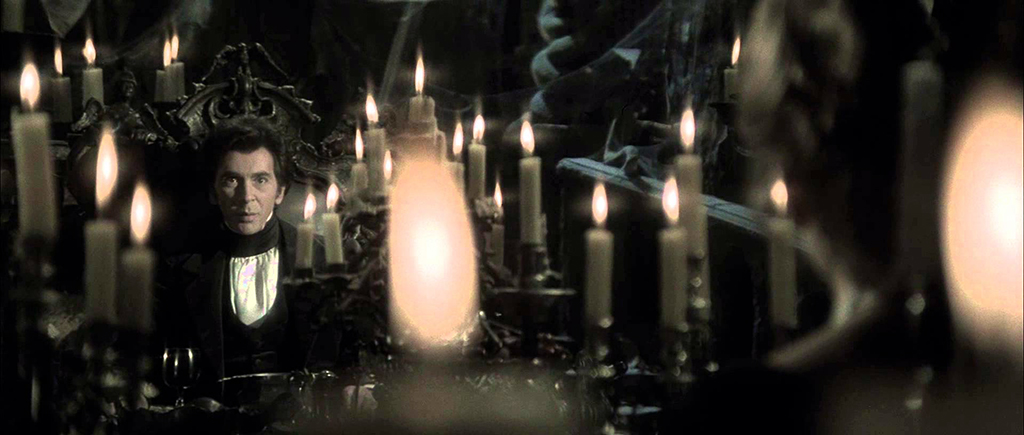
Seems to me I live my undeath like a candle in the wind.

Seems to me I live my undeath like a candle in the wind.

John Badham’s version of the classic Dracula (1979), starring Frank Langella as the titular Count, came out around the same time as a few other vampire films, notably Werner Herzog’s elegant remake of Nosferatu. Badham’s adaptation wasn’t horribly reviewed, but apparently audiences were experiencing some vampire fatigue, and it only did so-so business at the box office. I was only seven when it was released in theaters, so I didn’t catch it until it ran on television a year or two later; in fact, I’m fairly sure it was the first of the major Dracula film adaptations I ever saw, even before the more-famous Bela Lugosi and Hammer versions.

Like the 1931 Bela Lugosi film, Badham’s Dracula was based on the stage play rather than the novel, and followed a lot of the tropes of the Universal version. For example, Dracula is portrayed as a seductive, romantic figure rather than a ratlike monster as in the book, and the entire first part of the novel (where Harker is kept prisoner in Dracula’s Transylvanian castle) is scuttled, allowing the movie to start with the Count’s arrival on English shores. Something the Badham film does that I thought was odd, though, is that it reverses the characters of Lucy and Mina; Mina is the first one attacked and vampified by Dracula, for example, while Lucy is Harker’s fiancée, and is attacked later but ultimately saved when the vampire is staked. The film also portrays Mina as the daughter of Van Helsing and Lucy as the daughter of Dr. Seward. These changes don’t ruin the story or anything, but they also don’t really add to it, so I’m not sure why they were made. Perhaps because some characters were eliminated for brevity (like poor old Quincey Morris, who hardly ever gets a part in these adaptations), the screenwriter thought it would increase the drama and emotional coherence of the characters to make them all related somehow, but I’m just speculating about that. Still doesn’t explain why Lucy and Mina were reversed, but whatever.
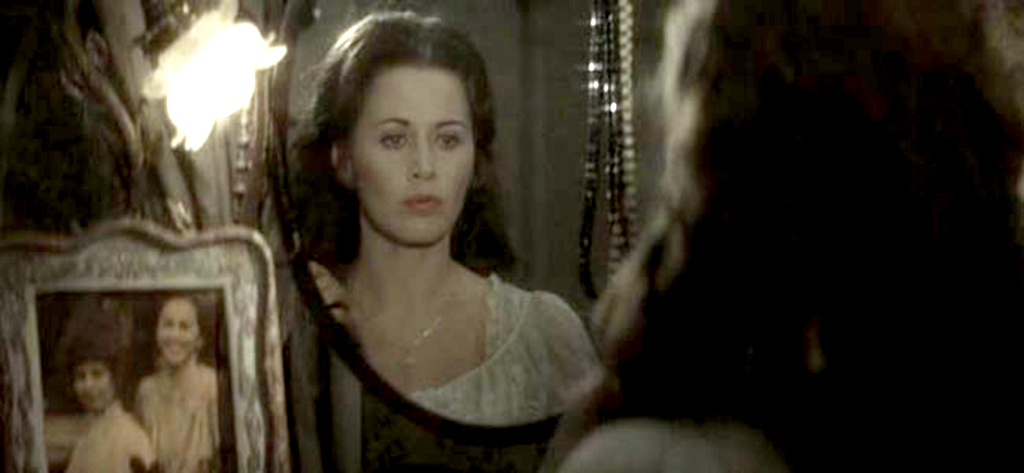
Pictured: Identity crisis.

Pictured: Identity crisis.

As I said, I don’t remember a great deal about the film as a whole; I remember enjoying it, and being quite taken with Langella’s graceful performance as the Count, but even though I saw the movie several times when I was about nine years old, very little of it made a lasting impression. Except for that one, very brief scene.

If my quick Google search is any indication, I’m not the only one that has had this scene burned into my memory for more than three decades. I’m not entirely sure why the scene is so memorable; it could be simply because in the context of the film, it is so shockingly unexpected. This version of Dracula, after all, was marketed more as a supernatural romance than a horror film, and played rather like a staid English parlor drama (with fangs). There was little to no gore that I remember, and nothing that was outright frightening. But then this happens:

The lovely Mina (Jan Francis) has been exsanguinated by the foxy Count one night while her friend Lucy (Kate Nelligan) is out tramping it up with Jonathan (Trevor Eve). It makes me feel weird to even type that, you guys. It’s like they were cheating or something, what with the character reversal and all. Though now that I think about it, how great would a Mina/Lucy catfight scene have been? Anyway. The next morning, Mina is pale and gasping for breath, and dies as a horrified (and guilty) Lucy looks on. Dr. Seward (Donald Pleasance) has no idea what could have killed Mina, and summons Dad Van Helsing (Laurence Olivier) to help solve the mystery.
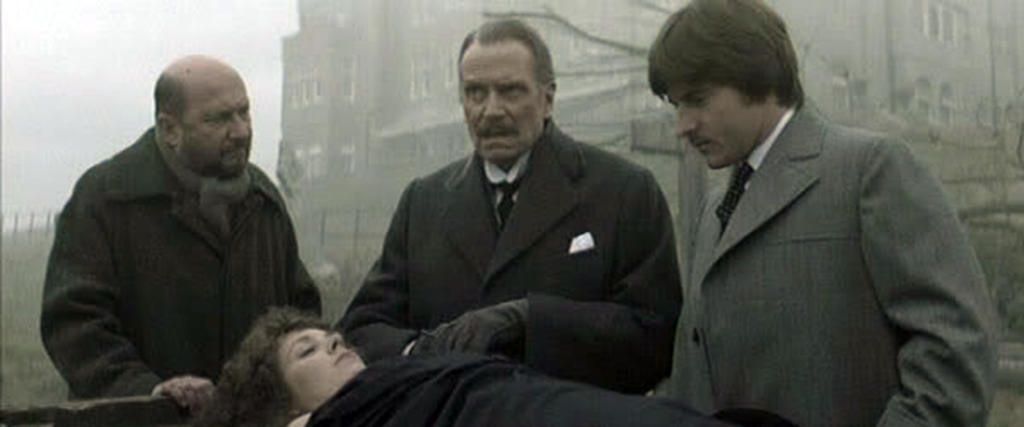
It’s clearly lupus.

It’s clearly lupus.

No slouch, Van Helsing immediately jumps to the most obvious conclusion, that eine nosferatu is running loose in the vicinity. As an aside, though, this is Van Helsing we’re talking about. He probably blames a vampire every time one of his socks disappears from the washing machine. Sure, he was correct in this case, but even a stopped clock, yadda yadda.

I’m not saying it was vampires. But it was vampires.

I’m not saying it was vampires. But it was vampires.

Anyhoo, Seward and Van Helsing visit Mina’s new grave in the cemetery, and find that her coffin is not only empty, but contains a ragged hole where she presumably dug herself out. The hole leads underground into some old mining tunnels, and they crawl down there to investigate, pretty sure of what they’re going to find. As they peer into the darkness, visions of the beautiful Mina probably uppermost in their minds…

Like so.

Like so.

…they begin to hear a shuffling sound coming toward them. They raise their lamps or candles (I can’t exactly remember which, and can’t find the scene on YouTube to check), and there, emerging from the darkness, is this horror, reaching for them and begging for a kiss:

At least she has a good personality. Well, aside from the bloodsucking.

At least she has a good personality. Well, aside from the bloodsucking.

This shit scared me SO BAD, you guys. And in this sense maybe it was a sound storytelling idea to make Mina Van Helsing’s daughter, because the tragedy of the scene is very apparent here, and underscores the horror with great effectiveness. The figure of the undead Mina is terrifying but also heartbreakingly pitiful, and the viewer really feels it when Van Helsing has to put down the monster his daughter has become. The rest of the film isn’t nearly as powerful, but that one scene is a stunner.

Keep watching this space for more of my horror-related wanderings, and news on my upcoming poltergeist book! Until then, Goddess out.
The Goddess’s Favorite Creepy Movie Scenes, or Ankhs for the Memories

I have to admit that, as a rule, I’m kinda over vampires these days. Like all self-respecting darklings, of course, I was all about Anne Rice back in the day, and my first (terrible, unpublished) novel was actually a painfully angsty vampire love story along those same lines. If only I had known that years later, someone would write Twilight and make all the money in the world, I might not have been so quick to shame-toss my manuscript in the garbage, but on such lack of foresight doth the vagaries of fate turn, or something.

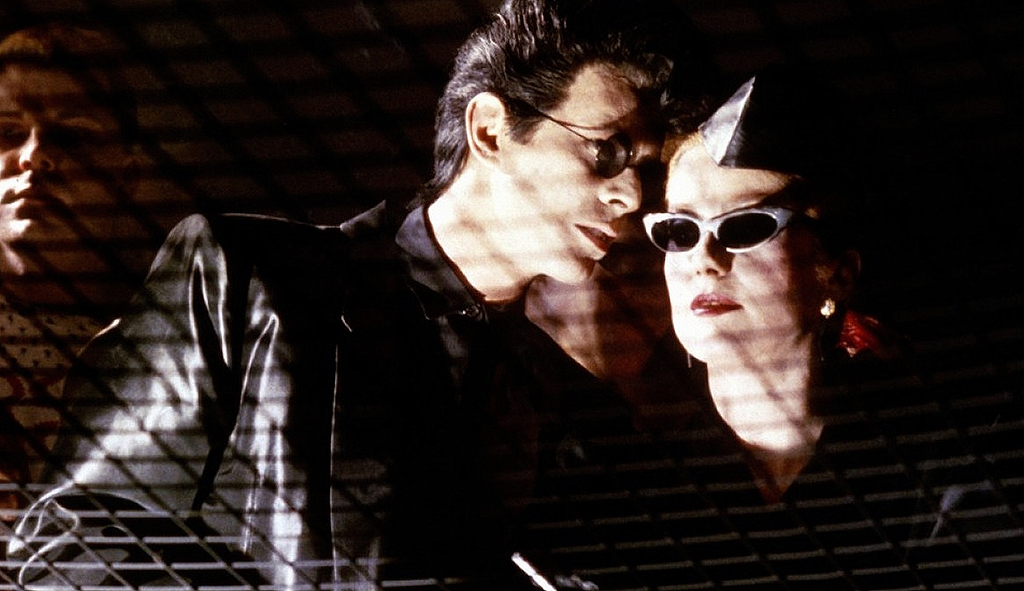
On the other hand, though, as an unrepentant goth chick for nigh on three decades, I’d be lying if I said I couldn’t be seduced by a genuinely great vampire film, especially if it was stylish as fuck, starred three of the best-looking people on the planet at the time, and boasted an opening scene featuring one of my favorite bands performing the grandaddy of all goth-rock anthems. By now you should have guessed that I’m talking about this gothic wet dream right here:

And who will we be having for dinner this evening?

And who will we be having for dinner this evening?

Tony Scott’s The Hunger (loosely based on an okay novel by Whitley “I Was Anal Probed by Extraterrestrials” Strieber) has been dogged by criticisms of style over substance pretty much since its release in 1983, but in my opinion, time has been very kind to it, and I would happily defend it as one of the very best vampire films of the 80s. Not only was it gorgeous to look at and chock full of fantastic acting performances, but it also took the tired vampire schtick and did something fairly original and arty with it (though of course much of the concept of interpreting vampire tropes through the lens of modern genetic science was present in Strieber’s book).

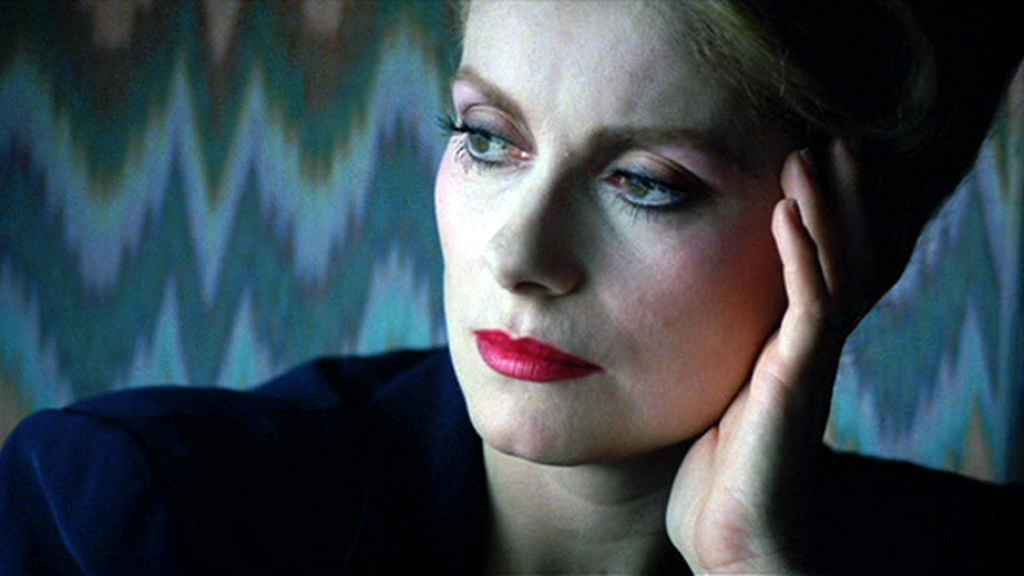
The Hunger is the story of beautiful, centuries-old vampire Miriam Blaylock (Catherine Deneuve) and her understandable but ultimately cruelly selfish quest to find a companion who will be with her forever. Her latest consort, John (David Bowie) has been with her for two hundred years, but John soon learns that Miriam’s promises of eternal youth were a lie when he begins to rapidly age, due to an apparent incompatibility between human and vampire blood that takes centuries to manifest.

Oh, did I neglect to mention that you'd spend eternity as a shambling living corpse? My bad, honey bunch.

Oh, did I neglect to mention that you’d spend eternity as a shambling living corpse? My bad, honey bunch.

John and Miriam enlist the services of cutting-edge gerontologist Dr. Sarah Roberts (Susan Sarandon) in an attempt to reverse the aging process, but all to no avail. After the feeble John kills the couple’s young music student, hoping that her blood will revitalize him, Miriam tenderly carries his still-living but disintegrating carcass into the attic. There she places him in a coffin along with her other former lovers, all of whom are enduring the same living death. It is this aspect of Miriam’s character that makes her monstrous: she is so desperate for companionship that she will strategically neglect to mention that the vampire gift she is bestowing comes with eternal life, yes, but not eternal youth. She will also keep her lovers alive and with her forever, even though they are suffering terribly.

Grief-stricken and lonely after John’s confinement, Miriam then sets her sights on Sarah and begins to groom her as her next companion. The pair exchange blood during a languid, gauzy, and super-hot sex scene, but Sarah discovers soon enough what Miriam’s gift entails. At first she refuses to accept her new blood-drinking nature, preferring to starve herself of the sustaining red stuff, but eventually her willpower fails her and she ends up killing her boyfriend Tom and feeding on him. Miriam thinks that Sarah is now on board with the whole vampire thing, but Sarah’s steely resolve is such that she attempts to cut her own throat with Miriam’s purpose-made ankh pendant rather than spend the next few hundred years at the vampire’s side. The distraught Miriam attempts to save her, but evidently Sarah’s attempted self-sacrifice has rallied the troops, so to speak; all of Miriam’s rotting former lovers rise from their coffins, kill Miriam, and fall to dust upon the floor, finally finding the sweet release of death that they had been denied for so long.

Exactly what about this whole scenario doesn't appeal to you???

Exactly what about this whole scenario doesn’t appeal to you???

There is then an odd coda to the film that doesn’t really make any sense in terms of the story, as we see briefly that Sarah has survived her suicide attempt and is now living as a vampire with a male and female consort of her own. Susan Sarandon has reported that she was not happy with this tacked-on ending, as it negated the whole arc of her character and the point of her rebellion, but there was little she could do about it, since the producers apparently wished to leave the film open-ended in case they wanted to make a sequel down the line (sigh). The scene is only a few seconds long and doesn’t spoil the film, but it is kind of a WTF moment.

All that aside, though, let me take a moment to rhapsodize about all the great things this film does. Casting the impossibly beautiful and elegant Deneuve as a vampire was a stroke of genius, as her quiet gravitas and cold yet seductive grace lend a sense of timelessness to her portrayal that makes it very easy to believe, not only that she has been alive for millennia, but also that she could easily embody the conflict of genuine loving feeling existing alongside such fiendish cruelty. Susan Sarandon’s character is a perfect counterpoint, a thoroughly modern woman whose pragmatism and independence is the polar opposite of Miriam’s needy heartlessness.

OMG, stop being so pretty.

OMG, stop being so pretty.

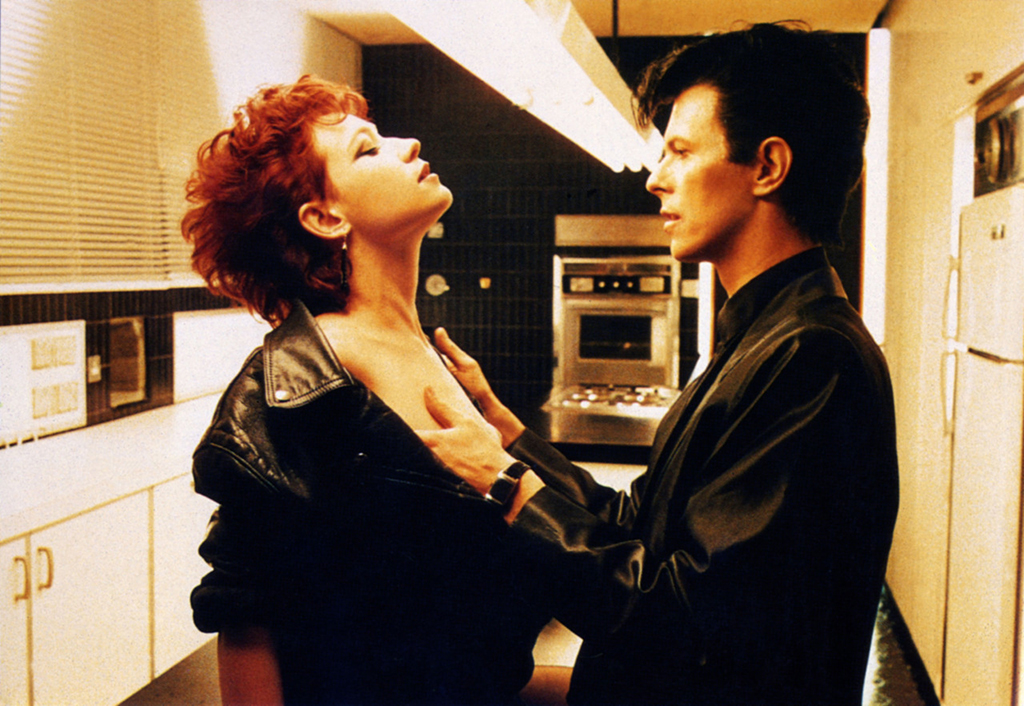
Bowie is likewise great as the doomed companion, putting in a restrained and perfectly balanced performance in which the struggle between his deep love for Miriam and his anger at her betrayal of him are readily apparent.

At least Ann Magnuson got to be felt up by David Bowie before her tragic exsanguination.

At least Ann Magnuson got to be felt up by David Bowie before her tragic exsanguination.

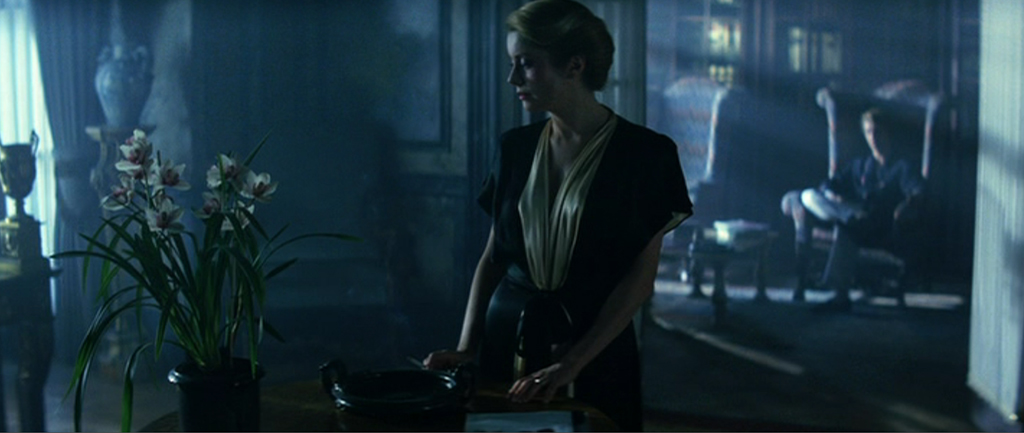
The set design is also gorgeous, soft-focused and romantic, with billowing white curtains, shafts of dim light illuminating flocks of doves, and the spectacularly old-world interiors of the Blaylocks’ tastefully appointed New York townhouse brilliantly contrasted against the sterile environment of Sarah’s medical clinic. I’ve heard many people complain that The Hunger looked more like a music video than a movie, and I understand that assessment, but I feel as though the entire look of the film is a crucial part of its enduring charm. Its aesthetic flair was certainly one of the things that first drew me to it in the 1980s, and to be frank I think it looks even better now that we’ve had more than thirty years’ perspective on it.

Holy shit, I would live in this house so hard.

Holy shit, I would live in this house so hard.

The fact that the film also has such a dynamite opening, with the vampiric Peter Murphy in a cage intoning “Bela Lugosi’s Dead” with his band Bauhaus, is simply the pitch-black icing on the darkly glamorous cake that is this movie.

Undead to the third power.

Undead to the third power.

Unlike many other vampire films of the period, The Hunger is more concerned with artistic visuals and exploring the relationships of the characters than it is with outright horror or gore. That’s not to say that there aren’t some intensely bloody scenes, and the final shots of Miriam’s ancient, skeletal companions rising up against her are fairly horrific, but fans of more in-your-face horror may find the film far too cerebral for their tastes, and that’s as it should be. Different strokes, and all that.

WHATCHOO TALKIN’ ABOUT GODDESS? (SORRY, HAD TO.)

WHATCHOO TALKIN’ ABOUT GODDESS? (SORRY, HAD TO.)

Until next time, Goddess out.

The Goddess Revisits Season Two of “Masters of Horror”

Just as a quick reminder, I’ve put up a Patreon campaign to raise some much-needed funds for my writing endeavors, so take a look if you missed my previous post, and give something if you can, would you? Thank you.

Now, since I went into the specifics of “Masters of Horror” in my previous post about season one, I’m just going to jump right in and begin discussing season two, the rewatch of which I just completed. The quality of the second season of Mick Garris’s generally excellent series was a lot more consistent than the first, in the sense that there were no particularly terrible episodes, but there weren’t really any jaw-dropping, “Imprint”-quality ones either, though many of them were quite good, and all were at least decently watchable.

The season two revisit has been a little more fun for me and has provided a slightly different perspective on the show, since the God of Hellfire became interested in this fucked-up series I was obsessively watching and decided he wanted to watch some of it too. So I’ll be providing a little of his insight on the episodes, when he provided it. And now, onward.

MastersOfHorror2

THE DAMN GOOD

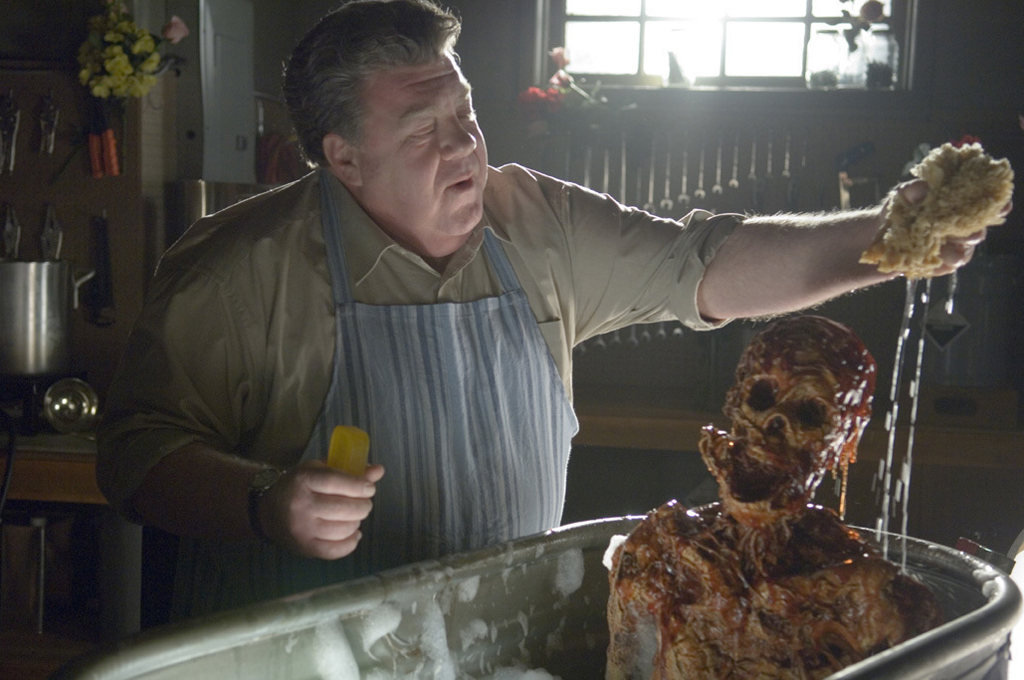
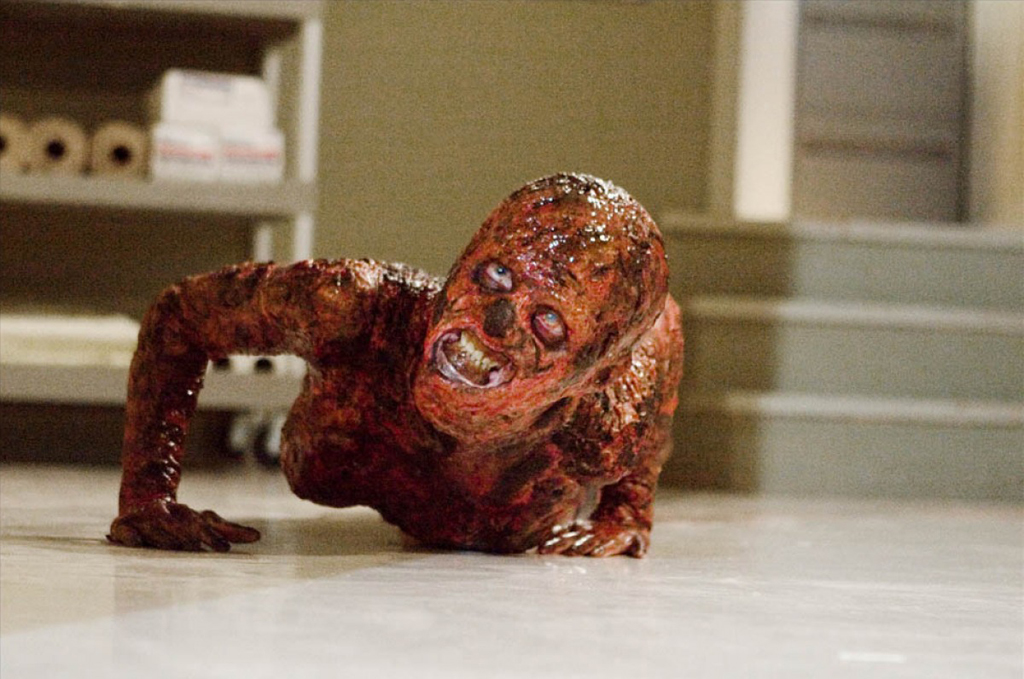
There were two episodes that, for me, stood out as being the best examples of what season two had to offer. The first was “Family,” directed by John Landis and featuring the lovable George Wendt (of “Cheers” fame) playing brilliantly against type as a suburban serial killer and corpse collector. I’m not entirely sure if the concept for this story was at least partly inspired by Miriam Allen deFord’s 1961 short story “A Death in the Family,” which it strongly reminded me of and which was made into an episode of “Night Gallery” back in 1971. John Landis’s “Family” ends up going off in a different direction entirely, though, and has a great twist ending. George Wendt imbues his schlubby, lonely bachelor psychopath with such pathos that it’s hard not to feel bad for him, even while he’s killing little girls and old ladies to deflesh and add to his happy skeletal family. Twisted, tragicomic, and great.

Norm realizes the folly of storing the hydrochloric acid on the shelf right next to the lavender bath oil.

Norm realizes the folly of storing the hydrochloric acid on the shelf right next to the lavender bath oil.

The second standout of season two, the Rob Schmidt-directed “Right To Die,” recalled the furor over the Terri Schiavo case and starred the terrific Martin Donovan, who I’ve been a fan of since his numerous appearances in Hal Hartley’s films in the eighties and nineties. Donovan plays a dentist who has been cheating on his wife with his buxom assistant; shortly after the wife finds out, she and her wayward husband are involved in a terrible car accident in which all of the wife’s skin is burned off. Initially engaging in a legal battle with his mother-in-law for the right to turn off his wife’s life support, Dr. Adulterer soon changes his tune when it comes to light that his wife is now able to open up an enormous can of supernatural scorned-woman whoop-ass whenever she flatlines. Since I’m always down to see a cheater (and worse, as it turns out) get his just desserts, this episode was a satisfying, gory, and somewhat surprising ride.

In an attempt to be edgy, Smokey Bones new barbecue menu took things just a bit too far.

In an attempt to be edgy, Smokey Bones new barbecue menu took things just a bit too far.

THE PRETTY DAMN GOOD

Several of the other episodes, while not quite to the caliber of the aforementioned, were still reliably entertaining. “Sounds Like,” directed by Brad Anderson from a short story by Mike O’Driscoll, was in the words of the GoH “like a really, really good ‘Twilight Zone’ episode,” and recounted the sad tale of a suburban middle-manager type guy who loses his son to a rare heart condition and subsequently develops hypersensitive hearing that eventually drives him insane. Very low-key in the gross-out department, but a nice slow burn of suspense and escalating tension.

“Pro-Life,” John Carpenter’s taut tale of a determined, fifteen-year-old pregnant girl and a demonic battle in a besieged abortion clinic, was also pretty fantastic, with Ron Perlman giving a chilling performance as the girl’s fundie nutbag father. Intense, violent, and genuinely frightening, even if the whole “devil-baby” angle is a touch cheesy.

Dario Argento’s “Pelts” was the Italian maestro’s second contribution to the series, adapted from a short story by F. Paul Wilson. The somewhat ridiculous premise sees a fur trader (played by Meat Loaf!) getting his hands on some beautiful raccoon pelts that magically make everyone who works with them do unbelievably gory things to themselves that mirror what was done to the dead animals. Squicky, over the top (it IS Argento, after all), and lots of fun.

He would do anything for love, including giving you the shirt off his back, or the skin off his torso, or something.

He would do anything for love, including giving you the shirt off his back, or the skin off his torso, or something.

The Joe Dante-directed “Screwfly Solution,” while not nearly as stupidly overblown as his first-season “Homecoming,” still tackled hot-button sociopolitical issues (feminism and male aggression, in this case), but in a far less obnoxious way than his first foray in the series. I thought it was still a bit too glib and a tad on the overly obvious side for my taste, but overall I quite enjoyed it, and the GoH chose it as his favorite episode of season two, so in deference to him I decided to place it in the “pretty damn good” category. The GoH is a big fan of apocalyptic-type scenarios in horror that are just barely plausible, so this tale of an unknown biological agent that ramps up male hostility to the point where the men are killing off all the women on earth, was right up his alley and scared him more than any of the other episodes. Also, SPOILER ALERT, it was aliens all along, and aliens are pretty much the GoH’s favorite thing in the whole wide galaxy, you guys; you don’t even know. I forgot to add that this episode featured both Jason “90210” Priestley AND Elliott “M.A.S.H.” Gould as high-echelon environmental scientists, which is probably something you can’t say about any other movie in history. So there’s that.

Also decent was “We All Scream for Ice Cream,” directed by Tom Holland from a short story by John Farris (with a teleplay by the great David J. Schow). Bearing shades of Stephen King’s It, this straightforward tale of supernatural revenge sees a mentally-slow but well-liked (and clown-clad) ice cream man “accidentally” killed by some miscreant children. Years later, a sinister ice cream van prowls the small town’s streets at night, seeking to revisit the sins of the fathers upon the sons, as it were. Well-executed and fairly creepy.

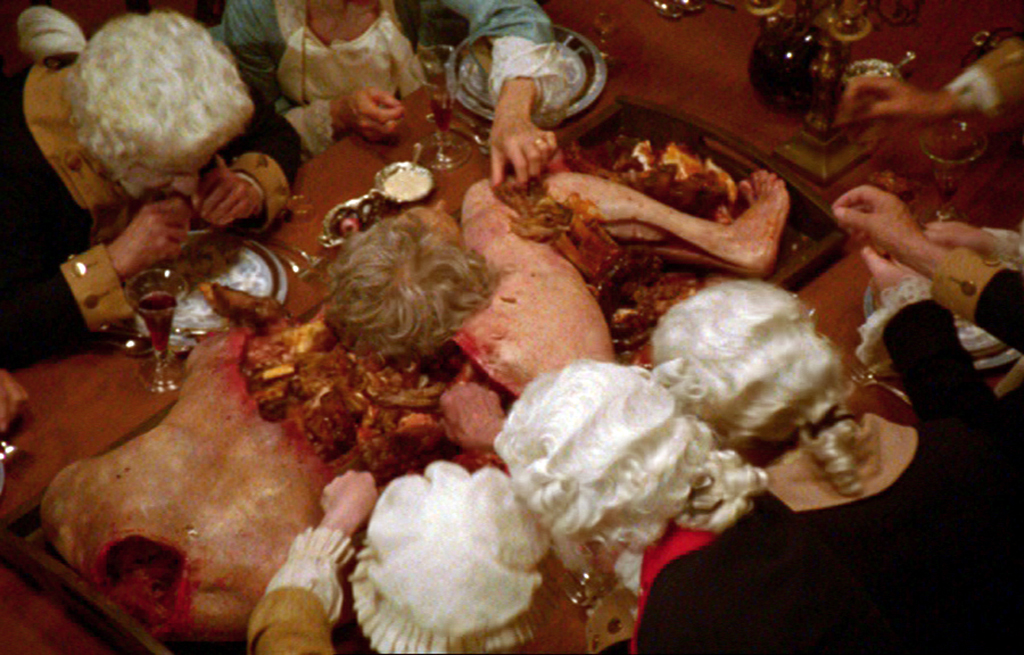
Rounding out the “pretty damn good” category, Stuart Gordon’s adaptation of “The Black Cat” featured Jeffrey Combs as a tormented Edgar Allan Poe living out (or is he?) a couple of his more famous short stories. I thought the ending was something of a cop-out, but I’ll forgive it (this time) because the performances and gore were solid (BAD KITTY!) and the episode as a whole was pretty great, with some brilliant comic touches. Likewise with “The Washingtonians,” directed by Peter Medak from a short story by Bentley Little. The premise was so utterly bizarre, and the execution so overdone and absurd, that it circled all the way around to being awesome again. Intensely gory, and one of the funniest—and easily the wackiest—episodes of the series.

American History Blechs.

American History Blechs.

Also quite good was the final episode, Norio Tsuruta’s “Dream Cruise.” Glacially paced, and pretty standard J-horror all around (complete with long-haired female wraith), but with a story that held a few surprises, lovely cinematography, and a nice creep factor. A worthy end to the series.

THE JUST OKAY AND THE DISAPPOINTING

A few of the episodes, while not bad per se, were just not as good as I was expecting, given the talent involved. As much as I adore the stories of Ambrose Bierce, for example, the Tobe Hooper-directed adaptation of “The Damned Thing” (with a teleplay by Richard Christian Matheson, no less) was not particularly engaging or memorable, making me question the decision to make it the inaugural episode of the second season.

masters-of-horror-serie-tv-s-2-the-damned-thing-04-g

You cursed brat! Look what you’ve done! I’m melting! Melting!

Also a disappointment, and for similar reasons, was “Valerie on the Stairs,” directed by series creator Mick Garris from a terrific short story by Clive Barker. I’m a huge fan of Barker’s stories and novels, but his fantastical creations are somewhat hit or miss when adapted to screen, and this one seemed more miss than hit. Tony “Candy Man” Todd played a fetching demon, and Christopher Lloyd was his pleasingly manic self, but the episode seemed flimsy, slightly repetitive, and a tad silly, with an anticlimactic ending let down by cheesy special effects.

The Mick Garris-directed “The V Word” (and I hate to say it, but Garris was kind of 0 for 3 on his own episodes of the series he created, in my opinion) was not a total waste of time, but not an experience I’d care to revisit, either. The V could have stood for literally anything else—vagina, perhaps, or velveteen, or vivisection, or even Vivian Vance, for fuck’s sake—and I would have enjoyed it more, but since the V stood for “vampire” (oh…those), I was less than enthused, especially when whiny teenage boys were added into the mix. Watchable, but overall, meh.

v_word

Soooooooooooo high.

And thus completes my revisited rundown of “Masters of Horror!” Agree? Disagree? Care to start a virtual fistfight over which were the best episodes? Let me know. Until then, as ever, Goddess out.

The Goddess’s Favorite Creepy Movie Scenes, or Do You Kiss Your Mother With That Mouth?

I’m back from my vacation (which was fun and blissfully unproductive, thank you for asking), so I’m slowly getting back to work on this series, among other things. This sixth entry will be slightly different, as I’m going to highlight two creepy scenes whose visual impact has stuck with me since the eighties. They’re both very short scenes and have a similar theme, so I thought I’d just lump them together, if that’s all right with everyone.

I’d like to talk a bit here about things that scare us, or scare me in particular, since part of the appeal of writing this series was, for me, a desire to examine why I find particular images or situations disturbing, when perhaps other people may not. In regards to the two short vignettes I want to discuss, I’d like to focus on a particular subset of body horror, particularly facial “wrongness.”

It seems reasonable to assume that from an evolutionary standpoint, human brains developed with an instinctive ability to assess the physical “normality” of our fellow humans, if only in order to identify genetic fitness in potential mates. It’s why studies that have been done all over the world show that the humans consistently rated as the most attractive are the ones that are the most symmetrical. I’m simplifying here, but you get the gist. Humans know when someone looks okay, and when they don’t, even if they can’t articulate why.

This feature of the human mind can, of course, be subverted. Take, for example, the concept of the “uncanny valley,” that unsettling grey area where a human simulacrum looks so similar to a real human that we are almost fooled, but is ever-so-slightly “off” in a way we can’t quite put our finger on, causing us intense discomfort.

Horror filmmakers, consciously or not, have been playing with the concept of subverting physical normality since horror movies first began. Sometimes it’s blatant, like Regan’s 360-degree head-spin or her freaky “spider walk” down the stairs in The Exorcist, or the strange, jerking movements of long-haired female ghosts in many an Asian horror film. And sometimes it’s more subtle, like simply taking one facial feature and changing it in a way that upsets our deep-seated sense of physical regularity.

twilightzonenomouth

Twilight Zone: The Movie (1983) was an anthology film featuring several stories by different directors. The bulk of the stories were adapted from episodes of the classic “Twilight Zone” television series. One of these, the Joe Dante directed “It’s a Good Life,” was a loose remake of one of the most famous TZ episodes of all time (which had been in turn based on a short story by Jerome Bixby), the one that starred Bill Mumy as a functionally omnipotent child who could “wish people into the cornfield” if they did something to displease him.

In the 1983 film version, a schoolteacher named Helen (Kathleen Quinlan) stops at a café while on a road trip and there meets a young boy named Anthony (Jeremy Licht). She intervenes when he is being harassed by bullies, and then ends up giving him a ride home after she “accidentally” hits his bike with her car in the parking lot. Upon arriving at his cavernous mansion of a house, she quickly discovers that something is very amiss with Anthony. His entire family seems deathly afraid of him, and take great pains to bend to his every whim, whether that’s serving candied apples and peanut-butter-topped hamburgers for dinner, or allowing cartoons to play endlessly on every television in the house. It turns out that the family’s fear is well-placed, as Anthony has the supernatural ability to wish anything he desires into existence, and severely punishes anyone who interferes with his wishes.

One of the recipients of Anthony’s wrath is his sister Sara (Cherie Currie, who is perhaps best known as the lead singer of the band The Runaways). As Helen is wandering the vast halls of the mansion Anthony calls home, she stops to peer into a long, darkened bedroom. She smiles indulgently at the rows of identical single beds with their identical stuffed pandas, and then she notices a girl sitting in a wheelchair at the far end of the room. The girl’s back is to her; she seems to be wearing pajamas and is staring at a flickering television screen playing a loop of a black and white cartoon. Helen calls out to her, but the girl doesn’t answer or turn around. Anthony comes up beside Helen in the doorway and explains that this is his sister Sara. “She was in an accident,” he says, and then he and Helen proceed down the hall.

We then see a shot of Sara from the front, though half her face is concealed by the angle of the television set. Her eyes are wide and a bit crazed as they frenetically follow the cartoon action on the screen in front of her. And then the camera tips upward to reveal the bottom half of the girl’s face. She has no mouth, only smooth flesh where the lips should be. It’s a very short but pleasantly chilling moment, and all done very simply. There is no gore, no blatant deformity, just that disturbingly empty expanse where the girl’s mouth should be. Later in the story, we learn that Anthony crippled his sister and took her mouth away so that she wouldn’t “nag” him anymore. The other sister who reveals this information (played by Nancy Cartwright, the voice of Bart Simpson) has an even more horrifying fate; Anthony puts her into a cartoon, where she is pursued and eaten by a dragon.

Don’t fuck with Anthony, is the message there, folks.

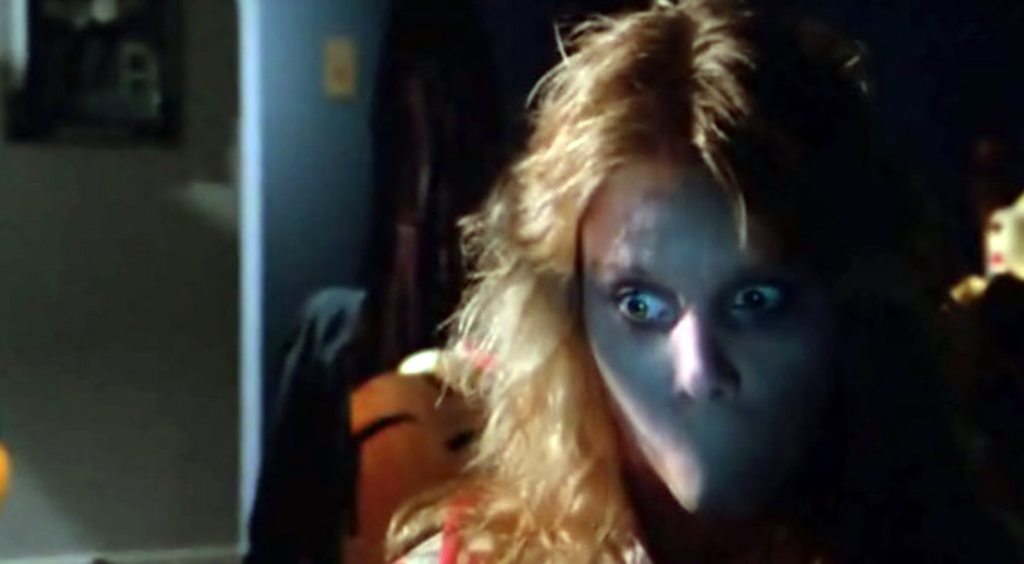
The second example of disturbing facial distortion is far more ostentatious, but it affected me mightily just the same. The Tom Holland-directed Fright Night (1985) was one of the best horror comedies of the decade, faultlessly combining hilarity, pathos, and terror into a wildly entertaining whole. Charley (William Ragsdale) is a regular high school kid who lives with his single mother (Dorothy Fielding), has a goofball horror-nerd best friend named Evil (Stephen Geoffreys), and a goody-two-shoes girlfriend named Amy (played by Amanda Bearse, who would later achieve great fame as neighbor Marcy on the long-running and much-beloved TV show “Married…With Children”).

Apparently, Charley also has a vampire as a new neighbor, though naturally no one believes it. Through binoculars, Charley has been watching neighbor Jerry Dandridge (suavely played by Chris Sarandon) evidently picking up high-class prostitutes and later carrying suspiciously body-shaped garbage bags out of the house next door with the help of his carpenter/houseboy/manservant Billy Cole (Jonathan Stark). After trying to alert family, friends, and then police, all to no avail, Charley gets desperate and enlists (well, buys) the services of his hero, has-been TV horror host Peter Vincent (portrayed with great sensitivity and humor by Roddy McDowall) to help stop the bloodsucker.

At one point, the charismatic Dandridge has put his vampy moves on the virginal Amy, chasing her to a downtown nightclub and dancing with her seductively before biting her. Later on in the film, Charley comes across Amy in the basement of Dandridge’s house. She is nearly unrecognizable, her formerly good-girl demeanor completely transformed into a feral sexpot (a giant upgrade in my opinion, but that’s neither here nor there). She approaches him in her see-through white gown and bares her fangs at him, then cruelly teases him: “What’s wrong?” she says, running her hands through her wild red hair. “Don’t you want me anymore?” Charley, frightened by this frankly sexual creature who used to be his withholding girlfriend, thrusts a crucifix at her. She shrieks and turns from him, then tries another tactic. “It’s not my fault, Charley,” she cries pitifully in her good-girl-Amy voice. “You promised you wouldn’t let him get me! You promised!”

Charley, dope that he is, falls for it and drops the crucifix, moving toward her. “Amy…” he says. And then we pan over to Amy’s face, only to see this:

AmyFrightNight

There is a terrifying rictus of a mouth, huge and impossibly wide and filled with sharp teeth. When I first saw that mouth in 1985, I think my heart stopped a little bit; it was just the enormity of it, the way it consumed the lower half of her face. Between the mouth and the round red eyes, I was put in mind of a giant anaconda about to swallow someone’s head. That image has stayed with me from that day to this. For his part, Charley, upon seeing Amy’s bloodcurdling visage, screams and tries to fight her off, foxy vampire or no. He is profoundly relieved when she is transformed back into her ordinary self after Dandridge is killed.

And so Fright Night leaves us with a question for the ages: Better to have a slightly annoying girlfriend who won’t put out, or a supernatural, oversexed hellbeast who wants to eat your face off? Charley chose the safer option; would you? 😉

Until next time, Goddess out.

Dr. John Polidori and The Vampyre

Though Dracula and Lestat are far better known today, modern vampire literature owes a great deal to Polidori’s Lord Ruthven. The original article I wrote can be found here.

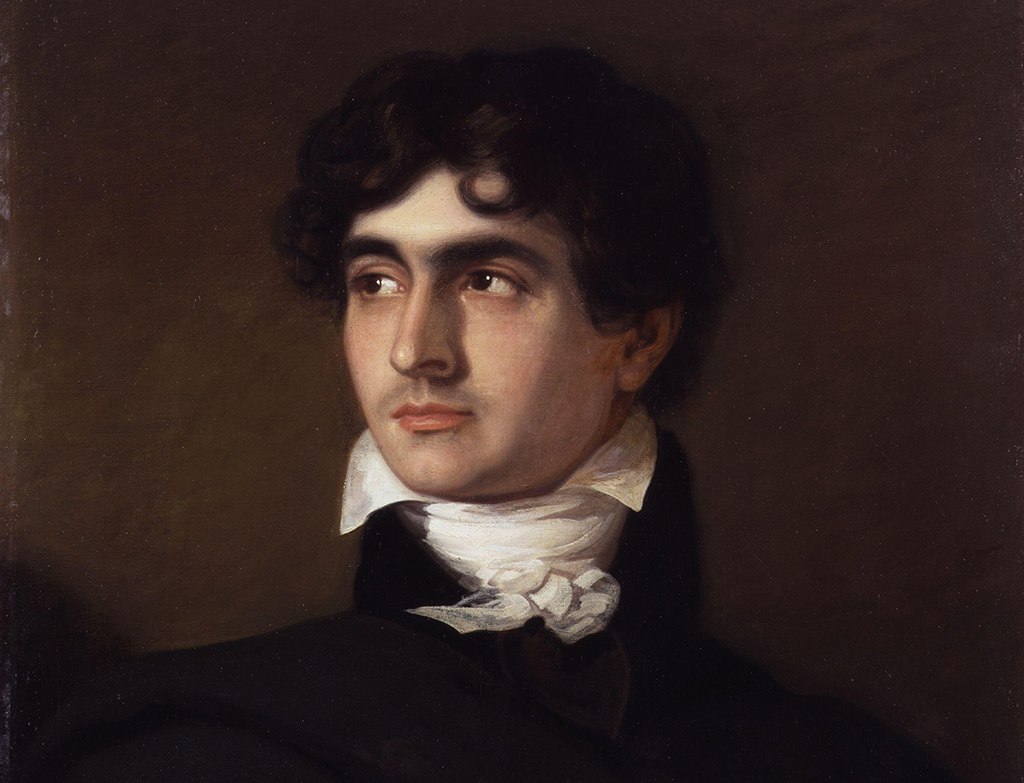
John_William_Polidori_by_F.G._Gainsford

Born John William Polidori in September 1795, the creator of the earliest English vampire story actually trained as a physician, obtaining his medical degree from the University of Edinburgh at the age of nineteen. But his true wish was to be a writer, and with a view to realizing that dream, he took a post as personal physician to Lord Byron, a position that thrust him into the very center of the vanguard of literary romanticism. According to letters and diaries written by acquaintances, Polidori was apparently roundly disliked, but his lucky association with Byron would open up a wealth of opportunity and ensure his minor legacy.

Villa Deodati and the Haunted Summer

Like several other significant works of the period — most notably Mary Shelley’s Frankenstein — Polidori’s vampire story had its genesis in the infamous “haunted summer” of 1816, when Lord Byron invited a handful of luminaries to spend time with him at his villa on Lake Geneva in Switzerland. Polidori soon found himself in the company of the freethinking poet Percy Bysshe Shelley and his soon-to-be wife Mary Godwin, along with Mary’s stepsister Claire Clairmont, who was also Byron’s lover. The unconventional writers evidently took some delight in teasing Polidori for his uptight nature and literary ambitions; Polidori was so stung by the mockery that he challenged Shelley to a duel, which never came to fruition.

In the by now well-known scenario, Lord Byron challenged his guests to each write an original ghost story. Mary Godwin’s, of course, was later published as Frankenstein, or the Modern Prometheus. Shelley, Byron, and presumably Clairmont each wrote fragments of poems or stories, some of which were later fleshed out and published. Byron’s novel fragment, which he quickly lost interest in and abandoned, was picked up by Polidori, who used it as the basis of his own story, which he called “The Vampyre.” The vampiric character of Lord Ruthven, in fact, was very obviously based on Lord Byron himself.

The Vampyre Published…and Misattributed

Lord Byron had never felt that warmly toward Polidori — by his own admission, he found the doctor silly, pretentious, jealous and insecure, and once threatened to give him “a damned good thrashing.” Tensions between the two men came to a head shortly after the summer of 1816, and Byron dismissed Polidori from his post as physician.

The following spring, “The Vampyre” was published in the New Monthly Magazine, but without Polidori’s permission; worse, it was attributed to Lord Byron. Publisher Henry Coburn had evidently obtained the story through unknown channels and thought slapping Byron’s name on it would help sell more copies. Polidori protested and threatened to sue; Coburn paid him £30 and republished the story as “related by Lord Byron to Doctor Polidori,” but the damage had mostly been done, and Byron would be credited with writing “The Vampyre” for many years to come, even after he had published his original novel fragment, the one that Polidori had based his own story on.

The Vampyre Finds Fleeting Success

Perhaps due to rumors that Byron was its true author, or knowledge that the vampire in the story was based on him, “The Vampyre” was a rousing success, with five editions printed in 1819 alone. Critical opinions of the tale were a mixed bag; some derided it as “trashy,” while no less an authority than Goethe claimed it was the best thing Byron had ever written. Whatever its literary merits, though, the gothic tale of the vampiric and debauched Lord Ruthven traveling the continent with a young man named Aubrey in his evil thrall was unquestionably the very first English-language vampire tale, and hence the dark godfather to every fictional bloodsucker that followed — from Dracula to Lestat to Edward Cullen.

The Tragic End of John Polidori

Polidori continued his medical practice, using his literary notoriety as leverage to woo high-society patients. His ministrations were often fatal, however, and he later abandoned medicine to go into law. His writing impulse never left him; in 1819 he published a novel called Ernestus Berchtold which sold less than 200 copies, and two years later produced a Byronesque poem called The Fall of the Angels which likewise garnered scant attention. The thwarting of his ambitions led to a depressed gambling spree, and with debts spiraling out of control, Polidori committed suicide by taking prussic acid, a month shy of his 27th birthday.

Polidori has turned up as a character in several films and novels, many of which revolve around Byron, the Shelleys, and the summer of 1816. He is nearly always portrayed negatively, as a vain, talentless hanger-on with pretensions that outstripped his abilities. But his legacy lives on as the seed out of which all of modern vampire literature has sprouted.

Sources:

Davenport-Hines, Richard (1998). Gothic: Four Hundred Years of Excess, Horror, Evil and Ruin. North Point Press. ISBN: 086547544.

Hoobler, Dorothy (2007). The Monsters: Mary Shelley and the Curse of Frankenstein. Back Bay Books. ISBN: 0316066400.