My new book is SO SO close to being available, you guys! The ebook version should be up by the end of next week, with print and audio book versions to follow shortly afterwards. In the meantime, here is a trailer I made to whet your appetite!
Author: Jenny Ashford
The Rochdale Poltergeist on Where Did the Road Go?
Hey y’all! Here is me talking about The Rochdale Poltergeist and various other things on Where Did the Road Go?, one of my favorite radio shows to be on! And stay tuned, because very soon I will be posting a book trailer and release dates for my new book, House of Fire and Whispers, about the “Demons In Seattle” case! Thanks for reading, and keep it creepy, my friends.

My New Book About the ‘Seattle Demon House’ Will Be Out Soon!
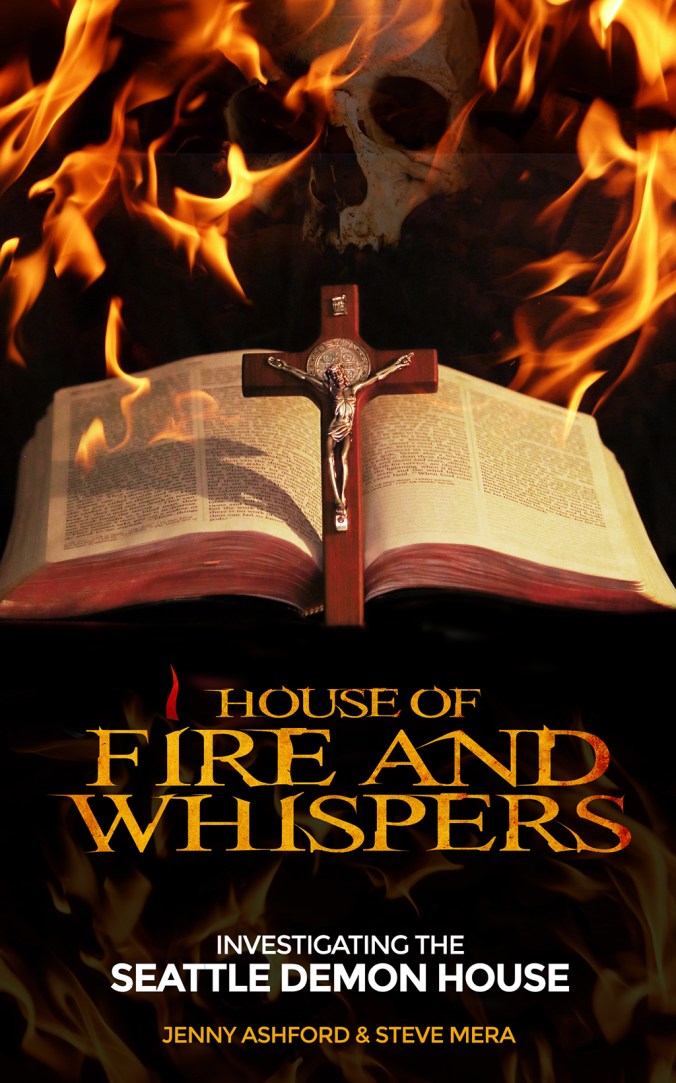
BOO, paranormal pals! Remember a while back I said I was working on another book with Steve Mera, the parapsychologist with whom I penned the wonderful and frightening tome The Rochdale Poltergeist (which you should buy right now if you haven’t already)? Well, I’m happy to announce that progress on the new book has been much faster than anticipated, and I will very likely be able to unleash it upon the world as soon as next month! Please try to contain yourselves. As a teaser, I will post the cover artwork below, and as I will be appearing on several radio shows in the next few weeks to talk about it, I will also be posting links to shows here as they come along. Thank you, and happy haunting.
Even Those Representing God Must Rely on Advertising: An Appreciation of “Seven Blood Stained Orchids”
It’s a stormy Saturday afternoon here in central Florida, and as I often like to do on wet weekends such as these, I decided to while away a couple of hours with a strangely comforting European cult flick from the 1970s and then tell the internet how I felt about it, whether the internet wants to hear it or not. Did I mention I’m back on the giallo kick? No? Okay, consider it mentioned.
Anyway, I’ve obviously written about a few gialli before, and the funny thing about the genre is that you don’t have to see too many of them before you start getting into what I call “endless giallo recursion,” or alternately, “The Giallo Small World Hypothesis.” To wit, the movie we’re discussing today is another one with bloody flowers prominent in the title and the plot (just like the subject of my older post, The Case of the Bloody Iris), and another one featuring Marina Malfatti (who was also in a couple of other gialli I wrote about, The Night Evelyn Came Out of the Grave and All the Colors of the Dark), albeit in a fairly small role.
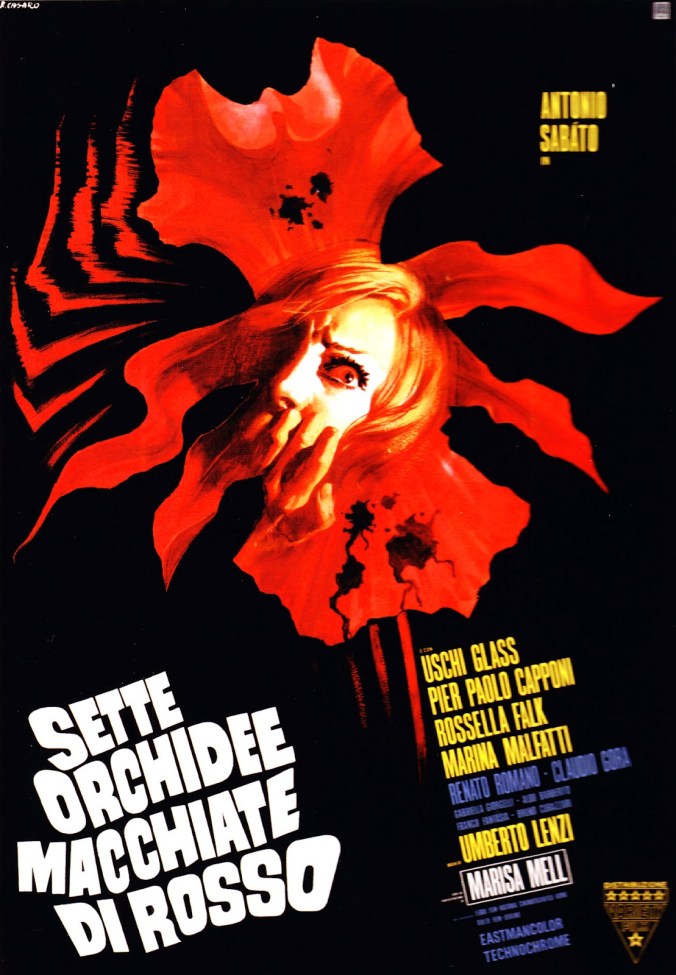
Seven Blood Stained Orchids (Sette orchidee macchiate di rosso) was released in 1972 and was the last of a series of four Italian/German co-productions (fun fact: in Germany, the equivalent of gialli is “Krimi”) based upon the works of prolific British crime writer Edgar Wallace. It was directed by Umberto Lenzi, probably most infamous (at least in the U.S. and U.K.) as the director of a couple of the most notorious “video nasties,” Eaten Alive and Cannibal Ferox. Now, before you go getting any ideas, Seven Blood Stained Orchids is pretty much a textbook giallo and has very little in common with Lenzi’s gore films; in fact, the violence here is exceptionally tame, with the bloodiest scene probably being a relatively mild murder with a whirring drill (and you know you’re a horror junkie when a grisly drill-through-the-heart scene barely raises an interested eyebrow). So whether that makes you more or less likely to want to watch it is entirely up to you.

NEEDS MOAR NEEDLES TAPED UNDER EYEBALLS.
As I said, this movie ticks pretty much all the blood-spattered little giallo boxes: there’s a black-gloved killer stalking and killing scantily-clothed women with a knife, there’s a strange calling card left at the murder scenes (in this case, an occult-looking silver half-moon pendant), there is an investigation undertaken by one of the target victims when police prove less than useful, and there is the standard parade of shifty motherfuckers who drift through the story and serve as red herrings until the mystery slowly becomes resolved. Could the killer be the enigmatic old man babbling in German in the cemetery? The heroin-shooting Jimi Hendrix fan who does nothing but host open-door naked orgy parties at his zebra-print hippie pad? Or perhaps it’s his blouse-wearing boyfriend, who is a dead ringer for Rufus Wainwright? Or how about that hard-faced old battle-axe in the lunatic asylum who gives one of the potential victims a whole faceful of stinkeye and keeps a thermometer under her chair cushion, the way you do?
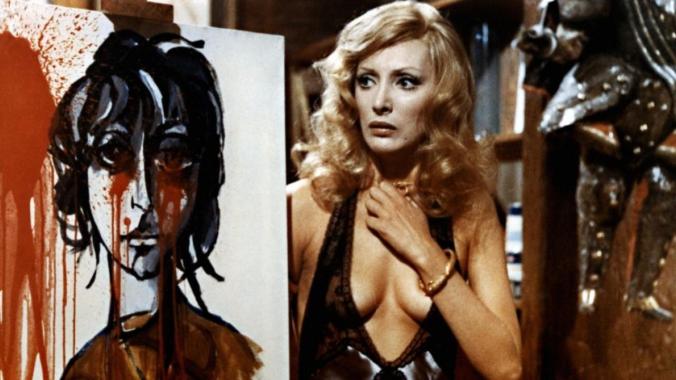
“I DON’T CARE WHO IT IS, AS LONG AS THE STAB WOUNDS DON’T MAR MY CHESTICULAR PERKINESS.”
Briefly, the main plot revolves around a woman named Giulia (Uschi Glas) and her new husband, fashion designer and bossy-boots Mario (Antonio Sabato), as they attempt to get to the bottom of a mysterious series of killings, linked by the aforementioned half-moon pendant. After the murder of a prostitute (Lina Franchi) and an artist (Marina Malfatti), Giulia is targeted for death while she is on a train with Mario, heading toward their honeymoon destination. She survives, but because the killer beat cheeks before checking to make sure she was dead (rookie mistake), the police stage a mock funeral for her and keep her in hiding while they try to draw the murderer out. One of the repeated motifs of the film, though, is the general ineffectiveness of the cops, as they time and again fail to protect the marked women, even after Giulia and Mario have figured out the tenuous connection between the victims and helpfully provided a list of who is likely to meet the killer’s knife next. So fuck the police, the movie seems to be saying, since they apparently can’t manage to catch a cold even when all the legwork is done for them.

“YEAH, THEY’RE STANDING RIGHT HERE…YEAH, THEY JUST ASKED ME TO WIPE THEIR ASSES FOR THEM TOO.”
During the course of the film, we learn a great number of interesting facts. Among these are that serial killers become infinitely less sympathetic when they stoop to poisoning a bunch of kittens; that “The American Hospital” actually refers to the name of a medical facility in Rome and is not an admission that the Italians think there is only a single hospital on the entire American continent; that confessional booths in Catholic churches really need a better security detail; that a drugged-up sex soiree can’t be complete without poorly-applied body paint and a poster of Marilyn Monroe somewhere in the mix; and that not wearing a kicky purple scarf with your mod ensemble will make everyone think you’re a straight-up hooker who deserves to be bludgeoned to death in a cornfield.

All in all, this was a fairly solid example of the genre, not mind-blowingly awesome, but quite enjoyable, well-paced, and rather elegantly shot. The central plot device of the authority figures in the movie being powerless to protect the victims added a nice little undercurrent of dread to the entire affair. While the reveal of the killer was something of a surprise, the untangling of the murderer’s motive was not as splashy or madness-fueled as in other examples of the genre, so it frankly fell a little flat for me, since I’m more into the excesses of Argento. But I would still recommend this to giallo fans as a decent, middle-of-the-road entry into the annals of Italian crime thrillers.
Until next time, keep it creepy, my friends. Goddess out.
The Limit Has Finally Been Transgressed: An Appreciation of “Hour of the Wolf”
Hälsningar, minions! Today we’re delving into the surreal and arty waters of the Ingmar Bergman oeuvre, and even though I’m gonna try REALLY hard to not make any Swedish Chef jokes, I’m not going to promise anything, because y’all know how I roll.
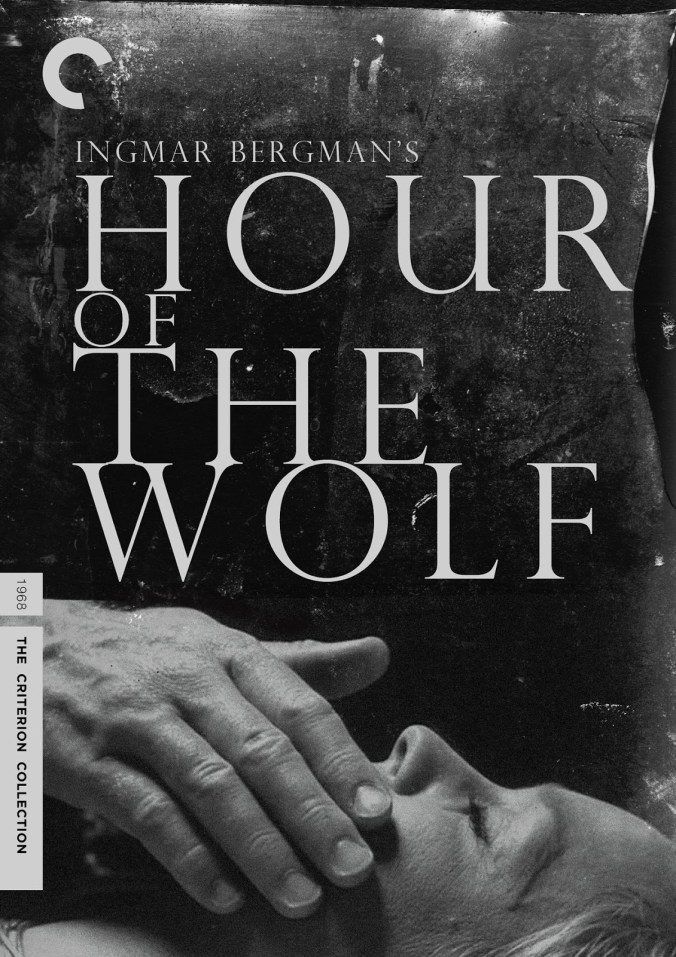
Hour of the Wolf (or Vargtimmen in Swedish) was released in 1968, and is probably the closest thing to a straight horror movie that Bergman ever did. That said, it’s still miles away from a traditional horror flick of the era, being more like an intensely eerie, psychological mindfuck with some really, really disturbing imagery; essentially, it’s film as wide-awake nightmare. Regular readers of this blog will be familiar with my love of ambiguity and surrealism in horror, and here is one of the best examples I have yet seen; in execution and implication, it’s absolutely skin-crawling. It’s also fairly obvious that this film was a pretty big influence on David Lynch’s Eraserhead, and in its themes of spiraling madness it also bears something of a resemblance to Roman Polanski’s Repulsion.
The story concerns an artist, Johan Borg (Max von Sydow), who is vacationing at a remote island cottage with his pregnant wife Alma (Liv Ullman). At the beginning of the movie, Alma is talking directly to the camera about the disappearance of her husband, as if she is being interviewed for a documentary. The remainder of the film is told in flashback; we see the bizarre disintegration of Johan’s mental state, and wonder how much of what we’re seeing is real.
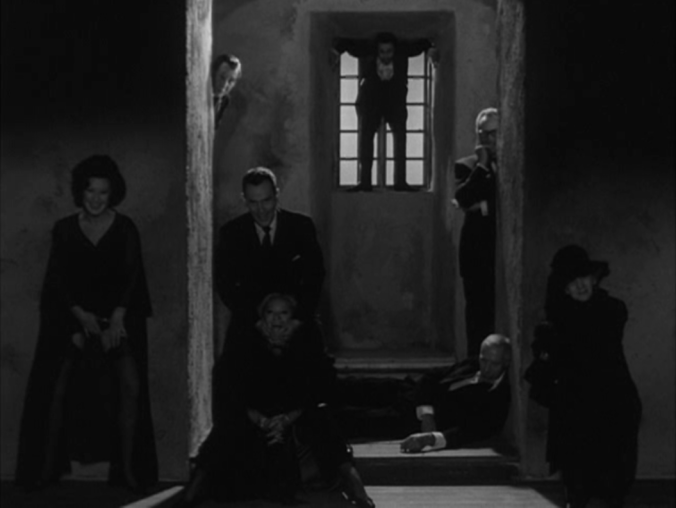
What makes this film so unsettling is its resolute refusal to explain itself. Johan interacts with strange people as he walks around the island, and he seems to think that they are demons, even though Alma can see them too; and for most of the movie, they seem like real people, albeit really skeevy ones. Johan has drawn all of them in his sketchbook, though the viewer never sees the drawings, but only Alma’s horrified reactions to them. He also has names for them, like the Bird-Man, the Schoolmaster, and The Lady with a Hat (about whom Johan once tells Alma that you don’t want to be around when the lady takes the hat off, because the whole face comes off with it. NOPE).
At one stage, a man named Baron von Merkans invites Johan and Alma to his nearby castle for a party, and when they attend, it’s the trippiest get-together ever, as all the guests laugh bizarrely, yammer on about meaningless topics, and overpraise Johan’s art to a really uncomfortable degree. Everyone seems hostile and cruel, as though they’re mocking him, but no reason for this is apparent. One of the women at the party shows Johan and Alma her bedroom, in which hangs a huge portrait of a woman named Veronica Vogler, who was apparently Johan’s ex-lover, though it is never clarified if she was a real person, or another figment of Johan’s crumbling imagination.
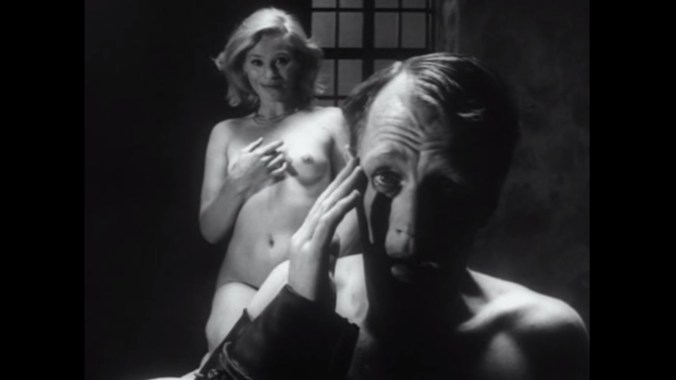
Johan suffers terribly from insomnia, and Alma often stays awake with him in support. During the long nights, they have some extremely disturbing discussions. In one very eerie scene, Johan tells Alma about a trauma from his childhood in which he was locked up in a closet with what he thought was a small person who wanted to gnaw his toes off. He also confesses to a possibly fictitious incident some time before whereby he murdered a little boy while out fishing. During this conversation, he clarifies the meaning of the phrase “hour of the wolf,” which according to folklore is the hour in the middle of the night when most deaths and births take place. Much of the horror in the movie is conveyed in these weird conversations, though there are plenty of uncanny visuals to highlight the nightmarish narrative, like a man suddenly walking up a wall and across a ceiling, or a woman pulling off her face and popping her eyeballs into a wine glass.


If you’re getting the sense that this is a really bizarre, disjointed film, then you’re entirely correct, but its inexplicable strangeness is very, VERY effective in making this one of the most haunting and genuinely unnerving films I’ve ever seen (and that’s saying a lot). The underlying themes of the film seem to tie in with the fine line between artistic genius and madness, with the power of deep-seated fears and shameful desires to unhinge the mind, and with the possibility that insanity may be contagious, as Alma wonders at the end whether her love for Johan caused her to share in his delusions. There is also a repeating motif of eating or biting—the demonic people that Johan sees are portrayed as something akin to vampires or birds of prey, and during the flashback scene where Johan is recounting his murder of the boy at the seashore, the boy bites him several times during the struggle. Indeed, the working title of the manuscript was “The Maneaters,” so perhaps there is some reference here to the way that fears and traumas, whether real or imagined, can eat away at one’s sanity.
All in all, not a film for everyone, obviously, but I found it an intense experience, so disquieting and ominous that it was sort of distressing to watch. Its slow pace and stark cinematography only added to the uncomfortable atmosphere. If you haven’t seen it, and are a fan of Bergman’s other films, or just like surrealistic horror in general, I would definitely recommend it, even though it legit creeped me the fuck out. In fact, I know I said I was gonna try not to, but I need a laugh after watching it, so here we go.
Sorry, Sweden.
Goddess out.
Strange Men Have Been Following Women Since the Stone Age: An Appreciation of “All the Colors of the Dark”
Welcome back to our regularly scheduled programming, horror hounds. We’re traveling back to Italy for this one, and back to the giallo genre; we’re also revisiting some familiar faces from previous blog posts, because today’s movie features Edwige Fenech and George Hilton (from The Case of the Bloody Iris), as well as Marina Malfatti (who starred in The Night Evelyn Came Out of the Grave). So, without further delay, let’s jump right into the psychedelic cauldron of Satan, shall we?

All the Colors of the Dark (Tutti i colori del buio, 1972) was an Italian/Spanish co-production, but set in London, and directed by Sergio Martino. It’s essentially a groovier, less satirical, and WAY more surreal take on Rosemary’s Baby, with similar themes of black magic, ambiguous reality, and crushing paranoia.
Beautiful but mentally fragile protagonist Jane has been going through some shit; not only was her mother murdered when she was five years old, but a year before the events of the film, she was in a car accident in which she suffered a miscarriage. Her boyfriend, pharmaceutical rep and raging jackwad Richard, was driving the car, and sorta feels responsible for the whole losing the baby thing, although he still kinda treats Jane like crap anyway. Ever since the tragedy, Jane has been plagued with horrific, Fellini-esque nightmares in which toothless old ladies cackle in close-up and a mysterious man with ice-blue eyes repeatedly stabs women in their beds.
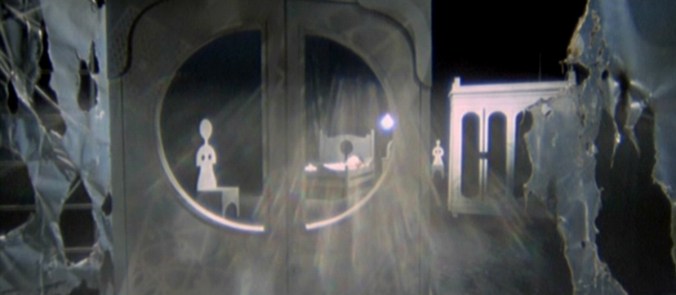
DAVID LYNCH TO THE WHITE COURTESY PHONE.
In true “Yellow Wallpaper” fashion, Richard has been pooh-poohing Jane’s wishes to see a psychiatrist, insisting she just needs to keep ingesting the weird blue toilet-tablet vitamin concoction he’s giving her to flush away the crazy, since he clearly subscribes to the Tom Cruise School of Psychiatry Is Evil and Scientology Solves All the Things With Vitamins and OT Powers. But since playing with the Ty-D-Bol Man doesn’t seem to be doing her any damn good, Jane finally takes her sister Barbara’s advice and goes to see the psychiatrist Barbara works for, a kindly old man called Dr. Burton. Doc seems more understanding, but her nightmares are not going away, and what’s worse, she’s starting to see the blue-eyed man stalking her in real life, or so it would appear.
Fearing she might be going batshit insane, she finally confides in foxy new neighbor Mary, whose first suggestion, obviously, is for Jane to accompany her to a black magic ritual, which should clear that whole mental illness thing right up, with the well-known healing power of Beelzebub. Jane gives this course of action about ten seconds of thought before going, “Sounds like a plan,” and after a festive afternoon of dog-blood drinking and gang rape, she seems right as rain again.

BLACK CANDLES AND WHITEFACE: THE CURE FOR WHAT AILS YOU.
But not so fast! In a stunning twist, it turns out that demonic cults headed by fey bearded men wearing fabulous gold Lee press-on nails may not actually be conducive to one’s overall well-being! Who’da thought? From here on out, the movie takes on the aspect of a fever dream, as we’re not really sure who we can trust and what is really happening. Is the blue-eyed psycho real or imaginary? Is everyone Jane knows conspiring with the cult to push her off her rocker for good? Has Richard fucked every woman in the immediate vicinity, including Jane’s sister? What’s the over/under on how long it would take to murder a couple of German senior citizens and prop them up at the breakfast table as though they’re still alive? Will Jane ever learn to cook bacon and eggs properly? The surrealistic touches come hard and fast, and the viewer will be left confused and on edge until the very end.

WAKING UP ON THE LAWN OF A SATANIC MURDER MANSION; WE’VE ALL BEEN THERE.
I really dug this one a lot; I loved the psychedelic weirdness and the ambiguity, and it had a really unsettling undertone of claustrophobia, as the world seemed to close in around poor Jane, leaving her with no one to trust. The cinematography was also lovely and strange, if a little heavy on the wacky camera effects. Definitely one of the more unique gialli, and one I’d definitely recommend to fans of Satanic cult movies as well.
That’s all for this installment, so until next time, keep it creepy, my friends. Goddess out.
My Final Thoughts on the Pulse Shootings
Okay, now that I’ve had a few days to process my emotions about what happened here, I feel like I can write my final words on it before I resume my usual silly horror posts. If you’re sick of hearing about it, I understand, but I just want to get this off my chest, so read on if you want to.
As I mentioned in my previous post, I live in Orlando, and I’m at the downtown clubs every single weekend. I’ve been to Pulse, and I’ve been to lots of other LGBTQ and LGBTQ-friendly bars in the city over my long clubgoing career. This could easily have happened to any of my friends, or to me, and in fact, many of the victims of this attack were friends of friends. As a goth chick, I’m very familiar with the feeling of camaraderie and family that springs from clubs like these, the feeling of these places as safe havens away from people who don’t understand those who are different. So if anyone reading this is thinking it didn’t matter as much because it was “just” a gay bar, or “just” a Latin night, or whatever, then kindly fuck the fuck off, and just keep fucking off until you drop off the face of the earth, thanks. And if your religion says it’s cool to hate on gay people, or anyone else who doesn’t share your beliefs, then you helped contribute to the worldview that caused this, and you need a new fucking religion, or none, preferably. Gain some fucking empathy and get on that right away, thanks. And if you’re really a special kind of stupid and think the shooting didn’t really happen, that it was some “false flag” operation, engineered so OMG OBUMMER CAN TAKE OUR GUNZZZZ or some asinine conspiracy bullshit like that, then fuck the fuck off into a rocket heading straight into the motherfucking sun, you disgusting waste of skin and oxygen. YOU ARE PART OF THE PROBLEM. PEOPLE FUCKING DIED HERE. Again, thanks ever so much.
Whether the anal pustule who perpetrated this horror was a Muslim terrorist, a raging homophobe, a self-loathing closet case, or a combination of all three, he was, most definitely, a pathetic fucking coward, warped by a fundamentalist mindset that saw LGBTQ people as less than human, as worthy of execution. This is what fundamentalist religion does to people. It most assuredly did it to this shitstain, and it has sadly affected all of us. And it will continue to affect us, whether the extremism is inspired by Islam, Christianity, or motherfucking Scientology. This is NOT OKAY. Humans are humans, and even if your “belief system” disagrees with how they live their lives, they were in no way hurting you, and you have NO FUCKING RIGHT to impose your ridiculous beliefs onto them with violence, or onto the rest of us. Be religious if you must, but keep that shit to your own goddamn self and leave everyone else out of it.
But here is the thing. I know it’s still scary right now, my Orlando family. Every time something like this happens, we are reminded that we are not safe, we are not invincible, even when we are just minding our own business, hanging out and drinking and dancing with our friends as we’ve done countless times before. Some of my friends are worried about going out and just living their normal lives now, afraid that something like this will happen again. And guess what? It CAN happen again, and it probably will.
But you know what else? THESE GAPING ASSHOLES WILL NEVER WIN. They may get some of us sometimes. They may knock us back, make us afraid for a little while. BUT THEY WILL NEVER GET US ALL. There are way more of us than there are of them, and we are far stronger than they will ever be. Their worldview is fading into the past. Their stranglehold on our hearts and minds is dying. Deep down they know this, and they’re panicking and lashing out at us the only way they know how. They have to target the innocent, because they are fucking WEAK. Yes, one fuckstick massacred 49 beautiful people who had family and friends who loved them, 49 people who were just out having a good time and living their lives. He wounded dozens more, and their lives will never be the same. That is a horrible tragedy.
But in the aftermath of all the horror, I saw something extraordinary emerge. Hours after the shooting, every blood bank in central Florida was overwhelmed with people wanting to help, giving blood if they could, bringing food and water to others if they couldn’t. LGBTQ charities were flooded with millions of dollars in donations. Vigils downtown were packed to the gills with people—gay and straight, religious and not—raising candles in remembrance of the fallen. All over the world, people—of all races, sexualities, religions—took to the streets, and buildings were lit up in rainbow colors in solidarity with those lost and those who remained behind. THIS is what you are contending with, you haters and despicable cockroaches who would vilify and kill others who don’t share your antiquated views. You tried to bring us down with your hate, and instead you only inspired love and support. You FAILED, as you will always fail. This weekend in Orlando, and many more after it, people will be right back out, dancing and drinking and living their happy lives; LGBTQ people will be walking hand in hand, kissing their SO’s, and all in defiance of YOU and others like you. You changed us, yes, but you will never beat us. I can feel contempt for you, sure, even anger; but mostly what I feel is pity, because that is what you are: pitiful, and sad, and on the losing side of history.
So stay strong, my Orlando brothers and sisters. The people who hate you are nothing, and will be remembered with nothing but disgust for their vile actions. If you’re afraid to come out for a while, that’s okay. Deal with things in the way that’s best for you. But know that this coming Saturday night, I will be downtown, raising a glass for the victims, and dancing for all those who no longer can.
Thank you, and Goddess out.

Some Thoughts on the Mass Shooting in Orlando
Sorry for the seriousness, folks, but this one hit close to home. As regular readers will know, the God of Hellfire and I are very active in the downtown Orlando alternative club scene, and though Pulse was not one of our regular haunts (we had only been there once or twice), it was very close to the clubs that are, and we knew many people who frequented it, worked there, or lived nearby. It could have easily been any of us, and in fact, we and many people we knew were indeed in the area last night, as we and they are nearly every Saturday night. The GoH and I uncharacteristically went home early, but it could have been different. I can’t imagine what the victims and their families and friends must be going through right now, and for what it’s worth, my most heartfelt sympathies are with them.
If you live in the area, please consider donating blood (though you might want to wait a few days, as the need will be ongoing and I think all area donation centers are overwhelmed at the moment). If you don’t live in the area, please consider donating to the Pulse Tragedy Community Fund or the Pulse Victims Fund on GoFundMe (but trust me, don’t read the comments there if you want to keep your faith in humanity).
Thank you.
Oh, and fuck your motherfucking homophobic religions.
I Will Be at Gods & Monsters in Orlando This Saturday!
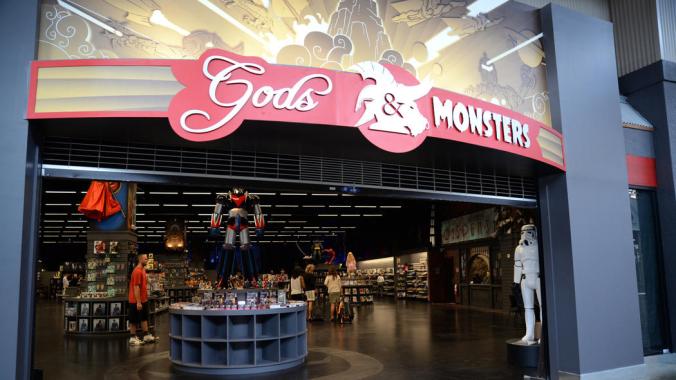
Deep down in your heart of hearts, you’ve always known that your life could not be complete until you had seen the Goddess in person and purchased one of her delectable and terrifying tomes right from the source. Well, all of your fevered prayers have been answered, because I will be making an appearance at the Gods & Monsters First Anniversary Event this Saturday, June 11th, starting at 11:00am! Come on down to the Artegon Marketplace at 5250 International Dr, Orlando, FL 32819. Lots of my books will be for sale, and there will be a ton of other authors, artists, and other vendors hawking their wares, plus workshops, gaming tournaments, a costume contest, and much more! Gods & Monsters is a fantastic, HUGE venue with a bar in back, and you’ll want to stay all day and get your nerd on. See all my central Florida peeps there!
In Case You Missed It: My Interview on Radio of Horror
If you missed it last Sunday, now you can listen to this fun, rambling interview with me, conducted by Dr. Chris of Radio of Horror, anytime you want to! Like now would be a good time, don’t you think?

