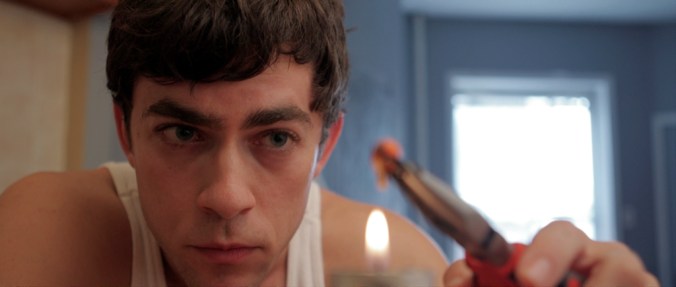
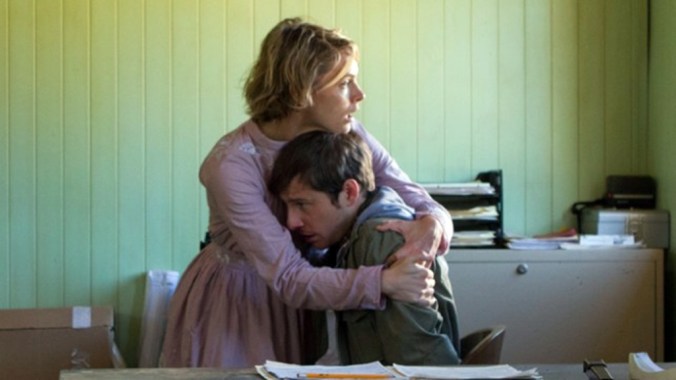
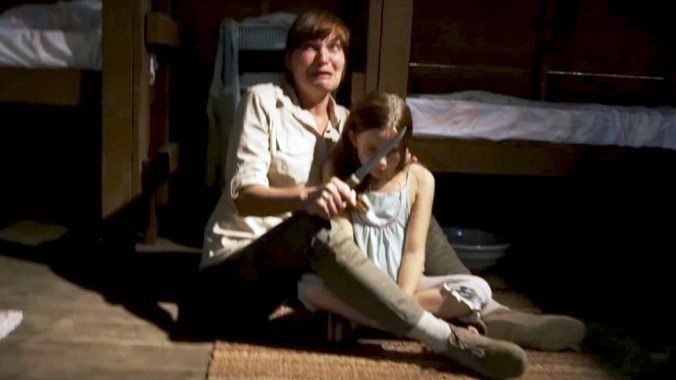
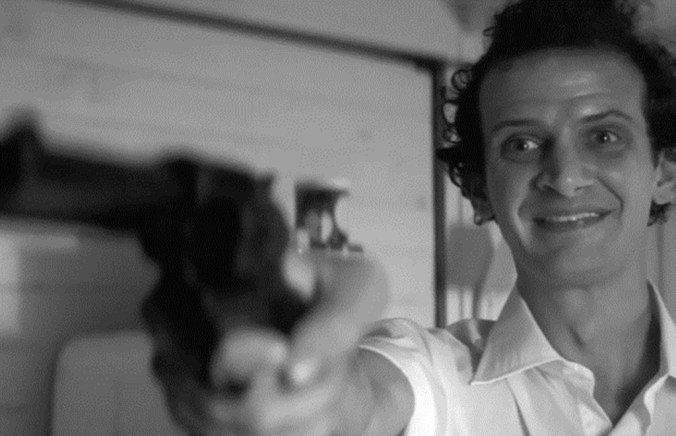
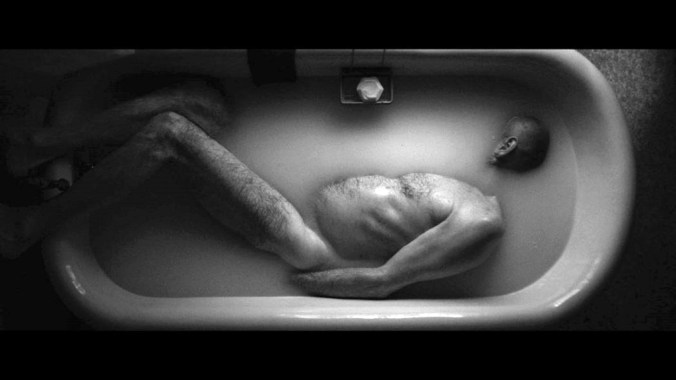
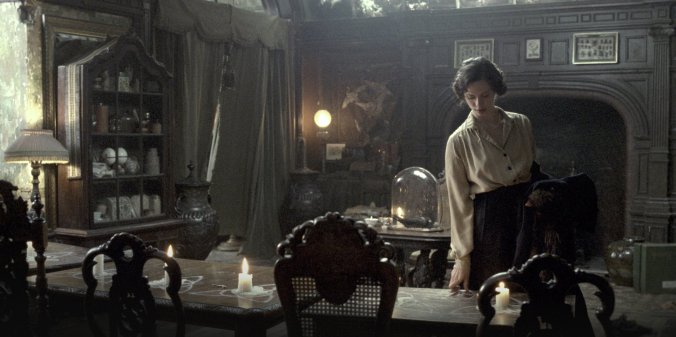
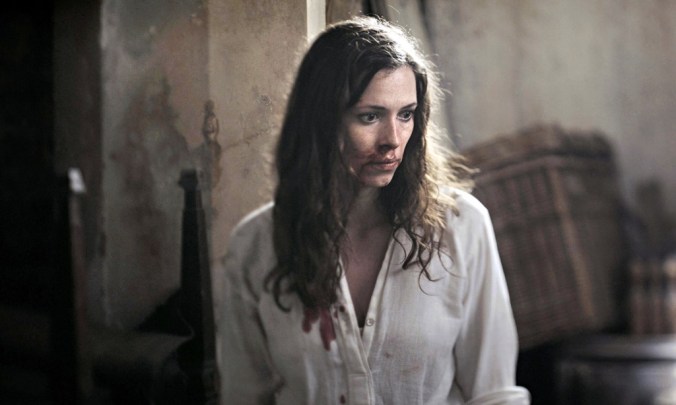
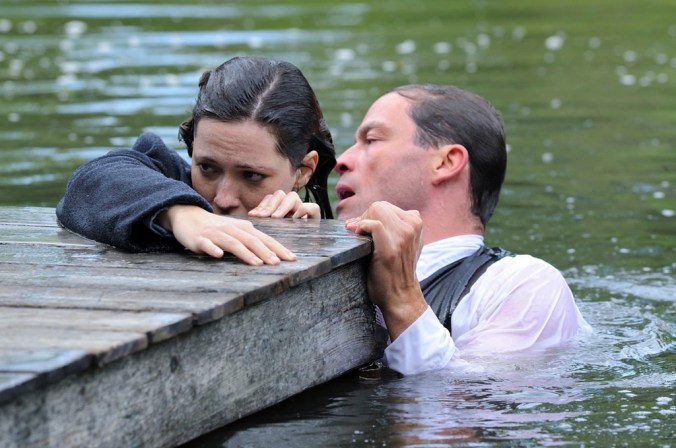
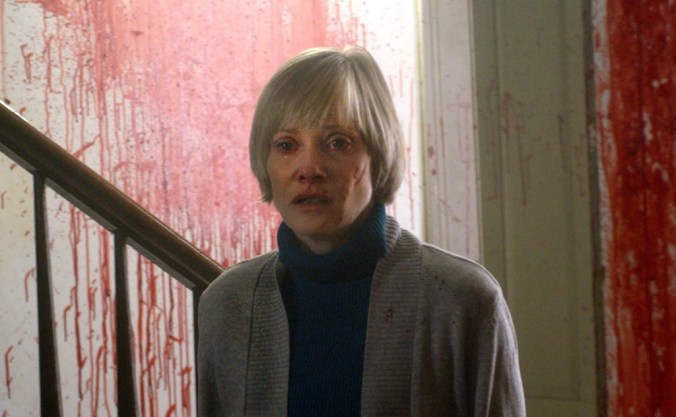
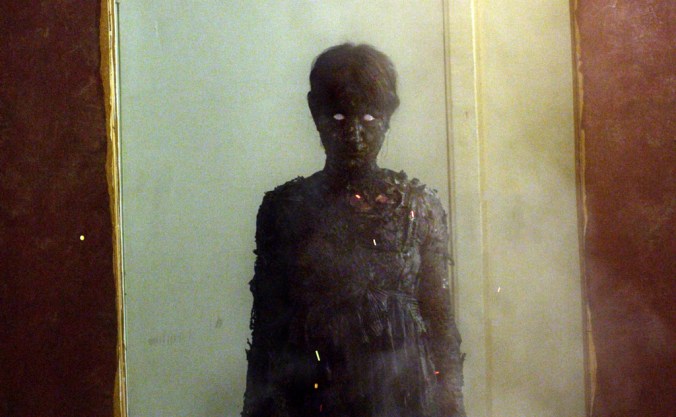
Horror Double Feature: The Shrine and The Dead Room

Well, it’s that time again: time for me to browse Netflix for a couple decent-looking horror movies, watch ’em, and tell you guys what I thought about ’em. Today’s twofer features a Canadian demon-possession flick and a Kiwi haunted house tale, so let’s get right into it.

2010’s The Shrine was the second feature from writer/director Jon Knautz, a follow-up to his well-received horror comedy Jack Brooks: Monster Slayer. The Shrine completely dispenses with the comedy, though, and goes in a far more serious and demonic direction, and while it’s not a great film by any stretch, it’s fairly entertaining and has a decent switcheroo ending that I admit I didn’t see coming.

Shrine2

In the cold open, we see a standard sacrificial setup, as a bunch of robed men strap a man dressed in a white gown to a table, then proceed to nail a metal mask to his face, Black Sunday style. After the title drop, we’re whisked away to the apartment of a squabbling couple: she is go-getting journalist Carmen (Cindy Sampson), he is photographer Marcus (Aaron Ashmore). Marcus is complaining that Carmen is so lost in her work that she doesn’t have time for him, Carmen gets defensive, Marcus gets pissed off and leaves.

In the meanwhile, Carmen has been following an intriguing lead on a story she wants to pursue. A backpacker named Eric Taylor (Ben Lewis) has gone missing while traveling in rural Poland, and Carmen’s research turns up the fact that several other tourists have disappeared from the same area over the past fifty years. She goes to her editor all jacked up about the story, but he thinks it sounds lame and wants her to go to Omaha to do a story about something far less lame: bee farming. True to her go-getting (and frankly irresponsible) nature, Carmen tells the editor that she’s totally going to Omaha to work on that bee thing, but instead she conspires with her intern Sara (Meghan Heffern) to go to Poland to look for the missing backpacker.

I have to say, I got kinda hung up at this point in the plot, because if Carmen was using an expense account from the company to pay for her travel (which I would assume she would be; what journalist can afford to drop a few grand of their own money on three tickets to Poland at a moment’s notice?), then wouldn’t she get caught immediately for buying flights to Poland instead of Nebraska? And wouldn’t she have to check in with the editor while she was working on the story? And wouldn’t the farmer in Omaha who she was supposed to interview be calling the magazine to ask where Carmen was if she didn’t show up? Like, I know a lot of movies have journalists basically just running around willy-nilly working on stories with seemingly no policing of where they’re going or what they’re spending the company’s money on, but for some reason it seemed particularly egregious here.

Anyway, Carmen is somehow able to convince Marcus to come along on the trip to act as photographer, and she says that it will be good for their relationship, even though Marcus’s main complaint about their relationship was that her head was always in her work and she couldn’t ever turn it off. So why he’d want to go along with her on yet another work assignment which frankly sounds pretty dangerous is also kinda beyond me. But whatever.

Carmen and Sara visit the mother of Eric Taylor, who tells them that neither the American nor the Polish police give a single whiff of a fuck about finding her son, and she’s just glad that a journalist is actually willing to go over there to find out what happened to him. Mrs. Taylor gives Carmen Eric’s travel journal, which was in the luggage she was sent after it was found in some airport far away from where Eric disappeared. Carmen says this was also the case in the other disappearances; that the vanished people’s luggage would randomly turn up at various airports around Europe.

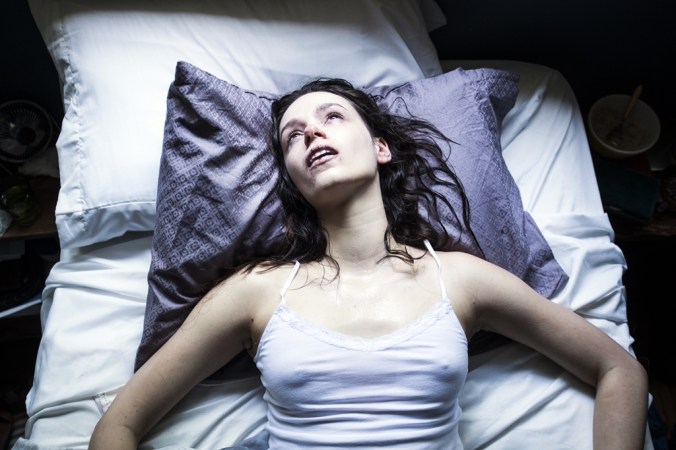
Before they leave on their trip, Carmen has a fairly creepy nightmare about Eric’s ghost turning up in her room with his eyes gouged out, screaming at her to “leave me alone.” Naturally, she does not heed this advice at all, much to her ultimate detriment.

The last entries in Eric’s journal reveal that he was in a small town in Poland called Alvania. He wrote that the people there were unfriendly and suspicious, and that there was a weird fog bank that never seemed to dissipate hovering over the trees. The final entry detailed Eric’s decision to go see what the mysterious fog was all about.

Shrine6

So Carmen, Marcus, and Sara arrive in Alvania, and find the locals just as mistrustful and potentially-murdery as advertised. They speak to a little girl called Lidia (Julia Debowska), who seems to recognize the photo of Eric they show her, but the trio are then run off by a burly blond farmer named Henryk (Trevor Matthews), who waves his butcherin’ knife at them and tells them to beat cheeks, which they wisely do, at least temporarily. On their way out of town, they notice the strange fog that Eric talked about in his journal.

Marcus thinks it’s about time to call the whole thing a wash, but of course Carmen can’t let it go. It comes to light that she lied to Marcus and told him that the magazine had sent her on this story, rather than it just being Carmen going all rogue reporter, and then he gets doubly pissed when he finds out that Sara was in on the deception too. Carmen begs him to follow the story through, because she says if she goes back to the U.S. with no story at all then her career is basically over, even though I’m pretty sure it would be over anyway after her editor finds out that she misappropriated company funds to go off on a little adventure that he specifically told her not to go on, but again, whatever. Marcus, shockingly, does not laugh in her face and turn the car right around, but is all like, fine, we’ll drive back to that fog bank and see what that’s all about.

The fog in the woods is super dense and doesn’t move, even though it’s a windy day. The three of them debate about whether they should go in it or not, but then Sara, seemingly under some kind of trance, wanders off into it. She’s gone for a really long time, and finally Carmen says she’ll go in after her, admitting that since she (Carmen) is the one who got them into this situation, then she should be the one to go poking through the spooky mist.

Sara makes her way out of the fog after Carmen has gone in, and she seems disoriented and has a scratch on one cheek, but she won’t tell Marcus what she saw in there. Meanwhile, Carmen is wandering around in the fog for a time before coming across a statue of a demon that sort of looks like Pazuzu just hanging out in the smoke. She takes a couple pictures of it, but then sees that its head changed position while she wasn’t looking, and then it starts to bleed from its eyes and mouth, and the stone heart in its hand begins to beat. She runs the hell out of the fog and shares a meaningful glance with Sara, who tells Carmen that she saw the statue too.

Shrine5

Shortly afterward, Lidia finds them in the woods and tells them that she knows where Eric is. She leads them to a sort of basement-like structure where the trio discover a whole bunch of coffins containing shriveled corpses wearing white gowns and having metal masks nailed onto their faces. One of the bodies is obviously Eric, identified by a distinctive tattoo on the back of his hand. As they’re checking out the dead people, Lidia unsurprisingly locks the three of them in the basement, but they manage to escape.

The unfriendly locals find them and give chase; Sara is hit in the calf with a crossbow bolt, and eventually all three are knocked out with chloroform and tied up. At this point you could be forgiven for thinking that this was gonna go in a Hostel-like direction, as I did, but I’m glad to say that it actually takes something of an unexpected turn.

Shrine3

Shrine1

The women are separated from Marcus, and are taken to the titular shrine where they are stripped and put into the telltale white gowns. Marcus is hauled off and held at gunpoint, forced to dig what is presumably a grave. Back at the shrine, Carmen is put in a cage while Sara gets strapped to the table from the beginning of the movie. The robed dudes around her make big cuts in her arms and slice her Achilles tendons, then out comes the Black Sunday mask. Before Sara dies, we see the robed guys from her point of view and they all look like demons.

Back at the grave, Marcus manages to whack his captor with a shovel and grab his gun. He runs to the shrine, just in time to see the dead Sara being put in a wooden coffin. He sees that Carmen is still alive and is able to bust her out. The two of them run to a house near the edge of the village, where Marcus trains the gun on the family within and tells them that he just needs the keys to their truck so they can escape. The family seems terrified at the sight of Carmen in her white gown, and we soon find out why: the little boy in the house, Dariusz (Connor Stanhope), can speak a little English, and tells Marcus that Carmen is now evil because she has seen the statue in the fog.

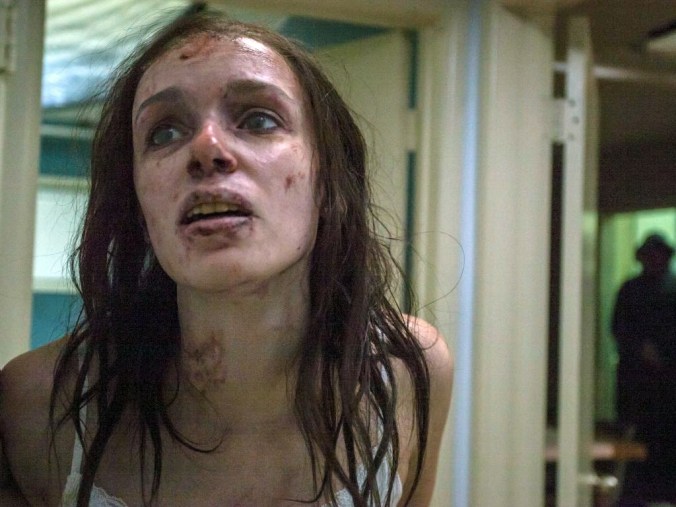
Sure enough, Carmen begins acting all possess-y, seeing the family as demons, seeing objects moving around on their own. Before you can say Regan MacNeil, Carmen has gone full-on red-eyed murder-devil, and brutally slaughters the poor family, even the kid, tearing all their intestines out for good measure.
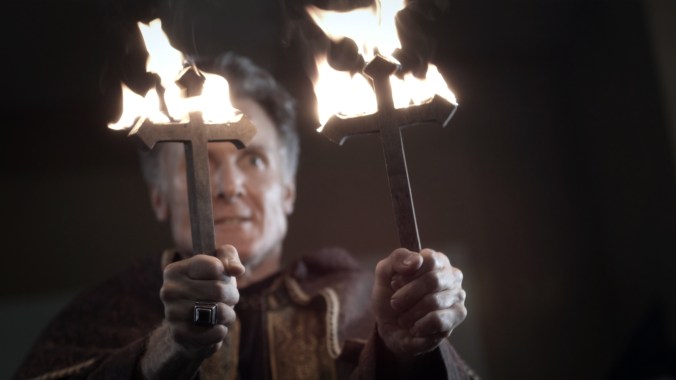
Shrine7

The robed guys turn up at the house and try to exorcise her, but Carmen uses her new demon powers to kill a bunch of them too, including the main priest, Arkadiusz (Vieslav Krystyan). Henryk, taking over the mantle from the dead priest, manages to force Carmen down to the floor and get a metal mask poised over her face. Marcus, finally understanding why these sacrifices are necessary (and maybe glad to get rid of his bitch-ass girlfriend whose reckless ambition got them into this mess in the first place), helps out by holding Carmen’s head still so Henryk can hammer the mask in place and kill the demon.
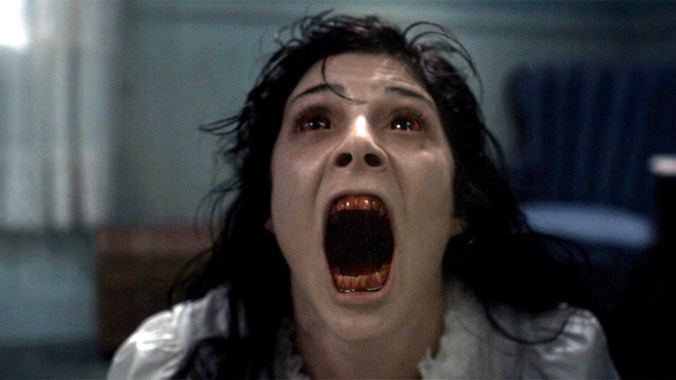
Shrine8

Afterwards, Marcus is allowed to leave, since he did not go into the fog and hence did not contract the demon cooties. Henryk tells Marcus that the village has been under this curse for ages and that there’s nothing they can do about it, save for warning people away. So even though the villagers were portrayed as the bad guys at first, it turned out they didn’t have a choice; if people didn’t heed their warnings and went into the fog anyway, demons would possess them and they would have to be dealt with before shit got out of hand.

I really liked that the movie played with the audience’s expectations, reversing the common “murdery small-town foreigners” trope, and I really did like the scene where Marcus finally understands the whole deal and steps in to help the villagers kill his possessed girlfriend. The gore in this was also pretty fun, particularly the slaying of the family near the end, and the demon faces were fairly creepy. The special effects were mostly good, though the green-screened fog bank sequence looked a little hokey, and the way the shots were lit seemed flat and not all that visually interesting.

But besides that, I think the movie suffered quite a bit from its main characters making such boneheaded decisions and being so generally unlikable. You could argue that since the investigating Americans were sort of ultimately the bad guys, then making them unlikable was a deliberate directorial choice, but honestly, I think the ending when Carmen gets sacrificed would have had a lot more emotional impact if you had liked her or Marcus at all, if you had any sympathy for their situation, or if you believed that they loved (or even liked) each other. As it was, I didn’t buy them as a couple because all they did was snipe contemptuously at each other, so when Marcus was obliged to help sacrifice Carmen I was like, “Eh, good riddance.” It was really her monumental stupidity that got Sara killed anyway (Sara being pretty much the only sympathetic character, even though she wasn’t given much to do other than looking young and vulnerable), and the fact that Carmen wouldn’t back off of the story even when it was clearly getting dangerous suggested that she gave way more of a shit about her career than she did her boyfriend or her intern, so fuck her, basically. She pretty much got what she deserved for not leaving well enough alone.

So all in all, not a bad movie, but sort of a frustrating one. Watch it for the decent gore, the relatively brisk pace, and the interesting plot inversion, and just try to ignore the rest.

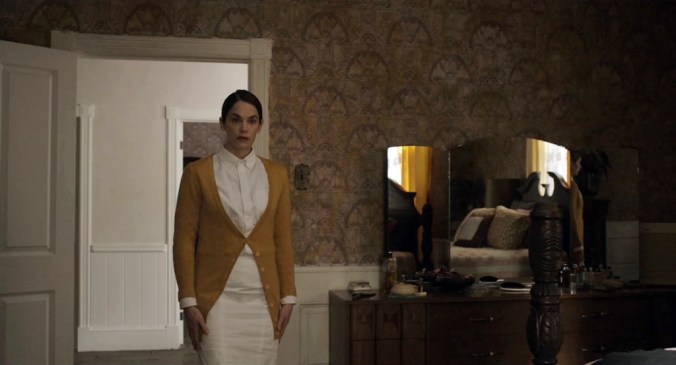
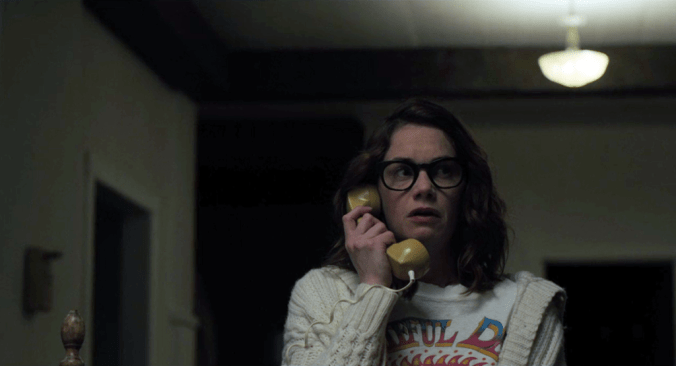
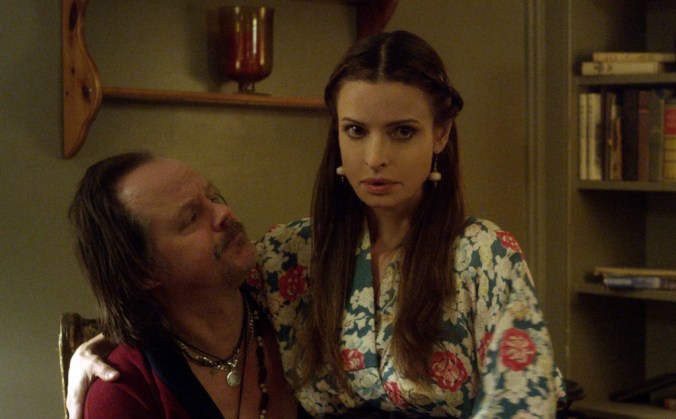
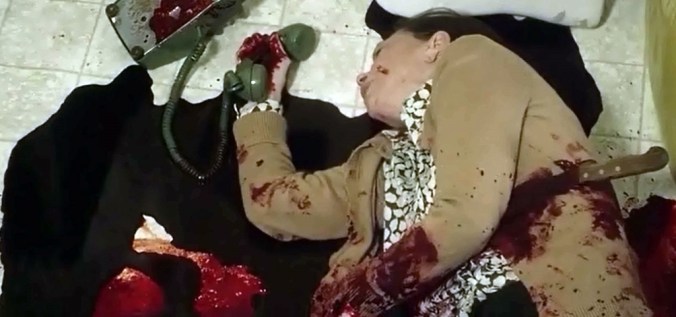
The second film in the double feature was much better in my opinion, though it seems to have gotten some mixed reviews. 2015’s The Dead Room was directed by Jason Stutter and was apparently based on an urban legend about a haunted farmhouse in New Zealand. Though the movie has a pretty standard plot about a group of ghost hunters investigating a supposedly haunted property, I really liked the slow build-up of the tension, and the fact that it was creepy without really showing very much or explaining anything until the end.

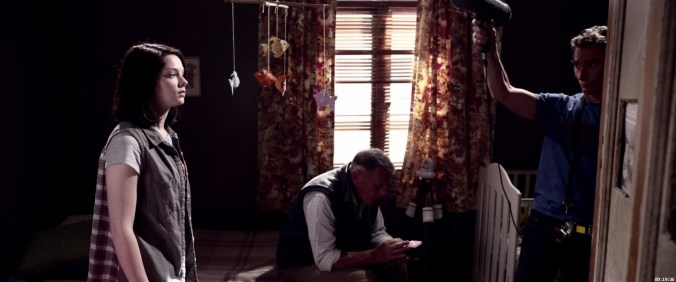
In many ways, The Dead Room is similar in setup to the classic 1973 flick The Legend of Hell House (which the GoH and I did a funny retrospective about here). You have the young psychic, Holly (Laura Petersen), who is very intuitive and truly believes in the persistence of personality after death. You have the crotchety old parapsychologist Scott (Jeffrey Thomas), who believes in the paranormal but is intensely skeptical, and thinks it’s all caused by energy that can be dispersed with a machine of his own invention. You have the petty sniping between the two of them as they struggle to find some common ground with their differing approaches to the supernatural. Stuck in between the two is the third member of the team, friendly tech guy Liam (Jed Brophy), who just wants to capture some evidence and move on to the next case.
DeadRoom1

The ghost busters are hired by an insurance company to determine if there is actual paranormal activity at the property, since the family who had been living there suddenly fled, leaving all of their stuff behind, including half-eaten plates of food on the table, all their baby supplies, and their three parakeets. The team settle in for their several-day stakeout, setting up their equipment and investigating the house. Psychic Holly makes her way through the rooms, but finds it strange that she doesn’t feel anything of a paranormal nature at all. Scott thinks the family who took off are trying to scam their insurance company, and doesn’t really think they’re going to find anything of note.

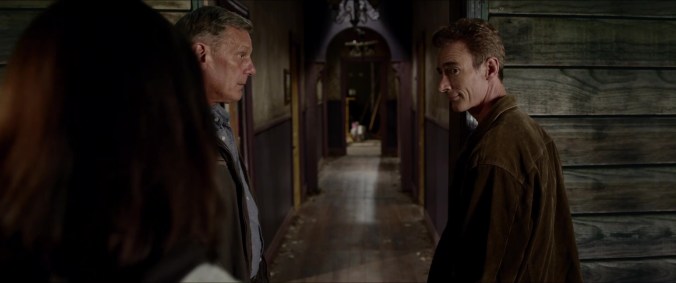
At first, it would seem that Scott is correct, because nothing really happens the entire first day the team is there. But late that night, at 3:00 a.m., the front door opens by itself, some footsteps are heard in the hallway, and a light fixture swings a bit. The team actually sleep through this first manifestation, but the following morning, they notice that the motion camera caught the door opening, and then seemed to follow some unseen thing through the hall. Scott brushes it off, thinking it was just a draft, but Liam and Holly aren’t so sure.
DeadRoom4

The following night, again at 3:00 a.m., a loud bang awakens everyone in the house, and this time they all see the door opening, hear footsteps, and see the light swinging. Holly claims she sees a figure walking toward them and standing in front of her, a giant of a man, she says, but neither of the men see him, and though Liam believes that she sees the ghost, Scott doesn’t really buy it, though he can’t deny that there is some pretty inexplicable activity going on.

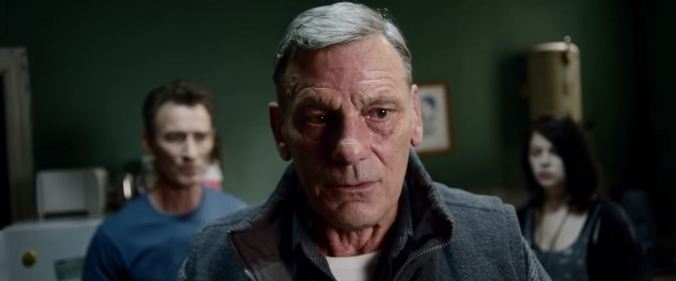
The next day, they go from room to room trying to make contact with the spirit, but at first they aren’t really getting anything. Scott is disappointed, because even though they captured a few things on film, it was nothing all that impressive, and he’s still half-believing that there could be a rational explanation. Holly begins to feel a drastic temperature drop, but again, the men do not experience it, and their instruments don’t read any change. She also claims that the air feels different, and Scott gets exasperated because her feelings are subjective and he wants something concrete.
DeadRoom2

At last, Scott determines that the battery in his EMF meter is dead, and when he replaces it, he gets a reading through the roof, bolstering Holly’s intuition that something is present. Curiously, the reading is ridiculously strong everywhere in the house except for one room at the end of the hallway (which I’m guessing is the titular “dead room”).

That night, the 3:00 a.m. manifestation occurs again, but this time the spirit is far more aggressive and threatens Holly, busting holes in the wall just behind her head. She and Liam want to leave, but Scott tells them that ghosts have never harmed anyone, that all the spirit can do is scare them. He wants to stay and gather more evidence, and hopefully be able to test the machine he built, which is supposed to disperse ghosts using infrasound. Liam and Holly are frightened, but agree to stay a little longer.

Unfortunately, it seems the ghost really doesn’t want them there, because it starts breaking windows and showering the team with glass, chucking furniture at them, and generally being a supernatural dick. The only thing the team can do to get away from the onslaught is hide in the dead room, which the ghost cannot enter for some reason.

At last, Scott decides it’s time to try out his infrasound ghost-be-gone machine, and just like in The Legend of Hell House, it actually seems to work. Holly creeps through the house after the machine has done its job, and she’s surprised that the mean male ghost seems to have dissipated. The smug Scott calls up the insurance company, tells them that not only do they have evidence that the haunting was real, but they also completely took care of the problem, making the house livable for the exiled family once again.

But this is a horror movie, so you know things aren’t going to be resolved quite so easily. While they are packing up their equipment, Liam notices a strange, freezing cold spot on one of the walls in the dead room. Wanting to be thorough, they bust a hole in the wall and discover a ladder leading down to a secret room. In said room, they find the mummified remains of a woman chained to a chair, again harking back to the secret chamber that contained the preserved body of Emeric Belasco in The Legend of Hell House.
DeadRoom3

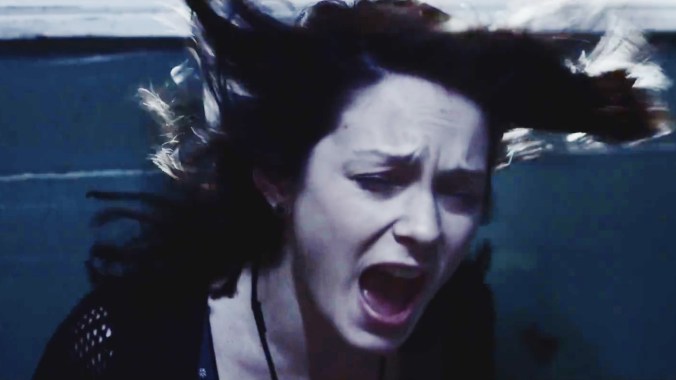
The team calls the police to deal with the body, but when the cops descend to the secret chamber, they don’t find the corpse. Uh-oh. Sure enough, moments later, Holly’s eyes go white as though she is possessed, the cops get flung against the walls and presumably killed, and chaos ensues. Holly informs the team that the belligerent male ghost that Scott’s machine got rid of was only trying to scare them out of the house to protect them from the other really mean ghost, the woman in the secret room, who ends up killing every damn person in the movie.

There were actually a lot of things I really liked about The Dead Room. I loved that it took its time, leaving everything kind of low-key and ambiguous throughout the first half, lulling you into a sort of trance as you just watched this paranormal team doing a routine investigation, catching a few minor things, but nothing really crazy. The film showed a lot of restraint, but left just enough tension that you weren’t really sure if or when something bad was going to happen or what it would be.

The characters were all really likable right from the start, and had a good rapport with one another that made you instantly believe that they had done a bunch of these investigations together. Their characters were given personalities organically, without really giving much back story, which kept things simple enough that the plot wasn’t bogged down with exposition, but kept the characters appealing enough that you cared what happened to them.

I also really liked that a lot of stuff wasn’t shown, which I think made the movie creepier. When they find the mummified woman in the basement, for example, the viewer is not shown her face; we only see the characters react to seeing it. Likewise, the male ghost is never shown except for one brief shot where he’s merely a vague shadow coming down the hallway. While a lot of reviews I read complained that the movie was too slow and derivative and not scary enough, I thought the fact that it stayed fairly simple and grounded helped a lot with making it eerie and more intriguing. I could have done without the final Paranormal Activity-style shot of the scary female ghost rushing at the camera, but all in all, I found it a nicely atmospheric and pleasantly tense addition to the haunted house subgenre, despite it being nothing terribly original.

That’s all for now, so until next time, keep it creepy, my friends. Goddess out.


Horror Double Feature: Baskin and Under the Shadow

I decided to do something of a Middle Eastern theme for today’s double feature, consisting of two films I had heard a great deal of positive press about and had been wanting to see for ages. The first is a surreal torture-fest from Turkey, the second a more traditional metaphorical ghost story with an Iranian-born director and an international production team hailing from Qatar, Jordan, and the UK. So let’s get started.

Imagine, if you will, a bizarre, hyper-gory, Turkish-flavored version of Hellraiser, but filtered through the surrealist sensibilities of a hypothetical love child of Dario Argento and David Lynch, and you might come close to getting an idea of the vibe of the 2015 flick Baskin (whose title loosely translates to “raid” or “descent,” either of which fits in with the theme of the story, at least as I was able to puzzle it out).

While I admit I didn’t have much of an idea what in the hell was going on most of the time, there was something queasily alluring in its dreamlike narrative that just kind of sucked me in and kept me watching as the thing got weirder and weirder and sicker and sicker. Since I deliberately refrained from reading any reviews before I watched it, I really had no idea what it was about or where it was going, and I think that definitely made me intensely curious about what weird shit was gonna happen next.

Heavily symbolic and very deliberately paced, I can see this movie just pissing some people off for taking a while to get where it’s going and for “making no sense,” and while I do respect that as a valid complaint, I don’t think a pat, open and shut plot was really what first-time feature-film director Can Evrenol (who expanded Baskin from his own 2013 short film) was shooting for, which is a good thing, because this is one strange-ass movie, to put it mildly.

The film opens with a creepy, unexplained sequence in which a little boy is awakened in the middle of the night by the sound of a woman (his mother?) in the next room having sex (or perhaps being brutalized; this isn’t clear). The noise stops, abruptly, after which the boy goes out to the living room and sees that the TV is on, showing nothing but static. He then looks back down the hall into his room, seeing that the light has turned red. He looks terrified, and starts banging at his mother’s bedroom door, but there is no answer, and in the next moment, an arm emerges from the darkness and snatches him.

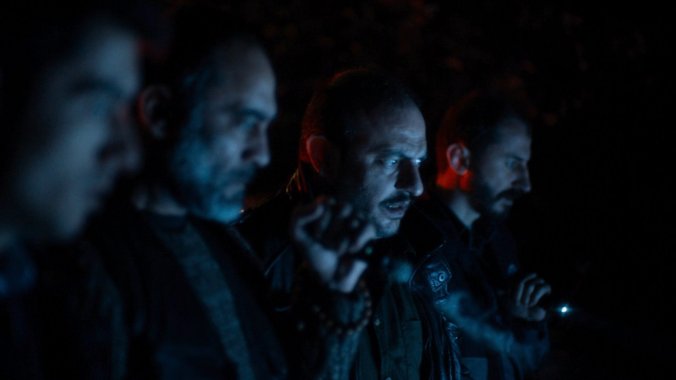
After this intriguing setup, we are introduced to the movie’s main characters; they are five cops, sitting in a run-down old restaurant in the middle of the night and out in the middle of nowhere. They’re all shooting the shit, betting on soccer games and joking with each other about their sexual encounters with both animals and hookers. They are Boss Remzi (Ergun Kuyucu), Yavuz (Muharrem Bayrak), Apo (Fatih Dokgöz), young rookie cop Arda (Gorkem Kasal), who we later learn is the grown-up version of the boy at the beginning of the movie, and Seyfi (Sabahattin Yakut), who seems to be feeling unwell and refrains from participating in all the banter.

Baskin1

Throughout this entire scene, strange little details put the viewer on edge. An unidentified person in a hooded robe carries a bucket that appears to have some bits of bloody meat in it to the back of the diner, and the cook puts the (human?) meat on the grill. Seyfi runs to the bathroom to throw up, and sees a frog in the soap dish, after which the hooded figure is briefly seen behind him. He screams, but after a few minutes he’s fine, telling his fellow cops that he just thought he was losing his mind for a second. The loudmouthed and bravado-packed Yavuz tries to start a fight with the waiter for implying that he’s gay, even though moments before he told the story of going to a hotel with a prostitute who looked like a Victoria’s Secret model, finding out it was a dude, then having sex with him anyway.

Eventually, the cops, who are working the night shift and clearly bored as hell, pile into their cop van and start driving down the desolate rural road, singing along to a pop song on the stereo and generally having a grand old time. Then a garbled message comes over the radio, calling for backup at a place called Inceagac (the crime code is given as a 4455, but I don’t know what that signifies in Turkey, and Googling it gave me bupkis). Seyfi, who is driving, says he’s heard of the place and it isn’t far away, but he also makes some vague pronouncements that he’s heard a lot of bad shit about it, though he notes that there are three shrines there.

Even though Seyfi insists he knows where Inceagac is, they keep driving and he can’t find the turn-off, even though they should have passed it by now, and then he sees a naked man dart in front of the van and disappear into the woods. They stop the van and pile out to find the guy, but can’t, and then they notice all these weird scratches that kinda look like symbols etched into the side of the van. They also see a whole shit-ton of frogs on the side of the road, a rather unsettling sight. Eventually they get back on the road, but they haven’t gone very far before they actually hit what appears to be a bloody figure who looms in front of them, and the van crashes into a stream.

It’s here where the movie really begins to fuck with reality. Just after the wreck, we’re suddenly back in the restaurant again. Boss Remzi and Arda are at the table, while the other guys quietly watch TV across the room. It comes to light that Arda’s parents died when he was young, and that Boss Remzi essentially adopted Arda at the request of Arda’s uncle.

Arda then tells a story about a recurring nightmare he has, which relates back to the sequence at the beginning of the film. He says that when he was a child, he and his friend promised each other that whichever of them died first would appear to the other, but without scaring them. Arda then tells Boss Remzi about the dream at the beginning of the movie, and specifies that when he looked back into his room and saw the red light, he knew that his friend was in there and he didn’t want to see him. He then says he woke up, but was still in a dream, and then he says that the next day he found out that his friend really had died the night he first had the nightmare.

The restaurant then starts to fill up with some black fluid that comes out from beneath Arda’s hands and drips down from the ceiling. This was actually my favorite scene in the film; it reminded me strongly of the infamous Winkie’s Diner sequence from Mulholland Drive, and had the same sort of eerie, unmoored-from-reality quality. In parts, the whole film also reminded me a bit of Adobe James’s short story “The Road to Mictlantecutli,” which was in an anthology I wrote about here.

Baskin5

But then we’re back in the wrecked van, and everyone has gotten out of the crash just fine, but then they come across an encampment of gypsy-type folk who have a bucket of frogs (like you do) and are sitting around a fire kinda laughing at the cops, sarcastically taunting them about the accident. A little girl bangs a spoon on a pot and says something to them, but I don’t know what it was because there were, cleverly, no subtitles at that point. The cops ask if these people know where Inceagac is, and they say it’s just through the woods, so the cops set out on foot, with one of the guys from the encampment leading the way.

Once they reach their destination, which is a huge abandoned building that the gypsy guy says used to be a police station and then a stable, they see another police car with its lights flashing out front, though there is no sign of the cops who called for backup and the radio isn’t working. The five cops troop into the building, and end up walking straight into Hell; in other words, this is where the Hellraiser/torture-porn part of the movie begins, though it still retains its surrealist, dreamlike, overlapping timeline deal throughout.

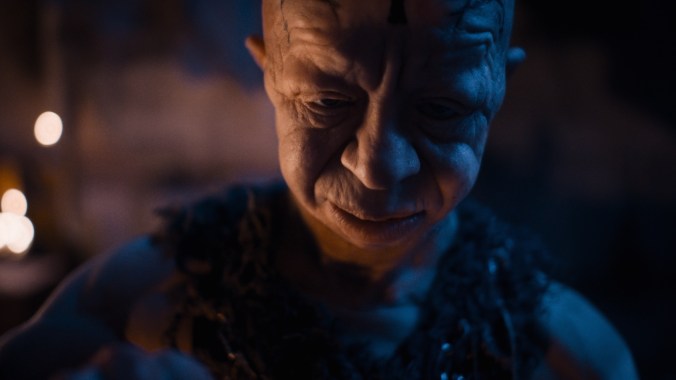
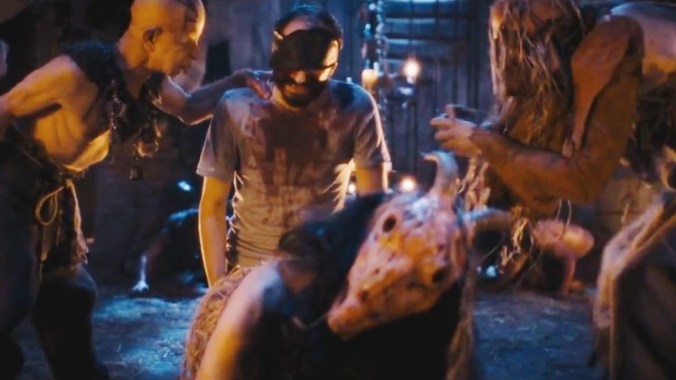
In short, the building appears to be home to a sort of sadomasochistic and cannibalistic cult that seems to worship the man in the hooded robe from earlier. When this particular individual finally reveals himself, he is SUPER freaky looking. He’s essentially what it would look like if Michael Berryman and Rondo Hatton somehow had a baby who was also a roided-out little person doing partial Yoda cosplay. This person is known as Baba, is festooned with padlock jewelry, has a tattoo of a keyhole in the middle of his forehead, and proceeds to do all kinds of nasty things to our “heroes,” under the guise of shepherding them into Hell, or enlightenment, or something. Eyes are gouged out and then the empty sockets are tongue-kissed, intestines are yanked out, Yavuz is forced to have sex with a woman with a goat head, after which she squats and gives birth to what appears to be a stone fetus. It gets weird, and gross, and fairly WTF.

Baskin2

Throughout all this, Arda is somehow still going back and forth between the situation they’re in and the diner scene with him and Boss Remzi, and I’m not really sure if everything in this sequence is a collective hallucination, if they all died at some earlier point, if this is all happening in Arda’s dreams, or what. A whole “caught in a time loop” angle is suggested by what happens at the very end (when — very late spoiler alert — it’s revealed that Arda was actually the bloody person that the cop van hit before crashing into the stream), but it isn’t really explained why these particular men were singled out in this way, if they were being punished for something (and really only Yavuz was a mouthy, abusive asshole; the others were mostly inoffensive, and Arda and Boss Remzi were actually pretty nice guys), or if it was something they all imagined. I’m operating under the assumption that the restaurant at the beginning was supposed to be purgatory, and the choices the characters made along the way eventually led them into Hell, but I could be wrong about that.

Baskin3

There is also Arda’s character, who is obviously “special” in some way, as much is made of his psychic dreams, and Boss Remzi makes several references to him having known about all this stuff (i.e. Hell and the Devil) since he was a child. It’s also Arda who ultimately ends up defeating Baba, by inserting a key (which he pulls out of the slashed throat of the dying Boss Remzi) into the keyhole tattoo on Baba’s forehead.

After I watched the movie, I was intrigued enough to do a bit of research about it to see if I could figure out some of the symbolism, and I came across a theory that seemed pretty spot-on: that the entire thing was based on Zoroastrian myth about the crossing of the Bridge of Judgment into the realm of the dead, with the arm at the beginning belonging to a child-snatching nightmare demon named Taram Baba, the abandoned building being a type of Hell called the House of Lies, and Arda representing a savior figure who ultimately frees the souls of the other cops from the purgatorial loop they all found themselves caught in.

It was a nightmarish experience, to say the least, and while I’m not going to pretend I knew exactly what the meaning of it was, I got enough of the gist to enjoy the ride, and it’s definitely a movie that I think will get better with multiple viewings, since it’s so threaded with metaphor and significant imagery. Though it borrows generously from a bunch of other films, notably Hellraiser, Hostel, Suspiria and Inferno (particularly in the color palette), The BeyondCarnival of SoulsLost Highway, Martyrs, and A Serbian Film, it’s still a pretty original take on the genre, and it was really cool to see a horror film from a country that doesn’t make a lot of them (or at least doesn’t make many that get U.S. releases). Recommended if you like surrealistic gore flicks with something of an eerie, slow-burn vibe and if you can handle not having everything explained.

Next up is 2016’s Under the Shadow, the directorial debut of Iranian-born Brit Babak Anvari. It’s a far more low-key piece than Baskin, playing something like a Middle Eastern version of The Babadook cross-bred with The Devil’s Backbone and Hideo Nakata’s Dark Water, but it’s a fantastic, spooky tale laden with subtext and peppered with unsettling images.

UndertheShadow1

The film is set in Tehran in 1988 during the long-running Iran-Iraq War. Main protagonist Shideh (Narges Rashidi) is a thoroughly modern, Westernized woman who, at the beginning of the movie, gets kicked out of medical school for her involvement in leftist politics during the Cultural Revolution. Her dreams of becoming a doctor dashed, she also has to deal with her physician husband Iraj (Bobby Naderi) thinking that maybe it’s all for the best, telling her that maybe now she can focus more on caring for their daughter Dorsa (Avin Manshadi). Shideh bristles with resentment at being forced into a more traditional female role that she never wanted, and although she clearly loves her family, she begins to take her frustrations out on them, as well as pouring her energies into endless aerobics undertaken in front of an illegal, bootlegged Jane Fonda workout video.

As the war drags on, Iraj is forced to the front lines to tend to the wounded; if he doesn’t go, he will lose his license to practice. Shideh is doubly irritated that she is now obligated to care for Dorsa all on her own, but she stubbornly refuses to go to Iraj’s parents house for support and relative safety from air raids, insisting that she and Dorsa will be just fine staying in their own home.

UnderTheShadow2

But shortly after Iraj leaves, Dorsa begins to complain about hearing noises in the house, and she later tells her mother that a mute neighbor kid, Mehdi (Karam Rashayda) has told her that there is an evil djinn haunting the building. Shideh has no patience with fairy tales, and angrily tells Mehdi’s caretakers (who took him in after his parents were killed in the war) to have the child stop telling her daughter scary stories. The neighbors, though, are traditional Muslims, and believe that djinn are real.

The creep factor really begins to ramp up after their apartment building is hit by a missile, which fails to explode but causes some significant damage. Shideh is called to help one of the neighbors who has had a heart attack, but he dies anyway, and the guilt begins to get to her. During all the hubbub, Dorsa loses her beloved doll, Kimia, which was ostensibly protecting her from the djinn, and then Dorsa starts getting ill, contracting a fever that won’t go away, losing her appetite, and having trouble sleeping.

As the film goes on, the child becomes convinced that the djinn took Kimia and she needs to go up to the fourth floor to save her. The building begins to empty out, as neighbors flee the war-torn city for safer locales, until eventually only Shideh and Dorsa remain. Meanwhile, Shideh starts seeing glimpses of creepy shit too, but for a long time she refuses to believe that the haunting is really happening. The cracks in the walls and ceilings of the apartment, much like in Dark Water, reflect the cracks appearing in Shideh’s belief system as well as her relationship with her daughter.

The great thing about Under the Shadow is that, like The Babadook, the story can be enjoyed simply as an eerie supernatural horror flick, or as a multilayered metaphor. Clearly, the character of Shideh is having a hard time accepting that the (traditional, fairy-tale) haunting is real in much the same way that she does not want to accept that the war and the creeping sharia law taking over her country is real, and as I said, she fights against the suffocating forces of traditionalism by lashing out at her husband and, particularly, her child, both of whom represent a female’s hated traditional role. Shideh is trying to hang on to all the rights and privileges of the normal life she previously enjoyed, even as they are slipping away from her. This is amply illustrated by a great scene near the end of the film where Shideh grabs Dorsa and flees from the apartment after seeing the djinn, only to be caught by police out in the street and arrested because she failed to cover her head. She is then berated by the morality police because, according to them, a woman should be more afraid of being exposed in public than anything else, even, the unspoken subtext implies, murderous djinn.

UnderTheShadow6

Thematically, it is also significant that the djinn in the story is portrayed as a ghostlike figure wearing a chador, which not only almost succeeds in convincing Dorsa that it would be a better mother than Shideh is, but ultimately tries to smother Shideh and Dorsa at the end before they finally escape, suggesting that not only will the pall of conservatism envelop Shideh, but also girls of the upcoming generation. And at the end of the film, when it is revealed that, although Shideh and Dorsa managed to drive out of Tehran, the doll Kimia’s head and one of Shideh’s medical books was left behind, it is implied that the oppressive forces of the djinn/sharia law will follow them wherever they go.

Despite all the heavy symbolism, as I mentioned earlier, this is still also a creepy ghost story and can be enjoyed simply on those terms. It’s more subtle and character-based, with only a couple of jump scares, but it does have some wonderfully uncanny imagery, including a chilling scene where Shideh is pulling a figure she thinks is Dorsa out from under the bed. Recommended for fans of interesting metaphorical ghost stories; if you liked The Babadook (or Marjane Satrapi’s graphic novel Persepolis, which explores many of the same themes), this should be right up your alley. My only complaint about the movie is that the version currently on Netflix is dubbed (UGH), when subtitles would have obviously been much better. The dubbing is a bit wooden, which mars the experience somewhat, but I got used to it after a while and it didn’t bother me so much. Still, though, I hate dubbing; it’s too distracting knowing that I’m not hearing the actors’ real voices.

That’s all for this installment of Horror Double Feature, so until next time, keep it creepy, my friends. Goddess out.

 

Horror Double Feature: Clown and Mercy

Today’s double slice of Netflix horror goodness runs the gamut from scary killer clowns to…well, scary killer grandmas. I never said it was a particularly wide gamut, did I? On we go.

So, back in 2010, cheeky monkey movie-writing-and-directing dudes Jon Watts and Christopher D. Ford made a fake trailer for a fake horror movie called Clown, which to the surprise of no one, was a poignant, tasteful, and poetic tribute to the grim determination of the men and women who survived the Great Depression.

Just kidding, it was about a child-eating clown demon.

Anyway, these two scamps had the large brass cojones to put, “From the Master of Horror, Eli Roth” right there in the credits of their trailer, even though Eli Roth had absolutely never heard of these miscreants in his entire life. But there is a lesson here, folks: Namely, that sometimes if you’re ballsy and sneaky enough, you can sometimes get what you want, whether you really deserve to or not. Point being, this little stunt they pulled got back to the actual Eli Roth, who was amused by their brazenness and intrigued by the concept of the fake movie, so when Watts and Ford decided to make Clown for real, Eli Roth agreed to be one of the producers.

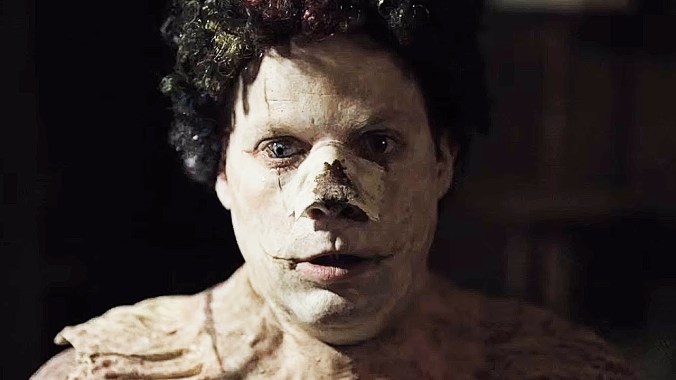
The 2014 film has a fairly straightforward premise: Main character Kent McCoy (Andy Powers) is a realtor as well as a lovable husband and dad, and he has booked a clown for his clown-loving son Jack’s (Christian Destefano) birthday party. Unfortunately, there is a mix-up at the clown-renting establishment, and the party clown can’t come. Kent (very fortuitously) stumbles across a clown suit in the property he’s been fixing up for sale, and he slaps that bitch on and entertains all the kids at his son’s party, Dadding like a boss. His wife Meg (Laura Allen) is so pleased with him that she even gives him a little clown lovin’ later that evening, which is frankly a sentence I thought I’d never type, but here we are.

Clown2

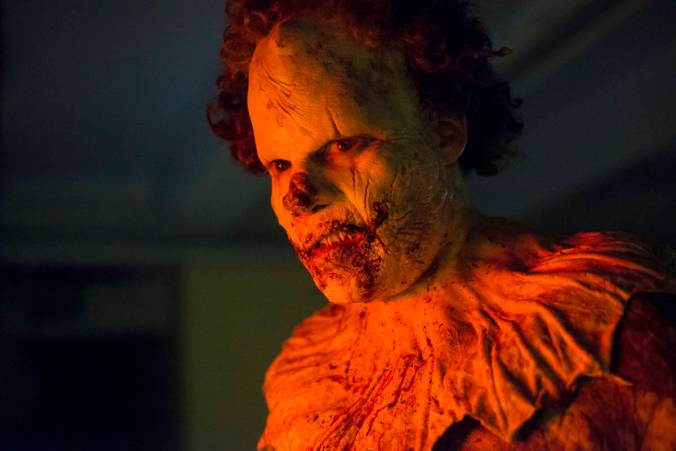
The problem arises on the following morning, as Kent slowly begins to discover that the clown costume refuses to come off. The rainbow wig has grown into actual hair, the clown white cannot be scrubbed away, and the bulbous red nose takes most of his actual nose with it when Meg yanks it off with one of her dental tools. Kent has also developed an unbelievable appetite, and his stomach makes disgusting gurgling noises as if he’s still hungry even after he’s eaten everything in the house (and left a giant mess in the kitchen for his poor wife to clean up, I might add. MEN, amirite?).

Clown3


Clown5

Kent’s condition begins to deteriorate rapidly, and when he eventually tracks down the brother of the previous (deceased) owner of the suit, a man named Herbert Karlsson (Peter Stormare), he discovers that, obviously, the suit is not a costume at all, but the skin and hair of an ancient child-eating demon called a clöyne. Herbert has a scary hand-drawn book about the critter, as you would, and he informs Kent that the only way to get rid of the demon is to behead the person wearing the suit, which in this case would be Kent. Kent is shockingly not down with the beheading, and fights his way out of Herbert’s shop, but he soon begins to realize that the demon is quickly taking over and that he suddenly has an insatiable desire to eat children. Don’t we all? (No.)

In order to protect his family, he goes into hiding at one of his more down-market properties, but the hunger is beginning to gnaw away at him (heh), and at some stage he decides he’s going to have to kill himself. As grim as that sounds, it’s actually pretty hilarious watching clown-Kent trying unsuccessfully to blow his brains out with a pistol and getting nothing but a gaudy spray of rainbow-colored blood on the wall for his efforts, and then rigging up a super-elaborate rotating-saw contraption to try to lop his own head off (which unfortunately only succeeds in breaking the saw blade, which flies off and kills a nearby child, which Kent then eats).

Oh, and I forgot to mention that apparently, the clown curse can be broken if Kent eats five kids. Meg figures this out by discovering that Herbert had once worn the suit and turned into the demon himself, but had reverted back to normal after his cancer-doctor brother fed him five terminally ill kiddoes. The Make-A-Wish Foundation, this ain’t.

Clown1

At the climax of the film, clown-Kent goes on a bloody child-munching spree in a Chuck E. Cheese’s, of all places, and his devoted wife Meg, who still believes that Kent can be saved, actually kidnaps a young girl she sort of knows with the intent of her being the fifth sacrifice that will bring Kent back to normal. But Kent has other plans, and wants his own son Jack to be the fifth kid, which of course Meg is not on board with, leading to the final showdown between mallet-wielding Meg and kiddie-snacking clown-Kent.

Clown4

As a movie, Clown is obviously not a grand artistic statement or anything, and yeah, killer clowns are kinda played, but I actually thought this flick was a lot of fun. The premise is amusingly ridiculous, the clown transformation is well-handled and delightfully squicky, and you have to give props to a movie with the stones to kill and mutilate children with such wicked glee. As body horror goes, I’ve seen way grosser, but the gore here is nicely done and should satisfy fans of blood and guts.

The humor is also rather subdued, which I liked a lot, as I think it made the movie funnier than it would have been if they’d gone over the top with it (I swear, I laughed for five minutes at that rainbow blood when Kent shot himself in the head, and also at that framed black and white photo of the kid that had been picking on Jack…as the God of Hellfire pointed out, “Look, it’s his bully portrait”). Besides all that, the main character of Kent remained believable and even sympathetic up until the end. Like I said, not a deep metaphorical horror story or anything, just a big, dumb, fun flick to watch with your friends while cramming popcorn, peanuts, cotton candy, and delicious children into your mouth-hole.

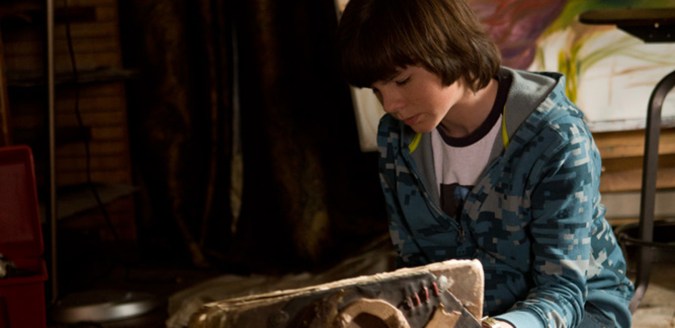
Next up, a movie from Blumhouse that somehow kinda flew under everyone’s radar, even though its pedigree would have suggested a much wider release and much more hoopla. Mercy, which was dumped straight to VOD in 2014, is based on Stephen King’s short story “Gramma” (from 1985’s Skeleton Crew collection) and stars Chandler “Carl Grimes” Riggs from The Walking Dead.

Mercy1

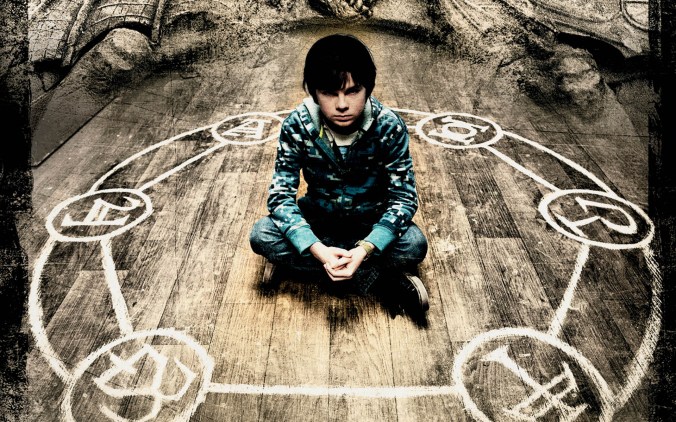
Obviously, the movie takes some liberties with the source material, as “Gramma” was a fairly compact, simple tale about an eleven-year-old boy who gets left alone to look after his terrifying grandmother, and after she “dies,” discovers that she might be housing a demon. While Mercy keeps this general outline for the final portion of the film, a whole bunch of characters and plot intricacies are added in to flesh out the story, and not all of these additions were completely necessary, in my opinion.

One thing I did like about Mercy was that the titular grandmother (Shirley Knight) was actually portrayed at first as a sympathetic character, if somewhat witchy, and that her grandson George (Chandler Riggs) was shown as being best friends with her. It is only as the movie progresses, as Mercy gets older and has to go to a home after having a stroke, that Mercy’s demon possession becomes more pronounced and she turns into a monster.

Mercy

In brief, George, his mom Rebecca (Frances O’Connor) and older brother Buddy (Joel Courtney) have to move back to Gramma’s house in the country to take care of her after she becomes bedridden and the nursing home can’t handle her bizarre outbursts anymore. George is excited to see his beloved Gramma, since he hasn’t seen her in a year, but he is disappointed to find out that his Gramma is a lot different than he remembered.

Over the course of the film, we discover that Gramma Mercy actually sold her soul to a demon named Hastur when she was young, because she was infertile and desperately wanted children. Indeed, she soon got the children she wanted, but the cost was that her goodness slowly began to erode away, and it got to the point where her husband couldn’t take it anymore and committed suicide (by splitting his own face in half with an ax, no less, which is quite a feat if you’ve never tried it).

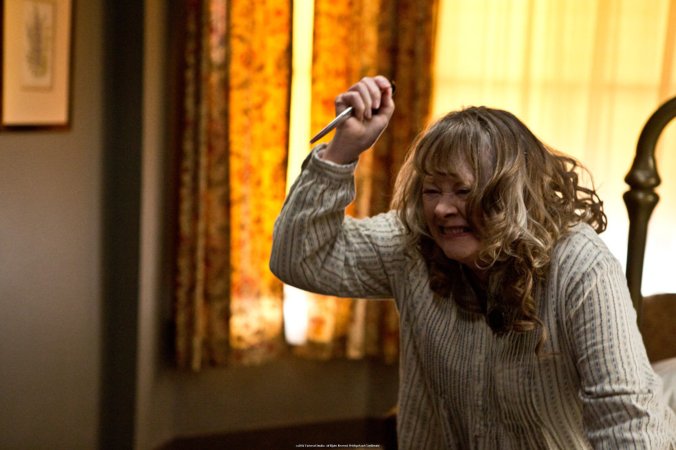
George (and his mom, to a lesser extent) wants to believe that the good Gramma is still in there somewhere, but the local priest and George’s drunken uncle Lanning (Mark Duplass of the previously-discussed Creep, in easily the film’s most entertaining performance) believe that the evil has completely taken over, and maybe even that Mercy was always evil. After George is convinced to water down Gramma’s meds with saline solution, thinking the meds are what is making her batshit, she starts acting up in all kinds of crazy ways, doing creepy Satanic chants and killing Lanning (and a few others) stone dead.

The final act of the film follows Stephen King’s story pretty closely, as George’s brother Buddy gets wounded and Mom has to take him to the hospital, leaving George alone with his now completely possessed Gramma, who dies on his watch before various other demonic shenanigans ensue. Much like the original story, we’re not entirely sure whether the demon actually succeeds in getting passed on to George, or whether he ultimately defeats it, though it’s suggested that the latter scenario is the case.

Mercy

This movie…I admit I’m kind of ambivalent about it. It looked fantastic, and I love witch/demon stories, especially ones with a bit of a Lovecraftian flair like this one has. The general cinematography was gorgeous and evocative, the “weeping book” imagery was cool and a rad addition to the story, the performances were pretty strong throughout (except Chandler Riggs, who is not bad, but just Chandler Riggs-y, y’know, and hey, don’t hate, I love The Walking Dead). I just thought that the story could have been simplified and streamlined more, which I guess is a pretty weird thing to say about a movie that was only 78 minutes long, but in a way, the fact that it was so short meant that maybe they should have expanded more on a few ideas instead of just giving short shrift to all the extra concepts and unnecessary characters they had rattling around in there.

Like, for instance, as much as I love Dylan McDermott, who was his character exactly in relation to the main family, and why did he need to be in this, and what was the point of the flirtation between him and George’s mom that never came to anything? What was with his character’s apparently Satan-worshipping wife with the scary demonic paintings? What was with the creepy black dog/hellhound deal? Why the crazy aunt escaping from the asylum only to get killed instantly? And was she the one who sent the verbena? And why was it necessary that George have a ghost/imaginary friend? (I mean, I guess I understand that the girl was supposed to be his Gramma’s pure soul before she got possessed or whatever, it just seemed a strange way to get that across).

See what I’m saying? A lot goes on in this thing, and because there are so many characters and plot threads in what is essentially a pretty straightforward demon-possession story, a lot of the tendrils are just kinda left hanging and underdeveloped. That’s not to say it’s a bad movie…it’s definitely not. Hell, it’s not even a bad Stephen King adaptation, and Lord knows there are shit-tons of those. It’s enjoyable enough, and creepy and entertaining as this type of thing goes, but I didn’t feel like it was anything particularly special. Just fair-to-middlin’, as my own (non-evil) Gramma used to say.

That’s all for this installment, so until next time, keep it creepy, my friends. Goddess out.
Horror Double Feature: Beyond the Gates and Dead Silence

It’s another lazy weekend, which means it’s time once again for another horror two-hitter, courtesy of Netflix. Today’s pairing was really nothing to write home about, but enjoyable enough to write a blog post about, so let’s get right to it.

First up, 2016’s Beyond the Gates, directed by Jackson Stewart, and winner of the midnight-movie audience award at the Los Angeles Film Festival. The film, like many indie horrors of the past few years, is a throwback to a golden era of horror cinema (the 1980s; not that I’m complaining about that), and overall I found it a fairly charming effort, though I admit the pacing and tone seemed a shade uneven. Though the movie wasn’t really scary, had a somewhat slow first half, and was obviously a bit hamstrung by its nothing budget, I gotta say I’m looking forward to what this director comes up with in the future, as this was a pretty solid and generally entertaining horror-comedy.

The movie deals with two estranged and polar opposite brothers, uptight and nerdy recovering alcoholic Gordon (Graham Skipper) and shiftless bum John (Chase Williamson), who reunite in their home town in order to pack up their Luddite dad’s old-school video rental store. Seems that dear old dad, also an alkie, has been prone to binges and disappearances for some time, but since his most recent vanishing act has lasted more than seven months, the guys are assuming that this time, their father is never coming back.

Gordon decides to stay at his parents’ empty house while he’s in town, and he’s soon joined by his sweet and supportive girlfriend Margot (Brea Grant), who we later learn was the reason for Gordon giving up drinking, since he hurt her once when he was drunk. Before too long, John also asks to stay there, since apparently the couch he had been surfing on ejected him back into the streets for failure to cough up any rent money.

As the brothers are sorting through the vast and shadowy store, they discover in the locked back office the last thing their father had been watching before he vanished: one of those interactive VHS games that were fairly popular back in the 80s and early 90s, called, naturally, “Beyond the Gates.” The guys watch part of the tape (which features the wonderful Barbara Crampton of Re-Animator fame as the “host” of the game; she is easily the best part of the movie, peering creepily out of the TV screen with her kohl-rimmed eyes), and eventually come to believe that the game had something to do with their father’s disappearance, and finally they figure out that they’re going to have to play the game to the end to find out what happened to him and help him escape from whatever hell-dimension he got sucked into.

This movie did have quite a lot to recommend it, especially if you love cheapie 80s horror flicks and the more recent movies that pay homage to them. Barbara Crampton, as I said, was fantastic; some of the funniest/creepiest parts of the movie involved Gordon, John, and Margot hemming and hawing about the game, and Barbara Crampton (ostensibly on an old black and white VHS tape) just staring intently at them, waiting for them to make their next move. I also really liked the whole retro feel of the opening credits and the movie as a whole, including the Goblin-like opening theme and the predominance of neon pinks and blues. The look of the video store also brought back some pleasant memories, and the tone of the film was overall very similar to a movie of this type from the era. I also loved the design of the board game itself, which had a wonderful homemade gothic aesthetic going on.

I also liked that the movie took its time establishing the relationships between the characters, though I’m not sure it was entirely successful on that score, as I never felt fully engaged with them. And honestly, I felt like the plot could have been sped up a tad, as the first half of the movie seemed to drag somewhat before we got to the actual gameplay. And once the game actually started, there seemed to be a lot of scenes of the characters arguing about whether they should continue playing or not, which got a little repetitive.

I should also say that I felt like the balance between the horror and the comedy was a bit strange; much of the humor was fairly low-key, which is fine, but then there were a couple scenes of over-the-top gore that were clearly supposed to be funny (and they were, for the most part), and a brief comic turn by Jesse Merlin as a ghoulish antique shop proprietor, but the funny stuff didn’t really seem to fit in with the mostly serious relationship drama going on between the brothers and between Gordon and his girlfriend. So as I said, the tone of it was a bit off.

It was also painfully clear that budgetary constraints forced the filmmakers into a box; the journey “beyond the gates” and into the evil dimension was simply facilitated by an ordinary iron gate sitting in the house’s basement, and the evil dimension was just the basement shot with creepier lighting and a smoke machine, but I’m not gonna fault the movie too much for that, because making an indie movie and having to squeeze every penny is hard enough without assholes like me dinging you for having more ambition than cash. And it could be that they shot it like that on purpose, in order to give it that legit 1980s low-budget schlock touch.

So all in all, a decent 80s throwback that should please fans of the same, though it could have done with a bit more cohesion and a slightly quicker pace.

Next up, a film I only just got around to seeing, even though it came out way the hell back in 2007. James Wan and Leigh Wannell, obviously best known at the time for the Saw series, made Dead Silence three years after their breakout debut, and though it’s a completely different kind of film than any in the Saw franchise, I came away feeling sort of meh about the whole thing. I should note here that while I can see why James Wan became such a horror behemoth, most of his movies (The Conjuring, Insidious, even Saw) never struck me as anything particularly special. I realize that’s just me; for some reason his movies, while I enjoy them for the most part, don’t resonate with me, and I tend to forget them shortly after seeing them. I can’t really articulate why that is, but maybe in the course of writing out my thoughts on Dead Silence, I can clarify what I mean.

DeadSilence

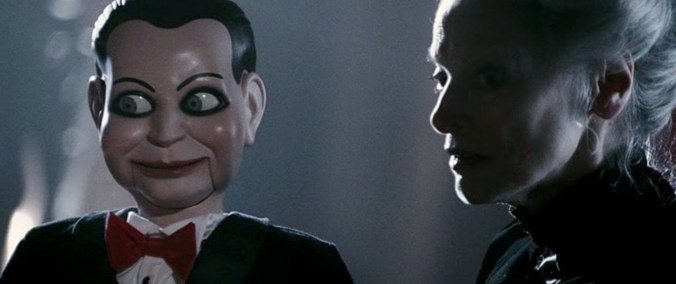
The premise, for the three of you who haven’t seen it, is that main character Jamie (Ryan Kwanten) and his wife Lisa (Laura Regan) receive an unmarked package that contains a creepy ventriloquist’s dummy named Billy. Even though Jamie (and maybe Lisa too, this wasn’t clear) come from a small town where there’s a scary urban legend about a ghostly ventriloquist and a perception that ventriloquist’s dummies are portents of death, Jamie doesn’t immediately chuck the thing out of the nearest window or set it on fire, but instead leaves it in the apartment with his wife while he goes to grab some takeout. Predictably, the doll murders Lisa, ripping out her tongue and leaving her with her mouth wrenched open like a vent figure’s. This prompts Jamie to return to his hometown of Ravens Fair to try to figure out who sent the doll and why it killed his wife, and on the journey, he is pursued by the endlessly shaving and wisecracking Detective Jim Lipton (Donnie Wahlberg), who is convinced that Jamie is responsible for the murder.

First of all, I have to say that this movie looks terrific. Very gothic and atmospheric, which is always a plus in my book. I also dug the whole ventriloquist aesthetic, with the old-school theater and all the trappings of 1940s showbiz, and I gotta admit that the dolls were effectively eerie, as vent figures in movies tend to be. Ghost ventriloquist Mary Shaw (Judith Roberts) was also cool-looking and easily the scariest part of a not-very-scary movie; overall, the visuals and the sound design of Dead Silence were admittedly pretty rad.

Where the movie failed, I felt, was in the plotting and the characterization. The characters were not engaging or charismatic, made dumb decisions (by gum, I think I’ll drive to a cemetery in the middle of the night with a haunted doll sitting right beside me in the passenger seat!), and spouted lame, cliched dialogue. The acting performances were not all that great, with Donnie Wahlberg’s detective seeming like a weird parody of a character and the guy who played Jamie just kind of bland.

The way the story moved along also felt too pat and obvious: for example, Jamie is all, I’m gonna go ask my estranged dad what’s going on with all this murderous doll ghost business, and then he goes to his dad’s house, and his dad’s like, I don’t want to tell you, and Jamie’s like, no dude, tell me, and dad’s like, okay, then, we all killed Mary Shaw back in the day and now she’s killing all our descendants in revenge, sorry I never laid all that exposition on you before, my bad. You get my drift? I just felt like everything was over-explained, like the movie didn’t trust the audience to figure anything out and had to make double-dog sure we were all on the same page, even though viewers were not only on the same page, but had finished the book a long time before the movie did.

DeadSilence3

The “twist” at the end of the movie was sort of neat, but not entirely unexpected. I don’t know, the whole gestalt of the movie reminded me of some of the lamer, PG-13 horror flicks of the era, like Darkness Falls, except a bit gorier; it seemed as though it wasn’t really made for adults. I watched the whole thing through and didn’t get too annoyed, but overall I thought it was just kind of there. But then again, I feel that way about a lot of James Wan’s movies. I think I would have liked this flick a lot more if I had watched it with the volume down and played some music to it instead, because it would make a gorgeous long-form goth-rock video, but as a movie…eh, not so much.

That’s all for now, and until next time, steer clear of retro VHS games and tongue-stealing vent puppets, and keep it creepy, my friends. Goddess out.
 

Horror Double Feature: Honeymoon and Uncle John

Relationships…they can be rough. Whether your significant other is slowly changing into someone else, or your budding office romance is in danger of being sabotaged by a small-town murder committed by an affable family member, there’s always something that can (and will) go wrong. And if there is a theme to today’s Netflix Double Feature, then I can’t really think of a better one than “you can never really know the people you love.” So let’s do this.

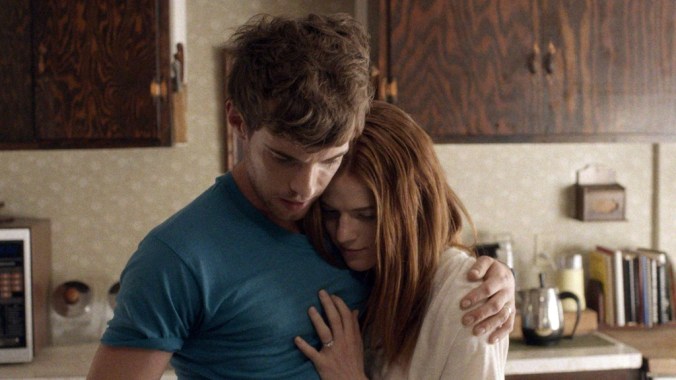
A hit at the 2014 South by Southwest Film Festival, director Leigh Janiak’s impressive debut Honeymoon is, I think, best enjoyed going into it cold, as I did, because I really had no idea what was going on until near the end, which made the film a reliably harrowing experience (I‘m gonna spoil it here, though, so caveat emptor). It’s not quite up there with some other recent indies I’ve reviewed (They Look Like People, Starry Eyes, The Invitation), but it’s a solid slice of micro-budget horror/sci-fi that actually left a lingering impression on me for several days afterwards.

Starring two British actors playing hipster Brooklynites (Rose Leslie from Downton Abbey and Game of Thrones, and Harry Treadaway from Penny Dreadful and Cockneys vs. Zombies), Honeymoon draws great emotional power from the isolated setting and the all-in performances of its main characters. Essentially a two-hander (there are also two peripheral characters, but they’re only in a couple of scenes), the movie wrings ample tension from the idea that the person you know and love the most is not the person that you thought, mining that same vein of paranoia that infuses classic horror films like Rosemary‘s Baby, and most relevantly, Invasion of the Body Snatchers.

Honeymoon1

Bea and Paul are sickeningly adorable newlyweds, and we meet them first through the precious conceit of their wedding video, where they talk about their first date and lament that some people weren’t happy that they had cinnamon buns instead of cake at their wedding. The lovebirds are next shown arriving at a remote cabin in the woods for their honeymoon, said cabin having belonged to Bea’s family for many years, though Bea has apparently not been there since she was a teenager. Interestingly, I didn’t notice any mention being made of where her parents were now, though I’ll save my speculations about that for later.

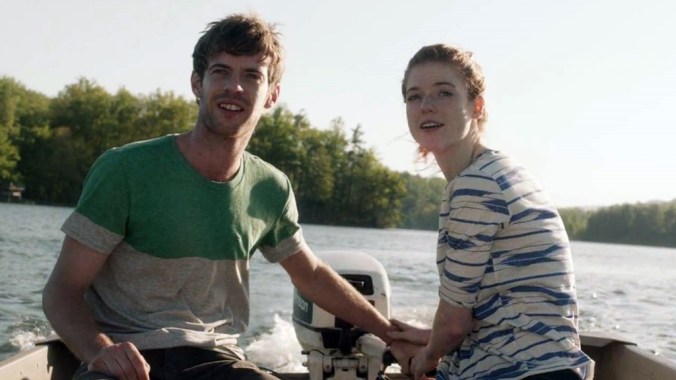
Bea and Paul waste no time getting into honeymoon mode, having sex, cooking pancakes, fishing out on the lake, and generally being their darling, ridiculously in-love selves. This buildup of their relationship is important, because it makes the horrible things that happen later all that much more gut-wrenching.

Honeymoon2

The first little thing that seems off occurs when Bea and Paul take a break from their constant shagging to walk down to a local restaurant. It looks deserted, but when they go inside, they run into Will (Ben Huber), who initially seems super aggro until he recognizes Bea as the girl he used to hang out with when they were both thirteen and their families both summered on the lake. They have an awkward catch-up, but something seems not-right about Will, and Paul can’t help but notice the weird way the guy is checking out his wife. Weirder still is the subsequent appearance of Will’s wife Annie (Hanna Brown), who looks ill and frightened, and tells Bea and Paul they need to get out of there. Bea also makes note of how Will grips Annie’s arm as though he wants to hurt her.

Later, in bed, Bea explains to Paul who Will is, and she seems unable to stop thinking about how strange the whole situation was. She makes a few playfully disparaging comments about Paul not being as “alpha” as Will, but then she seems to get down to the bottom of what troubled her about the exchange when she says, “You’re not like him. We’re not like them.” Foreshadowing, yo.

Only a day or two into the wedded bliss, Paul wakes up in the middle of the night to find that Bea is gone. After searching the house, he runs out into the woods yelling for her, clearly terrified that something dreadful has happened. He eventually finds her, standing out in the woods, naked and disoriented. He brings her back to the house and she insists that she’s fine, that she must have just been sleepwalking. Paul seems a tad skeptical of this explanation, but is mostly just relieved that he found Bea in one piece.

From that point forward, though, Paul notices that Bea is starting to change. She becomes a little distant and forgetful. When making breakfast, she forgets to batter the French toast and just leaves nude bread to burn on the grill, and she forgets to grind the beans in the coffee maker. She starts forgetting things about their wedding, which only occurred four days before. She starts writing things about her life, like her name, her address, and her birthday, in a notebook that she tries to hide from Paul. She starts using strange phrases (“I’m going to take a sleep,” for example, or referring to a suitcase as a “clothes box”). She starts losing interest in sex, even though she was previously all about it. Paul observes her standing in front of a mirror “practicing” things she’s going to say to him later. He even notices bizarre sores on her inner thighs that Bea insists are just mosquito bites. He tries to talk to her, but she just attributes it to being tired, of the stress from the wedding catching up with her.

Honeymoon3

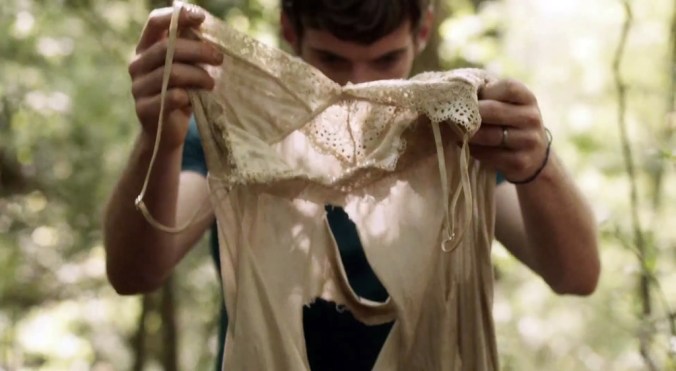
Paul isn’t buying it, and thinks it has something to do with that night out in the woods. To this end, he goes out in the daylight to the spot where he found her, and discovers not only her torn “special honeymoon nightgown” out there covered with some kind of suspicious slime, but also what appears to be a large footprint. From this, he deduces that Bea and Will had some sort of tryst out in the woods, and that she’s been acting so odd because she feels guilty and is trying to keep it from him.

Paul confronts her about the nightgown, though he tells her that even if she did sleep with Will that night, that he still loves her and that he just wants to know, because otherwise he has no idea what is going on with her. Bea gets angry and defensive, and accuses him of ruining everything. Paul, terrified and confused about what is happening to this woman that he previously adored, decides to get some answers from Will.

But when he goes to the restaurant, he doesn’t find Will, though he does find Annie, who looks even more fucked up than before. She tells him Will is “hiding,” and that Paul should leave because, “We’ll hurt you.” Paul notices that Annie has the same sores on her inner thighs as Bea does, but of course Annie won’t tell him what’s going on either. After she takes off, Paul finds Will’s bloody hat floating in the lake near the dock. He also finds sheets of paper with writing on it, showing that Annie has also taken to writing down simple details about her identity over and over, just like Bea has. Hmmmmm.

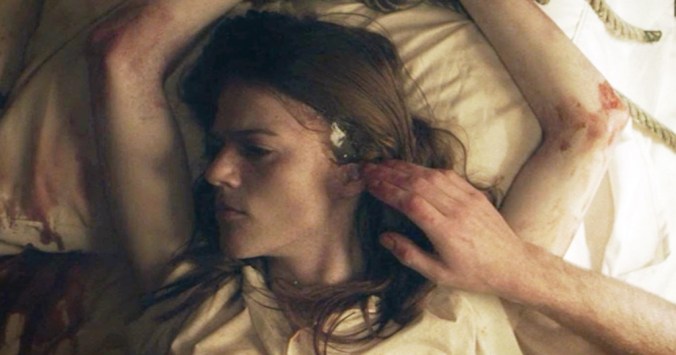
From this point forward, things take a more body-horror type turn, as various fluids such as blood, slime, and weird webbing begin coming out of Bea’s vagina and other orifices. Paul is beginning to twig to the fact that Bea is not really Bea anymore, but she insists she still is. When he grills her on various aspects of their life and her identity, she has a hard time remembering them correctly, though she seems frightened by this and begs him to help her. Honestly, I thought this was really the best part of the movie, because Harry Treadaway did a fantastic job conveying how it would feel to see a woman you loved clearly changing into someone else while still looking like the person you married, and Rose Leslie was equally great at getting across the terror of knowing that you were changing but being unable to convince your loved one that deep down you were still you in there somewhere.

Honeymoon4

So, at last, after Paul reaches into his wife’s vag and pulls out an alarming item that looks something like a giant animate root, the explanation is forthcoming. That night in the woods, Bea finally admits, there was a bright light that came to her and put something inside her. She knows what it is and she knows what she’s supposed to do, and she knows that “they” are going to be taking her, and there’s nothing either of them can do about it. She says she just wanted to have these last few days with Paul be perfect before she got taken away.

So yeah…aliens. I mean, they didn’t come out and say it was aliens, but it was obviously something like that, some type of body-snatching extraterrestrial beings that didn’t want the men, but only the women, because of course Annie got taken over and impregnated too. At the end, Bea decides that she doesn’t want the aliens to kill Paul, so she decides to “hide” him from them (just like Annie did to Will). Unfortunately, her idea of hiding him entails knocking him out, then tying him to an anchor and dropping him to the bottom of the lake, since she has apparently forgotten that humans can’t breathe underwater. There was actually a nice piece of foreshadowing of this sequence earlier in the film, when Bea and Paul are out fishing, and Bea mentions while fastening a worm to a hook that worms can breathe underwater for five minutes, implying that the aliens who have overtaken her see humans as no different than earthworms.

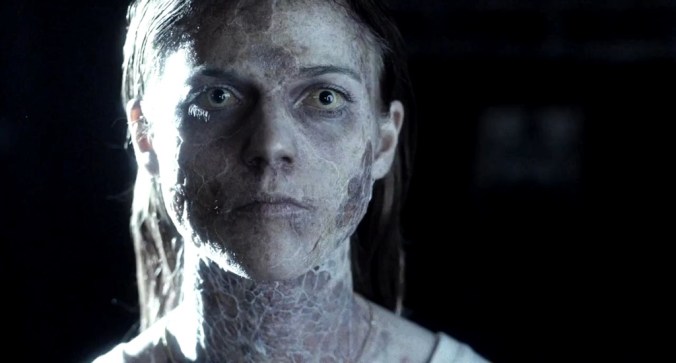
In the final scene, we see Bea looking all gross, with yellow eyes and weird webby skin, and then a bright light comes and she goes to meet the aliens.

Honeymoon5

I really enjoyed this movie a lot, though I will admit that it’s always something of a letdown when the explanation is “aliens.” I realize that’s just me, though; for some reason I’m generally not a fan of movies where aliens are the baddies, with only a few obvious exceptions. And to Honeymoon’s credit, it must be said that it didn’t really smack you in the face with aliens, as it didn’t really show them as anything other than bright lights and a few vague silhouettes, and the word itself was never mentioned.

That said, the suspense in this was terrific, and I really was intrigued by the story, trying to figure out what the hell was going on with Bea. Additionally, both Harry Treadaway and Rose Leslie really sold the terror and confusion that would arise from such a scenario, and the movie works just as well as a straight horror/sci-fi flick as it does a sly metaphor about relationship breakdown, about that horrible feeling when you slowly start to realize that you have married a stranger.

I have to say that I think I would have liked a little more explanation about the nature of the body-snatching, though. Why did the aliens target the women in this particular remote location, or was this happening all over the world and we were just seeing it affect this one area? Did Bea know about the body-snatchers from before, when she used to spend summers there as a kid? Was she, in fact, an alien pretending to be a human all along? (I admit I don’t really buy this, since it’s suggested that she and Paul had been together for a long time before they married, but it’s still a possibility, I guess.) Where were her parents all this time, and were they also taken over by the aliens at some earlier date? I don’t know if the movie would have benefited from more explanation or if it was better left ambiguous the way it was, but I have to admit that I was left kinda curious. Which I suppose is the mark of a good movie, that I wanted to know more about it. So there’s that.

I would definitely recommend this for fans of body-snatching movies, horror/sci-fi crossovers, and general body horror (though it’s not nearly as disgusting as Starry Eyes was, I have to say), as well as fans of intimate relationship dramas gone monstrously wrong.

Speaking of relationship dramas (sort of), the second film in the line-up is actually not a horror film per se, but more like a Coen-Brothers-style crime thriller interwoven with a sweet and understated romantic comedy/drama. The end result is not quite as strange as that sounds, and even though the juxtaposition of the two genres is an audacious one, particularly for a first-time director, it somehow really works, producing a gripping film whose seemingly disparate plot lines nicely complement one another. And if you’re looking for some nail-biting suspense on top of that, this flick’s got that in spades.

UncleJohn1

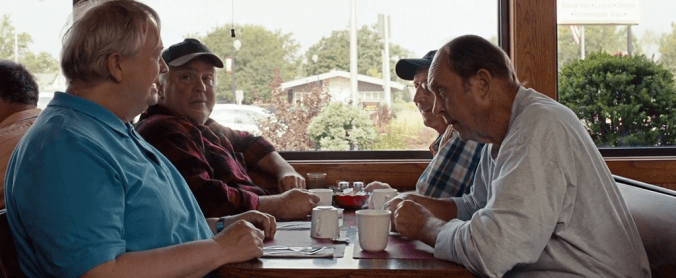
2015’s Uncle John, directed by Steven Piet, starts out by introducing us to the title character, a stoic but friendly Wisconsin carpenter (played by veteran actor John Ashton) who happens to be right in the middle of murdering a dude and meticulously covering up the crime. Right away, the movie sucks you in, especially since nothing is really explained right off the bat, and additionally since after disposing of the body in a bonfire in broad daylight, Uncle John is seen bein’ a neighborly and well-respected member of the small farming community, sitting with his oldster buddies at the local cafe. So the viewer is like, what was that murder all about? Is this guy a serial killer or what?

UncleJohn5

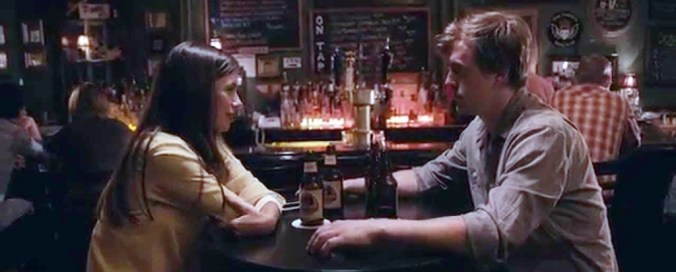
Before we really get any definitive answers, though, the movie seemingly barrels off in another direction. Now we’re in a hip Chicago advertising firm filled with scruffy millennials. Graphic designer Ben (Alex Moffat) is being introduced to his new manager, a lovely young woman named Kate (Jenna Lyng), who he is instantly attracted to. They have some sweet and genuine banter, and there are hints that some romance may be developing between these two appealing characters in the very near future.

UncleJohn3

UncleJohn4

Then we’re back to the murder in Lodi, Wisconsin, where we learn that the man Uncle John murdered was named Dutch and that he wasn’t a particularly popular person in town. Evidently he had fucked a bunch of people over, but had just recently had a vision in which he had seen hell, and had subsequently given his life over to Jesus. He had spent the previous few weeks going to all the townsfolk he had wronged and trying to make amends, though obviously the wrong he did Uncle John was too big for forgiveness. No one seems terribly put out by Dutch’s disappearance, and the police are operating on the assumption that he just got drunk and drowned in the lake, but Dutch’s shady brother Danny (Ronnie Gene Blevins) has a hunch that Dutch was murdered, and is bound and determined to find out whodunnit.

Meanwhile, back in Chicago, Ben and Kate are having some will-they-won’t-they type interactions, and even though it sounds dismissive when I say it like that, these two characters really are adorable and funny and a pleasure to watch. Kate has just left a long relationship with a co-worker and has decided she won’t be dating any more co-workers in the future (sad trombone), but Ben decides to be her friend anyway, hoping that she’ll eventually see the light. Somewhere around this stage, we finally figure out the relationship between the two parallel plots: Uncle John is Ben’s uncle, and John raised him after Ben’s mother was killed in an “accident” and after he was abandoned by his father. Ben has nothing but praise for Uncle John, who he clearly loves and admires a great deal.

UncleJohn2

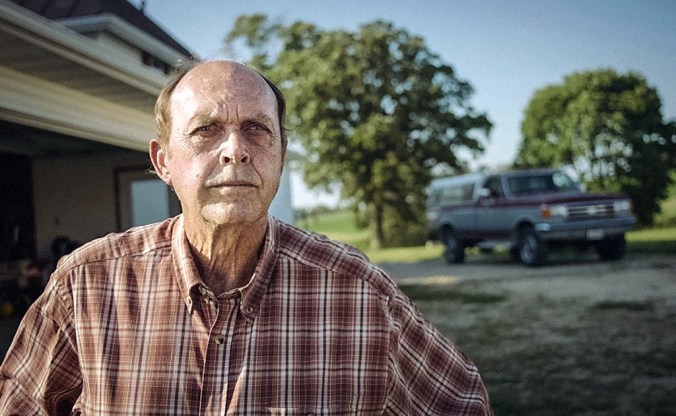
Back in Lodi, the search for Dutch continues, and Danny is growing ever more suspicious, particularly of John, though John keeps his Midwestern affability intact. I gotta say, I’ve seen John Ashton in a lot of movies, but I think this is my favorite role of his I’ve seen; he’s just so good as the quiet, friendly, small-town guy who decides to take care of business and is the last person anyone would suspect of doing such a thing. In fact, that’s kinda the great thing about this movie, is that despite Uncle John being a murderer, you can’t help but love the guy and defend his actions, especially when we learn that John killed Dutch because Dutch had been having an affair with his sister (Ben’s mother) and had treated her horribly, and that him leaving her prompted her to commit suicide.

In Chicago, Ben and Kate are working some weekend overtime together at the office when they decide they want to break for coffee and doughnuts. They initially plan to go somewhere nearby, but Ben mentions that he’s never had any doughnuts as good as the ones in his hometown, so on a whim, Kate suggests they finish up their work and then take the two-and-a-half-hour drive out to Lodi to visit the place where Ben grew up, and possibly spend the rest of the weekend visiting with Uncle John. And hence, the two plots finally converge.

When Ben and Kate arrive in Lodi, John is surprised to see them, especially since Danny has been sniffing around and making veiled threats, but everyone puts on friendly faces. Danny even stays over at John’s house while Ben and Kate proceed to grill some steaks, though after trying to needle John about his sister’s death, John takes him aside and has some words with him, after which Danny storms off. Ben and Kate, clueless as to what’s been going on, wonder what got up his butt, but John covers for him, saying he just had to go to work.

As the evening goes on, the tension starts to mount. You know that Danny is going to come back and do something bad, and because you’ve spent so much time getting to know Ben, Kate, and John, you really, really don’t want anything bad to happen to them. You especially don’t want Ben and Kate to get caught in the crossfire of all this intrigue, especially since they have no idea what has been going on in Lodi, and no idea that John is actually a murderer.

So then two things start to happen. Ben and Kate, who are still playing the “just friends” game, are sleeping in different rooms, but both of them come downstairs around the same time, ostensibly to see if the other one is up. So yeah, they end up sharing a sweet kiss, and we’re like YAY because honestly, these two are cute and we’ve been rooting for them.

But then, outside, Danny has indeed returned. He has a can of gasoline, and a gun in his waistband. What he doesn’t know, though, is that Uncle John has already assumed that Danny would be coming back, and is hiding in the barn with a rifle.

There then comes an absolutely stomach-churning sequence where Danny is looking at the house, fiddling with his gun, and we can clearly see Ben and Kate through the windows as they finally act on their attraction after all this time. And maybe it’s dumb, but I was like, oh man, please don’t let this end the way it looks like it’s gonna, I really liked those two, and they didn’t even do anything. It looks bad for them, and I admit I didn’t really want to keep watching.

But luckily — spoiler alert — John emerges from the barn and whacks Danny (quietly) upside the head with the rifle butt, then slowly and silently squeezes the life out of him, thereby saving his nephew and his nephew’s new love without them even knowing they were ever in danger. It’s actually a really touching scene, as it shows how the salt-of-the-earth small town old guy is willing to murder and go to jail to save his adopted son, even though by his facial expression, you can tell that John really didn’t want to have to do it.

Uncle John2

Ben and Kate head back to Chicago the next morning, neither of them the wiser, and as they have a discussion in the car about Kate’s “crazy” relatives and Ben’s “normal” Uncle John, John himself is shown burning Danny’s body in a bonfire in the quarry. A cop car pulls up behind him, and you’re like, uh oh, jig’s up, but really the cop is just there to tell John that now Danny is missing and he might want to watch out for himself, since Danny was going around town thinking everyone murdered his brother Dutch and that he might be dangerous. Irony! So John skates, but for how long?

This sounds like a film that shouldn’t really work, but it does, beautifully. The two plots, while completely different on their surfaces, actually complement and comment on one another in myriad ways. Amid the film’s themes are how little you actually know about the “dark sides” of those you love, and how parents, biological or otherwise, will sacrifice everything to keep their children from harm, even if that means covering up a murder or two.

As I said, not really a horror movie, but a fantastic suspense thriller with some absolutely stellar performances and a third act that had me perched on the edge of my chair. Recommended to Coen Brothers fans as well as more general lovers of crime movies and odd mashups.

That’s all for this installment. Until next time, keep it creepy, my friends. Goddess out.
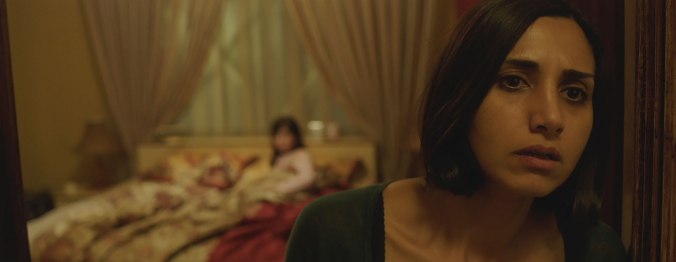


Horror Double Feature: Creep and They Look Like People

Well, it’s another rainy summer Saturday, I am sick as hell, and in order to alleviate the symptoms of my unknown malady, I decided to cheer myself up with a couple horror movies on Netflix (hey, you cheer yourself up in your own way; horror just makes me feel better, okay?).

It so happened that I had something of a “strange bromance” theme with today’s picks, which is odd because even though I generally choose movies I’ve heard positive things about through the grapevine, I mostly pick the movies at random, and I deliberately try not to read too much about the movies before I watch them, because I like to come to them with as few preconceptions as possible. So today’s pairing was something of a happy accident, and I will say that even though the two films are starkly different in their methods of attack, both had some surprisingly insightful things to say about friendship, trust, and mental illness, aside from both being scary as fuck. They were also, I should note, both directorial debuts of their respective helmers, something I found quite extraordinary as each film unfolded, so confident did both the movies come across. As you can probably tell, I would highly recommend both of them, with absolutely no caveats or reservations whatsoever. Onward.

First up, 2014’s Creep, co-written by and starring Patrick Brice (who also directed) and Mark Duplass. The film utilizes the found-footage platform and is a partially improvised piece, but it’s quite unlike any other found footage movie I’ve seen, and its oddity and focus on the interplay between the only two characters gives it a palpable tension throughout.

Creep3

Aaron (Patrick Brice) is a videographer who answers a mysterious Craigslist ad offering him $1000 for a day’s work, the only requirement being that his discretion would be appreciated. When he arrives at the remote cabin, he meets the goofy and personal-space-invading Josef (Mark Duplass), who we immediately suspect is up to some sketchy business, though quite what that is, we’re not entirely sure.

Josef tells Aaron that he had cancer a couple of years before that went into remission, but that recently the cancer returned in the form of a baseball-sized, inoperable tumor in his brain. He says that doctors have only given him a couple of months to live, and also that his wife Angela is pregnant with their first child. Josef says that, just like in the tearjerker Michael Keaton movie My Life, he wants to document a day in his life so that his unborn son will someday be able to watch it and know something about what his father was like.

Aaron is sympathetic, but still businesslike, and proceeds to document the weirdness that is Josef, just as he was paid to do. Right off the bat, Josef tests the boundaries of Aaron’s discomfort by stripping down and getting into the bathtub, saying that he wants to simulate giving his baby son “Buddy” a bath, just like his father did when he was little. Aaron is a little disturbed, especially when Josef pretends to drown himself in the tub and then brushes it off as his “weird sense of humor,” but he carries on, not only because he was hired to do so, but also, it’s implied, because he’s beginning to feel sorry for Josef, who is ostensibly dying and clearly needs a friend.

Creep4

As the day goes on, the oversharing, overly friendly, and overly optimistic Josef takes Aaron on a hike to find a healing spring in the woods that’s shaped like a heart, jumps out from behind trees to frighten Aaron and then comments approvingly on Aaron’s “murderous” expressions, and puts on a wolf mask and dances around, claiming the mask was his father’s and that it represented a friendly wolf character named Peachfuzz (which was the original title of the movie, by the way). The viewer is left unsettled and nervous by Josef’s goofball antics, which aren’t really threatening per se, but which are so strange that you just know something is up with the guy; the tension comes from not knowing exactly what his endgame is.

Creep1

Creep2

At the end of the day, Aaron has had just about enough of Josef and prepares to leave, but Josef convinces him to have one last drink so they can film the end of “Buddy’s” video. They have the drink, Josef confesses some decidedly un-kosher things about his wife, and then Aaron decides now is the time to get the fuck out of Dodge. Only, uh oh, where are his car keys? Thinking fast, Aaron invites Josef to have one more drink, which he spikes with Benadryl. After Josef falls asleep, Aaron begins poking around for his keys. During the search, Josef’s phone rings, and it’s Angela, who confirms Aaron’s suspicions that something is amiss by saying that she’s actually Josef’s sister, not his wife, that Josef has “some problems,” and that he (Aaron) would do well to just walk out of the house and never come back.

As Aaron tries to escape, it comes to pass that Josef has woken up, and is now wearing the wolf mask and blocking the door. The two men have a scuffle, during which the camera winks off, and in the next scene, we are shown footage of Josef walking in the woods near the cabin, carrying three garbage bags and then digging what appears to be a grave. For a moment, we presume that the movie has gone the direction we expected it would, but Creep has some twists up its sleeve.

As it turns out, Aaron got away from the house just fine. The footage of the “grave” we’re seeing was actually sent to him by Josef, presumably as a threat. From then on, the movie becomes more of a bizarrely hilarious/horrifying stalker tale, with Josef sending him strange videos and then sending him other videos apologizing for those, sending him weird gifts (like a silver locket with both their pictures in it, engraved with “J + A Forever”), and turning up at his apartment without Aaron’s knowledge. This part of the movie is actually even creepier than the first, if that’s possible, because even though we’re now sure that something is really not right with Josef, we still kinda feel sorry for him, as it really seems that he’s just lonely and emotionally unstable. Aaron too is drawn in by the man and can’t stop thinking about him, confessing to the camera that he’s been having strange nightmares about Josef, and that he still wants to believe that Josef is a good guy who just needs some help.

Creep5

It is in this spirit that he receives Josef’s final video, in which Josef tells Aaron that he simply can’t stop lying and that he has no friends, and he seems entirely aware that what he’s been doing is creepy and off-putting, but that he’s just desperate for some human connection. He asks Aaron to meet him one last time, in a wide open public place, so that he can confess everything to Aaron and have some closure before moving on with his life.

Aaron, perhaps naively, agrees, though he takes the precaution of filming the encounter surreptitiously and keeping his finger poised over 911 on his cell phone. However — spoiler alert — neither of these precautions help him one little bit. In the end, in fact, Aaron’s kindness and empathy with the unhinged Josef lead to a somewhat predictable but expertly executed ending, made all the more powerful by the detachment of the act and the disturbing reveal of the coda.

Gotta say, I really loved this one; the back-and-forth between the two characters was entertaining, genuine, and organic, and the movie deftly balanced comedy with horror to a spectacular degree, where one was greatly enhanced by the other. Josef’s strange personality was compelling and produced tons of tension throughout the whole movie, as you weren’t really sure whether the guy was just a socially awkward eccentric or a full blown nutjob. Aaron was also an immensely relatable character, and it was easy to place myself in his shoes as the situation he found himself in grew ever more bizarre. Definitely an original take on the found-footage genre, and a movie that leaves a lasting impression.

Next up, another tale of two bros, but one with a much more uplifting and heartfelt conclusion. 2015’s They Look Like People, written and directed by Perry Blackshear, is psychological horror at its very finest, mining the depths of the human mind to stunning effect, crafting a film that is simultaneously terrifying and deeply moving.

They-Look-Like-People-2

In the film, Wyatt (MacLeod Andrews) and Christian (Evan Dumouchel) are old school buddies who reconnect in New York City after having been separated for many years. Both were bullied geeks at school, with the implication being that they became such close friends as kids because they were all one another had. In the ensuing years, Christian, once a 98-pound-weakling, has tried to reinvent himself by bulking up at the gym and trying to “dominate” at his hip media-type job, helped out by listening to daily affirmations on his headphones, read to him by his ex-fiancee. He’s also trying to put the moves on his boss Mara, played with great spunk and sensitivity by Margaret Ying Drake. Despite his insistence that this is the “new,” more confidant Christian, however, his insecurities are still painfully evident.

They-Look-Like-People-4

Wyatt, on the other hand, has taken a different path, working manual labor. He has also recently broken up with a fiancee, but his biggest problems far outweigh that; it seems, in fact, that Wyatt has been receiving calls on his broken cell phone from someone who is telling him that the people around him are being infected and taken over by demons, and that he must be prepared for battle because he is one of the chosen, the “blessed,” who can see the demons and help rid the world of them.

It is in the character of Wyatt that the movie really shines, and in fact this is easily one of the best and most sensitive portrayals of mental illness I think I have ever seen on film. Wyatt, despite his obvious schizophrenia and the possible danger he may pose to others, is always sympathetic and is never portrayed as a crazy person, but rather as someone who is most of the time able to fake being normal for the benefit of those around him, who is aware that something is wrong with him but unable to tell what is real and what isn’t, and at the same time is greatly disturbed and frustrated by this inability.

They-Look-Like-People-1

The most frightening scenes in the film come from Wyatt’s warped perceptions of friends and strangers alike, as he seeks to discover who has been taken over by the demons and who hasn’t. Though the movie doesn’t have many traditional “jump scares,” most of the scenes with Wyatt are just straight-up skin-crawling, because you’re never sure what his twisted brain is going to show him, and the fact that you like him and feel for him so much as a character gives that added little flourish of dread. As his mental state deteriorates to the point where he is building up an arsenal of axes and sulfuric acid to deal with the upcoming monster takeover, the audience finds itself frightened on his behalf as well as for the fates of his friends, all the while railing against the tragic injustice of his duplicitous mind.

They-Look-Like-People-5

Another fantastic thing about They Look Like People is the way the deep friendship between the two male leads is explored; here are two men who feel lost and inadequate in their own ways, but are able to bond with and love one another unreservedly. Their relationship, I would argue, is the only thing that keeps each of them hanging in there long after they normally would have given up, and the scenes of them goofing around in Christian’s apartment like they did when they were kids really gave the movie a lot of genuine heart, and made the final act all that much more affecting.

They-Look-Like-People-3

The conclusion of They Look Like People is just absolutely perfect, a thing of beauty, really. It’s tense and terrifying, sure, but also so touching that I legitimately teared up. In the end, it is Christian’s unwavering trust in Wyatt and his willingness to put his own life on the line for his friend that ultimately saves Wyatt from his madness. So while the film is undoubtedly scary and gave me the heebie-jeebies in much the same way a David Lynch movie does, it is also indescribably human in a way a lot of horror movies just aren’t. Its naturalism, deep sympathy for its characters, and overarching pall of impending doom make it easily one of the best recent horror films I’ve seen, no doubt about it. A great, chilling, and gripping watch from beginning to end. Definite winner.

Until next time, keep it creepy, my friends. Goddess out.
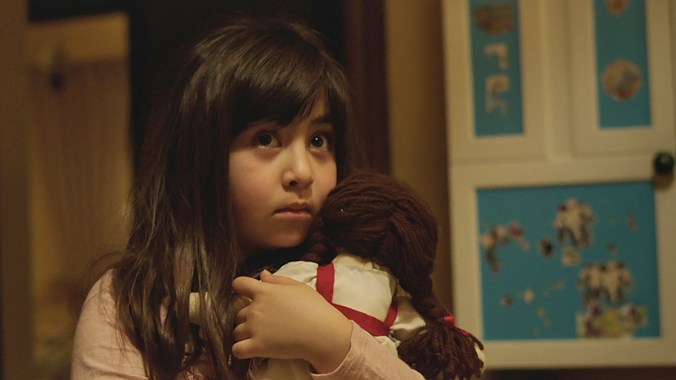


Horror Double Feature: The Sacrament and The Eyes of My Mother

It’s dual movie reviewin’ time again, folks! Today’s double bill features two films that share something of a ponderous, more art-house aesthetic, and while both have their profoundly disturbing moments, their approach to their respective subjects is miles apart.

First up is Ti West’s 2014 faux documentary, The Sacrament. The conceit of the film is that a young photographer named Patrick (Kentucker Audley) has received a letter from his formerly drug-addicted sister Caroline (Amy Seimetz) in which she sings the praises of a new commune she has joined (in some never-mentioned country) that has helped her get clean and get her life back together. Slightly concerned for her welfare, Patrick decides to go visit her, taking along a two-man team from Vice Media, Sam and Jake (played by AJ Bowen and Joe Swanberg, respectively), to document this odd-sounding community and perhaps get a juicy story out of the deal.

The guys arrive at the secluded forest village, named Eden Parish, and while they are initially taken aback by the men with guns guarding the gates who seem reluctant to let them inside, once Caroline emerges, everything is sorted out, and the visitors are seemingly given every hospitality. Patrick separates from the others so he can spend some quality time with Caroline, and Sam and Jake are allowed to roam the grounds freely and interview the locals, who all seem quite content in this utopian commune and who have nothing but praise for the group’s leader, an enigmatic Southern preacher simply known as Father.

Sam and Jake are suspicious of all this hippie bullshit, but they do have to admit that everyone seems genuinely happy and well cared-for, and both men are impressed by the pleasant little village these people have carved out of the surrounding wilderness with nothing but their own hands. Nothing much, in fact, seems to be wrong with the place at all, except for a mute girl named Savannah (Talia Dobbins) who seems to be following them around and giving them meaningful glances. Hell, Father even agrees to be interviewed by the Vice guys on camera, provided the interview takes place in front of all the villagers at the small celebration they’re planning that evening to welcome the visitors.

Sacrament1

Now, you know and I know that something is deeply fucked up about the place, despite how idyllic it appears, and after the interview goes down at nightfall, things start falling to shit fairly quickly. Savannah slips the Vice reporters a note asking them to help her, and from there it transpires that the village contains several defectors who are desperate for Sam and Jake to help them escape, but are terrified their treachery will be found out. Caroline is seen wandering around the commune, clearly high as balls, and it’s implied that she’s sleeping with Father, which would seem rather counter to the village’s supposed Christian virtues. The armed guards from out front are a menacing presence in the village as well, and Savannah’s mother Sarah (Kate Lyn Sheil) insists that Savannah and the other children there have been abused, and that any deviance from Father’s agenda could get them killed.

Sacrament3

I will say that as a stand-alone film, this was quite an effective and chilling tale. The found-footage aspect works well with the material, and provides an immediacy to the events that helps to build suspense. The actors are all great and very believable in their roles, the tension builds up at a nicely measured pace before a genuinely frightening and nail-biting climax, and Gene Jones as Father is pitch-perfect as the affably charming and hypnotic cult leader whose aw-shucks personality masks a deep psychosis fueled by intense paranoia.

That said…I’ve gotten this far without even mentioning the J word, but now it’s time to address that gorilla in the room. The only thing about The Sacrament that I found disappointing is that for viewers who know the details of the 1978 Jonestown Massacre, this will all seem way too familiar. Some reviews of the film I read claim that The Sacrament is “loosely based” on the events at Jonestown. Loosely, my ass. This is basically a straight-up retelling, just slightly modernized and with a few aspects changed. Not that there’s anything wrong with that, and I will admit that it’s not the movie’s fault that I have seen several documentaries about the real event (which was far more horrific than anything dramatized here), and so wasn’t surprised at all by any plot development taking place in the movie.

While I enjoyed the film a lot, and really appreciated its steady ratcheting up of horror, I found myself hoping more than once that it would deviate somewhat from the Jonestown narrative and show me something new. I even for a second thought that maybe Ti West would build the story up to be just like Jonestown, and then totally subvert the audience’s expectations by, I dunno, making the cult people turn out to be the sympathetic victims of the Vice dudes’ exploitative filmmaking? Something like that. But no such thing occurred. If you know how Jonestown played out, you’ll know how the movie plays out, Kool-Aid (well, technically Flavor-Aid) and all. Spoiler alert? Sorta, but not really.

Sacrament2

I was also kinda let down by the fact that there wasn’t a lot of insight given into why the people in Eden Parish wanted to be there, how much they knew about what was really going on behind the scenes, and why they turned a blind eye to the fucked up things that were happening in the commune. A few mentions were made of them being “brainwashed,” but this wasn’t explored as deeply as I felt like it should have been, which made the turnabout from kumbaya to killing fields feel a little too sudden.

Sacrament4

So while I would recommend this unreservedly to fans of Ti West’s other films (which I loved, particularly The House of the Devil), I feel like viewers who are not at all familiar with what happened at Jonestown will probably enjoy it a lot more, since the subject matter will seem fresh. And even for those people, I would recommend that if you want to see some real horror based on real footage of this shit, watch the 2006 documentary Jonestown: The Life and Death of Peoples Temple, which has extensive archival footage of the actual cult, interviews with Jim Jones, interviews with people who escaped the massacre, and really unsettling video and audio of everything that went on there. Chilling and grim as fuck, and way scarier than any fictionalization could ever be.

Next up on the double bill is a movie that has pretty much polarized critics at one extreme or the other, which to me generally suggests something that’s definitely worth seeing at least once. 2016’s The Eyes of My Mother was the directorial debut of Nicolas Pesce, premiering at the Sundance Film Festival, and while I can see why some reviewers really hated it, I found it mesmerizing, intense, and nightmarish.

Filmed in gorgeous black and white, The Eyes of My Mother tells a tale in three chapters about a girl named Francisca (played as a child by Olivia Bond and as a young woman by Kika Magalhães), who lives on a remote farm with her mother (Diana Agostini) and father (Paul Nazak). Francisca’s mother, a surgeon originally from Portugal, apparently instilled in the child a love of dissection and anatomy; this is a household, after all, where Dad coming home to find Mom and daughter cutting the eyes out of a cow head on the kitchen table ain’t no thing.

Eyes2

Shortly into the film, a creepy traveling salesman named Charlie (Will Brill) drops by the house and asks to use the bathroom. Mother is reluctant, but he insists, and she finally relents. Unfortunately, this salesman is actually a wandering psychopath, and proceeds to murder Mother in the bathtub while Francisca sits in the kitchen. Father, upon arriving home, discovers Charlie hacking away at his wife, and without much fanfare, knocks Charlie out and chains him up in the barn. He and Francisca then bury Mother in the yard.

To me, this seemed like the eeriest aspect of the film: not only the resolute refusal of the movie to really explain any of the characters’ motivations or reasoning, but also Father and Francisca’s bizarrely stoic acceptance of everything that happens. Neither of them get particularly upset, neither talks much to the other. They just go about their grim tasks in emotionless silence, which I thought was very effective in accentuating the horror that unfolds on screen. Even Charlie, when asked by Francisca why he chose her family to target, simply replies, “You let me in.”

Eyes3

In the second chapter, we see that Francisca has grown up, and her father has died. We also discover that Charlie is still chained up in the barn after all these years, and that Francisca has been feeding and caring for him, claiming he is her “only friend.” Of course, she has also cut out Charlie’s eyes and vocal cords, so y’know, with friends like those…

Oh, and Francisca is also keeping Dad’s body around, bathing with it, sitting next to it on the couch, crying about how much she misses him. It isn’t really clear how long Dad has been dead or how he died exactly. It’s also implied here that Francisca thinks she is in some kind of communication with her dead mother, who she often asks for advice about what to do next.

To assuage her loneliness, Francisca drives to a bar and picks up a girl, Kimiko (Clara Wong), who she brings home. Everything seems fine at first, if a little awkward, but then the wide-eyed and eerily detached Francisca begins talking about how someone killed her mother, and then goes on to say that she killed her father, though she doesn’t specify when or how. Kimiko is understandably weirded out, and tries to get out of Dodge, but Francisca becomes desperate to prevent her leaving, and presumably murders Kimiko off-screen, since in the following scene we see Francisca placing individually wrapped chunks of meat into the refrigerator.

Later, Francisca even unchains Charlie and brings him up to the house to have sex with him, though after she falls asleep, the weakened and eyeless murderer tries to escape from the house. He doesn’t get very far before Francisca catches up with him in the yard and stabs him repeatedly, obviously getting some kind of erotic charge out of the killing.

Eyes1

The third chapter relates how the lonely psychopath, upon perceived advice from her dead mother, walks to the side of the road and gets picked up in a car driven by a woman with a baby. Given Francisca’s proclivities, it will not be a surprise to anyone that she kidnaps the baby after stabbing the mother in the back, after which she chains the mother up in the barn just like the dear departed Charlie, and then proceeds to raise the child as her own, naming him Antonio.

The final portion of the film sees Antonio grown to about a six-year-old who eventually discovers the eyeless and voiceless woman chained in the barn. After Francisca will not tell him who the woman is, he decides to free her, after which the poor woman makes her way to the road, where she is helped by a passing trucker. The woman then evidently goes to the cops, because at the end all we see is a bunch of cars coming up the drive of Francisca’s house, and Francisca panicking and locking herself and Antonio in the bathroom. Francisca brandishes a knife, telling her “son” that she will not allow them to take him away from her. She is presumably then killed by the police, though this is not shown.

Eyes4

The Eyes of My Mother is definitely not a film for everyone. In its execution, it had hints of The Hour of the Wolf, Eraserhead, and Begotten, and not just because it was in black and white. The film is languidly paced, somewhat surreal, and feels quite long even though it’s only a spare 76 minutes. There are extended shots of people walking slowly across a yard, there are long stretches with no dialogue, and much of the violence, while disturbing when imagined, takes place off-screen and is mostly suggested by implication. Nothing is really explained to any great degree, everything is just laid out as it is, for the viewer to take or leave.

While I understand how some people found the film pretentious or slow, I thought it was very well done, and I found the matter-of-fact way its disturbing events were depicted to be quite unsettling. I admit I was quite hypnotized by the narrative, as I was left wondering what intensely messed up thing was going to take place next. The character of Francisca was especially eerie, as the viewer can sympathize with her forlorn isolation even as we are horrified by her actions. Recommended to fans of Ingmar Bergman or those who are into more arty horror; anyone else will probably just find it a frustrating slog.

Until next time, keep it creepy, my friends. Goddess out.


Horror Double Feature: The Awakening and The Canal

Quite by accident, today’s double feature happens to consist of two films from the UK: the 2011 classically-structured English mystery/ghost story The Awakening, and the more modern-expressionist Irish murder-demon tale from 2014, The Canal. While neither of them was particularly original plot-wise, there was a great deal to enjoy in both films, and I have few qualms about recommending them to interested parties, as long as you’re not expecting to get blown away. Keep in mind that both have pretty significant plot twists that will be spoiled here, so read no further if you haven’t seen them. This is your final warning!

First up, The Awakening is the kind of movie that will probably appeal to fans of neo-gothic ghost stories like The Others, The Woman In Black, The Devil’s Backbone, and The Orphanage (of which I am definitely one), with all the standard ingredients: creaky old mansions, possible spirit kids, a plucky heroine, a kindly matron, a murder mystery, lots of shifty characters, and a repressed and horrific past. There are two really outstanding things about this film, one of which is the gorgeous cinematography, painting everything in hues of blue and gray and setting a bleak and eerie mood with long shots of empty hallways, vast green lawns, and shadowed rooms.

The other outstanding thing is the performance of lead Rebecca Hall (who I also enjoyed in her roles in The Prestige, The Gift, Vicky Christina Barcelona, and Frost/Nixon), who is electrifying to watch, playing a character who is tough as nails and in complete control of her emotions, all the while seething underneath with a naked fragility that she is loath to show to anyone.

That said, the movie also has some significant problems, which I will get to in a bit.

The Awakening is set in 1921, and Hall plays Florence Cathcart, a fiercely intelligent, no-nonsense spiritualist debunker in the Houdini vein. She has written a well-regarded book on exposing fraudulent mediums, called Seeing Through Ghosts, and has become somewhat famous (as well as reviled by the spiritualist community) for her work with the police in raiding fake séances (as if there are any other kind, but I digress). In fact, the first sequence of the film shows us Florence at work, busting up a deliciously creepy séance with ruthless efficiency, showing everyone the wires and parlor tricks used to make the attendees believe they are talking to their loved ones. Predictably, the people at the séance get righteously pissed off at Florence for exposing the fraud, instead of at the fake mediums who are taking their money and fooling them into thinking they‘re communicating with dead people. Typical.

rebecca-hall-the-awakening

It also comes to light that Florence has lost her lover in the war, and that much like Houdini and his mother, Florence maintains her staunch atheism and disbelief in the afterlife both because she feels that fake mediums are taking grieving people like her to the cleaners for a false promise of communication, but also because she still holds out a tiny spark of childish hope that one of these mediums will actually be real and will be able to contact her lost beloved, so that she can apologize for the wrong she did him just before his death.

A short time after the séance raid, Florence is approached by Robert Mallory, who teaches Latin at a boys’ boarding school called Rookford. He explains to Florence that the school is haunted by a boy who might have been murdered there at some point in the past, and that one of the students has recently died, apparently after being frightened to death by the ghost. At first Florence brushes him off, saying she’s too busy and that the “proof” of the haunting he’s brought looks like bullshit, but since there would be no movie if she didn’t go, she eventually agrees to travel to the school and investigate.

awakening2

Once she gets to Rookford, she meets matron Maud (Imelda Staunton, who I absolutely loved in Mike Leigh’s Vera Drake), who is almost creepily interested in her and effusively praises her book (which she keeps on the shelf right next to the Bible), saying that she doesn’t believe in any of this haunting nonsense either and that she hopes that Florence will be able to get everyone‘s heads on straight. She also meets a few of the other boys, including the angel-faced Tom (Isaac Hempstead-Wright, best known from “Game of Thrones”), some of the other teachers, like the anger-issue-ridden Malcolm McNair (Shaun Dooley), as well as the requisite sketchy groundskeeper Edward Judd (Joseph Mawle).

One aspect of the film I thought was rather nicely done was the undercurrent of war and the influenza outbreak that was going on in England at the time. At the school, everyone seems either sick or wounded in some way, haunted by the horrors going on around them, and groundskeeper Judd is reviled by all the other teachers because he faked an injury to get out of service. An understated touch, but a welcome one that helps place the story in the context of its times.

Awakening1

Florence wastes little time in setting up all the latest scientific equipment and using her considerable intellect and knowledge of the tricks of the trade to get to the bottom of the mystery. And here’s where I thought the movie was at its best, because Florence is able to easily discover that the “ghost” the dead boy saw was in fact one of the other students playing a prank, and that the deceased child actually died from an asthma attack after Malcolm McNair punished him for his fear by locking him outside, trying to “toughen him up.” When Florence exposes the truth, Malcolm tearfully apologizes, claiming that he was only so harsh on the boys because he was trying to make them tougher than the current generation, since, having seen war, he would know that they would have to be. The other teachers are sympathetic, but Malcolm still gets fired, and rightfully so.

So, problem solved, right? No ghost, no mysterious death. Not so fast. At this point there was still a great deal of the movie to go, so I figured that even though Florence had presumably found out that the ghost was fake, that there would actually be a real one lurking in there somewhere that would melt the black, unfeeling heart of the skeptic. I have to admit, this common plot device always disappoints me somewhat, because it seems as though skeptics are invariably portrayed in horror movies as wrong and damaged in some way, and this film was no exception. While I know that we couldn’t have horror stories without writing about the supernatural, and while I’ve always been a big fan of supernatural-based horror tales myself, I’m always kind of annoyed by the lazy “hardline asshole skeptic finds out there really ARE ghosts, and becomes a better person” trope. It doesn’t ruin the movie, but I just found it an obvious “twist,” and somewhat jarring within the context of the film.

0817AWAKENING_SPAN-superJumbo

After the fake ghost is unmasked, the boys all leave the school for the Christmas holiday, save for Tom, who has to stay behind because his parents are ostensibly in India. Although Florence initially plans to leave, she ends up seeing something in the school that leads her to believe that the place really is haunted, and she is determined to stay there until she finds out what it is. Another thing keeping her at the school is her budding romance with Robert Malloy, and her connection to the lonely little Tom, who adores her and seems to know a lot about her, for reasons which will become clear later.

And right here is where most of the major problems with the movie begin. Florence, presented in the film as a thoroughly modern, rational woman, begins to essentially have a nervous breakdown, chasing after ghosts, crying uncontrollably, seeing strange visions, even attempting suicide by throwing herself into the lake and subsequently throwing herself at Robert Malloy. It’s sort of a bizarre character shift, and while it wasn’t too egregious while I was watching it, when I thought about it later on, it bothered me a lot more.

THE_AWAKENING_2

There is also a minor subplot with groundskeeper Judd, who attacks and attempts to rape Florence in the woods, before being frightened by the ghost, after which Florence kills him in self-defense and Robert covers it up. I’m not really sure why this subplot is here, because it doesn’t really have anything to do with the main story and doesn’t serve any purpose other than showing the audience that all the other war-hero characters were correct in assuming that the malingering Judd was kind of a scumbag.

And the ultimate resolution of the mystery, which I admit came as something of a surprise, was also unnecessarily convoluted and admittedly a tad confusing. It turned out that twenty years ago, when the school was a private residence, Florence had lived there with her parents, her nanny, and her nanny’s son. Florence’s father had flipped out one day, killed her mother in front of her, and then came after her with a shotgun. Florence hid from him in a hole behind the wall, along with her friend Tom (yep), the nanny’s son. Florence’s father shot through the wall, aiming for Florence, but killed Tom instead, then shot himself when he saw what he’d done.

Awakening3

So basically, Tom has been the terrifying “ghost with the twisted face” all along (which was actually a pretty creepy and arresting visual, though I thought the explanation that most of the time he could control the twisty-faced thing and look like a normal kid was kind of lame), and it turns out that Maud is his mother, as well as Florence’s erstwhile nanny. That’s why Maud and Florence are the only ones who can see Tom (though this isn’t clear until you watch it a second time, just like The Sixth Sense), and that’s why Maud was acting so strangely at first, because she was the one who convinced Robert to summon Florence there; she was looking to see if Florence remembered her or remembered anything about what had happened. So the whole point of Florence being at the school was not so much to debunk the ghost, but to remember and come to terms with the horrible past she had blocked out.

The ending also got a little weird, as Maud decides that she and Florence should look after Tom forever because he’s lonely and he‘s starting to appear to more of the boys at the school, which frightens them. So Maud poisons herself and attempts to poison Florence, though it appears that Tom intervenes and gives her an ipecac. While some viewers thought that Florence really did die and that it was her ghost we saw at the end leaving the school, I’m pretty sure she actually did live, though it could be read either way because of the cryptic way the scenes and the dialogue are shot.

Awakening4

As I said, there were some rather odd tonal shifts and bizarre character 180s going on, the repressed memory angle was way too complicated and silly to be believable, and I thought there were some unnecessary plot threads that could have been eliminated; but all in all, it was a rather enjoyable mystery that looked great and had some interesting twists, even though some of them were a little WTF. If you have a hankering for an old-school Victorian-style ghost story with some Houdini-type scientific skepticism threaded in, and if you can live with some clumsy plot developments that don’t always work, then you may find your fix somewhat sated here.

The second film in our UK double feature is 2014’s The Canal, written and directed by Ivan Kavanagh. Though this one had far fewer plot issues than The Awakening and hence was probably the better film overall, I think I ended up liking it about the same, just because it suffered a tad from an unoriginal storyline and had a more modern, jump-scare-heavy aesthetic. That said, though, it did have a slightly surreal feel to it which I appreciated, some decent scares and disturbing imagery, and at times it reminded me a bit of Candyman, which is always a good thing.

We begin the tale as main protagonist David (Rupert Evans) moves into an old house in Dublin with his pregnant wife Alice (Hannah Hoekstra). Not much happens at first to suggest that anything is amiss, but then we skip ahead five years. David and Alice’s son Billy (Calum Heath) sometimes complains about monsters in the house, as five-year-olds are wont to do. In addition, the love appears to have gone out of David and Alice’s marriage, as he begins to suspect that she is having an affair with one of her clients.

Canal6

Worse yet, during the course of his job as a film archivist for the National Archives, he is sent a series of police films from 1902, which show the aftermath of a grisly murder that took place in the very house he lives in with his family. The crime spree involved a man who had brutally butchered his two-timing wife and their two children, then later beheaded their nanny before throwing her body into the canal that still runs alongside the street the house is located on.

Soon enough, David becomes obsessed with these films and begins to investigate other murders that have taken place around the canal, and it’s implied that he is seeing parallels between the family dynamic at work in the 1902 murders and what’s taking place in his own life (since David and Alice also employ a nanny, by the name of Sophie, played by Kelly Byrne). Shortly afterward, he obtains definitive proof of his wife’s dalliances when he follows her one night when she is supposed to be “working late” and sees her banging her hunky work colleague Alex (Carl Shaaban).

Canal4

In fact, on the night he sees the two of them together, he has flashes of the 1902 murder films, and picks up a hammer as if he is going to revisit the past with extreme prejudice. But then he thinks better of it and leaves without the lovers seeing him. On his walk back home, he throws the hammer into the canal, and then starts feeling sick about what he almost did. He enters a nearby Trainspotting-level public bathroom, where he vomits all over the place, but also has disturbing visions of someone standing outside the stall and a creepy man whispering something unintelligible into his ear. As he staggers out of the bathroom, he sees what he thinks is his wife struggling with a dark figure on the banks of the canal, and then falling in, screaming. Thinking he is imagining it, he heads back home.

But wouldn’t you know it, his wife has not come home by morning, and after dropping Billy off at school, he goes to the police to report her missing. He doesn’t tell the police that he knows about her affair, and he doesn’t tell them that he thought he saw her fighting with a man by the canal, since he believes (probably with some justification) that the cops will think he killed her if they find out he was following her and actually did momentarily consider busting in her head with a hammer.

Canal5

Lead detective McNamara (a wonderful Steve Oram) is still intensely suspicious, since, as he tells David, when wives go missing, it’s ALWAYS the husband. He tries to get David to confess by sticking the knife in about the affair, which apparently everyone knew about but David. David is, however, adamant that he loved his wife and wouldn’t hurt her. And because of David’s visions, the audience is actually not sure either whether he really did kill his wife and then sort of blocked it out by imagining all this trippy stuff with the creepy dudes in the disgusting toilet.

Subsequently, Alice’s body is found in the canal, but in a surprising twist, the coroner finds no evidence that she was murdered, and rules that she was probably walking home, broke her heel, fell into the canal, and drowned. David is heartbroken, but also somewhat relieved, though his grief is tempered somewhat by the revelation that Alice was pregnant with Alex’s child and that she had been planning on leaving David when she died.

Canal1

There is a funeral, and David hires Sophie on to stay full time to help take care of Billy, but Detective McNamara is still convinced that David is the killer, and his suspicions prompt him to have David watched, as well as contact child services to see about having Billy taken away from him.

It is at this point that the real mindfuck of the movie begins, because although it would seem that David has been exonerated of his wife’s allegedly accidental death, he starts to become convinced that the man who murdered his family back in 1902 is still in the house, or that there is some evil force operating in the house that makes its residents go murderously insane.

Propping up this belief is the sighting of the man (and Alice) at varying times in the house, as well as on the films he makes around the house and near the canal in order to catch the “ghost.” He attempts to rally his work friend Claire and the nanny Sophie to his cause, trying desperately to convince them that not only is there an evil spirit in his house, but that it killed his wife and is going to kill Billy and Sophie next. Sophie and Claire, however, simply think that the grief over his wife’s death has sent him off the deep end, and urge him to get help, which he refuses. It is never really made clear whether the women can see the “ghosts” that occasionally turn up on his films, making the suspense over David‘s supposedly deteriorating mental state all the more compelling. There also remains the intriguing possibility that Alice’s death was simply an accident, and David is blowing it into this batshit demon scenario in order to assuage his guilt about his murderous thoughts.

Canal7

Meanwhile, police recover the hammer that David threw into the canal on the night of Alice’s death, and since David’s fingerprints are on it, McNamara’s suspicions are reignited. David finally admits to the police that he had known about the affair and that he had seen Alice and Alex together that night, but insists that the ghost in the house is responsible for Alice’s death, not him. Not surprisingly, the police are less than impressed by this outlandish story.

The real strength of the film is that the viewer never really does figure out whether David actually killed his wife (and later Claire) and is so crazy he’s attributing it to spirits, or whether the spirits are real and are making him murder people, or whether the spirits are the ones doing it and then are making him think that it was him. Late in the film, David finds a series of creepy old photographs behind a wall that imply that the former residents of the house were Satanists who sacrificed babies and threw them into the canal, so it would seem that there was some evil jiggery-pokery going on in the place, but then near the end of the film, as David is trying to escape from police with Billy in tow, he is shown visions of himself drowning his wife in the canal and strangling Claire, so we don’t really know if this is actually what happened, or if these visions were shown to him by the evil ghosts.

Canal2

The ending of this was actually rather dark, which surprised and somewhat delighted me, in a grim way. David dies by drowning in the canal, though Billy is pulled out by Detective McNamara. You’d think that would be the wrapped-up, somewhat happy ending, but there’s a nasty little coda: Billy is back at the house with his grandmother, and he goes into his room to retrieve a few of his toys, since Grandma is selling the house and they are moving away. While inside alone, Billy sees David’s eye peering at him through a crack in the wall, and David tells the child that he is in the house with Mommy, and that Billy can stay with them forever if he wants to. Cut to a solemn little Billy emerging from the house and getting into the car with his grandmother, after which he jumps out of the car while it’s moving and gets crushed under the wheels. The last shot is the real estate agent being startled by Billy’s ghost as it closes the door of an upstairs bedroom.

I’m guessing that this final little twist suggests that the evil ghost (or force or demon or whatever) was manipulating the perceptions of everyone who lived there. So Billy didn’t really see his dad in the wall; that was just the demon persuading him to join the party, as it were. At least that was how I interpreted it.

As I said, this film reminded me pleasingly of Candyman, what with a desperate and sympathetic protagonist trying to convince a skeptical world that a supernatural force was responsible for murders which looked very much like he had committed. The acting was great, the story interesting if nothing new, the cinematography containing nicely surrealistic flourishes. The ghost sightings were also effectively creepy, especially the ones that appeared on old-timey looking film. Another well-above-average recent horror entry in this double-feature series, and one I’d definitely recommend.

Well, that’s all for now, so until next time, keep it creepy, my friends. Goddess out.


Horror Double Feature: Starry Eyes and The Invitation

It’s yet another Double Feature day at Chez Hellfire, and damn, if all the movies I’m going to be watching for this series are as fantastic as these two, then I’m going to be a very happy horror nerd indeed.

Like We Are Still Here, discussed previously, Starry Eyes also premiered at the South by Southwest film festival, albeit a year earlier, in 2014. Written and directed by Kevin Kölsch and Dennis Widmyer and partially funded through a Kickstarter campaign, the film has received tons of positive press, and it’s not hard to see why. Starry Eyes is essentially an homage to classic 60s and 70s Satanic cult flicks (Rosemary’s Baby, To the Devil a Daughter) filtered through the dark-side-of-Hollywood motifs of David Lynch’s Mulholland Drive and Inland Empire, with a giant, sticky dollop of gruesome, Cronenberg-style body horror thrown into the mix. The film is intensely disturbing, gloriously gross and violent, blackly comic, and absolutely riveting from start to finish, not only a fun (if extremely grim), gory ride, but also a startlingly cynical meditation on the lengths people will go to for fame, the soul-sucking nature of the Hollywood system, and the corrosive effects of unfettered ambition.

STARRY_EYES_Cover_Preview

Easily the best thing about the film is the astounding breakout performance of lead actress Alex Essoe, who goes to unbelievable lengths for the role and makes her tragically flawed protagonist not only completely grounded and believable, but also simultaneously sympathetic and monstrous. Essoe plays Sarah Walker, one of millions of aspiring young starlets trying to make it in L.A. To pay the bills, she works at a dreary Hooters-type restaurant called Big Taters, but she feels she is destined for bigger things. To this end, she has been constantly going out for auditions and getting rejected, all the while trying to tamp down her extreme insecurity and self-hatred by pulling out her own hair and going into psychotic rages where she feels she must punish herself for her failings.

Not helping matters are the “friends” she surrounds herself with, only a few of which (particularly her roommate Tracy, played by Amanda Fuller, and aspiring indie film director Danny, played by Noah Segan) seem genuinely supportive of her goals. One friend in particular, a rather passive-aggressive bitch named Erin (played with cunty relish as well as surprising depth and humanity by Fabianne Therese) continually chips away at Sarah’s self-esteem with her denigrating comments.

Starry-Eyes-Alex-Essoe1

As unsure of herself and relatively unstable as she is, Sarah does manage to pull off a decent audition for a horror film called The Silver Scream, produced by a long-running production company called Astraeus Films. The only problem is, her performance is really nothing special, just like all the others, and she is summarily dismissed by the intensely creepy casting agents (played by Maria Olsen and Marc Senter). In the bathroom after her audition, she looses her frustration in a torrent of primal screaming and hair pulling, and wouldn’t you know it, the casting agent happens to come into the bathroom and witness the psychotic episode, which piques her interest anew, prompting Sarah to come back to the casting office to re-enact her terrifying tantrum for them, so they can see “the real Sarah.”

starry-eyes-promo-shot-bed_1

As the story goes on, Sarah is called back for more auditions that get weirder and sketchier until she eventually gets called to meet the producer, a perpetually leering and overly tanned old creep who predictably wants to make a Faustian bargain with Sarah, essentially asking her to give herself up body and soul for the tantalizing reward of fame. It shouldn’t come as a surprise to anyone that Sarah is not being recruited for a horror movie so much as initiated into a Satanic cult of Hollywood elites, one that will of course require sacrifice in order to achieve Sarah’s final transformation from struggling actress and breastaurant waitress to glamorous Tinseltown screen idol.

Though the plot is, as I mentioned, essentially a retelling of the Faust tale and therefore familiar territory, the real fun of the film is in watching Sarah slowly spiral downward as she siphons off bits of her soul to achieve her dreams. After accepting the cult’s invitation, Sarah begins to physically deteriorate to a horrifying degree, so much so that the viewer is simultaneously revolted and intrigued, not particularly wanting to see whatever disgusting indignity is coming next, but also unable to look away. Again, Essoe is outstanding in the role, laying herself bare in every way imaginable and completely going for it in the gross-out department (there‘s a lot to be said for the dedication of an actress who is willing to fill her mouth with real maggots). Her performance is such that as I watched it, I found myself hating her for her weakness and naivety, empathizing with her outsider status, insecurity, and desire to achieve her dream, and actually rooting for her to go all the way with her horrible deeds to get what she wanted in the end. The fact that I could feel all these emotions at once is a testament to Essoe’s extraordinary talent.

starry-eyes

All the other actors in the film are great too, and I thought it was fantastic how even characters like Erin and Big Taters manager Carl (wonderfully played by Pat Healy) that were supposedly “villains” (at least from Sarah’s perspective) were given dimension and humanity; even though they did and said some shitty things and were seemingly standing in the way of Sarah‘s aims, they did still genuinely care about Sarah’s well-being, which made her act of viciously turning on them near the end all the more devastating.

starryeyes

The special effects were also top-notch, with Sarah’s bodily disintegration especially grotesque and nauseating. The violence was also wickedly nasty and brutal, portrayed in an unsettlingly matter-of-fact fashion, with one kill in particular (in which the camera barely flinches as someone’s head is pounded into pulp) being almost unwatchably grisly. Topping the film off with a flourish is a fantastic score and terrific sound design that really adds to the atmosphere. Put it all together and you’ve got one skin-crawling, black-hearted blast of a movie that I would not hesitate to wholeheartedly recommend, though definitely NOT to the squeamish.

Another South by Southwest festival alum comprises the second movie in our double bill, and even though it’s a completely different style and experience than Starry Eyes, it is equally stellar, and likewise comes very highly recommended.

invitationcover

2015’s The Invitation was directed by Karyn Kusama (of Girlfight and Jennifer’s Body fame) and features a splendid ensemble cast that includes Logan Marshall-Green (Prometheus), Tammy Blanchard (Into the Woods, Moneyball), and John Carroll Lynch (Fargo, Zodiac, “The Walking Dead”). The film is actually far closer to a thriller than a straight horror film, but don’t let that dissuade you, because this thing had me perched on the edge of my seat biting my fingernails the entire time; it is fantastically, unbearably tense.

The setup of the plot is this: Will and his girlfriend Kira have been invited to a dinner party at the home of Will’s ex-wife Eden and her new husband David. No one has really seen Eden and David for two years, so the couple claim they’re having this get-together for all their friends so everyone can catch up. It’s also established early on that Will and Eden divorced shortly after their son was killed in a freak accident (after which Eden also attempted suicide), and Will is not entirely sure he’s ready to see Eden again, as well as return to the house where the tragedy occurred, but with the help of the supportive Kira and all their other friends, he’s hoping he can make a go of it.

invitation3

At first, everything seems fairly normal, if a little awkward as everyone feels each other out and gets reacquainted after such a long time apart. The weirdness begins to happen in very small increments: Eden and David introduce Sadie, a woman who is living with them and is obviously their lover. They have also invited a man named Pruitt, who seems polite enough but is also ever so slightly menacing. Eden is putting on a somewhat creepy façade of serene happiness, but early in the evening she has a bit of an episode and slaps one of the other guests, though she recovers her composure fairly quickly. Will notices David locking the doors, and when Will asks about this, David brushes it off by saying that there has been a recent home invasion in the neighborhood and he just wants to keep everyone safe. While Will is snooping around his former home, he comes across a bottle of phenobarbitol in the nightstand of David and Eden’s bedroom.

invitation2

There is also the small matter of another guest, Choi, being very late, and of no one being sure where he is since there is no cell phone reception up in the hills where the house is located. As the party goes on, it comes to light that Eden and David have been in Mexico for most of the previous two years, and that while there they joined a sort of spiritual self-help group that has supposedly helped Eden let go of her grief about her son’s death. David, Eden, Pruitt, and Sadie all sing the praises of this group and its enigmatic leader, Dr. Joseph, though the rest of the party guests make jokes about them joining a cult and seem uncomfortable when it appears that David is trying to convert everyone at the party by showing them an unsettling video of Dr. Joseph and two other group members presiding over the death of a terminally ill woman.

The party grows ever stranger, becoming equal parts overtly sexual and intensely disquieting (especially after Pruitt makes a disturbing confession about what happened to his wife), and at one point, another guest, Claire, decides she’s had enough and wants to leave. David tries to prevent her, but Will, who has been getting increasingly suspicious that something sinister is going on, confronts David, and Claire is allowed to go out to her car, though Pruitt follows behind her because he has parked her in. Will goes to the window to watch Claire leave, as he believes Pruitt is going to do something to her, but he is called away before he can see anything.

invitation1

The bulk of the narrative goes on in this way, as Will begins to see even the most innocuous actions of the party’s hosts as evidence that something terrible is about to go down. This was the best aspect of the movie by far, because the viewer is left to wonder if there really is something weird going on with David and Eden, or if Will is just having a breakdown because he hasn’t yet come to terms with his son’s death and Eden’s remarriage. Adding to the tension is the fact that none of the other party guests seem to think anything odd is going on at all, and several of them try to reason with Will at various points, leading the audience to think that Will is simply isolating himself from the group, acting like a paranoid weirdo, and letting his imagination run away with him. The film also plays with our expectations by making some of Will’s suspicions come to nothing. As I’ve stated many times before, I really like movies that are ambiguous like this, where you’re not sure if the protagonist is really perceiving things as they are or if their emotions are ultimately clouding their judgment.

invitation4

I won’t spoil the conclusion, because it’s really terrific, and the very last scene actually made my jaw drop, due to its devastating implications. In short, this is a tightly directed, beautifully acted thriller that maintained a palpable sense of tension throughout and culminated in a terrifying and satisfying climax. Good stuff.

Until next time, keep it creepy, my friends. Goddess out.
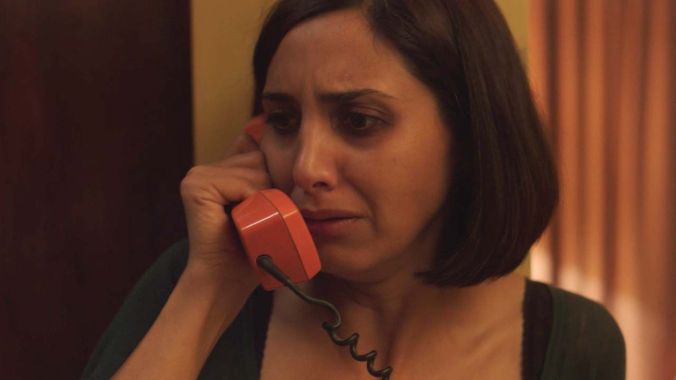
Horror Double Feature: I Am the Pretty Thing That Lives in the House and We Are Still Here

As regular readers will recall, I had a series on this blog titled Hulu Horror Double Feature. You may have noticed I haven’t written any of those in a while, and you may have also deduced that I stopped doing them right around the time that Hulu went to an entirely subscription-based format and got rid of all its free content. Since our household already pays for a Netflix subscription, I wasn’t gonna pay for Hulu as well, especially since I unfortunately don’t have loads of time to watch stuff. So from this point forward, whenever I do more recent double feature posts, the reviews will be of horror films that are featured on Netflix (or, for older ones, on YouTube‘s or Amazon‘s pay-per-film service). I do realize that this limits my options somewhat, as Netflix isn’t actually known for having a vast horror movie library (though they have improved somewhat this year, and hell, I may pony up for a Shudder subscription one of these days), they have enough decent-looking recent flicks that I can probably squeeze at least a few long-form posts out of ‘em. So consider my Hulu Horror Double Feature category to now be a more generic Horror Double Features. And that’s all I have to say about that.
With that requisite housekeeping out of the way, let’s settle in for our opening salvo in the new improved Double Feature category. The first movie I’m discussing is one I’d been hearing a great deal about since its premiere at the Toronto Film Festival last year, and although reviews were somewhat mixed, most of the negative reviews I read complained only that the movie was too slow, spare, and minimalist. Well, to me, that’s like an open invitation. Because if there’s one thing I love and can’t stop harping about on this very blog (see my reviews on The Haunting, Soulmate, House of Last Things, Yellowbrickroad, and pretty much any ambiguously creepy ghost story), it’s eerie, slow-burn, vaguely surrealist ghost stories that show very little but leave a lingering impression on the patient viewer.

By now you may have guessed that I’m going to be talking about 2016’s I Am the Pretty Thing That Lives in the House. Directed by Oz Perkins (son of the legendary Anthony), and starring Ruth Wilson (best known in the US for her work on the Showtime series The Affair) and Paula Prentiss (best known, at least to me, for starring in the dynamite 1975 movie adaptation of Ira Levin’s The Stepford Wives), the movie is a master class in using subtle cinematography and sound design to engender a cloying atmosphere of dread that pervades every frame of the film, even though nothing particularly terrifying appears to be happening. One review I read stated that the film was what it would look like if David Lynch decided to adapt a Shirley Jackson novel, and to me that seems to hit it right on the head.

The rather simple plot involves a neurotic hospice nurse named Lily Saylor who is sent to a remote old house to care for Iris Blum, a retired author of pulp thrillers, who suffers from dementia. During Lily’s eleven-month tenure, it comes to light that the house may or may not be haunted by a spirit named Polly Parsons, the subject of Iris’s most famous novel, The Lady in the Walls, whose ghost supposedly told the story of her tragic murder to Iris some years before.

Complicating matters somewhat is the fact that right in the first few minutes of the film, Lily herself breaks the fourth wall and tells the audience straight out that she is going to die, and the fact that Iris insists on calling Lily by Polly’s name, as well as the fact that the theme of ghosts forgetting how they died comes up several times, suggests that something more ambiguous than a simple haunting is taking place, and that perhaps our protagonist Lily is not exactly what she seems.

PrettyThing1

The movie is essentially a story inside a story inside a story. Was Polly a real person who was murdered in the house and whose ghost still remains there? Or did Iris just make her up, and is Lily conjuring the spirit out of her nervous imagination? Is Lily, in fact, dead the whole time and acting as the ghost herself throughout the entire film? I Am the Pretty Thing could be read in myriad ways, which is one of the aspects contributing to the creeping unease infusing its entire run-time.

The plot of the film, though, such as it is, is really not the star of the show. That would be the almost unbearable buildup of uncanny dread which makes the viewer feel unmoored in a waking nightmare. The gorgeous cinematography (by Julie Kirkwood) focuses on the house’s stark, neutral interiors to great effect, wringing eerieness out of every unsettling, off-center shot of white walls juxtaposed against blackened doorways beyond, of a stubbornly folded corner of carpet, of an empty chair pushed against a wooden table. The movie’s portentous framing of ordinary objects as sinister is quite Lynchian and very, very effective in building up tension, as the viewer is never sure what they’re going to see. Even though standard “jump scares” are almost non-existent, we are kept constantly on edge waiting for something awful to happen, just because of the way the cinematographer plays with our expectations.

PrettyThing5

PrettyThing4

Also contributing to the film’s sense of free-floating anxiety is the fact that its time frame is never firmly established (though judging by the clothes Lily wears, the phone in the house, and the presence of cassette tapes, I’m guessing it’s the early to mid eighties), and that Lily herself is an almost painfully awkward character, a prissy, repressed throwback to an earlier era. Her uncomfortable interactions with estate manager Mr. Waxcap (played with an almost undetectable straight humor by Bob Balaban) ramp up our anxiety on her behalf, a very intriguing way of making us relate to her situation. In this way, Lily is very much like the character of Eleanor in Shirley Jackson’s brilliant Haunting of Hill House. And similar to that novel, the “haunting” in the Blum house seems to be analogous to the slow unraveling of Lily’s mental state, or alternately her slow-dawning realization that she herself is a ghost, either literally or metaphorically. The fact that most of her early voice-overs are later revealed to be paraphrases from Iris’s novel about Polly Parsons drives this point home rather succinctly, as do the recurring images of rot and fragmented reflections.

PrettyThing3

While I will admit that for those who enjoy more straightforward, plot-driven horror, I Am the Pretty Thing might seem like a boring, overly-indulgent slog to nowhere with few big scares, no huge payoff, and long, lingering shots of furniture and faces with very little dialogue or action. But for those like me, who enjoy more cerebral horror that is more interested in building a mood and getting underneath the viewer’s skin with its nebulous oddities, there is much to recommend here, though I would add that it is best watched alone, at night, with no distractions, so that you can get entirely lost in its world and lulled into its creepy spell. It’s definitely a movie that sticks with you long after you’ve seen it, and that in itself is a wonderful thing for any horror film to do.

Next up on the double feature is a far less experimental film that had its premiere at another recent film festival (in this case South by Southwest back in 2015), and although the movie was highly lauded, favorably compared to the splendid It Follows, and ended up on a lot of critics’ “ten best horror films of the year” lists (including Rolling Stone’s), I honestly wasn’t all that crazy about it, though it did have some entertaining moments.

Directed by Ted Geoghegan and packed with horror movie all-stars (Barbara Crampton from Body Double and Re-Animator; Lisa Marie from Ed Wood, Mars Attacks, and Lords of Salem; writer/actor/director Larry Fessenden from Session 9 and much, MUCH more), We Are Still Here has a fairly standard horror movie set-up. The main characters are a middle-aged married couple, Paul and Annie Sacchetti, who move out to a remote house somewhere in New England following the death of their college-age son Bobby in a car accident. Shortly after they move in, a few little things happen around the house that suggest maybe Bobby’s ghost has come along for the ride, but it doesn’t take long at all before the audience realizes that something far more infernal is going on than a harmless lingering spirit.

WeAreStillHere4

It is in fact this nearly immediate blowing of the entire horror wad, as it were, that I think is one of the film’s main weaknesses. It gets off to a promising, low-key start, with some effectively eerie shots of the roads and the isolated house all covered with a blanket of snow, with very spare dialogue that nonetheless conveys the deep grief the couple is feeling, and with very understated hints that something in the house might not be quite right: a picture falling over, a strange noise in the cellar, a ball rolling down the stairs.

The choice to set the film in 1979 was also a decision I’m on board with, as not only does it help to evoke a golden era in horror cinema (also evidenced by a few subtle references to classic horror films of the period, such as The Changeling and The Shining), but it also gives it an otherworldly feel and more of a sense of dread, since the problems that arise can’t be solved by Googling stuff or calling for help on a cell phone.

WeAreStillHere3

But really, as soon as the couple’s obviously not-to-be-trusted neighbors show up about ten minutes in and start going on about the house having been a mortuary and the family living there supposedly being run out of town for stealing corpses back in 1859, and making reference to the house needing “fresh souls,“ it all just gets a bit too on the nose and seems to move along too quickly with no regard for subtlety or restraint. And then once the electrician comes and the audience is pretty much shown exactly what happens to him, all sense of anticipatory dread is lost, for we have already seen everything there is to see. From that point on, it’s just more of the same, only bloodier.

Clocking in at only an hour and twenty-three minutes (and a not insignificant chunk of that is the long end-credit sequence), I think the movie might have actually benefited from being a bit longer, so that the characters and story had more room to breathe before everything went all demonic and wacky.

WeAreStillHere5


That said, I think the film also would have REALLY benefited from taking everything down a notch or ten. While I generally don’t have a problem with copious gore or jump scares per se, there is a point at which you’re going so far over the top that the story is just not scary anymore and veers over into unintentional comedy. The burned-looking ghosts were cool, for example, but I didn’t need to see them in my face every few minutes, which significantly lessened their impact. The gore was fairly well-done, but I didn’t need everyone to die in enormous, ridiculous sprays of blood and chunks like the second coming of Dead Alive.

In fact, I think the entire reason that this movie didn’t really click with me was because its tone seemed all over the place: on the one hand, it seemed to want to be a serious horror film, but then on the other hand you had these kinda goofy, over-acting characters who shamelessly chewed the scenery and dropped boatloads of exposition at pretty much every opportunity when the audience could have figured out the story just fine without all the over-explaining. Either do a serious horror film or do a horror comedy; it takes a very deft hand to make a decent film balancing elements of both, and I just felt like this wasn’t really getting there.


WeAreStillHere2

WE-ARE-STILL-HERE_Dagmar

I admit I did like the séance scene with Paul and stoner dude Jacob, and I sort of liked the overall premise of the movie, which was marginally in the vein of a 70s-style, small-town folk horror type deal, and I sort of liked the creepy weirdness of all the townsfolk being in on this big secret, but other than that, I kinda found my attention wandering during the movie, since I pretty much knew where it was going, and when I was paying attention, I was cracking jokes about it, which I can assure you did NOT happen while I was watching I Am the Pretty Thing. While I can see why a lot of horror fans dug it, it was just way too obvious and over-the-top for my tastes, trying to smack you in the face with HORROR, and it seemed like it was trying to be too many things at once at far too frenetic a pace. Your mileage, of course, may vary.

Until next time, keep it creepy, my friends. Goddess out