Apples Come In Chocolate Brown, Apples Come in Taffy Gold: It’s a 1970s Haunted House Double Feature!

Long time no review, Goddess fans! As usual, I’m having to open this post by apologizing for my woeful lack of recent long-form film reviews on this blog. But as most of you will have surmised, I’ve been up to my forked tail in other projects, including promoting my latest book The Unseen Hand, working on my upcoming true crime book The Faceless Villain, and recording and promoting the 13 O’Clock Podcast, as well as trying to establish a new offshoot channel called 13 O’Clock In Minutes, which will, when it goes online, serve as a more bite-sized version of the show as well as a promotional vehicle for the main podcast.

So as you can imagine, I unfortunately haven’t had much time to sit down to watch and analyze some of the underrated horror flicks I adore so much. But today, a Saturday, fate intervened: the God of Hellfire and I had actually planned a small party this afternoon, but as it happened, when we awoke this fine morning, we discovered that our air conditioning had crapped out yet again (we just had it fixed two weeks ago, but Florida is nothing if not murder on air conditioning units), so we had to call off the get-together so our friends wouldn’t have to spend their Saturday sweating their asses off in our eighty-degree foyer.

Therefore, left at sixes and sevens with no plans, and confined to the bedroom where the emergency window unit is at least keeping the small area around the bed comfortable until the repair guy can come out several days from now, I decided I might as well put my sudden free time to use by watching some horror flicks and writing about ‘em. So after that enormous and probably unnecessary introduction (but hey, I’m the queen of too much information), let’s get to the actual movies!

I decided to return not only to my favorite decade for horror movies, but also to my favorite horror subgenre for this post. In short, I’m reviewing two haunted house films from the 1970s, both of which have made numerous appearances on various “underrated” lists around the internet, and both of which happen to have been made for television.


First up is 1972’s Something Evil, a TV movie directed by none other than Steven Spielberg (and airing not long after his much-better-known, classic made-for-television film Duel) and starring a bunch of familiar 1970s faces, such as Darren McGavin (of Kolchak fame, among many other things), Sandy Dennis (who was also in God Told Me To, which I wrote about here), and famously ginger-haired “Family Affair” kid Johnny Whitaker.

The story is a fairly standard haunted-house-slash-possession yarn, concerning a city slicker ad exec, his hippie-esque artist wife, and their two children moving from New York City out to a “charming” rural house in Pennsylvania Dutch country which turns out to be infested with demons.

While Something Evil, due to its subject matter, bears some superficial resemblance to other devil-possession films of the period, such as Rosemary’s Baby and The Exorcist, I found myself comparing it more to other rural or folk horror stories from the 60s and 70s, such as The Other, The Wicker Man, Burnt Offerings, or Harvest Home.

After a cold open which sees an old man (presumably the home’s former owner) being pursued through a hex-symbol-adorned barn by an invisible force and then falling to his death from the hayloft, the Worden family purchases the property after wife Marjorie falls in love with the place while they’re on vacation. Not long afterward, things start to go south, though it isn’t clear at first whether something is wrong with the house itself or with the flaky and seemingly unstable Marjorie.

se04

Despite the movie’s short runtime, clocking in at only 73 minutes, it’s still a pretty effective slow burn, and does a lot with its simple story. At first, there are just minor hints that something is amiss; for example, locals tell the family that something is odd about the place, and the townsfolk all seem to sincerely believe that devils are real. Additionally, the Wordens’ neighbor seems to make a point of ritualistically killing chickens in the yard and flinging their blood around, which disturbs Marjorie greatly, as it would.

As if that isn’t unsettling enough, Marjorie thinks she hears a baby crying out in the barn, but nothing is there when she goes to check. She also begins to grow increasingly interested in the occult and with the hex symbology prevalent in the area. Early on in the film, a couple attending the Wordens’ housewarming party is killed in a mysterious car accident on the way home, adding to Marjorie’s increasing paranoia that something evil has been unleashed in the house through her actions.

Naturally, Marjorie’s husband Paul thinks she is losing her mind, as he is often away at work and doesn’t see any of the phenomena that Marjorie claims is taking place. And indeed it does seem as though Marjorie herself is essentially the problem, as she grows depressed, suicidal, and even violent toward her children. It gets to the point where she paints a hex symbol on the floor as protection and keeps her children locked away from her, as she no longer trusts herself around them, sincerely believing that she has become possessed by demons. In a final twist, though, it comes to light that Marjorie is not the target of the demons’ evil at all, and in fact the only possessed person in the farmhouse is the couple’s son Stevie, whose demon-hosting status is revealed at the end in a well-staged scene complete with levitation and scary voices.

While the plot of Something Evil will be extremely familiar to anyone with even a passing knowledge of horror films from the era, Spielberg’s direction really elevates what could have been just a forgettable, throwaway 70s TV movie into something quite intriguing, using its presumably tiny budget to great effect. Everything is kept very understated, but slightly off-kilter, giving the film a pleasing sense of dread-laden believability. The ambiguity is also very well-done, and adds to the unnerving atmosphere. The movie additionally boasts some eerie, surreal touches, such as the creepy discovery of a mason jar full of red goo from which the ghostly baby crying apparently emanates, and the unexpected appearance of a pair of glowing red eyes in a photograph at Paul’s advertising agency. No rotating heads or pea soup vomit, sure, but the low-key effects work well within the movie’s framework.

I would unreservedly recommend Something Evil, not only to Spielberg fans curious about his early work, but also to connoisseurs of 70s horror in general. The film certainly isn’t reinventing the wheel, but it’s still an enjoyable little occult thriller with some effectively haunting imagery. It’s just a shame it isn’t better known and more widely available.

stonetape-main

Next on our double feature is a British teleplay from 1973 called The Stone Tape. Written by Nigel Kneale (probably most famous for writing the Quatermass series), the movie was broadcast on BBC 2 as a Christmas ghost story, though it’s actually more of a mashup between old-school Victorian ghost story and tech-driven sci-fi, somewhat similar in concept to The Legend of Hell House.

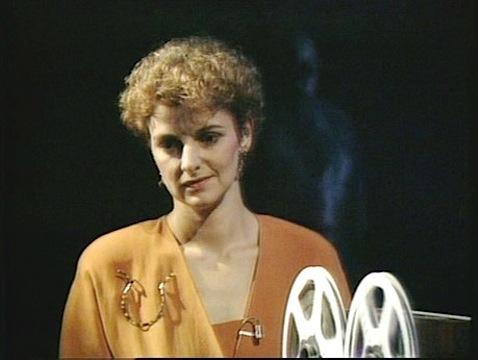
The tale concerns a gaggle of laddish, wisecracking scientists who are in the process of moving into their new research facility in a partially renovated and reputedly haunted mansion called Taskerlands. The scientists are apparently trying to develop a new recording medium to wrest the cutting edge away from their Japanese competitors. But the only female member of the team, a computer programmer named Jill who is also evidently somewhat psychic, almost immediately sees a ghost in the unrenovated portion of the mansion, and shortly afterward, the male members of the team all hear bloodcurdling screams emanating from the same area. It comes to light that the ghost is very likely that of a maid named Louisa who died by falling down the stairs many years before, and that the part of the house that’s home to the ghost is also exceedingly old, perhaps dating back to the era of the Saxons.

While the entire team is disturbed by the haunting, they’re also quite curious and keen to use their state-of-the-art research equipment to record and study the mysterious phenomena. After much theorizing and jiggery-pokery, they figure out that the stone walls of the old room are acting as some sort of crude recording device that takes impressions of extreme emotions that occurred in the room, but that instead of just recording like one of those newfangled magnetic tapes, the mechanism is actually dependent upon the sensitivities and emotional states of the living people present, i.e. that the humans witnessing the haunting are analogous to amplifiers for the titular “stone tape.”


The scientists are quite intrigued by this hypothesis, hoping that it might be a scientific breakthrough that can put them ahead of their technological rivals. But the more they try to get the phenomena to perform for their tests, the more frustrated they get, until at last it seems that they have accidentally erased the recording of Louisa’s death, and most of the team decide to abandon the project, since they believe the “haunting” is gone.

Jill, though, isn’t having it. Being more sensitive than the men, she feels there may be something deeper lurking at Taskerlands, hypothesizing that Louisa’s ghost might have been only the top layer of the recording, and that older recordings might have been overlaid by the most recent one. Bolstering her theory is a local priest, who informs her that an unsuccessful exorcism was performed on the land in 1760, before the house was even built, suggesting that the land has been haunted for far longer than anyone thought. She also has a frightening episode in which she hears and feels a malevolent presence, but no one else hears it.

Jill tries to tell the remainder of the team about her discovery, but no one wants to listen, and her friend and director of the project Peter Brock tells her to take a two-month leave because he thinks she’s losing her marbles. Before she leaves, though, she goes in the room one last time, and is summarily killed by the entity. The men find her later, her eyes frozen open in terror.

In a final little “fuck you,” Brock informs the authorities that Jill was emotionally unstable, and he shreds all the research she was doing that showed that the evil presence might have been there for seven thousand years. But Jill gets some small measure of revenge from beyond the grave when Brock goes into the haunted room at the end and is subjected to the most recent recording: Jill’s voice screaming his name before her death and begging for him to help her.

I have to admit, I didn’t like this one quite as much as Something Evil, but it was still an entertaining sci-fi ghost story that was a bit heavier on the sci-fi than the ghosts. The acting was a tad stagy, and the beginning of the film almost felt like a Vaudevillian routine, but that’s to be expected for a British teleplay of this era, and once it moved past that, it was a fairy effective scare-fest, though also like a lot of films of the time, it takes a while to get where it’s going, and the full impact of the story doesn’t come to fruition until the final couple of minutes.

If you liked The Legend of Hell House but thought it needed more focus on the haunting machine, then you’ll probably love this, as it’s a pretty similar concept, and in fact, the hypothesis that ghosts are simply recordings of past events that have somehow been captured by surrounding materials is still known in paranormal circles as the “stone tape theory.” I’d also recommend it if you liked the Quatermass movies or other 70s British sci-fi horrors, such as The Asphyx (which I wrote about here) or The Projected Man (which made a fantastic MST3K episode).

That’s all for now, minions! Keep it creepy, my friends. Goddess out.

13 O’Clock Episode 41 – The Dark Side Haunting, From the Files of Ed and Lorraine Warren

In 1978, Bobby and Addie Wilcott bought an old New England house to fix up. Little did they know that a few decades later, enough creepy shit would happen in their humble abode to warrant a pretty damn good episode of A Haunting titled “The Dark Side.” The haunting started small — doors opening and closing by themselves, a broken player piano suddenly belting out tunes willy-nilly — but eventually cockroaches, child endangerment, and the Warrens got involved. On this episode, Tom and Jenny return to their discussion/review of A Haunting episodes, talking about the re-enactment itself, and also taking another opportunity to talk about the Warrens, because you know how we always have fun doing that. Spray around some odor of sanctity and enjoy episode 41.

Download the audio file from Project Entertainment Network here, or watch the YouTube version here. Also, don’t forget to follow the 13 O’Clock Podcast blog, subscribe to our YouTube channel, like us on Facebook, and follow us on Twitter.

13 O’Clock Episode 39 – The Haunting of Summerwind

Some of our listeners might remember the episode of the TV show A Haunting which was titled “The Haunting of Summerwind.” The house called Summerwind, in fact, is better known as the Lamont Mansion, and a bunch of spooky legends surround the place. Even though the house was destroyed by fire in 1988, ghost hunters in Wisconsin still claim that the area is haunted, and on this episode of 13 O’Clock, Tom and Jenny not only discuss the history and stories about the Lamont Mansion, but also how the facts differ from the episode of A Haunting (which, incidentally, is Tom’s very favorite episode of the show). We also discuss our feelings about other paranormal shows currently on the airwaves.

Download the audio file from Project Entertainment Network here, or watch the YouTube version here. Also, don’t forget to follow the 13 O’Clock Podcast blog, subscribe to our YouTube channel, like us on Facebook, and follow us on Twitter.

My New Book “The Unseen Hand” is Now Out in ALL Formats!

Heads up, poltergeist pals! My latest tome, The Unseen Hand: A New Exploration of Poltergeist Phenomena, is now available from Amazon in print, ebook, AND audio book formats! It’s an exhaustive compendium of over one hundred recorded poltergeist cases throughout history and across the globe, summarized and analyzed for your spooky reading pleasure. Please obtain a copy tout suite, and if you’d be so kind as to write a review if you like it, I would be most appreciative. If you’re still not convinced, read the blurb below the cover art and then just tell me you don’t want to read it. YOU WANT TO READ IT.

Do it.

Goddess out.

UnseenHandCover_Ebook

Rapping on the walls. Mysterious rains of stones. Furniture moving around by itself. Phantom voices. Unexplained fires. Invisible assaults. The symptoms of poltergeist activity are well known, but what is a poltergeist, really? Is it some type of demon, or an angry spirit whose only mission is to cause mischief and destruction? Is it the unconscious energy of a troubled living person, somehow affecting the environment from a distance? Or could it all be simply fraud or misidentification? In this comprehensive book, well over one hundred cases of poltergeist activity, from the first century to the present day, are summarized and examined. All the best-known cases are presented, from Borley Rectory to the Bell Witch, from the Great Amherst Mystery to Gef the Talking Mongoose, from Rosenheim to Tina Resch, from Enfield to the Entity. A large selection of fascinating and lesser-known accounts from all over the world are also included, and all contain testimony of the most eerie and extraordinary events. In addition, the book contains in-depth discussions of distinct patterns, stages, and theorized causes of poltergeist phenomena, drawing from some of the best research in parapsychology, neuroscience, and quantum mechanics, as well as a skeptical perspective to provide a grounded overview. The Unseen Hand is the ultimate, one-stop shop for readers interested in poltergeist disturbances throughout history and the theories behind what causes them.

13 O’Clock Episode 20 – Hauntings and Poltergeists with Parapsychologist Steve Mera

Happy 2017! On this first episode of the new year, Tom and Jenny have a very special guest, parapsychologist Steve Mera. Steve has been in the field for more than 30 years and has investigated hundreds of paranormal cases. Jenny even co-authored two books with him about two of his most fascinating investigations, The Rochdale Poltergeist and House of Fire and Whispers: Investigating the Seattle Demon House. On this episode, he talks about both those cases, as well as his career in the paranormal in general, including the differences between poltergeist infestations and hauntings, and what he thinks of popular “ghost hunting” shows. Tune in and enjoy the science behind the spooky.

Download the audio file from Project Entertainment Network here, or watch the YouTube version here. Also, don’t forget to follow the 13 O’Clock Podcast blog, subscribe to our YouTube channel, like us on Facebook, and follow us on Twitter.

We Don’t Want to Give Anyone Sleepless Nights: An Appreciation of “Ghostwatch”

As you can see, I’m finally getting a chance to do another long-form horror writeup on this here blog, after weeks of being buried under the writing of a new book (which will probably be titled The Unseen Hand: A New Exploration of Poltergeist Phenomena; more details to come) and the work of keeping up with our weekly 13 O’Clock podcast (which you should check out here, if you haven’t already). Oh, and we have shirts too!

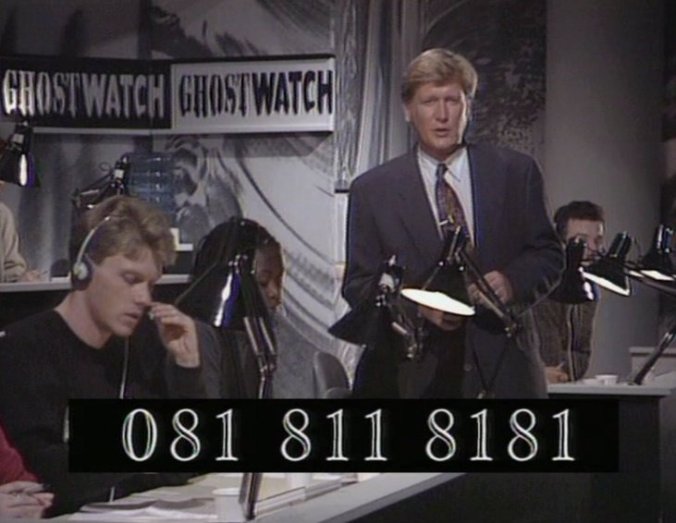
Anyway, I had been itching to get around to seeing Ghostwatch for a while now, since I had noticed it on so many “Best Haunted House Movie” lists and since I had heard a little bit about the uproar it caused when it was aired. If you don’t know, Ghostwatch was broadcast by the BBC on Halloween night 1992, and it was presented as an actual live program of a poltergeist investigation, complete with actual BBC TV personalities (Michael Parkinson, Mike Smith, Sarah Greene, and Craig Charles) playing themselves, and a real phone number that viewers could presumably call while the show was going on.

ghostwatch-1992-002-presenter-open-line

However – PLOT TWIST – the show was actually a fictional teleplay that had been recorded weeks before; anyone who called the phone number during the ostensibly “live” show heard a prerecorded message explaining that the show was fictional, and then prompting the caller to record their own personal experiences with the paranormal to be used at a later date.

Much like Orson Welles’ infamous War of the Worlds broadcast, apparently a shit-ton of viewers did not get the memo that the show wasn’t real, and understandably were concerned, and then totally wigged out, as they watched some of their favorite Beeb presenters being terrorized by an increasingly violent haunting occurring on live television. Adding to the realism was the rather clever conceit of callers during the show complaining of paranormal activity like stopped clocks and inexplicably broken glass happening in their own homes as the program progressed, giving the whole affair the feeling that it could get you too.

ghostwatch-3-presenters

In these more cynical, post-Blair-Witch times of meta-fictions, “found footage,” and mockumentaries, it’s probably hard to imagine how so many people could have been fooled by the BBC’s inventive little Halloween prank (though even in 2012, many dumbasses fell for that fake-as-shit mermaid documentary on Discovery, so maybe we can’t judge too harshly). I gotta say, though, even though I saw Ghostwatch in 2016 with the benefit of hindsight and knowledge of the film’s origins, I can kinda see why some folks were confused (well, at least until the end). Ghostwatch did seem, at first, to be a pretty standard, somewhat larky British chat/investigative program of the time (much like the popular CrimeWatch show that it was based on), and the movie even threaded in some cunning little details like lost video feeds, dead air time, prank and drunk callers, and other little glitches that made it seem like an actual live broadcast.

In brief, the film detailed an investigation of an allegedly haunted house in Northolt, London. The home was occupied by a single mother named Pam Early and her two teenaged daughters Kim and Suzanne, and it’s clear that the family dynamic and the phenomena on display was a direct reference to the Enfield haunting (and in fact Guy Lyon Playfair, who had been on the Enfield investigation and wrote a book about it called This House Is Haunted, worked as a consultant on Ghostwatch, so the similarities should not be surprising). Children’s show presenter Sarah Greene and comic relief broadcaster Craig Charles were on site at the house, while the serious and seemingly trustworthy Michael Parkinson acted as the main in-studio host (chatting with a parapsychologist named Dr. Pascoe, played by Gillian Bevan). Mike Smith, Sarah Greene’s real-life husband and a popular presenter in his own right, manned the phones and gave ongoing reports on the public’s reactions to what was unfolding before them.

Although the film is obviously a little dated now, it’s actually still pretty damn effective, and I can imagine how much more effective it would have been if you were watching it without having any idea that it was all staged. The performances are all fairly naturalistic, and the manifestations of the paranormal are rolled out slowly, realistically, and rather subtly (again, at least until the end).

The movie messes with the viewer in myriad ways: for example, a piece of footage shown at the beginning of the program that ostensibly shows the two girls in their bedroom being assaulted by weird banging sounds and a couple of flying objects becomes a bone of contention when, later in the show, callers to the program start insisting that they saw a dark figure standing in the shadows of the girls’ room. As the calls pile up, the parapsychologist asks if they can replay the footage to see what the callers are talking about. Parkinson eventually replays it, and yeah, there does seem to be a dark figure there, maybe, even though you are quite sure you didn’t see it the first time. But both the parapsychologist and Parkinson claim they don’t see anything. Then they rewind the tape and play it again, and now, there’s nothing there. The parapsychologist then draws a little doodle on the screen showing where she thinks a shadow on a curtain is making people see things, but she draws it in a slightly different place to where we think we saw the figure. Very sneaky indeed.

There are other great little moments like that. All the real TV presenters do a believable job of treating the whole thing as a bit of a laugh at first, and Michael Parkinson gets pretty riled up at one point when the camera crew at the house catches one of the girls faking the mysterious banging sounds they’ve been hearing off and on (which is supposedly coming from the poltergeist that the family has dubbed Pipes). Parkinson is huffy and just wants to end the whole show after that happens, but the parapsychologist starts arguing that just because the girl was caught faking doesn’t mean that some of the other manifestations aren’t real, because she (meaning Dr. Pascoe) has been to the house and investigated it herself, and saw many inexplicable things that could not have been faked by the children. This also had parallels with the Enfield case (where the girls were caught faking a couple of times), as did the tape the parapsychologist plays in the studio which is supposedly a recording of one of the girls speaking in a creepy spirit voice (Enfield focus Janet Hodgson would often speak in the gruff voice of an old man who said his name was Bill). There was also the nice touch of a pooh-poohing skeptic from the real-life organization CSiCOP appearing on satellite feed and denouncing the whole thing as a fraud.

I also enjoyed the slow-burn buildup of the story behind the house’s haunting, and the eerie details that emerged when neighbors and people on the street got interviewed by the jocular Craig Charles. Bystanders mention missing girls from the neighborhood, beheaded pregnant dogs found in the playground, and the possibility that the street was once the home of a murderous “baby farmer” (who I’m guessing they modeled after infamous serial killer Amelia Dyer).

Best of all, though, was the way they treated the actual ghost, Pipes, with such subliminal deviousness. According to most internet accounts, Pipes actually appears in the movie eight or nine times, but on my first viewing, I only caught a glimpse of him once or twice, and I wasn’t even completely sure of those. I actually had to go back and check for the other instances, because I had missed him completely. Hell, a few times he was only put in there for three frames, so you would have had to have been watching with an eagle eye to spot him at all. I liked this trope a lot, because it meant that the movie was trying to creep you out without really showing anything that your brain registered consciously. Pipes was always a did-I-just-see-that flash in a mirror as a camera panned across, or a subtle shape in the background that could have been anything, or an uncannily grinning dude behind someone else in a crowd scene who you would barely notice was there. It was actually pretty genius.

3

Pipes was only visible here if you brightened your TV screen, for instance.

Now, it should be said that if you watched this “live,” you could be forgiven for thinking it was real until the whole thing went a wee bit over the top as it got nearer to the end. While I loved the concept of the television show itself acting as a “nationwide séance” that was causing paranormal havoc in the homes across the UK that were viewing it, as well as in the studio itself (giving it yet another layer of meta-ness), I felt like it would have been more effective if they had reined it in a tad. That said, the final shot of Michael Parkinson wandering around the darkened and apparently abandoned studio and then talking in that creepy voice as though he had also been overtaken by Pipes, was actually pretty well done.

And you know I couldn’t get through this review without mentioning the unintentionally hilarious tidbit that the scary closet under the stairs where Pipes allegedly lived was referred to throughout the show as the “glory hole.” I’m sure British people of today are aware, but WOW, that phrase has a REALLY DIFFERENT connotation in America. Heh.

All in all, I thought Ghostwatch was a really entertaining and subtly unnerving film that was WAY ahead of its time in terms of its willingness to fuck with its audience in such a clever way, making the viewer complicit, as well as making a broader statement about the believability of media in general. While this theme is old hat nowadays, it was pretty subversive for 1992, and the viewing public’s reaction to the broadcast tells that tale pretty adequately, I think: 30,000 calls to the BBC during the program’s runtime, thousands of complaints pouring in for weeks afterward (mostly from people pissed off that they had been duped by presenters they had grown to trust), a couple claims of children watching it and developing PTSD because they thought it was real, and one sad case of a mentally disabled boy taking the whole thing far too seriously and committing suicide a few days after it aired. The BBC was actually forced to issue an apology, and never broadcast the program again. It developed something of a cult following in the ensuing years, though, and was eventually released on DVD. There was even a documentary made about it in 2013, and to this day, fans of the movie have an annual ritual where they all watch their copy of the movie at 9:25pm on Halloween night to see if they can actually bring about that fabled “nationwide séance” thing for real. It doesn’t appear to have worked so far.

I would definitely recommend Ghostwatch for fans of more subtle psychological horror and found-footage type stuff, but try to approach it from the perspective of the time to really appreciate it. That’s probably hard to do if you can’t remember a time when Blair Witch wasn’t a thing, and I guess it’s also hard if you’re not British and don’t understand the subtle mindfuck of seeing actual famous TV presenters messing with your head like this (the American equivalent might have been Walter Kronkite doing what appeared to be a serious documentary in which he at one point gets kidnapped by a sasquatch), but give it a shot and I think you’ll enjoy it a lot more.

Until next time, keep it creepy, my friends. Goddess out.

13 O’Clock Episode 12 – The Enfield Poltergeist

On the even dozenth episode of 13 O’Clock, Tom and Jenny have an in-depth and “spirited” (heh) discussion about what is probably the best-known poltergeist case of modern times, that of the Enfield Poltergeist from 1977.

The story of the Hodgson family and their bizarre encounter with the paranormal (or the shameless hoaxing by Janet Hodgson, depending on your perspective) has been the subject of numerous documentaries, a kick-ass book called This House Is Haunted by Guy Lyon Playfair, a British miniseries called The Enfield Haunting, and the recent Hollywood horror film The Conjuring 2.

Your favorite podcasters separate the wheat from the chaff, the fact from the fiction, and along the way give a shout-out to late parapsychologist Maurice Grosse, who spent over a year with the family investigating the disturbances, and kinda throw some shade on demonologists Ed and Lorraine Warren, who said they were involved in the case but really only showed up uninvited for like five minutes.

Flying toys! Flipping furniture! Floating children! A little girl saying all kinds of creepy shit in an old man’s voice! It’s all here on this entertaining exploration of the Enfield Poltergeist.

Download the audio file from Project Entertainment Network here, or watch the YouTube version here. Also, don’t forget to follow the 13 O’Clock Podcast blog, subscribe to our YouTube channel, like us on Facebook, and follow us on Twitter.