Karen Black at the Black House with the Black Fence: An Appreciation of “The Strange Possession of Mrs. Oliver”

You know how sometimes when you’re bored and kinda hung over on a Sunday, and you go poking around YouTube looking for some comforting 1970s horror to watch while you inhale your hearty lunch of homemade Swedish meatballs? And you know how every now and then, you fortuitously stumble across a made-for-TV movie from 1977 that you hadn’t heard of, and how sometimes that movie was written by Richard Matheson and starred Karen Black? Isn’t that fucking rad when that happens? I’m here to tell you that it is quite rad.

The Strange Possession of Mrs. Oliver is evidently something of a forgotten gem from the late 1970s, and despite its pedigree, hasn’t really gotten a great deal of attention; hell, I don’t think it’s ever even been released on DVD, at least in the U.S. The version I saw on YouTube had been transferred from a battered old VHS tape of the original telecast. It’s kind of a shame, because although this isn’t Matheson’s or Black’s best work, obviously, it’s still a really eerie mystery with a twist ending that totally blindsided me, which is not an easy thing for an ending to do.

Karen Black plays Miriam Oliver, an unhappy housewife straining under the controlling behavior of her buttplug husband Greg (George Hamilton), a hotshot lawyer who apparently wants nothing more than a wife who will dress like a Mormon schoolmarm, pump out babies at his command, and never leave the house or question his authority for any reason whatsoever.

As you might expect, Miriam is getting pretty resentful of the fact that she’s not allowed to work or go to college, and that Greg is pressuring her to have a child before she’s really ready (side note: Miriam’s character in the movie is supposed to be 26 years old, though Ms. Black was at least ten years older than that when this was filmed). She starts to rebel in little ways, like continuing to take her birth control pills on the sly; most significantly, she goes to the mall one day and is drawn to purchase a tight, low-cut red blouse, a blonde wig, some red lipstick, and some snazzy hoop earrings. She puts all the stuff on and is both enthralled and terrified by the fact that she looks like a completely different person. She even starts to act differently when she has her “costume” on, though of course Greg doesn’t really get it and thinks Miriam is losing her marbles. He does kinda try to be understanding, but it soon becomes apparent that Miriam is having a true identity crisis, and may in fact be “possessed,” just as the title of the movie suggests.

See, I neglected to mention that at the beginning of the film (and one other time subsequently), Miriam has been having these really creepy nightmares of attending a funeral and looking into the coffin, only to see herself lying there. She also has recurrent visions of fire, a small bouquet of dark purple or black flowers, and the sounds of a dog barking and a woman screaming. She also keeps seeing a dude with a gray sweatshirt and a sweet pornstache who drives a red pickup truck that inexplicably says “gasoline” on the side. Hmmmm.

On a whim, Miriam rents a cottage on the beach without asking her husband’s permission. He’s pissed, but after he sees how upset she is and how badly she wants it, he agrees that maybe they should rent a beach house so she can get away for a while, but of course he’s going to be the one to pick it out, because he can’t let her have one single thing. He also makes her an appointment to see a psychiatrist, and she seems relieved and compliant, though she tells him she wants to go to the appointment by herself, since he has to go out of town for a trial anyway.

Of course she skips out on the appointment, and instead puts on her slutted-up garb and heads for the beach house. A dog starts following her around, and seems to know her. She ducks into a bar in town, and as she does, she decides that because she has a new identity, she should have a new name. She sees a sign with the word “sandy” on it, and decides to call herself Sandy.

But oddly, as soon as she sits down at the bar, the surprised bartender addresses her as Sandy and asks where she’s been. Freaked out, she says her name is really not Sandy, but the bartender says she looks just like Sandy, a girl who always used to come in there. Even the drink she orders is the same one Sandy drank all the time. The bartender asks the two other shadowed figures at the bar whatever happened to Sandy, and one of them says that she moved away.

Then Miriam sits at a table near the dance floor to enjoy her drink, and who should sleaze up to her but Mr. Sweatshirt von Pornstache, the guy from her dream. She’s afraid of him, as well she should be, because he is crawling all up in her space, insisting she really is Sandy and she needs to stop lying about it. He won’t fuck off when she tells him to, but luckily Miriam is rescued by an extra from Saturday Night Fever, who asks her to dance. She tells him she can’t really dance, and indeed, at first she’s all awkward and shit, but then she finds her groove and starts disco-ing like a champ, just like those chicks on “Solid Gold.” Naturally, this makes Pornstache even more suspicious, because of course the way she dances is exactly the same way that Sandy used to.

So Miriam is getting more and more wigged out (pun very much intended) because Pornstache keeps stalking her around town, and she has the funeral dream again while she’s at the beach house, only this time the dream ends in a huge conflagration, through which Pornstache leers menacingly at her.

Now, I know what you’re thinking, because I was thinking the same thing, but I can assure you that what you are thinking is not actually what’s going on. And if you don’t want the ending spoiled, you might want to stop reading at this point. YOU HAVE BEEN WARNED.

So, you are thinking, as I was, that Pornstache killed Sandy by burning her house down, and that Sandy’s ghost is possessing Miriam, right? I mean, the word “possession” is right there in the title.

This is not what is happening. Kinda close, but much weirder.

So Miriam gets back into her regular Mormon drag, realizing that hubby Greg is gonna be home from his trip soon and she’d better skedaddle back to the unhappy homestead. But the dog that’s been following her won’t get out of her car, and finally she gets exasperated and asks a neighbor who the dog belongs to. He says it’s Mrs. Dempsey’s dog, and that Mrs. Dempsey lives a couple blocks away in “a black house with a black fence.”

Again, I know what you’re thinking. It’s a black house because it’s all burned, right? And Mrs. Dempsey is Sandy, and Sandy’s dead, right? WRONG. We really need to quit trying to guess how this is going to end, you guys. When Miriam finds the house, it’s just a regular un-arsoned house that for some reason is entirely painted black.

An old woman answers the door and says that yeah, the dog belongs to Mrs. Dempsey, who is away until later that evening. This woman is just house-sitting, apparently. The old woman calls the dog Henry, which freaks Miriam out for some reason, and then she’s freaked out even more when she sees one of those pots of black flowers on the windowsill. Then, as she’s leaving, she glances through a window of the house and sees a painting of a girl who looks very much like her, with blonde hair, a tight red blouse, and hoop earrings. Miriam loses her shit and asks the housesitter woman who the girl in the painting is, but the old woman doesn’t know. She says that Miriam should come back after seven and talk to Mrs Dempsey, so Miriam resolves to do just that. By the way, Pornstache has been lurking around this whole time, so there’s also that.

Miriam then passes another neighbor, and asks if Mrs. Dempsey had a daughter. The guy doesn’t really remember at first, but then he says that he thinks he recalls someone mentioning that Mrs. Dempsey indeed had a daughter who died five years before. AHA!!! See, Sandy IS dead!!! WRONG AGAIN. I TOLD YOU TO STOP TRYING TO GUESS.

Meanwhile, back at the Greg Oliver Prison for Matronly Breeder Wives, hubby has returned from his business trip and is calling around to try to find out where his errant wife has gotten off to. He finds out that she skipped her shrink appointment, and surmises, correctly, that she probably went to her beach house. So he heads on over there in order to give her a good talking-to.

Miriam, still being tailed by Pornstache, returns to the Dempsey house, and here’s where the big bombshell finally comes to light. Mrs. Dempsey answers the door and sees Miriam there, her face partially in shadow. She seems REALLY cheesed off, accusing Miriam of playing a sick joke on her. Mrs. Dempsey asks who she is, and when Miriam says her name, Mrs. Dempsey is all FUUUUUUUUUUUCK YOOOOOOOOOOOOU. Then Mrs. Dempsey turns on the porch light, sees Miriam’s face properly, and calls Miriam Sandy. Miriam protests, and asks about Mrs. Dempsey’s dead daughter in the painting. Mrs. Dempsey says that the painting isn’t of her daughter, but is a portrait that her daughter painted of her best friend Sandy. “THIS IS MY DAUGHTER,” Mrs. Dempsey shrieks, thrusting a framed photograph at Miriam. “THIS WAS MY DAUGHTER MIRIAM.” And right there in the photo is matronly Miriam, complete with librarian bun and giant seventies glasses.

What in the Samuel Langhorne HELL is going on here, you may wonder? Okay, pay attention. Five years before, Pornstache (whose real name is Mark) was supposed to marry Sandy, but she broke up with his ass and he didn’t take it too well. One night when Sandy and Miriam were at Sandy’s house, Pornstache showed up and set Sandy’s car on fire. The fire spread to the house. Sandy got away, but Miriam and Sandy’s parents died in the blaze.

So basically, the Miriam we’ve been following through this whole movie really WAS Sandy the whole time. She just felt so guilty that Miriam had died because of her that she dissociated and took over Miriam’s identity. As Miriam, she met and married Greg, and only after several years did fragments of her actual identity start filtering back to her. That was why, at the beginning of the movie, that “Miriam” kept telling Greg that she felt suffocated and that she wanted to be her “real self,” though she couldn’t articulate to him who that was. Deep down she knew she was really party-girl Sandy, but Greg had only ever known her as staid, conservative Miriam. So there you have it. No possession, no ghosts, nothing supernatural at all.

At the very end, Pornstache tries to kill Miriam/Sandy, but she is saved when Greg arrives just in the nick of time. She tells him who she really is, and he seems surprisingly okay with it, unless he’s simply planning on calling the men with the butterfly nets after the credits roll. That seems like the kind of dick move he would pull.

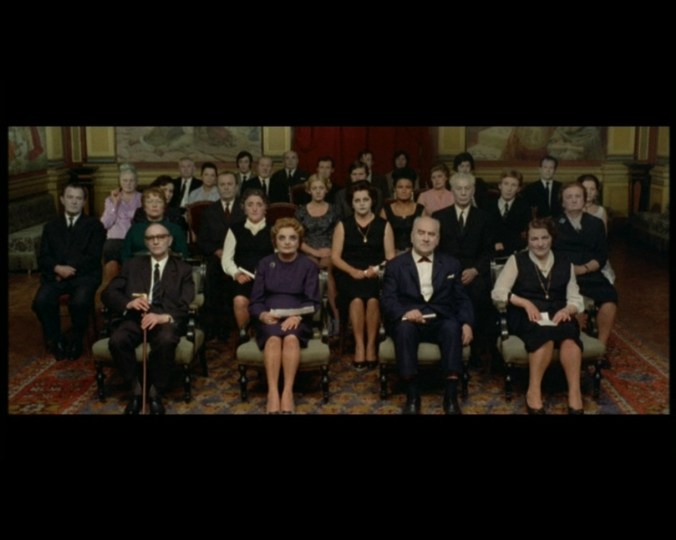
Gotta say, I really enjoyed this quite a lot, and I don’t think that was just the remnants of last night’s alcohol talking. The funeral scenes in particular were eerily surreal and creepy as hell, and the whole thing, while rather slow-moving, was intriguingly spooky and mysterious. Karen Black was absolutely great as the unstable Miriam, and George Hamilton was appropriately assholish, without seeming like a cartoon villain. And as I said, the ending, when Mrs. Dempsey handed Miriam the picture of herself, literally made my jaw drop. I didn’t even care that the whole “possession” title was a misnomer; I was just so pleasantly shocked by this bizarre twist that I did not see coming in any way, shape, or form.

Fans of Karen Black, Richard Matheson, and eerie 70s mysteries would do well to give this a chance, and hopefully someday it will get a proper high-quality release, because it really is quite a good example of made-for-TV horror from that golden decade. It was a total accident that I came across it, but as Bob Ross would have said, sometimes there are happy accidents. 🙂

Until next time, keep it creepy, my friends. Goddess out.
Hulu Horror Double Feature: The Inhabitants and Wax

It’s another lazy Saturday afternoon, my horror honchos, and that means it’s time for another random double feature to while away the weekend hours. Today’s mix was a pretty strange juxtaposition, I gotta say, but it ended up a generally better viewing experience than last time, so let’s jump right in. Oh, and I know I usually forget to say this, but there will probably be some spoilers ahead, though I’ll try not to ruin anything completely.

the-inhabitants

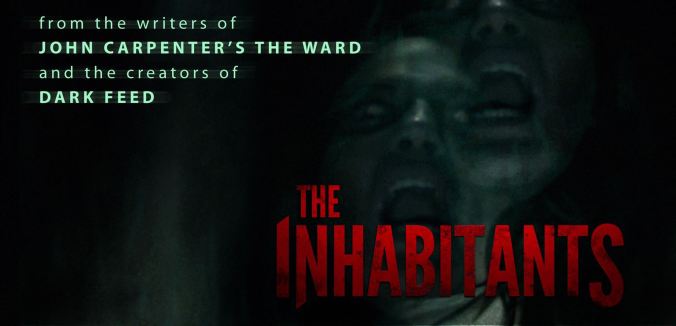
First up, The Inhabitants from 2015, directed by Michael and Shawn Rasmussen. Hot damn, this was a good one. It had pretty much everything I like: a spooky old house in New England, an atmosphere of increasing dread that never showed too much or went too far over the top, and best of all, Salem witches, you guys! Yay, I love witches!

The setup of the story is simple in the extreme. Jessica (Elise Couture) and Dan (Michael Reed) are a young married couple who decide to purchase the March Carriage Bed and Breakfast when the elderly folks who previously owned it died (in the husband’s case) or got sent to a nursing home (in the wife’s case). One thing I should point out that gave this movie an added bonus of historical eerieness is that the house where it was filmed actually once belonged to the Reverend Samuel Parris, whose daughter and niece kicked off that whole Salem Witch Trial thing with their crazy accusations. Nice job, girls. 😦

the-inhabitants-2015-review-by-sandra-harris-654044

So, pretty standard creepy shit starts to go down once the couple get moved in; floorboards creak like someone’s walking around, some kinda menacing teenagers hang out in the woods like they’re watching the place, and so on. Jessica begins to research the history of the house so she’ll be able to tell their potential guests some interesting anecdotes, and it turns out that the house was once the home of a 17th-century midwife who was accused of and eventually hanged for witchcraft. The couple find a “gently used” birthing chair in the basement, to boot. Eeeewwwwwww.

The festivities don’t really begin in earnest until Dan is conveniently called away for a few days on a business trip, leaving Jessica in the house alone. I won’t spoil too much, but when he returns, he finds that Jessica has…changed, and not necessarily for the better.

the-inhabitants-di-1

The thing I loved most about this movie was its consistently tense, claustrophobic atmosphere. The house itself is so eerie and so effectively filmed that the whole movie just drips spookiness during its entire running time. I also liked the measured pacing of the film; steady, not in any hurry to get anywhere, but subtly ratcheting up the dread as it went along. Another thing I really liked was that everything was done through suggestion; there was no splashy gore, not many jump scares, and a lot of plot aspects were left ambiguous for the viewer to puzzle over. For instance, who installed those video cameras in all the rooms? What were those teenagers doing out in the woods, and exactly what were they planning to do when they broke in? What ultimately happened to Dan and Jessica’s dog Wylie? Where did the “children” originally come from, and why did they need to be “fed?” These questions are not answered outright, but it doesn’t matter; it all just adds to the overall ambience. I would recommend this film unreservedly to anyone who enjoys slow-burn haunted house flicks as much as I do; I thought it was really fantastic and effective.

wax-2014-spanish-horror

Next up was a film that was a whole different kettle of fish, and while I didn’t dislike it, it gave me a lot more mixed feelings than The Inhabitants did. Part found-footage, part torture porn, part self-referential homage, the 2014 Spanish movie Wax was directed by Victor Matellano and featured a bunch of genre-specific cameos, including Geraldine Chaplin (daughter of Charlie), Jack Taylor (who starred in some of Jess Franco’s films), and the voice of Paul Naschy. It was a fairly enjoyable movie on the whole, but I feel like it was a little unfocused and too long and drawn out to really ring my bell, if you know what I’m saying.

geraldine-chaplin-in-wax-2014

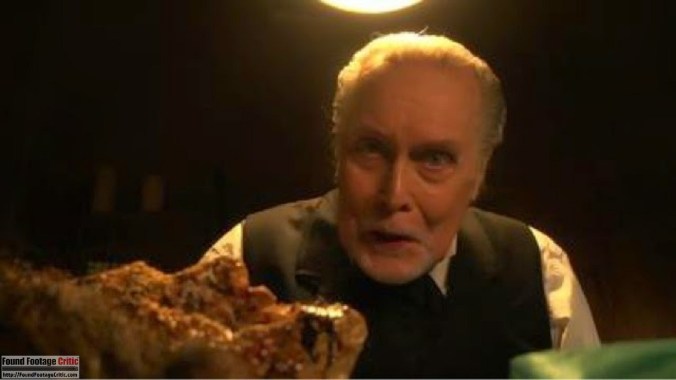
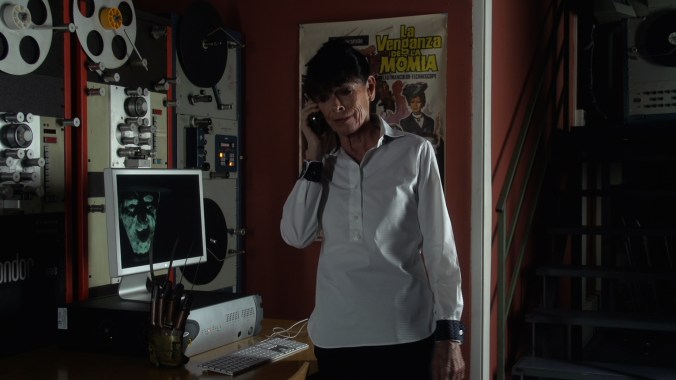
The conceit is this: Muppet-haired smart-ass and horror geek Mike (Jimmy Shaw) is hired by a TV producer (Geraldine Chaplin) to be locked into a supposedly haunted Barcelona wax museum overnight, and film a documentary-cum-reality-show while he’s in there. Interwoven with this narrative is the story of the subject of the museum’s newest exhibit—a notorious and cannibalistic serial killer named Dr. Knox, who had a thing for gadding about dressed like Vincent Price’s character in House of Wax and eating his victims’ internal organs while they were still alive.

wax-2014-fanart

So Mike is wandering around the dimmed museum, filming his reality show, and every now and then there’s an intercut of footage of Dr. Knox addressing the camera and describing whatever indignities he is visiting upon his current unfortunate victim. These interstitials are described in-film as being videos that were found in one of Dr. Knox’s hideouts after his arrest, and the museum has them playing on a loop near his wax figure. Fun for the whole family! These bits of the movie are actually fairly gruesome, but nothing to really put you off your lunch or anything, unless you’re super squeamish.

wax-2014-nude-victim

At about the halfway point of the movie, some paranormal-type stuff starts happening around the museum, like figures seemingly moving, props falling over, mysterious lights, and a red ball that is significant to the plot turning up in the darnedest places. Then, during one of Mike’s scheduled phone calls with the TV producer, it comes to light that Dr. Knox has escaped from prison, and wouldn’t you know it, Mike soon starts seeing him lurking around the museum and understandably begins to freak the fuck out.

One thing I will say about the found footage aspects of the film, is that I thought the trope was pretty effectively utilized here, especially near the end, when Mike is being pursued around the museum by Dr. Knox and only has that creepy green night-vision mode to see by. The museum itself, which I’m guessing is probably a real one, also looks terrific and suitably unsettling, especially in Mike’s POV shots, because you can really get the palpable sense that you’re walking through this spooky-ass place in the dark yourself.

wax-jack-taylor-hearse

But overall, I felt like the movie just didn’t hang together all that well, like it was trying to be too many things at once. And I was also left pretty confused by what was actually going on at the end of the thing. AHOY! SPOILERS AHEAD! Okay, so at the end, we’re led to believe that the TV producers had actually set the whole thing up, that Dr. Knox was not actually in the museum, and that they were deliberately trying to drive Mike crazy (or crazier) to make a good TV show. Were they actually planning for him to die of fright, or was that just a lucky side effect? Also, Mike’s wife and kid were killed by Dr. Knox? And he didn’t know it? I mean, he must not have known, because he didn’t seem any more squicked out by the Dr. Knox murder footage than a normal person would be. It wasn’t really made clear whether he even knew his wife and kid were dead, honestly. I mean, there was that one scene where he was kinda getting weirdly friendly with a wax figure of a prostitute and saying how much he missed his wife, but I thought that was because she had left him, like she said she was going to in that one flashback he had. If that’s not what happened, then what was the point of that brief flashback where she said she was gonna leave him? And when he showed the picture of his son Rob to the museum curator at the beginning, he referred to the kid in the present tense and didn’t act all sad or like the kid was dead or anything. So like, in light of the ending, were we supposed to interpret that as a symptom of his mental illness, or what? I just feel like that whole situation wasn’t conveyed effectively, and neither was the line between what was really in the museum, what was set up by the producers, and what was only in Mike’s imagination. It didn’t really ruin the movie or anything, but it was sort of frustrating nonetheless.

This one…eh, I could have taken it or left it. I wouldn’t really recommend it unless you think it’s the kind of thing you’d be into, but keep in mind that it’s kinda meandering and goes on way longer than it needs to. Not bad, but not great.

Until next time, keep it creepy, my friends. Goddess out.
Hulu Horror Double Feature: The Attic and Boo

I know it’s been a while since I’ve done one of these, but that’s mostly because my laptop and browser at home are so damn ancient that I can no longer watch Hulu on there. But I managed to wangle another computer that Hulu worked on, and I did it all for you guys. Considering the double bill I got handed today, though, I’m actually kinda sorry I bothered, but since I did, let’s soldier on to the reviewin’, shall we?

AtticCover

First up, The Attic from 2007. This one actually sounded pretty promising going in, as it was directed by Mary Lambert (of Pet Sematary fame) and starred a pre-“Mad Men” Elisabeth Moss. The description sounded like a fairly standard haunted house/evil twin tale, but I really like those, as regular readers will know, so I dived right in.

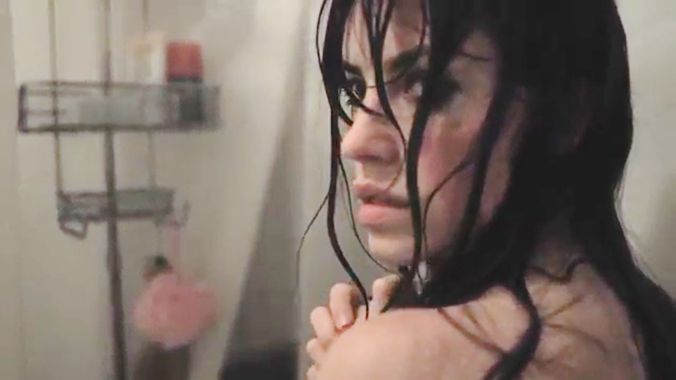
In brief, it’s the story of a college girl named Emma who moves into an old house with her mother, father, and mentally challenged brother (played by the screenwriter, Tom Malloy), and subsequently develops agoraphobia, an eating disorder, and a severe case of seeing creepy shit at every turn. The largest proportion of the creepy shit she sees is an apparition of a girl who looks just like her, except with ghostly makeup on. She becomes convinced that she had a twin sister named Beth who died twelve days after she was born, and she starts to believe that her parents killed Beth because she had a birth defect, and/or that they are into black magic and are trying to bring Beth back from the dead to kill her for some reason…? Aiding her in her investigation/delusion is a house-calling psychologist who may or may not be banging her mom, and Ridiculously Photogenic Paramedic/Police Detective Guy Who is Also Maybe a Real Estate Agent and Almost Definitely a Demon, I think? Emma gets crazier and crazier during the course of the film, and you kind of really don’t know if she actually is nuts or if her parents really are The Worst™, because they act like sketchy shitlords through most of the movie. Then you find out that yeah, Emma really is crazy and imagining everything, except maybe not because the house is doing it somehow, with the help of the low-rent James Dean demonic paramedic dude? Hell, I don’t know.


A few things. I really wanted to like this movie. I loved Elisabeth Moss on “Mad Men,” and I’m a fan of Pet Sematary as well. And I’m not gonna say The Attic sucked completely; I mean, I sat through the whole thing and it didn’t get on my nerves too much, and I was interested enough in the plot to keep watching until the end. But it had some really major problems. First off, the acting was really…let’s be charitable and call it “uneven.” Elisabeth was sort of okay, but kind of all over the place; you could tell what she was shooting for, but she wasn’t quite getting there and it was a tad off-putting. Catherine Mary Stewart was fine as her mom, but was only in a few scenes and didn’t make much of an impression. John Savage played her dad, and I don’t know what the hell was going on with him, because it was a really strange performance, just weirdly gruff and kinda dyspeptic. The retarded brother was all right, if just a shade on the overdone side. All in all, the cast didn’t really gel all that well, and it made for a really bizarre, uncomfortable dynamic throughout the whole film. I guess if you viewed it as entirely seen through Emma’s warped sensibilities, then it makes some kind of sense, but I don’t know if that was what the filmmakers intended, and it wasn’t obvious during viewing, so even if it was intentional, then it was not very well handled.

Also, the resolution of the plot was kind of lame, and didn’t really give a clue as to the true nature of the haunting, or whatever it was supposed to be. What exactly was in the house, why did it manifest itself the way it did, and what did the chisel-jawed paramedic fella have to do with all of it? Was he, like, a sorcerer, or what? How come the girl who had lived in the house thirty years previously also saw a ghostly döppelganger, just as Emma did, but then the girl who moved into the house at the end just saw the James Dean guy in the attic mirror? And if Emma had imagined everything about James Dean guy, then how come the gun he gave her was real enough to kill people with? It just made no damn sense.

So, in the aggregate, not a terrible film, but pretty dumb, disappointing, and kind of a hot mess. But little did I realize that The Attic would look like fuckin’ Shakespeare next to the following movie that Hulu barfed up for my weary eyeballs. Sigh…

boo.20800

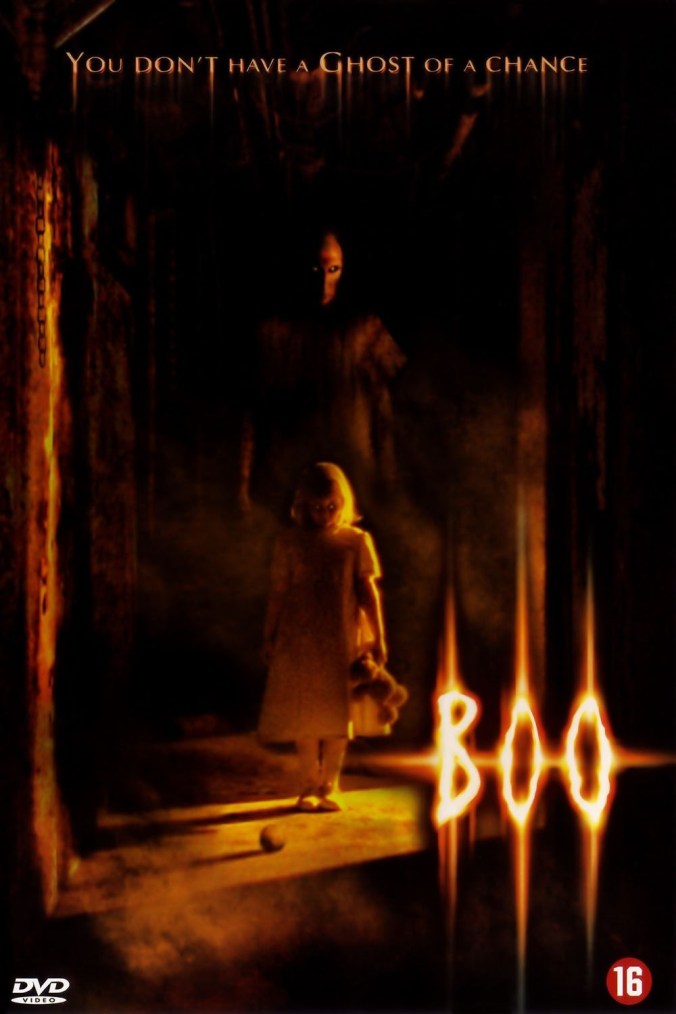
Boo came out in 2005 and was the debut film of a dude who used to write for Fangoria. You’d think that a guy like that would have a fairly firm handle on what makes a decent horror flick, but in this case, you would be tragically and utterly incorrect. In short, this was a run-of-the-mill teen slasher that was trying very hard to be a fun mashup of Scream, Halloween, Night of the Demons, and Session 9, but just ended up falling flat on its face with wildly inconsistent acting, a stupid and unnecessarily convoluted concept, bad CGI, and a plot that dragged out longer that Berlin Alexanderplatz.

Just recapping it here is making me tired all over again, so I won’t really go into many more details except to say that it concerns a bunch of dumb-ass college students who go to spend Halloween at an abandoned mental hospital that’s supposed to be haunted. You can probably guess what’s gonna happen from there. The only highlights of the film were the copious amounts of drippy gore, a brief cameo by Dee Wallace Stone as a nurse, and the sadly underdeveloped subplot of the grizzled cop character who had once starred in a series of blaxploitation films under the name of Dynamite Jones. I actually wished I had been watching one of his movies—particularly Count Pimpula—instead of this irritating, overlong bullshit. Meh.

And that’s all she wrote for another Hulu double feature installment. Until next time, keep it creepy, my friends. Goddess out.

I Will Be at Gods & Monsters in Orlando This Saturday!

$_57

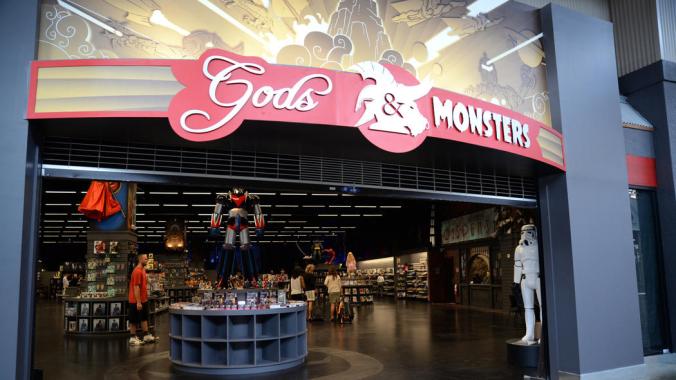
Deep down in your heart of hearts, you’ve always known that your life could not be complete until you had seen the Goddess in person and purchased one of her delectable and terrifying tomes right from the source. Well, all of your fevered prayers have been answered, because I will be making an appearance at the Gods & Monsters First Anniversary Event this Saturday, June 11th, starting at 11:00am! Come on down to the Artegon Marketplace at 5250 International Dr, Orlando, FL 32819. Lots of my books will be for sale, and there will be a ton of other authors, artists, and other vendors hawking their wares, plus workshops, gaming tournaments, a costume contest, and much more! Gods & Monsters is a fantastic, HUGE venue with a bar in back, and you’ll want to stay all day and get your nerd on. See all my central Florida peeps there!

os-pictures-gods-monsters-opening-at-artegon-2-022


Insane People Seem to be Graced with Incredible Powers: An Appreciation of “God Told Me To”

A horrorific Monday to all of you fiends out there! I’ve returned once again to my favorite horror decade for today’s post, though I’m putting the gialli down for a brief rest so that I can discuss one of the weirder American horror flicks from the 1970s, one that I’d seen pop up on a lot of people’s “best underrated 70s horror” lists but had only just got around to seeing.

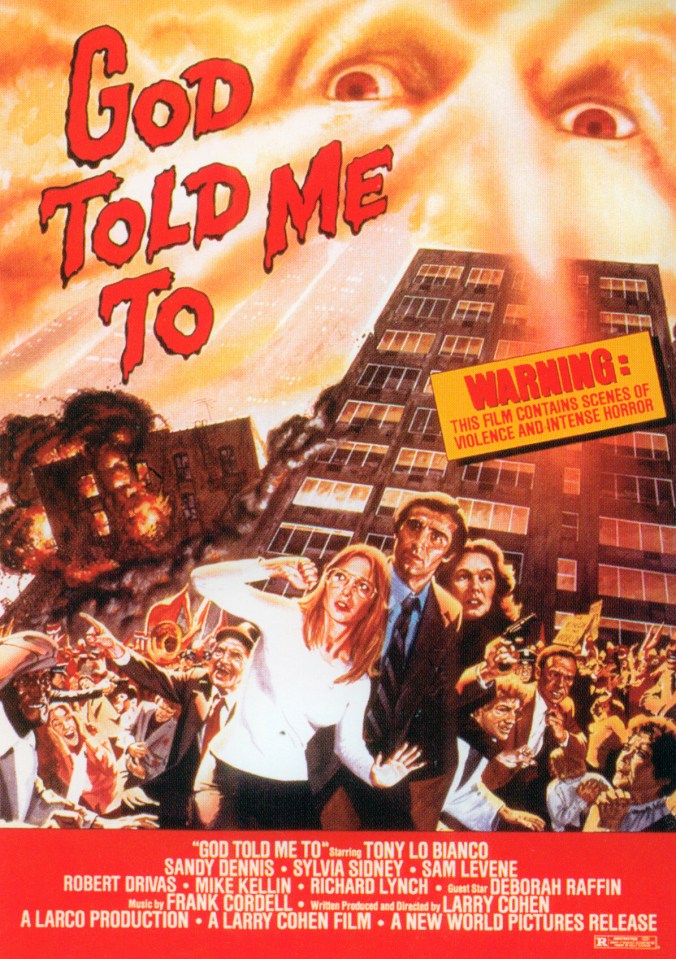
God Told Me To (1976) aka Demon

Directed by Larry Cohen

Shown: Poster Art

Larry Cohen is probably best known to horrorphiles as the director of the It’s Alive killer baby series, as well as a few other cult classics like The Stuff and Q: The Winged Serpent (and, it must be said, one of the better episodes of Mick Garris’s “Masters of Horror” series, the Fairuza Balk-starring “Pick Me Up”). But the film I want to discuss today is one of his stranger and more subversive ones, a film that actually had some pretty complex things to say about religious belief, violence, racial tensions, and gender fluidity. I’m speaking, of course, of 1976’s God Told Me To (also known as Demon, for some unfathomable reason).

The movie centers around New York City police detective Peter Nicholas (Tony Lo Bianco), who is investigating a bizarre series of crimes in which seemingly random people suddenly snap and go on mass killing sprees around the city, always giving the excuse that “God told me to,” right before they meet their own ends. You would think that this film, then, would progress something like a thriller or police procedural, and you’d be partially right, but honestly, if you’ve never seen it, I don’t think you could ever imagine the batshit directions this thing wanders off into. If you’d like to approach this movie cold, though, I suggest you not read any further here, as I’m inevitably going to spoil some key aspects of the plot. You have been warned.

godtold8big

Detective Nicholas lives with his girlfriend Casey (Deborah Raffin), telling her that his devout wife Martha (Sandy Dennis) will not let him divorce her, even though in reality it’s his own Catholic guilt that prevents him. It is his very conflicted faith that causes him to obsess about the ostensibly religion-motivated mass murders occurring regularly around New York, but as he delves deeper into the crimes, he discovers some mightily disturbing facts about the motives of the killers, and also that he himself might somehow be involved in what appears to be some mass hysteria or conspiracy.

godtold2big

And yes, that is indeed Andy Kaufman in his first film role!

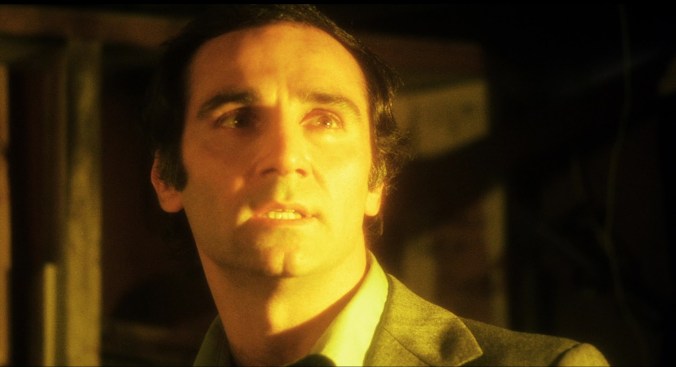
It turns out that all of the murderers had fallen under the spell of a mysterious, androgynous cult figure known as Bernard Phillips (Richard Lynch), who seems to have the power of mind control over his subjects. As Nicholas digs into Phillips’ murky past, he finds that Phillips’ mother was supposedly a virgin when she bore him, and further, that she had reported being abducted by a ball of light and subsequently impregnated by what amounted to extraterrestrials. After Nicholas locates the elusive Phillips in a dark basement ringed with flames (obviously a stand-in for Hell), he finds that Phillips wants to control him most of all, but cannot do it, for some reason he can’t fathom.

As the investigation goes on, Nicholas finds that Phillips’s history mirrors his own; the detective’s own mother was also knocked up by visitors from beyond the stars, and the only reason that Nicholas wasn’t aware of it was that his human genes turned out to be more dominant than the alien ones. In the final battle between the half-alien “siblings,” Phillips attempts to persuade Nicholas to impregnate him via a pulsating vagina in his abdomen, but Nicholas ain’t having none of that freaky extraterrestrial action and kills the being, repeating the mantra that “God told me to” when he is later arrested for murder.

god-told-me-to-1976

I have to say that this is probably the strangest of all the religion-themed horror flicks of the decade, and I haven’t even really scratched the surface of all the insane shit that goes on in this movie. The weirdest thing about it is that it isn’t lurid or funny at all; it’s played completely straight and serious, and is all the more unsettling because of it. God Told Me To is almost like a whacked-out mashup of Dog Day Afternoon, Rosemary’s Baby, Xtro, and the book Chariots of the Gods, and as such, it has many layers of satirical social commentary that are just as relevant today as they were in the 1970s. For example, what is the nature of religious belief, and is it detrimental to the individual and to society as a whole? What is God, and if God supposedly speaks to someone, who’s to say that what God says is right or moral? Where is the line between male and female, and does it even matter? These may seem pretty heavy questions for a little B-horror movie to be tackling, but God Told Me To does so with a surprisingly deft hand. The entire feeling the film evokes is one of a society teetering on the edge of chaos as conflicting forces—of good and evil, masculine and feminine, black and white—all clash in one enormous and yet insidious paroxysm of violence.

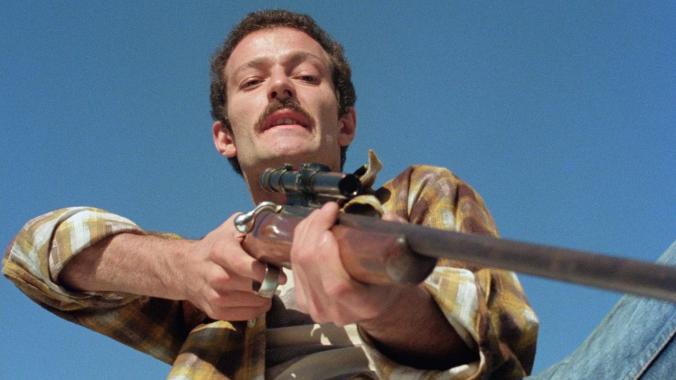
It also has some wonderfully frightening scenes, from the fantastic opener as a lone sniper atop a water tower calmly picks off random pedestrians on a city street; to Nicholas’ harrowing visit to Phillips’ mother, who suddenly attacks him in a knife-wielding frenzy; to the movie’s best and most chilling sequence, where Nicholas questions a man who has just massacred his entire family in cold blood at Phillips’ psychic behest. The lucid, almost beatific way the man describes the murders is disturbing in the extreme.

So if you’re a fan of religion-themed and/or gritty urban horror from the 1970s that’s cross-pollinated with a hint of sci-fi, then God Told Me To should definitely be added to your must-see list. Until next time, keep it creepy, my friends. Goddess out.

Tomatoes Feel Pain When You Poke Them: An Appreciation of “Short Night of Glass Dolls”

Greetings once again, my creepy companions! If you read my last post on The House with the Laughing Windows, you will perhaps have surmised that I’ve gone off on a bit of a giallo kick lately. Sure, I’ve always been a big fan of the best-known films in the genre, your Argentos and your Bavas, but recently I’ve gotten a bee in my bonnet about writing my own giallo-type story as a lark, and as such I decided to seek out a few of the lesser-known examples of the genre that I hadn’t seen, just to give me some additional inspiration. (And speaking of which, do you guys know about this random giallo generator? Because it is delightful.)

345744-giallo-short-night-of-glass-dolls-wallpaper

So today I chose a 1971 film that has appeared on a few lists around the internet as one of the classics, though I admit I had never heard of it before I went hunting around. Originally known as Short Night of the Butterfly (which actually makes more sense to the plot), the film was eventually released under the title Short Night of Glass Dolls (or La Corta notte delle bambole di vetro, if you prefer) due to another movie with “butterfly” in the title being released around the same time. It was the directorial debut of Aldo Lado, who also directed another classic giallo, Who Saw Her Die? (which I might do a post about one of these days).

schnappschuss-2022-04-24-mit-13_01_33-pm-9223


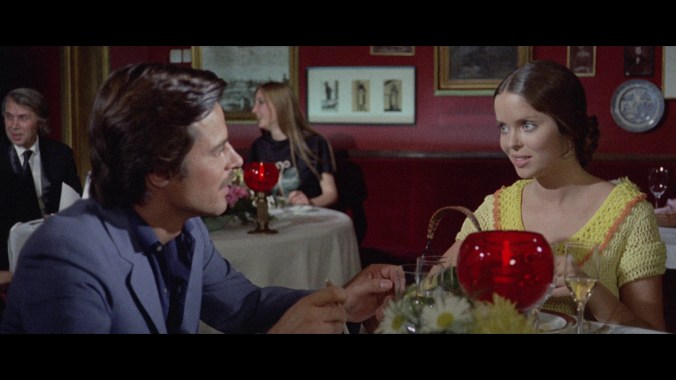
In the film, an American journalist named Gregory Moore (Jean Sorel) has been covering political unrest in Prague, and is planning to pull some strings to smuggle his smoking hot Czech girlfriend Mira (played by a very young Barbara Bach) out of the country and back to London with him at the end of his assignment. But one night after a party, he is called away on a story tip which turns out to be a distraction, and when he returns to his apartment, he discovers that Mira is missing. The weirdest thing about her disappearance is that she didn’t take her handbag, her passport, or apparently any of her clothes; even the dress she wore to the party is still in the apartment, flung over a chair as if she had just taken it off and then gone parading out into the night stark naked. The remainder of the main plot is Gregory’s investigation into what happened to Mira, which of course involves a bevy of shady characters who either stonewall him completely or mysteriously end up dead shortly after giving him information; police hostility and suspicion about his role in the disappearance; the discovery that Mira’s odd vanishing act isn’t the only such case by a long shot; and troubling hints at some pretty sinister forces lying just beneath the veneer of Prague’s supposedly respectable ruling class.

ShortNightOfGlassDolls1

I also neglected to mention that this film has an unusual conceit: The entire search for the lost Mira is detailed in flashback, as Gregory lies in a morgue awaiting autopsy. See, at the very beginning of the movie, he is found, apparently dead, in a public park, but a voiceover lets the audience know that he’s actually still very much alive, but frustratingly unable to let anyone else know about his terrifying predicament. The film flips back and forth between the doctors’ fruitless attempts to revive him and his memories of looking for Mira and falling into the big conspiratorial clusterfuck that led him to the sad state of affairs he finds himself in. It’s actually a great plot device, as not only is the viewer intrigued by the mystery of the missing girlfriend, but also held in nail-biting suspense over whether Gregory will be snapped out of his deathlike trance before the autopsy knife ends his life for real.

shortnight3big-e1457713843131-1024x430


Like The House With the Laughing Windows, Short Night of Glass Dolls has a definite political undercurrent, though it is much more overt than the former film, so much so that I would classify it less as an undercurrent and more as a pretty obvious allegory, which is why I believe its original title was more relevant. In the resolution if its mystery, I would actually hazard a guess that it was a precursor and/or inspiration for Stanley Kubrick’s Eyes Wide Shut, as it exposes the perverse and almost vampiric nature of those in society’s top echelons, as they drain the life, both literally and figuratively, from those unfortunate souls beneath them.

schnappschuss-2022-04-24-mit-13_00_27-pm-26945

Also like the formerly discussed film, the pace of the movie is rather slow, but there is a much more lurid sexual nature to the crimes than House with the Laughing Windows had. The Prague backdrop is also a highlight, oppressive and beautiful at the same time, which handily ties in with the movie’s themes. In addition, there is some lovely imagery of butterflies and glass chandeliers and those gorgeous baroque interiors that are often a fixture of these movies. I also liked some of the seemingly random, unsettling details, like the scientist who was experimenting on plants and trying to determine if they could feel pain. And as I mentioned before, the suspense throughout the film is fantastically well-done, as the whole story becomes something of an unbearable race against time. And I won’t spoil the ending, but I will say that it was quite wonderfully cruel and shocking, and something I really didn’t expect. Highly recommended.

Until next time, keep it creepy, my friends. Goddess out.
My Colors Are Hot Like Fresh Blood: An Appreciation of “The House with the Laughing Windows”

Ciao, bambini! I know I’ve been writing more about newer movies recently with my Hulu Horror Double Feature series, so I figured it was about time to return to the decade that spawned most of my favorite films, the funky fly 70s, and also delve a bit deeper into that rich vein of goodness that is the Italian giallo genre.

I’ve written about Italian movies before (Suspiria, The Psychic, House of Clocks), and I even wrote a short overview of the history of the giallo film, in which I happened to mention the movie I want to talk about today, which is right here with English subtitles, if you want to watch along:

1976’s The House with the Laughing Windows (aka La casa dalle finestre che ridono), aside from its completely rad title, is considered a classic of the genre, even though many of the more lurid, baroque elements present in the better-known giallo films of Dario Argento and others are notably absent. Directed by Pupi Avati, the movie actually bears some resemblance to Lucio Fulci’s Don’t Torture a Duckling, as well as the restrained but unsettling vibe of Nicholas Roeg’s Don’t Look Now. In other words, it’s actually more of a low-key mystery than a straight horror film, and as such it might be a tad too ponderous for some, but it does feature a subtle sense of dread as a constant undercurrent, and the final few minutes are fantastic.

tumblr_nwgbi0u4nN1qzphgoo6_1280

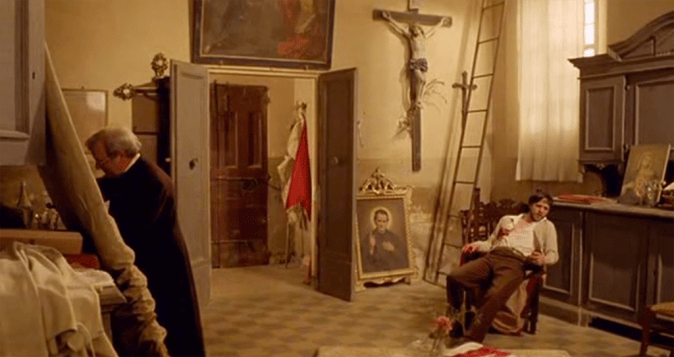
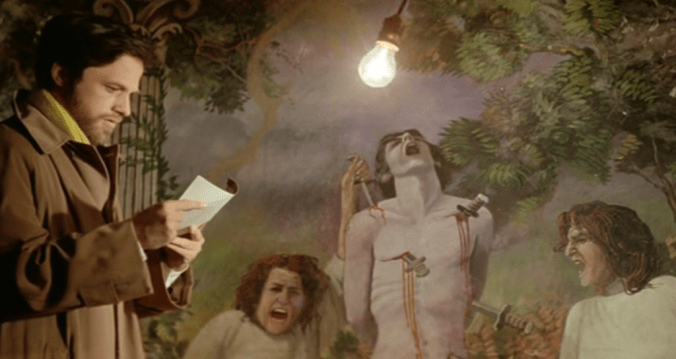
In brief, art expert Stefano (Lino Capolicchio) is summoned to a small village in rural Italy to restore a fresco of St. Sebastian on a wall of the town church. The rather macabre painting was done by a local artist named Legnani (Tonino Corazzari), who committed suicide two decades before and is known around town as the “painter of agony,” because he preferred to depict his subjects in terrible pain or in the final moments before their death. Stefano tries to get to work on the restoration, but to a man, every townsperson seems secretive and vaguely hostile, and someone keeps calling Stefano at his hotel, warning him against altering the fresco. The only friendly faces are Stefano’s longtime friend Antonio (Giulio Pizzirani), who mysteriously dies before he can tell Stefano what he knows about the painting, and a new schoolteacher, Francesca (Francesca Marciano), who arrived on the same ferry as Stefano did. Stefano and Francesca quickly become entangled, and their budding relationship constitutes a significant facet of the plot as it moves toward the discovery of the town’s secrets.

tumblr_nxf3j6Ga211sh4itto5_1280

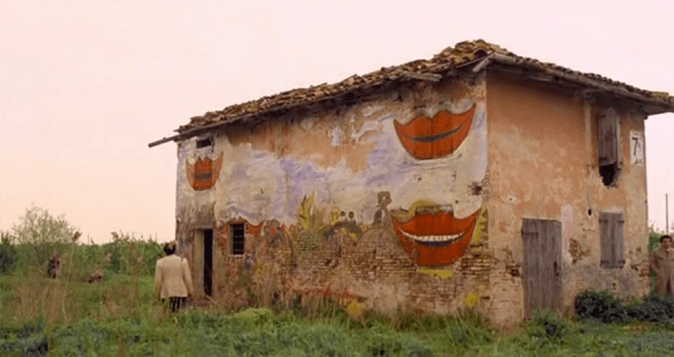
Despite its rather subdued narrative, The House with the Laughing Windows does boast many of the hallmarks of a stereotypical giallo: The protagonist is thrust into a mystery he becomes obsessed with solving, there are numerous red herrings which are never explained, there is a somewhat dreamlike logic at work surrounding certain plot points, and the heart of the mystery deals with madness and sexual deviance (though any actual sex in the movie is generally implied rather than shown). Additionally, the house with the laughing windows itself serves as something of a metaphor for the plot, signifying as it does a decay of happiness, a loss of innocence, a hole of insanity that sucks in everyone in the vicinity. More historically-astute reviewers than I have also noticed the film’s inferred references to shame about Italy’s fascism during the war; this isn’t really relevant to the conventions of the giallo, but I thought I’d mention it here, as the subtext does elevate the film above lesser examples of the genre.

tumblr_nwgbi0u4nN1qzphgoo5_1280

Where the movie differs from better-known giallo films is in the absence of the trademark black-gloved killer, the unerotic nature of the murders (there is one rape preceding a murder, but it is not really shown, and the other murders are simply workmanlike and not fetishized), and the dearth of any particularly Grand Guignol moments like you’d see in many other typical gialli.

That said, the ending is fairly shocking and grotesque, especially since the rest of the movie is so slow-moving and understated. I’m not sure I’m completely on board with the final reveal of one of the troublemakers, and in light of the mystery’s resolution I’m not entirely certain why the townspeople behaved the way they did toward Stefano, but these are minor quibbles that contributed to the Polanski-esque feeling of paranoia that pervaded the whole enterprise, so I’m willing to forgive the inconsistencies. It really is a masterpiece of the genre, helped along immensely by its eerie, sepia-toned vistas and its steady ramping up of tension. A must-see for fans of gialli and atmospheric European horror.

Until next time, keep it creepy, my friends. Goddess out.