Readers should not be surprised to find that I’ve had poltergeists on the brain recently. Not only have I been doing radio shows to promote The Mammoth Mountain Poltergeist (such as here and here), but I’ve also been working on a new book in conjunction with parapsychologist Steve Mera about one of the poltergeist cases he investigated in the 1990s. So those “noisy spirits” have been the overarching theme for the last few weeks of my life, if you catch my drift.
And because I love nothing so much as overkill, I decided to mine the poltergeist thang for this newest entry in my Parchment to Pixels series. Sky Living in the UK recently began airing a three-part miniseries based on the very famous 1977 Enfield Poltergeist case (which I actually summarized in my own Mammoth Mountain book, in the chapter on related cases). I’ve only seen the first two parts so far, but I thought I’d share my impressions, and perhaps edit this post or write a new one after the final installment airs. We’ll see how it goes.
Called “The Enfield Haunting,” the miniseries features an impressive cast of British acting heavyweights, like Timothy Spall, Matthew Macfadyen, and Juliet Stevenson (as Maurice Grosse, Guy Lyon Playfair, and Betty Grosse, respectively), as well as some terrific child actors portraying the put-upon Hodgson brood. Eleanor Worthington-Cox (of Maleficent fame) as Janet Hodgson is especially good.
The series is very loosely based on Guy Playfair’s paranormal classic This House Is Haunted, and Playfair himself shares writing credit on the show (with Joshua St. Johnson). Having read the book myself about a year ago when I was researching my own book, I will say that this series is definitely not the place you want to go if you simply wish to see the tale told realistically; the show is heavily, heavily dramatized, features several big scares that were not in the book, and hews to a more traditional horror movie structure. There’s nothing wrong with that, of course, as long as you know what to expect, but I have to say it was a little jarring for me at first, until I just relaxed and went with the flow instead of going, “Uh, no, that didn’t happen like that” every five minutes. By the way, if you’d like to see a more low-key rundown of the purported facts in the case, there’s a documentary here that’s actually pretty interesting. Oh, and from here on out, I’m likely gonna be spoiling some shit, so if you haven’t watched the series yet, YOU HAVE BEEN WARNED.
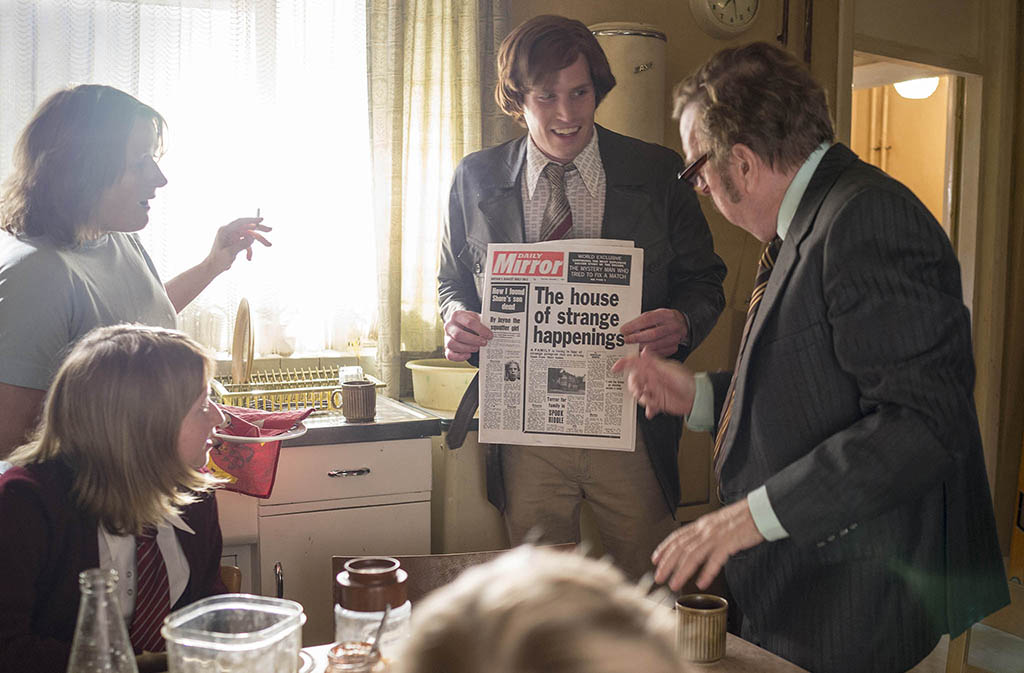
You can read about the Enfield case on Wikipedia or in Playfair’s book, so I’m not gonna summarize it here, but I’d like to point out a few places where the series very obviously hyped up the terror and the drama from the fairly matter-of-fact reports of the paranormal investigators who worked on the case.
Though it is true, for example, that Janet supposedly channeled the spirit of a man named Bill who had died in the house (he’s named Joe in the series, for some reason), I don’t recall that she ever actually claimed to have seen an apparition of him. Bill manifested himself mostly as a creepy voice that would issue from Janet’s throat (or from behind her, as she claimed) and say nonsensical things, swear profusely, or occasionally come up with some tidbit about his death that actually did check out later. In the series, though, the spooky old fuck is everywhere, first appearing (in a pretty effective jump scare, I have to admit) when Janet is looking through her sister’s Viewmaster, and subsequently popping up outside of windows and so forth. Once he even turns up in the living room downstairs, puts his hand over Janet’s mouth as though to suffocate her, and (presumably) kills the family’s pet canary. And when Janet speaks in Joe’s voice, it is portrayed as possession, more or less.

In fact, so far in the series, it seems as though the horrible Joe (who, it is hinted, was a molester/abuser when he was alive, according to his son, who Maurice Grosse interviews at one point) is painted as the main antagonist and a definite evil presence in the home who is on a quest to hurt Janet. In the second episode of the series, Guy brings in a psychic who makes contact with Joe, and after doing so, warns the family and the investigators not to try to contact or interact with him again, because he is the literal worst.
This is quite different to the book, in which it’s pretty much understood from the get-go that the “poltergeist” is not the spirit of a dead person at all, but rather the psychokinetic energy produced by Janet and, to a lesser extent, her sister Margaret, evidently triggered because the children were under intense duress after the departure of their father and their subsequent fall into further poverty. I don’t remember a psychic being called in by the investigators in the book, but if there was, then the psychic certainly didn’t channel a demonic old man or give the investigators such a grave warning. EDITED TO ADD: I was a bit mistaken in this. After discussing the book last night with the God of Hellfire, who read it at the same time as I did (I read it aloud to him after buying it for him for his birthday, matter of fact), he says that the investigators called in several psychics, none of which were much shakes, mostly just spouting useless “I feel a presence” type stuff, as most psychics are prone to do. Interestingly, though, the GoH remembers the last psychic that was brought in actually stopped the phenomena from occurring for good, or at least happened to be present when the phenomena stopped on their own.
The paranormal experiences portrayed in the series, in fact, pretty much take the gist of what was actually reported in the case and then ramp it up a hundredfold to make it as scary as possible. The splashiest things reported at Enfield in 1977 were things like furniture moving on its own, small objects (books, LEGO bricks) flying about the room, Janet’s weird “Bill” voice, some possible levitation, and a couple of apportations. In the series, though, Guy Playfair gets bodily thrown against a wall by an unseen force, Janet is nearly strangled by a possessed curtain (which actually only wrapped itself around her midsection briefly in real life), and sister Margaret begins speaking in the Joe voice as well, as though the “spirit” is moving from person to person.
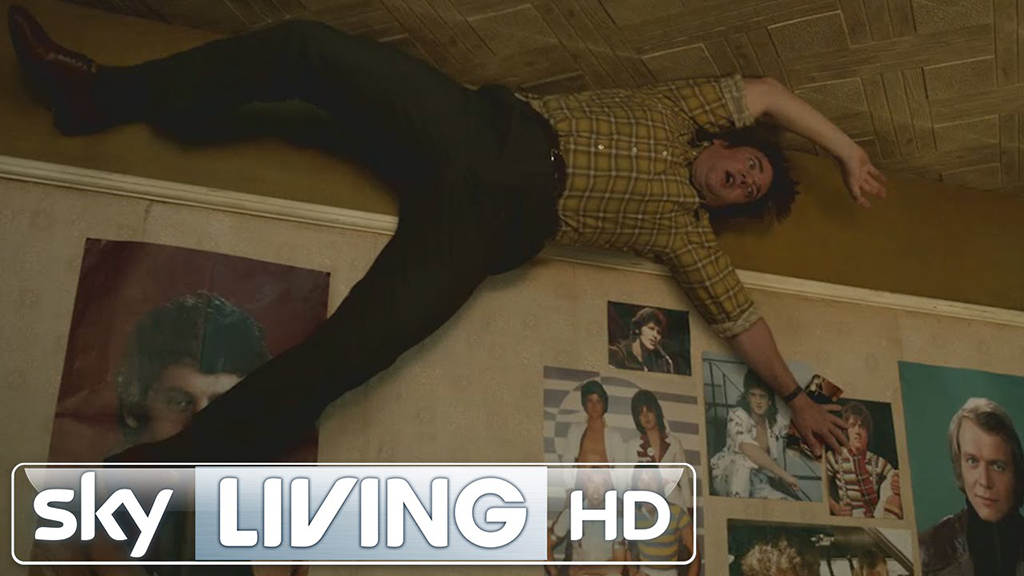
David Soul seems unimpressed by the flyin’ Guy.
The relationship between Grosse and Playfair in the series is also far more contentious than it was in reality, and while I understand this was done to heighten drama and turn the whole thing into a more typical film narrative, it still struck me as strange, especially since Playfair himself was a co-writer on the series. In the actual case, Grosse and Playfair were both members of the Society for Psychical Research, and were casual friends. Grosse began working at Enfield, and at a meeting of the SPR asked the assembled members for assistance. Playfair volunteered, as he had at that point written several books and articles on paranormal topics and was experienced in the type of phenomena being reported. That’s about as conflicted as I remember their relationship being, i.e., not at all.
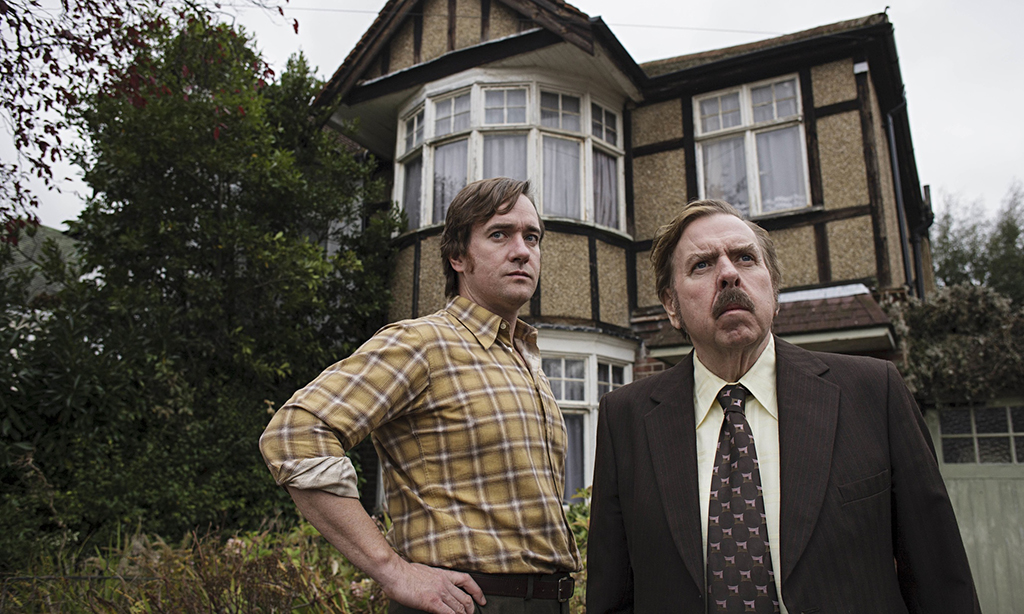
In the series, though, Grosse begins camping out at the Hodgson home, doing his investigation thing, when Playfair shows up unexpectedly, offering help. It comes to light later that the bigwigs at the SPR have sent him to keep an eye on Grosse, since the SPR are thinking that Grosse has become too credulous and unstable since the death of his daughter, and is maybe going to screw up the case and make the SPR look like idiots. While it is certainly true that the real Grosse’s interest in the paranormal was sparked by his desire to contact his daughter (also named Janet), who died young in a motorcycle accident, in all the interviews I saw with him and in everything I read about him, he never struck me as any more credulous than anyone else in the field, and in fact seemed pretty level-headed, maintaining a healthy skepticism about the paranormal in general.
In a way, I almost wish I could just watch “The Enfield Haunting” as is, without knowing anything about the actual case, because I think I would enjoy it a lot more. It’s certainly a top-notch production, from the stellar acting performances to the fantastic cinematography to the wonderfully eerie vibe that permeates the entire endeavor. It’s creepy and pretty great, as a matter of fact; it’s just a shame that I’m so familiar with the source material that such a drastic fictionalization of it is sort of bothersome for me to watch (I’m sure I’ll feel the same way about the upcoming film The Conjuring 2, which will also be based on Enfield). It’s no fault of the series, really, and I actually do recommend it to those with an interest in such things. Besides all that, as I was watching it I couldn’t help but wonder what a Hollywood adaptation of my own book The Mammoth Mountain Poltergeist would look like, and I can’t decide if the thought is hilarious or horrifying. Anyway. More to come later, possibly, when I’ve seen part three of the series, so come back next time, same bat time, same bat blog. Until then, Goddess out.
UPDATE! Okay, the GoH and I actually did watch the third and final part of this last night, and I have to say, I think in my previous viewing I was being a bit too kind vis a vis the series wildly deviating from the source material. While I still stand by my statement that the series is good and well-made if you don’t happen to know anything about the original case, the final segment really went flying off the rails and abandoned any semblance of reality. It seemed as though as the series neared its climax, the writer(s) no longer felt the need to simply sex up the reported facts of the case and instead went whole hog with just making shit up. Interestingly, the GoH tells me that he located an interview with Playfair on the internet (I can’t find it at the moment) in which Playfair said that he was unhappy with how the series had turned out, and that when he had been given partial writing credit he had been promised that the series would closely follow the actual facts of the case as he had written them in his book. He claimed that the actual facts he had reported were scary enough without having to go all Hollywood on the thing, and if that’s true then I kinda feel bad for him. As I said, I can’t find the interview myself, but the GoH read me bits of it last night, so make of that what you will.
As I said before, the series ran with the theme of making the poltergeist phenomena attributable to a ghost of some kind, although it did pay some lip service to the idea that Janet was causing the manifestations using psychokinetic energy powered by her repressed rage (there is one amusing scene, for example, where Grosse takes Janet to an airport and lets her scream out her frustrations to her heart’s content as the planes roar overhead).

Let the hate flow through you.
This reasonable hypothesis is undermined, however, by pretty much everything else in part three of the series. There is crockery flying around everywhere, sinks full of blood, a tiny Tinkerbell-like light that torments and burns the girl, multiple apparitions, full-on possession of both Janet and the returning psychic; the shit just gets ridiculous. I think the most egregious example of this is when Janet is taken to the hospital after she breaks her thumb during a particularly violent poltergeist attack. In the real case, Janet (with no broken bones, it should be said) is simply sent to the hospital to have a standard examination, to rule out any mental or physical illness. She is given a clean bill of health and is sent home. In the series, however, she is put in a private ward, drugged all to hell (with the nurses soberly intoning that she can somehow withstand a HUGE amount of sedatives without seeming fazed), strapped to a bed, and threatened with electrical brain zapping. Later the bed dramatically flips over with the restrained Janet still on it. The girl’s mother, perhaps to save her from the suggested brain zapping, tells the hospital administrators that the family simply made the whole poltergeist thing up for publicity and that all she has to do is have a word with Janet and the whole thing will stop. Playfair and Grosse are both present at this meeting, and feel betrayed, though I guess the family didn’t really make it up because everything is okay with them later, though this is not shown. It’s a tad confusing, but whatever. It should be unnecessary to point this out, but none of this even remotely happened in the book; as far as I can recall, this was made up by the series writers from whole cloth.
There is also a rather silly scene where Playfair attempts to “exorcise” Joe by showing Janet the man’s ashes in a jar and trying to get his spirit to move on. Nothing like this happened in real life either, especially not the bit where Janet seemingly made the jar levitate up to the ceiling and then shattered it, showering everyone present with dead people ashes. The investigators never attempted an exorcism, and wouldn’t have attempted one in any case, since they were operating under the assumption that Janet herself was causing the phenomena.
Another aspect in which part three deviates quite a lot from the source material is Janet’s apparent channeling of Grosse’s daughter, and Grosse’s subsequent mental breakdown. He blames himself for his daughter’s death, you see. His wife leaves him (they make up at the end, though), he pretty much falls apart, and begins using Janet as a sort of surrogate daughter. Grosse in real life seemed like an okay dude, and I feel this does him a disservice. Of course the real Grosse was devastated by his daughter’s death, but he never once claimed that his daughter had contacted him, either through Janet or otherwise. And yes, he did become very fond of Janet and her family, as you would any group of people you remained in close contact with for more than a year, but I did not get the impression that he felt Janet Hodgson was trying to give him messages from his daughter. In the series, it almost seemed as though Grosse ultimately became the catalyst for the poltergeist and not Janet; at one point, Janet tells Playfair that Grosse is the one keeping the poltergeist there because he has unresolved issues about his daughter’s death, and indeed, the poltergeist phenomena doesn’t stop until Janet, speaking in Grosse’s daughter’s voice, tells Grosse that she is fine and that there is no need to forgive him for her death because it wasn’t his fault. It all just seemed very pat and more typical of a horror movie than a real, documented case, which generally has no rhyme or reason at all. So that rankled more than the earlier instances of embellishment, which at least bore some resemblance to the real reports.
Do I still recommend it? Sure, if you like poltergeist movies. But don’t expect it to be anything like what actually happened. If you’re okay with that, then go to town. The series definitely had some eye-rolling moments, but on the whole it was decently creepy, and the acting was mostly quite good. So, for the second time, Goddess out.


![Pageflex Persona [document: PRS0000038_00060]](https://goddessofhellfire.com/wp-content/uploads/2015/02/mammothmountainbookcover_blog.jpg)
 Goddess of Hellfire