Mary Shelley, Frankenstein & the Summer of 1816

A strange gathering of intellectual luminaries during one “haunted summer” produced one of literature’s most enduring creations.

MaryShelleyFrankenstein

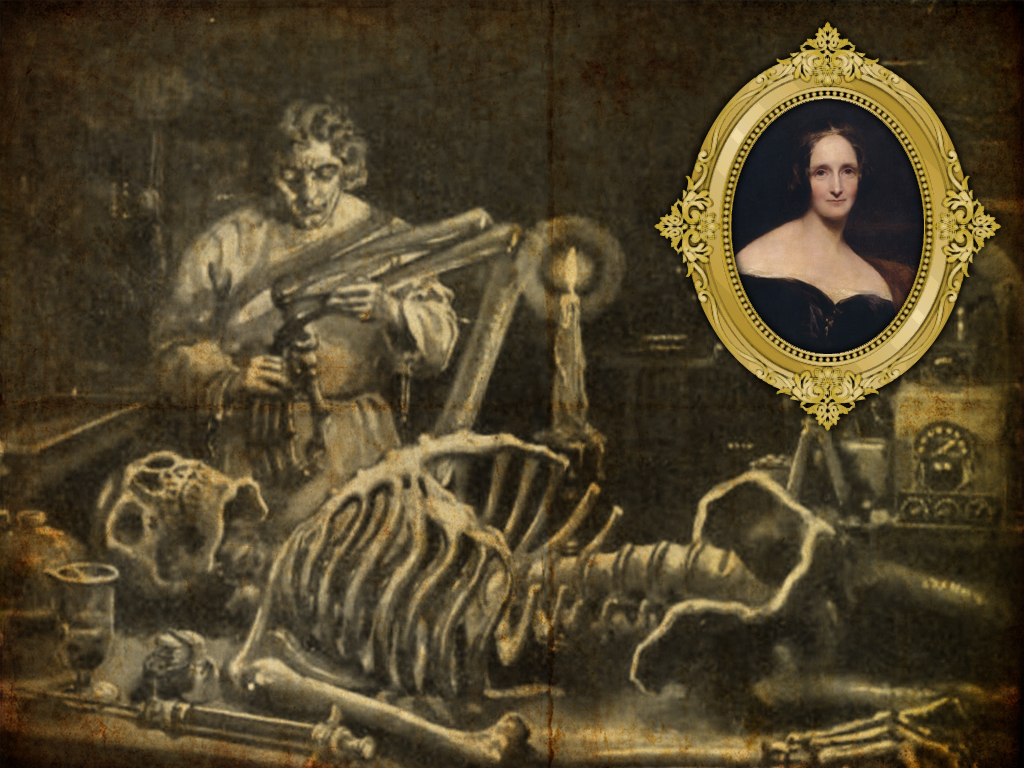
Frankenstein’s monster is one of the most ubiquitous characters in popular culture, appearing everywhere from movies and novels to children’s toys and cereal boxes. Though the image we have of the lumbering creature today—greenish skin, square head, beetling brow, ropy scars and neck bolts—has been largely formed by Boris Karloff’s stunning portrayal in the Universal horror films of the 1930s, in the beginning, the monster was literally dreamed into existence under rather eerie circumstances by an eighteen-year-old girl.

Summer in Switzerland

It was May 14, 1816. Romantic poet Percy Bysshe Shelley and his “wife” Mary (the couple only married later that year, though Mary already used his last name) had been invited by friend and fellow poet Lord Byron to visit him at a rented chateau, Villa Deodati, on Lake Geneva in Switzerland. Also joining the festivities were Mary’s stepsister Claire Clairemont—who was pregnant with Byron’s child and was trying to get back into his good graces—and Byron’s personal physician John Polidori.

The gathering apparently started out quite idyllic—the friends spent long hours writing, discussing weighty ideas, and boating in the lake. But a short time after the group arrived, the weather took a bizarre turn, and it seemed the streaks of lightning and the torrents of rain would never cease. Mary and the others were confined to the house for many days.

Ghost Stories

More reading and discussion ensued. Particular topics of conversation included the early evolution theories of Erasmus Darwin, as well as the new science of galvanism. Also contributing to the entertainment of the group was a book of German ghost stories called Fantasmagoria, which the friends took turns reading aloud.

The combination of the macabre tales and the isolating weather seemed to have strange effects on everyone present; Percy Shelley, at one point, succumbed to visions that sent him screaming from the room. Later, Shelley claimed that Byron’s reading of the Samuel Taylor Coleridge poem “Cristabel” had brought to mind the image of a woman with eyes instead of nipples, which horrified him.

Setting to Work

Some time after this incident, the group decided that they would each try to write their own ghost story. Most set to work immediately and produced tales of varying quality. Byron wrote a story fragment titled “The Burial,” which was later published as a postscript to his narrative poem Mazeppa. Shelley wrote a tale called “The Assassins,” which apparently never saw the light of day (though his poem Mont Blanc, written around the same time, was published later that year). Dr. Polidori wrote “The Vampyre,” later expanded to novel length, which was the first vampire story published in English and which some speculate might have been an inspiration for Bram Stoker’s Dracula, written 78 years later.

The Monster Is Born

Mary Shelley, however, couldn’t think of an idea for a story, and had to respond with a frustrated “No” when asked by the others if she had begun work on it. But then, one night, she had a terrible nightmare. She woke violently amid the sounds of the storm howling outside. The dream had been so vivid that she had a difficult time believing it hadn’t been real. Since she was too shaken to sleep, she began writing down her dream, in which “a pale student of the unhallowed arts” used bits of corpses to create a man. “By the glimmer of the half-extinguished light,” she wrote, “I saw the dull yellow eye of the creature open; it breathed hard, and a convulsive motion agitated its limbs.”

Mary’s terrifying dream was described verbatim in the story she presented to the others. Though the first draft was only about 100 pages long, Percy loved the story and encouraged Mary to flesh it out. She did, and two years after the strange events at Lake Geneva, the story was published as Frankenstein, or the Modern Prometheus, thus introducing one of literature’s most frightening figures to the world at large.

The Goddess’s Favorite Creepy Movie Scenes, or Down in the Mines with Mina

One of the main underlying themes of a lot of these blog posts is an examination of why particular moments in horror film, literature or music made a lasting impression on me while others did not. Why, for example, was I terrified by the bubbling cauldron sound at the beginning of “The Monster Mash”? Or the schlocky scene in My Bloody Valentine where the homicidal miner pops out of the closet with the pickaxe? Or the part in Fright Night where Amy reveals her horribly wide terror-mouth? I still have no idea, but it’s been fun reliving all this stuff from my wayward youth and trying to find some kind of perspective on it, or contemplating the threads that might tie all these disparate things together.

The next scene I want to discuss is another one of those that, for whatever reason, has stuck with me for 35 years, even though I don’t remember much about the rest of the film. The scene itself was only a couple of minutes long, but I can still vividly remember the heart-stopping shudder that traveled through my body the first time I saw it, and further recall how I studiously covered my eyes during the scene on subsequent re-watches of the movie.

Before I get to the main feature, allow me another short commercial break. I still have a Patreon campaign going to fund my writing work, and there are lots of neat rewards just for pledging a few bucks a month, so check it out, won’t you? Thank you. And now back to our regularly scheduled programming.

Seems to me I live my undeath like a candle in the wind.

Seems to me I live my undeath like a candle in the wind.

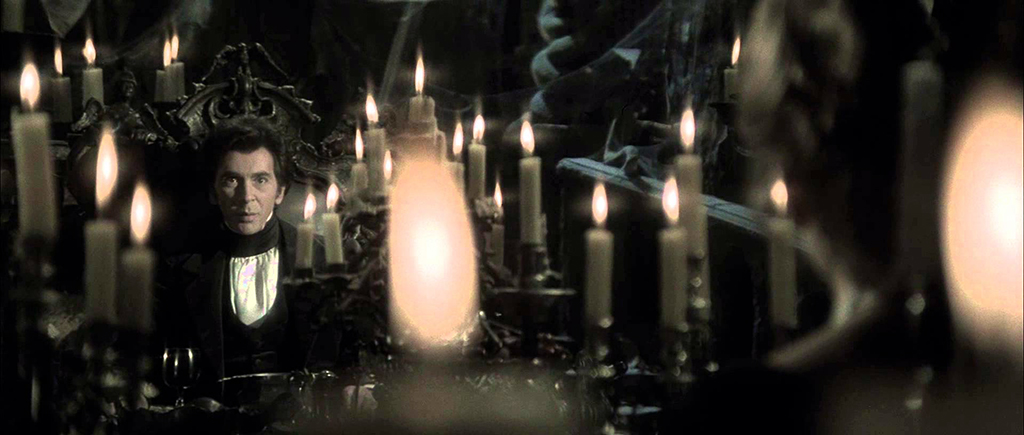
John Badham’s version of the classic Dracula (1979), starring Frank Langella as the titular Count, came out around the same time as a few other vampire films, notably Werner Herzog’s elegant remake of Nosferatu. Badham’s adaptation wasn’t horribly reviewed, but apparently audiences were experiencing some vampire fatigue, and it only did so-so business at the box office. I was only seven when it was released in theaters, so I didn’t catch it until it ran on television a year or two later; in fact, I’m fairly sure it was the first of the major Dracula film adaptations I ever saw, even before the more-famous Bela Lugosi and Hammer versions.

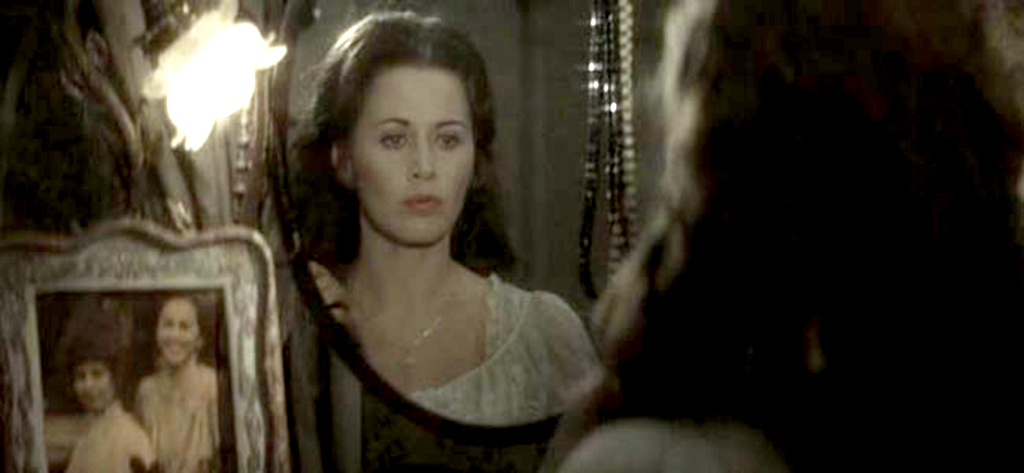
Like the 1931 Bela Lugosi film, Badham’s Dracula was based on the stage play rather than the novel, and followed a lot of the tropes of the Universal version. For example, Dracula is portrayed as a seductive, romantic figure rather than a ratlike monster as in the book, and the entire first part of the novel (where Harker is kept prisoner in Dracula’s Transylvanian castle) is scuttled, allowing the movie to start with the Count’s arrival on English shores. Something the Badham film does that I thought was odd, though, is that it reverses the characters of Lucy and Mina; Mina is the first one attacked and vampified by Dracula, for example, while Lucy is Harker’s fiancée, and is attacked later but ultimately saved when the vampire is staked. The film also portrays Mina as the daughter of Van Helsing and Lucy as the daughter of Dr. Seward. These changes don’t ruin the story or anything, but they also don’t really add to it, so I’m not sure why they were made. Perhaps because some characters were eliminated for brevity (like poor old Quincey Morris, who hardly ever gets a part in these adaptations), the screenwriter thought it would increase the drama and emotional coherence of the characters to make them all related somehow, but I’m just speculating about that. Still doesn’t explain why Lucy and Mina were reversed, but whatever.

Pictured: Identity crisis.

Pictured: Identity crisis.

As I said, I don’t remember a great deal about the film as a whole; I remember enjoying it, and being quite taken with Langella’s graceful performance as the Count, but even though I saw the movie several times when I was about nine years old, very little of it made a lasting impression. Except for that one, very brief scene.

If my quick Google search is any indication, I’m not the only one that has had this scene burned into my memory for more than three decades. I’m not entirely sure why the scene is so memorable; it could be simply because in the context of the film, it is so shockingly unexpected. This version of Dracula, after all, was marketed more as a supernatural romance than a horror film, and played rather like a staid English parlor drama (with fangs). There was little to no gore that I remember, and nothing that was outright frightening. But then this happens:

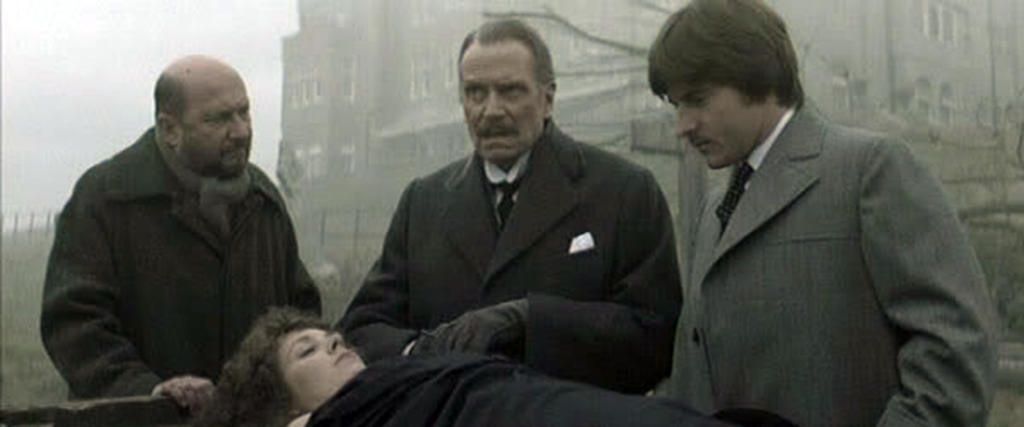
The lovely Mina (Jan Francis) has been exsanguinated by the foxy Count one night while her friend Lucy (Kate Nelligan) is out tramping it up with Jonathan (Trevor Eve). It makes me feel weird to even type that, you guys. It’s like they were cheating or something, what with the character reversal and all. Though now that I think about it, how great would a Mina/Lucy catfight scene have been? Anyway. The next morning, Mina is pale and gasping for breath, and dies as a horrified (and guilty) Lucy looks on. Dr. Seward (Donald Pleasance) has no idea what could have killed Mina, and summons Dad Van Helsing (Laurence Olivier) to help solve the mystery.

It’s clearly lupus.

It’s clearly lupus.

No slouch, Van Helsing immediately jumps to the most obvious conclusion, that eine nosferatu is running loose in the vicinity. As an aside, though, this is Van Helsing we’re talking about. He probably blames a vampire every time one of his socks disappears from the washing machine. Sure, he was correct in this case, but even a stopped clock, yadda yadda.

I’m not saying it was vampires. But it was vampires.

I’m not saying it was vampires. But it was vampires.

Anyhoo, Seward and Van Helsing visit Mina’s new grave in the cemetery, and find that her coffin is not only empty, but contains a ragged hole where she presumably dug herself out. The hole leads underground into some old mining tunnels, and they crawl down there to investigate, pretty sure of what they’re going to find. As they peer into the darkness, visions of the beautiful Mina probably uppermost in their minds…

Like so.

Like so.

…they begin to hear a shuffling sound coming toward them. They raise their lamps or candles (I can’t exactly remember which, and can’t find the scene on YouTube to check), and there, emerging from the darkness, is this horror, reaching for them and begging for a kiss:

At least she has a good personality. Well, aside from the bloodsucking.

At least she has a good personality. Well, aside from the bloodsucking.

This shit scared me SO BAD, you guys. And in this sense maybe it was a sound storytelling idea to make Mina Van Helsing’s daughter, because the tragedy of the scene is very apparent here, and underscores the horror with great effectiveness. The figure of the undead Mina is terrifying but also heartbreakingly pitiful, and the viewer really feels it when Van Helsing has to put down the monster his daughter has become. The rest of the film isn’t nearly as powerful, but that one scene is a stunner.

Keep watching this space for more of my horror-related wanderings, and news on my upcoming poltergeist book! Until then, Goddess out.

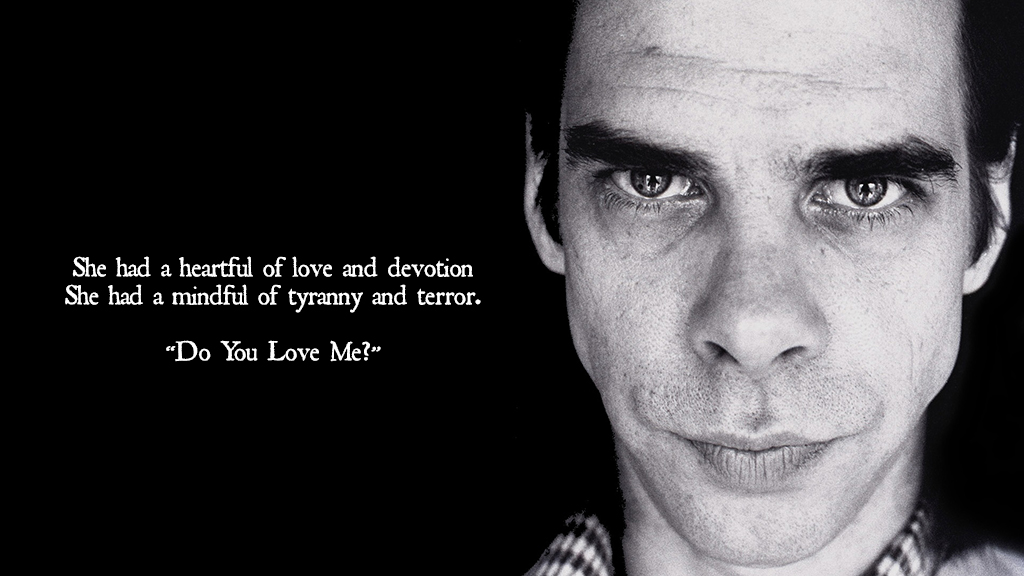
A Heart Full of Love and Devotion, a Mind Full of Tyranny and Terror: The Goddess Does an Extended Nick Cave Fangirl Squee

It occurs to me that I have been somewhat neglectful in this blog series, which I admit I first started with the intention of focusing on horror movie scenes that had made an impact on me and influenced my own work in some way. As readers may have noticed, however, the series sort of got away from that narrow focus pretty quickly, as I delved into literature as well, and after a while I figured that my horror influences were far too broad to confine to just film. Matter of fact, I feel as though books and other things have ultimately had more impact on my writing than movies have. And in my desire to keep to a theme, I feel like I’ve been giving short shrift to what is probably my main influence in this area: namely, music.

As befits a horror writer, I delved into the gothic subculture at a fairly young age, when it was still something of an underground phenomenon in the early to mid 1980s. So well did its musical and aesthetic parameters fit my personality that I stayed with it far past the point when many abandoned it, and even now, at the ripe old age of 42, I find myself still continually entranced with the scene, and very active in my little central Florida pocket of it. I’m not going to lie and say that the fashion wasn’t a large draw for me, because it always has been, but then as now, my primary love is for the music, which has been a constant and steadfast companion of mine for more than three decades.

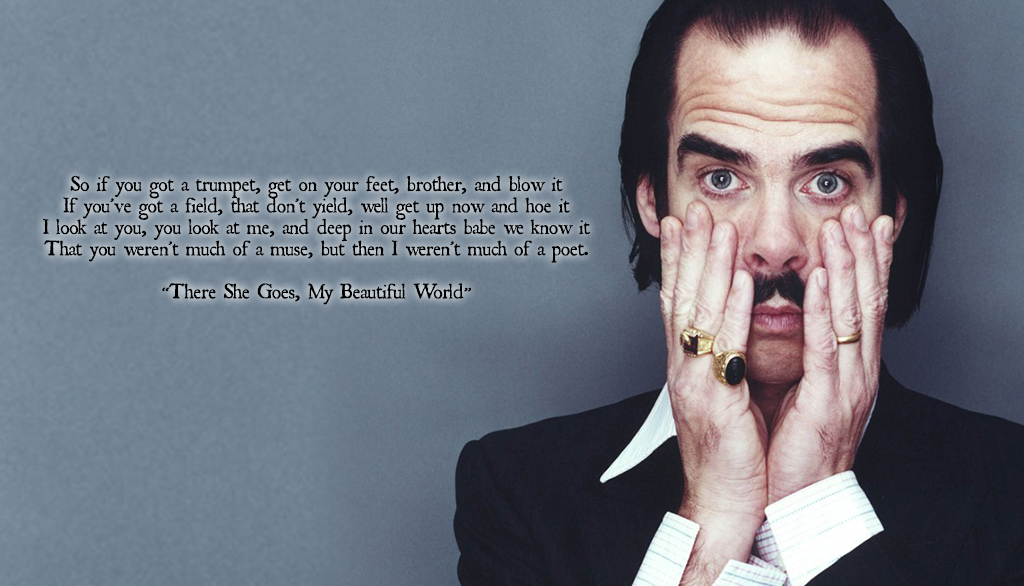
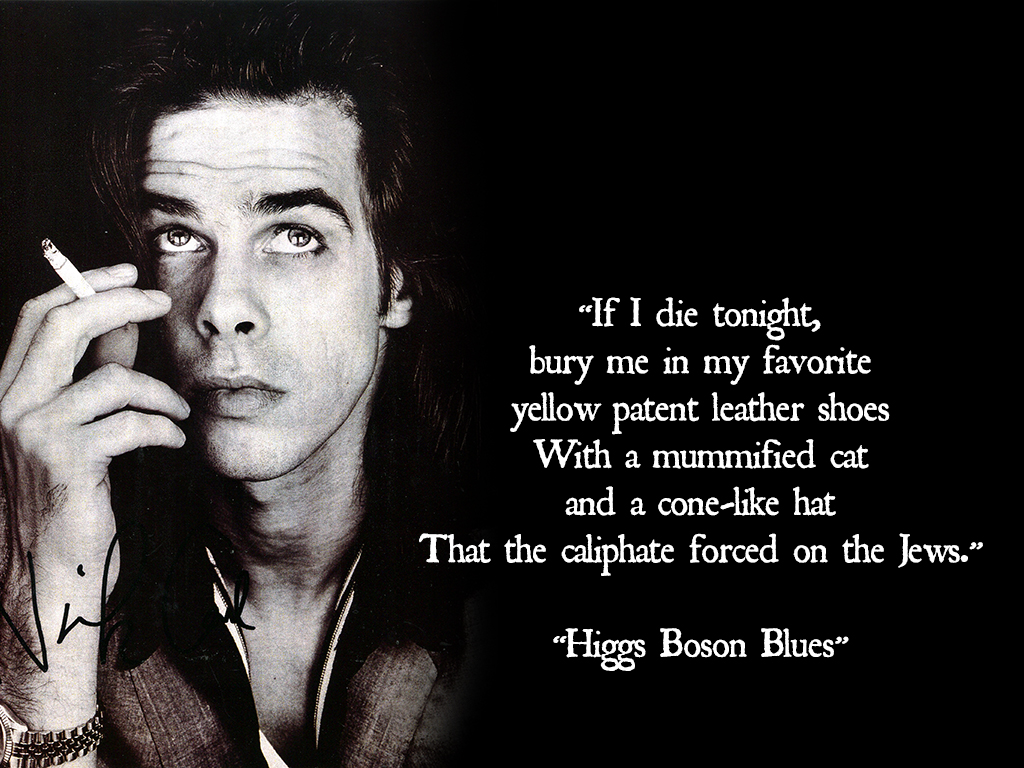
I’m an admirer of many dark sounds, from the bleakness of post-punk to the syncopated angst of synthpop, but I’d like to expound at length, if I may, about a singular figure in music who has had more influence on my work than probably anyone else, whose music and words have filtered so far into my psyche that they now seem an integral component of my very cells. He speaks to me and for me, and has conjured more extreme emotions in me than almost anyone else in my life, even though I have never met him. This near-mythical figure is none other than Nick Cave.

StaggerLee

I have briefly mentioned him on this blog before (when I insisted that someone adapt his insane novel And the Ass Saw the Angel to film), but so intense is my admiration, so insidious is his influence, and so steeped in horror is much of his work, that I felt he deserved his own blog entry. I was inspired to write it now because this past weekend, I was finally able to view the outstanding quasi-documentary about the legendary artist, 20,000 Days On Earth. I watched that spectacular thing twice straight through, fascinated anew by the man’s keen insight into his own creative process and aghast at his staggering, prolific genius. At one point in the documentary, he says that everyone has an innate desire to be someone else, to be transported and transformed into something greater than oneself. He achieves this through performance, his father achieved it through his intense love of literature, and in turn, I achieve it through listening to his music. Nick Cave is not simply a singer, songwriter, novelist, screenwriter, and actor; he is a goddamn force of nature, one that is terrible and beautiful and all-encompassing.

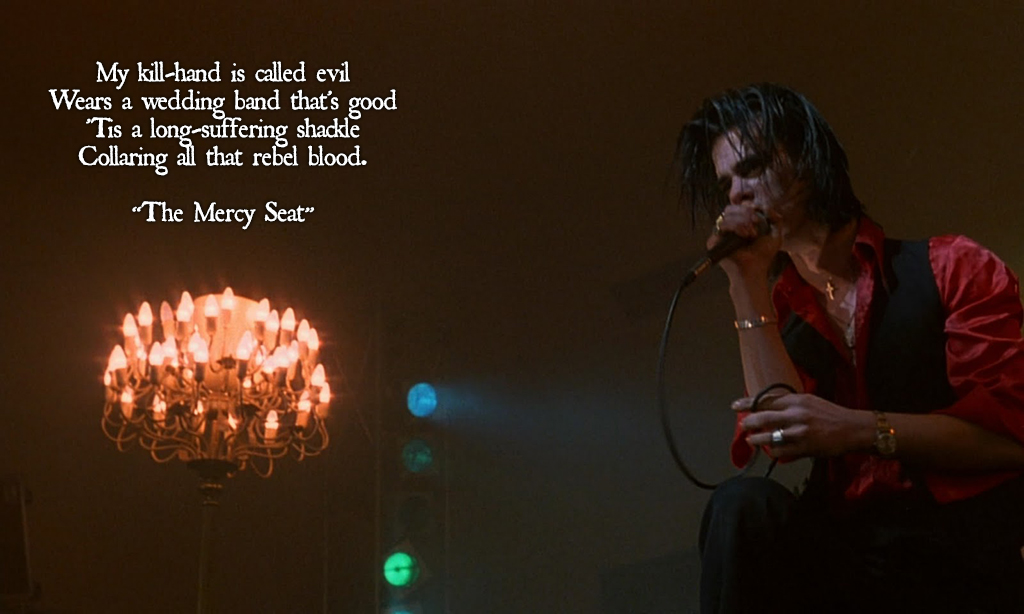
MercySeat

I first stumbled across Cave’s work in 1987 or thereabouts, after seeing the video for “The Mercy Seat” on MTV’s sadly defunct alternative music show, “120 Minutes.” The song, an epic, terrifying slab of gorgeous noise told from the point of view of a convicted murderer contemplating God’s judgment as he waits to die in the electric chair, made an instant impression, as did Cave himself: a tall, gaunt, crowlike figure with a shock of black hair and an intensity that blazed out through the television screen like a demon supernova. Who the fuck WAS this? I had sort of heard of him, I suppose, though at the time I was wrapped up more in the glam/deathrock end of the musical spectrum (Bauhaus, Alien Sex Fiend) and had largely neglected the more noisy/no wave/experimental corners of the alt landscape. Nick changed all that in seven minutes of enthralling hell.

DoYouLoveMe

Over the next couple of years, I used whatever money I could scrape together and purchased his entire back catalog, including all the albums by his previous band, The Birthday Party, whose feral lunacy served as a seductive counterpoint to the more introspective direction of his later work. As I burrowed further into the world Nick had created — lurid, profane, and ugly, yet strangely transcendental for all of that — his vision began to spill over into my own. My first published short story, a runner-up in my local newspaper’s Halloween story contest, was based on his 1986 song “Jack’s Shadow,” and the first novella I ever completed, Bully Bones, was named after the Birthday Party song, and contained a few strategic Cave name-checks.

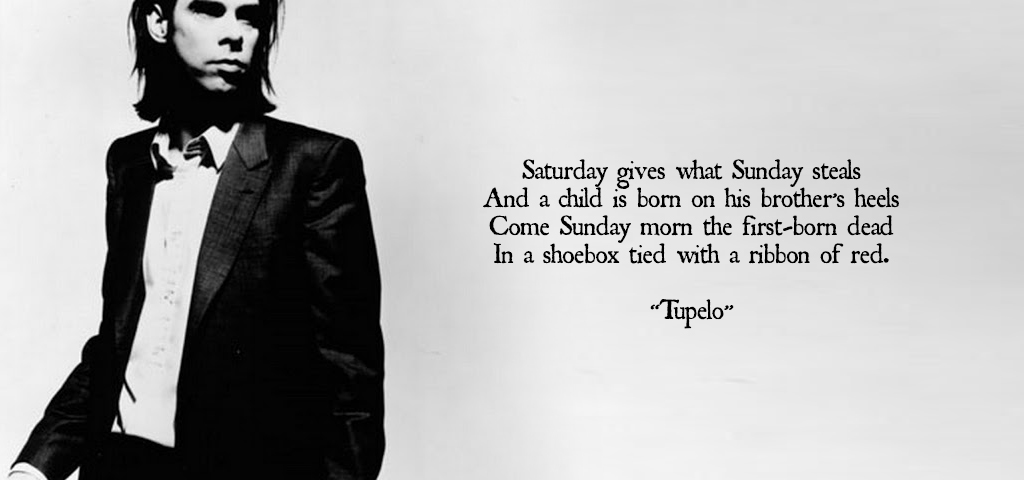
Tupelo

As the years went on, my relationship to his music grew ever more complex. While I was initially disappointed by the more subdued Cave who emerged on 1997’s The Boatman’s Call, as I aged and matured I began to realize that the intensity of his early days was still very much present; only the method of attack had changed. Whereas before he wore his passion and ferocity on his sleeve, shrieking to the heavens like a possessed madman, he had now found a quieter outlet to exorcise his devils, and the resulting songs were indescribably beautiful, as every nuance of his extraordinary voice conveyed oceans of sadness, anger, loss, and yes, even redemption.

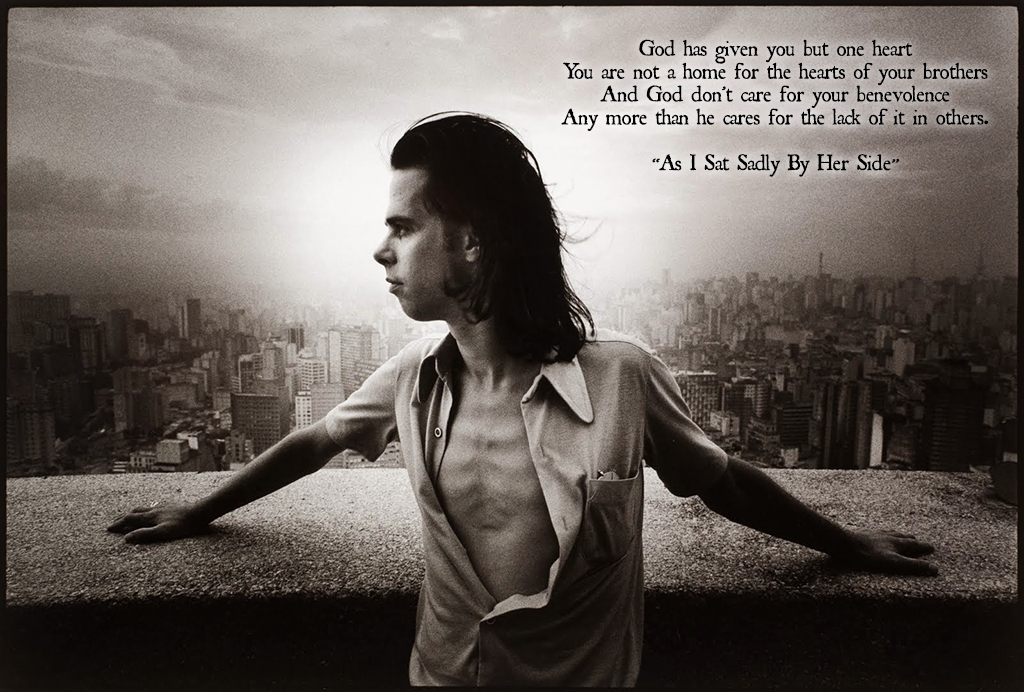
SatSadly

And his words. Oh god, his beautiful words. His phrases are like a form of magic, by turns profound and ridiculous, lofty and vulgar, sly and forthright, astonishingly heartfelt and blackly comic. He is a poet in the very truest sense of the word, a master not only on par with musical stalwarts like Dylan, Cohen, and Reed, but also with literary giants like Faulkner, Joyce, and Yeats. His words are passion and perfection.

BeautifulWorld

I feel as though Nick Cave occupies a unique place in musical history, a true “rock star” in an industry that doesn’t really produce them anymore. He somehow manages to bare his soul for everyone to see, but still maintains a sort of godlike mystique, as though the truth of him can be better approached through the construction of his own artifice. His arrogant, too-cool swagger is delightfully undercut by his arch self-mockery, making him nearly immune to accusations of excessive self-regard. His universally recognized brilliance allows him to get away with things that no other musician I can imagine would get away with, and he does it with a characteristic, unerring aura of giving-no-fucks. Yet he clearly gives ALL the fucks, about his work, about his legacy, about how he is perceived. It’s a tremendous balancing act, and Cave accomplishes it with seemingly no effort at all, with a suave flick of his be-ringed hand and an unflappable smooth-down of his sharp black suit. He is like an alchemist of old, a hellfire preacher and a broken supplicant, a silver-tongued angel and a gutter-mouthed devil, all in one chimerical package.

Scum

I’ve written so many words here to try to convey my feelings about the man and his music (“Prolix! Prolix! Nothing a pair of scissors can’t fix!”), but I fear that I have still fallen far short, and for that I apologize, not only to him, but to the entire universe that conspired to create him. In sum, if there can be such a thing as a creative muse, suffice it to say that I consider him mine, and for that I will be eternally grateful. Thank you, Nick, and long may you wave. Goddess out.

HiggsBoson


The Goddess Picks Her Five Favorite Horror Novels by Women

WomenInHorrorHeader


February, in case you hadn’t heard, has been designated Women In Horror month, and even though I gotta admit I’m kinda longing for a future where female horror writers will be so commonplace that it will be unnecessary to even remark upon them, I do feel like we vagina-havers still need our own month for now. That’s because, for whatever reason, women who write horror are still thought of as something of a novelty, or at very least a tad oddball. It’s a lot better than it used to be, sure, but even in this enlightened year of 2015, it’s not unusual for a horror anthology to come out containing no women authors at all, and there’s still a lingering perception that women don’t like horror as much as the guys do, or they don’t write it as well, or something, since apparently we’re all just precious delicate flowers who could never possibly enjoy the song of the chainsaw, the call of Cthulhu, the visceral thrill of seeing someone’s spine forcefully extricated through their mouth. I guess there’s a similar bullshit thing going on with female comedians and “girl geeks,” but I’m not really gonna go into all that because this is a horror blog, and I gotta stay focused on the topic without going off on a rant. Anyway, since I’m a woman who has always loved everything to do with the horror genre, I’ve decided to celebrate Women In Horror Month by honoring a few of my favorite “girl” writers in the genre with this humble blog post. So here we go.

WomenInHorrorNovels

Shirley Jackson – The Haunting of Hill House

I know I talk about this book a lot (and I wrote a whole blog post about the fantastic film adaptation as well), but that’s because it is probably my favorite horror novel of all time, and easily one of the best horror novels of the 20th century. In Ms. Jackson’s capable hands, something as pedestrian as a haunted house story becomes a multilayered, intensely terrifying study of psychological breakdown. Her masterful characterization of Eleanor Vance is one of the best in literature of any genre, and I would defend that statement to the grave. If you love Haunting of Hill House, and I know I do, also check out her other novels The Sundial and We Have Always Lived in the Castle, which explore similar themes.

Anne Rivers Siddons – The House Next Door

Another haunted house story (because you know how much I love those), but from the completely opposite side of the spectrum as Jackson’s novel. The haunting in The House Next Door takes place in a fancy, newly-built contemporary pad thrown onto an odd-shaped lot by a hot-shot architect in a chi-chi Atlanta suburb. The main players are agonizingly upper-crust, status-conscious, and at times completely snobbish and obnoxious, but their unlikeability makes their fates that much more devastating. The cursed-from-birth house next door doesn’t contain anything as gauche as a spirit, exactly, but more like a force that somehow knows and plays upon the residents’ deepest fears and insecurities, and dishes out scares accordingly. A fresh take on the subgenre, and a satisfying one.

Doris Lessing – The Fifth Child

A supremely literary horror story, and a short one clocking in at only 150 pages, but its tentacles grasp tightly. Somewhat reminiscent of Rosemary’s Baby, The Fifth Child sees “perfect” married couple David and Harriet pushing out one kid after another, much to the consternation of their extended families, who fear that the couple cannot care for the ones they already have. The first four kids are pretty much okay, but that fifth one, as the title suggests, is a doozy. A concise and terrifying examination of family dynamics and the social expectations surrounding the bearing of children.

Poppy Z. Brite – Exquisite Corpse

Perhaps this isn’t a fair choice for a “women in horror” post, since Poppy (born Melissa Ann Brite) has since undergone gender reassignment and now prefers to be known as Billy Martin, but at the time this novel was written she was still identified by a female pronoun as far as I know, so I’m going to include it. It’s a shockingly sick tale of two serial killers (based on real-life nutcases Dennis Nilsen and Jeffrey Dahmer) who join forces in order to find “the perfect victim.” They find their unicorn in the form of a pretty Vietnamese boy named Tran, and the story spirals into horrific madness from there. All of Brite’s trademarks are present, from the obsession with twisted killers to a fixation on the darkest and seediest underbellies of New Orleans. This is an intensely gory and profoundly fucked-up (but fantastic) novel.

Caitlín R. Kiernan – The Red Tree

Kiernan has written a lot of great books, including several pleasingly Lovecraftian ones. The Red Tree is the creepy tale of a woman named Sarah who moves to an old house in the woods after a terrible breakup and becomes obsessed with the ancient tree growing in the backyard, and the manuscript she finds that seems to hint that the tree conceals some terrible secret. If you like this one, I’d also recommend Silk and Low Red Moon by the same author.

Until next time, Goddess out.

We Painters Use the Same License as Poets and Madmen: Paolo Veronese Faces the Inquisition

If you liked my graphic novel The Tenebrist, which told the fictionalized tale of batshit Renaissance painter Caravaggio, then you might like this article I wrote on Paolo Veronese and his run-in with the Inquisition in Venice. Give it a read, why don’t you? Oh, and also, don’t forget that I have a Patreon campaign up to raise some filthy lucre for my horrific writing endeavors, so please help out if you can! Thanks, and on with the show!

Paolo_Veronese_007

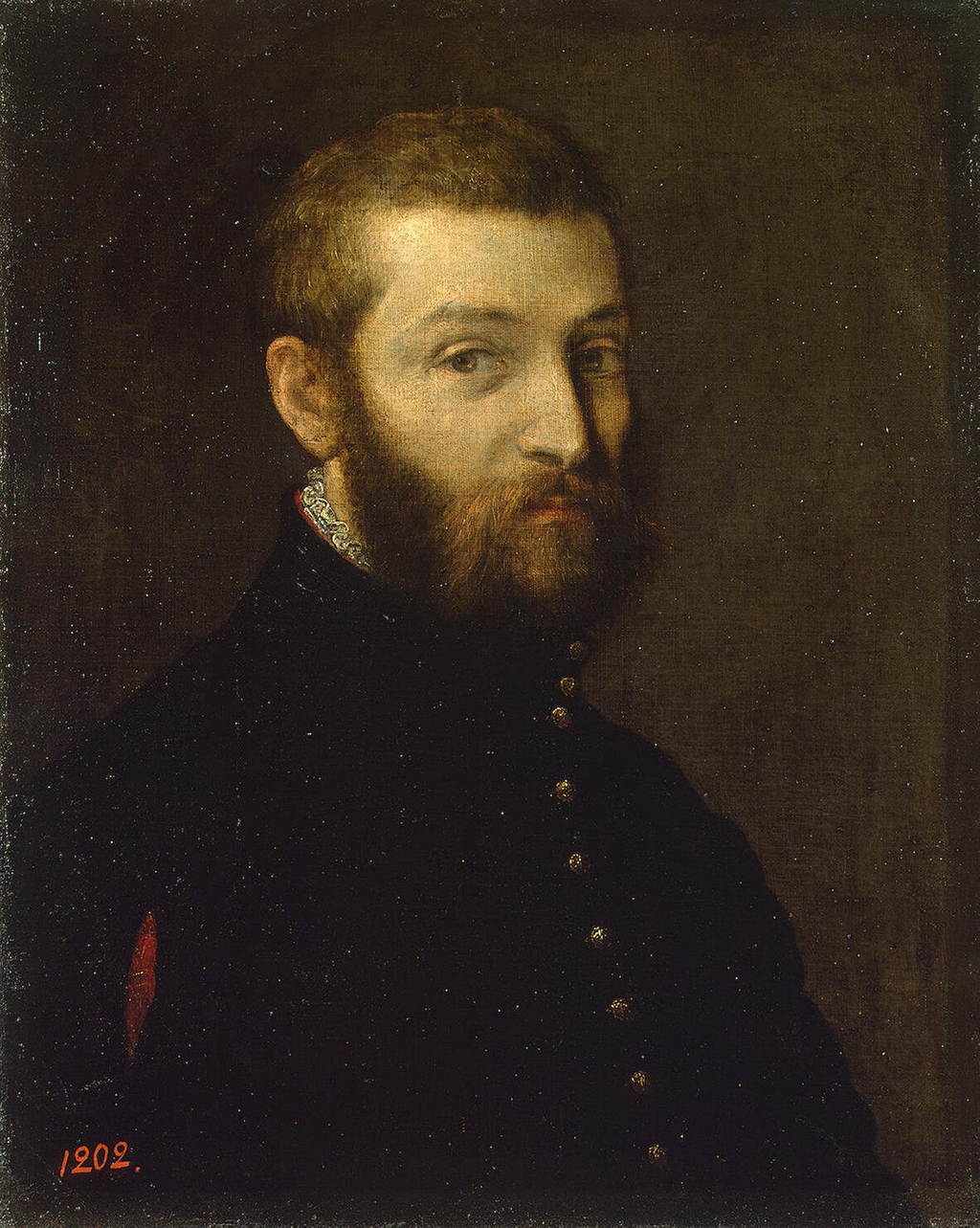
Born in Verona in 1528, Paolo Caliari, Il Veronese was one of the unquestioned leaders of the Italian Renaissance; along with the work of fellow Venetian School artists Titian and Tintoretto, Veronese’s paintings and drawings would serve as an influence on later artists as diverse as Rubens, Velázquez, Délacroix and Cézanne. He was lauded for his opulent use of color and the realism of his drawing; after settling in Venice in 1553 his work was much in demand by both secular and ecclesiastical patrons. But despite his fame and success, his well-known credo of complete artistic license would eventually land him in a spot of hot water.

Veronese’s Last Supper

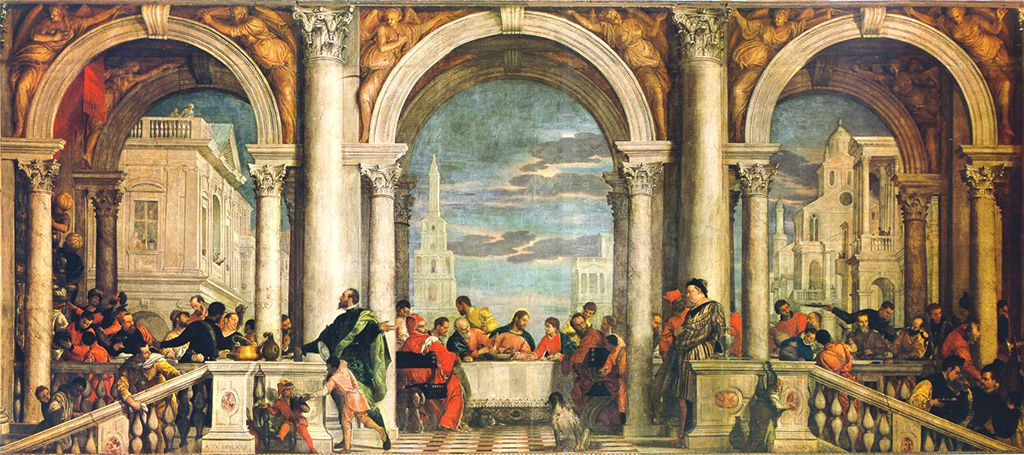
In 1573, Veronese set to work on a commission for the convent of San Giovanni e Paolo. It was to be a Last Supper, a massive work on canvas, measuring about thirty-nine feet wide and seventeen feet high. The work is a sumptuous feast of reds and golds, with stately columned arches framing the action, which features not only Christ and the twelve disciples, but also a host of other figures. These include servants, dwarfs, jesters, soldiers, and other “extras” not usually found in artistic depictions of the scene.

Veronese was clearly taking liberties with the well-worn subject, but apparently the authorities did not appreciate the painter’s creativity. No sooner was the work delivered to the convent than Veronese was summoned before the Holy Tribunal of the Inquisition to answer to a charge of heresy.

The Inquisition in Venice

Though at that point in the 16th century the Inquisition still held full, terrible sway over most of central and western Europe, in Venice its power was decidedly limited by the Senate. Nonetheless, the Inquisition certainly had the power to harass and threaten (if not necessarily torture) subjects it deemed guilty of impiety, and in July of 1573 Veronese fell into the crosshairs.

At issue were the many extraneous figures appearing in the painter’s Last Supper. Veronese had painted the same subject several times before and drawn little comment, but in this particular picture he admitted the great size of the canvas had compelled him to embellish the scene with nearly three dozen unnecessary people. At the tribunal, the inquisitors asked Veronese if he felt it was “suitable” that the Last Supper contain “buffoons, drunken Germans, dwarfs and other such absurdities,” and went on to state that heretical German artists often added such figures into religious paintings in order to ridicule the Catholic church. The inquisitors also seemed highly offended by the figure of a servant with a bloody nose, the notable absence of the Magdalene, and the very obvious presence of a dog sitting directly in the foreground of the picture, looking out at the viewer.

Veronese’s Meager Defense

For his part, it was highly fortunate that the Inquisition didn’t have quite the teeth it had in other parts of Europe, for as Veronese listened to the litany of charges against his work, he could offer only feeble justifications. He claimed he had only added the figures as “ornament” to fill up the space, and that the offending dwarfs, servants and buffoons were supposed to be understood as occupying a separate room from Christ and the disciples. He further argued that the house of Simon, where the Last Supper took place, might realistically have contained such people.

Finally, he pulled out the “everyone else does it” defense, pointing out that the exalted Michelangelo had painted Christ, the Virgin Mary, St. Peter and other religious figures in the nude in the Pope’s Chapel in Rome. “We painters use the same license as poets and madmen,” Veronese explained to the inquisitors, pleading his case for leniency. “I had not thought that I was doing wrong.”

The Aftermath of the Trial

After his grilling before the tribunal, Veronese was ordered to “correct” the painting within three months. Specifically, the Magdalene was to be painted in place of the dog, and the offending “drunken Germans” were to be blotted out entirely. On this condition, Veronese was set free, much to his great relief.

As meek and frightened as the painter had been while facing the inquisitors, once he was released he took a rather cavalier attitude toward their judgment. The news of his trial made his work more popular and sought-after than ever, and Veronese took up his brush with zeal in order to keep up with the new commissions. But he never took his brush to the notorious Last Supper, leaving dog, dwarfs, and drunken Germans just as he had originally painted them. His only sop to the Inquisition was changing the work’s title from The Last Supper to The Feast in the House of Levi. It is under this title that the famed heretical canvas can still be seen today, at the Galleria della Academia in Venice.

Veronese, the passive-aggressive badass.

Veronese, passive-aggressive badass.

Sources:
Janson, H.W. (2001). History of Art. Abrams Books. ISBN: 0130197327.
MacFall, Haldane (1911). A History of Painting. D. D. Nickerson and Company. ASIN: B000YFTXCW.

“Lepidoptera”

butterfly silence

Stephanie Guthrie stood in the center of the pile of blood-soaked bodies, her arms outstretched, her face a blank mask. Children pointed and screamed, animals paced in their cages. Zoo employees gaped like statues, unable to believe what they had just seen. Soon enough, the police came to quell the panic, and then an ambulance came, and bundled the woman inside.

****

“I haven’t been able to get a single word out of her,” said Theresa Hill, the police psychologist. “Looks like partial catatonia.”

Vic Unger, the lead investigator on what was sure to be the most bizarre case the city had ever seen, made a disgusted sound. “Typical. And wait ‘til you hear what we got back from the lab guys.”

“What’s that?” The halls were nearly empty in this ward, and Theresa’s voice echoed like a snatch of memory.

“Cause of death for all fifteen people at the zoo,” Vic said, “was evidently a mass poisoning. In other words, they were gassed.”

Theresa raised her eyebrows at him. “Terrorists?”

Vic shrugged. “That’s why we need to get a story out of the sole survivor in there.” He scratched distractedly at his three days’ growth of beard. “She doesn’t strike me as the terrorist type, I gotta say.”

“No. Maybe the poison came from somewhere else, and Miss Guthrie was the only one lucky enough to survive it?”

“Could be, although witnesses say the people around her dropped dead as soon as she raised her arms, like the two events were related. Have you done any scans on her or anything? Checked her for brain damage?”

“Yes. Looks like nothing out of the ordinary so far.”

“Damn.” Vic was a handsome man, only in his mid-thirties, but already cultivating a look of hangdog cynicism that Theresa found amusing. They had reached the end of the hall, and the locked room where Stephanie Guthrie was being held for observation. Theresa produced a set of keys from the pocket of her coat and opened the door.

Stephanie was sitting rigidly in the chamber’s only chair, her hands resting stiffly on her lap. She didn’t look up as Theresa and Vic entered, but kept her gaze fixed on a spot just below eye level. A very long moment passed before she even blinked.

“Hello there, Miss Guthrie.” Theresa stood before the woman, her arms crossed. “How are we doing today?”

Stephanie, of course, did not answer.

“The investigator is here, Miss Guthrie,” Theresa continued, gesturing to Vic, who was standing slightly behind and to the left of her. “He’d really like to get to the bottom of what happened at the zoo on Saturday. Do you think you’ll be able to cooperate?”

More silence in which Stephanie’s chest barely rose and fell with her breathing.

Vic stepped forward at Theresa’s urging. “I’m Vic Unger, Miss Guthrie,” he said. “I’d like to help you, but to do that I need to ask you some questions. Is that all right?”

Another blink, another breath.

Vic wasn’t in the mood for this; his impatience was one of his few negative attributes. “Can’t you just hypnotize her or something?” he asked.

Theresa stared down at the top of Stephanie’s head. “That may become necessary, although I have to tell you ahead of time that hypnosis is sometimes not a very effective psychiatric tool. We generally only use it as a last resort.”

“Well, can you get started on all the other resorts? I’d really like to figure out what the hell is going on here.”

“As would we all, Mr. Unger.” Theresa smiled at him. “But cases like this take time. I’m sure you understand.”

Vic nodded. He did understand, but he didn’t like it.

****

The next day, driving up the interstate, Vic ran the facts of the case through his mind again, hoping to stumble upon a detail he’d missed the first few times. Last Saturday at approximately two-fifteen p.m. at the Langford County Zoo, thirty-two-year-old Stephanie Guthrie had been strolling through the butterfly garden in the company of her thirty-six-year-old fiancé, Ray Framington. According to witnesses—the few who were left alive, that is—they had been holding hands, and Stephanie had been smiling. Then suddenly, things had taken a macabre turn. In an instant, the woman had gone white, tilting her head slightly upwards as if she had just heard something that shocked her beyond her capacity to reason. Her eyes apparently
glazed over, and even though Ray Framington had shaken her, trying to discern the problem, she had acted as though he wasn’t even there.

Then, witnesses agreed, she had slowly begun to raise her arms, until they were even with her shoulders. At the moment when she opened her hands, spreading her fingers to their farthest extremes, the fifteen people closest to her—including her fiancé—had simultaneously begun to bleed from every orifice, and after an agonizing moment of this horrifying spectacle, all fifteen had dropped dead to the concrete like sacks of grain. As this was happening, Stephanie Guthrie stood as still as marble in the center of the action, her outstretched hands like white wings, her expression as lifeless as that of a china doll.

When the police and then the ambulance had come, she had said nothing, reacted to nothing. The EMT’s who strapped her onto the gurney said that she was completely docile, but also entirely lacking in humanity, like an empty husk.

Since then, her condition had not changed.

Vic took a swig of black coffee from his thermos, settling it back into the fork of his crotch. His dark mood was getting darker by the minute.

He thought of Dr. Hill’s mention of terrorists. That had been his first thought too, but something about the situation didn’t sit right. Besides that, a search of Stephanie Guthrie’s person had turned up nothing resembling a container in which the toxin could have been carried, and even her skin had only shown trace amounts of the chemical that had killed the others. It was all very odd.

Whatever direction the case was taking, the department was on his ass to put it to bed as quickly as possible, and to that end he was skipping lunch and driving up to Hastings to interview Miss Guthrie’s parents. He hoped they could give him some insight into her history, her personality; from long experience, though, he knew this wasn’t likely. He sighed and turned off the highway.

Vic parked in front of a modest brick townhouse and slid out of the car. He’d called the Guthries yesterday to set up the meeting, and now, as he walked up the driveway, he noticed the curtain twitching as someone peered out at him. He pretended he hadn’t seen.

His knock was answered by a rail-thin man in his mid-sixties, clean shaven with a slick bald head. His eyes were absinthe-green, sharp and wary. “Come in, Inspector…Unger, was it?”

“Call me Vic, Mr. Guthrie. Thanks.” Vic passed over the threshold and immediately spotted Mrs. Guthrie, who stood nervously at the end of the hall. She was also in her sixties, still fairly youthful and fit, though the few lines on her face appeared deep with worry.

At Mr. Guthrie’s invitation, Vic took a seat in the living room, choosing a worn upholstered chair near the unlit fireplace. He
noticed a framed photograph of Stephanie on the mantel, and for a moment he marveled at the difference between the cheerful girl in the picture and the sullen zombie he’d seen back at the hospital. Mrs. Guthrie offered tea, which Vic politely refused. He waited until the couple had settled themselves on the matching sofa across from him, and then he got straight to the point.

“Let me just say that I want nothing more than to see that Stephanie gets the help she needs, Mr. and Mrs. Guthrie,” he began. “As I’m sure you’re aware, the situation is very grave. Fifteen people are dead, and it appears that Stephanie may somehow be involved, as either a victim or a perpetrator. As I told you on the phone, she is refusing or unable to speak, so anything you can tell me would be greatly appreciated.” He pulled a tiny tape recorder from his jacket pocket. “May I?” The couple murmured assent, and he switched it on.

Mrs. Guthrie’s lower lip was trembling. “I just don’t understand how any of this could have happened,” she said. “Stephanie never hurt anyone. And she would never do anything to hurt Ray—she adored him.”

Mr. Guthrie was nodding in agreement. “Yes, there must be some mistake. I’m sure she was just the victim of a horrible attack, or perhaps a freak accident.”

“That’s what we’re hoping to find out,” Vic said with a tight smile. “Please forgive me, but I have to ask some of these questions. Now, about Ray, they were engaged, correct?”

“Yes.”

“Had they been having any problems, though? Arguments? Had her behavior seemed any different recently?”

Mr. Guthrie was shaking his head before Vic had even finished speaking. “We just saw the both of them on Friday night. They came over for dinner. Nothing was wrong; they were happy, laughing. Talking about the wedding plans.”

“I just can’t believe Stephanie would have anything to do with anything so horrible,” Mrs. Guthrie said. Her eyes were glistening, but she spoke firmly. “The poor dear. Especially after—”

“Yvonne!” Mr. Guthrie bellowed.

Vic fixed each of them with a hard stare. “Especially after what?”

“Nothing, Inspector,” said Mr. Guthrie. “My wife was just going to say, especially after we had just seen her the day before.” He shot Yvonne a warning look that he probably thought Vic didn’t notice.

“George…” She reached out and touched the back of his hand.

Vic’s impatience was beginning to flare up again. “It won’t help your daughter’s case if you keep information from me,” he said, trying to tone down the irritation in his voice.

“She’s not our daughter,” Mrs. Guthrie said with a defiant glance toward her husband. “I thought you might have found that out by now.”

“Yvonne, I told you…”

Vic put up his hand to silence Mr. Guthrie, who was clearly approaching a meltdown. “Let your wife talk, sir.”

“He doesn’t like to talk about it,” said Mrs. Guthrie, patting her husband’s hand again. “It was his brother and sister-in-law, you know.”

Mr. Guthrie looked ready to explode, but Vic preempted him with a calming gesture. “Go on, Mrs. Guthrie.”

“It was such a long time ago. Stephanie was only about ten at the time,” Yvonne said. “A very bright child, she was. We didn’t see her often back then, you understand. Her parents—that’s George’s brother and sister-in-law—lived in Rosemere, about ninety miles north of here. But we saw them on holidays, of course.”

Vic wondered if this story would be going anywhere relevant, but he leaned forward in his seat, silently encouraging her to continue.

“Well, it happened at Stephanie’s school,” Yvonne said. She glanced over at George, who had covered his face with his hands. “It was one of those open house nights, you know, where the parents come to meet the teachers and so on. Do you have any children, Inspector?”

Vic did, a baby son, but he shook his head no. He didn’t want Mrs. Guthrie getting sidetracked.

“Well, it was the funniest thing,” Yvonne continued, to Vic’s relief. “Not funny, of course, but strange. I don’t think anyone ever figured out exactly what happened. It was all so sudden. One minute, there were kids and parents milling around the classroom, looking at all the projects the children had made, and then the next minute…”

Mrs. Guthrie waved her hand vaguely in the air. Her bottom lip was trembling again. “I wasn’t there, you understand,” she said, her voice going hoarse. “But I heard all about it. The papers said there was blood everywhere, covering everything. And all those poor little children…” The tears finally came, and Yvonne pressed her hands to her lips, and indication that she could not continue.

Vic looked to Mr. Guthrie, who looked haggardly back at him. “What happened?” Vic asked.

“They all died, what do you think happened?” George rasped. “My brother and sister-in-law, some other parents, teachers, a bunch of kids. Almost everyone in the room, as a matter of fact. Stephanie and one other person were the only ones who survived.”

“But what killed them?” Vic urged, exasperated. “Was it a shooting?”

Mrs. Guthrie had recovered enough to speak again. “I told you, they didn’t know what it was. Everyone just dropped dead, near as I can figure from the news stories. No one was shot, they were sure of that, but…” She trailed off, shrugging. “I guess they didn’t have all the fancy forensic science they have nowadays. Anyway, it was in all the papers back then. The Rosemere Gazette, a couple of others.” She sniffed and wiped at her nose primly with a handkerchief she had produced from her pocket.

Vic made a mental note to check the archives for news stories about the deaths; he didn’t remember hearing about it at the time, but he hadn’t been much older than Stephanie then, and he doubted that any news story, no matter how bizarre, would have made its way into his teenage psyche all those years ago. “Was Stephanie questioned after all this happened?” he asked.

Mr. and Mrs. Guthrie looked at each other. There was a long pause, then Yvonne finally said, “She was never the same afterwards.” Her voice was so soft that Vic had to lean farther forward to hear her. “She just kind of…vanished into herself. Not surprising, I suppose, after such a trauma. George and I got custody—we were the closest relatives, you know, and we were happy to do it—but we couldn’t reach the girl. She had to be…hospitalized for a while.” Yvonne looked as though she might be on the verge of losing it again, but she clenched her jaw and held herself together.

“How long was she hospitalized, Mrs. Guthrie?” Vic had lowered his voice to match hers.

“Oh…almost two years, I think it was.” She sounded almost apologetic, as though the girl’s illness was a personal failing. “I hated to see her in there, I really did, but…well, what else could we do?”

“They did help her in that hospital, right enough,” Mr. Guthrie added. “Stephanie was never the same as before, but once she came out of there she was much better. Not like she was, but still okay.” Now it looked as though George might break down crying again.

Vic thought he had caused the couple enough anguish for one day, so he switched off the recorder, replaced it in his pocket, and stood to go. “Thanks very much, Mr. and Mrs. Guthrie,” he said, reaching out to shake their hands. “I’ll be in touch. And if you think of anything more, give me a call.”

“We certainly will.”

Vic left the pair to their heartbreak, and made his way back to his car, where he finished off the thermos of now lukewarm coffee. His earlier hesitancy, it seemed, had been wrong; he had obtained quite a bit of interesting information from Stephanie’s adoptive parents. And now it seemed like the reticent Miss Guthrie wasn’t quite as above suspicion as she had first appeared.

****

Theresa Hill locked her office door behind her, then retraced her well-worn steps down the hall to Stephanie Guthrie’s room. It had been four days since the incident, and very little progress had been made. The woman was easily the most difficult case she’d ever run across, and as such, was maddeningly intriguing.

Stephanie had not moved during Theresa’s absence. The doctor fetched a chair from an adjacent room and placed it a few feet from Stephanie, then closed the door.

Perhaps hypnosis was the only way to reach the patient, Dr. Hill mused. Certainly nothing else had worked—Theresa had tried cajoling and threatening, withholding food, appealing to Stephanie’s love for her family and her dead fiancé. The woman had sat there through it all, stoic, emotionless. She wasn’t completely out of it, Theresa knew—she had been eating a little, and could be counted upon to get up and use the bathroom when necessary, but beyond that she was a shell of a person, an automaton.

Theresa began today’s session as she had begun the others, talking to Stephanie in low tones, addressing her frequently by name in order to place focus on her core identity. As with all the other times, Stephanie did not react, not even to make fleeting eye contact with the doctor.

After about fifteen minutes of this, Theresa sighed and stopped talking. Clearly it was time for a different approach, one she had been putting off for days. She reached into the pocket of her coat and drew out the small metronome she had brought from her office; she got up and placed it on the seat of her chair. She turned it on, and its winking silver needle began to tick back and forth with a sound like a wooden cane tapping on pavement.

“I don’t know if you can hear me or understand me, Stephanie,” said Dr. Hill, standing off to the side with her hands clasped behind her back. “But if you can, I want you to look at the object in front of you. Concentrate on it very hard, and ignore everything else but it and the sound of my voice.”

Theresa had no idea whether Stephanie was complying or not, since her blank expression did not change. She pressed on. “Good. Just keep looking at it, focusing on the needle going back and forth, back and forth.”

Again, there was no discernible reaction, but Theresa continued on, allowing her voice to become softer and softer until it was a pleasant drone in the drab room. At last, she said, “Now, Stephanie, I want you to close your eyes.”

For a long moment nothing happened, and Theresa’s hopes began to fade. Perhaps they would never be able to reach the woman; perhaps the bizarre deaths at the zoo would remain forever unsolved.

Then Stephanie’s eyes fluttered closed.

Theresa almost leaped for joy, but managed to keep her voice level, even as her heart hammered against her ribcage. “Very good, Stephanie. Now I want you to go back to last Saturday, the day you and Ray went to the zoo. Do you remember?”

Stephanie didn’t answer, but her brow furrowed as though she’d just heard some troubling news. Theresa was so elated to see a change in expression that she immediately moved on to the next question. “What happened that day, Stephanie? Can you tell me?”

The patient’s frown deepened, and her eyelids began to twitch. Theresa thought she saw the woman shake her head, ever so slightly, but it might have been wishful thinking. “Can you tell me what happened, Stephanie?” Dr. Hill persisted, trying mightily to keep from badgering her. “You were walking along with Ray, weren’t you? There were some other people around. And then what?”

Two tears squeezed from beneath Stephanie’s closed lids and trickled down her cheeks. Her face was a mask of horror and sorrow, and Theresa considered waking her up right then, but at that moment Stephanie began to move.

Her arms, which had been dangling loosely by her sides, started to rise, almost as though they were attached to a puppeteer’s strings. Stephanie’s eyes remained closed, but her face contorted, seemingly fighting against the actions of the rest of her body.

Her arms were now outstretched, level with her shoulders, and as Theresa watched, the woman unfurled her fingers like flower petals and spread them wide. The doctor opened her mouth to ask what she was doing, but then Stephanie’s eyes flew open and her gaze fixed fully on Theresa, the zombie stare now replaced by a look of frightening, hyper-aware intensity. The doctor backed up a step.

“The voice,” said Stephanie, the words little more than a creak of muscles long unused.

Dr. Hill was so shocked that the patient had spoken that she stumbled over the next question and had to repeat it. “Whose voice, Stephanie?” she asked, trying to maintain contact with that unsettling stare. “What did it say?”

Stephanie’s eyes widened, becoming round black holes in the midst of her ghostly visage. There was a sound from behind, but Theresa ignored it, intent upon her patient’s words.

“Lepidoptera,” Stephanie said, and then her entire body seemed to collapse in on itself, her arms dropping back to her sides, her head falling forward until her chin rested on her chest. Blood came, first in a trickle and then in a torrent. Frantically, Theresa clapped her hands, attempting to wake the patient from the hypnotic trance, but the sharp sounds of her palms smacking together had no effect other than producing a flat echo against the gray concrete walls.

****

Vic stomped on the gas, urging the car to go faster, even though he was already exceeding the speed limit by a considerable margin. He hoped to Christ his hunch was wrong, but a sick feeling in the pit of his stomach suggested it wasn’t. In fact, if Dr. Hill had gone ahead with the planned hypnosis, then it was probably already too late.

After leaving the Guthries’ the day before yesterday, Vic had gone straight to the Rosemere library and spent the better part of the afternoon examining the newspaper archives on microfilm. And there, just as Mrs. Guthrie had stated, was the entire unbelievable story, laid out in all its puzzling detail, though Stephanie, being a minor, was not mentioned by name. Police at the time had been mystified, and even though Vic had scoured the later records, hoping for some follow-up, he had found nothing further, other than a short article a few months after the event which speculated that the deaths had been caused by some freak chemical seepage into the classroom, since the victims had apparently all succumbed to some unknown poisonous fumes. Just like the fifteen people at the zoo, Vic had thought grimly.

Only one other person had survived the accident twelve years before, and that was a young teacher by the name of Bill Travers. Vic had spent the previous day tracking the man down, only to find out that he had died in an institution, having been in a near comatose state for nearly ten years following the occurrence at the school open house. And after speaking to one of the older nurses who still worked at the hospital where Travers had died, Vic discovered something else—that when a doctor had attempted hypnosis in order to reach the poor man, Travers had ended up dead, the doctor catatonic. Post-mortem examination of Mr. Travers had revealed that his death was caused by the same mysterious chemical that had killed
the parents and children in the classroom, and the same one, Vic knew, that had killed the fifteen people at the zoo last week. He’d had a report back from the lab boys on that, too—they had no idea what the substance was, other than that it was sort of like a pheromone, but deadly poisonous. Yeah, tell me something I don’t know, Vic had said sardonically.

But there was a minor detail that nagged at Vic. The nurse at the institution where Travers had breathed his last had supplied him with a grainy, black and white videotape of the hypnosis session where Travers had died. The similarity with Stephanie’s case was chilling, as the man sat very still in his chair, seemingly insensate, as the doctor stood over him, intoning a list of questions that was meant to draw him out of his traumatized state. But suddenly, the man’s eyes had opened, his face had wrenched apart in a silent scream, and he had uttered a single word: Lepidoptera. The tape stopped just as his lifeless body slithered to the floor.

Vic blew through a yellow light that turned red the second he passed under it. He didn’t understand exactly what the mechanisms behind all this were, but the outcomes seemed abundantly clear. Something was causing these people to transform from normal, functioning human beings into…what? Was it some kind of killer virus triggered by environmental factors? Or even by some internal apparatus that lay dormant in the body until a particular moment caused it to flower?

Vic didn’t know, but he did know that both Stephanie Guthrie and Theresa Hill were in horrible danger. Even though he had abandoned the idea of God long ago, he began reciting a litany in his head, something like a prayer, though to who or what he was praying he couldn’t have said. Please let it not be too late, please let it not be too late…

After what seemed like hours of driving, the unobtrusive sign identifying the Mayflower Psychiatric Hospital loomed through his windshield. He turned the car without slowing down, feeling two tires leave the ground, and then tore down the long, tree-lined road that led to the parking lot. He pulled abruptly to the curb and leaped from the car, leaving the door wide open and the keys dangling in the ignition.

Doctors and nurses turned to stare at him as he belted down the halls, flashing his badge at anyone who looked as though they may try to stop him, squeezing through the digitally locked doors the second the shocked guards had opened them. His shoes squeaked on the linoleum, and his lungs were filled with the mingled odors of urine and sweat and formaldehyde.

He headed first for Dr. Hill’s office, but saw immediately that she was not there. His heart sinking, he continued running, down the endless corridors, deeper into the bowels of the hospital.

At last he arrived at Stephanie Guthrie’s room. He turned the knob and found it unlocked, which made his hopes dim even further. He was almost afraid of what he would see as he pushed open the door.

For a split second it appeared that everything was fine. Dr. Hill was standing in the middle of the room, leaning toward Stephanie, who sat in the chair she had barely moved from for several days, her eyes closed, her arms outstretched. An echo hung in the air, as though Dr. Hill had just asked a question that awaited an answer.

Just as Vic was about to speak and announce his presence, Stephanie’s eyes opened and fixed on the doctor’s. Her lips parted with a soft plip. Vic darted into the room, knowing what she was about to say, but for some reason time seemed to have slowed, the way it does in dreams. Stephanie seemed very far away, her mouth opening like a tiny black O. “Lepidoptera,” she said, and then her entire frame collapsed, and blood began to ooze from her nose and mouth. As Vic watched, she crumpled to the floor, her eyes already beginning to glaze over, the single word she had spoken humming around the enclosed space like a hellbent mosquito.

Dr. Hill was clapping her hands, obviously trying to awaken a patient that would wake no more. She still had not noticed Vic at all. She moved toward Stephanie.

And then Vic felt it, that word the woman had whispered, tunneling into his brain like an earthworm through the loam, lodging in the deepest part of him. He could feel it radiating outward from this command center, infecting his flesh, his entire molecular structure. He could feel it squirming within him, using him for its own devilish purposes, waiting for the moment when it would unleash itself upon the unwary, making of him an unwitting carrier, accomplice, slaughterer.

Dr. Hill finally turned and saw him standing there, and just before his brain began its inevitable withdrawal into its cocoon, he managed to lock gazes with her. She had fallen to her knees next to the corpse of her patient, clearly suffering the same appalling fate as he. Vic tried to smile at her, if only to show that they were now joined in their shared contagion, but he couldn’t quite do it.

At last he felt his body falling, and his thin veneer of rationality dissolved completely, his thumping heart keeping time with the ticking beat of the metronome.
The Goddess’s Favorite Creepy Movie Scenes, or Ankhs for the Memories

I have to admit that, as a rule, I’m kinda over vampires these days. Like all self-respecting darklings, of course, I was all about Anne Rice back in the day, and my first (terrible, unpublished) novel was actually a painfully angsty vampire love story along those same lines. If only I had known that years later, someone would write Twilight and make all the money in the world, I might not have been so quick to shame-toss my manuscript in the garbage, but on such lack of foresight doth the vagaries of fate turn, or something.

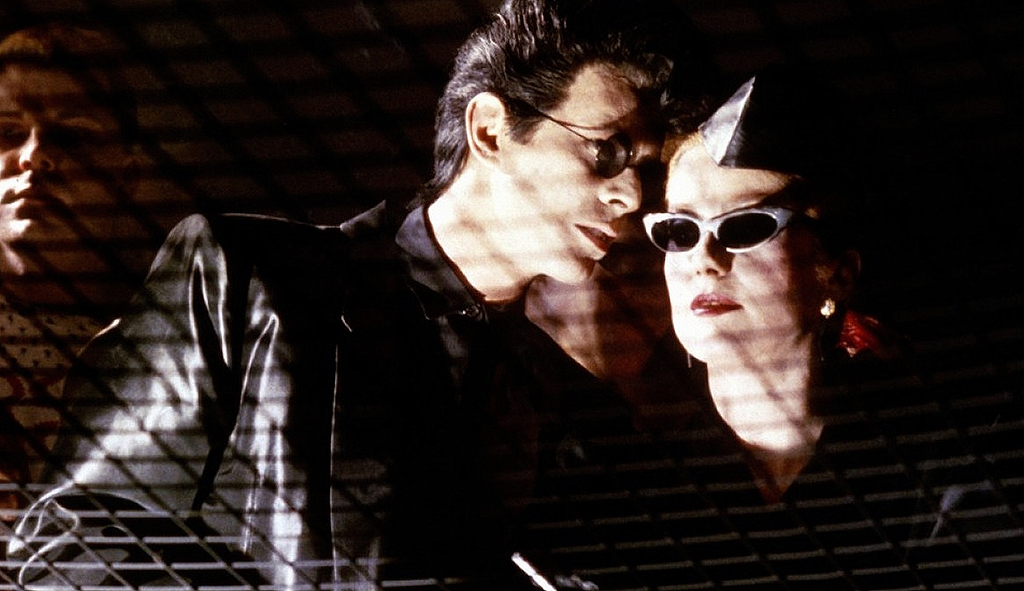
On the other hand, though, as an unrepentant goth chick for nigh on three decades, I’d be lying if I said I couldn’t be seduced by a genuinely great vampire film, especially if it was stylish as fuck, starred three of the best-looking people on the planet at the time, and boasted an opening scene featuring one of my favorite bands performing the grandaddy of all goth-rock anthems. By now you should have guessed that I’m talking about this gothic wet dream right here:

And who will we be having for dinner this evening?

And who will we be having for dinner this evening?

Tony Scott’s The Hunger (loosely based on an okay novel by Whitley “I Was Anal Probed by Extraterrestrials” Strieber) has been dogged by criticisms of style over substance pretty much since its release in 1983, but in my opinion, time has been very kind to it, and I would happily defend it as one of the very best vampire films of the 80s. Not only was it gorgeous to look at and chock full of fantastic acting performances, but it also took the tired vampire schtick and did something fairly original and arty with it (though of course much of the concept of interpreting vampire tropes through the lens of modern genetic science was present in Strieber’s book).

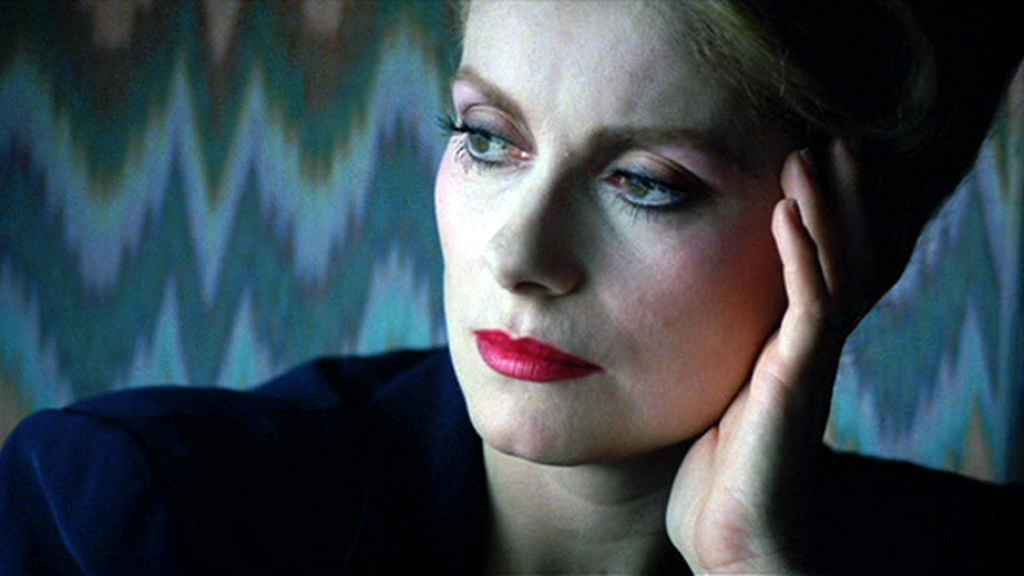
The Hunger is the story of beautiful, centuries-old vampire Miriam Blaylock (Catherine Deneuve) and her understandable but ultimately cruelly selfish quest to find a companion who will be with her forever. Her latest consort, John (David Bowie) has been with her for two hundred years, but John soon learns that Miriam’s promises of eternal youth were a lie when he begins to rapidly age, due to an apparent incompatibility between human and vampire blood that takes centuries to manifest.

Oh, did I neglect to mention that you'd spend eternity as a shambling living corpse? My bad, honey bunch.

Oh, did I neglect to mention that you’d spend eternity as a shambling living corpse? My bad, honey bunch.

John and Miriam enlist the services of cutting-edge gerontologist Dr. Sarah Roberts (Susan Sarandon) in an attempt to reverse the aging process, but all to no avail. After the feeble John kills the couple’s young music student, hoping that her blood will revitalize him, Miriam tenderly carries his still-living but disintegrating carcass into the attic. There she places him in a coffin along with her other former lovers, all of whom are enduring the same living death. It is this aspect of Miriam’s character that makes her monstrous: she is so desperate for companionship that she will strategically neglect to mention that the vampire gift she is bestowing comes with eternal life, yes, but not eternal youth. She will also keep her lovers alive and with her forever, even though they are suffering terribly.

Grief-stricken and lonely after John’s confinement, Miriam then sets her sights on Sarah and begins to groom her as her next companion. The pair exchange blood during a languid, gauzy, and super-hot sex scene, but Sarah discovers soon enough what Miriam’s gift entails. At first she refuses to accept her new blood-drinking nature, preferring to starve herself of the sustaining red stuff, but eventually her willpower fails her and she ends up killing her boyfriend Tom and feeding on him. Miriam thinks that Sarah is now on board with the whole vampire thing, but Sarah’s steely resolve is such that she attempts to cut her own throat with Miriam’s purpose-made ankh pendant rather than spend the next few hundred years at the vampire’s side. The distraught Miriam attempts to save her, but evidently Sarah’s attempted self-sacrifice has rallied the troops, so to speak; all of Miriam’s rotting former lovers rise from their coffins, kill Miriam, and fall to dust upon the floor, finally finding the sweet release of death that they had been denied for so long.

Exactly what about this whole scenario doesn't appeal to you???

Exactly what about this whole scenario doesn’t appeal to you???

There is then an odd coda to the film that doesn’t really make any sense in terms of the story, as we see briefly that Sarah has survived her suicide attempt and is now living as a vampire with a male and female consort of her own. Susan Sarandon has reported that she was not happy with this tacked-on ending, as it negated the whole arc of her character and the point of her rebellion, but there was little she could do about it, since the producers apparently wished to leave the film open-ended in case they wanted to make a sequel down the line (sigh). The scene is only a few seconds long and doesn’t spoil the film, but it is kind of a WTF moment.

All that aside, though, let me take a moment to rhapsodize about all the great things this film does. Casting the impossibly beautiful and elegant Deneuve as a vampire was a stroke of genius, as her quiet gravitas and cold yet seductive grace lend a sense of timelessness to her portrayal that makes it very easy to believe, not only that she has been alive for millennia, but also that she could easily embody the conflict of genuine loving feeling existing alongside such fiendish cruelty. Susan Sarandon’s character is a perfect counterpoint, a thoroughly modern woman whose pragmatism and independence is the polar opposite of Miriam’s needy heartlessness.

OMG, stop being so pretty.

OMG, stop being so pretty.

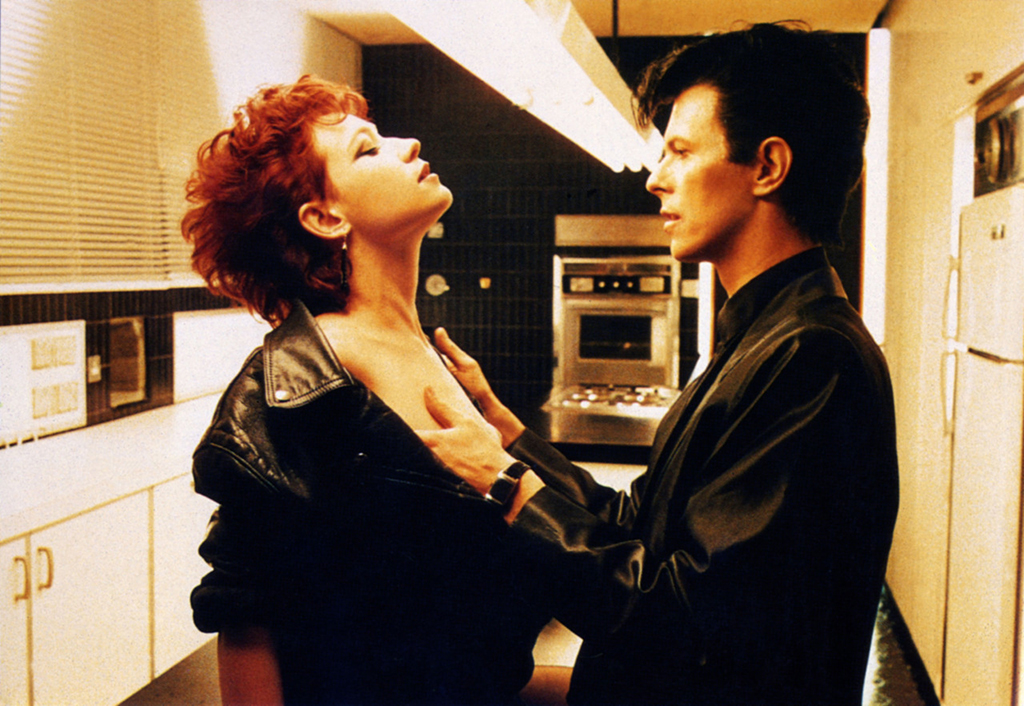
Bowie is likewise great as the doomed companion, putting in a restrained and perfectly balanced performance in which the struggle between his deep love for Miriam and his anger at her betrayal of him are readily apparent.

At least Ann Magnuson got to be felt up by David Bowie before her tragic exsanguination.

At least Ann Magnuson got to be felt up by David Bowie before her tragic exsanguination.

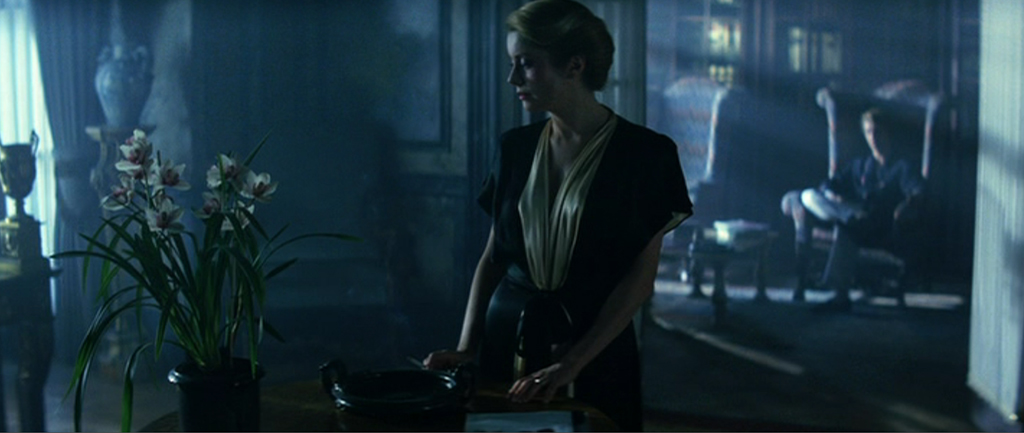
The set design is also gorgeous, soft-focused and romantic, with billowing white curtains, shafts of dim light illuminating flocks of doves, and the spectacularly old-world interiors of the Blaylocks’ tastefully appointed New York townhouse brilliantly contrasted against the sterile environment of Sarah’s medical clinic. I’ve heard many people complain that The Hunger looked more like a music video than a movie, and I understand that assessment, but I feel as though the entire look of the film is a crucial part of its enduring charm. Its aesthetic flair was certainly one of the things that first drew me to it in the 1980s, and to be frank I think it looks even better now that we’ve had more than thirty years’ perspective on it.

Holy shit, I would live in this house so hard.

Holy shit, I would live in this house so hard.

The fact that the film also has such a dynamite opening, with the vampiric Peter Murphy in a cage intoning “Bela Lugosi’s Dead” with his band Bauhaus, is simply the pitch-black icing on the darkly glamorous cake that is this movie.

Undead to the third power.

Undead to the third power.

Unlike many other vampire films of the period, The Hunger is more concerned with artistic visuals and exploring the relationships of the characters than it is with outright horror or gore. That’s not to say that there aren’t some intensely bloody scenes, and the final shots of Miriam’s ancient, skeletal companions rising up against her are fairly horrific, but fans of more in-your-face horror may find the film far too cerebral for their tastes, and that’s as it should be. Different strokes, and all that.

WHATCHOO TALKIN’ ABOUT GODDESS? (SORRY, HAD TO.)

WHATCHOO TALKIN’ ABOUT GODDESS? (SORRY, HAD TO.)

Until next time, Goddess out.

A Trailer for My Fabulous Graphic Novel “The Tenebrist”

TenebristCover_Blog

I’ve used some of my admittedly lackluster video-fu to make this short trailer for my illustrated/graphic designed/collage-type book The Tenebrist. It’s a somewhat fictionalized account of the tragic (and murderous) career of the mad genius painter Caravaggio, and it’s illustrated with a bunch of his gorgeously luminous paintings. Watch the trailer, if you please, and then buy your brand-spanking new copy right here. Thanks ever so much.

The Goddess Sings the Praises of “Stories That Scared Even Me”

il_fullxfull.519529127_cvh8

There is nothing I love so much as a well-told and terrifying short story. Sure, novels are great, and can conjure an entire world that you can lose yourself in for days or weeks at a time; but there is something about that sharp jolt from a short tale that can be read all in one sitting (though perhaps not forgotten so quickly as that). Short stories are my preferred medium for writing as well, and I hope one day to be able to create something even partially approaching the nightmarish impact of some of my favorite short stories of all time: Lovecraft’s “Pickman’s Model.” Poe’s “Masque of the Red Death.” Oliver Onions’s “The Beckoning Fair One.” Charlotte Perkins Gillman’s “The Yellow Wallpaper.” H. Russell Wakefield’s “The Triumph of Death.” Clive Barker’s “In the Hills, the Cities.”

When I was a wee Goddess, one of my very favorite things was to go to the library and check out one of the giant horror anthologies that flew under the “Alfred Hitchcock Presents” banner. A shit-ton of them were published, and I think I probably read them all during my formative years. The stories contained therein were a huge influence on little nugget me, who was already starting to show a penchant for the literary and the horrific. My grandfather, knowing of my predilections, gave me one of the anthologies out of the vast, dusty collection of books he kept in teetering stacks on the floor of his creepy, overstuffed house. I still have it, though its pages have fallen completely out of its binding from the many rereads it underwent over the years. It was published in 1967, only five years before I was born. It was called Alfred Hitchcock Presents: Stories That Scared Even Me. Even the title intrigued me! THESE STORIES SCARED ALFRED HITCHCOCK, YOU GUYS. THAT’S HARDCORE.

Sadly, this incredible collection is now out of print, but used copies can be found pretty easily, and if you’re into a lot of the horror fiction that came out from around the 1920s to the 1960s, I would recommend you pick up a copy, because it is the most consistently great horror anthology I’ve ever read. There isn’t a dud among the 25 tales featured, and there isn’t a story in there that isn’t excellent at the very least. The collection has something for damn near everyone: Weird monsters (Fishhead, Men Without Bones, It, The Troll, Out of the Deeps)! Dystopias (Not With a Bang, X Marks the Pedwalk)! Creeping suburban horror (Tough Town, One of the Dead)! Jack the Ripper (The Knife)! Vampires (The Real Thing)! Nazis (Evening at the Black House)! I’ll provide a full table of contents at the bottom of the post, if you’re curious.

It’s difficult to choose my five favorite stories out of such an embarrassment of riches, but for the purposes of this blog post, I’m going to attempt it. Wish me luck.

skeleton_funeral-1194616

“A Death in the Family” by Miriam Allen deFord

I briefly mentioned this story before in my post about season two of “Masters of Horror,” and I also mentioned that it had been turned into a partial episode of “Night Gallery.” It’s the tale of a lonely undertaker who has an entire “family” of stolen, preserved corpses in his basement to keep him company. His secluded little world is disrupted, however, when kidnappers drop the murdered body of a beautiful little girl on his doorstep, and he must wrestle with the decision of either doing the right thing by the girl’s family, or adding the perfect daughter to his own. The whole tale just oozes a cold, chilling atmosphere, and the helpless empathy you feel with the bereft protagonist gives this one a real emotional punch.

sliceofbloodycake

“Party Games” by John Burke

Since I was about the same age and personality type as the main protagonist of this story, the quietly sly Simon, this story really resonated with me when I first encountered it. Fairly violent, but in a pleasingly understated and very British way, the story follows the tragic arc of Simon’s ill-fated birthday party, and examines the vengeful depths that might be lurking just below the surface of even the shyest and most innocuous of little boys.

Natchez-36

“Curious Adventure of Mr. Bond” by Nugent Barker

Really more of a novella than a short story, this tale is told in three rough parts. Mr. Bond is a traveler who goes to a succession of three oddly-named inns, and slowly begins to discover the terrible secret connection between them. I like this one a great deal because it has sort of an eerie fairy-tale feel, and the gruesome outcome is satisfyingly icky.

escaneo-811

“The Road to Mictlantecutli” by Adobe James

I’m always down for a good devil story, and this one takes a fairly original and somewhat dreamlike path. Saturated in the atmosphere of the American Southwest and shrouded in Aztec myth, this story of an unsympathetic fugitive from the hangman who has his own ghastly “Hotel California” experience out in the desert is blood-red perfection.

indian-mirror-costa-concordia-cruise-liner-sunk

“Journey to Death” by Donald E. Westlake

The premise is simple: Two men are trapped in an airtight game room when their cruise ship plunges to the bottom of the ocean. But the execution is skin-crawling, the tension palpable, and the resolution grim. A shining example of taking a bare-bones frame and building a towering edifice of terror upon it.

And here, as promised, is the entire list of stories featured in this fantastic collection. Check it out; you won’t be disappointed. Until next time, Goddess out.

“Fishhead” by Irvin S. Cobb
“Camera Obscura” by Basil Copper
“A Death in the Family” by Miriam Allen deFord
“Men Without Bones” by Gerald Kersh
“Not with a Bang” by Damon Knight
“Party Games” by John Burke
“X Marks the Pedwalk” by Fritz Leiber
“Curious Adventure of Mr. Bond” by Nugent Barker
“Two Spinsters” by E. Phillips Oppenheim
“The Knife” by Robert Arthur
“The Cage” by Ray Russell
“It” by Theodore Sturgeon
“Casablanca” by Thomas M. Disch
“The Road to Mictlantecutli” by Adobe James
“Guide to Doom” by Ellis Peters
“The Estuary” by Margaret St. Clair
“Tough Town” by William Sambrot
“The Troll” by T. H. White
“Evening at the Black House” by Robert Somerlott
“One of the Dead” by William Wood
“The Master of the Hounds” by Algis Budrys
“The Real Thing” by Robert Specht
“Journey to Death” by Donald E. Westlake
“The Candidate” by Henry Slesar
“Out of the Deeps” by John Wyndham